Health Insurance Startups Bet It’s Time for a Nineties Revival

https://www.bloomberg.com/news/features/2018-07-24/health-insurance-startups-bet-it-s-time-for-a-nineties-revival

Image result for Health Insurance Startups Bet It’s Time for a Nineties Revival


As high health costs squeeze employers, managed care is making a comeback.

Nineties throwbacks have swept through music, television and fashion. Some startups want to bring a bit of that vintage feel to your workplace health insurance plan.

Health maintenance organizations drove down costs but were painted as villains in that decade for limiting patient choice, rationing care and leaving consumers to grapple with high bills for out-of-network services. But some features of the plans are regaining currency. Companies reviving the model say that new technology and better customer service will help avoid the mistakes of the past.

Rising health-care costs and dissatisfaction with high-deductible plans that ask workers to shoulder more of the burden are pushing employers to consider new ways of controlling spending—and to rethink the trade-offs they’re willing to make to save money.

Medical costs have increased roughly 6 percent a year for the past half-decade, according to PwC’s Health Research Institute, outpacing U.S. economic growth and eroding workers’ wage gains. Some employers, such as Amazon.com Inc.Berkshire Hathaway Inc. and JPMorgan Chase & Co.—wary of asking workers to pay even more—are trying to rebuild their health programs.

Barry Rose, superintendent of the Cumberland School District in northern Wisconsin, went shopping recently for a new health plan for the district’s 290 employees and family members after its annual coverage costs threatened to top $2 million.

“How do we provide quality, affordable and usable health care for employees,” said Rose. “I can’t keep taking money out of their paychecks to spend on health insurance.”

The company he picked, called Bind, is part of a new generation of health plans putting a tech-savvy spin on cost controls pioneered by HMOs.

Bind, started in 2016, ditches deductibles in favor of fixed copays that consumers can look up on a mobile app or online before heading to the doctor. Another upstart, Centivo, founded in 2017, uses rewards and penalties to nudge workers to get most of their care and referrals for specialists from primary-care doctors.

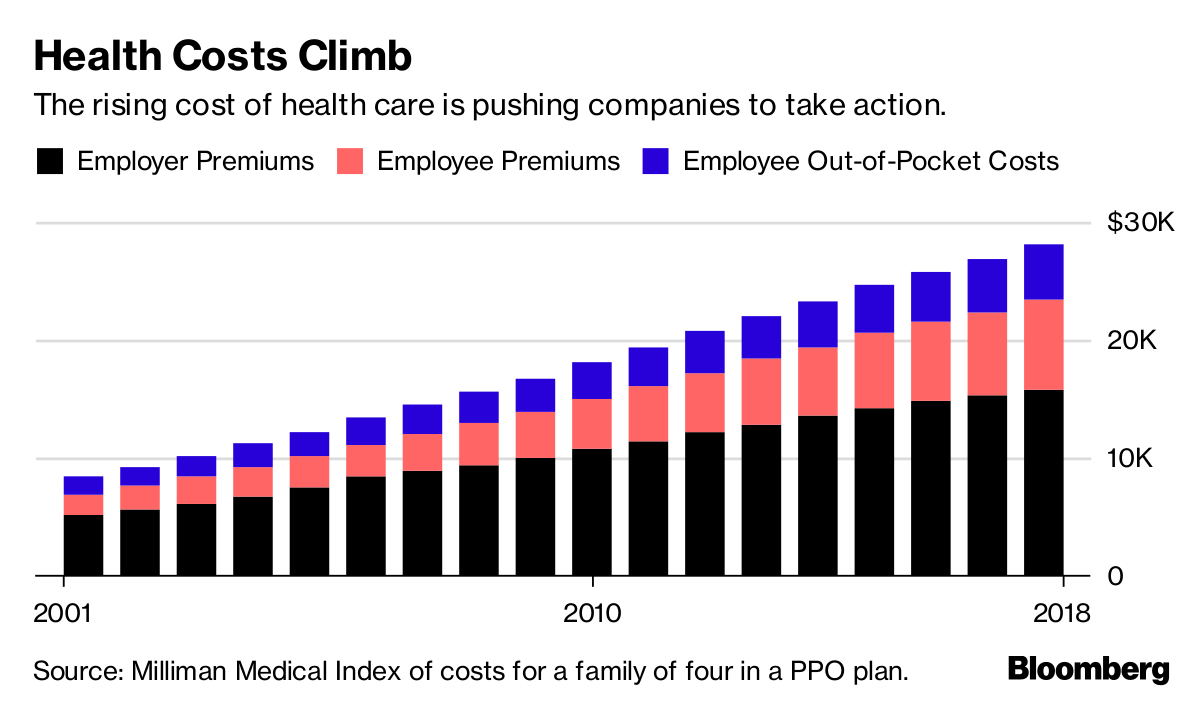
Health Costs Climb

The rising cost of health care is pushing companies to take action.

For many years, employers offered health plans that paid the bills when workers went to see just about any doctor, imposing few limits on care. The companies themselves usually paid much or all of the premiums.

Confronted with rising costs in the 1990s, many employers switched to HMOs or other forms of what became known as managed care. The switch worked, helping hold health costs down for much of the decade.

Soon, however, consumer and physician opposition grew amid horror stories of mothers pushed out of the hospital soon after childbirth, or patients denied cancer treatments. States and the federal government passed laws to protect consumers, and, in 1997, then-President Bill Clinton appointed a panel to create a health consumers’ Bill of Rights.

“The causes of the backlash are much deeper than the specific irritations or grievances we hear about,” Alain Enthoven, the Stanford health economist who helped pioneer the idea of managed care, said in a 1999 lecture. “They are first, that the large insured employed American middle class rejects the very idea of limits on health care because they don’t see themselves as paying for the cost.”

Workers would soon bear the cost, though. By the end of the decade, employers had moved away from these limited health plans. In their wake, costs skyrocketed, giving rise to a new cost-containment tool: high deductibles.

Centivo co-founder Ashok Subramanian spent the past decade trying to figure out how to offer better health insurance at work. His first startup, Liazon, helped workers pick from a big menu of coverage options. He sold it for some $215 million to Towers Watson in 2013, but he said it didn’t fix the bigger problem: Workers had lots of options, but none of them were very good.

“Yes, we were increasing choice, yes we were enabling personalization, but the choices themselves were not that good,” Subramanian said in an interview. “The choices themselves were predicated on a system in which the fundamental incentives in health care are broken.”

Tony Miller, Bind’s founder, helped give rise to health plans with high out-of-pocket costs. He sold a company called Definity Health that combined health plans with savings accounts to UnitedHealth Group Inc. for $300 million in 2004. He now says high-deductible plans failed to deliver on their promises.

“There’s a fever pitch of frustration at employers,” he said. “They’re tired of using the same levers that they’ve been using for the past 20 years.”

UnitedHealth, the biggest U.S. health insurer, helped create Bind with Miller’s venture capital firm and is an investor in the company, which has raised a total of $82 million. Bind is also using UnitedHealth’s network of doctors and hospitals as well as some of its technology.

Centivo has raised $34 million from investors including Bain Capital Ventures.

Centivo and Bind both promise to reduce costs for patients and employers while making it easier to find doctors and check coverage. They say they’ll reduce costs by making sure patients get the care they need, keeping them healthy and avoiding emergencies or unnecessary treatment.

Covered?

The proportion of Americans under 65 in health plans with high deductibles continues to increase.

In most cases, workers who follow the rules of Centivo’s plans won’t face a deductible. When signing up, employees pick a primary-care doctor, who’s responsible for managing their care and making decisions on whether they need to see a specialist. Care provided or directed by that primary physician is free, as is some treatment for chronic diseases such as diabetes, depending on how employers choose to set up the coverage.

The goal is to ensure workers get the care they need, while avoiding low-value treatments. Those who go to an emergency department in cases that aren’t true emergencies, for example, could face high costs.

“The big question is: Is the market ready for it?” said Mike Turpin, who advises employers on their health benefits as an executive vice president at USI Insurance Services. “The American consumer just has it built into their head that access equals quality.”

Bind bundles its coverage so consumers don’t get billed for lots of charges for services that are part of the same treatment. In Rose’s district, the copay for an emergency room visit is $250, while the cost of a hospital stay is capped at $1,000. Office visits are $35; preventive care is free.

Bind also offers what it calls on-demand insurance. Coverage for planned procedures such as knee surgery, tonsil removal or bariatric surgery must be purchased before the operation. That gives Bind a chance to push customers toward a menu of lower-cost alternatives or cheaper providers.

A patient who looks up knee arthroscopy, for instance, would also be offered physical therapy. The patient’s cost for the surgery ranges from $800 at an outpatient center to more than $6,000, in an example used by Miller. Surgeries in hospitals are typically more costly. Bind also charges more for providers who tend to be less efficient or have worse outcomes.

The ability to view costs upfront is part of what appealed to Rose, the Wisconsin superintendent. “Each of my employees knows exactly what they’re paying for, and they have choice in it,” he said.

Rose said the switch to Bind will save his district several hundred thousand dollars, depending on how much health care his workers need over the next year.

Lawton R. Burns, director of the Wharton Center for Health Management and Economics at the University of Pennsylvania, recently authored a paper with his colleague Mark Pauly arguing that it’s probably impossible to simultaneously improve quality, lower costs and achieve better health outcomes. The ideas now being pushed forward, he writes, are similar to ideas tested in the 1990s.

“It’s deja vu all over again,” he said. “It’s not clear to me, this is just me talking, that people have learned the lessons of the 1990s.”


Walmart drug program cheaper for many Medicare patients

https://www.nbcnews.com/health/health-news/walmart-drug-program-cheaper-many-medicare-patients-n893811

Grand Opening At A New Wal-Mart Store

Walmart’s $4 generic prescription drug program ends up being cheaper for some Medicare patients than their own health insurance, according to a new study released Monday.

It’s more evidence that patients cannot always rely on their health insurance to get them the lowest prices for their prescription drugs, said Dr. Joseph Ross of the Yale School of Medicine, who led the study.

“Patients were paying more out of pocket when they were using their insurance than when they went to Walmart,” Ross told NBC News.

The study, published in the Annals of Internal Medicine, documents that Walmart provides a better deal than the government’s health insurance plan for people over 65. And that is bad news for Medicare, because if people don’t take their drugs, whether for cost or for other reasons, they tend to get sicker and then end up costing even more to treat.

“Everyone’s talking about pharmacy costs these days,” Ross said. “We did this study in part because of all the discussion about pharmacy gag rules.”

Pharmacy gag rules prevent pharmacists from telling patients that they could save money on drugs, for instance by not using their health insurance.

Pharmacy benefit managers are the middlemen between drug companies and pharmacies, and some of those companies have agreements forbidding talk of discounts. But some states have also banned pharmacists from giving this information to customers.

According to the National Conference of State Legislatures, at least 22 states have some kind of gag rule legislation.

One way patients can get around this is to ask, but few people think to do so.

Ross and colleagues decided to see what would happen if Medicare patients just took advantage of Walmart’s program offering $4 generic prescription drugs.

They looked at Walmart’s generic list for drugs commonly used to treat heart conditions, including high blood pressure and high cholesterol.

“Next, we used Medicare prescription drug plan data from June 2017 to determine beneficiary out-of-pocket costs for the lowest-priced dose of each drug in each plan,” they wrote. They got data on more than 2,000 Medicare prescription drug plans, including Medicare Advantage plans.

Overall, 21 percent of the plans asked patients to pay more out of pocket for the drugs than they would pay if they just got them for $4 at Walmart, the team reported.

Medicare Advantage plans were the most expensive for patients, Ross said. And the higher-tier programs were the worst, he found.

“Twenty percent of the time, at least, we should go to Walmart,” Ross said.

It doesn’t help that Medicare is very complicated. Patients can choose from dozens of different plans, depending on where they live, and it can take a great deal of research to find out which plan is most likely to cover a particular person’s health conditions for the least amount of money.

“Each Medicare drug plan has its own list of covered drugs (called a formulary),” the Center for Medicare and Medicaid Services says on its website.

“Many Medicare drug plans place drugs into different ‘tiers’ on their formularies. Drugs in each tier have a different cost. A drug in a lower tier will generally cost you less than a drug in a higher tier.”

Ross said it is time-consuming to compare one Medicare plan to another. But understanding one of the many plans tells people very little about what the others might offer.

“If you have read through the details and material for one plan, you have read through the details and materials for one plan. It’s very hard to compare,” he said.

In addition, any given plan may change the drugs that it covers and their prices throughout the year.

Ross said he studied Walmart because its $4 price for a 30-day supply of a generic drug seemed like the least expensive option, but other retailers also have inexpensive drug plans. Some grocery-based pharmacies even offer free drugs, such as antibiotics.

These offers get customers into the store, and the hope is that they’ll buy something else while they are there.

Ross said no patient should decide on a Medicare plan based solely on whether Walmart offers a better deal on prescriptions.

Switching plans might not be the best idea, because different plans provide different levels of coverage for doctor visits, medical procedures and other health needs.

“What we are showing is there may be some ways to save some money on some drugs by going to Walmart,” Ross said.

According to the Kaiser Family Foundation, about 90 percent of prescriptions filled in the U.S. are for generic drugs. Most people get health insurance through an employer, and the typical co-pay for a generic drug for a patient covered by employer-provided health insurance is $11, Kaiser found. For a brand-name drug, the average co-pay is $33.

Walmart is moving aggressively to get a big share of the U.S. health care market. Besides having large pharmacies, stores offer free health screenings and the company has said it intends to expand its locations of retail walk-in health clinics.

Walmart is also negotiating a closer partnership with health insurer Humana, including the possibility of buying it outright, according to CNBC.

The discount retailer’s $4 generic prescriptions beat Medicare’s co-pays 21 percent of the time, a study found.


“The Inevitable Math behind Entitlement Reform”

“The Inevitable Math behind Entitlement Reform”

Image result for Entitlement Reform


That’s the title of a new NEJM Perspective by Michael Chernew and me. After crunching the numbers, our argument is that for long term cost control we will probably need to address growth in per capita health care utilization. The easy “solutions” won’t be enough.

Much of the projected increase in inflation-adjusted spending on health care entitlements, particularly for Medicare, stems from assumed increases in utilization (e.g., 2.75 percentage points of the 5.33% annual projected growth for Medicare spending). Strategies for holding utilization growth below projections (and more in line with very recent historical growth) will thus be central to the success of any attempt at cost containment.

[One approach] is to dissuade patients from seeking care by charging them more at the point of service. About 85% of Medicare beneficiaries have supplemental plans (e.g., Medigap) that reduce their out-of-pocket costs. Policies that limit the generosity of such plans could reduce Medicare spending considerably. However, such strategies would increase beneficiaries’ financial risks, reduce access to care, and probably exacerbate health disparities.

A second strategy is to help beneficiaries improve their health by enhancing long-term care management and preventive services with the goal of avoiding more expensive services. Evidence suggests that although this type of approach is probably beneficial to patients and may be cost-effective, it is generally not cost saving.

The piece continues with some more promising approaches, in our view. Click to read it in full (unfortunately pay-walled though).


Reducing Drug Prices and Medicare’s Role: ‘It’s Complicated’

https://us5.campaign-archive.com/?u=8ccc385380053ffb629ecef0f&id=fd94cdddf1

Related image

Reducing Drug Prices and Medicare’s Role: ‘It’s Complicated

The White House Rose Garden was in full bloom when President Trump took the podium to announce that his administration was “launching the most sweeping action in history to lower the price of prescription drugs for the American people.”

He said: “It’s been a complicated process, but not too complicated.”

Thing is, it is pretty complicated and made more so by the admittedly tangled web of lobbyists knocking with dogged determination on lawmakers’ doors in pursuit of one thing: higher drug prices.

Their efforts appear to be working. In 2017, they spent almost $280 million in pursuit of their employers’ objectives. Another estimate puts the cost of drug lobbying at $2.3 billion from 2006 to 2016, and it’s clear that the industry also pays substantially to support candidates for both houses of Congress.

The President talked about his announcement being “the most sweeping action in history to lower the price of prescription drugs.” If you remember the presidential campaign, he promised to utilize Medicare’s gorilla purchasing power to negotiate directly to reduce prices. That all sounded very promising.

What Medicare Can and Can’t-Do

Medicare buys more drugs than anyone else, because it has a base of approximately 60 million people over age 65 or younger with certain disabilities, and is the largest single healthcare payer. However, the law actually prevents Medicare from carrying on direct negotiations with pharmaceutical companies. Specifically, it bars the Secretary of the Department of Health and Human Services (HHS) from managing the negotiations. Right now that’s Alex M. Azar II, a former executive with behemoth pharmaceutical company Lilly USA LLC, of Eli Lilly and Co.

Many were chagrined that the “American Patients First” does not, in fact, have any mandate for Medicare to negotiate directly with drug manufacturers. Some have described the situation in general as a gift, with a big bow around it, to America’s drug companies.

To understand why this happened, it helps to understand some of the history. Hearken to 2006, when Congress was in the throes of arguing the federal law around Medicare’s Part D law, the Medicare Modernization Act that became enforced in 2003. It was the most extensive rejuvenation of the program in 38 years.

Lobbyists persuaded lawmakers that if Medicare gained the ability to negotiate, that it would be akin to price control and an affront to the free market. Insurance companies in charge of subsidizing the new coverage were charged with managing drug costs.

Drugs Do Come Cheaper

In contrast, AARP invites us to consider how the Veterans Health Administration (VHA) deftly negotiates drug prices. The proof is in the pricing, as VHA pays 80 percent less for brand names than Medicare Part D. The VHA’s formulary list, that magic roster of medications it covers is a powerful negotiating tool. The relationship between Medicare and Medicaid that exists within the Food and Drug Administration (FDA) means the former two agencies must cover all FDA-approved drugs. That’s in spite of the fact that less expensive and equally effective medications can be bought on the open market.

Maybe you wonder how your fellow Americans feel about all of this. Big surprise: Democrats, Republicans, and independents are all pretty much on the same page. That’s according to a report from the National Academies of Sciences, Engineering, and Medicine. The analysis states emphatically that “finding a way to make prescription medicines — and healthcare at large — more affordable for everyone has become a socioeconomic imperative.”

According to the Henry J. Kaiser Family Foundation, a majority of Democrats (96 percent), Republicans (92 percent), and Independents (92 percent) think that yes, our government should have to negotiate power here.

Maybe Yes, Maybe No

Kaiser’s analysis of this conundrum over the “noninterference clause” is this. Those in favor of having Azar negotiate think this would result in leverage to reduce drug costs, especially around medications with sky-high prices but with no competition. They say private plans just don’t pack enough punch that way.

As expected, those who proclaim “no” shrug and opine that the Secretary simply couldn’t get better deals done. Then there’s the argument that haggling over price would inhibit pharma’s research and development, limiting the opportunities for more and better medications to improve quality of life and save lives.

As Kaiser notes, in addition to allowing the HHS Secretary to make better deals on drugs, another option would be to establish a public Part D plan that works in partnership with private Part D. “The Secretary would establish a formulary for the public Part D plan and negotiate prices for drugs on that formulary.”

There’s also a compromise approach of sorts in the mix that would address those expensive drugs and those that don’t have therapeutic alternatives: The Secretary could negotiate those.

At the end of the day, before Medicare can become the drug price negotiator extraordinaire, the law must be changed, and that’s a big lift. Based upon history, even Republicans are not expected to want to do this, and for sure pharma will recoil. That leaves consumers using Part D watching and waiting for change.

Drug Negotiation Side Effects

Increasing negotiating around Medicare could have ramifications if the President transfers expensive medications from Part B — the first Medicare legislation in 1965 —
to Part D, says The New York Times.

AARP says it’s worried about increasing out-of-pocket charges if this happens. Also, 9 million Medicare members in Part B don’t have Part D, leaving a void as to who will pay medication costs.

The publication asked doctors for their opinions and one responded that one misstep could be “a disaster.” Another worried about Part D drugs’ prices increasing more than Part B’s. Still, other notes protected classes of Part D drugs that must be covered by insurance plans, but in this instance may hamper Part D negotiations.


House panel advances bill that would temporarily halt ObamaCare’s employer mandate

http://thehill.com/policy/healthcare/396770-house-panel-passes-bill-that-would-repeal-obamacares-employer-mandate

House panel advances bill that would temporarily halt ObamaCare's employer mandate

The House Ways and Means Committee on Thursday approved legislation that would chip away at ObamaCare, including a measure that would temporarily repeal the law’s employer mandate.

The bill sponsored by GOP Reps. Devin Nunes (Calif.) and Mike Kelly (R-Pa.) would suspend penalties for the employer mandate for 2015 through 2019 and delay implementation of the tax on high-cost employer-sponsored health plans for another year, pushing it back to 2022.

Congress repealed the penalty associated with the individual mandate last year, but it doesn’t take effect until 2019.

“I think it’s fair, if we relieve the burden for individuals, that we stand with our small and mid-sized companies,” Kelly said.

Powerful lobbying groups like the U.S. Chamber of Commerce have pushed for a repeal of the employer mandate.

The other measure, sponsored by Reps. Peter Roskam (R-Ill.) and Michael Burgess (R-Texas), would allow the use of ObamaCare’s tax credits for plans outside of the exchanges in the individual market. It would also allow anyone to purchase a catastrophic plan — plans that are cheaper but cover fewer services and are currently only available for those under the age of 30.

The bill “provides a much needed offramp for pressure people are feeling right no in terms of premiums increases and limited choices,” Roskam said.

Both measures advanced on party-line votes.

Democrats opposed the bills, saying they would cost too much and destabilize ObamaCare.


Medigap Enrollment and Consumer Protections Vary Across States

Medigap Enrollment and Consumer Protections Vary Across States

One in four people in traditional Medicare (25 percent) had private, supplemental health insurance in 2015—also known as Medigap—to help cover their Medicare deductibles and cost-sharing requirements, as well as protect themselves against catastrophic expenses for Medicare-covered services. This issue brief provides an overview of Medigap enrollment and analyzes consumer protections under federal law and state regulations that can affect beneficiaries’ access to Medigap. In particular, this brief examines implications for older adults with pre-existing medical conditions who may be unable to purchase a Medigap policy or change their supplemental coverage after their initial open enrollment period.

Key Findings

  • The share of beneficiaries with Medigap varies widely by state—from 3 percent in Hawaii to 51 percent in Kansas.
  • Federal law provides limited consumer protections for adults ages 65 and older who want to purchase a supplemental Medigap policy—including, a one-time, 6-month open enrollment period that begins when they first enroll in Medicare Part B.
  • States have the flexibility to institute consumer protections for Medigap that go beyond the minimum federal standards. For example, 28 states require Medigap insurers to issue policies to eligible Medicare beneficiaries whose employer has changed their retiree health coverage benefits.
  • Only four states (CT, MA, ME, NY) require either continuous or annual guaranteed issue protections for Medigap for all beneficiaries in traditional Medicare ages 65 and older, regardless of medical history (Figure 1). Guaranteed issue protections prohibit insurers from denying a Medigap policy to eligible applicants, including people with pre-existing conditions, such as diabetes and heart disease.
  • In all other states and D.C., people who switch from a Medicare Advantage plan to traditional Medicare may be denied a Medigap policy due to a pre-existing condition, with few exceptions, such as if they move to a new area or are in a Medicare Advantage trial period.

Medigap is a key source of supplemental coverage for people in traditional Medicare

Medicare beneficiaries can choose to get their Medicare benefits (Parts A and B) through the traditional Medicare program or a Medicare Advantage plan, such as a Medicare HMO or PPO. Roughly two-thirds of Medicare beneficiaries are in traditional Medicare, and most have some form of supplemental health insurance coverage because Medicare’s benefit design includes substantial cost-sharing requirements, with no limit on out-of-pocket spending. Medicare requires a Part A deductible for hospitalizations ($1,340 in 2018), a separate deductible for most Part B services ($183), 20 percent coinsurance for many Part B (physician and outpatient) services, daily copayments for hospital stays that are longer than 60 days, and daily copays for extended stays in skilled nursing facilities.

To help with these expenses and limit their exposure to catastrophic out-of-pocket costs for Medicare-covered services, a quarter of beneficiaries in traditional Medicare (25 percent) had a private, supplemental insurance policy, known as Medigap in 2015 (Figure 2). Medigap serves as a key source of supplemental coverage for people in traditional Medicare who do not have supplemental employer- or union-sponsored retiree coverage or Medicaid, because their incomes and assets are too high to qualify. Medicare beneficiaries also purchase Medigap policies to make health care costs more predictable by spreading costs over the course of the year through monthly premium payments, and to reduce the paperwork burden associated with medical bills.1

Medigap policy benefits were standardized through the Omnibus Budget Reconciliation Act of 1990, which also included additional consumer protections discussed later in this issue brief.2 Of the 10 standard Medigap policies available to beneficiaries, Plan F is the most popular, accounting for over half of all policyholders in 2016, because it covers the Part A and B deductibles (as does Plan C), and all cost-sharing for Part A and B covered services.3

The share of all Medicare beneficiaries with Medigap coverage varies widely by state—from 3 percent in Hawaii to 51 percent in Kansas in 2016 (Figure 3, Appendix Table). In 20 states, at least one-quarter of all Medicare beneficiaries have a Medigap policy. States with higher Medigap enrollment tend to be in the Midwest and plains states, where relatively fewer beneficiaries are enrolled in Medicare Advantage plans.4

Medigap coverage is substantially more common for Medicare beneficiaries ages 65 and older than it is for younger Medicare beneficiaries, many of whom qualify for Medicare because of a long-term disability. Only 5 percent of traditional Medicare beneficiaries under age 65 had Medigap in 2015—considerably lower than the shares in older age brackets (Figure 4). The low enrollment in Medigap by beneficiaries under age 65 is likely due to the absence of federal guarantee issue requirements for younger Medicare beneficiaries with disabilities (discussed later in this brief) and higher rates of Medicaid coverage for people on Medicare with disabilities who tend to have relatively low incomes.

Federal law provides limited consumer protections for Medigap policies

In general, Medigap insurance is state regulated, but also subject to certain federal minimum requirements and consumer protections. For example, federal law requires Medigap plans to be standardized to make it easier for consumers to compare benefits and premiums across plans. Federal law also requires Medigap insurers to offer “guaranteed issue” policies to Medicare beneficiaries age 65 and older during the first six months of their enrollment in Medicare Part B and during other qualifying events (listed later in this brief). During these defined periods, Medigap insurers cannot deny a Medigap policy to any applicant based on factors such as age, gender, or health status. Further, during these periods, Medigap insurers cannot vary premiums based on an applicant’s pre-existing medical conditions (i.e., medical underwriting). However, under federal law, Medigap insurers may impose a waiting period of up to six months to cover services related to pre-existing conditions, only if the applicant did not have at least six months of prior continuous creditable coverage.5 As described later in this brief, states have the flexibility to institute Medigap consumer protections that go further than the minimum federal standards.

Federal law also imposes other consumer protections for Medigap policies. These include “guaranteed renewability” (with few exceptions), minimum medical loss ratios, limits on agent commissions to discourage “churning” of policies, and rules prohibiting Medigap policies to be sold to applicants with duplicate health coverage.6 (For further details on these requirements and a history of federal involvement in the Medigap market, see Medigap: Spotlight on Enrollment, Premiums, and Recent Trends, April 2013.)

When does federal law require guaranteed issue protections for Medigap?

Federal law provides guaranteed issue protections for Medigap policies during a one-time, six-month Medigap open enrollment period for beneficiaries ages 65 and older when enrolling in Medicare Part B, and for certain qualifying events. These limited circumstances include instances when Medicare beneficiaries involuntarily lose supplemental coverage, such as when their Medicare Advantage plan discontinues coverage in their area, or when their employers cancel their retiree coverage. Beneficiaries who are in a Medicare Advantage plan also have federal guaranteed issue rights when they move to a new area and can no longer access coverage from their Medicare Advantage plan. In these qualifying events, people ages 65 and older in Medicare generally have 63 days to apply for a supplemental Medigap policy under these federal guaranteed issue protections.

Federal law also requires that Medigap polices be sold with guaranteed issue rights during specified “trial” periods for Medicare Advantage plans. One of these trial periods is during the first year older adults enroll in Medicare. During that time, older adults can try a Medicare Advantage plan, but if they disenroll within the first year, they have guaranteed issue rights to purchase a Medigap policy under federal law. Another trial period applies to Medicare beneficiaries who cancel their Medigap policy to enroll in a Medicare Advantage plan. These beneficiaries have time-limited guaranteed issue rights to purchase their same Medigap policy if, within a year of signing up for a Medicare Advantage plan, they decide to disenroll to obtain coverage under traditional Medicare.

States have the flexibility to institute Medigap consumer protections that go further than the minimum federal standards, such as extending guaranteed issue requirements beyond the open enrollment period or adding other qualifying events that would require insurers to issue policies, as discussed later in this brief.

When does federal law not provide guaranteed issue protections for Medigap?

Broadly speaking, after 6 months of enrolling in Medicare Part B, older adults do not have federal guaranteed issue protections when applying for Medigap, except for specified qualifying events described earlier (Table 2). Therefore, older adults in traditional Medicare who miss the open enrollment period may, in most states, be subject to medical underwriting, and potentially denied a Medigap policy due to pre-existing conditions, or charged higher premiums due to their health status.

Medical Underwriting. Insurance companies that sell Medigap policies may refuse to sell a policy to an applicant with medical conditions, except under circumstances described above. The Text Box on this page provides examples of health conditions that may lead to the denial of Medigap policies, derived from underwriting manuals/guides from multiple insurance companies selling Medigap policies. Examples of conditions listed by insurers as reasons for policy denials include diabetes, heart disease, cancer, and being advised by a physician to have surgery, medical tests, treatments, or therapies.

Barriers for Beneficiaries Under Age 65 with Disabilities. Under federal law, Medigap insurers are not required to sell Medigap policies to the over 9 million Medicare beneficiaries who are under age of 65, many of whom qualify for Medicare based on a long-term disability. (However, when these beneficiaries turn age 65, federal law requires that they be eligible for the same six-month open enrollment period for Medigap that is available to new beneficiaries age 65 and older.)

Beneficiaries Choosing to Switch from Medicare Advantage to Traditional Medicare. There are no federal guarantee issue protections for individuals who choose to switch from a Medicare Advantage plan to traditional Medicare and apply for a Medigap policy, except under limited circumstances described in Table 2. In most states, therefore, beneficiaries who want to switch from their Medicare Advantage plan to traditional Medicare may be subject to medical underwriting and denied coverage when they apply for a Medigap policy because they do not have guaranteed issue rights, with some exceptions (e.g., if they have moved or if they are in a limited trial period). In states that allow medical underwriting for Medigap, Medicare Advantage enrollees with pre-existing conditions may find it too financially risky to switch to traditional Medicare if they are unable to purchase a Medigap policy. Without Medigap, they could be exposed to high cost-sharing requirements, mainly because traditional Medicare does not have a limit on out-of-pocket spending (in contrast to Medicare Advantage plans).7

Some states require guaranteed issue and other consumer protections for Medigap beyond the federal minimum requirements

States have the flexibility to institute Medigap consumer protections that go further than the minimum federal standards. While many states have used this flexibility to expand guarantee issue rights for Medigap under certain circumstances, 15 states and the District of Columbia have not, relying only the minimum guarantee issue requirements under federal law (Table 3).

Only four states require Medigap insurers to offer policies to Medicare beneficiaries age 65 and older (Figure 5). Three of these states (Connecticut, Massachusetts, and New York) have continuous open enrollment, with guaranteed issue rights throughout the year, and one state (Maine) requires insurers to issue Medigap Plan A (the least generous Medigap plan shown earlier in Table 1) during an annual one-month open enrollment period. Consistent with federal law, Medigap insurers in New York, Connecticut, and Maine may impose up to a six-month “waiting period” to cover services related to pre-existing conditions if the applicant did not have six months of continuous creditable coverage prior to purchasing a policy during the initial Medigap open enrollment period.8 Massachusetts prohibits pre-existing condition waiting periods for its Medicare supplement policies.

Many other states have expanded on the federal minimum standards in more narrow ways by requiring Medigap insurers to offer policies to eligible applicants during additional qualifying events (Table 3). For example, 28 states require Medigap insurers to issue policies when an applicant has an involuntary change in their employer (retiree) coverage. (This qualifying event is more expansive than federal law, which applies only when retiree coverage is completely eliminated.) Nine states provide guaranteed issue rights for applicants who lose their Medicaid eligibility.9

As noted above, federal law does not require Medigap insurers to issue policies to Medicare beneficiaries under the age of 65, most of whom qualify for Medicare because of a long-term disability. However, 31 states require insurers to provide at least one kind of Medigap policy to beneficiaries younger than age 65 (typically through an initial open enrollment period).10

Some states provide stronger consumer protections for Medigap premiums than others

States also have the flexibility to establish rules on whether or not Medigap premiums may be affected by factors such as a policyholder’s age, smoking status, gender, and residential area. Federal law allows states to alter premiums based on these factors, even during guaranteed issue open enrollment periods.

There are three different rating systems that can affect how Medigap insurers determine premiums: community rating, issue-age rating, or attained-age rating (defined in the Text box below). States can impose regulations on which of these rating systems are permitted or required for Medigap policies sold in their state. Of the three, community rating provides the strongest consumer protection for Medigap policies because it does not allow premiums to be based on the applicant or policyholder’s age or health status. However, insurers in states that require community rating may charge different premiums based on other factors, such as smoking status and residential area. In states that allow attained age rating, older applicants and policyholders have considerably less protection from higher premiums because premiums may increase at unpredictable rates as policyholders age.

Premium rating systems

Community rating: Insurers must charge all policyholders within a given plan type the same premium without regard to age (among people age 65 and older) or health status. Insurers can raise premiums only if they do so for all policyholders of the given plan type. Insurers may still adjust premiums based on other factors, including smoking status, gender, and residential area.

Issue-age rating: Insurers may vary premiums based on the age of the policyholder at the time of purchase, but cannot increase the policyholder’s premium automatically in later years based on his/her age. Additionally, insurers may charge different premiums based on other factors, including health status, smoking status, and residential area.

Attained-age rating: Insurers may vary premiums based on the age of the policyholder at the time of purchase and increase premiums for policyholders as they age. Additionally, insurers may charge different premiums based on other factors, including health status, smoking status, and residential area.

Currently, eight states (AR, CT, MA, ME, MN, NY, VT, and WA) require premiums to be community rated among policyholders ages 65 and older. This means that Medigap insurers cannot charge higher premiums to people because they are older or sicker, and therefore, must charge an 80-year old policyholder the same as a 70-year old policyholder regardless of health status (Table 4). Insurers may still adjust premiums based on other factors, including smoking status, gender, and residential area. A state’s community rating requirement does not, in itself, guarantee that applicants will be issued a policy in the state. However, as described earlier, four of the states that have community rating (CT, MA, ME, NY), have guarantee issue protections and require insurers to issue Medigap policies to eligible applicants either continuously during the year, or during an annual enrollment period.

The remaining 38 states and the District of Columbia do not require premiums to be community rated; therefore, Medigap premiums in these states may be subject to issue-age and attained-age rating systems, depending on state regulation. Medigap insurers are permitted to offer community rated policies in these states, but most do not.11 Additionally, Medigap insurers may increase premiums due to inflation, regardless of the premium rating system.12

Discussion

Medigap plays a major role in providing supplemental coverage for people in traditional Medicare, particularly among those who do not have an employer-sponsored retiree plan or do not qualify for cost-sharing assistance under Medicaid. Medigap helps beneficiaries budget for out-of-pocket expenses under traditional Medicare. Medigap also limits the financial exposure that beneficiaries would otherwise face due to the absence of an out-of-pocket limit under traditional Medicare.

Nonetheless, Medigap is not subject to the same federal guaranteed issue protections that apply to Medicare Advantage and Part D plans, with an annual open enrollment period. As a result, in most states, medical underwriting is permitted which means that beneficiaries with pre-existing conditions may be denied a Medigap policy due to their health status, except under limited circumstances.

Federal law requires Medigap guaranteed issue protections for people age 65 and older during the first six months of their Medicare Part B enrollment and during a “trial” Medicare Advantage enrollment period. Medicare beneficiaries who miss these windows of opportunity may unwittingly forgo the chance to purchase a Medigap policy later in life if their needs or priorities change.13 This constraint potentially affects the nearly 9 million beneficiaries in traditional Medicare with no supplemental coverage; it may also affect millions of Medicare Advantage plan enrollees who may incorrectly assume they will be able to purchase supplemental coverage if they choose to switch to traditional Medicare at some point during their many years on Medicare.

Only four states (CT, MA, NY, ME) require Medigap policies to be issued, either continuously or for one month per year for all Medicare beneficiaries age 65 and older. Policymakers could consider a number of other policy options to broaden access to Medigap. One approach could be to require annual Medigap open enrollment periods, as is the case with Medicare Advantage and Part D plans, making Medigap available to all applicants without regard to medical history during this period. Another option would be to make voluntary disenrollment from a Medicare Advantage plan a qualifying event with guaranteed issue rights for Medigap, recognizing the presence of beneficiaries’ previous “creditable” coverage. For Medicare beneficiaries younger than age 65, policymakers could consider adopting federal guaranteed issue protections, building on rules already established by the majority of states.

On the one hand, these expanded guaranteed issue protections would increase beneficiaries’ access to Medigap, especially for people with pre-existing medical conditions. They would also treat Medigap similarly to Medicare Advantage in this regard, and make it easier for older adults to switch between Medicare Advantage and traditional Medicare if their Medicare Advantage plan is not serving their needs in later life. On the other hand, broader guaranteed issue policies could result in some beneficiaries waiting until they have a serious health problem before purchasing Medigap coverage, which would likely increase premiums for all Medigap policyholders. A different approach altogether would be to minimize the need for supplemental coverage in Medicare by adding an out-of-pocket limit to traditional Medicare.14

Ongoing policy discussions affecting Medicare and its benefit design could provide an opportunity to consider various ways to enhance federal consumer protections for supplemental coverage or manage beneficiary exposure to high out-of-pocket costs. As older adults age on to Medicare, they would be well-advised to understand the Medigap rules where they live, and the trade-offs involved when making coverage decisions.


Kavanaugh Supreme Court Fight Will Be All About Health Care

https://www.thefiscaltimes.com/2018/07/10/Kavanaugh-Supreme-Court-Fight-Will-Be-All-About-Health-Care

Image result for supreme court


he fight over President Trump’s pick of Appeals Court Judge Brett Kavanaugh to the Supreme Court is on, with Democrats launching what The Washington Post called “an all-out blitz” to defeat the nomination.

So get ready to hear a lot about health care in the coming days.

The Washington Post’s Dana Milbank notes that former Republican senator Jon Kyl, now a lobbyist for the pharmaceuticals industry, has been tapped to guide Kavanaugh’s path through the Senate. Why? Because by picking Kavanaugh, “Trump has guaranteed that health care will be at the center of the confirmation fight,” Milbank says.

Democrats welcome that fight, even if they have little chance of actually blocking the nomination. “The liberal base is fired up about abortion rights, but Senate Democratic Leader Charles Schumer (N.Y.) will seek to emphasize access to affordable health care as much as Roe v. Wade in the battle over the Supreme Court,” The Hill’s Alexander Bolton reports.

Focusing on health care might make sense for Democrats in a number of ways:

  • It reinforces the party’s preferred midterm election messaging in an area where voters say they trust Democrats more than Republicans.
  • Framing women’s reproductive rights as a matter of access to health care will be less polarizing in red states where seats are at stake in November, Bolton writes.
  • Playing up access to affordable health care may also put more pressure on Republican Sens. Susan Collins of Maine and Lisa Murkowski of Alaska, both of whom voted against Obamacare repeal last year.

If confirmed, Kavanaugh may get to weigh in on any of a number of cases with the potential to reshape health policy well beyond abortion rights. Despite his long legal record, “many of his health-related decisions are open to parsing from either side of the aisle and don’t actually provide a clear insight into where he’d stand on the Supreme Court,” The Washington Post’s Colby Itkowitz says.

Here are some key issues and cases that could be decided by the Supreme Court and Kavanaugh:

Obamacare’s protections for people with pre-existing medical conditions: Americans overwhelmingly support keeping these protections in place, according to a Kaiser Family Foundation poll from last month, but Trump’s Justice Department has asked a federal court to rule that those provisions of Obamacare are invalid. The case will soon be heard in a district court in Texas and could make its way to the Supreme Court before long. Sen. Joe Manchin of West Virginia, one of the few Democrats who might back Kavanaugh, said in a statement that he wants to hear where the judge stands on the ACA protections for those with pre-existing conditions before deciding whether to confirm him.

Medicaid: A federal court late last month blocked Kentucky’s plan to introduce work requirements for Medicaid recipients. The Trump administration is likely to appeal the ruling. Other states are also implementing work requirements. “As more states experiment with these programs and the cases wind their way through the courts, the Supreme Court may weigh in and shape how low-income Americans access Medicaid across the country,” Arielle Kane, director of health care at the Progressive Policy Institute, writes at the New York Daily News. The high court could also be asked to consider whether private health care providers can sue over Medicaid reimbursement rates, a question that could open the door to state funding cuts.

Risk adjustment payments to insurers: The Trump administration just froze billions of dollars of payments to insurers who enroll costlier-than-expected patients. The payments come from money collected from other insurers in the individual market. Legal challenges involving these payments are making their way through the courts. In the meantime, “the insurers in the individual market must manage uncertainty and constant change — resulting in higher prices for health care consumers,” Kane writes.

Industry consolidation: “Last year, four of the largest insurers tried, and failed, to merge into two. This year, CVS has proposed merging with Aetna, Amazon has acquired PillPack, and Walmart is seeking to combine with Humana,” Kane writes. “This so called ‘vertical integration’ raises questions about monopolies, competition and health-care pricing. It is likely that at some point courts will weigh in.”


Insurers warn of rising premiums after Trump axes Obamacare payments again

https://www.reuters.com/article/us-usa-healthcare-obamacare/insurers-predict-market-disruption-after-trump-suspends-obamacare-risk-payments-idUSKBN1JY0RI

Image result for Insurers warn of rising premiums after Trump axes Obamacare payments again

Health insurers warned that a move by the Trump administration on Saturday to temporarily suspend a program that was set to pay out $10.4 billion to insurers for covering high-risk individuals last year could drive up premium costs and create marketplace uncertainty.

The Affordable Care Act’s (ACA) “risk adjustment” program is intended to incentivize health insurers to cover individuals with pre-existing and chronic conditions by collecting money from insurers with relatively healthy enrollees to offset the costs of other insurers with sicker ones.

President Donald Trump’s administration has used its regulatory powers to undermine the ACA on multiple fronts after the Republican-controlled Congress last year failed to repeal and replace the law propelled by Democratic President Barack Obama. About 20 million Americans have received health insurance coverage through the program known as Obamacare.

America’s Health Insurance Plans (AHIP), a trade group representing insurers offering plans via employers, through government programs and in the individual marketplace, said the CMS suspension would create a “new market disruption” at a “critical time” when insurers are setting premiums for next year.

“It will create more market uncertainty and increase premiums for many health plans – putting a heavier burden on small businesses and consumers, and reducing coverage options. And costs for taxpayers will rise as the federal government spends more on premium subsidies,” AHIP said in a statement.

It could also encourage more insurers to bow out of Obamacare.

“This is occurring right at the time of year that people (insurers) are making decisions about whether to participate in the exchanges and what premiums to charge if they do,” said Eric Hillenbrand, a managing director at consultancy AlixPartners. “This will affect their thinking on both of those decisions.”

The Centers for Medicare and Medicaid Services (CMS), which administers ACA programs, said on Saturday that months-old conflicting court rulings related to the risk adjustment formula prevent them from making payments.

CMS was referring to a February ruling from a federal court in New Mexico that invalidated the risk adjustment formula, and a January ruling from a federal court in Massachusetts that upheld it.

CMS administrator Seema Verma said in a statement the administration was “disappointed” in the February ruling and that CMS has asked the court to reconsider and “hopes for a prompt resolution that allows CMS to prevent more adverse impacts on Americans.”

But supporters of the ACA criticized the CMS announcement as the latest move by the Trump administration to undermine Obamacare.

“We urge the Trump administration to back off of this dangerous and destabilizing plan, and instead begin working on bipartisan solutions to make coverage more affordable,” said Brad Woodhouse, the executive director of Protect Our Care, a progressive group that supports Obamacare.

The administration has made several other moves in recent years to scale back or halt implementation of certain aspects of the ACA.

Late last year, it said it would halt so-called cost-sharing payments, which offset some out-of-pocket healthcare costs for low-income patients.

It has also scaled back the advertising budget for Obamacare healthcare plans during the open-enrollment period by about 90 percent.

“What you are effectively doing is dismantling pieces of [the ACA] without replacing them,” Hillenbrand said. “It moves us back to some extent to the status quo where people with pre-existing conditions found it very difficult to get insurance.”