Ambulance trips can leave you with surprising — and very expensive — bills

https://www.washingtonpost.com/national/health-science/ambulance-trips-can-leave-you-with-surprising–and-very-expensive–bills/2017/11/17/6be9280e-c313-11e7-84bc-5e285c7f4512_story.html?tid=ss_tw-bottom&utm_term=.78d3dfa36d97

Image result for high ambulance bill trends


One patient got a $3,660 bill for a four-mile ride. Another was charged $8,460 for a trip from a hospital that could not handle his case to another that could. Still another found herself marooned at an out-of-network hospital, where she’d been taken by ambulance without her consent.

These patients all took ambulances in emergencies and got slammed with unexpected bills. Public outrage has erupted over surprise medical bills — generally out-of-network charges that a patient did not expect or could not control — prompting 21 states to pass laws over the years protecting consumers in some situations. But these laws largely ignore ground ambulance rides, which can leave patients stuck with hundreds or even thousands of dollars in bills and with few options for recourse, finds a Kaiser Health News review of 350 consumer complaints in 32 states.

Patients usually choose to go to the doctor, but they are vulnerable when they call 911 or get into an ambulance. The dispatcher picks the ambulance crew, which may be the local fire department or a private company hired by the municipality. The crew, in turn, often picks the hospital. Moreover, many ambulances are not summoned by patients, but by police or a bystander.

Betsy Imholz, special projects director at the Consumers Union, which has collected more than 700 patient stories about surprise medical bills, said at least a quarter concern ambulances.

“It’s a huge problem,” she said.

Forty years ago, most ambulances were free for patients, provided by volunteers or town fire departments using taxpayer money, said Jay Fitch, president of Fitch & Associates, an emergency services consulting firm. Today, ambulances are increasingly run by private companies and venture capital firms. Ambulance operators now often charge by the mile and sometimes for each “service,” such as providing oxygen. If the ambulance is staffed by paramedics rather than emergency medical technicians, that will result in a higher charge — even if the patient didn’t need paramedic-level services. Charges range from zero to thousands of dollars.

The core of the problem is that ambulance companies and private insurers often can’t agree on a fair price, so the ambulance service doesn’t join the insurer’s network. That leaves patients stuck with out-of-network charges that are not negotiated, Imholz said.

This happens to patients frequently, according to a recent study of more than half a million ambulance trips taken by patients with private insurance in 2014. The study, by two staffers at the Federal Trade Commission, found that 26 percent of these trips were billed on an out-of-network basis.

That figure is “quite jarring,” said Loren Adler, co-author of a recent report on surprise billing.

The KHN review of complaints revealed two common scenarios leaving patients in debt: First, patients get into an ambulance after a 911 call. Second, an ambulance transfers them between hospitals. In both scenarios, patients later learn the fee is much higher because the ambulance was out-of-network, and after the insurer pays what it deems fair, they get a surprise bill for the balance, also known as a “balance bill.”

The Better Business Bureau has received nearly 1,200 consumer complaints about ambulances in the past three years; half were related to billing, and 46 mentioned out-of-network charges, spokeswoman Katherine Hutt said.

While the federal government sets reimbursement rates for patients on Medicare, it does not regulate ambulance fees for patients with private insurance. Those patients are left with a highly fragmented system in which the cost of a similar ambulance trip can vary widely from town to town. There are about 14,000 ambulance services across the country, run by governments, volunteers, hospitals and private companies, according to the American Ambulance Association. (The Washington area reflects that mix.)

For a glimpse into the unpredictable system, consider the case of Roman Barshay. The 46-year-old software engineer, who lives in Brooklyn, was visiting friends in the Boston suburb of Chestnut Hill last November when he took a nasty fall.

Barshay felt a sharp pain in his chest and back, and he had trouble walking. An ambulance crew responded to a 911 call at his friends’ house and drove him four miles to Brigham and Women’s Hospital, taking his blood pressure as he lay down in the back. Doctors there determined he had sprained tendons and ligaments and a bruised foot, and released him after about four hours, he said.

After Barshay returned to Brooklyn, he got a bill for $3,660, or $915 for each mile of the ambulance ride. His insurance had covered nearly half, leaving him to pay the remaining $1,890.50.

“I thought it was a mistake,” Barshay said.

But Fallon Ambulance Service, the private company that brought him to the hospital, was out-of-network for his UnitedHealthcare insurance plan.

“The cost is outrageous,” said Barshay, who reluctantly paid the bill after Fallon sent it to a collection agency. If he had known what the ride would cost, he said, he would at least have been able to refuse the ride and “crawl to the hospital myself.”

In a statement, UnitedHealthcare said: “Out-of-network ambulance companies should not be using emergencies as an opportunity to bill patients excessive amounts when they are at their most vulnerable.”

“You feel horribly to send a patient a bill like that,” said Peter Racicot, senior vice president of Fallon, a family-owned company based outside Boston.

But ambulance firms are “severely underfunded” by Medicare and Medicaid, Racicot said, so Fallon must balance the books by charging higher rates for patients with private insurance.

Racicot said his company has not contracted with Barshay’s insurer because they couldn’t agree on a fair rate. When insurers and ambulance companies can’t agree, he said, “unfortunately, the subscribers wind up in the middle.”

It’s also unrealistic to expect EMTs and paramedics at the scene of an emergency to determine whether their company takes a patient’s insurance, Racicot added.

Ambulance services must charge enough to subsidize the cost of keeping their crews ready around the clock, said Fitch, the ambulance consultant. In a third of the cases where an ambulance crew answers a call, he added, they end up not transporting anyone and the company typically isn’t reimbursed for the trip.

In part, Barshay had bad luck. If his injury had happened just a mile away — inside Boston’s city limits — he could have ridden a city ambulance, which would have charged $1,490, according to Boston EMS, a sum that his insurer probably would have covered in full.

Very few states have laws limiting ambulance charges, and most state laws that protect patients from surprise billing do not apply to ground ambulance rides, according to Brian Werfel, a consultant to the American Ambulance Association. And none of the surprise-billing protections apply to people with self-funded employer-sponsored health insurance plans, which are regulated only by federal law. That’s a huge exception: 61 percent of privately insured employees are covered by self-funded employer-sponsored plans.

Some towns that hire private companies to respond to 911 calls may regulate fees or prohibit balance billing, Werfel said, but each locality is different.

Insurers try to protect patients from balance billing by negotiating rates with ambulance companies, said Cathryn Donaldson, a spokeswoman for America’s Health Insurance Plans. But “some ambulance companies have been resistant to join plan networks” that offer Medicare-based rates, she said.

Medicare rates vary widely by geographic area. On average, ambulance services make a small profit on Medicare payments, according to a report by the Government Accountability Office. If a patient uses a basic life support ambulance in an emergency in an urban area, for instance, Medicare payments range from $324 to $453, plus $7.29 per mile. Medicaid rates tend to be significantly lower.

There’s evidence of waste and fraud in the ambulance industry, Donaldson added, citing a study from the Office of Inspector General at the Department of Health and Human Services. The report concluded that in 2012 Medicare paid more than $50 million in improper ambulance bills, including for supposedly emergency-level transport that ended at a nursing home, not a hospital. One in 5 ambulance services had “questionable billing” practices, said the report, which noted that Medicare spent $5.8 billion on ambulance transport that year.

Most complaints reviewed by Kaiser Health News did not appear to involve fraudulent charges. Instead, patients got caught in a system in which ambulance services can legally charge thousands of dollars for a single trip — even when the trip starts at an in-network hospital.

That’s what happened to Devin Hall, a 67-year-old retired postal inspector in Northern California. While he faces Stage 3 prostate cancer, Hall is also fighting a $7,109.70 bill from American Medical Response, the nation’s largest ambulance provider.

On Dec. 27, 2016, Hall went to a local hospital with rectal bleeding. Because the hospital didn’t have the right specialist to treat his symptoms, it arranged for an ambulance ride to another hospital about 20 miles away. Even though the hospital was in his network, the ambulance was not.

Hall was stunned to see that AMR billed $8,460 for the trip. His federal health plan, the Special Agents Mutual Benefit Association, paid $1,350.30 and held Hall responsible for $727.08, records show. (According to his plan’s explanation of benefits, it paid that amount because AMR’s charges exceeded the plan’s Medicare-based fee schedule, which is based on Medicare rates.) But AMR turned his case over to a debt collector, Credence Resource Management, which sent an Aug. 25 notice seeking the full balance of $7,109.70.

“These charges are exorbitant — I just don’t think what AMR is doing is right,” said Hall, noting that he had intentionally sought treatment at an in-network hospital.

He has spent months on the phone calling the hospital, his insurer and AMR trying to resolve the matter. Given his prognosis, he worries about leaving his wife with a legal fight and a lien on their Brentwood, Calif., house for a debt they shouldn’t owe.

After being contacted by Kaiser Health News, AMR said it pulled Hall’s case from collections while it reviews the billing. After further review, company spokesman Jason Sorrick said the charges were warranted because it was a “critical care transport, which requires a specialized nurse and equipment on board.”

Sorrick faulted Hall’s health plan for underpaying, and said Hall could receive a discount if he qualifies for AMR’s “compassionate care program” based on his financial and medical situation.

“In this case, it appears the patient’s insurance company simply made up a price they wanted to pay,” Sorrick said.

In July, a California law went into effect that protects consumers from surprise medical bills from out-of-network providers, including some ambulance transport between hospitals. But Hall’s case occurred before that, and the state law doesn’t apply to him because of his federal insurance plan.

The consumer complaints reviewed by Kaiser Health News reveal a wide variety of ways that patients are left fighting big bills:

• An older patient in California said debt collectors called incessantly, including on Sunday mornings and at night, demanding an extra $500 on top of the $1,000 that his insurance had paid for an ambulance trip.

• Two ambulance services responded to a New Jersey man’s 911 call when he felt burning in his chest. One of them charged him $2,100 for treating him on the scene for less than 30 minutes — even though he never rode in that company’s ambulance.

• A woman who rolled over in her Jeep in Texas was charged a $26,400 “trauma activation fee” — a fee triggered when the ambulance service called ahead to the emergency department to assemble a trauma team. The woman, who did not require trauma care, fought the hospital to get the fee waived.

In other cases, patients face financial hardship when ambulances take them to out-of-network hospitals. Patients don’t always have a choice in where to seek care; that’s up to the ambulance crew and depends on the protocols written by the medical director of each ambulance service, said Werfel, the ambulance association consultant.

Sarah Wilson, a 36-year-old microbiologist, had a seizure at her grandmother’s house in rural Ohio on March 18, 2016, the day after having hip surgery at Akron City Hospital. When her husband called 911, the private ambulance crew that responded refused to take her back to Akron City Hospital, instead driving her to an out-of-network hospital that was 22 miles closer. Wilson refused care because the hospital was out-of-network, she said.

Wilson wanted to leave. But “I was literally trapped in my stretcher,” without the crutches she needed to walk, she said. Her husband, who had followed by car, wasn’t allowed to see her right away. She ended up leaving against medical advice at 4 a.m. She landed in collections for a $202 hospital bill for a medical examination, a debt that damaged her credit score, she said.

Ken Joseph, chief paramedic of Emergency Medical Transport, the private ambulance company that transported Wilson, said company protocol is to take patients to the “closest appropriate facility.” Serving a large area with just two ambulances, the company has to get each ambulance back to its station quickly so it can be ready for the next call, he said.

Patients such as Wilson are often left to battle these bills alone, because there are no federal protections for patients with private insurance.

Rep. Lloyd Doggett (D-Texas), who has been pushing for federal legislation protecting patients from surprise hospital bills, said in a statement that he supports doing the same for ambulance bills.

Meanwhile, patients do have the right to refuse an ambulance ride, as long as they are older than 18 and mentally capable.

“You could just take an Uber,” said Adler, co-author of the surprise-billing report. But if you need an ambulance, there’s little recourse to avoid unexpected bills, he said, “other than yelling at the insurance company after the fact, or yelling at the ambulance company.”

Hospital revenue cycles improving, but denials are up

https://www.healthcaredive.com/news/hospital-revenue-cycles-improving-but-denials-are-up/511014/

Image result for insurance denials

Dive Brief:

  • Recycle cycle performance for hospitals and health systems is improving, but there are still major risks. These risks include increased denial write-offs, bad debt and inefficiencies, such as the costs associated with collecting from patients, according to Advisory Board’s recent Revenue Cycle Survey.
  • A median 350-bed hospital lost $3.5 million in increased denial write-offs from payers over the past four years, according to the report.
  • Jim Lazarus, national partner of technology at Advisory Board, said revenue cycle benchmarks are “encouraging,” but they also show “the risks of complacency.”

Dive Insight:

Advisory Board’s biennial survey reviewed four critical performance indicators. The researchers found mixed results. Denials remain an issue for hospitals, which wrote off 90% more uncollectable denials compared to six years ago.

The report also highlights downstream challenges. The median hospital successful denial appeals rate over the past two years:

  • Dropped from 56% to 45% for commercial payers
  • Fell from 51% to 41% for Medicaid
  • Increased from 50% to 64% for Medicare and Medicare Advantage

Advisory Board predicted that denials will remain an issue as an increasing number of them “are based on medical necessity rather than technical or demographic error.”

James Green, national partner of consulting at Advisory Board, said hospitals and health systems need strategies to address denials proactively.  “The wide range of denials performance among health systems — spanning 3% of net patient revenue between high and low performers — amounts to a $10 million swing for a median 350-bed hospital. Appeals are becoming increasingly difficult, so health systems should focus on approaches such as improved documentation and authorization processes,” said Green.

Another issue for health systems and hospitals is cash flow. In a bit of good news, the median performance for net accounts receivable days improved 8% between 2015 and 2017. However, Advisory Board warned the gains may be partially caused by write-offs and other factors, which can reduce accounts receivable and pose other challenges.

In another bit of good news, expanded coverage via the Affordable Care Act reduced hospital bad debt. However, that is offset by more and higher patient deductibles. Hospitals in Medicaid expansion states performed better regarding less bad debt, but high-deductible health plans (HDHP) increased unpaid patient obligations across all states regardless of whether they expanded Medicaid.

A recent Kaiser Family Foundation study found that the average deductible for people with employer-based health insurance increased from $303 in 2006 to $1,505 in 2017.

Advisory Board said the increase of HDHPs shows hospitals and health systems need to focus on patient collections, particularly at the point of service (POS). The report said a median 350-bed hospital could increase collections from $800,000 to nearly $3 million by improving POS collections. Advisory Board added that systems that collect upfront often give patients discounts, which result in a 90% increase in POS collections compared to those that do not offer discounts.

The cost of collections is an issue that continues to plague health systems. The median cost to collect has remained at 3% over the past four years, but that is higher than what it cost a decade ago. Advisory Board said reducing those costs are critical given the softening hospital margin trends in the past year. Health systems have also not realized cost improvements despite consolidation and centralized revenue cycle functions.

“While, for example, patient access is difficult to centralize, other functions present good opportunities, such as coding, billing, collections, denials and payer contracting, especially given their high operational costs for these functions,” said Christopher Kerns, executive director of research at Advisory Board.

Lower reimbursements and inpatient services coupled with a payer push for more outpatient services and patients taking on more responsibility for out-of-pocket costs is causing hospitals and health systems to figure out ways to survive. While Advisory Board mentioned suggestions to improve revenue cycle, some systems have instead decided mergers and acquisitions and divestitures are a better way to go.

Going those routes to improve financial footing has their own set of barriers. For instance, mergers and acquisitions reduce expenses for hospitals, but they can also cut revenue and hurt margins in the first two years, according to a recent report by the Deloitte Center for Health Solutions, in collaboration with Healthcare Financial Management Association.

As the Advisory Board report shows, there is some good news concerning hospital revenue cycles. However, hospitals must continue to improve patient collections as well as reduce payer denials — in a cost-effective manner — if they can expect to remain viable.


Insurers Can Bend Out-Of-Network Rules For Patients Who Need Specific Doctors

https://khn.org/news/insurers-can-bend-out-of-network-rules-for-patients-who-need-specific-doctors/?utm_campaign=KHN%3A%20Topic-based&utm_source=hs_email&utm_medium=email&utm_content=58529177&_hsenc=p2ANqtz-85eIov6h_xyFiUgaAQ4fPQfmFKIGc3Hy-dk3J1iXBI7lQ6d8lPFgPXXyeWrMceH2mGmhwxT0ZSLJVK3aeIMHcE7YGtbg&_hsmi=58529177

The Affordable Care Act has so far survived Republican attempts to replace it, but many people still face insurance concerns. Below, I answer three questions from readers.

Q: I have a rare disease, and there is literally only one specialist in my area with the expertise needed to treat me. I am self-employed and have to buy my own insurance. What do I do next year if there are zero insurance plans available that allow me to see my specialist? I cannot “break up” with my sub-specialty oncologist. I must be able to see the doctor that is literally saving my life and keeping me alive.

If the plan you pick covers out-of-network providers, you can continue to see your cancer specialist, although you’ll have to pay a higher percentage of the cost than if you were seeing someone in your plan’s network.

But many plans these days don’t provide any out-of-network coverage. This is certainly true of plans sold on the health insurance exchanges.

The situation you’re concerned about — that a specialist you consider crucial to your care isn’t in a plan’s provider network — isn’t uncommon, said Sabrina Corlette, a research professor at Georgetown University’s Center on Health Insurance Reforms.

If this happens, you can contact your plan and make the case that this particular provider is the only one who has the expertise to meet your needs. (Unfortunately, you probably can’t get this coverage assurance before you sign up.) Then ask your plan to make an exception and treat the out-of-network specialist as if she were in network for cost-sharing purposes. So, if in your plan an in-network specialist visit requires a $250 copayment, for example, the plan would agree that’s what you’d be charged to see your out-of-network specialist.

Or not. It’s up to the plan officials, and they may argue that someone in network has the expertise you need. If you disagree, you can appeal that decision.

But it may not come to that, said Corlette.

“Plans are prepared for this — the good ones are, anyway,” she said. “My understanding is that it’s pretty routine to grant exceptions for narrow subspecialties.”

Q: My company has asked employees to pay the Cadillac tax rather than putting the burden  on the company. They are also telling us not to worry because it will never happen, but want us to agree that if it does we will take on the cost. Can they do that?

Let’s step back for a minute. The so-called Cadillac tax is a 40 percent surcharge on the value of health plans above the thresholds of $10,200 for single coverage and $27,500 for family plans.

A few months ago when it looked as if the ACA was going to be replaced, many employers believed, as yours apparently still does, that the Cadillac tax would never become effective. Both the House and Senate bills delayed the tax until 2026, and a lot can happen between now and then. With the collapse of efforts to repeal the ACA, however, the tax is on the front burner once again, said J.D. Piro, who leads the health and law group at benefits consultant Aon Hewitt. It’s set to take effect in 2020.

Under the law, insurers or employers would be responsible for paying the tax, but experts say the costs would likely be passed through to enrollees (whether or not you explicitly agree to absorb them). So it may not matter how you respond to your employer.

Also, employers who don’t want to pay the surcharge might sidestep the issue by reducing the value of the plans they offer, said Piro. For example, they could increase employee deductibles and other cost-sharing, make coverage less generous or shrink the provider network.

“That’s simplest way to avoid the tax,” he said.

Q: I need to purchase affordable health insurance for my two daughters who are 19 and 17. Is Trump insurance available yet? I need something I can afford and everything is so expensive.

President Donald Trump never put forward a proposal to replace the ACA. Instead, he backed the House and Senate replacement versions, which ultimately failed. But those versions might not have addressed your concerns, and you could have several options through the ACA.

“Coverage wouldn’t necessarily have been cheaper,” said Judith Solomon, vice president for health policy at the Center on Budget and Policy Priorities.

Under the Senate bill, for example, the nonpartisan Congressional Budget Office predicted that average 2018 premiums for single coverage would be 20 percent higher than this year’s. In 2020, however, premiums would be 30 percent lower than under current law, on average. But deductibles and other out-of-pocket costs would be higher for most people under the Senate bill, according to the CBO.

Premiums for young people would generally have declined. The bill would have allowed insurers to vary rates to a greater degree based on age, resulting in lower premiums for young people. In addition, premium tax credits generally would have increased for young people with incomes above 150 percent of the poverty level.

Your current coverage options under the ACA depend on your family situation. If you have coverage available to you through your employer, you can keep your daughters on your plan until they turn 26. For many parents, this is the most affordable, comprehensive option.

If that’s not a possibility, assuming the three of you live together and you claim them as dependents on your taxes, you may qualify for subsidized coverage on the health insurance marketplace next year. Your household income would need to be no more than 400 percent of the federal poverty level (about $82,000 for a family of three). You can apply for that coverage in the fall.

If you live in one of the 31 states plus the District of Columbia that have expanded Medicaid coverage to adults with incomes below 138 percent of the poverty level (about $28,000 for a family of three), you could qualify for that program. You don’t have to wait for open enrollment to sign up for Medicaid.


Rising Health Insurance Costs Frighten Some Early Retirees

https://khn.org/news/rising-health-insurance-costs-frighten-some-early-retirees/?utm_campaign=KHN%3A%20Topic-based&utm_source=hs_email&utm_medium=email&utm_content=58529177&_hsenc=p2ANqtz-85eIov6h_xyFiUgaAQ4fPQfmFKIGc3Hy-dk3J1iXBI7lQ6d8lPFgPXXyeWrMceH2mGmhwxT0ZSLJVK3aeIMHcE7YGtbg&_hsmi=58529177

Don and Debra Clark of Springfield, Mo., are glad they have health insurance. Don is 56 and Debra is 58. The Clarks say they know the risk of an unexpected illness or medical event is rising as they age and they must have coverage.

Don is retired and Debra works part time a couple of days a week. As a result, along with about 20 million other Americans, they buy health insurance in the individual market — the one significantly altered by the Affordable Care Act (ACA).

But the Clarks are not happy at all with what they pay for their coverage — $1,400 a month for a plan with a $4,500 deductible. Nor are they looking forward to the ACA’s fifth open enrollment period, which runs from Wednesday through Dec. 15 in most states. Many insurers are raising premiums by double digits, in part because of the Trump administration’s decision to stop payments to insurers to cover the discounts they are required to give to some low-income customers to cover out-of-pocket costs.

“This has become a nightmare,” said Don Clark. “We are now spending about 30 percent of our income on health insurance and health care. We did not plan for that.”

Karen Steininger, 62, of Altoona, Iowa, said her ACA coverage not only gave her peace of mind but also helped her and her husband, who is now on Medicare, stay in business the past few years. But they too are concerned about rising costs and the effect of the president’s actions.

The Steiningers are self-employed owners of a pottery studio. Their income varies year to year. They now pay $245 a month for Karen’s subsidized coverage, which, like the Clarks’, has a $4,500 deductible. Without the government subsidy, the premium would be about $700 a month.

“What if we make more money and get less of a subsidy or just if the premiums increase a lot?” Karen Steininger asked. “That would be a burden. We’ll have to cut back on something or switch to cheaper coverage.”

The experiences of the Clarks and the Steiningers point to an emerging shortfall in the ACA’s promise of easier access to affordable health insurance for early retirees and the self-employed. Rising premiums and deductibles, recent actions by the Trump administration, and unceasing political fights over the law threaten those benefits for millions of older Americans.

“These folks are rightly the most worried and confused right now,” said Kevin Lucia, a health insurance specialist and research professor at Georgetown University’s Health Policy Institute in Washington, D.C. “Decisions about which health plan is best for them is more complicated for 2018, and many people feel more uncertain about the future of the law itself.”

At highest risk are couples like the Clarks who get no government subsidy (which comes in the form of an advanced tax credit) when they buy insurance. That subsidy is available to people earning up to 400 percent of the federal poverty level, or just under $65,000 for a couple. Their income is just above the amount that would have qualified them for a subsidy in 2017.

Premiums vary widely by state. Generally, a couple in their late 50s or early 60s with an annual income of $65,000 would pay from $1,200 to $3,000 a month for health insurance.

Premiums rose an average 22 percent nationwide in 2017 and are forecast to rise between 20 and 30 percent overall for 2018.

In an analysis released this week based on insurers’ rate submissions for 2018, the Kaiser Family Foundation found that individuals and families that don’t qualify for a subsidy but are choosing plans on the federal marketplace face premiums 17 to 35 percent higher next year, depending on the type of plan they choose. (Kaiser Health News is an editorially independent program of the foundation.)

A similar increase would be expected for people who also buy on the marketplaces run by some states or buy directly from a broker or insurance company.

The substantial premium increases two years in a row could lead fewer people to buy coverage.

“I’m really worried about this,” said Peter Lee, CEO of Covered California, the exchange entity in that state. “We could see a lot fewer people who don’t get subsidies enroll.” He said that California has taken steps to mitigate the impact for people who don’t get subsidies but that “consumers are very confused about what is happening and could just opt not to buy.”

There are already signs of that, according to an analysis for this article by the Commonwealth Fund. The percentage of 50- to 64-year-olds who were uninsured ticked up from 8 percent in 2015 to 10 percent in the first half of 2017. In 2013, the figure was 14 percent.

Indeed, the ACA has been a boon to people in this age group whether they get a subsidy or not. It barred insurers from excluding people with preexisting conditions — which occur more commonly in older people. And the law restricted insurers from charging 55- to 64-year-olds more than three times that of younger people, instead of five times more, as was common.

The law also provided much better access to health insurance for early retirees and the self-employed — reducing so-called “job lock” and offering coverage amid a precipitous decline in employer-sponsored retiree coverage that began in the late 1990s.

Only 1 in 4 companies with 200 or more workers offered any kind of coverage to early (pre-65) retirees in 2017 compared with 66 percent of firms in 1988, reported the Kaiser Family Foundation. And the vast majority of small firms never did offer such coverage.

Overall, before the ACA became law, 1 in 4 55- to 64-year-olds buying coverage on their own either couldn’t get it at all because of a preexisting condition or couldn’t afford it, according to AARP.

“The aging but pre-Medicare population was our major reason to support the ACA then and it still is now,” said David Certner, director of legislative policy at AARP. “This group benefited enormously from the law, and we think society and the economy benefited, too.”

Just how many 55- to 64-years-olds have been liberated from job lock by the ACA has yet to be fully assessed. But recent data show that 18 percent of people ages 55 to 64 who were still working in 2015 got coverage through the ACA marketplaces, up from 11.6 percent in 2013, according to an analysis for this article by the Employee Benefit Research Institute.

Also, a report released in January 2017 by the outgoing Obama administration found that 1 in 5 ACA marketplace enrollees of any age was a small-business owner or self-employed person.

A bipartisan effort is underway in Congress to provide dedicated funds to woo enrollees to healthcare.gov and help state agencies explain changes in the law for 2018 triggered by the Trump administration. But the fate of the proposed legislation is uncertain.

The Clarks said they’ll look carefully at options to keep their premiums affordable in 2018.

Said Don Clark, “If we get to a point where we have a $10,000 deductible and pay 40 percent or more of our income for health insurance, I’m not sure what we’ll do. We can’t afford that.”


The Senate Tax Bill Threatens Access to Health Care

https://www.americanprogress.org/issues/healthcare/news/2017/11/16/442906/senate-tax-bill-threatens-access-health-care/

Image result for individual mandate

This week, Senate Republicans announced that they plan to pay for their tax cuts for large corporations and millionaires not only by imposing tax increases on the middle-class but also by undermining people’s access to health care. Specifically, they have proposed eliminating the Affordable Care Act’s (ACA) individual mandate, which helps keep premium costs affordable by ensuring that both healthy and sick people have health insurance.

Repealing the mandate would drive up premiums by 10 percent in 2019 and lead to 13 million fewer people having health insurance by 2025. A Congressional Budget Office (CBO) report also revealed that the similar House version of the tax bill would result in $25 billion in cuts to Medicare in fiscal year 2018 and hundreds of billions of dollars of cuts to the program overall. Taken as a whole, the tax bill would not only increase taxes for millions of middle-class families but would also have disastrous effects on people’s health care.

A typical middle-class family buying individual market insurance would see premiums increase nearly $2,000

The Senate tax bill would substantially increase premiums in the individual market for health insurance, and middle-class families would bear the brunt of the price hike. The bill would eliminate the individual mandate—the requirement that people maintain health coverage or pay a penalty. Without the mandate, people would only purchase coverage when they needed it, resulting in adverse selection that would drive up premiums. The CBO estimates that premiums would increase about 10 percent as a result of this adverse selection.

The Center for American Progress estimates that this premium increase translates to an extra $1,990 for benchmark plan coverage for an unsubsidized middle-class family of four. Families with incomes above 400 percent of the federal poverty level (FPL)—more than $98,400 for a family of four in the lower 48 states—are not eligible for premium tax creditsto reduce the cost of marketplace coverage. The 10 percent increase would be an even greater financial burden for families in states with higher premium levels, increasing costs by $2,900 in Alaska, $2,350 in Maine, and $2,060 in Arizona.

13 million more people would be uninsured by 2025

The CBO estimates that repeal of the mandate would result in 4 million fewer people having coverage in 2019 and 13 million fewer with coverage by 2025. As a result, about 16 percent of the nonelderly population would not have health insurance by 2025, compared with about 10 percent currently.

The individual mandate is necessary because of the consumer protections put in place by the ACA. The ACA banned discrimination by insurance companies against people with pre-existing conditions, required that people be charged the same amount regardless of health status, and eliminated annual and lifetime limits on coverage. But these protections would also make it easy for people to game the system by only buying health insurance once they needed it. To address this concern, the ACA coupled these reforms with an individual shared responsibility provision, also known as the individual mandate, which requires that everyone maintain health insurance coverage so that the overall insurance risk pool is healthy and premium rates are kept in check.

Repeal of the mandate would have two effects on the individual market. First, people who expect to be healthy would avoid purchasing coverage until they need it. As a result, the remaining enrollees in the individual market would be sicker on average, and insurance companies would need to raise rates to cover the increased average cost. Second, the resulting higher premiums would discourage additional people from purchasing coverage through the individual market. Those who become uninsured would no longer have financial protection against catastrophic medical costs, and hospitals and other providers would be forced to provide more uncompensated care.

Medicare would be cut by $25 billion in 2018

In addition to its frontal assault on health care for the middle class, the Senate bill would also secretly cut Medicare. Because the tax cuts for the wealthy in the proposed bill are not fully paid for, they would increase the deficit by more than $1.4 trillion over 10 years. But the little-known Statutory Pay-As-You-Go Act of 2010 requires that any deficit-increasing legislation be offset with cuts to other mandatory programs, including Medicare. The CBO has estimated that the offsetting spending reductions for the similar House version of the tax bill would cut Medicare by about $25 billion in fiscal year 2018. Given that similar cuts would be required in subsequent years, the total cost imposed on the Medicare program would be hundreds of billions of dollars over the next decade. This would have a particularly harmful effect on rural hospitals with thin margins, which could be at risk of closure as a result.

Asking millions of middle-class families to pay more in taxes so that corporations and the wealthy few can pay less in bad enough. But to use those cuts to also undermine health care for middle-class families is unconscionable. Once again, the congressional majority seems to be doing everything in its power to make life harder for everyday Americans, just so it can provide giveaways to the wealthy few.

Methodology

Our estimated reduction in coverage in 2025 due to repeal of the mandate is based on national projections by the CBO. The CBO estimates that 13 million fewer people will have coverage in 2025, including 5 million fewer people with Medicaid, 5 million fewer people with individual market coverage, and 3 million fewer people with employer-sponsored insurance. We used data from the 2016 American Community Survey Public Use Microdata Sample (ACS PUMS), available from the IPUMS-USA to tabulate the number of nonelderly people in each state by primary coverage type using a coverage hierarchy. We then assumed that each state’s reduction in coverage was proportional to its share of the national total for each of those three coverage types. For more on the IPUMS-USA data set, see Steven Ruggles and others, “Integrated Public Use Microdata Series: Version 5.0” (Minneapolis: Minnesota Population Center, 2010).

We made two adjustments to our ACS PUMS tabulations to account for potential effects of Medicaid expansion in Maine, given voters’ recent approval of expansion. We increased the number of Medicaid enrollees in Maine by 51,000 based on projections by the Urban Institute. We also decreased the number of people with coverage through Maine’s individual market by 20 percent to account for the fact that some enrollees will lose access to marketplace premium subsidies when they become Medicaid eligible under expansion. Enrollment data from the Centers for Medicare and Medicaid Services (CMS) show that 27 percent of 2017 marketplace plan selections were by people with family incomes between 100 and 150 percent of the federal poverty level.

Our estimates of 2019 premium increases are based on the CBO projection that mandate repeal will increase individual market premiums 10 percent. We used the HealthCare.govplan information to calculate the 2018 average marketplace benchmark—second-lowest cost silver—plan in each state, weighting by the geographic distribution of current marketplace enrollment. We then inflated that premium to 2019 levels according to National Health Expenditure projections for per-enrollee cost growth. To calculate the 2019 average benchmark premium specific to a typical family of four, we borrowed the example family composition that the U.S. Department of Health and Human Services uses in its reports: 40-year-old and 38-year-old parents and two children. We estimated that the family would pay an additional 10 percent of that 2019 benchmark due to mandate repeal. Premium data were not available for all states.

Finally, our estimates of state-level cuts to Medicare in fiscal year 2018 divided the $25 billion total Medicare funding reduction projected by the CBO proportional to each state’s share of national Medicare spending as of 2014, the most recent year for which CMS National Health Expenditure data is available, using data published by the Kaiser Family Foundation.

Health Care for Millions at Risk as Tax Writers Look for Revenue

https://www.bloomberg.com/news/articles/2017-11-16/health-care-for-millions-at-risk-as-tax-writers-look-for-revenue

Image result for individual mandate

The Republican tax plans are suddenly looking a lot more like health-care bills, with provisions that may affect coverage and increase medical expenses for millions of families.

The House version of the tax bill, which President Donald Trump endorsed on Tuesday, would end a deduction that allows families of disabled children and elderly people to write off large medical expenses. The Senate plan would repeal the Obamacare requirement that most Americans carry insurance, a move that insurers promise would raise premiums in the nationwide individual insurance market.

The provisions would help offset the cost of large tax cuts for corporations and individuals. But the move has sparked a new wave of opposition from the health-care industry and others who are concerned about its impact — the same political headwinds that tanked Republican efforts to repeal the Affordable Care Act earlier this year.

Either proposal, if signed into law, “could be devastating for some families with disabilities,” said Kim Musheno, vice president of public policy at the Autism Society, a Bethesda, Maryland, organization that advocates for people with autism. “Families depend on that deduction. And if they deal with the individual mandate, that’s going to cut 13 million people from their health care,” she said, citing a Congressional Budget Office estimate.

Republicans and some conservative groups, though, argue that removing the penalty for uninsured individuals would represent a tax cut for many low-income people who pay it now. Americans for Tax Reform, the group led by anti-tax crusader Grover Norquist, said that Internal Revenue Service data from tax year 2015 show that 79 percent of households that paid the penalty earned less than $50,000 a year.

Most Americans already think the tax legislation is designed to benefit the rich and oppose the bill by a two-to-one margin, according to a Quinnipiac University poll released on Wednesday. The survey was conducted between Nov. 7 and Nov. 13 — before the repeal of the Obamacare mandate was introduced — and has a margin of error of 3 percentage points. Some of the details in both tax plans have changed since the survey, and the Senate tax-writing committee is still working on its draft.

Republican Concerns

Few Republicans have spoken out about the House bill’s repeal of the medical-expense break. The bill faces a vote on the House floor Thursday. But some criticism has begun to surface as advocacy groups including the AARP and the American Cancer Society have highlighted the harm the House bill could have on families battling diseases and on the elderly. People with tens of thousands of dollars in annual medical expenses often rely on the tax deduction to make ends meet.

Representative Walter Jones, a North Carolina Republican, said Wednesday he’ll vote against the House bill in part because it eliminates the deduction for out-of-pocket medical expenses.

“There are a lot of seniors in my district and this is life and death for them,” he said.

The deduction is allowed under current law if medical expenses exceed 10 percent of a taxpayer’s adjusted gross income. Almost 9 million taxpayers deducted about $87 billion in medical expenses for the 2015 tax year, according to the IRS.

Representative Greg Walden, an Oregon Republican who chairs the Energy and Commerce Committee, said some of his constituents who live in expensive elder-care facilities could be harmed if the deduction is scrapped.

“I think it’s one we have to continue to massage a bit,” he said. “There’s a lot of things out there and there’s maybe going to be an opportunity to adjust some of them.”

He declined to elaborate.

Obamacare Repeal

On the other side of the Capitol, Senate Republican leaders’ sudden decision to add a partial Obamacare repeal to their bill has energized Democratic opposition.

“You don’t fix the health insurance system by throwing it into a tax bill and causing premiums to go up 10 percent,” Senator Sherrod Brown, an Ohio Democrat, told reporters Wednesday.

Were the ACA’s insurance mandate repealed absent a new policy to compel the purchase of coverage, the CBO projects that premiums would rise 10 percent for people who buy insurance on their own and more than 13 million Americans would lose or drop their coverage.

But a reduction in the number of people with insurance also translates to less taxpayer money spent to provide subsidies for premiums under the ACA. Ending the requirement as of 2019 would save the government an estimated $318 billion, helping to offset the cost of lowering the corporate tax rate.

In addition, the Senate’s tax plan could trigger sharp cuts to Medicare and other programs in order to meet budget deficit rules, according to CBO.

Easy Ads

The move to target Obamacare comes after Republicans lost elections in Virginia and other states earlier this month. Health care was a significant factor in those races and Republicans will face punishing campaign ads if they try to chip away at Obamacare or end the medical-expense deduction while cutting taxes, said political analyst David Axelrod, a former top adviser to President Barack Obama.

“The thing that makes it more of a potent issue is that it’s all being done to facilitate what essentially is a massive corporate tax cut and an individual tax cut that’s skewed to wealthy Americans,” he said in an interview. “You don’t have to work very hard to make those ads.”

The White House argues that the ACA’s insurance mandate isn’t popular and disproportionately affects low- and middle-income Americans who are forced to buy insurance that may be more expensive than they can afford.

“The President’s priorities for tax reform have been clear from the beginning: make our businesses globally competitive, and deliver tax cuts to the middle class,” White House spokesman Raj Shah said in a statement. “He is glad to see the Senate is considering including the repeal of the onerous mandates of Obamacare in its tax reform legislation and hopes that those savings will be used to further reduce the burden it has placed on middle-class families.”

‘Cut Top Rate’

Trump, though, has said proceeds from repealing the insurance mandate should be used to cut taxes even further for wealthy people.

“How about ending the unfair & highly unpopular Indiv Mandate in OCare & reducing taxes even further?” Trump said Monday in a tweet. “Cut top rate to 35% w/all of the rest going to middle income cuts?”

Like Republicans’ failed attempts to repeal the ACA, the tax plan is amassing a growing list of opponents from the world of medicine.

Insurers, hospital groups and disability advocates have spoken out forcefully against the health-care proposals in the bill. Hospitals and insurance groups wrote a letter to Congressional leaders on Tuesday warning of dire health-care outcomes if the tax measure becomes law.

“Repealing the individual mandate without a workable alternative will reduce enrollment, further destabilizing an already fragile individual and small group health insurance market on which more than 10 million Americans rely,” said the letter, signed by six health-care groups, including the American Hospital Association and America’s Health Insurance Plans.


Poll: Ahead of House Tax Reform Vote, Americans are More Likely to Rank Children’s Health Care, Hurricane Relief and Other Issues as Top Priorities for Washington

http://connect.kff.org/poll-ahead-of-house-tax-reform-vote-americans-are-more-likely-to-rank-childrens-health-care-hurricane-relief-and-other-issues-as-top-priorities-for-washington?ecid=ACsprvumAORaSTpZGqmqhYQaXpeqtZoXjMxf6lbzmdUaIsV8vQ82Gwn_2PBBsI5zIiSuUzZ5w8-C&utm_campaign=KFF-2017-November-Poll-Tax-Reform-Vote&utm_source=hs_email&utm_medium=email&utm_content=58466081&_hsenc=p2ANqtz-8Cag0QgNSRgFKsxX_UJAz_sPw8ZG2hIH2l7nv8vGW9Dn5a8w_Mcy5njs5Hwf79zPT3e9Z8cecPnIWqwTXGvfb_qKXqRg&_hsmi=58466081

tax reform poll chart 2.png

Controlling Immigration Tops Republicans’ Priority List, With Tax Reform among a Number of Second-Tier Issues Including Hurricane Relief and ACA Repeal

Most of the Public Initially Favors Getting Rid of the ACA’s Individual Mandate As Part of Tax Reform, But Some Become Opponents When Presented with Facts and Arguments for Keeping the Mandate

As the House prepares to vote Thursday on its tax reform bill, a new Kaiser Family Foundation poll finds almost three in 10 Americans (28%) view tax reform as a top priority for President Trump and Congress.

That’s significantly fewer than the share that say the same about reauthorizing funding for the Children’s Health Insurance Program (62%), hurricane recovery funding (61%), stabilizing the Affordable Care Act’s insurance marketplaces (48%) and addressing the prescription painkiller epidemic (43%).  Two immigration-related issues – strengthening controls to limit who enters the country (35%) and passing legislation to allow the Dreamers to legally stay (34%) – also rank higher, while a similar share (29%) say repealing the Affordable Care Act is a top priority.

Among Republicans, half (51%) say reforming the tax code is a top Washington priority, behind strengthening immigration controls (69%) but similar to the share who consider hurricane recovery funding (52%), repealing the Affordable Care Act (50%), stabilizing the insurance marketplaces (46%) and reauthorizing CHIP funding (46%) to be top priorities.

In a tweet Monday, President Trump called on Congress to end the Affordable Care Act’s individual mandate, which requires most Americans to have health insurance or pay a tax penalty and has long been the least popular provision in the law. While the House tax reform bill does not currently address the mandate, key Republican senators said Tuesday that they will include such a provision in their version of the bill.

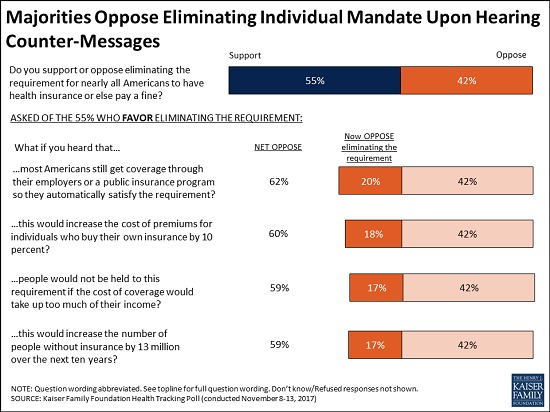
The new poll finds that most Americans (55%) initially support eliminating the mandate as part of tax reform, while four in 10 (42%) oppose it. Most Republicans (73%) and independents (58%) support ending the mandate, while most Democrats (59%) oppose it.

These views are malleable, with about a third of supporters (representing a fifth of the public overall) switching to oppose the mandate’s repeal when presented with facts and arguments about who is impacted and potential consequences of its repeal.

For example, the share who oppose eliminating the mandate can rise as high as 62 percent when initial supporters hear that most Americans get coverage through their employers or government programs that meets the mandate’s requirements. Similar majorities ultimately oppose eliminating the mandate when presented with other arguments against it, including that premiums for people who buy their own health insurance would go up, that people are exempted from the mandate if the cost of coverage takes up too much of their income and that getting rid of the mandate would result in 13 million more people being uninsured over the next 10 years, as the Congressional Budget Office has estimated.

One provision in the House bill would eliminate a tax deduction that allows people with high medical costs to deduct any medical and dental expenses that exceed 10 percent of their income.  A majority (68%) of the public – including majorities of Democrats (77%), independents (66%), and Republicans (61%) oppose eliminating the tax deduction for individuals who have high health care costs.

More than four in 10 (44%) of the public think eliminating the deduction for high medical costs will affect them and their families, though in reality a much smaller share of the public uses that deduction in any given tax year. According to the Internal Revenue Service, about 17 percent of taxpayers who file itemized deductions use this deduction (approximately 6% of all taxpayers and 3% of the public).

Looking ahead to the 2018 midterm elections, the public is divided over whether not passing a tax reform plan or not repealing the ACA would be a bigger deal for President Trump and Republicans. Nearly half of the public say it will be a bigger problem if the president and Republicans are unable to pass their tax reform plan (47%), similar to the share who say it will be a bigger problem if they are unable to revive a repeal of the ACA (44%). Republicans are also divided, with similar shares saying   it would be a bigger deal if President Trump and Republicans are unable to repeal the ACA (50%) and if they are unable to pass tax reform (45%).

Designed and analyzed by public opinion researchers at the Kaiser Family Foundation, the poll was conducted from November 8 – 13, 2017 among a nationally representative random digit dial telephone sample of 1,201 adults. Interviews were conducted in English and Spanish by landline (415) and cell phone (786). The margin of sampling error is plus or minus 3 percentage points for the full sample. For results based on subgroups, the margin of sampling error may be higher.

No Limit: Medicare Part D Enrollees Exposed to High Out-of-Pocket Drug Costs Without a Hard Cap on Spending

No Limit: Medicare Part D Enrollees Exposed to High Out-of-Pocket Drug Costs Without a Hard Cap on Spending – Issue Brief

Related image


Introduction

Prescription drugs play an important role in medical care for 59 million seniors and people with disabilities.  Medicare beneficiaries have access to outpatient prescription drug coverage through the Part D prescription drug benefit, which is administered by private stand-alone prescription drug plans (PDPs) and Medicare Advantage drug plans (MA-PDs). Since the start of the Medicare Part D program in 2006, the drug benefit has helped to lower out-of-pocket drug spending for all enrollees. Beneficiaries in Part D plans with low incomes and modest assets are eligible for additional assistance with plan premiums and cost sharing through the Low-Income Subsidy (LIS) program, reducing out-of-pocket costs even further for this population.

The Centers for Medicare & Medicaid Services (CMS) establishes guidelines that all Part D plans must follow for the design of the drug benefit and the value of coverage that must be offered. Plans are allowed to vary, however, along dimensions that affect beneficiaries’ access to and costs for medications, including which drugs are covered and cost-sharing requirements. The standard Part D benefit in 2017 includes a deductible ($400), followed by 25 percent coinsurance for prescriptions up to an initial coverage limit ($3,700 in total costs), and then a coverage gap where enrollees without low-income subsidies pay a larger share of their drug costs until their out-of-pocket drug spending exceeds a catastrophic coverage threshold ($4,950). The Affordable Care Act (ACA) included a provision to phase out the Part D coverage gap by requiring plans to cover a growing share of total drug costs and providing a manufacturer price discount of 50 percent for brand-name drugs filled in the gap, with the amount of the manufacturer discount counting towards the out-of-pocket threshold that triggers catastrophic coverage. Once enrollees’ drug spending reaches the catastrophic threshold, those without the LIS pay up to 5 percent of their total drug costs; those who qualify for the full low-income subsidy pay nothing for their drugs in this phase of the benefit. Plans typically place drugs that cost over $670 per month on a specialty drug tier, with coinsurance that ranges from 25 percent to 33 percent.

Concern has been rising in recent years about the growing cost burden on Medicare and beneficiaries posed by new, unique, and expensive specialty drugs used to treat a range of diseases. The Medicare Boards of Trusteesand the Medicare Payment Advisory Commission have documented this rising cost burden on the Medicare program, which is reflected in higher Part D program spending overall, as well as higher spending for reinsurance of high-cost Part D enrollees who reach the catastrophic coverage phase of the benefit, where Medicare pays for 80 percent of drug costs. Although Part D provides coverage of catastrophic drug expenses, enrollees who do not receive the LIS are still responsible for up to 5 percent of their drug costs in this phase of the benefit. For very high-priced medications, this relatively small coinsurance rate can translate to a significant amount of out-of-pocket costs for beneficiaries who do not receive low-income subsidies.

This analysis examines the out-of-pocket prescription drug cost burden for Medicare beneficiaries in Part D plans who do not receive low-income subsidies, focusing on those enrollees who have drug costs that exceed the catastrophic coverage threshold. We refer to this group as Part D enrollees with high out-of-pocket drug costs. Although these enrollees do not comprise the entire group of enrollees who have high total drug spending that exceeds the catastrophic coverage threshold, they are exposed to a potentially large cost burden because they do not receive the financial protection of the low-income subsidies. We analyze Medicare prescription drug event claims data for 2015, the most recent year of publicly available Medicare claims data, and trends since 2007, the first full year of the Part D drug benefit. For detail on the data and methods, see the Methodology.

Discussion

In recent years, the high and rising cost of prescription drugs has emerged as a pressing issue for consumers, public programs, and private insurers. As our analysis shows, Medicare beneficiaries who do not receive the additional financial protection provided by low-income subsidies are not insulated from this cost burden and can incur substantial out-of-pocket costs for their medications. We find that one million Medicare beneficiaries in Part D plans who were not receiving low-income subsidies had high out-of-pocket costs in 2015—that is, drug spending above the catastrophic coverage threshold—and their annual out-of-pocket spending averaged over $3,000 in 2015.

Our analysis indicates that out-of-pocket costs above the catastrophic threshold represent a growing concern for people with Medicare, and both MedPAC and Medicare’s actuaries have shown that rising spending for catastrophic coverage has placed greater fiscal pressure on Medicare. Our analysis also shows that the number of Part D enrollees who did not receive low-income subsidies and had out-of-pocket spending above the catastrophic threshold has increased over time. Looking to the future, we would expect to see continued increases in the number of enrollees reaching the catastrophic coverage threshold in 2016 and later years, due in part to the ACA changes to the coverage gap as well as the greater availability and use of high-priced drugs. These trends have cost implications both for beneficiaries and, as the Medicare actuaries have projected, for Medicare.

Part D enrollees with high out-of-pocket costs in 2015 spent an average of $1,215 out of pocket on their prescriptions filled above the catastrophic threshold, or $1.2 billion in the aggregate. In other words, Part D enrollees would have collectively saved $1.2 billion if Part D had a hard cap on out-of-pocket spending, rather than requiring enrollees to pay up to 5 percent coinsurance in the catastrophic coverage phase. Placing a hard cap on out-of-pocket spending under Part D would save money for enrollees, but would increase costs to Medicare and would not address underlying concerns related to high-priced drugs.

While Part D has helped make drugs more affordable for people with Medicare, and the ACA has provided additional relief to enrollees with high drug costs by gradually closing the coverage gap, the absence of an annual out-of-pocket spending limit under Part D exposes enrollees to significant costs—unless their incomes and assets are low enough to qualify for low-income subsidies. Various proposals to reduce drug costs—including allowing the federal government to negotiate prices for Medicare beneficiaries, and allowing Americans to import drugs from Canada and other countries—enjoy broad, bipartisan public support. With a growing number of people on Medicare facing high out-of-pocket drug costs, alleviating this burden remains an issue for federal policymakers to address.

Maine Medicaid expansion vote seen as ‘Obamacare’ referendum

https://www.apnews.com/59f70b01af374560baccce244cca0b3d/Maine-Medicaid-expansion-vote-seen-as-‘Obamacare’-referendum

Image result for maine

The roiling national debate over the government’s proper role in health care is coming to a head in a state more commonly known for moose, lobster and L.L. Bean.

On Nov. 7, voters in Maine will decide whether to join 31 other states and expand Medicaid under former President Barack Obama’s Affordable Care Act. It is the first time since the law took effect nearly four years ago that the expansion question has been put to voters.

The ballot measure comes after Maine’s Republican governor vetoed five attempts by the politically divided Legislature to expand the program and take advantage of the federal government picking up most of the cost.

It also acts as a bookend to a year in which President Donald Trump and congressional Republicans tried and failed repeatedly to repeal Obama’s law.

Activists on both sides of the issue are looking at the initiative, Maine Question 2, as a sort of national referendum on one of the key pillars of the law, commonly known as Obamacare. Roughly 11 million people nationwide have gained coverage through the expansion of Medicaid, the state-federal health insurance program for lower-income Americans.

Republican consultant Lance Dutson called Maine’s initiative a national bellwether in which the needs of the people could trump political ideology.

A pillar of former President Barack Obama’s health care law faces a test in Maine, where voters will decide whether to expand Medicaid. If voters pass the initiative, Maine would become the 32nd state to accept the expansion. (Oct. 31)

“People believe there are good parts to Obamacare and bad parts to Obamacare. And without taking Medicaid expansion, we are leaving one of the good parts on the table while still suffering from the bad parts of it,” said Dutson, who supports Question 2.

Maine may not be the last state to put the Medicaid question before voters. Expansion proponents in Idaho and Utah have launched similar efforts in those states aimed at the 2018 ballot.

If the initiative passes, an estimated 70,000 people in Maine would gain health coverage. The issue is personal to many in an aging, economically struggling state with a population that is smaller than the city of San Diego.

Nature painter Laura Tasheiko got dropped from Medicaid three years ago after successfully battling breast cancer. Since then, she has relied on the charitable services of a hospital near her home in Northport, a seaside village of less than 2,000 people about 100 miles northeast of Portland.

She worries about having another serious health problem before she is eligible for Medicare when she turns 65 next year.

“Some of the after-effects of the chemo can be severe, like heart failure,” she said. “Having no insurance is really scary.”

Maine’s hospitals support the Medicaid expansion and say charity care costs them over $100 million annually. The initiative’s supporters have reported spending about $2 million on their campaign, with hundreds of thousands of dollars coming from out-of-state groups. By comparison, the lead political action committee established to oppose the measure has spent a bit less than $300,000.

Among those who say Maine will benefit from the expansion is Bethany Miller. She said her adult son, Kyle, needed Medicaid because he couldn’t afford subsidized monthly insurance premiums even though he was working.

She remembers watching as her son’s eyes went hollow and his body turned skeletal in the weeks before he died, at age 25, from a diabetic coma a year ago.

“He had a job, but he didn’t make enough money to pay for his basic needs and his insulin, and he couldn’t live without his insulin,” said Miller, who lives in Jay, a small paper mill town about 70 miles north of Portland.

LePage, a Trump supporter, is lobbying furiously against the initiative. He and other critics warn that the expansion will be too costly for Maine, even with the federal government picking up most of the tab. After 2020, the state’s share of paying for the expansion population would be 10 percent.

LePage warns that he would have to divert $54 million from other programs — for the elderly, disabled and children — to pay for Medicaid expansion.

“It’s going to kill this state,” he said.

LePage said he considers Medicaid another form of welfare and wants to require recipients to work and pay premiums.

Maine currently serves about 268,000 Medicaid recipients, down from 354,000 in 2011. LePage credits the drop to his administration’s tightened eligibility restrictions.

If Question 2 passes, the Medicaid expansion would cover adults under age 65 with incomes at or below 138 percent of the federal poverty level. That’s $16,643 for a single person or $22,412 for a family of two.

State Rep. Deborah Sanderson, a Republican, said Maine is already struggling to serve its rapidly aging population as nursing homes shutter and rural hospitals struggle.

“I get accused on occasion of trying to pit one population of folks against another,” she said. “It’s a case of only having a certain amount of resources to take care of a large number of needs.”

Finances are a concern in a state marked by factory closures and sluggish wage growth.

But with more people living on the margins, advocates of the expansion say that is all the more reason to extend the benefits of Medicaid. About 8 percent of Maine residents do not have insurance, a little less than the national percentage.

Democratic Sen. Geoffrey Gratwick, a retired rheumatologist, said he has seen many patients throughout his career who did not have health insurance and came to him with a disease already in its late stages. He voted for all five Medicaid expansion attempts.

“They are just as good people as you or I, but their lives will be shorter and they will be sicker,” he said. “Compassion, common sense and our economic interest demand that we get them the health care they need.”

Nathalie Arruda and her husband, Michael, are in that group that is sometimes without insurance. They live in the farming community of Orland, halfway between New Hampshire and the state’s eastern border with New Brunswick, Canada.

The couple run a computer business and rely on herbal teas and locally grown greens to stay healthy as they fall in and out of Medicaid eligibility. LePage restricted Medicaid eligibility for adults with dependents, like the Arrudas.

“There have absolutely been times when my husband or I have put off getting something looked at that we probably should have because we didn’t have coverage,” Arruda said.

In Miller’s view, her son would still be alive if LePage had signed one of the Medicaid expansion bills sent to him by the Legislature.

When Kyle turned 21, he was one of thousands who lost MaineCare coverage under the governor’s reforms. She said he juggled construction jobs but couldn’t afford his $80 subsidized monthly premium for private insurance.

He struggled to pay medical bills from emergency room visits, Miller said.

Before Kyle died last November, he had landed a steady job at a plastics factory that promised health insurance. He didn’t live long enough to get the coverage, falling into a diabetic coma.

“He started rationing his insulin so he could buy food,” his mother said. “And it cost him his life.”