Industry Voices—Beyond benefit design, provider billing policies hit families hardest

https://www.fiercehealthcare.com/payer/industry-voices-beyond-benefit-design-it-s-provider-billing-hits-families-hardest?mkt_tok=eyJpIjoiWWpZNU4yTTROREExWlRsaSIsInQiOiJjZHh5VGpsWnhSN3RLQjNHbDNsWUROQkg0Y2EzOFZ3OFY2Z0Z1a1dFNVhwNkRXNTE3dTNMK0U2TloxUnFKT1RDU29cL3NEZ0gwMTdJbUptaTFxamFTbFg1cG1PbFRHbTQ2TmQzRHhYZERqcUZXQ1B0YVF1aW1QODBDb2g3aHA1cEwifQ%3D%3D&mrkid=959610&utm_medium=nl&utm_source=internal

What happens when record increases in health insurance premiums and deductibles put too much stress on patients’ pocketbooks? They delay needed care out of fear they’ll be unable to shoulder an unexpected medical expense for themselves or their families.

Now more than ever, patients worry about their ability to cover out-of-pocket healthcare costs, a recent Commonwealth Fund survey shows. The percentage of patients who believe they could afford the care they need is falling, and many say satisfying their financial obligations for care has become more difficult.

But these data only tell part of the story. Our own research shows that while 68% of patients want to discuss financing options that could ease their minds about mounting healthcare expenses, providers are falling short—and families, especially, are feeling the pinch.

Feeling the pinch

According to our survey, 27% of households with children are likely to delay care because they can’t afford to pay for it. Families are also less likely to pay their out-of-pocket costs for care in full—and their chances of having their account sent to collections are twice as high.

It’s not that families and individuals don’t want to cover their out-of-pocket costs. In fact, half of the patients surveyed were willing to select providers based on the availability of financing plans that stretch out their obligation into more manageable monthly payments. The trouble is, providers have been slow to adopt flexible payment plans. They are even slower to discuss financing options with patients or publicize them more broadly.

It’s time for a new approach to patient billing—one that takes into account patients’ desire to fulfill their financial obligations for care, addresses their concerns from the point of service, and demonstrates a willingness to meet them where they are.

The experience of one new mother in Florida illustrates the gains hospitals can make when they take a compassionate approach to patient collections. As she prepared to give birth to her daughter, she found herself facing a financial dilemma. The hospital required her to “reserve” her spot in its labor and delivery unit—for a $1,000 deposit. With no money in reserve and a baby on the way, she feared she wouldn’t be able to deliver her baby at the hospital.

She asked hospital representatives whether the hospital might consider a payment plan instead of a lump-sum payment. To her relief, the hospital allowed her to extend the payment over 12 months—interest-free. It’s an option that relieved the stress of the financial burden of care during what should be a joyous time for her family.

Making a difference through flexible payments

Offsetting the impact of out-of-pocket medical costs for individuals and families doesn’t require an overhaul of a hospital’s patient financial services program. Instead, hospitals can take simple steps to help patients more easily fulfill their financial obligations for care—and reduce their costs to collect as well as bad debt in the process.

Consider offering a variety of options for payment, such as low-interest and no-interest loans that all patients qualify for, without the fear of credit reporting or negative consequences. Setting the program up so that patients have a choice and opt into the program significantly helps the patient experience. Discuss their estimated out-of-pocket expense with patients before or at the point of care, and share information on payment plans widely, both onsite and online. Lastly, a program that is consumer friendly with easy ways to pay their bills and manage their accounts will go a long way to increase patient satisfaction.

Taking a more proactive approach to affordability is not only the right thing to do for patients but also the smart choice in protecting an organization’s long-term financial health.




Older Americans worried about insurance coverage, health costs as they approach retirement

https://www.fiercehealthcare.com/payer/older-americans-worried-about-insurance-coverage-and-health-costs-as-they-approach-retirement?mkt_tok=eyJpIjoiTXpGak0yVmtNamN6TnpkaCIsInQiOiJtQnVtUmFtN0RYbHMzb2hyM1wvXC93N1kwRDJ6RmlNSjg5Q2VsYkFFSTJpZlptKzc2b1ByYTcrVzNxNUtcL3BwVWVIbzJBWThSWmY4ZXpHK1RBUWdWODhqdkxYMXZQRnJtNWV4TWc4aFJqVUdiXC9sWWh0MEdJK2NPckNzVDQ3ZlhoUEgifQ%3D%3D&mrkid=959610&utm_medium=nl&utm_source=internal

A sizable percentage of Americans between the ages of 50 and 64 are worried about their healthcare coverage as they head toward retirement, according to a new poll from the University of Michigan.

Although some of these concerns include things people can’t directly control, such as policy changes, many are focused on maintaining current coverage provided through an employer while reducing personal healthcare expenses.

“The ACA’s insurance coverage expansion was intended, in part, to reduce ‘job lock’ and allow individuals to change or leave their job without concern about becoming uninsured,” the report says. “However, data from this poll suggest that many adults age 50–64 still worry about maintaining employer-sponsored health insurance and keeping a job for that reason.”

About a quarter (27%) of respondents fear they won’t be able to afford their insurance over the next year, and nearly half (45%) expressed little to no confidence in being able to afford their insurance when they retire.

Meanwhile, 13% of those surveyed postponed medical care within the last year due to cost concerns. Another 15% postponed procedures until they could change their plan the following coverage year—so it would be covered, to incur lower out-of-pocket costs or to see a specific doctor in-network. Additionally, 8% of respondents between the ages of 60 and 64 reported delaying a procedure until they could get Medicare.

Nearly 1 in 5 (19%) said they were keeping a job, delaying retirement or considering delaying retirement to keep their employer-sponsored insurance. With that in mind, 71% of retirees were confident in their ability to afford insurance—a much higher percentage than those who were working (54%) or not working (49%).

Men were more confident than women that they could afford insurance at retirement (61% vs. 50%). Those in “excellent” health were more confident than those in “good” or “fair/poor” health (62% vs. 54% and 42%), as were those with a college degree compared to those without.

Nearly 8 in 10 respondents (79%) said they were very confident in their ability to navigate the health insurance landscape, though about 3 in 10 (29%) indicated little or no confidence that they could determine the out-of-pocket costs associated with a prospective service.

The study indicates Americans are closely watching and responding to challenges to the Affordable Care Act, such as a ruling by a federal judge in Texas striking down the law. Over the weekend, the judge issued a stay on the ruling, saying the healthcare law should remain in effect as appeals weave their way through the courts.

Half of those surveyed said they closely follow news about the ACA, Medicare or Medicaid, and 68% said they are worried about how their coverage may change due to federal policies.

“Regardless of potential federal policy changes, patients and their health care providers should discuss the out-of-pocket costs of health care, such as medical procedures, tests, or medications. Such discussions can help inform decisions about their health insurance options and the timing, choice, and appropriateness of health care services,” it concluded.


Proposed Changes to Medicare Part D Would Benefit Drug Manufacturers More Than Beneficiaries

https://www.commonwealthfund.org/blog/2019/proposed-changes-medicare-part-d-would-benefit-drug-manufacturers-more-beneficiaries?omnicid=EALERT1538445&mid=henrykotula@yahoo.com

senior opens medications

As part of the Bipartisan Budget Act of 2018 (BBA), Congress made changes to the Medicare prescription drug benefit program, or Part D, to lower spending for both beneficiaries and the federal government. Specifically, the BBA increased the size of the discount on brand-name drugs that manufacturers are required to offer beneficiaries who are in the Part D coverage gap, or “donut hole,” from 50 percent to 70 percent. (The donut hole, in which Medicare beneficiaries who have spent over a certain amount on prescription drugs must pay all drug costs out of pocket, was designed to help contain federal costs.) By increasing the size of the manufacturer discount, Congress was able to shrink the share of spending in the donut hole covered by Part D plan sponsors and beneficiaries.

Pharmaceutical manufacturers have continued to put pressure on Congress to make two changes: 1) roll back the discount from manufacturers from 70 percent to 63 percent (and increase Part D plan-sponsor liability) and 2) block an increase in the total amount beneficiaries must spend out of pocket on their prescription drugs before catastrophic coverage kicks in.

According to our analysis, these proposals would financially benefit drug manufacturers more than Medicare beneficiaries: while beneficiaries’ spending in the coverage gap would be slightly reduced, manufacturers’ spending would be reduced far more. Moreover, Medicare spending under Part D would increase to cover the savings to beneficiaries and manufacturers.

Key Definitions Under Part D

Donut Hole: The third phase of Medicare Part D coverage in which beneficiaries pay all drug costs out of pocket.

TrOOP (True Out-of-Pocket) Threshold: The total amount beneficiaries need to spend out of pocket before reaching catastrophic coverage.

Part D Plan Sponsors: Typically insurance companies and pharmacy benefit managers

Part D Coverage Gap Discount: A program established by the ACA that requires drug manufacturers and Part D plan sponsors to give beneficiaries price discounts on brand-name drugs when beneficiaries reach the coverage gap. It also reduces the share of spending that Part D plan sponsors cover.

Original Medicare Part D Design

When the Medicare Part D program was created in 2003, Congress required all Part D plan sponsors — typically insurance companies and pharmacy benefit managers — to establish a standard benefit package with four phases of coverage that beneficiaries move through depending on their drug spending. In the first phase, the federal government covers 100 percent of cost-sharing until beneficiaries reach their deductible. In the second phase, the federal government covers 25 percent of cost-sharing. In the third phase, known as the coverage gap or donut hole, beneficiaries pay all drug costs out of pocket. In the final phase, catastrophic coverage is reached and beneficiaries cover just 5 percent of cost-sharing.

The amount beneficiaries need to spend out of pocket before reaching catastrophic coverage is called the TrOOP (“True Out-of-Pocket) threshold; it was $5,000 in 2018. The TrOOP threshold increases each year to account for growth in Medicare per-beneficiary spending under Part D, which includes prescription drug prices.

Filling the Part D “Donut Hole”

As part of the Affordable Care Act (ACA), Congress included two changes to Part D to help fill the donut hole. First, Congress established the Part D Coverage Gap Discount Program that requires participating drug manufacturers and Part D plan sponsors give beneficiaries price discounts on brand-name drugs when beneficiaries reach the coverage gap. Between 2011 and 2020, this program reduces beneficiary cost-sharing in the gap from 100 percent to 25 percent. The discounts were phased in and scheduled to fill the coverage gap by 2020.

Second, Congress slowed the annual update to the TrOOP threshold through 2019 by basing the update on the consumer price index (CPI) plus 2 percentage points rather than drug spending growth. The purpose was to give certainty to the size of the donut hole during the phase-in of the manufacturer discount program. Because the CPI has grown far less rapidly than drug prices under Part D, this change has kept the size of the donut hole smaller, enabling beneficiaries to reach the catastrophic benefit sooner than they would have under the original Part D benefit. This also helps manufacturers, who don’t have to offer as many discounts when people are in the coverage gap for a shorter period of time. And once the federal government is covering more costs under catastrophic coverage, manufacturers no longer have to provide discounts at all.

While Congress slowed growth in the TrOOP threshold through 2019, under the ACA, the threshold amount reverts back to the pre-ACA calculation in 2020. When the threshold is based on drug price spending growth again, the amount a beneficiary must spend in the coverage gap will jump from $5,100 to $6,350. (If manufacturer price growth had been at or close to CPI growth in recent years, there would be no increase in 2020.) But if Congress wants to block the spike in the TrOOP amount, it must take action no later than June 2019, the deadline for Part D plans bidding to offer coverage in 2020.

Effect of the Bipartisan Budget Act of 2018 on the Coverage Gap

In February 2018, the BBA made changes to the Part D Coverage Gap Discount Program to help fill the donut hole in 2019 (a year earlier than the ACA provision) by increasing the manufacturer discount for beneficiaries from 50 percent to 70 percent and reducing the share that Part D plan sponsors cover. This change will require manufacturers to offer a larger discount and reduce beneficiaries’ out-of-pocket drug costs in the donut hole. By reducing the share that insurance companies or pharmacy benefit managers are responsible for, Congress intended to lower premiums, which in turn will save the federal government on premiums subsidies.

The Financial Impact of the New Proposals

While Congress established the Part D Coverage Gap Discount Program at the same time it slowed growth in the TrOOP threshold — and both relate to the donut hole — the two policies function independently and need not be conflated in terms of making changes to them in statute.

Moreover, the financial implications of proposals to change these components differ markedly. Beneficiaries spend an average of $1,321 on cost-sharing in the coverage gap today and would spend $1,156 in 2020 — or $165 less — if Congress amends the BBA and blocks the TrOOP increase as proposed by the pharmaceutical industry.

However, manufacturers would save even more under these proposed policies. Brand-name manufacturer discounts in the donut hole would fall from $3,698 per beneficiary today to roughly $2,998 — a reduction of $785 per beneficiary. Part D plan sponsors would spend $555 per beneficiary in the coverage gap or $291 more if both policies were addressed.

Understanding the implications of these proposals beyond their impact on Medicare spending and the federal budget is important. Even if Congress were only to block the increase in the TrOOP threshold — and not undo the increase in manufacturer discounts — beneficiary spending would be slightly lower (as a lower limit on TrOOP spending would enable beneficiaries to get out of the donut hole and into the most generous level of federal coverage more quickly) but manufacturers would still come out far ahead of both Part D plan sponsors and beneficiaries. Given the financial implications of these two policies, Congress may want to consider broader changes to Part D that would lower drug prices, provide more cost savings to beneficiaries, and avoid higher spending under the Medicare program.


Short-Term Health Plans Hold Savings For Consumers, Profits For Brokers And Insurers

https://www.thelundreport.org/content/short-term-health-plans-hold-savings-consumers-profits-brokers-and-insurers?mc_cid=87537ae734&mc_eid=1d14ffb322

Sure, they’re less expensive for consumers, but short-term health policies have another side: They’re highly profitable for insurers and offer hefty sales commissions.

Driven by rising premiums for Affordable Care Act plans, interest in short-term insurance is growing, boosted by Trump administration actions to ease Obama-era restrictions and possibly make federal subsidies available to consumers to purchase them.

That’s good news for brokers, who often see commissions on such policies hit 20 percent or more.

On a policy costing $200 a month, for example, that could translate to a $40 payment each month. By contrast, ACA plan commissions, which are often flat dollar amounts rather than a percentage of premium, can range from zero to $20 per enrollee per month.

“Customers are paying less and I’m making more,” said Cindy Holtzman, a broker in Woodstock, Ga., who said she gets 20 percent on short-term plan commissions.

Large online brokers also are eagerly eyeing the market.

Ehealth, one such firm, will “continue to shift our focus to selling short-term plans and non-ACA insurance packages,” CEO Scott Flanders told investors in October. The firm saw an 18 percent annual jump in enrollment in short-term plans this year, he added.

Insurers, too, see strong profits from plans because they generally pay out very little toward medical care when compared with the more comprehensive ACA plans.

Still, some agents like Holtzman have mixed feelings about selling the plans, because they offer skimpier coverage than ACA insurance. One 58-year-old client of Holtzman’s wanted one, but he had health problems. She also learned his income qualified him for an ACA subsidy, which currently cannot be used to purchase short-term coverage.

“There’s no way I would have considered a short-term plan for him,” she said. “I found him an ACA plan for $360 a month with a reduced deductible.” (A federal district court judge in Texas issued a ruling Dec. 14 striking down the ACA, which would among other things impact the requirements of ACA coverage and subsidies. The decision is expected to face appeal.)

Short-term plans can be far less expensive than ACA plans because they set annual or lifetime payment limits. Most exclude people with medical conditions, they often don’t cover prescription drugs, and policies exclude in fine print some conditions or treatments. Injuries sustained in school sports programs, for example, often are not covered. (These plans can be purchased at any time throughout the year, which is different than plans sold through the federal marketplaces. The open enrollment period for those ACA plans in most states ends Dec. 15.)

Consequently, insurers providing short-term plans don’t have to pay as many medical bills, so they have more money left over for profits. In forms filed with state regulators, Independence American Insurance Co. in Ohio shows it expects 60 percent of its premium revenue to be spent on its enrollees’ medical care. The remaining 40 percent can go to profits, executive salaries, marketing and commissions.

A 2016 report from the National Association of Insurance Commissioners showed that, on average, short-term plans paid out about 67 percent of their earnings on medical care.

That compares with ACA plans, which are required under the law to spend at least 80 percent of premium revenue on medical claims.

Short-term plans have long been sold mainly as a stopgap measure for people between jobs or school coverage. While exact figures are not available, brokers say interest dropped when the ACA took effect in 2014 because many people got subsidies to buy ACA plans and having a short-term plan did not exempt consumers from the law’s penalty for not carrying insurance.

But this year it ticked up again after Congress eliminated the penalty for 2019 coverage. At the same time, the premiums for ACA plans rose on average more than 30 percent.

“If I don’t want someone to walk out of the office with nothing at all because of cost, that’s when I will bring up short-term plans,” said Kelly Rector, president of Denny & Associates, an insurance sales brokerage in O’Fallon, a suburb of St. Louis. “But I don’t love the plans because of the risk.”

The Obama administration limited short-term plans to 90-day increments to reduce the number of younger or healthier people who would leave the ACA market. That rule, the Trump administration complained, forced people to reapply every few months and risk rejection by insurers if their health had declined.

This summer, the administration finalized new rules allowing insurers to offer short-term plans for up to 12 months — and gave them the option to allow renewals for up to three years. States can be more restrictive or even bar such plans altogether.

Administration officials estimate short-term plans could be half the cost of the more comprehensive ACA insurance and draw 600,000 people to enroll in 2019, with 100,000 to 200,000 of those dropping ACA coverage to do so.

And recent guidance to states says they could seek permission to allow federal subsidies to be used for short-term plans. Currently, those subsidies apply only to ACA-compliant plans.

Granting subsidies for short-term plans “would mean tax dollars are not only subsidizing commissions, but also executive salaries and marketing budgets,” said Sabrina Corlette of Georgetown University Center on Health Insurance Reforms.

No state has yet applied to do that.

For now, brokers are focusing on getting their clients into some kind of coverage for next year. Commissions on both ACA and short-term plans are getting their attention.

After several years of declining commissions for ACA plans — with some carriers cutting them altogether a couple of years ago — brokers say they are seeing a bit of a rebound.

Among Colorado ACA insurers, “it’s gone from about $14 to $16 per enrollee [a month] to $16 to $18,” said Louise Norris, a health policy writer and co-owner of an insurance brokerage.

Rector, in Missouri, said an insurer that last year paid no commissions has reinstated them for 2019 coverage. For her, that doesn’t really matter, she said, because once carriers started reducing or eliminating commissions, she began charging clients a flat rate to enroll.

Norris noted that some states changed their laws so brokers could do just that.

At least one state, Connecticut, ruled that insurers had to pay a commission, which she thinks is protective for consumers.

“Insurance regulators need to step in and make sure brokers are getting paid,” said Norris, or some brokers, “out of necessity,” might steer people to higher-commission products, such as short-term plans, that might not be the best answer for their clients.

Her agency does not sell short-term or some other types of limited-benefit plans.

“I don’t want to have a client come back and say I’ve had a heart attack and have all these unpaid bills,” she said.


Misconceptions About Health Costs When You’re Older

Misconceptions About Health Costs When You’re Older

Image result for Misconceptions About Health Costs When You’re Older

Some significant expenses decline as we age: Most mortgages are eventually paid off, and ideally children grow up and become self-supporting.

But health care is one area in which costs are almost certain to rise. After all, one of the original justifications for Medicare — which kicks in at age 65 — is that older people have much higher health care needs and expenses.

But there are a few common misunderstandings about health costswhen people are older, including the idea that money can easily be saved by reducing wasteful end-of-life spending.

Half our lifetime spending on health care is in retirement, even though that represents only about 20 percent of a typical life span. Total health care spending for Americans 65 and older is about $15,000 per year, on average, nearly three times that of working-age Americans.

Don’t expect Medicare to provide complete protection from these expenses.

Traditional Medicare has substantial gaps, leaving Americans on the hook for a lot more than they might expect. It has no cap on how much you can pay out of pocket, for example. Such coverage gaps can be filled — at least in part — by other types of insurance. But some alternatives, such as Medicare Advantage, aren’t accepted by as many doctors or hospitals as accept traditional Medicare.

On average, retirees directly pay for about one-fifth of their total health care spending. Some spend much more.

One huge expense no Medicare plans cover is long-term care in a nursing home.

Over half of retirement-age adults will eventually need long-term care, which can cost as much as $90,000 per year at a nursing home. Although most who enter a nursing home don’t stay long, 5 percent of the population stays for more than four years. You can buy separate coverage outside the Medicare program for this, but the premiums can be high, especially if you wait until near retirement to buy.

Although Medicare is thought of as the source of health care coverage for retirees, Medicaid plays a crucial role.

Medicaid, the joint federal-state heath financing program for low-income people, has long been the nation’s main financial backstop for long-term care. Over 60 percent of nursing home residents have Medicaid coverage, and over half of the nation’s long-term care is funded by the program.

That isn’t because most people who require long-term care have low incomes. It’s because long-term care is so expensive that those needing it can frequently deplete their financial resources and then must turn to Medicaid.

recent working paper from the National Bureau of Economic found that, on average, Medicaid covers 20 percent of retiree health spending. The figure is larger for lower-income retirees, who are more likely to qualify for Medicaid for more of their retirement years.

A widely held view is that much spending is wasted on “heroic” measures taken at the end of life. Are all the resources devoted to Medicare and Medicaid really necessary?

First, let’s get one misunderstanding out of the way. The proportion of health spending at the end of life in the United States is lower than in many other wealthy countries.

Still, it’s a tempting area to look for savings. Only 5 percent of Medicare beneficiaries die each year, but 25 percent of all Medicare spending is on individuals within one year of death. However, the big challenge in reducing end-of-life spending, highlighted by a recent study in Science, is that it is hard to know which patients are in their final year.

The study used all the data available from Medicare records to make predictions: For each beneficiary, it assigned a probability of death within a year. Of those with the very highest probability of dying — the top 1 percent — fewer than half actually died.

“This shows that it’s just very hard to know in advance who will die soon with much certainty,” said Amy Finkelstein, an M.I.T. economist and an author of the study. “That makes it infeasible to make a big dent in health care spending by cutting spending on patients who are almost certain to die soon.”

That does not mean that all the care provided to dying patients — or to any patient — is valuable. Another study finds that high end-of-life spending in a region is closely related to the proportion of doctors in that region who use treatments not supported by evidence — in other words, waste.

“People at high risk of dying certainly require more health care,” said Jonathan Skinner, an author of the study and a professor of economics at Dartmouth. “But why should some regions be hospitalizing otherwise similar high-risk patients at much higher rates than other regions?”

In 2014, for example, chronically ill Medicare beneficiaries in Manhattan spent 73 percent more days in the hospital in their last two years of life than comparable beneficiaries in Rochester.

“There absolutely is waste in the system,” said Ashish Jha, director of the Harvard Global Health Institute. But, he argues, waste is present throughout the life span, not just at the end of life: “We have confused that spending as end-of-life spending is somehow wasteful. But that’s not right because we are terrible at predicting who is going to die.”

Of course, beyond any statistical analysis, there are actual people involved, and wrenching individual decisions that need to be made.

“We should do all we can to push waste out of the system,” Dr. Jha said. “But spending more money on people who are suffering from an illness is appropriate, even if they die.”


States in the Obamacare lawsuit are biting the hand that feeds them

https://www.washingtonpost.com/news/powerpost/paloma/the-health-202/2018/12/20/the-health-202-states-in-the-obamacare-lawsuit-are-biting-the-hand-that-feeds-them/5c1a559e1b326b2d6629d4f8/?utm_term=.48253007006e

Image result for biting the hand that feeds them

Obamacare is precarious yet entrenched as 2019 approaches. Even many of the GOP-led states seeking to knock it down in court would be in a real bind should they succeed.

Of the 20 states involved in a high-profile Texas-led lawsuit arguing the Affordable Care Act is unconstitutional, nearly half have already accepted its extra dollars to expand their Medicaid programs or are moving that direction. States don’t have to expand Medicaid under a 2012 Supreme Court decision, but most have found it advantageous because the federal government foots most of the bill.

These states — nine in total — would suddenly be facing a much larger expense for hundreds of thousands of low-income earners newly enrolled in Medicaid under the ACA, should last week’s decision by U.S. District Judge Reed O’Connor rolling back the entire health-care law ultimately stand.

They include Louisiana, North Dakota and West Virginia, along with Arizona, Arkansas and Indiana, three states that expanded Medicaid but with some modifications. In three other states — Maine, Nebraska and Utah — voters approved ballot initiatives adopting expansion.

Yet these states are asking the courts to overthrow not just Obamacare’s protections for people with preexisting conditions – the part of the lawsuit that has gotten the most attention — but also the entire sweeping law, which is now firmly a part of the country’s health-care ecosystem eight years since its passage. More than 12 million people have become eligible for Medicaid since ACA passage, while another 11 million have enrolled in the ACA’s federally subsidized private marketplaces.

“God help us all, because the dark age is not that far from us again,” said Sen. Joe Manchin (D-W.Va.). “It will be worse than before because there won’t be the money to help rural clinics and hospitals.”

Developments in the past week — including the court ruling and slightly lagging marketplace enrollment figures released yesterday by the Trump administration — underscore the political divides dogging Obamacare even though Republicans in Congress and at the state level have embraced some of its major components.

Nearly 8.5 million people signed up for 2019 plans in the 39 states using the HealthCare.gov website (the other states run their own marketplaces), per figures from the Centers for Medicare and Medicaid Services. Enrollment was just 4 percent less than a year ago, due to a last-minute rush that suggests consumers were undeterred by the court ruling, our Washington Post colleague Amy Goldstein reports.

“After lagging by about 11 percent most of the six weeks of open enrollment — a shortened period adopted by the Trump administration a year ago — the more than 400,000 who selected coverage during the final week actually exceeded the year before,” Amy writes.

CMS Administrator Seema Verma seemed unperturbed by the reduced enrollment numbers, saying they merely show new GOP and administration policies to roll back some ACA requirements on insurers and consumers are working.

But if the entire law gets scrapped by the Supreme Court ( we should note, the case still has a long way to go in the legal system), it will quickly become clear the ACA — for whatever its faults — has extended benefits to Americans they’ve now come to expect. Despite their persistent rhetoric against the law, Republicans have found it politically necessary to embrace big parts of it, including its protections for people with preexisting conditions — and, in some states, its Medicaid expansion.

Case in point: West Virginia. Its Republican attorney general, Patrick Morrisey, has joined the lawsuit against Obamacare even though the state embraced its Medicaid expansion, growing its enrollment in the program by nearly one-third.The federal government covers more than 90 percent of the cost of the newly eligible enrollees.

When I asked Morrisey’s office about what striking the ACA would mean for Medicaid recipients, his office provided a statement praising O’Connor’s ruling and discussing premium hikes in the marketplaces — but didn’t mention Medicaid.

“Our nation must move beyond Obamacare, innovate, provide more choices to consumers, and attack the skyrocketing premiums that have caused such pain and hardship on West Virginian and American families,” the statement said.

In some cases, the decisions by state attorneys general to join the anti-ACA lawsuit has put them at odds with their governor. Louisiana’s Democratic governor, John Bel Edwards, moved quickly to expand Medicaid when he took office in 2016. Nearly half a million people have enrolled in Medicaid since then, growing the state’s program by 27 percent.

Edwards hasn’t hidden his disdain for Louisiana Attorney General Jeff Landry (R), who has called the law an “unconstitutional overreach.” Edwards issued a critical statement after last Friday’s decision.

“This was a short-sighted lawsuit, to say the least,” Edwards said in a statement. “I intend to vigorously pursue legislation to protect individuals with pre-existing conditions from losing their health insurance and ensuring the working people of our state aren’t penalized because of this decision.”


Conservatives Are Using the Courts to Attack Health Care for All Americans

https://www.americanprogress.org/issues/healthcare/news/2018/12/20/464562/conservatives-using-courts-attack-health-care-americans/

A doctor in Milton, Massachusetts, wheels his patient into his office, February 2018.

Conservative state officials, in conjunction with the Trump administration, have launched an all-out attack on health care in the United States. They have brought a suit to overturn the entirety of the Affordable Care Act (ACA), which would have serious consequences for nearly every American who has health coverage, whether through their employer, the individual market, Medicare, or Medicaid. And they found a partisan judge who, last Friday, proved willing to ignore the rule of law and help them advance their political agenda through the courts.

For now, the ACA remains the law of the land. But if the partisan decision in Texas v. United States is upheld, the consequences could be devastating. The Urban Institute estimates that overturning the ACA would result in 17 million more Americans being uninsured in 2019—in addition to coverage reductions that would occur due to the elimination of the individual mandate penalty. Millions of American families could be left without access to health care—and without the financial safety and peace of mind that health insurance provides. Overturning the law would also have serious negative effects on public health and drug development and would shorten the life of the Medicare trust fund. Moreover, it would provide a major tax break to the wealthiest Americans, insurance companies, and drug manufacturers.

Supporters of the decision have talked about this as an effort to end “Obamacare,” which may cause some people to mistakenly believe it only affects those who obtain coverage through the individual marketplace. Nothing could be further from the truth: Virtually no American’s health care coverage would be safe from the effects of this decision. Here are just some of the impacts that this decision, if upheld, would have.

Risks for people who obtain coverage through their employer

  • Lifetime and annual limits on coverage: Polling shows that without the ACA’s ban on lifetime and annual caps on benefits, firms would choose to reinstate limits on coverage. Tens of millions of workers and dependents could face annual or lifetime limits.
  • Loss of coverage for young adult children: The ACA requires employer plans that cover dependents to include young adults up to age 26. More than 2 million young adults have gained coverage under the ACA’s dependent coverage provision.
  • Loss of free preventive services, including contraception: The ACA requires preventive services—such as immunizations; screenings for cancer, diabetes, and depression; and well-child visits—to be available at no cost to the patient. Womensave about $250 annually thanks to the lack of cost sharing for contraception.
  • Elimination of rebates to cover excessively high premiums: The ACA requires insurers to provide rebates if they overprice premiums relative to actual medical costs. Under the ACA’s medical loss ratio provision, insurance companies paid back $344 million in 2016 to people with employer coverage.

Risks for people who receive coverage through Medicare

  • Increases in premiums and out-of-pocket costs: Elimination of the ACA would increase some beneficiaries’ premiums, deductibles, and copayments in Medicare Part A and Part B; overturning the law would eliminate Medicare savings, and premiums are based on program spending.
  • Cost sharing for preventive services such as mammograms: Under the ACA, Medicare provides preventive services and covers a yearly wellness visit at no cost to the patient.
  • Possibility of falling back into the prescription drug coverage gap: The ACA narrowed the Part D coverage gap and was on track to completely fill it by 2020. Without the ACA, many seniors could face higher costs for prescription medications.

Risks for people who receive coverage through Medicaid

  • Loss of coverage under the Medicaid expansion: About 12 million people are covered under the Medicaid expansion, which was funded mostly by the federal government under the ACA.
  • Higher costs for preventive services such as children’s vaccines: The ACA provided a financial incentive for states to provide preventive services to Medicaid beneficiaries free of charge, which a number of states currently utilize.
  • Fewer options to receive care in homes and communities: The ACA provided new options to states to allow elderly enrollees and enrollees with disabilities to receive care in their homes. If the law is overturned, more enrollees will be forced into institutional care.

Risks for people who buy insurance on their own

  • Loss of tax credits that make coverage affordable: Nearly 9 in 10 enrollees in the ACA marketplaces receive premium tax credits. Without the ACA, enrollees would lose financial assistance toward monthly premiums, as well as funding that helps lower deductibles and copayments.
  • Increased costs or denial of coverage due to pre-existing conditions: Without the ACA, individual market insurers would be allowed to charge more, exclude coverage benefits, or turn away people based on medical history. More than 133 millionAmericans with pre-existing conditions could be subject to discrimination if they ever needed individual market coverage.
  • Increased costs for older enrollees: The ACA limits how much more insurance companies can charge older people for coverage relative to younger ones. Without the ACA’s protections, the elderly and near-elderly would see their premiums rise

The legal reasoning behind the lower court’s decision to overturn the ACA is so poor that it has been decried by even some of the most strident conservative legal critics of the law—including those who have backed the previous efforts to overturn it through the courts. Congress has tried and failed to repeal the ACA, and voters in the midterm elections made it clear that they care about keeping protections for pre-existing conditions. Yet the court’s ruling has been approvingly cited by conservative political officials, including President Donald Trump. As such, the decision is best understood not as a legal opinion but instead as a policy preference pursued through the U.S. judiciary. That preference could not be clearer: to give the country’s wealthy and special interests massive taxes cuts—and pay for them with everyone else’s health care.


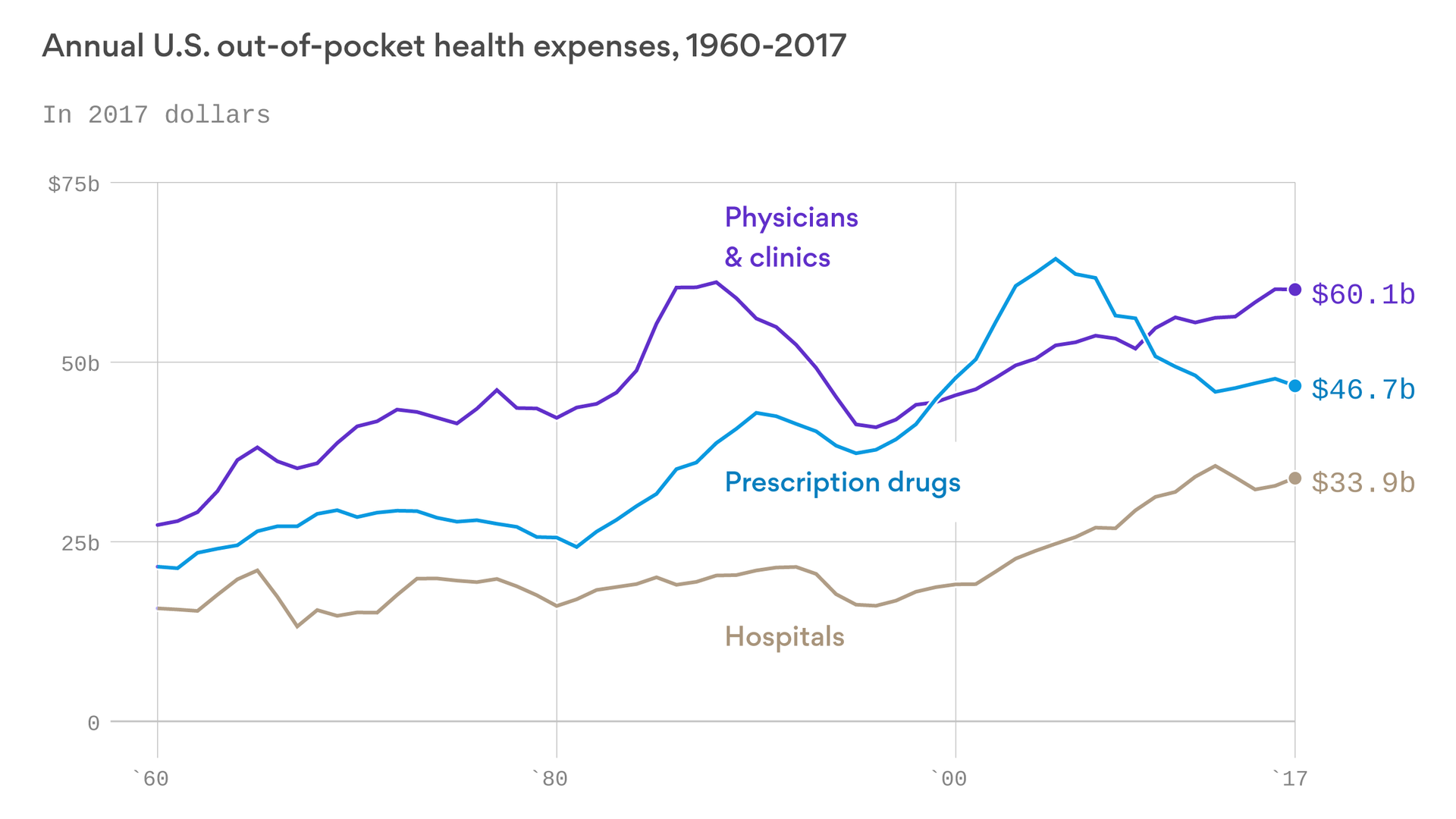
Hospitals smallest part of out-of-pocket costs

https://www.healthsystemtracker.org/interactive/?utm_campaign=KFF-2018-Peterson&utm_source=hs_email&utm_medium=email&utm_content=68267802&_hsenc=p2ANqtz–ktue7Wpa6NlVV1m5K05fMVx7jZNGoCLlk_ATmPS8Y6TgyNwDww1IGCz7sUIjYm69FTQmPft_pPBXXoE4h62JNKY1rEA&_hsmi=68267802&display=U.S.%2520%2524%2520Billions&service=Hospitals%252CPhysicians%2520%2526%2520Clinics%252CPrescription%2520Drug&source=Out%2520of%2520Pocket&tab=0

Image result for Hospitals smallest part of out-of-pocket costs


We spend more on hospital care than any other type of health care service, but hospitals make up the smallest amount of out-of-pocket spending.

  • That means insurers are passing on a smaller percentage of hospital costs to enrollees, although they indirectly pay for hospital care through premiums.

Between the lines:

  • “A big role of patient cost-sharing is to discourage use of inappropriate or unnecessary services. So much of hospital care is non-discretionary from the perspective of patients,” Kaiser Family Foundation’s Larry Levitt says.
  • Levitt adds that insurance tends to pay a bigger part of hospital bills versus other services because hospital bills tend to be large, causing patients to blow through their deductible or hit their out-of-pocket maximum.


20% of Americans are deferring healthcare because of cost, poll finds

https://www.beckershospitalreview.com/finance/20-of-americans-are-deferring-healthcare-because-of-cost-poll-finds.html?origin=rcme&utm_source=rcme

Related image

Americans are delaying medical care as they struggle with its affordability, according to the latest NPR-IBM Watson Health poll.   

The survey of more than 3,000 U.S. households in July found about 20 percent of respondents or someone in their household had postponed or canceled a healthcare service due to cost in the prior three months. 

Younger respondents were more likely to put off their healthcare needs. Thirty-four percent of respondents under 35 said they deterred care because of cost, compared with 8 percent of respondents 65 and older.

The poll also found 26 percent of respondents or someone in their household had difficulty paying for some type of healthcare service in the prior three months.

Again, younger respondents were more likely to experience trouble. Forty-one percent of respondents under 35 said they or a member of their household struggled to pay for a healthcare service, compared to 11 percent of respondents 65 and older and 26 percent of respondents ages 35 to 64.

The poll found 66 percent of respondents said they received a prescription in the prior three months, and 97 percent of those respondents had it filled. Of the respondents who said they had a prescription filled, 19 percent reported they had trouble paying for it.

Access the full poll results here.


Middle-income Americans paying more for health insurance

https://www.healthcaredive.com/news/middle-income-americans-paying-more-for-health-insurance/543903/

Dive Brief:

  • Middle-income families are spending more of their incomes on health insurance as average premiums skyrocketed in 2017 after modest rate increases earlier this decade, The Commonwealth Fund found in a new report.
  • Average employee contributions rose to nearly 7% of median income for single and family plans compared to 5.1% a decade ago. Premium contributions were 8% of median income or more in 11 states, including Louisiana, which had the highest percentage (10.2%).
  • The contributions and potential out-of-pocket spending for single and family policies was $7,240 in 2017. That was 11.7% of median income and an increase from 7.8% a decade ago.

Dive Insight:

Cost and price variations between areas aren’t anything new. A recent Network for Regional Healthcare Improvement found healthcare usage and pricing drive variation between states’ total healthcare costs. The report also found vast differences in costs between five states studied.

Overall, national health spending has slowed in recent years. The CMS Office of the Actuary reported this month that national health spending grew 3.9% ($10,739 per person) in 2017. It was the second consecutive year of slower healthcare spending growth. The slower cost growth is connected to fewer people receiving care.

The Commonwealth Fund found large differences between states. For instance, the average annual premium contributions for single-person plans ranged from $675 in Hawaii to $1,747 in Massachusetts. Michigan saw the cheapest premiums in family plans at $3,646 while Delaware had the highest at $6,533.

The average annual deductible for single-person policies increased to more than $1,800 in 2017. The gap was between $863 (Hawaii) and about $2,300 (Maine and New Hampshire). Three states (Florida, Mississippi and Tennessee) had average deductibles more than 6% of median income.

Premiums for employer health plans, which is how most Americans get coverage, increased 4.4% for single plans and 5.5% for family plans in 2017. All but five states saw higher single-person premiums with eight states averaging more than $7,000 (Alaska, Connecticut, Delaware, Massachusetts, New Jersey, New York, Rhode Island and Wyoming).

Meanwhile, family premiums increased in 44 states and were $20,000 or more in seven states (Alaska, Connecticut, Massachusetts, New Jersey, New York, West Virginia and Wyoming) and the District of Columbia.

The cost of health insurance is increasing faster than wage growth — and the Commonwealth Fund found that the added cost isn’t leading to higher-quality health insurance. The issue is especially a problem in southern states with lower median incomes, such as Mississippi.

The group suggested policymakers could tackle the problem of rising healthcare costs in a couple of ways.

Congress could provide more tax credits to people with employer-sponsored insurance, require businesses to improve plan benefit design to cover more services before employees reach their deductibles and offer refundable tax credits to offset out-of-pocket costs.

Other potential efforts include connecting provider payments to value and outcomes, addressing the concentration of payer and provider markets and slowing prescription drug cost growth. “Policymakers will need to recognize that the increasing economic strain of healthcare costs facing middle-income and poor Americans is driven by multiple interrelated factors and will require a comprehensive solution,” according to the report.