


Cartoon – State of Health Insurance

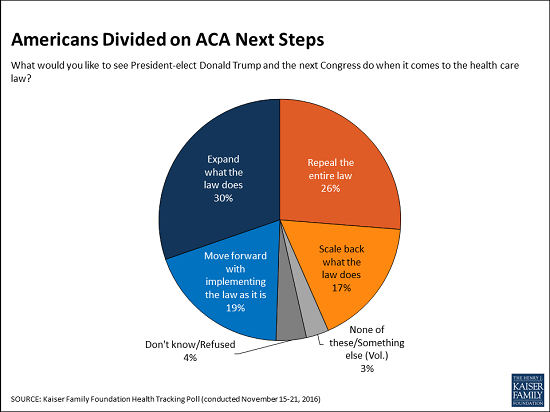
The first Kaiser Health Tracking Poll since the 2016 election finds that Americans are largely divided on the future of the Affordable Care Act even though many of the law’s major provisions remain quite popular across party lines.
The new survey finds that one fourth (26%) of Americans want to see President-elect Donald Trump and the next Congress repeal the entire law, and an additional 17 percent want them to scale back what the law does. This compares to 30 percent of the public who want to see the law expanded and 19 percent who want to see lawmakers move forward with implementing the law as it is.
The poll captures a slight uptick in the share of Americans who want lawmakers to scale back the law as well as a decrease in the share who want lawmakers to repeal the entire law. This is largely driven by Republicans: About half (52%) of Republicans now say they want to see the Affordable Care Act repealed, down from 69 percent in October. At the same time, a quarter (24%) of Republicans now want to see the law scaled back, up from 11 percent in October.
Among the quarter (26%) of Americans that want to see the Affordable Care Act repealed, 31 percent want to see the health care law just repealed and not replaced. About two-thirds wants lawmakers to repeal the health care law and replace it with a Republican-sponsored alternative, with 42 percent wanting lawmakers to wait to repeal it until the details of a replacement plan have been figured out and 21 percent wanting lawmakers to repeal it immediately and figure out a replacement plan later.
Among those who want the law repealed, 38 percent (or 10% of the public overall) change their opinion after hearing the argument that repealing the ACA would mean that insurance companies could deny coverage to people with pre-existing conditions. A slightly smaller share change their opinion after hearing that more than 20 million Americans could lose their coverage.
Pre-existing Conditions and Medical Underwriting in the Individual Insurance Market Prior to the ACA
Before private insurance market rules in the Affordable Care Act (ACA) took effect in 2014, health insurance sold in the individual market in most states was medically underwritten.1 That means insurers evaluated the health status, health history, and other risk factors of applicants to determine whether and under what terms to issue coverage. To what extent people with pre-existing health conditions are protected is likely to be a central issue in the debate over repealing and replacing the ACA.
This brief reviews medical underwriting practices by private insurers in the individual health insurance market prior to 2014, and estimates how many American adults could face difficulty obtaining private individual market insurance if the ACA were repealed or amended and such practices resumed. We examine data from two large government surveys: The National Health Interview Survey (NHIS) and the Behavioral Risk Factor Surveillance System (BRFSS), both of which can be used to estimate rates of various health conditions (NHIS at the national level and BRFSS at the state level). We consulted field underwriting manuals used in the individual market prior to passage of the ACA as a reference for commonly declinable conditions.

Nearly a century after Theodore Roosevelt’s Bull Moose Party first called for health insurance reform, the United States has made major advances in access, quality, and affordability.
In the six years since President Obama signed the Affordable Care Act (ACA) into law, 20 million more people have health insurance, and, for the first time in our history, more than nine out of every 10 Americans are insured. Growth in both premiums for employer coverage and overall Medicare spending has also slowed. The Centers for Medicare and Medicaid Services’ Actuaries now project that we are on track to spend $2.6 trillion less over the ACA’s first decade than was projected without the ACA back in 2010.
Even with this slow down, any increase in costs can be challenging for businesses monitoring expenses or families working through their budgets. That’s why stakeholders nationwide have been coming together to reshape the future of health care. Using new advancements in data, medicine, and the tools and resources provided by the Affordable Care Act, institutions across the country are building a health care system that works better for all Americans.
This work has gone on steadily for years — through political turmoil and challenges in the courts. Yet through each challenge, these reforms have endured.
They must continue to endure. The 20 million Americans who gained coverage cannot lose it again. The more than 129 million people with pre-existing conditions do not want to go back to a time when insurers could discriminate against them, or block them from coverage. Eleven million Medicare Part D beneficiaries cannot afford to lose the $2,000 they have each saved, on average, from the law’s work to begin closing the “donut hole.” The American people do not want to turn back our nation’s progress. Improvements need to be made, but they need to build on progress and not take us backwards in terms of access (the number of insured), affordability (costs to individuals, businesses, and taxpayers), and quality (the benefits that are being provided).
As the Obama Administration comes to a close, this piece lays out my vision for the future of health care. I share the steps we have taken to change how we pay for health care, incentivize coordination, and unlock health care data. This is the path forward—a system where innovative actors are putting the patient at the center—and, despite differences in health care, I firmly believe it is a vision on which we can all agree.

Throughout his campaign and in the days following the election, President-elect Donald Trump said that one of his top priorities as the commander in chief would be to repeal and replace Obamacare, a major component of the Affordable Care Act (ACA). By having a Republican president as well as the GOP holding a majority in Congress (which also support its repeal), it’s likely that this will occur, says Ashraf Shehata, MBA, advisory leader for health plans and partner of the firm’s Global Healthcare Center of Excellence, KPMG.
But how do you go about replacing Obamacare when 20 million Americans are now obtaining healthcare coverage from it?
http://money.cnn.com/2016/11/21/news/economy/medicaid-trump/index.html

Think less federal funding, more state control, fewer participants and higher costs for those in the program.
Here’s how Medicaid works now:
Nearly 73 million Americans are on Medicaid or the related Children’s Health Insurance Program (CHIP). The programs cost $509 billion in fiscal 2015, with the federal government shouldering 62% of the bill and states paying 38%.
While Democrats say the program is a vital part of the safety net, Republicans have long criticized it as being bloated, inefficient and rife with fraud. They want to limit the federal government’s financial responsibility, while giving states more direct control over whom to enroll and what kind of coverage participants receive.
On the campaign trail, Trump was emphatic about having the government provide coverage to the poor, even as he vowed to dismantle Obamacare.
“You cannot let people die on the street, ok?,” he said at a CNN town hall in February. “The problem is that everybody thinks that you people, as Republicans, hate the concept of taking care of people that are really, really sick and are gonna die. We gotta take care of people that can’t take care of themselves.”

Donald Trump and Republicans in Congress are vowing to repeal and replace the Affordable Care Act, the signature health care overhaul of President Obama.
Trump has offered a few ideas of where he’d like to see a health care overhaul go, such as a greater reliance on health savings accounts, but he hasn’t provided a detailed proposal.
The absence of specifics on health care from the president-elect makes the 37-page plan that Speaker of the House Paul Ryan has released the fullest outline of what Republicans would like to replace Obamacare. Some health policy analysts say it looks a bit like Obamacare light.
“Republicans through this plan have embraced, I think rightfully so, the basic idea that everybody in the U.S. should have health insurance,” says Jim Capretta, a health policy fellow at the American Enterprise Institute. “And people who are outside the employer system should get some level of financial help through a tax credit, because, frankly, that’s similar to the tax break that is available through employer coverage.”
Republicans had been criticized for years for promising to repeal the ACA and offering nothing as a replacement. Ryan unveiled the proposal at AEI in June.

President-elect Donald Trump has decided repealing the ACA will officially be among his top priorities when he takes office, Vice President-elect Mike Pence told Chris Wallace on Fox News Sunday.
“Decisions have been made by the President-elect that he wants to focus out of the gate on repealing Obamacare and beginning the process of replacing Obamacare with the kind of free market solutions that he campaigned on,” Mr. Pence said on Fox News.
The Trump-Pence transition team has been working with congressional leaders from both political parties to move Mr. Trump’s “aggressive policy agenda” forward, Mr. Pence said. This weekend Mr. Pence met with Senate Minority Leader Chuck Schumer, D-N.Y., Senate Majority Leader Mitch McConnell, R-Ky., House Minority Leader Nancy Pelosi, D-Calif., and House Speaker Paul Ryan, R-Wis., according to the interview.
Later on the show, Fox News spoke with Sen. Schumer, who said the ACA is one of the issues on which Democrats plan to “oppose [Mr. Trump] tooth and nail.” Sen. Schumer said Mr. Trump would not be successful in his efforts to repeal the healthcare reform law.
“He won’t be able to do it, because now even he, after his meeting with President Obama, said, ‘Oh, I want to keep the good things.’ Well, you can’t keep the good things without keeping [the] ACA,” Sen. Schumer told Fox News.
Scott Becker, publisher of Becker’s Hospital Review, says it is still unclear if Mr. Trump can or will be able to push through an ACA repeal. “It’s a fascinating statement because it’s not clear Republicans have the votes to repeal this without making complicated accommodations on a few levels, particularly for preexisting conditions and some funding issues,” Mr. Becker says.

The last six and a half years have been uncharted territory in our nation’s century-long debate over health reform. For the first time the fight was about how to implement an attempt at near-universal coverage rather over what this plan should look like and what could win enough support in Congress. The Affordable Care Act (ACA) has survived major political, legislative, and legal tests, including dozens of repeal votes, two Supreme Court decisions, the 2012 presidential election, and state-level resistance.
I was outside the Supreme Court on June 25, 2015 when the King v. Burwell decision was released. I was there the moment activists switched their signs from saying “Don’t you dare take my care” to “The ACA is here to stay.” I wrote that we could finally say with some certainty that they were right, the law is here to stay. They were wrong. I was wrong.
Donald Trump’s victory throws the future of health reform into complete chaos. He will take office in January 2017 with Republican majorities in the House and Senate. President Trump, Speaker Ryan, and Senate Majority Leader McConnell have all made repeated promises to get rid of Obamacare. They will face enormous pressure to follow through with their threats of repeal. Approximately 21 million people are projected to lose insurance if they follow through with their initial proposals.
The first step to figuring out where to go from here is understanding what decisions are on the horizon. Here are my first 20 questions about health reform under the Trump administration , in no particular order:
 HENRY KOTULA