Vulnerable Rural Hospitals Face Quandaries Over Questionable Billing Schemes

https://khn.org/news/vulnerable-rural-hospitals-face-quandaries-over-questionable-billing-schemes/

Image result for rural health

Two rural Missouri hospitals recently handed over their operations to a private company that promised to turn them around with a billing practice it calls “a lab outreach program.”

But the approach that company is using is drawing attention from lawmakers and Missouri’s auditor. It is similar to a tactic underway at 20 rural hospitals in Missouri, Kansas, Oklahoma, Florida and California.

Read KHN’s previous coverage of this topic: “Outsiders Swoop In Vowing To Rescue Rural Hospitals Short On Hope — And Money” by California Healthline senior correspondent Barbara Feder Ostrov.


A Long Road to Care for Rural Californians

A Long Road to Care for Rural Californians

Cramped rural hospital in Happy Valley California

In the northeast corner of California, nearly kissing Nevada and Oregon, lies Surprise Valley. At approximately 70 miles long, the valley is home to 1,232 people, which works out to about two people per square mile. Services are sparse: The Chamber of Commerce website lists two grocery stores, one insurance agency, and one hospital with an emergency room to provide care to its residents.

Essential CoverageThat hospital, Surprise Valley Community Hospital, is a vital institution, but it is bankrupt. Barbara Feder Ostrov of Kaiser Health News reports that years of mismanagement caught up to the hospital in 2017. By the time state inspectors arrived that June, the hospital was in a state of disarray — crushed by debt, it had only one acute care bed and a chief administrator who was MIA. Residents of Surprise Valley were torn between keeping it open and shuttering it even though the nearest hospital with an emergency room is 25 miles away on the other side of a mountain pass. In the June 5 California election, county voters chose to sell the hospital to an out-of-state entrepreneur rather than risk the hospital’s closure.

Surprise Valley isn’t alone in its lack of access to health care. Since 2010, 83 rural US hospitals have closed, Michael Graff writes in the Guardian. For residents of rural areas, the closure of the local hospital can cut off a lifeline. When Portia Gibbs of Belhaven, North Carolina, had a heart attack in 2014, her husband, Barry, had to choose between driving her 60 miles east to a hospital in Nags Head or 70 miles west to a hospital in the town of Washington. Portia never made it to a hospital.

It’s difficult to attract physicians and hospitals to rural areas, where wages and reimbursement rates tend to be lower. “What happens is if you’re a cardiologist you have a tendency to move to the East Coast where you can get paid more for the same procedure,” said US Senator Jerry Moran (R-Kansas) in a meeting with HHS Secretary Alex Azar, according to Modern Healthcare.

Solving the Rural Hospital Puzzle

There is no easy fix for the decline in the number of rural hospitals, but Moran and other senators have proposed fixing the Medicare wage index. The index, which factors into reimbursement of hospitals serving Medicare patients, is a formula that accounts for geographic differences in wages and the cost of living. Some lawmakers contend that the formula penalizes rural hospitals and exacerbates the hospital shortage. Updating the index to increase payments to Medicare providers in underserved areas could draw more physicians to rural hospitals, which could help prevent hospitals from going under.

Some rural hospitals have tried another solution: joining multihospital systems. In California, where 25% of rural hospitals have closed over the past two decades, 19 rural hospitals have combined forces in systems composed of at least two other hospitals. However, our analysis of six of these hospitals showed mixed results for this strategy: The financial status of one rural hospital improved substantially after joining a system, but two others saw lower net income.

Perhaps a more feasible solution to lack of access to care in rural areas can be found in expanding the health care workforce. A study published in Health Affairsfound a growing presence of nurse practitioners (NPs) among rural practices nationwide. From 2008 to 2016, the number of NPs in rural areas increased 43%. Not surprisingly, “states with restricted scopes of practice had lower NP presence and slower growth.” The authors conclude that “adding nurse practitioners is a useful way for practices to align themselves with contemporary efforts to improve access and performance.”

It seems fitting and bittersweet to end this edition of Essential Coverage with our tribute to the late Herrmann Spetzler, the visionary CEO and the heart of Open Door Community Health Centers in rural Humboldt and Del Norte Counties. To underscore his commitment to providing health care in remote locales, he often described himself in meetings and speeches as “Herrmann Spetzler, RURAL.” Spetzler’s unexpected death in March cut short his life’s work to provide health care to everyone, regardless of income or geography. His passing leaves a huge hole in the community he served.


Auditor “shocked” by massive billing schemes at rural hospitals

https://www.cbsnews.com/news/questionable-billing-schemes-rural-hospitals-costing-health-insurance-companies-millions/

Image result for Auditor "shocked" by massive billing schemes at rural hospitals

Rural hospitals across the country are closing at the highest rates in decades. Since 2010, 83 have shuttered. Desperate to stay open, some hospitals got caught up in dubious billing schemes. In March, CBS News investigated questionable billing at rural hospitals in Georgia and Florida.

Insurance companies reimburse rural hospitals at higher rates to help keep critical healthcare in those communities. Those higher rates have made rural hospitals attractive targets for schemes that have generated nearly half a billion dollars in allegedly fraudulent billing.

In 2016, Missouri state auditor Nicole Galloway began examining the finances of several rural hospitals in her state. One was Putnam County Memorial, a 15-bed hospital in Unionville, Missouri, struggling to keep its doors open.

“We were shocked….When we started to look at the financial records and notice that tens of millions of dollars were coming through, I remember sitting down at the table with my audit staff and, you know, I just said we gotta dig deeper on this,” Galloway told CBS News’ Jim Axelrod.

Her team discovered a management company called Hospital Partners had swooped in weeks before Putnam was about to close, promising to turn it around. They made deals with labs around the country to funnel billing for blood tests and drug screens through Putnam, which collects higher reimbursement rates as a rural hospital. Putnam kept about 15 percent; most of the money was wired back to the labs and the management company.

“Essentially the hospital appeared to act as a shell company for these questionable lab billings,” Galloway explained. “In a six-month period, the hospital funneled through about $92 million in revenues. To put that in perspective, the previous year their total revenues were $7.5 million.”

And it wasn’t just happening at Putnam. According to court filings reviewed by CBS News, insurance companies are now attempting to claw back nearly a half a billion dollars they paid rural hospitals across the country with similar billing arrangements which they call “fraudulent.” They all declined our requests for an interview so we sat down with Jason Mehta, a former federal prosecutor who specialized in healthcare fraud.

“The question’s gonna be did the laboratories intend to cheat? Did they intend to trick? Did they mislead the insurance companies? Because simply making extra money isn’t a crime in and of itself. It’s the question of, was someone tricked? Was some deceived?” Mehta said.

Insurance companies say one way labs deceived them was paying kickbacks to healthcare providers for specimens they could then bill at the higher reimbursement rates. CBS News obtained a voicemail of a lab representative soliciting samples from a rehab center in California.

“He would send about, as soon as you guys sent 300 samples he would just send you $100,000 right then and there,” the representative is heard saying on the message.

“If I heard that message and we were talking about Medicare money, I would be very, very concerned and I would be opening an investigation immediately,” Mehta said. “In my experience, some of the most sophisticated actors in this space, some of the ones that….get the most amount of money from the healthcare programs, are those that know exactly where the line is, and skirt right up to that line.”

What Mehta told us could cross the line is a key finding of Nicole Galloway’s audit.

“Several months after the questionable lab billings had started, there was no operating lab in the hospital,” she said.

Which begs the question, how could they be billing for lab tests if there was no lab in the hospital?

In March, Blue Cross Blue Shield filed a $60 million lawsuit against Hospital Partners, alleging their arrangement with labs was a “fraudulent scheme.” Hospital Partners is suing Galloway, claiming she had no right to audit Putnam.

“They (Hospital Partners) are pushing back on us but I will tell you that will not stop me from doing my job on behalf of taxpayers,” Galloway said.

In a statement, Hospital Partners said “Putnam County Memorial Hospital is authorized by law to assign and bill for clinical laboratory testing provided at a reference lab.” On Tuesday, the Missouri Attorney General’s office told “CBS This Morning” it is actively investigating this matter.


340B Drug Program Sees Massive Changes on the Horizon

http://www.healthleadersmedia.com/health-plans/340b-drug-program-sees-massive-changes-horizon?spMailingID=12791316&spUserID=MTY3ODg4NTg1MzQ4S0&spJobID=1321984466&spReportId=MTMyMTk4NDQ2NgS2#

Image result for 340b drug pricing program


A proposal in the Senate aims to create savings for health providers while a new report details how to maximize the program’s pharmacy benefits.  

The 340B Drug Pricing Program represents ample healthcare and business opportunities to some, while others see it as a federal program in need of significant reforms to address outstanding cost concerns.

The program, which provides Medicare payments for outpatient drugs to hospitals serving high volumes of low-income patients, has garnered both praise and controversy in recent months. The program is viewed as crucial for rural hospitals attending to high Medicare populations, but also as a lightning rod for perceived governmental mismanagement.

Sage Growth Partners, a healthcare business consultant agency based in Baltimore, released a report Thursday titled, “Realizing the Full Power of 340B Pharmacy Benefits.” The report includes three distinct 340B models health systems can implement: do-it-yourself, contract pharmacy, or global managed services.

Dan D’Orazio, CEO of Sage Growth Partners, said while contract pharmacy models have been the most popular approach, businesses have to assess their own expectations and needs when getting involved with the 340B program.

“This report takes a look at how you decide to manage or operate one of these entities and whether you go it alone, find a commercial partner like a pharmacy or find a managed partner to help you do that,” D’Orazio told HealthLeaders Media. “There are different models to do that and I think they have different ramifications for profitability, patient care, coordination of care, and medication adherence.”

D’Orazio said recent reports have indicated the 340B program is “a little out of control” but said the public should not be scared, adding the program represents a “real opportunity” for health systems dealing with financial pressures. He also said the program’s rules are clear, though hospitals may need to engage with managed partners for experience and assistance with any lingering complexities.

Ire, attention center on 340B

Despite the enthusiasm to maximize 340B benefits, the program has sustained pointed criticism in recent months.

A recent Pacific Research Institute study found numerous cases of abuse and profiteering, ultimately urging Congress to reform the program. A report from the Department of Health and Human Services’ Office of Inspector General last month highlighted $4.4 billion in federal funds misspent on health care programs last year, including 340B.

Those interested in implementing the strategies detailed in the Sage Growth Partners’ report will have to account for legislative corrections, which could be on the way.

Sen. Bill Cassidy, R-La., introduced the HELP Act on Tuesday, which would create a moratorium on registering “new non-rural section 340B hospitals and associated sites.” In a press release, Cassidy stated his support for 340B while highlighting the need for improvement after documented instances of wasteful spending.

“But too often the program’s discounts are used to pad hospitals’ bottom lines instead of helping disadvantaged patients afford their treatments,” Cassidy said. “This bill will increase transparency and accountability and help ensure these discounts reach patients.”

The group 340B Health, which represents hospitals and health systems, issued a statement responding to Cassidy’s legislative proposal.

“We agree the 340B program is an important resource for hospitals and their patients, and support having a thoughtful conversation about transparency in the 340B program,” the statement read. “However, we are concerned by the proposals included in the HELP Act.

“If enacted, these changes would limit the ability of 340B hospitals to fulfill their mission to care for all Americans regardless of their ability to pay. The legislation would make changes to the rules on which hospitals can participate in 340B, which could reduce the number of hospitals that could qualify for the drug discounts. It would also impose significant new reporting requirements that would not shed any light on what hospitals do with their 340B savings to help patients.”

So far, the bill has not even advanced to a committee vote.

Hospital Distress to Grow If Congress Closes Door to Muni Market

https://www.bloomberg.com/news/articles/2017-12-08/hospital-distress-to-grow-if-congress-closes-door-to-muni-market

  • Small, lower-rated facilites could see costs rise 1-2 percent
  • At least 26 non-profit hospitals already in default, distress

As Congress moves to assemble the final version of its tax plan, projects like Spooner, Wisconsin’s 20-bed hospital hang in the balance.

The rural community, about 110 miles (177 kilometers) northeast of Minneapolis, sold tax-exempt bonds to build the $26 million facility it opened last May. The hospital’s chief executive officer said that if its access to such low cost financing had been cut off it would have paid over $6 million more in interest.

That may soon be an expense that other hospitals across the country will have to shoulder. The House’s tax legislation revokes non-profit hospitals’ ability to raise money in the municipal market, where investors are willing to accept lower interest rates because the income is exempt from federal taxes. That’s threatening to saddle health-care providers with higher borrowing costs at a time when their finances are already under pressure.

“Should tax-exempt financing not be available in the future, it may really harm our ability to build affordable senior housing and assisting living facilities,” said Michael Schafer, Spooner Health’s CEO.

For small, rural hospitals across the country, labor, drug, and technology costs are increasing faster than the revenue and patients’ unpaid debts are on the rise. Higher financing costs would be one more challenge.

David Hammer, head of municipal bond portfolio management for Pacific Investment Management Co., said the loss of the tax-exemption could raise borrowing costs by 1 to 2 percentage points at small facilities with a BBB rating or below. That “could have a meaningful impact on their balance sheets,” he said.

At least 26 non-profit hospitals are already either in default or distress, meaning they’ve notified bondholders of financial troubles that make bankruptcy more likely, according to data compiled by Bloomberg. That includes falling short of financial terms set by their debt agreements and having too little cash on hand.

Many of them are based in rural communities where the populations tend to be “older, poorer and sicker,” according to Margaret Elehwany, the vice president of government affairs and policy at the National Rural Health Association. She estimates that about 44 percent of rural hospitals operate at a loss. There have been at least seven municipal bankruptcy filings by hospitals since last year, the most of any municipal sector excluding Puerto Rico.

The risk that Congress will prevent hospitals from accessing the municipal market worries Dennis Reilly, the executive director of the Wisconsin Health & Educational Facilities Authority, an agency that issues debt for non-profits such as Spooner Health.

“All of us in the industry were completely blindsided by the House proposal,” Reilly said in an interview from Washington, where he was meeting with members of Congress about the proposed bill.

“Without tax-exempt financing, not-for-profits across the country will have increased borrowing costs of 25 to 35 percent because they’ll have to access the taxable market,” he said. “For many of the rural providers like Spooner, much of their project they would not have been able to do with the higher cost of capital.”

A Rush to Beat the Clock

Hospitals are among those rushing to issue tax-exempt debt while they still can. Mercy Health, a Catholic health-care system that operates in Ohio and Kentucky, is scheduled to sell $585 million tax-exempt bonds next week. The deal, originally planned for early next year, was moved up after the release of the House proposal.

Spending more on debt would cut into the funds available for facilities, equipment and charitable outreach, like programs for opioid addiction, according to Jerome Judd, Mercy’s senior vice president and treasurer. “Things like that are impacted,” he said.

At least some members of Congress share the hospital executives’ concerns. Last month, some Republican lawmakers sent a letter to leadership pushing for the final plan to preserve the ability of hospitals and other entities, like affordable housing agencies and universities, to issue tax-exempt bonds.

“Private activity bonds finance exactly the sort of private public partnerships of which we need more of, not less,” they wrote. “These changes are incompatible with President Trump’s priority for infrastructure investment in the United States.”

It’s Tough to be Small

Some hospitals already opt to sell their bonds in the taxable municipal market to avoid disclosures and restrictions over how the proceeds are used, though they are typically larger entities that can secure advantageous rates because of the size of their deals. Patrick Luby, a municipal analyst at CreditSights, said smaller clinics with only a few million of bonds to sell would have a hard time accessing that market, which attracts corporate debt investors accustomed to big issues.

“Even what we would consider a large deal in the muni market is almost an odd lot in corporate bonds,” he said. “Very large hospital chains, large household name universities — global investors will buy those names, but they’re not going to buy a $15, $25, $50 million local hospital.”

If the House plan is enacted, hospitals “will have a really difficult time accessing the market,” he said.


Healthcare bankruptcies more than triple in 2017

https://www.beckershospitalreview.com/finance/healthcare-bankruptcies-more-than-triple-in-2017.html

Image result for hospital bankruptcies

Regulatory changes, the rise of high-deductible health plans and advances in technology are a few of the factors that have taken a toll on healthcare companies’ finances, and these challenges may lead many hospitals and other medical companies to restructure their debt or file for bankruptcy in the coming year, according to Bloomberg.

Although hospitals are expected to face financial challenges in the year ahead, many healthcare companies are already struggling. According to data compiled by Bloomberg, healthcare bankruptcy filings have more than tripled in 2017. Healthcare bankruptcies are on the rise as filings across the broader economy have fallen since 2010, according to the report.

The challenges in the healthcare sector may hit rural hospitals the hardest due to the reduction in Disproportionate Share Hospital payments.

The ACA calls for annual ggregate reductions to DSH payments from fiscal year 2014 through fiscal year 2020. Subsequent legislation delayed the start of the reductions until fiscal year 2018, which began Oct. 1, and pushed the end date back to fiscal year 2025.

David Neier, a partner at Winston & Strawn, told Bloomberg the cuts to DSH payments may “single-handedly throw hospitals into immediate financial distress.”


Medicaid Expansion Has Improved the Financial Outlook for Safety-Net Hospitals

http://www.commonwealthfund.org/publications/issue-briefs/2017/nov/financial-impact-state-medicaid-expansion-safety-net-hospitals

Abstract

  • Issue: Safety-net hospitals play a vital role in delivering health care to Medicaid enrollees, the uninsured, and other vulnerable patients. By reducing the number of uninsured Americans, the Affordable Care Act (ACA) was also expected to lower these hospitals’ significant uncompensated care costs and shore up their financial stability.
  • Goal: To examine how the ACA’s Medicaid expansion affected the financial status of safety-net hospitals in states that expanded Medicaid and in states that did not.
  • Methods: Using Medicare hospital cost reports for federal fiscal years 2012 and 2015, the authors compared changes in Medicaid inpatient days as a percentage of total inpatient days, Medicaid revenues as a percentage of total net patient revenues, uncompensated care costs as a percentage of total operating costs, and hospital operating margins.
  • Findings and Conclusions: Medicaid expansion had a significant, favorable financial impact on safety-net hospitals. From 2012 to 2015, safety-net hospitals in expansion states, compared to those in nonexpansion states, experienced larger increases in Medicaid inpatient days and Medicaid revenues as well as reduced uncompensated care costs. These changes improved operating margins for safety-net hospitals in expansion states. Margins for safety-net hospitals in nonexpansion states, meanwhile, declined.

Background

Through their missions or legal mandate, safety-net hospitals provide care to all patients, regardless of their ability to pay.1 They include public hospitals, which are often providers of last resort in their communities; academic medical centers, which combine their teaching function with a mission to serve vulnerable populations; and certain private hospitals.

Safety-net hospitals deliver a significant level of care to low-income patients, including Medicaid enrollees and the uninsured, typically providing services that other hospitals in the community do not offer — trauma, burn care, neonatal intensive care, and inpatient behavioral health, as well as education for future physicians and other health care professionals. They are also an important source of care to uninsured individuals who are ineligible for Medicaid or subsidized marketplace coverage because of their citizenship status.2

Several studies have suggested major reductions in uncompensated care and improved financial status at safety-net institutions in states that expanded Medicaid compared to those in states that did not expand.3,4 However, these results were based on interviews with a limited number of safety-net health system executives and staff. Our analysis expands on this research by examining changes in key financial metrics — that is, uncompensated care, Medicaid costs and revenues, and total hospital margins–across safety-net hospitals nationally using standardized data.

When compared to other short-term acute care hospitals, hospitals that met our safety-net hospital criteria had substantially higher Medicaid revenue and uncompensated care levels than non-safety-net hospitals. Safety-net hospitals, however, had lower operating margins (Exhibit 1).

Below we discuss findings on the impact of the Affordable Care Act’s (ACA) Medicaid expansion on safety-net hospitals’ financial status. The ACA allowed states to expand Medicaid eligibility to nonelderly adults with incomes up to 138 percent of the federal poverty level. The reduction in the number of uninsured under the ACA coverage expansions was expected to reduce the uncompensated care that hospitals provide, thus improving their financial status. As of 2015, 31 states and the District of Columbia had expanded Medicaid, while 19 states had not.5

We measure changes in the financial status of safety-net hospitals in states that expanded Medicaid prior to 2015 (326 hospitals) versus safety-net hospitals in states that did not expand or expanded in 2015 or after (268 hospitals). (See “How We Conducted This Study” for complete methods.)

Key Findings

Our analysis of Medicare cost report data for federal fiscal years 2012 and 2015 shows a sizable contrast in financial performance between safety-net hospitals in states that expanded Medicaid under the ACA and those in states that did not. Performance metrics included the following:

    • Hospital operating margins.6 Operating margins improved for safety-net hospitals located in Medicaid expansion states compared with declines for those in states that did not expand. From 2012 to 2015, operating margins for safety-net hospitals in Medicaid expansion states increased from –3.2 percent to –2.1 percent in 2015 (Exhibit 2, Appendix A). In contrast during the same period, operating margins for safety-net hospitals in nonexpansion states declined from 2.3 percent to 2.0 percent. Largely accounting for this difference were increased Medicaid revenues and reduced uncompensated care costs. Even after expansion, safety-net hospitals’ operating margins in Medicaid expansion states were lower than those in nonexpansion states.
    • Medicaid inpatient days. From 2012 to 2015, safety-net hospitals in Medicaid expansion states experienced larger growth in Medicaid utilization than those in nonexpansion states (Exhibit 3). During the study period, Medicaid inpatient days in expansion states rose 13.5 percent. In comparison, Medicaid inpatient days in nonexpansion states fell slightly, by 0.9 percent.
    • Medicaid revenues and costs.7 The rise in use of safety-net hospitals in Medicaid expansion states resulted in these hospitals’ increased Medicaid revenue and costs compared to a slight decline in nonexpansion states (Exhibit 4). From 2012 to 2015, safety-net hospitals’ Medicaid revenues as a share of net patient revenues rose 12.7 percent in Medicaid expansion states. In contrast, during the same period, safety-net hospitals’ Medicaid revenues as a share of net patient revenues declined 1.8 percent in nonexpansion states. However, safety-net hospitals’ profit margins on Medicaid patients fell from 6.8 percent to 0.7 percent in expansion states, suggesting that the revenues received for newly eligible patients did not keep pace with the higher cost of treating these patients.
    • Uncompensated care costs.8 In 2012, safety-net hospitals’ uncompensated care costs as a percent of total hospital operating costs equaled 6.7 percent in expansion states compared to 5.7 percent in nonexpansion states (Exhibit 5). By 2015, however, the safety-net hospitals’ share of uncompensated care declined to 3.5 percent in expansion states, or a reduction of 47.4 percent. By comparison, in nonexpansion states that year, uncompensated care costs as a share of total hospital operating costs fell to 5.3 percent, a 7.8 percent reduction.

Discussion

These data suggest that the Medicaid expansion created by the ACA had a significant positive financial impact on safety-net hospitals in states that expanded Medicaid eligibility relative to those in states that did not expand. Safety-net hospitals in expansion states saw larger increases in Medicaid patient volume and revenue, reduced uncompensated care, and improved financial margins compared to safety-net hospitals in nonexpansion states. Although our study’s results are specific to safety-net hospitals, other studies have found similar trends across all hospitals in expansion and nonexpansion states.9

The improved financial stability of safety-net hospitals could allow these hospitals to continue expanding outpatient capacity, invest in strategies to improve care coordination, hire new staff, and develop better infrastructure to monitor costs.10 Such investments can also help prepare hospitals for new payment arrangements that may require them to assume more financial risk for patient care and outcomes. Improvements not only benefit the institutions and Medicaid patients but the communities these hospitals serve.

Current attempts to repeal the ACA aim to eliminate the Medicaid expansions over time and curtail Medicaid spending by more than $800 billion over 10 years. The Congressional Budget Office estimates that about 14 million people could lose their Medicaid coverage by 2026, which would have an adverse effect on safety-net hospitals in those states. Specifically, safety-net hospitals’ gains in reduced uncompensated care and improved overall financial margins could be lost in the future.


The collapse of Community Health Systems

https://www.axios.com/the-collapse-of-community-health-systems-2471839258.html

Image result for The collapse of Community Health Systems


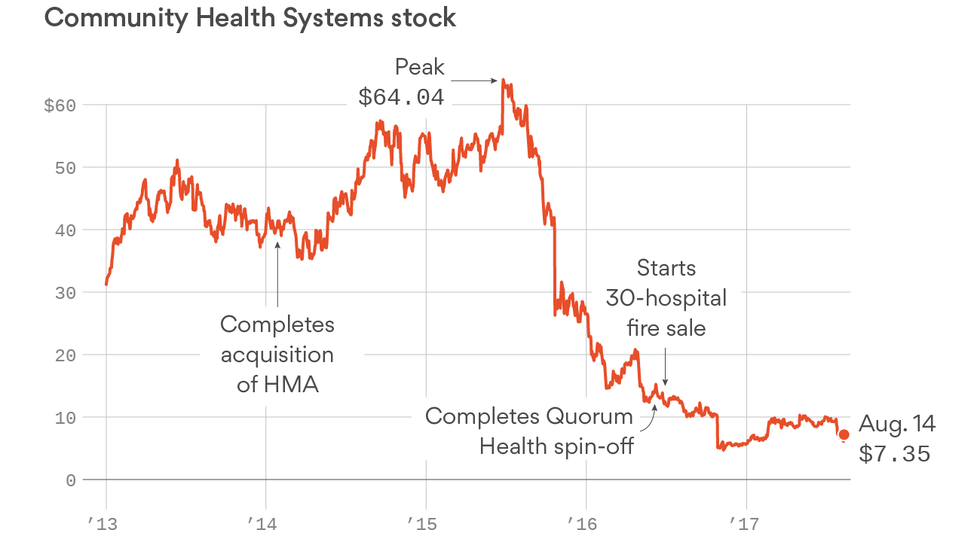
Just three years ago, Community Health Systems was the largest for-profit operator of hospitals with more than 200 facilities scattered in rural and suburban areas with growing populations. Now, the company is hemorrhaging money, sitting atop a mountain of debt and teetering on the edge of bankruptcy — all major reasons why CHS has lost almost 90% of its market value.

“I think the company has a nontrivial chance of defaulting,” said one CHS investor who asked to be unnamed because of the sensitivity of the issue. Tomi Galin, a CHS spokeswoman, did not make any company officials available for an interview, but said the company is confident it will have “a stronger core group of hospitals that are better positioned for long-term growth.”

Why it matters: CHS sits in a massive hole after a string of missteps, according to industry insiders. And it’s not likely to get better for CHS, or the local communities that rely on a CHS facility, as more people get treated in lower-cost outpatient centers instead of the hospital.

The collapse: It began in 2013 and continued into January 2014. That’s when CHS completed its acquisition of Health Management Associates, a for-profit hospital chain that had a slew of financial and legal problems. The deal was worth $7.6 billion, including debt, and made CHS the largest for-profit hospital company by number of facilities.

“That was the death knell,” a health care investment banker said. “HMA was a troubled company, and (CHS) thought bigger would be better.”

Here’s what has happened at CHS since then:

  • A market cap that crumbled from roughly $7.5 billion in 2015 to less than $800 million today.
  • Net losses of almost $1.9 billion from the start of 2016 through the second quarter of this year.
  • A ballooning debt load totaling $14.7 billion as of June 30.
  • Larry Robbins, a prominent hedge fund manager, dumped his entire portfolio of CHS stock. Paul Singer of Elliott Management did the same earlier this year.
  • A fire sale of 30 hospitals to get cash to pay down debt.
  • Some of those sold hospitals were HMA remnants, while others were considered CHS’ better, more profitable hospitals. “It’s almost like they’re burning the furniture,” the banker said. An investor said CHS was “selling off the fine china” to meet debt payments.
  • A completed spin-off of Quorum Health that, in essence, threw many struggling rural hospitals off CHS’ books. Quorum isn’t faring well either.
  • High amounts of uncompensated care. CHS owns many hospitals in the South, and most of those states did not expand Medicaid under the Affordable Care Act. That means CHS has absorbed more uncompensated care than hospitals in Medicaid expansion states.

Looking ahead: CHS plans on divesting even more hospitals, executives said during their latest earnings call. They likely will be profitable hospitals, as buyers won’t touch money-losing inpatient facilities with dwindling admissions.

But large debt payments are due in 2019 through 2022. Short-term cash from transactions appears to be a bandage, and a subsequently smaller profit base won’t solve the big debt picture, making bankruptcy a real possibility, an investor said.

Galin, the CHS spokeswoman, said the money from the hospital sales “are being used to reduce our debt” and that “cash flow generation remains strong.”

Leadership questions: Many CHS executives have retired or left in the past two years, including longtime CFO Larry Cash. Wayne Smith, the CEO of the hospital chain since 1997, remains in his position. Smith is one of the highest earners among hospital executives and reaped more than $1 million in bonuses alone the past two years even though CHS’ stock price tanked.

Numerous sources would not go on the record to talk about CHS. One hospital industry analyst said this when asked how Smith still had his job despite the company’s problems: “Your question is very valid.”

Auditor: 15-bed Missouri hospital at heart of $90M billing fraud scheme

http://www.beckershospitalreview.com/finance/auditor-15-bed-missouri-hospital-at-heart-of-90m-billing-fraud-scheme.html

Image result for fraud and abuse

Putnam County Memorial Hospital, a 15-bed hospital in Unionville, Mo., received $90 million in insurance payments in less than a year for lab services that were performed at other facilities across the country, according to The St. Louis Post-Dispatch, which cited a report released Wednesday by Missouri State Auditor Nicole Galloway.

According to Ms. Galloway’s report, Putnam County Memorial Hospital contracted with Hospital Laboratory Partners in September 2016 to operate a clinical laboratory on behalf of the hospital.

“Immediately upon signing the management contract with the hospital, the CEO and his associates began billing significant amounts of out-of-state lab activity through the hospital,” according to the auditor’s report.

Putnam County Hospital allegedly acted as a shell company by submitting claims for other labs and funneling the insurance payments through the hospital.

“Based on our review of hospital accounts, the vast majority of laboratory billings are for out-of-state lab activity for individuals who are not patients of hospital physicians,” states the auditor’s report.

Ms. Galloway has turned her findings over to the Missouri attorney general, the FBI and the Putnam County prosecuting attorney, according to KCUR.

On Thursday, Hospital Laboratory Partners said the auditor’s report mischaracterizes the payments. The company said Putnam County Hospital, a critical access hospital, is authorized to bill for off-site lab work.

“The assignment of non-patient lab specimens has been standard practice for rural and critical access hospitals for many years,” Hospital Laboratory Partners attorney Mark Thomas said in a statement to The Kansas City Star“The purpose of the rural/critical access exceptions is to give rural healthcare facilities a fighting chance to survive and serve their local communities.”


Senate health bill a ‘death sentence’ for rural hospitals

http://www.fiercehealthcare.com/healthcare/senate-health-bill-a-death-sentence-for-rural-hospitals?utm_medium=nl&utm_source=internal&mrkid=959610&mkt_tok=eyJpIjoiWVRKa1kyRmhOemN6TXpOaSIsInQiOiI2U1oxdXAzN2xlRmx3S2lLSGc0aHpWWk5JZ2ducVduYTF6emxLR0JLOEdRQ2lLbHhTTFBcL0VPYjREUkVcLzJKS1BCV3U3NFdBN3NoZnRmUFV2bXJQUElwMGFUamxiTTN4QjhNdGlsV0x1U0lZZWxDdEhZcFVISFBBd2J0enliWkhqIn0%3D

costs

The Senate’s healthcare bill, if passed, could spell doom for some cash-strapped rural hospitals, many of which are already vulnerable to closure, experts say.

Much of the concern is centered on cuts to Medicaid in the bill—a proposal that is also worrying to large hospitals and health systems—which could leave millions more uninsured and significantly increase uncompensated care costs.

“These hospitals are hanging on by their fingernails,” Maggie Elehwany, vice president of government affairs for the National Rural Health Association, told CNN. “If you leave this legislation as is, it’s a death sentence for individuals in rural America.”

The cuts wouldn’t only hurt patients, according to a new report. Some of the bill’s proposals could also lead to thousands of rural healthcare workers losing their jobs. The Chartis Center for Rural Health, a part of strategic planning firm The Chartis Group, estimated that the BCRA, if passed as is, could cause 34,000 rural healthcare jobs to be eliminated.

Under the Senate’s bill, the cuts could cost rural hospitals $1.3 billion in lost revenue. Much of this would be felt in reduced Medicaid payments; expansion states, this would be about $442,000 lost each year per facility, while it would equal about $224,000 in lost revenue. It would likely push nearly 150 more rural facilities into the red, according to the analysis.

One such vulnerable facility is Lincoln Community Hospital, the small, regional hospital in Hugo, Colorado. The 50-bed hospital serves the the town of about 825, according to an article from National Public Radio, with many of its patients on either Medicare or Medicaid.

The funding cuts proposed in the Better Care Reconciliation Act have given leaders at Lincoln pause, and if the hospital were to close it would leave local residents in a “medical desert,” as it’s more than 100 miles to the next nearest hospital.

The facility was nearly shut down several decades ago, and former board member Ted Lyons said that, though the Affordable Care Act is far from perfect, he hopes that members of Congress work to protect rural hospitals if they intend to move forward with a repeal.

“You don’t drown the duck to get the feather out of him,” Lyons told NPR.

Rural healthcare leaders in Pennsylvania expressed similar concerns. Washington Health System operates two hospitals, one with 260 beds and one with 49 beds, in the western part of the state. CEO Gary Weinstein told WESA that if its smaller Waynesburg hospital closed, patients would have to travel at least 30 minutes for care.

The Waynesburg facility is located in Greene County, which is ranked 60th out of 67 Pennsylvania counties in per capita income, so many of its patients are Medicaid recipients. If a patient without insurance comes into the hospital, it recoups just 5% of its costs, Weinstein said.

“We don’t make money when somebody is insured by Medicaid, but at least we get something,” Weinstein said. “But when somebody has no insurance at all, a lot of times they just aren’t able to pay any part of the bill.”

Weinstein said he has spoken to Sen. Pat Toomey, R-Pennsylvania, one of the 13 senators involved in crafting the Senate’s bill, about that possibility, asking him to make additional changes to the legislation.