Medicare Advantage industry sees slower growth for 2019

https://www.modernhealthcare.com/article/20190116/NEWS/190119927/medicare-advantage-industry-sees-slower-growth-for-2019

Image result for Medicare Advantage industry sees slower growth for 2019

Medicare Advantage insurers added 1.4 million members to their rosters for 2019 coverage, as they looked to grow membership in a market known for being politically safe and predictably lucrative. But Advantage membership is growing at a slower pace compared with previous years. 

According to the latest federal data showing enrollment as of this month, 22.4 million people are enrolled in Medicare Advantage for 2019 coverage—an alternative to the traditional Medicare program in which private insurers contract with the federal government to administer program benefits. That’s an increase of 6.8% since January 2018. Health insurers, however, managed to grow their Advantage membership base by more than 1.5 million in both 2016 and 2017.

Some industry experts were expecting more. “The formula was there: Health plans were aggressive, they got nice rate increases, the rules around benefit design relaxed a little bit,” explained Jeff Fox, president of Gorman Health Group, which provides technology and other services to Medicare Advantage plans.

Fox expected Advantage enrollment to increase by double-digits over the past year, as health plans invested heavily in marketing and the federal government provided one of the biggest rate increases for the plans in years at 3.4%. The Trump administration also granted Advantage plans the flexibility to provide more supplemental benefits in 2019, such as transportation and in-home care.

But Fox said distraction from the craziness of the November midterm elections may have kept some seniors from enrolling during the annual open enrollment that lasted from Oct. 15 to Dec. 7, 2018. While the CMS data captures some of the sign-ups from open enrollment, figures out next month are likely to be higher.

Despite the slower pace, many Advantage insurers still experienced big enrollment increases as they picked up more market share. About half of all members are covered by just three companies. UnitedHealth held onto the top spot, adding nearly 500,000 Advantage members in the past year for a total 5.7 million. UnitedHealth holds more than a quarter of the total Medicare Advantage market share.

Humana remained the No. 2 Advantage insurer with 3.9 million members, an increase of 10.4% over January 2018. But thanks to its acquisition of Aetna, CVS Health took the No. 3 spot with 2.2 million Advantage enrollees. Kaiser Foundation Health Plan and Anthem rounded out the top five insurers with the most Advantage members.

On a percentage basis, Anthem and Aetna grew membership the fastest. Anthem’s Medicare Advantage membership spiked 53% to 1.1 million members compared with the same time last year. The Indianapolis-based insurer has long focused on serving employers, but recently turned its sights to growing Medicare Advantage rolls through acquisitions and expansions in places where it already operates.

Anthem bought Florida-based Medicare plans HealthSun in December 2017 and America’s 1st Choice in February 2018, together giving Anthem about 170,000 more Advantage members. Anthem CEO Gail Boudreaux told investment analysts in July that the company would focus on selling group Medicare Advantage plans and serving medically complex dual-eligible members in 2019.

CVS Health, meanwhile, grew its Medicare membership by 26.7% in 2018 to 2.2 million through its acquisition of Aetna. The deal is still technically awaiting a federal judge’s approval. In a research note Monday, Barclays equity analyst Steve Valiquette noted that Aetna’s membership growth was driven by its expansion into about 360 new counties. Valiquette wrote that the growth experienced by some public health insurers during the annual enrollment period for 2019 coverage was driven more by market share gains than by industry growth.

Medicare Advantage enrollment is climbing as the baby boomer generation ages rapidly into Medicare. Those seniors are used to employer-sponsored managed-care plans and are choosing Advantage over traditional Medicare more often than previous generations did. Seniors also often get more benefits, including dental care, eyeglasses and gym memberships, with an Advantage plan. 

Medicare Advantage also enjoys support from both political parties and is able to weather swings from one federal administration to the next, whereas insurers that sell plans in the individual market, for example, may have to deal with more volatility.

Moreover, Medicare Advantage margins tend to hover between 4% to 5%, whereas Medicaid margins come in at 2% to 3% and the individual market historically has had even lower margins, S&P analyst Deep Banerjee told Modern Healthcare in August. The group employer business has higher margins, but that market isn’t growing like Medicare Advantage is.



Healthcare’s vertical mergers kick-started a massive industry shift in 2018. Will it pay off?

https://www.fiercehealthcare.com/payer/healthcare-s-vertical-mergers-kick-started-a-massive-industry-shift-2018-will-it-pay-off?mkt_tok=eyJpIjoiTnpBNE1HTmtObUl3WVRkayIsInQiOiJFOU1xMDRPMGtzMCtnWXU4MExUVFAzZ3Jrdm5cL2s3S1dMRkVldTRWS2QyNmJZU255UWRIWW14QmtXVkJ2T2VTeGpYTVBvQXZWWW1JVnB0S0crTXV3aFhDS0wrY3NzTmtEYmJEMHdvSG03bGkxS2ZlREdiaWZydFZkbkdlXC9tTHE1In0%3D&mrkid=959610&utm_medium=nl&utm_source=internal

Mergers and acquisitions deals consolidation

Two massive megamergers in CVS-Aetna and Cigna-Express Scripts dominated the conversation around mergers and acquisitions in healthcare.

Whether you think the mergers will help or hurt consumers, both deals have sparked a distinct shift across the industry as competitors search for ways to keep pace. It also frames 2019 as the year in which five big vertically integrated insurers in CVS, UnitedHealth, Cigna, Anthem and Humana begin to take shape.

Combined, the mergers totaled nearly $140 billion.

Both CVS and Cigna closed their transactions in the fourth quarter with promises that their new combined companies would “transform” the industry. Unquestionably, it’s already triggered some response from other players. Whether those companies can make good on their promises to improve care for consumers remains to be seen, and the payoff may not come for several years, as 2019 is likely to be a year of initial integration.

While CVS and Cigna hogged most of the spotlight, several other notable transactions across the payer sector could have smaller but similarly important consequences going forward.

WellCare acquires Meridian Health Plans for $2.5B

In May, WellCare picked up Illinois-based Meridian Health Plans for $2.5 billion, acquiring a company with an established Medicaid footprint with 1.1 million members. The deal boosted WellCare’s membership by 26%.

But the transaction also thrust WellCare back onto the ACA exchanges. Meridian has 6,000 marketplace members in Michigan.

Importantly, the acquisition gave WellCare a new pharmacy benefit manager in Meridian Rx. CEO Kenneth Burdick said it would provide “additional insight into changing pharmacy costs and improving quality through the integration of pharmacy and medical care.”

WellCare also makes out on CVS-Aetna transaction

WellCare was also a beneficiary of the CVS-Aetna deal after the Department of Justice required Aetna to sell off its Part D business in order to complete its merger.

The deal adds 2.2 million Part D members to WellCare, tripling its existing footprint of 1.1 million.

Humana goes after post-acute care

2018 was the year of post-acute care acquisitions for Humana. The insurer partnered with two private equity firms to buy Kindred Healthcare for $4.1 billion in a deal that was first announced last year. It used a similar purchase arrangement to invest in hospice provider Curo Health Service in a $1.4 billion deal.

Both acquisitions give Humana equity stake in the companies, with room to make further investments down the road. Kindred, in particular, is expected to further Humana’s focus on data analytics, digital tools and information sharing and improve the continuity of care for patients even after they leave the hospital.

Not to be outdone, rival Anthem also closed its purchase of Aspire Health, one of the country’s largest community-based palliative care providers.

UnitedHealth keeps quietly buying up providers, pharmacies

With ample reserves, UnitedHealth is always in the mix when it comes to acquisitions. This year was no different. The insurance giant snapped up several provider organizations to add to its OptumHealth arm. In June, it was one of two buyers of hospital staffing company Sound Inpatient Physicians Holdings for $2.2 billion. It also bought out Seattle-based Polyclinic for an undisclosed sum. The physician practice has remained staunchly independent for more than a century.

Most notably, UnitedHealth is still in the process of closing its acquisition of DaVita Medical Group. DaVita recently dropped the price of that deal from $4.9 billion to $4.3 billion in an effort to speed up Federal Trade Commission approval.

The Minnesota-based insurer is also clearly interested in specialty pharmacies to supplement its PBM OptumRx. UnitedHealth bought Genoa Healthcare in September, adding 435 new pharmacies under its umbrella. Shortly after, it bought up Avella Specialty Pharmacy, a specialty pharmacy that also offers telepsychiatry services and medication management for behavioral health patients.

Centene invests in a tech-forward PBM

Perhaps in an effort to keep pace with Cigna and CVS, Centene has made smaller scale moves in the PBM space, investing in RxAdvance, a PBM launched by former Apple CEO John Sculley. Following an initial investment in March, Centene sunk another $50 million into the company in October and then announced plans to roll the solution out nationally. Notably, CEO Michael Neidorff has said he is pushing the PBM to move away from rebates and toward a model that relies on net pricing.

“You talk about ultimate transparency—that gets us there,” he said recently.


Softer bookings dampen Cerner’s Q3 growth

https://www.healthcaredive.com/news/softer-bookings-dampen-cerners-q3-growth/540694/

Dive Brief:

  • Cerner’s new bookings fell short of expectations in the third quarter of 2018, leading to lower than expected revenue for the period. While sales of licensed software grew 43% from a year ago to $1.59 billion, the EHR vendor didn’t match the second quarter’s $1.78 billion.  
  • Third quarter revenue totaled $1.34 billion, up 5% from the same period the prior year.
  • The earnings report comes as Cerner is under fire again for its performance on a Department of Defense contract. According to Politico, independent investigators for the Pentagon gave the company poor marks on its MHS Genesis EHR implementation, calling the system “not effective and not suitable” and “not interoperable.” The low assessment echoes an April DOD report.

Dive Insight:

Cerner attributed the lower-than-expected software bookings to timing and pointed to a strong pipeline of potential business hookups. Technology resales were also somewhat off in the third quarter.

“There isn’t anything that’s forcing clients to go get deals done,” Cerner CFO Marc Naughton said during a Thursday earnings call. “The market is still active. We just didn’t get much of it in Q3.”

Cerner also said it is not yet seeing the full impact of government contracts. Nonetheless, officials called it a strong quarter with solid results.

“We continue to have good contributions from our key growth areas” of population health, revenue cycle management and health IT outsourcing, said Chief Client Officer John Peterzalek, who replaces departing President Zane Burke starting next week.

“As we look at our portfolio and our investment plans, there’s some transformation of our own that we need to do to make sure we’re positioned well for the opportunities in front of us,” said Cerner Chairman and CEO Brent Shafer. “Part of that work is creating an operating model that is really designed to support innovation at scale. We are at scale now and want to continue to scale.”

Meanwhile, Cerner faces fresh competition from commercial health giant UnitedHealth, which is expanding into EHRs with a fully integrated system in 2019. During a recent earnings call, UnitedHealth CEO David Wichmann said the company will launch a “fully individualized, fully portable” EHR early next year leveraged off its Rally mobile wellness platform.


UNITEDHEALTH SEES EARNINGS INCREASE 13% IN Q2

https://www.healthleadersmedia.com/finance/unitedhealth-sees-earnings-increase-13-q2?utm_source=silverpop&utm_medium=email&utm_campaign=20180718_HLM_HP_resend%20(1)&spMailingID=13896483&spUserID=MTY3ODg4NTg1MzQ4S0&spJobID=1441533371&spReportId=MTQ0MTUzMzM3MQS2

Image result for UNITEDHEALTH SEES EARNINGS INCREASE 13% IN Q2

The insurer saw solid year-over-year growth in a variety of aspects, leading the company to raise its outlook for net earnings to end the year.

UnitedHealth Group posted $4.2 billion earnings from operations, an increase of 13% year-over-year, according to its second-quarter earnings report released Tuesday.

The results marked another strong quarter for the insurer, which saw its earnings from operations grow from $3.7 billion during Q2 2017, and even increase from $4.1 billion in Q1 2018. Compared to this time last year, UnitedHealth increased its overall revenues by $6 billion, improving its net margin to 5.2%.

“Today, UnitedHealth Group delivers increasing value to more people, driven by strong execution, consistently high quality, deep relationships and our distinctive combination of clinical, technology and information capabilities. As we look ahead, we will drive our growth on the strength of practical innovations that anticipate and respond to increasing consumer expectations and clear social needs,” UnitedHealth Group CEO David Wichmann said in a statement.

UnitedHealth’s consistent, improved performance comes as insurers brace for the widespread introduction of association health plans and short-term health plans. The health plan juggernaut is so enthused by its first-half financial performance that it raised its outlook for end-of-year adjusted earnings to $12.50 to $12.75 per share. After Q1, UnitedHealth projected a range of adjusted net earnings per share from $12.40 to $12.65. Meanwhile, GAAP diluted earnings ranged between $11.80 to $12.05 per share.

Moody’s Vice President Dean Unger said in a statement Tuesday that UnitedHealth’s leverage remains high and will increase slightly after the company finalizes its acquisition of DaVita Medical Group.

“But the pharmacy benefits manager and analytics business were also solid,” Unger said. “UnitedHealth’s scale, diversity and consistent and disciplined growth continue to support our A3 long-term issuer rating.”

Below are some additional highlights from UnitedHealth’s Q2 earnings report:

  • UnitedHealth posted cash flows from operations totalling $4 billion.

  • The insurer’s adjusted net earnings per share also grew 27.6%.

  • UnitedHealthcare added 2.2 million more consumers year-over-year.

  • Optum’s earnings from operations grew by 21.5% year-over-year to $1.8 billion.

Additional information is available in UnitedHealth’s filing with the Securities and Exchange Commission.


Health Insurers Had Their Best Quarter in Years, Despite the Flu

https://www.bloomberg.com/news/articles/2018-05-03/health-insurers-had-their-best-quarter-in-years-despite-the-flu

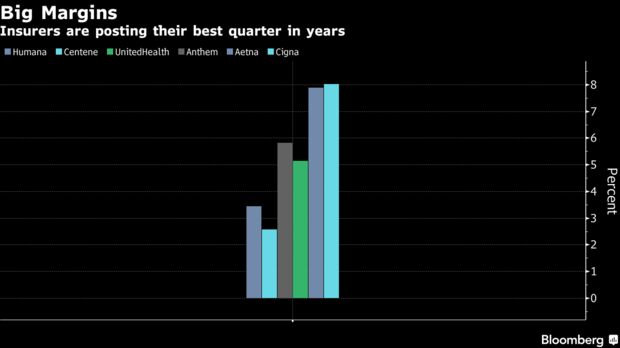
Here’s a look at how the margins of the largest in the quarter, based on data compiled by Bloomberg:

U.S. health insurers just posted their best financial results in years, shrugging off worries that the worst flu season in recent history would hurt profits.

Aetna Inc., for instance, posted its widest profit margin since 2004. Centene Corp. had its most profitable quarter since 2008. And Cigna Corp., which reported on Thursday, had its biggest margin in about seven years.

Analysts at Morgan Stanley, in a research note, said insurers are in the midst of a “hot streak.”

One big reason for the windfall is the tax cuts passed by Congress last year, which in some cases more than halved what the insurers owe the government. Aetna said its effective tax rate fell to 16.8 percent from 39.6 percent, for example. Many insurers also spent less on medical care than analysts had expected, even taking into account increased spending on flu treatments.


Under ACA, largest health plans net lion’s share of underwriting gains while smaller players struggle

https://www.fiercehealthcare.com/payer/health-plan-financial-performance-aca-deloitte?mkt_tok=eyJpIjoiTkdKallqUmhOV1prTmpZMyIsInQiOiIzV0NnWXA2amJKeHRybHVFTWl3bCtXMHpQXC92SXRnZyt0WGV0VFFUTkxoQk1UTHlyMGRlTFZkc3V2aXM0cGY5Q1Fndmh0ck5venI0OVJVMWhpNHQrakJWSytReEVBc2N4Y1lwRXBHQmZ2RGR6bk9cLzJxREZIbDk2VWQ2bzFKSmZvIn0%3D&mrkid=959610&utm_medium=nl&utm_source=internal

Financial market data. Image: Pixabay

The gap between the haves and have-nots has grown wider in the health insurance sector—and policy changes may be the culprit.

Most health plans are relatively small, posting an annual revenue of less than $2 billion, and are generally close to just breaking even financially. But the top three largest fully insured health plans by revenue—UnitedHealth Group, Kaiser Foundation Health Plan and Anthem—“exhibit performance that is dramatically differentiated from that of other market participants,” according to a new analysis from Deloitte.

For example, between 2011 and 2016, the top three saw their share of underwriting gains rise considerably even as their share of enrollment and revenue declined. By 2016, those three plans generated 84% of all underwriting gains in the fully insured market, while they accounted for just 55% in 2011. The top 10 plans, meanwhile, accounted for 92% of all underwriting gains in 2016.

What was behind that trend? Post-2014, one of the main reasons was the “number and magnitude of the losses suffered by many other health plans,” particularly in Affordable Care Act commercial individual products, the analysis said. Those losses were so large that they offset almost all the underwriting gains posted by the health plans not in the top three or top 10—thus magnifying the largest plans’ share.

For-profit insurers also grew faster and posted significantly higher margins than their nonprofit peers, the analysis found. While for-profit plans accounted for 66% of all underwriting gains in 2011, that share rose to 76% by 2016. Nonprofit plans, in comparison, saw their underwriting margins slip from 2.3% in 2011 to 0.8% in 2016.

The analysis also looked at health plan performance on the company and state levels. It found a significant increase in the number of plans with annual losses, a steep decline in average margins and widening variation among plans’ performance from 2011-2016. In addition, the number of states with health insurance market turbulence and unfavorable health plan financial performance increased.

Deloitte said its findings showed how large of a role public policy has played in driving change in the insurance markets in recent years. In addition, it highlighted the financial benefits associated with national scale.

Yet the firm also pointed out that it’s worth paying attention to how smaller-scale nonprofit plans are faring, given that they “play critical roles in their local communities and healthcare ecosystems.”

These plans, it noted, may lack the resources to withstand more disruption and “down years.” But with Republicans moving to unwind the ACA, that’s exactly what might lie ahead.


UnitedHealth’s Optum Launches $250M Fund To Invest In Start-Ups

https://www.forbes.com/sites/brucejapsen/2017/11/28/unitedhealths-optum-launches-250m-fund-to-invest-in-start-ups/#52b7275f43dc

The fast-growing Optum unit of the nation’s largest health insuance company is escalating its interest in startup and innovative ventures, launching a $250 million fund to develop early-stage healthcare companies.

Optum Ventures will be a venture fund “focused on investing in startup and early-stage companies whose innovations will help advance the health care system,” UnitedHealth and Optum executives announced at their investor conference in New York.

Optum Ventures investments will include digital health firms “that use data and insights to help improve consumers’ access to health care services and how care is delivered and paid for, and that make the health care system more reliable and easier to navigate.”

The Optum unit of UnitedHealth Group is already a key driver to the company’s overall growth. The insurer’s Optum line of businesses has generated throughout the double-digit percentage earnings growth across all product and service lines.

Optum provides pharmacy benefits management and technology services and also operates clinics and doctor’s offices. Its growth in the last year helped UnitedHealth overcome hundreds of millions of dollars in losses on sales of individual coverage under the Affordable Care Act.

Now, the growth of Optum will expand into new areas to feed the overall parent’s efforts.

“Optum Ventures is uniquely positioned to help develop and grow startups and early-stage companies through capital investment, Optum’s decades of experience in health care, and our access to the health care marketplace,” said Larry Renfro, CEO of Optum who will be the Managing Partner of Optum Ventures. “Optum Ventures will be the partner of choice for companies developing innovations that help make health care work better for everyone.”

Optum Ventures already has a list of early investments that includes: Apervita, which is developing a cloud-based technology to help speed the delivery of healthcare; Buoy Health, which executives say is working on an “artificial intelligence-powered digital health assistant” to help patients; and other health and analytics startups.

Optum Ventures, which will have offices in Boston and Menlo Park, Calif., will operate as a separate independent company funded by Optum under the leadership of partners A.G. Breitenstein and Virginia McFerran, who both have a history of involvement in health and technology. “Breitenstein and McFerran have years of experience in starting, advising and leading innovative health care enterprises,” Optum said in a statement.


Optum CEO Amir Rubin departs for top spot at concierge medicine firm One Medical

http://www.beckershospitalreview.com/hospital-executive-moves/optum-ceo-amir-rubin-departs-for-top-spot-at-concierge-medicine-firm-one-medical.html

Image result for amir dan rubin

Amir Rubin, executive vice president and CEO of UnitedHealth’s Optum division, is leaving to take on the CEO role at One Medical, according to a CNBC report.

One Medical is a concierge primary care group with 60 locations across the country. It also offers a virtual medical team and mobile applications. Members pay an annual fee and can get access to same-day appointments, scheduled electronically.

Companies can also offer One Medical’s services as a benefit. The group has gained more than $180 million in investor funding since its inception a decade ago, according to the report.

Mr. Rubin led Optum since January 2016, prior to which he served as president and CEO of Palo Alto, Calif.-based Stanford Health Care. His previous leadership roles include serving as COO for the UCLA Health System in Los Angeles and COO at Stony Brook University Hospital in New York City.

Mr. Rubin succeeds One Medical founder Tom X. Lee, who will stay on as executive chairman of the group.

UnitedHealth’s Optum division helps fuel 30% spike in Q2 earnings

http://www.beckershospitalreview.com/payer-issues/unitedhealth-s-optum-division-helps-fuel-30-spike-in-q2-earnings.html

Image result for UnitedHealth's Optum division

Minnetonka Minn.-based UnitedHealth Group recorded $2.3 billion in net earnings attributable to shareholders in the second quarter of this year, compared to $1.8 billion in the same period a year prior.

The health insurer’s earnings spike partially reflects a 20.5 percent year-over-year growth in earnings from operations across all lines of its Optum healthcare service division in the second quarter of 2017. The payer cited a growth in care delivery in its OptumHealth health management segment and growth in revenue management and business process services in its OptumInsight advisory consulting segment as contributors to Optum’s $1.5 billion earnings from operations in the second quarter.

UnitedHealth Group’s insurance arm, UnitedHealthcare, generated $2.2 billion in earnings from operations in the second quarter of 2017, a 13.9 percent increase from the second quarter of 2016. The payer attributed the uptick to strong revenue growth and an improvement in operating margins. While UnitedHealthcare’s employer and individual plan revenues fell $543 million year-over-year in the second quarter of this year due to its widespread ACA exchange exit, the loss was offset by gains in its Medicare and government businesses.

Overall, UnitedHealth Group saw revenue of $50.1 billion in the second quarter of 2017, up 7.7 percent year-over-year. Total operating costs also increased in the second quarter of this year, from $43.3 billion in the second quarter of 2016 to $46.3 billion in the same period this year.

UnitedHealth raised its outlook for adjusted net earnings to $9.75 to $9.90 per share this year, up from its previous projection of $9.65 to $9.85 per share in the first quarter of this year.


DOJ Sues Carolinas HealthCare Over Steering Restrictions

http://www.healthleadersmedia.com/leadership/doj-sues-carolinas-healthcare-over-steering-restrictions?spMailingID=9041425&spUserID=MTMyMzQyMDQxMTkyS0&spJobID=940977537&spReportId=OTQwOTc3NTM3S0#

carolinas-medical-center-1200xx2800-1575-186-0

Federal and state officials claim that the healthcare system used its market power to leverage steering restrictions in its contracts with major insurers, resulting in higher costs for consumers.