
Health care price transparency: Fool’s gold, or real money in your pocket?

http://theconversation.com/health-care-price-transparency-fools-gold-or-real-money-in-your-pocket-115103?utm_medium=email&utm_campaign=Latest%20from%20The%20Conversation%20for%20June%2025%202019%20-%201343712591&utm_content=Latest%20from%20The%20Conversation%20for%20June%2025%202019%20-%201343712591+CID_58c7f956f838d44f75c126a23c41100c&utm_source=campaign_monitor_us&utm_term=Health%20care%20price%20transparency%20Fools%20gold%20or%20real%20money%20in%20your%20pocket

Related image

The news is full of stories about monumental surprise hospital billssky-high drug prices and patients going bankrupt. The government’s approach to addressing this, via an executive order that President Trump signed June 24, 2019, is to make hospitals disclose prices, including negotiated rates with insurers, so that patients supposedly can comparison shop. But this is fool’s gold – information that doesn’t address the real question about why these prices are so high in the first place.

I know from my time as an academic researcher, hospital board member, adviser to Congress and health insurance CEO that the problems in health care are far deeper than just knowledge about hospital charges that few will ever pay.

While it is easy to blame greedy pharmaceutical manufacturers, health insurers and hospital executives, the problem comes from the very nature of our confused system. Who actually benefits from these high prices and why do they persist? Is it just greed, or something endemic in the system?

Should the EOB be DOA?
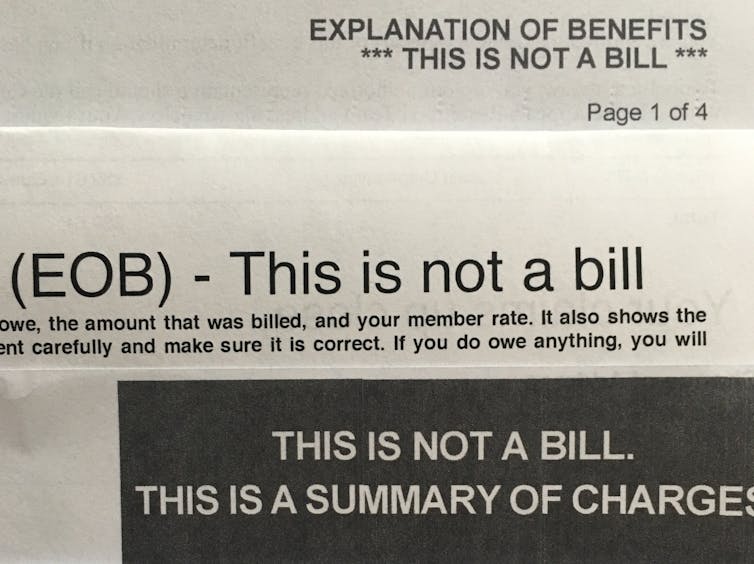
The EOB is not a bill, the insurance companies want you to know. Lynne AndersonCC BY-SA

Many in the health care system, including hospitals, doctors and insurers, are complicit in this confusing mess, although all can justify their individual actions.

The confusion begins for the patient when he or she receives an explanation of benefit (EOB). This typically says it is “Not a Bill,” although it really looks like one. What it actually shows is incredibly high provider prices and an equally implausible discount. The bottom line lists the actual payment and the amount the patient owes. Patients are supposed to be grateful for the discounts after they recover from the sticker shock of the listed price.

When a service is provided out-of-network, or is not covered at all, or the person doesn’t have insurance, the patient is supposed to pay this full amount. Such surprise bills” typically come to those least prepared to pay and, as a result, providers typically recover very little. So no one wins, except the collection agency and the lawyers.

I believe the standard EOB is the beginning of unnecessary complexity that leads to higher prices and an impossibly flawed market where shopping can never really work properly.

This ridiculous situation actually starts with insurance companies selling policies to ill-informed employers who don’t understand health care but effectively are the purchasers. Employers hire brokers and consultants to collect proposals from insurers; by some estimates, as many as 50 million people in the U.S. are covered by such plans.

These proposals frequently focus on the size of the discount from providers’ list prices as an indicator of how much the employer can save. The overall total cost or coverage is more important, but harder to estimate, since it depends on actual care delivered to employees. The unrecognized incentive for providers and insurers is to increase prices in order to increase the size of the discount.

I have actually seen cases where the insurer requests higher list prices from a provider to pump up the discount they can report to employers. This is crazy.

Stop the madness

One solution to this mess would be to require uniform prices by all providers to all purchasers. Maryland has a form of this “all-payer” system where everyone pays the same under rate regulation or negotiation. France, Germany, Japan and the Netherlands also use this form of control.

Benchmark pricing against what Medicare pays would do something similar, with everyone paying a fixed percent of these nationally regulated rates. This would blunt the ability of hospitals to arbitrarily jack up list charges and negotiate contract prices with insurers based on relative market power.

Unfortunately for consumers, such rate setting may be a political “bridge too far.” While some progressives might like regulation, conservatives likely will not because it challenges their faith in the superiority of free-market negotiations around prices.

And it might dampen innovation and even competition, depending on how realistic and flexible the regulators are in responding to new technology, alternative procedures, quality differentials and consumer demands – the decisions where markets are supposed work well.

Can price competition work?

It’s hard to shop around for some procedures, such as complex surgeries. Yulai Studio/shutterstock.com

The overarching question is whether patients and employers can ever do comparison shopping effectively. Clearly for many things, there can be no head-to-head choice. Trauma, highly complex surgery and other care cannot be predicted ahead of time or standardized to fit a consumer market model.

However, some things can be compared. Insurers now routinely let consumers know if a test or image could be done for less elsewhere. Perhaps comparing just a few services as an overall cost indicator is the best we can do.

But it may also be possible to determine overall relative bargains for a typical package of care to guide choices. My Cleveland hospital, MetroHealth System, manages Medicaid patients for a total cost which is 29% less than when they wander around without a medical home. This is a meaningful difference.

A first step towards comparison shopping might be eliminating the EOB as we know it. Rather than showing meaningless list prices, it would be more revealing if hospitals and insurers had to disclose their actual payment terms.

An alternative benchmark might be to provide health care consumers with a range of contract rates or the Medicare rate for a service. Then the difference between what you and others actually pay could be useful in comparing providers and insurers.

Those who long for a total overhaul of our system through “Medicare for All” or its variants, such as many Democrats vying for the nomination,will still have to deal with the question of how to contract and pay for all these moving parts. The temptation will be toward simple solutions involving prices, discounts and rate regulation – still, I believe, effectively a pursuit of fool’s gold.
 

Medical monopoly: An unusual hospital merger in rural Appalachia leaves residents with few options

https://www.tennessean.com/story/news/health/2019/06/23/ballad-health-merger-rural-hospital-closures/1342608001/

Protest organizer Dani Cook of Kingsport, Tennessee, conducts a Facebook Live outside Holston Valley Medical Center in Kingsport on May 7. The merger of Mountain State Health Alliance and Wellmont has led to the downgrading of the area's NICU and trauma center.

KINGSPORT, Tenn. – Molly Worley is an angry grandma.

For weeks she has stubbornly occupied a folding lawn chair on a grassy median outside Holston Valley Medical Center, sheltered from sweltering Appalachian summer sun by a thin tarp and flanked by a rotating crew staging a round-the-clock protest since May 1.

Behind them is the state-of-the-art neonatal intensive care unit where Worley’s newborn grandson spent his first weeks of life treated for opioid exposure.

In the same building is a Level I trauma center to respond to the most critical emergencies.

Both facilities will downgraded in the coming months, diverting the sickest babies and adults elsewhere.

The cuts are the latest fallout from an unusual and controversial merger between two former rival hospital systems headquartered in northeast Tennessee.

The newly formed company, Ballad Health, is now the sole hospital provider for a region the size of New Jersey. For nearly 1.2 million people people living in a largely rural stretch of 29 counties in northeast Tennessee and nearby parts of Virginia, North Carolina and Kentucky, Ballad hospitals are the only inpatient option.

Mergers involving hospitals that compete for same patients face opposition from the Federal Trade Commission, which can block mergers on the grounds the combined company can limit patient choices, cut services, raise prices and diminish quality.

Ballad officials found a way to bypass FTC rules. They turned to Tennessee state Sen. Rusty Crowe, R-Johnson City, who successfully carried legislation making the merger possible. Crowe is a longtime paid consultant with Ballad hospitals. 

Only a handful of other states have exempted similar hospital mergers from FTC anti-monopoly rules. Ballad’s is the largest.

CEO Alan Levine said the merger lets the hospital system save money and keep rural hospitals afloat in a state that is already No. 2 in the nation for closures.

Eliminating overlapping staff and services, including the trauma center and NICU, will free funds to invest in other public health initiatives. Ballad pledged to keep open all of its rural hospitals for five years and to invest $308 million in public health, medical education and other initiatives.

“Every decision we make starts and ends with how can we best serve the community and what does the evidence show will lead to the best possible outcome,” Levine said.

“You don’t want a trauma center on every corner and you don’t want a NICU on every corner because it dilutes volume and hurts quality,” he said.

No rural hospitals owned by Ballad have been closed. 

Some residents, doctors, nurses, EMS workers and public officials say the changes by Ballad expose the dangers of a single system imposing decisions on health care services on a captive audience that has no other options. More than 23,000 people have signed a petition opposing Ballad’s proposed changes.

“Never ever have I been this outspoken about anything,” said Worley, 60. “This NICU saved my grandson’s life. With Ballad we have no other choice. They have a monopoly at every level of health care.”

As hospital systems across the country struggle to stay afloat, particularly in rural areas, Ballad’s plan is being closely watched by other states weighing whether to allow other hospitals to take a similar approach.


SUPREME COURT TAKES UP $12B DISPUTE OVER ACA RISK CORRIDOR PAYMENTS

https://www.healthleadersmedia.com/finance/supreme-court-takes-12b-dispute-over-aca-risk-corridor-payments

U.S. Supreme Court

The justices agreed to hear arguments over whether Congress can pass riders that withhold funds in contravention of the relevant law’s intent without actually repealing the relevant law.


KEY TAKEAWAYS

The health plans argue the ACA’s mandate to issue risk corridor payments could not be repealed through an appropriations rider.

The approximately $12 billion in payments at issue in this dispute are for three benefit years: 2014-2016.

The U.S. Supreme Court agreed Monday to take up three consolidated cases from health plans challenging Congress’ refusal to authorize $12 billion in risk-mitigation payments under the Affordable Care Act.

The cases—which were brought by Maine Community Health Options, Moda Health Plan Inc., and Land of Lincoln Mutual Health Insurance Co.—argue that the ACA’s risk corridor program obligated Health and Human Services to make payments that the law intended “to induce insurer participation in the health insurance exchanges by mitigating some of the uncertainty associated with insuring formerly uninsured customers.”

Following the 2014 midterm election, lawmakers on Capitol Hill enacted an appropriations law for fiscal year 2015 that “would potentially allot money to HHS to cover” any such payments for the 2014 benefit year, but the law included a rider that required HHS to maintain the budget neutrality of the risk corridor program, the health plans said in their petition.

Because the amounts collected under the risk corridor program for 2014 “came nowhere close to what the government owed to insurers,” the government paid out only 12.6% of the total owed for the year, prorating the funds it owed to each insurer, the health plans wrote.

Similar riders were included in appropriations bills for fiscal years 2016 and 2017. But HHS used the funds it collected from benefit years 2015 and 2016 to further pay what it owed from the 2014 benefit year, making no payments for the 2015 and 2016 benefit years, the health plans wrote. (The program ended after three years.)

The health plans proposed two questions in the petition for a writ of certiorari for the justices to consider, but the justices agreed to hear argument only on the first: “Given the ‘cardinal rule’ disfavoring implied repeals—which applies with ‘especial force’ to appropriations acts and requires that repeal not be found unless the later enactment is ‘irreconcilable’ with the former—can an appropriations rider whose text bars the agency’s use of certain funds to pay a statutory obligation, but does not repeal or amend the statutory obligation, and is thus not inconsistent with it, nonetheless be held to impliedly repeal the obligation by elevating the perceived ‘intent’ of the rider (drawn from unilluminating legislative history) above its text, and the text of the underlying statute?”

In its response to the health plans’ petition, the U.S. government argued that a Government Accountability Office report identified only two possible sources of funding for the risk corridor payments: (1) the funds collected by HHS under the program itself, and (2) any lump-sum appropriation to manage certain Centers for Medicare & Medicaid Services programs. By enacting the appropriations laws as it did, Congress said that only the first funding source would be allowed, the response states.

America’s Health Insurance Plans (AHIP) President and CEO Matt Eyles said in a statement that insurers need stability from the government.

“Millions of Americans rely on the individual and small group markets for their coverage and care. Health insurance providers are committed to serving these patients and consumers, working with the federal government to deliver affordable coverage and access to quality care,” Eyles said. “The Supreme Court’s decision to hear this case recognizes how important it is for American businesses, including health insurance providers, to be able to rely on the federal government as a fair and reliable partner. Strong, stable and predictable partnerships between the private and the public sector are an essential part of our nation’s economy, and our industry looks forward to having this matter heard before the Court.”

The justices allotted one hour for oral argument on the dispute.


Nurse viewpoint: Modern healthcare system prioritizes profits over care quality

https://www.beckershospitalreview.com/quality/nurse-viewpoint-modern-healthcare-system-prioritizes-profits-over-care-quality.html

The American healthcare system benefits companies, hospital systems and administrators over patients and providers, wrote Theresa Brown, PhD, BSN, RN, in an op-ed for CNN.

 Five highlights from Dr. Brown’s opinion piece:

1. Providers work in an environment of “scarcity,” whereas CEOs, pharmaceutical companies and hospital systems live in “a world of plenty.”

2. Dr. Brown cites her own experience at a teaching hospital in the University of Pittsburgh Medical Center system, where she says nurses who requested more life-saving devices were told to do “more with less,” despite the hospital system’s multibillion-dollar revenues.

3. Dr. Brown writes nurses at the teaching hospital also faced staff shortages, which have been shown to negatively affect patient health outcomes.

4. In contrast, 14 pharmaceutical companies made profits of at least $1 billion in 2018. Yet Dr. Brown argues that vilifying such companies misinterprets the problem, which is the long line separating cash-strapped hospital floors from the large profits that benefit systems, companies and administrators over patients.

5. Dr. Brown supports Medicare for All, writing that it is a critical measure for the 66 percent of American households that say they must choose between purchasing food and healthcare.


HOW PEOPLE WEASEL OUT OF CHANGE AND JUSTIFY STAYING THE SAME

How People Weasel Out of Change and Justify Staying the Same

you seldom change while looking for excuses to stay the same

How to weasel out of change:

You’re frustrated when others do it. Maybe you’re a weasel, too.

#1. Weasel out of change by using the “exception justification”.

Exception-thinking appears when the response to advice is, “Yes, but,” or “What about?”

If you want to stay the same, use an exception like a comforting baby blanket. Now you can keep doing the same ineffective things and feel good about it.

It’s interesting that people who seek advice use small exceptions to justify rejecting advice.

You seldom change while looking for excuses to stay the same.

#2. Weasel out of change by using the “small flaw justification”.

If you want to stay the same, discount the WHOLE truth by finding a small flaw in the advice someone gives.

Find small reasons not to change so you can justify staying the same.

Imperfect people use imperfection as an excuse to continue following an ineffective path.

#3. Weasel out of change by using the “it might fail justification”.

It’s interesting that people who are failing use the excuse, “I might fail,” to continue failing.

Failure-thinking is seen when people say, “But it might not work,” or “What if I fail?”

You might not always get what you reach for, but if you reach for nothing, you always get it.

Tips:

  1. Stop using small things as reasons to reject the whole.
  2. Seek advice from someone you respect. Don’t judge it. Follow their advice for a week. (See: An Exercise Guaranteed to Ignite Growth in Anyone.)
  3. Invest in yourself. Hire a coach.
  4. Adopt an imperfect plan so you can make imperfect progress.
  5. Find reasons something might work.

What excuses do people use to avoid growth and change?

How might leaders overcome the challenge of weaseling out of change?