Years ago, anthropologist Margaret Mead was asked by a student what she considered to be the first sign of civilization in a culture.
The student expected Mead to talk about fishhooks or clay pots or grinding stones. But no. Mead said that the first sign of civilization in an ancient culture was a femur (thighbone) that had been broken and then healed.
Mead explained that in the animal kingdom, if you break your leg, you die. You cannot run from danger, get to the river for a drink or hunt for food. You are meat for prowling beasts. No animal survives a broken leg long enough for the bone to heal.
A broken femur that has healed is evidence that someone has taken time to stay with the one who fell, has bound up the wound, has carried the person to safety and has tended the person through recovery. Helping someone else through difficulty is where civilization starts, Mead said.
“We are at our best when we serve others. Be civilized.”- Ira Byock.
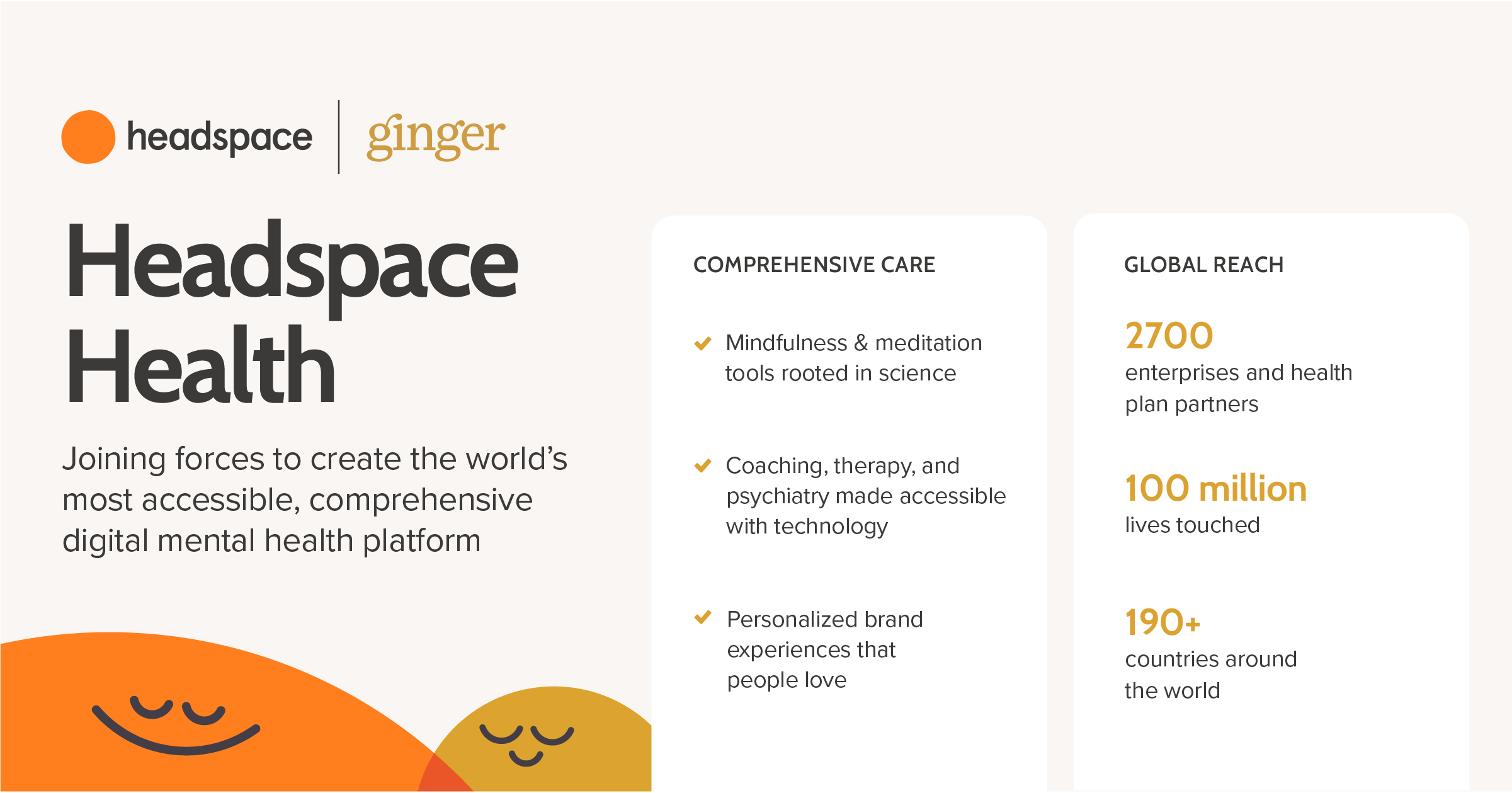
Two of the best-known companies in the virtual mental health space announced plans to merge this week, creating a $3B player poised to dominate this fast-growing segment of healthcare demand.
Headspace, a direct-to-consumer provider of app-based “mindfulness” meditation programs, will combine with Ginger, which sells text- and video-based coaching and therapy services to employers and insurers. Between them, the two companies claim to serve over 100M users worldwide.
Headspace is best known as a consumer-focused app, while Ginger largely serves business and payer clients. The combined company, to be called Headspace Health, will surely look to consolidate offerings into a comprehensive mental health service for employees, targeting a benefits market that is rapidly becoming overwhelmed with startup providers of virtual point solutions.
Behavioral health telemedicine utilization skyrocketed during last year’s COVID surge, and has been the one area of virtual care not to fall back to earth since—we’ve learned that virtual is often a superior approach for many mental health services.
Two questions arose in our minds after the Headspace/Ginger merger was announced. First, does the combined company bring a broad enough value proposition to overcome employer frustration with a highly fragmented market, or will the new Headspace Health eventually need to be part of a larger insurer platform to capture the opportunity in front of it? And second, does “mindfulness” even work?
The academic evidence is decidedly mixed, but the popularity of Headspace and other meditation apps, especially among Millennial consumers, might make that question moot. The mindfulness “wrapper” on more traditional mental health services may prove to be very popular with employees, and could become a must-have element of employers’ benefit packages.
Droplets, fomites, aerosols…these terms describing the kinds of particles which can spread virus particles rose to the top of our lexicon last year. Initially we focused on fomites, infectious particles deposited on surfaces, and worried that touching our groceries and mail could spread the coronavirus.
Scientists were convinced that most COVID transmission occurred via droplets, large respiratory particles exhaled in a cough or a sneeze that traveled only a short distance from an infected person, which led to the guidance that staying six feet apart would keep us safe. But worrisome case reports of a single individual passing the virus to a roomful of people, and the mitigating effects of ventilation, began to hint at aerosol transmission, a much more insidious type of spread in which the virus is transmitted through much smaller particles, which travel longer distances and can linger in the air for hours.
Aerosol spread is not only worrisome because it makes a pathogen more contagious, but smaller aerosol particles can be inhaled more deeply into the lungs, potentially causing more severe illness. A new review in Science evaluates the current data on COVID transmission and the advances made over the past year in understanding airflow and aerosol spread, making the bold statement that aerosol transmission is not only the main mechanism for COVID-19 spread, but is likely the primary mode of transmission for the vast majority of respiratory diseases.
Today, our lack of attention to ventilation, air purification and other means to reduce aerosol spread means that we are woefully unprepared for children to return to school—and underscores the need for extensive masking to mitigate transmission. But in the long run, better understanding the mechanisms for preventing airborne transmission could allow us to reduce susceptibility to a host of respiratory diseases. Take complications from asthma, which dropped dramatically during the pandemic—leading researchers to posit that viral infections, rather than environmental triggers, could be the more common cause behind exacerbations.
Harnessing this new knowledge will require further research to quantify the effects of spread and mitigation—and the willingness to invest in preventive measures in schools and other public spaces, yet another domain in which bolstering public health could have a meaningful long-term impact on our lives.




 HENRY KOTULA