https://www.washingtonpost.com/graphics/2020/local/news/n-95-shortage-covid/?utm_campaign=wp_post_most&utm_medium=email&utm_source=newsletter&wpisrc=nl_most

Nurses and doctors depend on respirator masks to protect them from covid-19. So why are we still running low on an item that once cost around $1?
The patient exhaled. She lifted her tongue for a thermometer. She raised her finger for a blood sugar test, and that’s when she started coughing. One cough can send 3,000 droplets into the air, one droplet can contain millions of coronavirus particles, and now some of those particles were heading for the face of emergency department nurse Kelly Williams.
The nurse inhaled. Strapped over her mouth and nose was an N95 respirator, the disposable filtering mask that has become the world’s most reliable and coveted defense against the virus.
N95s were designed to be thrown away after every patient. By this July afternoon, Williams had been wearing the same one for more than two months.
To get to her, the N95 had traveled from a British factory to a Baltimore warehouse, in a supply chain as tangled and layered as the web of microscopic fibers inside the mask’s filter.
It was purchased by Johns Hopkins Hospital, the famed medical institution that has tracked cases of the novel coronavirus around the world since the pandemic’s start. When its map of dots marking clusters of infections began to show pools of red across the United States, Hopkins was quietly unpacking a stock of personal protective equipment it had been building for over a year — a literal lifesaver when the onslaught of covid-19 cases led to a massive shortage of N95s.
Six months later, that shortage persists, leaving health-care workers exposed, patients at risk and public health experts flummoxed over a seemingly simple question: Why is the world’s richest country still struggling to meet the demand for an item that once cost around $1 a piece?

At Hopkins, nurses are asked to keep wearing their N95s until the masks are broken or visibly dirty. Williams, a 30-year-old from Georgia with a marathoner’s endurance and a nurse’s practicality, went into health care after working for three years in the corporate offices of retailers Abercrombie & Fitch and Under Armour. She understood supply chains. She believed that the makers of N95s, anticipating the pandemic’s eventual end, would invest only so much in expanding production. She believed it was her duty, on top of risking her life for her patients, to make her disposable respirator mask last through as many 12-hour shifts as she could.
When the country was short of ventilators, the companies that made them shared their trade secrets with other manufacturers. Through the powers of the Defense Production Act, President Trump ordered General Motors to make ventilators. Other companies followed, many supported by the government, until the terrifying problem of not enough ventilators wasn’t a problem at all.
But for N95s and other respirators, Trump has used this authority far less, allowing major manufacturers to scale up as they see fit and potential new manufacturers to go untapped and underfunded. The organizations that represent millions of nurses, doctors, hospitals and clinics are pleading for more federal intervention, while the administration maintains that the government has already done enough and that the PPE industry has stepped up on its own.
As the weather cools and the death toll climbs, America’s health-care workers fear that when winter comes, they still won’t have enough respirators. And the longer the shortage lasts, the longer N95s will remain largely out of reach for millions of others who could be protected by them — teachers and day-care workers, factory employees and flight attendants, restaurant servers and grocery store clerks.

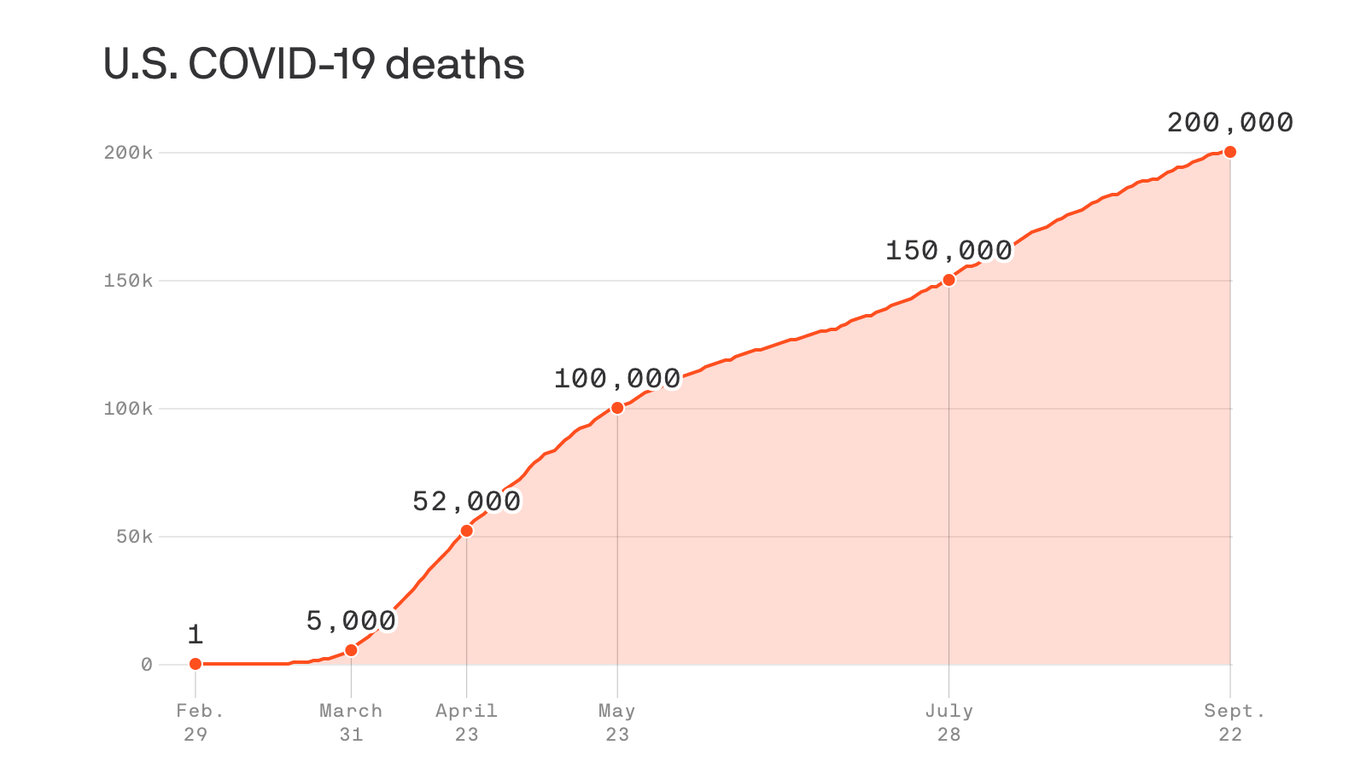
While the pandemic that has killed almost 200,000 Americans drags on, Williams will keep trying to conserve her respirator, wearing it as she rushes in and out of virus-filled rooms, touches virus-shedding patients, and now, comforts a covid-positive woman who is having a coughing fit.
“How can I help you feel a little more comfortable?” Williams asked her patient, who was in her 80s. The woman was about to be admitted to the hospital. Her oxygen level was too low, so they had to run tubes of air into her nostrils. If her situation didn’t improve, a ventilator could come next.
This was the routine in the part of the emergency department Williams called “Covidland.” She’d just risked exposure to care for this woman, but she would never get to find out what happened to her.
She could only take a deep breath through her N95, roll her patients upstairs and hope that she would never become one of them.

‘The gauntlet’
Before the N95 was on her face, it was in a plastic wrapper, in a box, on a shelf inside an East Baltimore warehouse four miles from the hospital. The 165,000-square-foot building had concrete floors, rolling doors, overhead lighting — unremarkable, except to a man named Burton Fuller.
Fuller, a 38-year-old father of three, had once planned on becoming a doctor. Instead, he went into hospital supply chains. It was the kind of job that didn’t earn many follow-up questions at dinner parties. But six months after Fuller was hired at Hopkins, the pandemic made him the person that everyone relied on and no one envied. It was up to him to keep 40,000 employees in six hospitals safe.
Even before covid-19, masks were key to that equation. There are surgical masks, which protect a patient from a nurse’s germs, and respirator masks, which protect a nurse from the patient. Humans have recognized the need for protective masks since at least A.D. 77, when Pliny the Elder wrote about wearing animal bladders as face coverings to make breathing easier in lead-filled mines.
The evolution of early masks brought leather beaks stuffed with straw and herbs to ward off the bubonic plague, and long beards that firefighters would wet and clamp between their teeth. Once the far more effective gas mask became standard for coal miners breathing in silica and soldiers facing chemical weapons, engineers at the Minnesota Mining and Manufacturing Company, better known as 3M, started trying to make a protective respirator that wasn’t so bulky. They realized in the 1960s that the technology used to make pre-made gift bows could also make a mask that was a lightweight, molded cup. And so began the single-use respirator as it exists today.
Inside that cup, and more recently, inside the flat-fold versions, is the key component: fibers 1/50th the width of a human hair, blown together in an intricate web that creates an obstacle course for dangerous particles. An electrostatic charge works like a magnet to trap the floating menaces and attach them to the fibers. If an N95 is fitted properly — a metal nose piece folded snugly, no beard in the way — less than 5 percent of even the most difficult-to-catch particles will make it into the lungs.
At Hopkins, Fuller’s job was to get manufacturers to deliver N95s and other equipment directly to the warehouse, rather than through a distributor. In 2019, the shelves started to fill up, and on one of them was the N95 that would make its way to nurse Kelly Williams. The respirator had been made by 3M at a plant in Aycliffe, a town of 7,000 in northern England.
But this Hopkins stockpile was rare in the world of hospitals, where costs were cut by using medical supply companies to provide equipment when it was needed, rather than letting PPE pile up.
Hospital administrators knew that in cases of natural disaster, chemical warfare or what global health officials used to call “Disease X,” the federal government had its own warehouses in secret locations, filled with PPE.
Except that in 2009, while Fuller was in his first job out of college, the H1N1 flu epidemic depleted 85 million N95s from the national stockpile — and the supply was never replenished. In 2013, 2014, 2016 and 2017, public health officials published alarming reports warning of a “massive gap” in what remained. Even more concerning, they said, the vast majority of N95s and the materials needed to manufacture them were now being made in Asia.
The Department of Health and Human Services did fund the invention of a “one-of-a-kind, high-speed machine” that could make 1.5 million N95s per day. But when the design was completed in 2018, the Trump administration did not purchase it.
This year, as the virus spread from Wuhan to Washington state, HHS turned down a January offer from a manufacturer who could make millions of N95s. The agency didn’t start ordering N95s from multiple companies until March 21. Paul Mango, deputy chief of staff for policy at HHS, would later call that timeline “friggin’ light speed … the fastest this has ever been done.”
By then, the United States had 8,000 reported coronavirus cases and 85 deaths, and health-care workers were panicking over PPE shortages.

Fuller’s orders began being canceled. As the Hopkins emergency department was being readied for covid-19 patients, and Williams was being told she would need to start wearing an N95, the hospital’s administration decided not to reveal how many N95s were in the warehouse.
“Only a half a dozen people know,” Fuller said. “Behavioral economics say that if we communicate a number someone perceives as high, they will use the supply more gratuitously. If we communicate a number they perceive as low, they may hoard to ensure there is enough.”
As the boxes of N95s were loaded into trucks headed for Hopkins hospitals, Fuller and a dozen staff members entered what he would come to call “the gauntlet.” Every hospital and health department in the country was competing for N95s and other PPE, a mess of bidding wars, price gouging and worthless knockoff masks. Fuller uncovered one scam when a company CEO, claiming to be based in Indianapolis, didn’t recognize the name of the city’s most famous steakhouse.
“For every mask shipment we have been able to bring in,” Fuller said, “there are 10 or 15 transactions we have had to terminate.”
He worked so much that his wife, home with their children, received flowers from Hopkins executives. He joked about the other crucial stockpile in his life, his wine collection.
Fuller was desperate to make the stockpiled N95s last as long as possible. He wanted every employee wearing one to also wear a face shield, but those, too, were impossible to find.
So at the end of March, the warehouse filled with folding tables spaced six feet apart. Volunteers were given foam strips, elastic straps and sheets of plastic to make homemade shields. At one of the most prestigious medical institutions in the country, they were trying to fix the problem for themselves, with scissors, staplers and hot glue guns.

‘Bracing yourself’
A face shield was clipped to Williams’s belt in the middle of May, when for only the fourth time during the pandemic, she unwrapped a new N95.
After nine weeks in and out of Covidland, she had come to trust in her disposable respirator. It hurt her nose, gave her acne and made breathing hard. But the power of its protection was starting to give her back the feeling of safety she’d lost in March when she and the dozens of colleagues who worked alongside her each shift watched the areas where they’d cared for gunshot victims and heart attack patients turn into isolation rooms. They were tested to make sure the N95s fit their faces and taught to use other respirators that looked like gas masks or blew clean air into a hood.
And then, they were slammed. The first covid patient to go on a ventilator at Hopkins was a 40-year-old who worked out every day. The ambulance bay became a testing center. Williams’s co-workers were crying in the break room. Her patients couldn’t breathe, and then tubes were going down their throats, and then it felt like she couldn’t breathe, like everything she knew about nursing would never be enough.
“Our lives changed overnight,” she said. “You’re bracing yourself for people to die.”
She started silently saying a prayer she knew, every morning, every few hours, then sometimes 20 times a day in Covidland.
God, grant me the serenity to accept the things I cannot change, it began. She said it before her patient started violently shaking and flailing, seizing in his bed. She couldn’t run out the door to ask for help, because to leave the room without potentially taking the virus out, she had to sanitize her gloves, trash them, take her gown off, trash it, exit into an antechamber, take off her first layer of gloves, sanitize her hands and wipe down her face shield. So she ran to the window and banged on it, then ran back to her patient, trying to hold him down, her face inches from his.
Courage, to change the things I can, the prayer continued. Williams said it in the car that she drove to work and wouldn’t let any member of her family touch. Its speakers blared Lizzo-filled playlists she used to pump herself up for what she told her friends was an “awesome learning experience.” She had been a nurse for only two years. Her job in merchandising at Under Armour had brought her to Baltimore, where she met her husband, Sean, and his two children. They were the ones to make her realize that she wanted a job where she could actually see the impact of all those hours she worked. Now, every day might be the day she took the virus home to them.
Grant me the serenity to accept the things I cannot change, courage, to change the things I can, and wisdom to know the difference. Another day in Covidland, and Williams was wearing her new N95, pumping her palms into an unconscious man’s chest, not thinking of all the particles flying out of his airways. Another, and her face shield popped off and clattered to the floor. Another, and a young Latina mother told Williams she couldn’t self-quarantine because she could not afford to stay home from work.
Another, and Williams was watching the chest of a middle-aged man rise and fall by the force of a ventilator. Outside the walls of the hospital on this day in July, America seemed to have moved on from the conversation about the shortage of N95s. Instead, people were fighting over simple cloth masks.
Maybe this patient had worn one. Maybe he’d said he didn’t believe in them. Either way, it was her job to take care of him. Williams suctioned virus-filled fluid from his airways, and breathed in again.
‘Not profitable’
The radio advertisements could be heard across South Dakota, playing inside cars passing billboards plastered with the same message: 3M is hiring in Aberdeen. In a state that hosted 460,000 people at an August motorcycle rally and requires no one to wear a mask sits the largest respirator plant in the United States.
Its N95 manufacturing lines have been running 24 hours a day, 7 days a week since Jan. 21, the same day public health officials announced the arrival of the coronavirus in Washington state.
Plant manager Andy Rehder hired 200 new employees this year and was still looking for more this summer so he could staff another N95 line being built. Rehder, whose wife wears an N95 as a hospital social worker, had a Bloomberg Magazine article from March displayed in his office. The headline asked, “How do you make more masks yesterday?”
The question still hangs over the plant, and the entire country, nearly six months after that article was published.
Ask the Trump administration, and the N95 shortage is nearly solved. Rear Adm. John Polowczyk, whom Trump put in charge of securing PPE, said that by December, 160 million N95s will be made in the United States per month. By his calculations, that will be enough to handle a “peak surge” from hospitals, clinics, independent physicians, nursing homes, dentists and first responders. The Strategic National Stockpile has 60 million N95s on hand, and states are rebuilding their stockpiles.
“I’ve got production up to what we think is the limits of what we need,” Polowczyk said. “I believe now that hospital systems are making management decisions that might lead to an appearance that we still don’t have masks, which is the farthest from the truth.”
But ask the people inside hospitals, and the shortage is far from over. An August survey of 21,500 nurses showed 68 percent of them are required to reuse respirators, many for more than the five times recommended by the CDC, and some even more than Kelly Williams. One Texas nurse reported she’s still wearing the same five N95s she was given in March.
Many health-care facilities that ordered KN95s, Chinese-made masks meant to have a similar filtering efficiency, gave up on them after realizing that the looser fit left workers in danger. The N95 shortage is more acute for primary care physicians, home health aides and hospice workers. But even for many hospital systems, the situation remains “fragile and challenging,” the American Hospital Association said this month.
“Maddening, frustrating, mind-blowing, aggravating, that’s the polite language for it,” said American Medical Association President Susan Bailey, who still hears from doctors who do not have respirators. “There has been such an outpouring for support for ‘health-care heroes.’ Everybody knows now how important it is for our front-line health-care workers to be able to work in a safe environment. … And yet, that desire doesn’t seem to be turning into a reality.”
The AMA, AHA, American Nurses Association and the AFL-CIO all point to the same solution: broader use of the Defense Production Act, which gives the president power over funding for the production and distribution of critical supplies during crises.
In August, Trump stood before a group of socially distanced reporters, praising himself for using the DPA “more comprehensively than any president in history.”
“There was a time,” he said, “when the media would say, ‘Why aren’t you using it? Why aren’t you using it?’ Well, we have used it a lot, where necessary. Only where necessary.”
That’s not what it looks like to the man who used to run Trump’s DPA program within the Federal Emergency Management Agency. Larry Hall, who retired last year, said the authority has been executed in an “ad hoc, haphazard fashion.”
Along with ordering 3M to import 166.5 million masks from China, the administration has used the DPA to invest $296.9 million in bolstering the N95 and filter-making supply chains. The Department of Defense, which oversees that funding, spends more per year on instruments, uniforms and travel for military bands.
“By not having a national strategy,” Hall said, “we have fewer masks.”
Ask the PPE industry and the refrain is that without long-term guarantees that the government will keep buying respirators, N95 manufacturers are wary of investing too much, and other companies that could start making respirators or the filters for them are hesitant to do so.
Peter Tsai, the scientist who invented a method to charge the fibers inside the respirator filter, knows why: “It is not profitable to make respirators in the United States,” he said. It can take six months just to create one manufacturing line that makes the N95′s filter.
But there is a workaround, Tsai said. Companies that already make similar filters — for vehicle emissions, air pollution and water systems — can modify their equipment to make N95 filters.
While Tsai, 68, has been fielding hundreds of calls from hospitals and researchers trying to sanitize N95s with heat and ultraviolet light, he has been working with Oak Ridge National Laboratory in Tennessee to woo the 15 to 20 American companies that have the potential to produce respirator filters more quickly.
The government has funded just three of these companies through the DPA.
Others have gradually joined in on their own. But then those filters have to be made into respirators, and those respirators have to be approved by NIOSH, the National Institute for Occupational Safety and Health.
The entire process has moved at a glacial pace in comparison with the flurry of activity that rid the country of its ventilator shortage. Ventec, a company known for its efficient, toaster-size ventilators, handed its plans over to General Motors so that the auto company, under the DPA, could mass produce a product that was known to work. Other ventilator companies followed, handing over their trade secrets to Ford, Foxconn and other major manufacturers.
But when GM started making N95s, engineers with expertise in car interiors and air bags were charged with figuring out the process from scratch, the company said. Although they received advice from major mask makers, there were no groundbreaking corporate partnerships this time. The first N95s GM made were rejected by NIOSH. The second design didn’t correctly fit most people.
Other potential manufacturers went through the same challenges as GM, failing tests and making flat-fold N95s that experts worry do not offer a tight enough seal.
“If there was some kind of intellectual sharing, they wouldn’t be doing that,” said Christopher Coffey, who was the associate director for science in the NIOSH approvals program before retiring in January.
The DPA does have a provision that would allow manufacturers to work together without being subject to antitrust laws. But it has yet to be used for N95s.
Instead, established U.S. makers of N95s, whose products have been successfully protecting miners, construction workers and health-care professionals for decades, have continued to protect their processes as intellectual property.
Though 3M helped Ford make the far more expensive powered respirators, which blow clean air into a hood, the company has not entered into any major partnerships with outside manufacturers to make N95s. Asked why, 3M declined to explain, instead pointing to its other pandemic partnerships.
Ford gained its own approval to manufacture disposable respirators but has made just 16,000 of them while focusing instead on face shields and surgical masks. Other major U.S. manufacturers of N95s, including Honeywell and Moldex, have kept their manufacturing in-house, too.
“Folks aren’t likely to share that information outside of their own company,” said Jeff Peterson, who now oversees NIOSH approvals. NIOSH employees may know how 3M makes its respirators and the filters inside them. But by contract, they can’t tell other manufacturers how to do the same.
Meanwhile, 3M continues to dominate the American N95 market. While other parts of its business, such as office supplies and industrial adhesives, have struggled during the pandemic, 3M has invested $100 million to expand domestic production of respirators from 22 million to 50 million per month. Once the new production line is up and running in South Dakota in October, that number is expected to reach 95 million per month in the United States.
It still won’t be enough.
“Even though we are making more respirators than ever before and have dramatically increased production,” 3M spokeswoman Jennifer Ehrlich said, “the demand is more than we, and the entire industry, can supply for the foreseeable future.”
‘I just don’t get it’
Her N95 was already on, but Williams’s hands were slipping as she tried to force on a pair of gloves. She could hear the alarms going off. One of her patients was crashing, and she had to get into the room.
She should be able to just go, her runner’s legs carrying her to the bedside. But in Covidland, there were two closed doors standing in her way. She had started wearing her N95 all day so she could be ready for this moment. She pulled on her gown and another set of gloves and her face shield, reached for the door — and realized the patient inside was her 13-year-old stepson Kellen.
She jolted awake. She was in her bed. Her husband was asleep beside her. She slid out from her sheets and went downstairs to check on her stepchildren. Kellen and 19-year-old Alle were sleeping, too.
The nurse inhaled. She could still hear the alarms.
This is what it meant now, to be a health-care worker: across the country, nurses and doctors were reporting increased sleeplessness, anxiety, depression and post-traumatic stress.
Williams reminded herself that she’d always had an N95, and the heavier, more protective respirators she sometimes wore instead.
But she knew, too, that covid-19 had taken the lives of more than 1,000 health-care workers, including a New Jersey primary care doctor who, determined to keep his practice open, doubled up on surgical masks when his N95 orders didn’t come. And a California nurse who rushed into a covid patient’s room to perform chest compressions. She saved his life, then doused her hair in hand sanitizer. She hadn’t been given an N95 at the beginning of her shift.
And then there was the news that shook every health-care worker Williams knew: Less than two miles from Hopkins, the head of the ICU at Mercy Hospital died after contracting the virus in July.
Joseph Costa was one of the people who’d guided the hospital through its PPE shortage early in the pandemic. His husband, David Hart, remembered him coming home and saying, “This is my mask for the week.” Neighbors pushed N95s through their mailbox slot.
“This is the United States of America, and we can’t seem to get factories built to deliver this stuff? I just don’t get it,” Hart said.
He will never know exactly how his husband, who insisted on caring for covid patients alongside his staff, became infected. Costa died in the ICU, the gloved hands of his colleagues on him as he went. Minutes later, they returned to caring for other patients.
At Mercy, at Hopkins, at every hospital that had found a way to get N95s, health-care workers wore their PPE to try to save the lives of people who contracted the virus because they had none.
Williams and her colleagues didn’t need to see the statistics to know that the pandemic was disproportionately affecting Black and Brown people, especially those deemed essential workers. They saw it in their patients and heard it from their families and friends.

Williams worked side by side with Shanika Young, a nurse whose brother seemed to have every known covid-19 symptom before he started to recover.
Afraid of infecting anyone in her community, Young went weeks without seeing her parents and newborn niece. She adopted a hound-mix puppy to have a friend when she couldn’t see her own. In the weeks that followed the killing of George Floyd, she agonized over her decision to stay away from the protests. She knew there wouldn’t be N95s there.
On a sweltering August morning, she left her dog in her apartment and packed her respirator in her car. She, too, re-wore her mask, but usually for four or five 12-hours shifts.
Now Young was taking it across Baltimore, not toward the hospital, but to a predominantly Hispanic neighborhood with one of the worst infection rates in the city.
During the pandemic, Baltimore has seen outbreaks in its homeless shelters, its trash-collecting facility and its jail. Now every place Young drove by fell on one side or the other of a new dividing line in America: those who have PPE and those who don’t. Bodegas, restaurants, nail salons and funeral homes. Downtown, a nonprofit’s dental clinic remained shuttered. She passed a mental health counseling center where sessions were still conducted only by video, and a physical therapist who wore KN95s to see clients. She parked near a school that, without N95s, had no way of ensuring its teachers were protected. It serves primarily Latino children, all of whom would be forced to learn online.
In the parking lot of the church, a booth that used to sell $1 snow cones had been transformed into a coronavirus testing center run by a team of Hopkins doctors and nurses.
On her day off, Young volunteered to work with them, spending hours sweating in her scrubs, sending swabs deep into nose after nose. She wore a surgical mask on top of her N95.
“I don’t think there’s any science that says this is actually safer,” she said. “But it’s just a mental thing.”
The line of people sweating on the asphalt was so long, Young couldn’t see the people at the end: a man in painter’s clothes, a mother pushing a stroller and a woman who, like Young, was wearing scrubs. Stitched onto the chest was the name of a retirement home.
‘Hazard’
The coughing patient was starting to fall asleep when Williams left her in the covid unit. Her shift had been over for more than 30 minutes. She checked in to make sure there was no one else who needed her help and headed for the locker room. She washed her hands twice. She used alcohol wipes to sanitize her phone, glasses, ID badges and pens.
She took off her N95, and she inhaled.
For the first time in two months, she decided that this respirator was done. Its straps were starting to feel too stretched. The shape of it looked just a little too warped.
Instead of hanging the N95 from a hook in her locker to air dry, she stuffed it in a bag marked “hazard.”
A new mask, still in its plastic packaging, was waiting for her next shift. She would wear it as long as possible, especially after learning that the Hopkins stockpile had run out of the British-made mask she wore and couldn’t get any more. She needed to change to a different type of N95, one that felt unfamiliar once again. She told herself that she was grateful just to have it. She told herself that it would protect her just the same.






/the-us-federal-trade-commission--ftc--bu-71968930-e5e36febe53543aaa53329c6c17fc982.jpg)