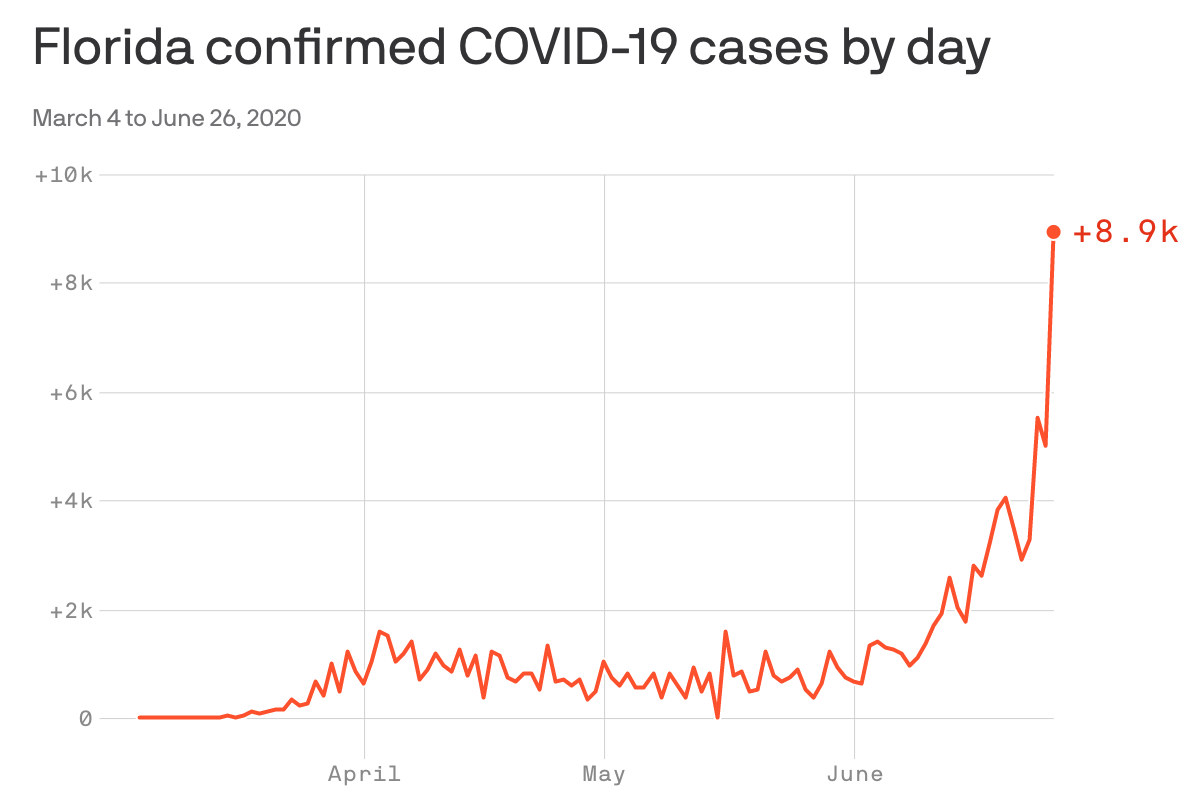
Florida smashes single-day record for new coronavirus cases

https://www.axios.com/florida-coronavirus-case-record-2991255d-5b29-42e0-9c67-39b26c1e541c.html?stream=health-care&utm_source=alert&utm_medium=email&utm_campaign=alerts_healthcare

Florida reports massive single-day increase of 9,000 coronavirus ...

Florida reported 15,299 confirmed coronavirus cases on Sunday — a new single-day record for any state, according to its health department.

The big picture: The figure shatters both Florida’s previous record of 11,458 new cases and the single-state record of 11,694 set by California last week, according to AP. It also surpasses New York’s daily peak of 11,571 new cases in April, and comes just a day after Disney World reopened in Orlando.

Worth noting: More than a dozen states have reported new highs for daily case numbers this week.


Fauci: Surge States Must Pause Reopening

https://www.medpagetoday.com/infectiousdisease/covid19/87527?utm_source=Sailthru&utm_medium=email&utm_campaign=Weekly%20Review%202020-07-12&utm_term=NL_DHE_Weekly_Active

Fauci: Surge States Must Pause Reopening | MedPage Today

NIAID chief pins hopes for long-term containment on vaccine.

States facing COVID-19 surges must hit “pause” on their reopenings and begin to truly follow the CDC guidelines for mitigating its spread, NIAID Director Anthony Fauci, MD, told The Hill during an online webinar hosted by the website on Thursday.

Cases in the U.S. peaked in April but instead of falling to near zero, as happened in many European countries, new daily diagnoses plateaued at about 20,000 per day.

That ended in late May, when new cases began rising again, driven by big increases in California, Texas, Florida, and Arizona. The national rate has been topping 50,000 per day; the widely cited Johns Hopkins University tracker’s count spiked by 113,000 in the 24 hours ending at 8:00 a.m. ET Friday.

“We need to get our arms around that … and we need to do something about it quickly,” Fauci said.

One major challenge is the nature of the virus itself, which is “spectacularly transmissible,” he noted.

But the other problem is that some states ignored public health experts’ advice.

“We went from shutting down to opening up in a way that essentially skipped over all the guideposts,” he said, referring to the benchmarks for each phase of the reopening process. “That’s not the way to go.”

Fauci said he hopes it won’t be necessary for sunbelt states to return to a total shutdown.

“We’ve got to get them to do very fundamental things: closing bars, avoiding congregations of large numbers of people, getting the citizenry in those states to wear masks, maintain six-foot distance, washing hands,” he said. “If we can do that consistently, I will tell you almost certainly you’re going to see a down curve of those infections.”

Fauci also offered his projections for vaccine development.

“We’re really cautiously optimistic that things are moving along quite well with more than one candidate.”

He said the Moderna vaccine, which the NIH helped to develop, “will very likely be going into advanced phase III clinical trials, by the end of this month, July.”

Other “equally promising” vaccine candidates will begin these trials “a little bit later.”

“[W]ith any vaccine development program you never can guarantee success … but the early signs are proving favorable,” he said.

Fauci said he hopes “by the end of this calendar year and the beginning of 2021, that we will have a vaccine that we will be able to begin to deploy to people who need it.”


Has Italy Beaten COVID-19?

https://www.medpagetoday.com/infectiousdisease/covid19/87446?utm_source=Sailthru&utm_medium=email&utm_campaign=Weekly%20Review%202020-07-12&utm_term=NL_DHE_Weekly_Active

Has Italy Beaten COVID-19? | MedPage Today

Nation adapts to “new normal” of masks and distancing; second wave now seen as unlikely.

Three weeks ago, the hospital Policlinico San Donato in Milan, Italy, slowly started to get back to a semblance of “normal.”

In the early days of the coronavirus pandemic, this 500-bed hospital was caring for 600 patients with COVID-19.

Now, the hospital’s chief cardiac surgeon, Lorenzo Menicanti, MD, says his unit is operating at 40% to 50% of its normal volume — which may sound underwhelming, but at one point his entire cardiac ICU was dedicated to the care of COVID-19 patients.

“We are almost out of the nightmare,” Menicanti told MedPage Today, noting that the hospital has seen no new positive cases in the last three weeks.

Once seen as the world’s worst hotspot, Italy has managed to bring the virus to heel, as has much of the rest of Europe. Italy has had more than 34,000 deaths, with nearly half of them in the Lombardy region, of which Milan is the capital.

At one time, experts in the U.S. were worried that it would become “the next Italy” — a prospect that now seems welcome as America has nearly 100,000 more deaths than the European country.

Menicanti attributes Italy’s success to surprisingly high levels of compliance with social distancing measures from the Italian people.

“In the beginning, all of us were shocked by the rules. To be locked in, not being able to travel or meet people, that’s very strange for us. Italians love crowded places,” Menicanti said. “But the population, incredibly, has followed the rules.”

Even today, Italians continue to be frightened into compliance and are “afraid to restart their lives normally,” he said.

“I think the feeling of the U.S. population is not the same,” he said.

Living the Nightmare

Italy’s first case of coronavirus was identified in Codogno, a town of 16,000 people about an hour’s drive from Milan.

Annalisa Malara, MD, an intensivist and anesthesiologist at Codogno Hospital, diagnosed the first patient there on Feb. 20.

Local officials responded swiftly: “I called the chief of the hospital who declared it a crisis situation,” Malara wrote in a narrative for the European Society of Cardiology.” The chief in Lombardy was contacted as were the politicians, and a national emergency was announced. Codogno hospital was put in lockdown and emergencies were sent to Lodi Hospital, which is 30 km away.”

The town locked down immediately and largely averted a major crisis, according to news reports. An Associated Press report from mid-March said most Codogno residents were wearing masks when they went outside, handshakes were forsaken and people kept a social distance as they waited in lines at pharmacies and food stores.

Other towns that didn’t implement such a strict lockdown right away, such as Bergamo and Cremona, were hit harder, and scenes of coffins piling up in churches were burned into the national psyche.

Mario Carminati, a priest in Bergamo, told the BBC that the “sound of ambulance sirens was constant. This was a reminder to be on the lookout, that if you didn’t do as they said, you could be next.”

“We don’t want to forget what happened,” Carminati said. “We want it to be a reminder of how to live in a certain way.”

That fear has produced compliance that made control of the virus possible, Menicanti said. The entire region of Lombardy now only has 41 COVID-19 patients in intensive care, down from a peak of 1,800. Only 277 people in the region are hospitalized with the disease.

“It’s another world, because in other times we had 12,000 patients hospitalized,” Menicanti told MedPage Today.

About 7% of staff at Policlinico San Donato became infected with the virus, a result Menicanti called lower than expected given that testing was limited at the beginning of the outbreak. “The PPE worked very well,” he said. “The incidence of infection in our hospital was low.”

However, more than 150 Italian doctors are said to have died from the virus.

Back to Business

Now in Lombardy, masks must be worn at all times while in public. Schools and universities remain closed. Bars and restaurants are open, but with social distancing rules in place. Some even place glass shields between tables. It’s the “new normal” that many Americans refuse to accept.

“It’s not nice to go to restaurants and see people inside cages, but it was a good way to start again, and people have accepted it,” Menicanti said.

While it was relatively easy to stop normal hospital operations and push all resources to COVID care, it’s “much more complicated to restart,” he said.

The layout of Policlinico San Donato has been changed so that there are new routes for COVID-free patients to enter and be transported through the hospital. All patients who enter the hospital must be screened for COVID and must have two negative swabs to be admitted to the surgical ward. An entire floor is devoted solely to screening.

Staff on the COVID wards are tested more frequently than those assigned to non-COVID areas. Menicanti said he’s tested about once a week.

A third of hospital beds must remain free in case there’s a new wave of infections, but “all the data we have in Italy are against this idea,” Menicanti said. “So probably in another couple of weeks, we will consider occupying all beds for normal operation.”

No Second Wave?

Like much of the rest of Europe, Italians have become so confident in their ability to control the virus that many experts believe there won’t be a massive “second wave” of infections and deaths.

Enrico Bucci, PhD, a molecular biologist and statistician who runs a company aimed at detecting research fraud, wrote in a widely shared Facebook commentary that the probability of having a second wave that produces as much mortality as the first is “pretty low.”

However, “the sooner we abandon spacing, masks, hand hygiene, tracking, isolation and containment measures in hospitals, the more we increase the likelihood of high-intensity epidemic waves,” Bucci noted.

Health officials have gotten better at identifying sources of infection and reacting quickly to contain them, Menicanti said. For instance, as soon as a hot spot at a company in Bologna was identified, it was shut down: “Now we know what to do” to prevent local outbreaks from growing into a large second wave, he said.

While he’s concerned about the winter and a double-whammy of flu and COVID cases, he noted that there’s a large campaign for flu vaccination that may help moderate that burden.

“Of course it’s not over, we know that,” he said. “But the population is very prudent and being very attentive to the rules.”

“Summer will be perfect, we hope,” Menicanti said. “We shall see what happens in October.”


COVID-19 surge pushes US toward deadly cliff

COVID-19 surge pushes US toward deadly cliff

Archive

The coronavirus is spreading at ever-faster rates in a broad array of states, putting the U.S. on the precipice of an explosion of illness that threatens to overwhelm the nation’s health care system.

The painful economic lockdowns imposed in March gave the country time to flatten the epidemiological curve and contain the virus. But that window of opportunity, which came at great economic cost, is quickly slamming shut. Health experts say all signs point to a deadly summer and fall unless government leaders implement a much more robust national strategy.

The breadth of the spread is staggering. Forty-three states have seen the number of cases confirmed on an average day increase in the last two weeks. The number of patients in hospitals has risen over the same period in 29 states. More than 80 percent of intensive care beds are occupied in Alabama, Arizona and Georgia.

The same models that predicted surges in Phoenix, Houston and Miami now show a new and broader round of cities as the likely next epicenters. The number of confirmed cases is likely to rise substantially in places like Atlanta, Kansas City, Mo., Tulsa, Okla., and Greenville, S.C.

The virus also appears to be traveling north along the I-95 corridor. Cities like Philadelphia and Baltimore, which struggled through earlier peaks of viral transmission, are now seeing early signs of a second wave. Transmissions even appear to be rising in New York City.

On the other side of the country, outbreaks in California have grown to unprecedented proportions. The Golden State is now averaging more than 7,900 new cases a day, substantially more than its seven-day average just two weeks ago.

Public health experts warn that the U.S. has only a fleeting window in which to wrestle the virus back under some form of control. Without a stronger national response, including restrictions on large gatherings and requirements that people wear masks in public, the risk of a second peak could bring new lockdowns and more economic harm, derail the beginning of the new school year and even overwhelm local health systems.

“Our projections show that without immediate actions to significantly reduce travel and social distancing nationwide, this virus will not only threaten our ability to reopen schools in the coming weeks, but our capacity to care for the sickest individuals,” said David Rubin, director of PolicyLab at the Children’s Hospital of Philadelphia whose models forecast higher case counts.

More than 3.1 million Americans have tested positive for the virus, though the Centers for Disease Control and Prevention estimate that as many as 25 million people in the U.S. may have contracted it. More than 133,000 people have died, almost twice as many victims as in Brazil, the second-hardest hit country.

Cities that successfully avoided early explosions of cases are now in the crosshairs after the loosening of restrictions in some states and regions that helped avoid what studies have suggested would have been tens of millions of infections.

“I would be lying if I didn’t say I was concerned,” Kansas City, Mo., Mayor Quintin Lucas said in an interview. “We have looked at the trends out of Texas, Arizona and Florida. Those states kind of reflect the political choices that were made statewide in Missouri, and that does give us concern.”

The Kansas City metropolitan area has confirmed more than 10,000 coronavirus cases. The PolicyLab model shows Jackson County, Mo., is likely to experience more than 200 new cases every day by the beginning of August.

Rubin warned that smaller cities are likely to experience significant outbreaks in the coming weeks, potentially straining health systems that are not as prepared to handle a high volume of patients in need of intensive care. College towns like South Bend, Ind., and Tuscaloosa, Ala., are beginning to see case counts rise even with most students gone.

“We’re starting to see a mild uptick,” said James Mueller, South Bend’s mayor. “We’re in a much better position now than we were for the first increase or the first peak.”

At other levels of government, some who have sought to downplay the severity of the American outbreak have pointed to an increasing number of tests being conducted across the country, which they say will naturally lead to identification of those who have only minor symptoms or asymptomatic cases. But the number of cases is rising faster than would be accounted for by the increase in testing; the share of tests coming back positive is rising in 38 states.

More than a quarter of tests conducted in Arizona are coming back positive, according to state data. More than 15 percent of tests are coming back positive in Alabama, Florida, Mississippi, South Carolina and Texas.

Governors in 23 states have ordered residents to wear masks in public, though President Trump has refused to order a nationwide mask mandate. Trump has instead focused on reopening the economy, insisting that schools operate as normal in the months before he faces voters in November.

But public health experts argue action is needed now to avoid a second peak of tsunami-like proportions.

“We never gave communities a real chance at success as we lacked a national strategy around masking and limiting gathering sizes to act as a buffer as places reopened,” Rubin and his colleagues Gregory Tasian and Jing Huang wrote.

“So, do we admit that we’ve failed and try to salvage the reopening of our schools in fall by quickly enacting a national approach to pause all reopenings and try to get our country back onto stable footing?” he asked. “It may not be what people want to hear, but the situation is that dire that we need to consider this.”