In educated and affluent Massachusetts, coronavirus cases surged. The decline has yet to come.

https://www.washingtonpost.com/national/coronavirus-massachusetts-cases-high/2020/05/01/8b7b748c-8b2b-11ea-8ac1-bfb250876b7a_story.html?fbclid=IwAR1Hon5rQwU9Tf5b2HQZktH2i8VbLURJomAkHzGmwde1J6N1rkqlaUaVup4&utm_campaign=wp_main&utm_medium=social&utm_source=facebook

Coronavirus cases surged in educated and affluent Massachusetts ...

Massachusetts has one of the most educated and affluent populations in the country. It’s home to some of the nation’s most preeminent medical centers. And it has political leaders who have worked cooperatively, across party lines, in the face of a crisis.

Massachusetts also has the third-highest number of confirmed state coronavirus cases, along with the fourth-highest death toll. And despite predictions that numbers would be falling by now after a month and a half of people staying at home, new case counts have instead remained stubbornly high.

The state’s struggle to combat the coronavirus reflects just what a tenacious adversary it really is. Even for a place that has a lot going for it, the toll has been severe — and it is growing by the day.

As of Friday, Massachusetts had more than 64,000 cases — behind only New York and New Jersey, its larger northeastern neighbors. New cases totaled 2,106, continuing a dismal streak lasting more than two weeks of at least 1,500 additional cases per day. Deaths hit 3,716, behind only New York, New Jersey and Michigan.

Even as many states began opening up their economies Friday — allowing restaurants, shopping malls and hair salons to do business — that remained a distant prospect in Massachusetts. Instead, Gov. Charlie Baker (R) on Friday was announcing new restrictions, including a requirement that people wear masks while in public.

“This is going to be a way of life,” Baker said. “No ifs, no ands, no buts, no doubts.”

The persistence with which people keep getting sick in Massachusetts has been matched in other hard-hit states. Rather than a precipitous decline, the number of new cases in places such as Illinois, California and the D.C. metro area has instead been leveling off slowly.

Experts say that is to be expected, even if it means a long road ahead.

“If social distancing is done well — and Massachusetts has done it pretty well — the effect is going to be to flatten the curve and spread it out over more time,” said David Hamer, professor of global health at Boston University and an infectious-disease physician at Boston Medical Center. “Instead of a peak, it’s a prolonged plateau. It’s going to be a gradual decline.”

Like other states, Massachusetts has avoided some of the most dire projections about how many people would fall ill. Its social distancing measures also have prevented hospitals from becoming overwhelmed.

But actually pushing down the rate — rather than treading water — will be tricky to pull off, because of the nature of who is getting sick.

More than half the state’s deaths have been people in long-term-care facilities, such as nursing homes. The elderly make up a slightly higher share of the Massachusetts population than the national average.

Essential workers — who have to commute to their jobs each day and often are in close quarters with others — also have been hit hard.

“Some people have been able to completely shelter at home. Their risk of getting anything is very low indeed,” said Jeffrey K. Griffiths, who teaches public health at Tufts University. “But there are other groups of people that man the gas stations, the grocery stores, the hospitals. They’re police and firefighters. They still have to go to work.”

And then there are the poor, for whom social distancing at home is particularly challenging.

Geralde Gabeau, an advocate for the state’s Haitian community, said she knows of immigrant families that are living 10 to a two-bedroom apartment and sharing a single bathroom.

“If one person gets infected, the likelihood of everyone being infected is very high,” she said. “There is no room for people to isolate.”

Gabeau said the immigrant assistance group she runs, Immigrants Family Services Institute-USA, has gone from helping 60 families to more than 300. “Our phone never stops,” she said.

And she hesitates before opening Facebook: “All you see is RIP,” she said. “Every single day, people are losing their grandparents. Yesterday we lost a young man, 34 years old. A family in Boston lost four people. The Haitian community is mourning like crazy.”

Immigrant groups say Massachusetts needs to do a better job circulating information about the coronavirus in multiple languages. Though much of the literature is translated into Spanish, that accounts for only about 40 percent of the state’s population that is not proficient in English. Gabeau said she has taken it upon herself to produce videos in Creole to help spread the truth about the virus for the Haitian community, which makes up a significant share of the state’s 1 million-plus foreign-born residents.

Massachusetts was among the earliest states to reckon with a coronavirus outbreak, recording its first case on Feb. 1. But Hamer said the virus was probably present far earlier, and it was far more widespread than anyone knew when Baker declared a state of emergency on March 10. With everyone cooped up indoors for the New England winter but without official mandates to socially distance, the virus had ample opportunity to spread.

Many of the cases from early March were traced back to a late-February conference hosted by a biotech company, Biogen.

Experts say that on the whole, the state has done well with its response. Baker is a Republican, while Democrats dominate the legislature. The two sides have worked cooperatively, with little partisan rancor.

“I would say that as a state we are doing this right,” said Maryanne Bombaugh, president of the Massachusetts Medical Society. “It’s a very positive example of how you can work together and make a difference for your people.”

Bombaugh cited in particular the prevalence of testing in Massachusetts, including of the asymptomatic, which she said accounts at least in part for the state’s relatively high infection levels. The state also is tracing those who come into close contact with people who have tested positive, a vital step in containing future outbreaks.

Unlike states that have been besieged by protests, there has been comparatively little pressure in Massachusetts to reopen before public health experts give the all clear. The state is among a coalition, led by New York, that is trying to coordinate reopenings across the Northeast rather than acting individually, as many states have done.

The state’s nonessential-business closure extends until at least May 18, with an advisory group due to report back to Baker by then on the best way to gradually reopen.

The governor on Friday said he was encouraged by a slight decrease in the percentage of coronavirus-positive patients requiring hospitalization. “Overall, this is a very good sign,” he said.

Yet testing is still below what epidemiologists would like to see before stay-at-home restrictions can be lifted. A sustained drop in positive results is another prerequisite. And although experts say it is probably coming, it will take some time to get there.

“The plateau is telling us that we’re getting there,” Griffiths said. “But if we were to open up again while we’re at that plateau, we would just see another sharp spike up.”


There’s a more accurate way to compare coronavirus deaths to the flu

https://www.washingtonpost.com/business/2020/05/02/theres-more-accurate-way-compare-coronavirus-deaths-flu/?fbclid=IwAR3OAIJLKvmK5f9lwxCbBsxdt3EbqsyRXEaWj1I_TWXyJahAHue8ABrPUCI&utm_campaign=wp_main&utm_medium=social&utm_source=facebook

Flu vs Covid19 death rate by age per CDC : Coronavirus

If we measure flu mortality the same way we count covid-19 deaths, the picture becomes very stark.

Months into the coronavirus pandemic, some politicians and pundits continue to promote ham-handed comparisons between covid-19 and the seasonal flu to score political points.

Though there are many ways to debunk this fundamentally flawed comparison, one of the clearest was put forth this week by Jeremy Samuel Faust, an emergency room physician at Brigham and Women’s Hospital at Harvard Medical School.

As Faust describes it, the issue boils down to this: The annual flu mortality figures published by the Centers for Disease Control and Prevention are estimates produced by plugging laboratory-confirmed deaths into a mathematical model that attempts to correct for undercounting. Covid-19 death figures represent a literal count of people who have either tested positive for the virus or whose diagnosis was based on meeting certain clinical and epidemiological criteria.

Such a comparison is of the apples to oranges variety, Faust writes, as the former are “inflated statistical estimates” and the latter are “actual numbers.”

To get a more accurate comparison, one must start with the number of directly confirmed flu deaths, which the CDC tracks on an annual basis. In the past seven flu seasons, going back to 2013, that tally fluctuated between 3,448 and 15,620 deaths.

Note that these numbers are very different from the CDC’s final official flu death estimates. For 2018-2019, for instance, the 7,172 confirmed flu deaths translated to a final estimate of between 26,339 and 52,664 deaths. Again, that’s because the CDC plugs the confirmed deaths into a model that attempts to adjust for what many epidemiologists believe is a severe undercount.

Now, let’s add a bar for this season’s covid-19 deaths, which as of this writing stands at 63,259, and which will be even higher by the time you read this. Note the drastic change in the y-axis to accommodate the scale of covid-19 mortality.

This year’s data are necessarily incomplete, as 22 weeks remain in the flu season. There are not likely to be many more flu deaths, as we are well past the worst of the season. But covid-19 mortality has plateaued at around 2,000 deaths per day. Where it will head next is anyone’s guess.

Using an apples-to-apples comparison, we can say that the coronavirus has already killed eight times as many people as the flu. By the time we get data for the entire season, the difference appears likely to be at least tenfold, or a full order of magnitude.

The coronavirus, Faust writes, “is not anything like the flu: It is much, much worse.”

One of the most challenging things about this pandemic is making sense of the profound uncertainty surrounding the many quantities that might appear, at first glance, to be rock solid. On the surface, comparing flu and coronavirus deaths seems like a simple proposition: dig up the official numbers of both and see which is greater.

But that effort gets complicated as soon as you realize that flu mortality is not reported as a tally but as an estimated range, which is far different from the individual counts, based on testing and diagnoses, used for covid-19. And because we can’t test and diagnose everyone, those covid-19 deaths are probably undercounted as well. Soon, what once appeared to be a simple mathematical exercise turns into a mess of algorithms, estimates and uncertainty.

People encountering that uncertainty for the first time, as many of us are during this pandemic, are likely to react in one of two ways. Some cherry-pick a single number that comports with their biases, creating an artificial certainty to score political points or avoid upsetting their preconceptions. That’s what the politicians and talking heads using faulty flu data to downplay the outbreak are doing. Others throw their hands up and declare the truth to be unknowable, indulging in the cynicism that believes you can “make statistics say whatever you want.”

But rather than try to make sense of this uncertainty ourselves, there’s a third option: turning to the experts who’ve devoted their entire careers to these questions. We can listen to the epidemiologists and physicians, people like Faust and his colleagues, who are trained to draw the best possible conclusions out of uncertain data, understanding that those conclusions may have to be updated as new information comes in.

And while the experts might not all agree on some points, something like a critical consensus emerges if we listen to enough of them. Then, that consensus can be used to inform policy that helps save lives and protect the economy.


Cartoon – Just Two on the Front Lines Who Checkout Hundreds of People a Day

Slavery 21st Century

Mapped: The State of Press Freedom Around the World

Mapped: The State of Press Freedom Around the World

Mapped: The State of Press Freedom Around the World - Visual ...

Mapped: The State of Press Freedom Around the World

View a more detailed version of the above map by clicking here

In many Western countries, it’s easy to take press freedom for granted.

Instances of fake news, clickbait, and hyper-partisan reporting are points of consternation in the modern media landscape, and can sometimes overshadow the greater good that unrestricted journalism provides to society.

Of course, the ability to do that important work can vary significantly around the world. Being an investigative journalist in Sweden comes with a very different set of circumstances and considerations than doing the same thing in a country such as Saudi Arabia or Venezuela.

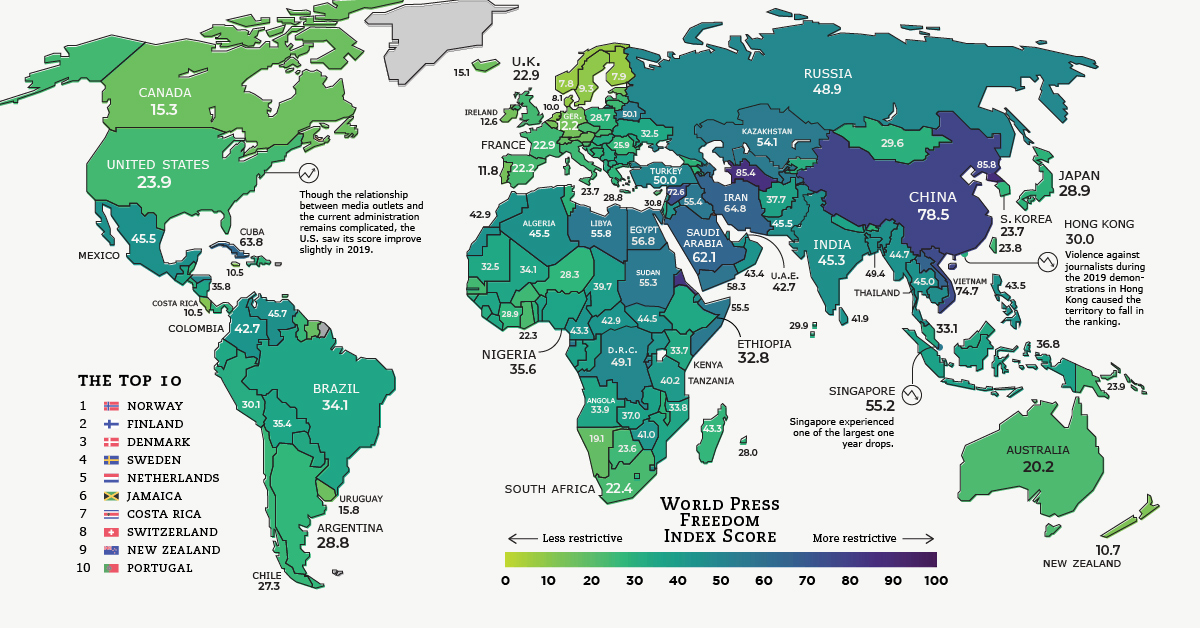
Today’s map highlights the results of the 2020 Global Press Freedom Index, produced by Reporters Without Borders. The report looks at press freedom in 180 countries and territories.

A Profession Not Without Its Risks

Today, nearly 75% of countries are in categories that the report describes as problematic, difficult, and very serious.

While these negative forces often come in the form of censorship and intimidation, journalism can be a risky profession in some of the more restrictive countries. One example is Mexico, where nearly 60 journalists were killed as a direct result of their reporting over the last decade.

journalists killed around the world

There is good news though: the number of journalists killed last year was the lowest since the report began in 2002.

Even better, press freedom scores increased around the world in the 2020 report.

Press Freedom: The Good, The Bad, The Ugly

Here are the scores for all 180 countries and territories covered in the report, sorted by 2020 ranking and score:

Which countries stood out in this year’s edition of the press freedom rankings?

Norway: Nordic Countries have topped the Press Freedom Index since its inception, and Norway (Rank: #1) in particular is an example for the world. Despite a very free media environment, the government recently mandated a commission to conduct a comprehensive review of the conditions for freedom of speech. Members will consider measures to promote the broadest possible participation in the public debate, and means to hamper the spread of fake news and hate speech.

Malaysia: A new government ushered in a less restrictive era in Malaysia in 2018. Journalists and media outlets that had been blacklisted were able to resume working, and anti-fake news laws that were viewed as problematic were repealed. As a result, Malaysia’s index score has improved by 15 points in the past two years. This is in sharp contrast to neighbor, Singapore, which is ranked 158th out of 180 countries.

Ethiopia: When Abiy Ahmed Ali took power in Africa’s second most populous country in 2018, his government restored access to over 200 news websites and blogs that had been previously blocked. As well, many detained journalists and bloggers were released as the chill over the country’s highly restrictive media environment began to thaw. As a result, Ethiopia (#99) jumped up eleven spots in the Press Freedom Index in 2020.

The Middle East: Though the situation in this region has begun to stabilize somewhat, restrictions still remain – even in relatively safe and stable countries. Both Saudi Arabia (#170) and Egypt (#166) have imprisoned a number of journalists in recent years, and the former is still dealing with the reputational fallout from the assassination of Saudi dissident and Washington Post columnist, Jamal Khashoggi.

China: Sitting near the bottom of the list is China (#176). More than 100 journalists and bloggers are currently detained as the country maintains a tight grip over the press – particularly as COVID-19 began to spread. Earlier this year, the Chinese government also expelled over a dozen journalists representing U.S. publications.

2020: A Pivotal Year for the Press

As the world grapples with a deadly pandemic, a global economic shutdown, and a crucial election year, the media could find itself in the spotlight more than in previous years.

How the stories of 2020 are told will influence our collective future – and how regimes choose to treat journalists under this atypical backdrop will tell us a lot about press freedom going forward.


Fauci warns states rushing to reopen: ‘You’re making a really significant risk’

https://www.washingtonpost.com/nation/2020/05/01/fauci-open-states-coronavirus/?fbclid=IwAR2zliMTNSIDC3ldCr7P3x4owkyZfqVKSJGj0M2pzYOH7XakQw6ztNAXcsI&utm_campaign=wp_main&utm_medium=social&utm_source=facebook

Fauci warns states rushing to reopen amid coronavirus pandemic ...

With the White House’s social distancing guidelines expiring Thursday, leaving states largely in charge of deciding how to move forward, Anthony S. Fauci warned local leaders to avoid “leapfrogging” critical milestones in an effort to reopen their economies amid the ongoing coronavirus pandemic.

“Obviously you could get away with that, but you’re making a really significant risk,” Fauci, director of the National Institute of Allergy and Infectious Diseases, said Thursday evening on CNN.

Fauci, who has repeatedly cautioned against prematurely easing restrictions, said he already noticed that some states and cities are not adhering to the steps laid out in the White House’s recently issued guidance on reopening — a plan that administration officials say will now replace the expired federal social distancing measures.

“If you follow the guidelines, there’s a continuity that’s safe, that’s prudent and that’s careful,” he said.

But if governors rush to reopen when they aren’t ready, Fauci cautioned that the move would likely only set back the progress their states have made.

“There’s no doubt in my mind that when you pull back mitigation, you’re going to start seeing cases crop up here and there,” he said. “If you’re not able to handle them, you’re going to see another peak, a spike, and then you almost have to turn the clock back to go back to mitigation.”

Fauci’s comments come as dozens of states have unveiled plans to begin easing stay-at-home orders, with some changes already taking effect despite the number of coronavirus cases and related deaths continuing to rise nationwide. Georgia Gov. Brian Kemp (R), for example, weathered intense criticism, including from President Trump, after announcing that he would lift restrictions on a wide array of businesses, allowing them to open a week ago.

The patchwork effort to return to some semblance of normalcy coupled with the absence of stringent social distancing recommendations has left health experts worried, The Washington Post’s Yasmeen Abutaleb and Rachel Weiner reported. Attempts to reopen states too soon at a time when social distancing remains the most effective way to stem the spread of the virus could increase the risk of new outbreaks, experts say. According to most recent figures, the United States has more than 1 million cases of the coronavirus and nearly 63,000 deaths.

On Thursday, Fauci appeared to echo those concerns, but stressed that major problems could be avoided so long as states adhere to the federal government’s reopening guidelines, which he described as “very well thought out and very well delineated.”

“I keep trying to articulate to the public and to the leaders, ‘Take a look at the guidelines,’ ” Fauci said on CNN. “They don’t tell you because you’ve reached the end of the 30-day mitigation period that, all of a sudden, you switch a light on and you just go for it. That’s not the way to do it. Each state, each city, each region is going to be a little different.”

Citing the guidelines, Fauci reiterated that states need to report a steady decrease in coronavirus cases within a 14-day period in addition to meeting other requirements before even thinking about moving on to the first phase of reopening.

“The discretion is given to the governors, they know their states. The mayors know their cities, so you want to give them a little wiggle room,” he said. “But my recommendation is don’t wiggle too much.”

While Fauci acknowledged that some local leaders are following the guidance, he said “others are taking a bit of a chance.”

“I hope they can actually handle any rebound that they see,” he added.

Later in the segment, Fauci was asked by CNN’s chief medical correspondent Sanjay Gupta about whether the rise in cases in states that are reopening would be incremental or exponential. In response, Fauci said that though he doesn’t know for sure, he doubted that any area would see “something as explosive as we saw in New York.” New York, which has yet to lift restrictions, is the epicenter of the U.S. outbreak with more than 300,000 confirmed cases and roughly 23,600 deaths.

But he warned that states could really find themselves in trouble if infections managed to “spill over into the general community,” similar to the way the virus spread in New York.

“If you can’t stop that from happening, then I think you’re really going to see the sharp peak,” Fauci said. “That is going to be very disturbing when that happens because it’s really going to take a while to get it back down.”