

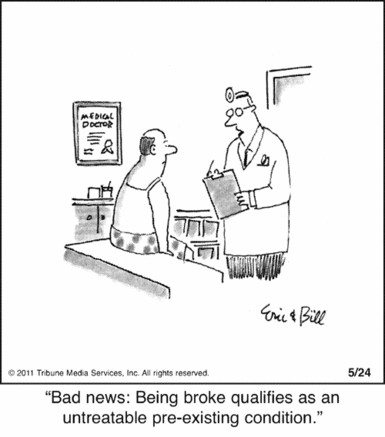
Cartoon – Untreatable Pre-Existing Condition


In Eleven States, 3 in 10 Non-Elderly Adults Would Likely Be Denied Individual Insurance Under Medical Underwriting Practices.
A new Kaiser Family Foundation analysis finds that 52 million adults under 65 – or 27 percent of that population — have pre-existing health conditions that would likely make them uninsurable if they applied for health coverage under medical underwriting practices that existed in most states before insurance regulation changes made by the Affordable Care Act.
In eleven states, at least three in ten non-elderly adults would have a declinable condition, according to the analysis: West Virginia (36%), Mississippi (34%), Kentucky (33%), Alabama (33%), Arkansas (32%), Tennessee (32%), Oklahoma (31%), Louisiana (30%), Missouri (30%), Indiana (30%) and Kansas (30%).
States with the most people estimated to have the conditions include: California (5,865,000), Texas (4,536,000), and Florida (3,116,000).
Using data from two large government surveys, the analysis estimates the total number of nonelderly adults in each state with a health condition that could lead to a denial of coverage in the individual insurance market, based on pre-ACA field underwriting guides for brokers and agents. The results are conservative because the data don’t include some declinable conditions. The estimates also don’t include the number of people with other health conditions that wouldn’t necessarily cause a denial, but could lead to higher insurance costs based on underwriting.




Suicide rates rose in all but one state between 1999 and 2016, with increases seen across age, gender, race and ethnicity, according to a report released Thursday by the Centers for Disease Control and Prevention. In more than half of all deaths in 27 states, the people had no known mental health condition when they ended their lives.
In North Dakota, the rate jumped more than 57 percent. In the most recent period studied (2014 to 2016), the rate was highest in Montana, at 29.2 per 100,000 residents, compared with the national average of 13.4 per 100,000.
Only Nevada recorded a decline — of 1 percent — for the overall period, although its rate remained higher than the national average.
Increasingly, suicide is being viewed not only as a mental health problem but a public health one. Nearly 45,000 suicides occurred in the United States in 2016 — more than twice the number of homicides — making it the 10th-leading cause of death. Among people ages 15 to 34, suicide is the second-leading cause of death.
The most common method used across all groups was firearms.
“The data are disturbing,” said Anne Schuchat, the CDC’s principal deputy director. “The widespread nature of the increase, in every state but one, really suggests that this is a national problem hitting most communities.”
It is hitting many places especially hard. In half of the states, suicide among people age 10 and older increased more than 30 percent.Percent change in annual suicide rate* by state, from 1999-2001 to 2014-2016 (Centers for Disease Control and Prevention)
“At what point is it a crisis?” asked Nadine Kaslow, a past president of the American Psychological Association. “Suicide is a public health crisis when you look at the numbers, and they keep going up. It’s up everywhere. And we know that the rates are actually higher than what’s reported. But homicides still get more attention.”
One factor in the rising rate, say mental health professionals as well as economists, sociologists and epidemiologists, is the Great Recession that hit 10 years ago. A 2017 study in the journal Social Science and Medicine showed evidence that a rise in the foreclosure rate during that concussive downturn was associated with an overall, though marginal, increase in suicide rates. The increase was higher for white males than any other race or gender group, however.
“Research for many years and across social and health science fields has demonstrated a strong relationship between economic downturns and an increase in deaths due to suicide,” Sarah Burgard an associate professor of sociology at the University of Michigan, explained in an email on Thursday.
The dramatic rise in opioid addiction also can’t be overlooked, experts say, though untangling accidental from intentional deaths by overdose can be difficult. The CDC has calculated that suicides from opioid overdoses nearly doubled between 1999 and 2014, and data from a 2014 national survey showed that individuals addicted to prescription opioids had a 40 percent to 60 percent higher risk of suicidal ideation. Habitual users of opioids were twice as likely to attempt suicide as people who did not use them.
High suicide numbers in the United States are not a new phenomenon. In 1999, then-Surgeon General David Satcher issued a report on the state of mental health in the country and called suicide “a significant public health problem.” The latest data at that time showed about 30,000 suicides a year.
Kaslow is particularly concerned about what has emerged with suicide among women. The report’s findings came just two days after 55-year-old fashion designer Kate Spade took her own life in New York — action her husband attributed to the severe depression she had been battling.
“Historically, men had higher death rates than women,” Kaslow noted. “That’s equalizing not because men are [committing suicide] less but women are doing it more. That is very, very troublesome.”
National Institute of Mental Health director Joshua A. Gordon explains some of the latest research surrounding suicide rates in the U.S.
Among the stark numbers in the CDC report was the one signaling a high number of suicides among people with no diagnosed mental health condition. In the 27 states that use the National Violent Death Reporting System, 54 percent of suicides fell into this category.
But Joshua Gordon, director of the National Institute of Mental Health, said that statistic must be viewed in context.
“When you do a psychological autopsy and go and look carefully at medical records and talk to family members of the victims,” he said, “90 percent will have evidence of a mental health condition.” That indicates a large portion weren’t diagnosed, “which suggests to me that they’re not getting the help they need,” he said.
Cultural attitudes may play a part. Those without a known mental health condition, according to the report, were more likely to be male and belong to a racial or ethnic minority.
“The data supports what we know about that notion,” Gordon said. “Men and Hispanics especially are less likely to seek help.”
The problems most frequently associated with suicide, according to the study, are strained relationships; life stressors, often involving work or finances; substance use problems; physical health conditions; and recent or impending crises. The most important takeaway, mental health professionals say, is that suicide is an issue not only for the mentally ill but for anyone struggling with serious lifestyle problems.
“I think this gets back to what do we need to be teaching people — how to manage breakups, job stresses,” said Christine Moutier, medical director of the American Foundation for Suicide Prevention. “What are we doing as a nation to help people to manage these things? Because anybody can experience those stresses. Anybody.”People without known mental health conditions were more likely to be male and to die by firearm. (CDC)
The rates of suicide for all states and the District of Columbia were calculated using data from the National Vital Statistics System. Information about contributing circumstances for those who died by suicide was obtained via the National Violent Death Reporting System, which is relatively new and in place in only 27 states.
“If you think of [suicide] as other leading causes of death, like AIDS and cancer, with the public health approach, mortality rates decline,” Moutier said. “We know that same approach can work with suicide.”

A new survey from Lumeris found that 27 percent of major U.S. health system executives intend to launch a Medicare Advantage plan in the next four years. Despite that, confidence among these same execs is lacking, with only 29 percent reporting they felt confident in their organization’s ability to make the launch successfully.
“These survey findings are consistent with our conversations with healthcare executives across the country who are feeling a sense of urgency around Medicare Advantage strategies, but also realize that this type of work is vastly different than traditional health system operations,” said Jeff Carroll, executive director of health plans at Lumeris, by statement.
In April, The Centers for Medicare and Medicaid Services announced it was releasing Medicare Advantage encounter data for the first time by request from the CMS Research Data Assistance Center. The MA encounter data, starting from 2015, provides detailed information about services to beneficiaries enrolled in a Medicare Advantage managed plan. It will give researchers insight into the care delivered under MA plans and will help them improve the Medicare program, CMS said. Annual updates are planned.
According to the 90 executives Lumeris surveyed from major health systems, the top reason for launching a Medicare Advantage plan is the opportunity to capture more value by controlling a greater portion of the premium dollar as compared to fee-for-service Medicare.
Other key drivers cited include market and regulatory trends supporting Medicare Advantage. In particular, shrinking Medicare margins could threaten the viability of hospitals and health systems as the senior population continues to grow and becomes a larger proportion of providers’ patient panels.
The respondents also recognized that launching a Medicare Advantage plan will be challenging due to the complexities of operating an insurance plan, which are far different than the capabilities required to successfully operate a health system.
They also shared concerns about the significant financial investment required and an overall lack of expertise in the health plan space. The majority of respondents, 59 percent, indicated they were likely to use outside resources to launch their plans — and that those resources are very likely to include a vendor partner that can mitigate operational risk.
“Launching and managing a Medicare Advantage plan requires skills beyond the core competencies of most health systems, which is one reason many provider-sponsored plans fail in the first few years,” Carroll said. “Through those failures, it has become clear that providers who select the right partners increase the likelihood for greater success in a shorter period of time.”
 HENRY KOTULA