Advocates roll out efforts to shield Medicaid

https://nxslink.thehill.com/view/6230d94bc22ca34bdd8447c8msmrk.ngi/32c5cdf6

Liberal advocacy groups are ramping up efforts to protect the Medicaid program from potential cuts by Republican lawmakers and the new Trump administration. 

The Democratic group Protect Our Care launched Tuesday an eight-figure “Hands off Medicaid” ad campaign targeting key Republicans in the House and Senate, warning of health care being “ripped away” from vulnerable Americans. 

The lawmakers include GOP Sens. Bill Cassidy (La.), Chuck Grassley (Iowa), Lisa Murkowski (Alaska) and Susan Collins (Maine), as well as Reps. David Schweikert (Ariz.), Mike Lawler (N.Y.) and David Valadao (Calif.). 

The campaign will also include digital advertising across platforms targeting the Medicaid population in areas around nursing homes and rural hospitals, ads on streaming platforms as well as billboards and bus stop wraps. 

Medicaid covers 1 in 5 Americans, and the group wants to highlight that includes “kids, moms, seniors, people of color, rural Americans, and people with disabilities.” 

“The American people didn’t vote in November to have their grandparents kicked out of nursing homes or health care ripped away from kids with disabilities or expectant moms in order to give Elon Musk another tax cut,” Protect Our Care chair Leslie Dach said in a statement.  

House Republicans have expressed openness to making some drastic changes in the Medicaid program to pay for extending President Trump’s signature tax cuts, including instituting work requirements and capping how much federal money is spent per person. The ideas have been conservative mainstays since they were included as part of the 2017 Obamacare repeal effort.  

Separately, advocacy group Families USA led a letter with more than 425 national, state and local organizations calling on Trump to protect Medicaid.  

The groups noted that if the Trump administration wants to trim health costs, “there are many well-vetted, commonsense and bipartisan proposals” that don’t involve slashing Medicaid. 

“In 2017, millions upon millions of Americans rose up against proposed cuts and caps and made clear how much they valued Medicaid as a critical health and economic lifeline for themselves, their families, and their communities. The American people are watching once again, and we urge you to take this opportunity to choose a different path,” they wrote.  

Healthcare’s Three Big Tents have Much in Common

Arguably, three trade groups have emerged at the center of healthcare system transformation efforts in the U.S.: the American Hospital Association (AHA), America’s Health Insurance Plans (AHIP) and the Pharmaceutical Research and Manufacturers of America (PhRMA). Others weigh in—the American Medical Association, AdvaMed, the American Public Health Association and others—but this trio is widely regarded as the Big Tents under which policy changes are pursued.

Each plays a unique advocacy role in the system, protecting their members’ turf from unwelcome regulation while fighting against restrictions that might limit their growth opportunities. Their focus is their members:

 AHAAHIPPhRMA
Members5000 hospitals & 43,000 individual members125 Health Insurers31 Manufacturers
Board Composition26 (10 female)33 (5 female)25 (3 female) 
Revenues (’22)$138.8 Mil$78.6 Mil$568.3 Mil
Revenue chg. ’22 v. ‘21+7.7%-7.1%-6.7
Margin (’22) $6.6 Mil$4.7 Mil$-0.1%
Exec Comp % of ’22 Rev8.4%9.6%3.9%
CEO (Tenure)Richard J. Pollack (since 2015, with AHA 37 yrs.).Mike Tuffin (since Jan 2024)Prior: SVP UHG, APCOStephen J. Ubl (since 2015)Prior: CEO AdvaMed, FAH
Direct Lobbying ‘23$30.2 MilNA$27.6 Mil
Total Industry Lobbying 2023 (includes all sources)$133.3 Mil$129.3 Mil$383.7 Mil

Sources:*Nonprofit Explorer – ProPublicaIndustries IRS Form 990 for 2022, the latest year available • OpenSecrets based on year-end 2023.

Ironically, these Big Tents have much in common:

  • All three serve diverse memberships and are highly protective of their Big Tents. But each faces growing intramural pressure from member cohorts that seek special attention–especially their large and highly profitable members vs. the rest.
  • All three struggle with the notions of affordability, price transparency, profit, executive compensation and value. These terms appear frequently in their white papers and comment letters but each tent defines them differently.
  • All three depend on physicians to fund member revenues: they’re gatekeepers to member patients, referrals and prescriptions. Each Big Tent is focused on advocacy that enables physician interactions upon which member revenues can be sustainable and service disruption minimal.  Thus, physician well-being is a concern to the Big Tents.
  • All blame factors outside their control for health costs escalation. The health habits of population, over-regulation and U.S. monetary policy are frequent targets. Projections by the CBO of annual health spending of 5.6% through 2032 are justified by the Big Tents as the net result of increased demand and flaws in the system’s incentives, legals protections and funding mechanisms. Each Big Tent is on the defensive about how they address costs and waste, and how their prices enable increased affordability.
  • All three spend heavily to influence lawmakers to avoid unwelcome regulation. Their spending for direct lobbying is multiplied by formal coalitions with friendly trade groups, political action committees, high net worth contributors and corporations. Coalition building is a major function in each Big Tent used against swings in public opinion of concern or against pending legislation that threaten member interests.
  • All three serve memberships that operate primarily with business-to-business (B2B) business models primarily. Each subordinates ‘consumerism’ to ‘patients, enrollees, and communities’ served by their members. Maximizing consumer (voter) good will and counter-messaging against hostile media coverage are core functions in each Big Tent.
  • All three favor incremental changes to the status quo over transformational reform of the system top to bottom. Wholesale change is unwelcome though the majority of U.S. adults say it’s fundamentally flawed and needs a fresh start.

In each campaign cycle, the Big Tents create playbooks based on possible election outcomes and potential issues they’ll confront. Each identifies possible political appointees to key government posts, committee appointments and legislative staff that with whom they’ll deal. Each reaches out to friendly think-tanks, ex-pats from previous government roles and research organizations to create favorable thought leadership for the talking heads they trust. And each lines up outside lobbyists to augment their staff.

The Boards of the Big Tent trio weigh in, but senior staff in each of the Big Tents drive the organization’s strategy. They’re experienced in advocacy, well-paid and often heavy-handed in dealing with critics.  

Operationally, the 3 Big Tents have much in common. Strategically, they’re far apart and the gap appears to be widening. Each blames the other for medical inflation and unnecessary cost. Each alleges the others use unfair business practices to gain market advantages. And each thinks their vision for the future of the U.S. health system is accurate, complete and in the best interest of the public good.

And none of the three has put-forth a vision for the long-term future of the U.S. health system.  Protecting the immediate interests of their members against unwelcome regulatory changes is their focus.

P.S. It can be argued that the American Medical Association is the Fourth Big Tent. However, fewer than a fourth of the million active practitioners are AMA members contrasted to the other Big Tents. Like the trio, AMA’s primary advocacy focus is its members: protecting against encroachment by non-physicians, maintenance of clinical autonomy, restrictions on the use of artificial intelligence in patient care and Medicare reimbursement rate changes are major concerns. And, akin to the others, the wider set of issues facing the system i.e. structure, funding, ownership, price transparency, workforce modernization et al. has gotten less attention.

Big Sky is Cloudy for Hospitals

As state hospital association leaders assemble in Big Sky, Montana this week, the environment for hospital-friendly legislation is threatening at best:

The public’s trust in hospitals has eroded. Hospital financial performance is a mixed bag: some are profitable and many aren’t. Congress thinks hospitals need more regulation to increase price transparency, require ownership disclosure, verify community benefits that justify tax exemptions and impose restrictions on hospital private equity investments. And programs through which state and federal health policies are authorized—HHS, CMS, FTC, FDA, CMMI et al—are in limbo as a result of the June 28, 2024 Chevron ruling by the Supreme Court.

At a federal level, the American Hospital Association has successfully fended-off a significant portion of proposed cuts to key programs (DSH, rural), delayed Congressional action against facility fees and site neutral payments, influenced improvement from April’s proposed 2025 Medicare rate from 2.6% to 2.9%, advanced legislation to protect healthcare workers and streamline prior authorization business practices by insurers. In most cases, it has pursued a unified agenda alongside its Coalition (America’s Essential Hospitals, the Federation of American Hospitals, the Catholic Health Association and the Association of American Medical Colleges , Children’s Hospital Association et al) and it has invested heavily in its lobbying:  $6.46 million in the second quarter 2024 (plus $4.1 million by HCA, AAMC, Tenet and others).

At the state level, the attention hospitals get is equally intense but more complicated: It starts with money and demand: Examples:

  • State resources: 9 states don’t tax any income, regardless of the source (AL, FL, NV, NH, TN, SD, TX, WA, WY); 4 states don’t tax any retirement income: (IL, IA, MS, PA); 8 states tax social security benefits (CO, MN, MT, NM, RI, UT, VT, WV)
  • Population health status: WalletHub used 44 measures to assess each state and the District of Columbia on healthcare cost, access, and outcomes. WalletHub weighted the three categories equally. The Top 5: MN, RI, SD, IA, NH; the bottom 5: MS, AL, WV, GA, OK

There are Blue and Red states. Some are growing and some declining. All are integrating more diverse populations and divergence between low- and high-income household financial security and spending. The health system, and its hospitals, impact all.

Healthcare spending for state employees, Medicaid and dual eligible enrollees and public health programs consume a third or more of total state spending. And actions taken in states vis a vis ballot referenda, executive orders, administrative agency rulings and legislative actions result in wide variance in the regulatory environments for hospitals. Consider:

  • 32 states have passed legislation to lower health system costs
  • 31 states have CON requirements (24 of these have been revised since 2021).
  • 15 states have passed laws to reduce or eliminate facility fees including hospitals
  • 17 have passed legislative to increase competition in healthcare
  • 23 passed legislation to reduce surprise medical bills
  • 9 have passed legislation to address community benefit declarations by NFP hospital and health systems.
  • 9 have passed legislation to reduce insurer prior authorization obstacles.
  • 13 passed legislation involving reference pricing requirements for hospitals
  • 8 states passed legislation requiring minimal levels of primary care services
  • 24 modified their Certificate of Need programs
  • 3 states have all-payer payment policies.
  • 8 states have drug price control commissions/mechanisms to limit price increases.
  • And all are grappling with determinations about abortion services, drug formulary design for Medicaid, state health employee health costs, Medicaid eligibility and funding, staffing requirements in hospitals and nursing homes, rural health solvency, telehealth efficacy, insurer plan design restrictions, and scope of practice expansion for nurse practitioners, pharmacists and much more.

The advocacy environment for hospitals at the state and federal levels will be dicier going forward: the near-term macro-environment is unwelcoming for hospitals presumed to have returned to profitability after the pandemic.

It’s root in four convergent issues:

  • Economic Uncertainty: Last week’s BLS jobs report signaled softening of the economy and alarmed some thinking it a harbinger of a possible recession.
  • Middle East Tension: the Israeli-Palestinian conflict appears headed toward a broader regional conflict involving Lebanon, Iran and others.
  • Campaign 2024: hyper-partisanship coupled with disinformation on both sides lends to voter unrest: healthcare affordability, price transparency, consolidation, executive compensation and inequity are ripe targets.
  • Healthcare Workforce Disenchantment (including Physicians): Hospitals directly employ half of the physician workforce and 30% of total health industry employment. Labor-management tension in hospitals is mounting.

For hospitals, effective advocacy is imperative: the reservoir of good will enjoyed for decades is evaporating. Advertising “we’re there for you” is timely as rural providers need a lifeline, and public castigation of “corporate insurers and billionaire critics” necessary to rally supporters.

But beyond these, two things are clear:

  • The marketplace for “hospitals” is fundamentally different than the past requiring a clearer value proposition and fresh messaging.
  • And in states, hospitals will encounter unique opportunities and challenges in plotting strategies for their future. No two are alike.

Big Sky is a symbolic locale for this week’s meeting of state health executives: the Big Sky over hospitals is cloudy.

Payers declare War on Corporate Hospitals: Context is Key

Last week, six notable associations representing health insurers and large employers announced Better Solutions for Healthcare (BSH): “An advocacy organization dedicated to bringing together employers, consumers, and taxpayers to educate lawmakers on the rising cost of healthcare and provide ideas on how we can work together to find better solutions that lower healthcare costs for ALL Americans.”

BSH, which represents 492 large employers, 34 Blue Cross plans, 139 insurers and 42 business coalitions, blames hospitals asserting that “over the last ten years alone, the cost of providing employee coverage has increased 47% with hospitals serving as the number one driver of healthcare costs.”

Its members, AHIP, the Blue Cross Blue Shield Association, the Business Group on Health, Public Sector Health Care Roundtable, National Alliance of Healthcare Purchaser Coalitions and the American Benefits Council, pledge to…

  • Promote hospital competition
  • Enforce Federal Price Transparency Laws for Hospital Charges
  • Rein in Hospital Price Mark-ups
  • Insure Honest Billing Practices

And, of particular significance, BSH calls out “the growing practice of corporate hospitals establishing local monopolies and leveraging their market dominance to charge patients more…With hospital consolidation driving down competition, there’s no pressure for hospitals to bring costs back within reach for employees, retirees and their families…prices at monopoly hospitals are 12% higher than in markets with four or more competitors.”

The BSH leadership team is led by DC-based healthcare policy veterans with notable lobbying chops: Adam “Buck” Buckalew, a former Sen. Lamar Alexander (R-TN) staffer who worked on the Health Education, Labor and Pensions (HELP) committee and is credited with successfully spearheading the No Surprises Act legislation that took effect in January 2022, and Kathryn Spangler, another former HELP staffer under former Sen. Mike Enzi (R-WY) who most recently served as Senior Policy Advisor at the American Benefits Council.

It’s a line in the sand for hospitals, especially large not-for-profit systems that are on the defensive due to mounting criticism. 

Examples from last week: Atrium and Caremont were singled in NC by the state Treasurer for their debt collection practices based on a Duke study that got wide media coverage. Allina’s dispute with 550 of its primary care providers seeking union representation based on their concerns about patient safety. Jefferson Health was called out for missteps under its prior administration’s “growth at all costs” agenda and the $35 million 2021 compensation for Common Spirit’s CEO received notice in industry coverage.

My take:

BSH represents an important alignment of health insurers with large employers who have shouldered a disproportionate share of health costs for years through the prices imposed for the hospitals, prescriptions and services their employees and dependents use.

Though it’s too early to predict how BSH vs. Corporate Hospitals will play out, especially in a divided Congress and with 2024 elections in 14 months, it’s important to inject a fair and balanced context for this contest as the article of war are unsealed:

  • Health insurers and hospitals share the blame for high health costs along with prescription drug manufacturers and others. The U.S. system feasts on opaque pricing, regulated monopolies and supply-induced demand. Studies show unit costs for hospitals along with prescription drug costs bear primary responsibility for two-thirds of health cost increases in recent years—the result of increased demand and medical inflation. But insurers are complicit: benefits design strategies that pre-empt preventive health and add administrative costs are parts of the problem.
  • Corporatization of the U.S. system cuts across every sector: Healthcare’s version of Moneyball is decidedly tilted toward bigger is better: in healthcare, that’s no exception. 3 of the top 10 in the Fortune 100 are healthcare (CVS-Aetna, United, McKesson)) and HCA (#66) is the only provider on the list. The U.S. healthcare industry is the largest private employer in the U.S. economy: how BSH addresses healthcare’s biggest employers which include its hospitals will be worth watching. And Big Pharma companies pose an immediate challenge: just last week, HHS called out the U.S. Chamber of Commerce for siding with Big Pharma against implementation of drug price controls in the Inflation Reduction Act—popular with voters but not so much in Big Pharma Board rooms.
  • The focus will be on Federal health policies. BSH represents insurers and employers that operate across state lines–so do the majority of major health systems. Thus, federal rules, regulations, administrative actions, executive orders, and court decisions will be center-stage in the BSH v. corporate hospitals war. Revised national policies around Medicare and federal programs including military and Veterans’ health, pricing, equitable access, affordability, consolidation, monopolies, data ownership, ERISA and tax exemptions, patent protections and more might emerge from the conflict. As consolidation gets attention, the differing definitions of “markets” will require attention: technology has enabled insurers and providers to operate outside traditional geographic constraints, so what’s next? And, complicating matters, federalization of healthcare will immediately impact states as referenda tackle price controls, drug pricing, Medicaid coverage and abortion rights—hot buttons for voters and state officials.
  • Boards of directors in each healthcare organization will be exposed to greater scrutiny for their actions: CEO compensation, growth strategies, M&A deals, member/enrollee/patient experience oversight, culture and more are under the direct oversight of Boards but most deflect accountability for major decisions that pose harm. Balancing shareholder interests against the greater good is no small feat, especially in a private health system which depends on private capital for its innovations.

8.6% of the U.S. population is uninsured, 41% of Americans have outstanding medical debt, and the majority believe health costs are excessive and the U.S. system is heading in the wrong direction.

Compared to other modern systems in the world, ours is the most expensive for its health services, least invested in social determinants that directly impact 70% of its costs and worst for the % of our population that recently skipped needed medical care (39.0% (vs. next closest Australia 21.2%), skipped dental care (36.2% vs. next closest Australia 31.7%) and had serious problems/ were unable to pay medical bills (22.4% next closest France 10.1%). Thus, it’s a system in which costs, prices and affordability appear afterthoughts.

Who will win BSH vs. Corporate Hospitals? It might appear a winner-take all showdown between lobbyists for BSH and hospital hired guns but that’s shortsighted. Both will pull out the stops to win favor with elected officials but both face growing pushback in Congress and state legislatures where “corporatization” seems more about a blame game than long-term solution.

Each side will use heavy artillery to advance their positions discredit the other. And unless the special interests that bolster efforts by payers are hospitals are subordinated to the needs of the population and greater good, it’s not  the war to end all healthcare wars. That war is on the horizon.

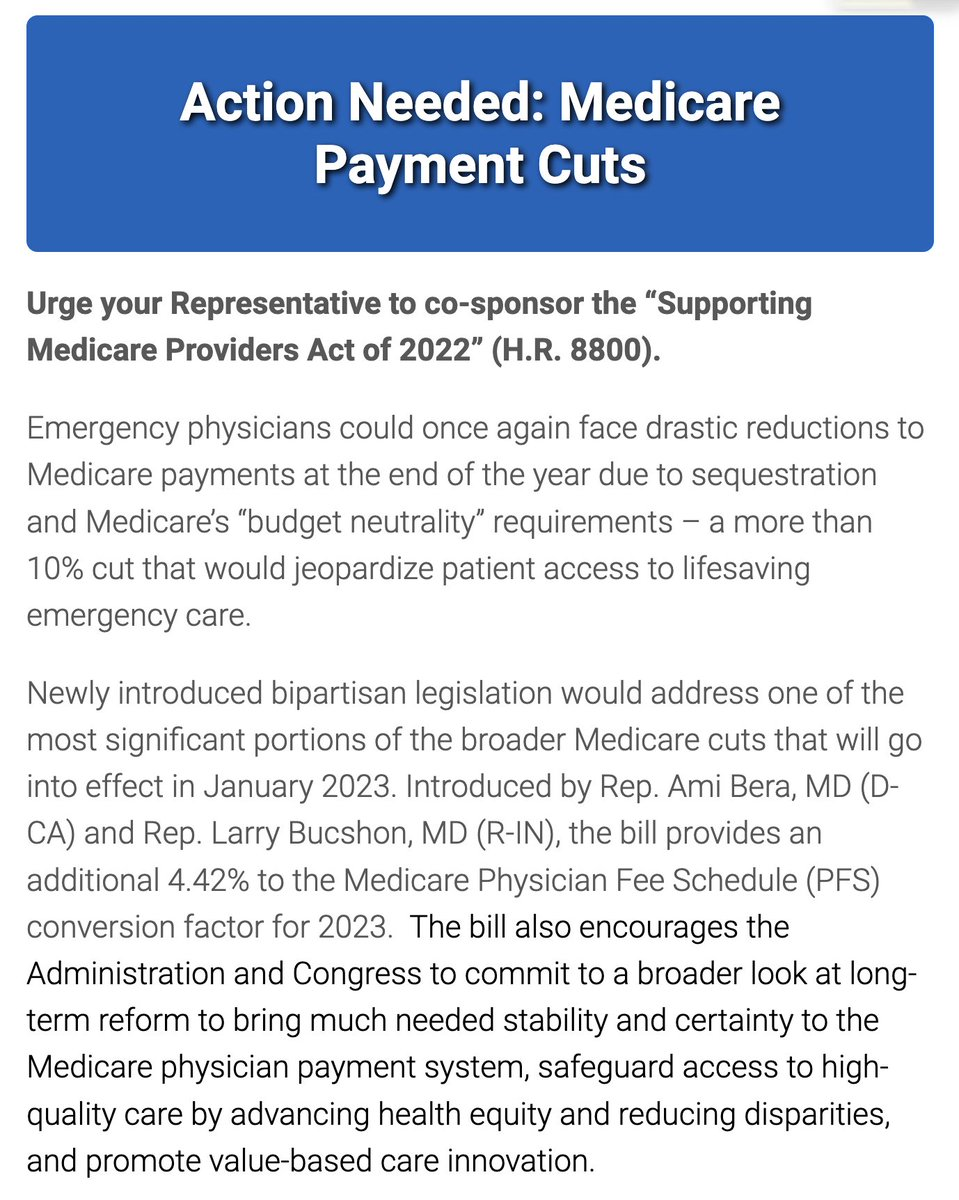
H.R.8800 – Supporting Medicare Providers Act of 2022

Due to the ongoing recess leading to the midterm elections, very important legislation introduced in September, H.R. 8800 – Supporting Medicare Providers Act of 2022, has stalled.

This critical, bipartisan legislation would stabilize Medicare for physicians and patients because it:

  1. Stops the 4.42% of the Medicare cuts related to the budget neutrality adjustment in the Medicare Physician Fee Schedule (MPFS), helping to buoy physician practices that are still recovering from the pandemic;
  2. Protects patients access to care, particularly in underserved communities; and
  3. Provides a commitment to long-term Medicare payment reform.

The AMA declares racism a public health threat

https://mailchi.mp/4422fbf9de8c/the-weekly-gist-november-20-2020?e=d1e747d2d8

AMA Declares Racism a Public Health Threat and Adopts Anti-Racist Policies  - Non Profit News | Nonprofit Quarterly

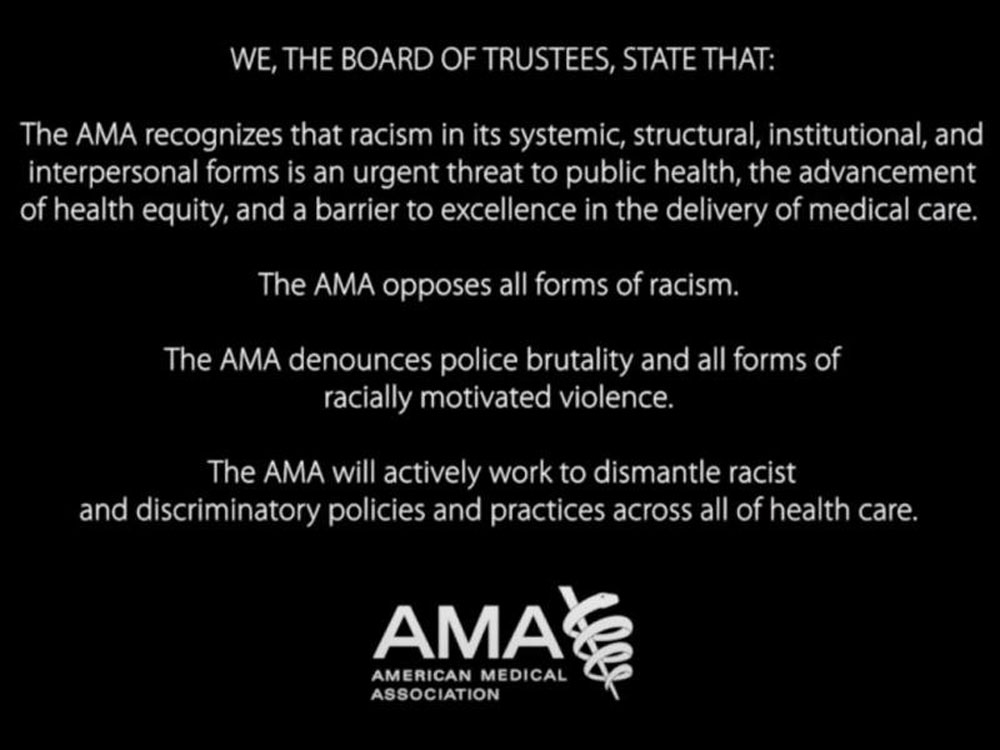
On Monday, the American Medical Association (AMA) voted to recognize racism as an “urgent threat to public health”. At its annual meeting, the organization’s House of Delegates voted to take actions to confront systemic, cultural and interpersonal racism, including acknowledging harm and bias in medical research and healthcare delivery, funding research to identify risks of racial bias to health, and encouraging medical schools to teach students about the causes and effects of racism, and strategies to prevent adverse health outcomes.

The resolution was one of several proposed items aimed at addressing racial diversity and equity in medical education and care delivery. Over the past two years, the AMA has been moving toward a more progressive stance on health and social policy; in June the AMA Board of Trustees also pledged action against racism and police brutality in response to the murder of George Floyd.

A generational divide between older and younger doctors was also apparent during last year’s debates on Medicare for All, when the organization narrowly voted to maintain its opposition to single-payer healthcare in a close vote that would have been unimaginable a decade ago.

At this week’s meeting, however, the group gave its stamp of approval to proposals for a more limited “public option” coverage expansion. As more young physicians enter the field of medicine, we’d expect the AMA to become a stronger voice on a range of social and policy issues. 

Northwell CEO Urging Healthcare Providers to Mobilize for Gun Control

https://www.healthleadersmedia.com/strategy/northwell-ceo-urging-healthcare-providers-mobilize-gun-control

Image result for Gun Control

The prominent executive is pushing beyond a letter he released last week and is now seeking to rally his peers around solving what he sees as a public health crisis.


KEY TAKEAWAYS

‘All of us have allowed this crisis to grow,’ he wrote in a letter published Thursday in The New York Times.

Healthcare CEOs should put pressure on politicians without resorting to ‘blatant partisanship,’ he said.

Northwell Health President and CEO Michael J. Dowling isn’t done pushing fellow leaders of healthcare provider organizations to take political action in the aftermath of deadly mass shootings.

Dowling addressed healthcare CEOs in a call to action published online last week by the Great Neck, New York–based nonprofit health system. Now he’s published a full-page print version of that letter in Thursday’s national edition of The New York Times, while reaching out directly to peers who could join him in a to-be-determined collective action plan to curb gun violence.

“To me, it’s an obligation of people who are in leadership positions to take some action, speak out, and prepare their organizations to address this as a public health issue,” Dowling tells HealthLeaders.

Wading into such a politically charged topic is sure to give some healthcare CEOs pause. Even if they keep their advocacy within all legal and ethical bounds, they could face rising distrust from community members who oppose further restrictions on firearms. But leaders have a responsibility to thread that needle for the sake of community health, Dowling says.

“I do anticipate that there’ll be criticism about this, but then again, if you’re in a leadership role, criticism is what you’ve got to deal with,” he says.

Dowling argues that healthcare leaders have successfully spoken out about other public health crises, such as smoking and drug use. But they have largely failed to respond adequately as gun violence inflicts considerable harm—both physical and emotional—on the communities they serve, he says.

“It is easy to point fingers at members of Congress for their inaction, the vile rhetoric of some politicians who stoke the flames of hatred, the lax laws that provide far-too-easy access to firearms, or the NRA’s intractable opposition to common sense legislation,” Dowling wrote in the print version of his letter. “It is far more difficult to look in the mirror and see what we have or haven’t done. All of us have allowed this crisis to grow. Sadly, as a nation, we have become numb to the bloodshed.”

His letter proposes a four-part agenda for healthcare leaders to tackle together:

  1. Put pressure on elected officials who “fail to support sensible gun legislation.” He urged healthcare CEOs to increase their political activity but avoid “blatant partisanship.” The online version of his letter links to OpenSecrets.org‘s repository of information on campaign contributions from gun rights interest groups to politicians.
  2. Invest in mental health without stigmatizing. Most mass murderers aren’t “psychotic or delusional,” Dowling wrote. Rather, they’re usually just disgruntled people who let their anger erupt into violence, which is why firearms sales to people at risk of harming themselves or others should be prohibited, he wrote.
  3. Increase awareness and training. Individuals shouldn’t be allowed to buy or access certain types of firearms “that serve no other purpose than to inflict mass casualties,” he wrote. Healthcare leaders should support efforts to spot risk factors and better understand so-called “red flag” laws that empower officials to take guns away from people deemed to be a potential threat to themselves or others, he wrote.
  4. Support universal background checks. In the same way that doctors shouldn’t write prescriptions without knowing a patient’s medical history to ensure the drug will do no harm, gun sellers shouldn’t be allowed to complete a transaction without having a background check conducted on the buyer, Dowling wrote, adding that a majority of Americans support this idea.

The letter notes that the U.S. has nearly 40,000 firearms-related deaths each year and that several dozen people have died in mass shootings thus far in 2019, including 31 earlier this month in separate shootings in El Paso, Texas, and Dayton, Ohio.

Corporate Responsibility

The way for-profit companies think about their relationship with the communities in which they operate has been shifting for some time. The most recent evidence of that shift came earlier this week, when the influential Business Roundtable released a revised statement on the principles of corporate governance, responding to criticism over the so-called “primacy of shareholders.”

The 181 CEOs who signed onto the new statement said they would run their business not just for the good of their shareholders but also for the good of customers, employees, suppliers, and communities. There’s some similarity between that updated notion of corporate responsibility and the sort of advocacy work Dowling wants to see from his for-profit and nonprofit peers alike.

Every single organization has a social mission, and large organizations that have sway in a local community have a responsibility to the community’s health, Dowling says.

“A healthy community helps and creates a healthy organization,” he says.

One major factor that may be pushing more CEOs to take a public stance on politically sensitive issues—or at least giving them the cover to do so confidently—is the generational shift in the U.S. workforce. Although most Americans overall say CEOs shouldn’t speak out, younger workers overwhelmingly support such action, as Fortune‘s Alan Murray reported, citing the magazine’s own polling.

Dowling says he has received hundreds of letters, emails, and phone calls from members of Northwell Health’s 70,000-person workforce expressing support in light of his original letter published online last week.

“The feedback has been absolutely universal in support,” he says.

But Which Policies?

Even among healthcare professionals who agree it’s appropriate to speak out on politically charged topics, there’s sharp disagreement over which policies lawmakers should enact and whether those policies would infringe on the public’s Second Amendment rights.

The group Doctors for Responsible Gun Ownership (DRGO) rejects the premise of Dowling’s argument: “Firearms are not a public health issue,” the DRGO website states, arguing that responsible gun ownership has been shown to benefit the public health by preventing violent crime.

Dennis Petrocelli, MD, a psychiatrist in Virginia, wrote a DRGO article that called Virginia’s proposed red flag law “misguided” and perhaps “the single greatest threat to our constitutional freedoms ever introduced in the Commonwealth of Virginia.” His concern is that the government might be able to take guns away without any real evidence of a threat.

While gun rights advocates may see Dowling as merely their latest political foe, Dowling contends that he’s pushing for a cause that can peaceably coexist with the constitutional right to bear arms.

“You can have effective, reasonable legislative action around guns that still protects the essence of what many people believe to be the core of the Second Amendment,” Dowling says. “It’s not an either/or situation.”

Others Speaking Out

Dowling isn’t, of course, the only healthcare leader speaking out about gun violence.

On the same day last week that Northwell Health published Dowling’s online call to action, Ascension published a similar letter from President and CEO Joseph R. Impicciche, JD, MHA, who referred to gun violence in American society as a “burgeoning public health crisis.”

“Silence in the face of such tragedy and wrongdoing falls short of our mission to advocate for a compassionate and just society,” Impicciche wrote, citing the health system’s Catholic commitment to defend human dignity.

The American Medical Association (AMA) and American College of Emergency Physicians (ACEP) each issued statements this month calling for public policy changes in response to these recent shootings, continuing their long-running advocacy work on the topic.

American Hospital Association 2019 Chairman Brian Gragnolati, who is president and CEO of Atlantic Health System in Morristown, New Jersey, said in a statement this month that hospitals and health systems “play a role in the larger conversation and are determined to use our collective voice to prevent more senseless tragedies.”