Fearing a ‘Twindemic,’ Health Experts Push Urgently for Flu Shots

Fearing a 'Twindemic,' Health Experts Push Urgently for Flu Shots ...

There’s no vaccine for Covid-19, but there’s one for influenza. With the season’s first doses now shipping, officials are struggling over how to get people to take it.

As public health officials look to fall and winter, the specter of a new surge of Covid-19 gives them chills. But there is a scenario they dread even more: a severe flu season, resulting in a “twindemic.”

Even a mild flu season could stagger hospitals already coping with Covid-19 cases. And though officials don’t know yet what degree of severity to anticipate this year, they are worried large numbers of people could forgo flu shots, increasing the risk of widespread outbreaks.

The concern about a twindemic is so great that officials around the world are pushing the flu shot even before it becomes available in clinics and doctors’ offices. Dr. Robert Redfield, director of the U.S. Centers for Disease Control and Prevention has been talking it up, urging corporate leaders to figure out ways to inoculate employees. The C.D.C. usually purchases 500,000 doses for uninsured adults but this year ordered an additional 9.3 million doses.

Dr. Anthony Fauci, director of the National Institute of Allergy and Infectious Diseases, has been imploring people to get the flu shot, “so that you could at least blunt the effect of one of those two potential respiratory infections.”

In Britain, Prime Minister Boris Johnson has been waging his own pro flu-shot campaign. Last month, he labeled people who oppose flu vaccines “nuts” and announced the country’s largest ever rollout of the shots. In April, one of the few reasons Australia allowed citizens to break the country’s strict lockdown was to venture out for their flu shots.

The flu vaccine is rarely mandated in the U.S. except by some health care facilities and nursery schools, but this month the statewide University of California system announced that because of the pandemic, it is requiring all 230,000 employees and 280,000 students to get the flu vaccine by November 1.

A life-threatening respiratory illness that crowds emergency rooms and intensive care units, flu shares symptoms with Covid-19: fever, headache, cough, sore throat, muscle aches and fatigue. Flu can leave patients vulnerable to a harsher attack of Covid-19, doctors believe, and that coming down with both viruses at once could be disastrous.

The 2019-20 flu season in the United States was mild, according to the C.D.C. But a mild flu season still takes a toll. In preliminary estimates, the C.D.C. says that cases ranged from 39 million to 56 million, resulting in up to 740,000 hospitalizations and from 24,000 to 62,000 flu-related deaths.

According to the C.D.C., flu season occurs in the fall and winter, peaking from December to February, and so was nearing its end as the pandemic began to flare in the United States in March.

But now, fighting flu proactively during the continuing pandemic presents significant challenges: not only how to administer the shot safely and readily, but also how to prompt people to get a shot that a majority of Americans have typically distrusted, dismissed and skipped.

With many places where the flu shot is administered en masse now inaccessible — including offices and plants that offered it free to employees on site and school health clinics — officials have been reaching out to local health departments, health care providers and corporations to arrange distribution. From now through Oct. 31, publicity campaigns will blast through social media, billboards, television and radio. Because the shot will be more difficult to access this year, people are being told to get it as soon as possible, although immunity does wane. There will be flu shot tents with heaters in parking lots and pop-up clinics in empty school buildings.

Because of the efforts, vaccine makers are projecting that a record 98 million flu shots will be given this year in the United States, about 15 percent more than doses ordered last year. The Kaiser Permanente health care system will be flooding more than 12 million of its members with flu shot reminders via postcard, email, text and phone calls.

Pharmacies and even supermarkets are expected to play a bigger role than they have in previous years. As of this week, Walgreens and CVS will have flu shots available. Walgreens will be hosting additional off-site flu vaccine clinics in community centers and churches. To reduce contact time, CVS is allowing patients to fill out paperwork digitally.

In New York City, which averages about 2,000 flu-related deaths a year, the health department has been reaching out to hundreds of independent pharmacies to administer the shots, because they are often located in outer-borough neighborhoods where the coronavirus has been rampaging. The health department has a detailed online flu vaccine locator.

“Access is a problem for all adult vaccines,” said L. J. Tan, chief strategy officer for the Immunization Action Coalition, a nonprofit group that works to increase vaccination rates, who was an early promoter of the term twindemic. “Adults may think, If I can get the flu shot easily, I might consider it.”

But as difficult as getting the flu shot to people safely will be, perhaps harder still will be persuading them to actually get it. In the 2018-19 flu season in the United States, only 45.3 percent of adults over 18 got the vaccine, with rates for those ages 18 to 50 considerably lower.

Skepticism to this vaccine runs high, particularly in communities of color because of longstanding distrust and discrimination in public health.2017 study in the journal Vaccine noted that, compared with white people, “African Americans were more likely to report barriers to vaccination, were more hesitant about vaccines in general and the flu vaccine specifically, more likely to believe in conspiracy theories and use naturalism as an alternative to getting vaccinated.”

Across all demographic groups, perhaps the most striking reason given for avoiding the flu vaccine is that people do not see it as efficacious as, say, the measles vaccine.

Indeed, it is a good vaccine but not a great one. It must be repeated annually. Immunity takes up to two weeks to kick in. But its efficacy also depends on how accurately infectious disease centers worldwide forecast which strains are expected to circulate in the coming year. And then those strains can mutate.

Although the flu shot confers immunity at all ages over six months, it can be less complete in people over 65. Depending on many factors, the shot’s effectiveness in a given year can range from 40 to 60 percent.

“But a vaccine not given won’t protect anyone,” said Dr. Jane R. Zucker, assistant commissioner for the Bureau of Immunization at the New York City Health Department, which has been hosting webinars for providers about how to have conversations about the flu shot with hesitant patients.

As health officials note, should a vaccinated person contract the flu, the severity will almost certainly be reduced, hospitalization rarely necessary. Especially with Covid-19 raging, public officials reason, those odds look pretty good.

Another reason people give for not getting the shot is they think it makes them sick.

“People who say ‘I’ll never get it because it gives me the flu’ have not had the flu and don’t know what it is,” said Patsy Stinchfield, senior director of infection prevention at Children’s Minnesota.

“What you’re feeling is your body’s immune response to the virus’s antigens,” said Ms. Stinchfield, a member of the C.D.C.’s influenza work group. “You may feel flu-ish. And that’s a good thing. It’s your body’s way of saying, ‘I am ready for the flu, and I won’t get as sick if I get the real one.’”

Public campaigns will describe the shot as a critical weapon during the pandemic. “Hopefully people will say, ‘There’s no Covid vaccine so I can’t control that, but I do have access to the flu vaccine and I can get that,’” Ms. Stinchfield said. “It gives you a little power to protect yourself.”

Other campaigns will emphasize familial and community responsibility.

Usually, flu vaccine compliance rates among people ages 18 to 49 are low. Vermont’s, for example, is only about 27 percent.

Christine Finley, the state’s immunization program manager, believes that rates will improve because of the pandemic’s stay-at-home households. “People are more aware that the risks they take can negatively impact others,” she said. “They’re often taking care of young children and older parents.”

If any example could prove instructive about protective behavior and flu vaccines during the coronavirus epidemic, it could well be Australia.

Australia’s flu vaccine rate tends to be modest, but this year demand was high. The government’s rollout of the shot began earlier than usual for the June-through-August winter because the coronavirus pandemic was exploding. Though the government had also issued strict no-entry limits among many states and territories and bans on international travel, the flu shot was one of the few reasons people could emerge from lockdown.

The prevalent strain circulating in the country is Type A, the most common and virulent form of flu, said Dr. Kelly L. Moore, a public health expert at the Vanderbilt University School of Medicine.

According to the C.D.C., Type A is the most likely to circulate globally. It mutates readily, particularly as it jumps between animals and humans.

“There are two strains of Type A influenza in the vaccine,” Dr. Moore said, “and so the very best way to protect yourself is to get the shot.”

Reported cases of flu in Australia have dropped 99 percent compared with 2019.

Australia’s milder-than-usual flu season is likely the result of a number of factors — strong flu vaccination uptake, social distancing, but also severely decreased movement of people,” said Dr. Jonathan Anderson, a spokesman for Seqirus, a supplier of flu vaccine.

But though American public health authorities usually look to Australia’s flu season as a predictive, Australians say this year it’s not a reliable indicator.

“This situation is of no comfort as these measures do not apply to the United States where the populace has never been effectively physical distancing,” nor have the country’s entry restrictions been as onerous, said Dr. Paul Van Buynder, a public health professor at Griffith University in Queensland, Australia.

All that Americans can do is get vaccinated against flu, he added, because circulation of the coronavirus remains high.

“It is likely they will have a significant influenza season this northern winter,” he said.


More than 1,000 people in the US have died of coronavirus nearly every day this month

https://www.cnn.com/2020/08/17/health/us-coronavirus-monday/index.html?utm_source=Sailthru&utm_medium=email&utm_campaign=Issue:%202020-08-17%20Healthcare%20Dive%20%5Bissue:29123%5D&utm_term=Healthcare%20Dive

Corpse Starts to Move In Body Bag - Valdelucio Goncalves - YouTube

The Covid-19 death toll in the United States has soared to more than 170,000, just 18 days after the nation marked 150,000 lives lost.

As cases have increased in the US, the lull between grim milestones has grown shorter. It took 54 days for the number of people killed by the virus to go from one to 50,000, and then 34 days to cross 100,000 mark on May 27. Now, more than 5.4 million people have been infected and 170,052 have died, according to data from Johns Hopkins University.
By September 5, the number of deaths could grow to 189,000, according to a projection from an ensemble forecast by the US Centers for Disease Control and Prevention.
More than 1,000 coronavirus deaths have been reported nearly every day this month. Since July 27, only five days have been under that threshold.

Cases and deaths are climbing as a potential vaccine is still months away and as students return to school for in-person classes amid growing outbreaks among younger populations.


‘We’ve got to break through to our young people’

While older Americans are more at risk for severe illness from coronavirus, health experts and officials are continuing to warn that younger populations are at the forefront of its spread.
“We’ve got to break through to our young people that they are not immune to the virus,” Chicago Mayor Lori Lightfoot said.
The city has seen a steady increase in cases, which she attributed to 18 to 29-year-olds.
Also steadily increasing is the number of cases among children, according to CDC guidance.
Early data led many experts to believe that children did not contract or spread the virus in the same way that adults do. But as more research has been done into their age group, that belief is changing, the CDC said.
“Recent evidence suggests that children likely have the same or higher viral loads in their nasopharynx compared with adults and that children can spread the virus effectively in households and camp settings,” the guidance states.
The new guidance comes as many schools have opened their doors to bring students back for in-person learning. Several have already experienced outbreaks, prompting quarantines and closures.
The Los Angeles Unified School District (LAUSD), which will begin its school year virtually this week, is launching a new program “that will provide regular COVID-19 testing and contact tracing to school staff, students and their families,” Superintendent Austin Beutner announced in a news release Sunday.
“Extraordinary circumstances call for extraordinary actions, and while this testing and contact tracing effort is unprecedented, it is necessary and appropriate,” Beutner said.

Infections reported as colleges reopen

Cases have also cropped up at colleges and universities as students return to campus.
Oklahoma State University announced Sunday that at least 23 sorority members in an off-campus house tested positive for the virus. The entire house is in isolation or quarantine and “will be prohibited from leaving the facility,” the university said.
Less than a week after starting classes, the University of North Carolina at Chapel Hill announced its fourth cluster of coronavirus on Sunday. The clusters were located at two residence halls, a private apartment complex that serves students and the Sigma Nu fraternity.
The North Carolina Department of Health and Human Services defines a cluster as five or more cases in close proximity.
The latest cases come after some universities reported infections even before the new school year began.
Over the summer, at least 38 students living in 10 University of Washington fraternity houses tested positive for the virus. And officials at UC Berkley confirmed 47 cases in just one week in July. Most of those cases, the university said in a statement, came from “parties connected to the CalGreek system.”

Positivity rates climbing

Health officials are hopeful that a new saliva test could give Americans a fast and inexpensive way to learn if they have Covid-19 and help to prevent increasing spread.
The SalivaDirect test, from researchers at the Yale School of Public Health, received emergency use authorization from the Food and Drug Administration on Saturday.
“If cheap alternatives like SalivaDirect can be implemented across the country, we may finally get a handle on this pandemic, even before a vaccine,” said Nathan Grubaugh, a Yale assistant professor of epidemiology.
The test comes as frustration grows over testing delays and shortages. Seventeen states are performing fewer tests this past week compared with the previous week, according to the Covid Tracking Project.
But while testing has gone down in those states, test positivity rates have increased in 34 states.
The test positivity rate is the percentage of tests being performed that come back positive for the virus. It is one of the metrics experts encourage officials to monitor when making reopening decisions.
Part of Illinois will be under new guidelines after three days in a row with a test positivity rate of 8% or higher, according to a news release from Gov. J.B. Pritzker.
Beginning Tuesday, all bars, restaurants and casinos in the Metro East area of Illinois will close by 11 p.m. Party buses will be closed and gatherings will be limited to 25 people or less, Pritzker said Sunday.
“If the data shows we need to go backwards in our reopening, I won’t hesitate to tighten restrictions to protect our collective health,” said Pritzker.


‘We’ve got to do better than this’: College students raise alarm by packing bars, avoiding masks

https://www.washingtonpost.com/nation/2020/08/17/alabama-georgia-college-parties-covid/?utm_campaign=wp_main&utm_medium=social&utm_source=facebook&fbclid=IwAR12brHn8KNahffNq1suWFbq1vjIJUj-LH8Y911HNVw-hhjhA-RIYiZqKdo

As college students pack bars, local officials sound a dire ...

Music blared outside a row of off-campus houses on Saturday near the University of North Georgia as hundreds of students packed the streets and front yards. Virtually no one wore a mask.

The huge party in Dahlonega, Ga., captured in a viral Twitter video, was one of a number of mass gatherings around the country this weekend as tens of thousands of students returned to college towns already on edge amid the novel coronavirus pandemic.

Local officials from Georgia to Alabama to Oklahoma reacted with horror and anger on Sunday, warning that unless students take social distancing and mask rules seriously, the fall semester could come to a swift end.

“Why?” tweeted Walt Maddox, mayor of Tuscaloosa, Ala., above a photo of hundreds of mostly mask-free University of Alabama students outside downtown restaurants. “We are desperately trying to protect @tuscaloosacity.”

Some universities are already battling coronavirus outbreaks, including the University of North Carolina at Chapel Hill — where four viral clusters have emerged one week after in-person classes started — and Oklahoma State University, where a single sorority house has 23 confirmed cases.

There’s no national consensus on how to approach college this fall, with many schools going at least partially online and others trying mass testing of students. But other large schools are welcoming everyone back to campus and relying on masks and social distancing to avoid outbreaks — a plan, as local leaders noted this past weekend, that could crumble if students don’t abide by the recommendations.

In Dahlonega, university officials chided the hundreds of students who gathered at an off-campus housing complex for the Saturday night party. In-person classes are scheduled to start Monday for the school’s roughly 19,000 students.

“We are disappointed that many of our students chose to ignore COVID-19 public health guidance by congregating in a large group without social distancing or face coverings,” a school spokeswoman told the Gainesville Times.

At Alabama’s two biggest schools, football players were particularly vocal in sounding the alarm as they watched fellow students congregate without face coverings. Although many of college football’s biggest conferences have canceled their fall seasons, the Big 12, ACC and SEC are pushing ahead — assuming campus outbreaks don’t interfere.

At Auburn University, wide receiver Anthony Schwartz tweeted Saturday that he had “seen crowds of people and none of them are wearing masks.” Chris Owens, a center at the University of Alabama, tweeted a photo on Sunday afternoon of a crowd of students with barely any face coverings in sight, asking: “How about we social distance and have more than a literal handful of people wear a mask? Is that too much to ask Tuscaloosa?”

Alabama’s athletic director, Greg Byrne, also warned that the scenes in Tuscaloosa put the season at risk.

“Who wants college sports this fall?? Obviously not these people!!” he tweeted Sunday. “We’ve got to do better than this for each other and our campus community. Please wear your masks!”

Maddox, the mayor, said he would ask the school’s police force to help Tuscaloosa police enforce mask rules. “Wearing a mask and practicing social distancing is not much to ask for to protect yourself, your family, your friends … and the jobs of thousands of people,” he tweeted.

In Stillwater, Okla., the editor at Oklahoma State’s student newspaper shot videos this weekend of packed clubs and bars and long lines outside downtown establishments.

The campus was already on high alert after the school announced Saturday it had quarantined dozens of students inside the Pi Beta Phi sorority house following at least 23 positive tests on Friday. “I’ve decided.. I’m not going to class on Monday,” Tre Sterling, a defensive back on OSU’s football team, tweeted above videos of student crowds downtown.

Stillwater Mayor Will Joyce said the city council would consider new pandemic rules on Monday, including an “emergency declaration, if necessary.”

“Every single person in Stillwater has a responsibility to help,” he tweeted. “Take every precaution you can to slow the spread. Wear your mask, avoid crowded areas, wash your hands, be a good neighbor.”


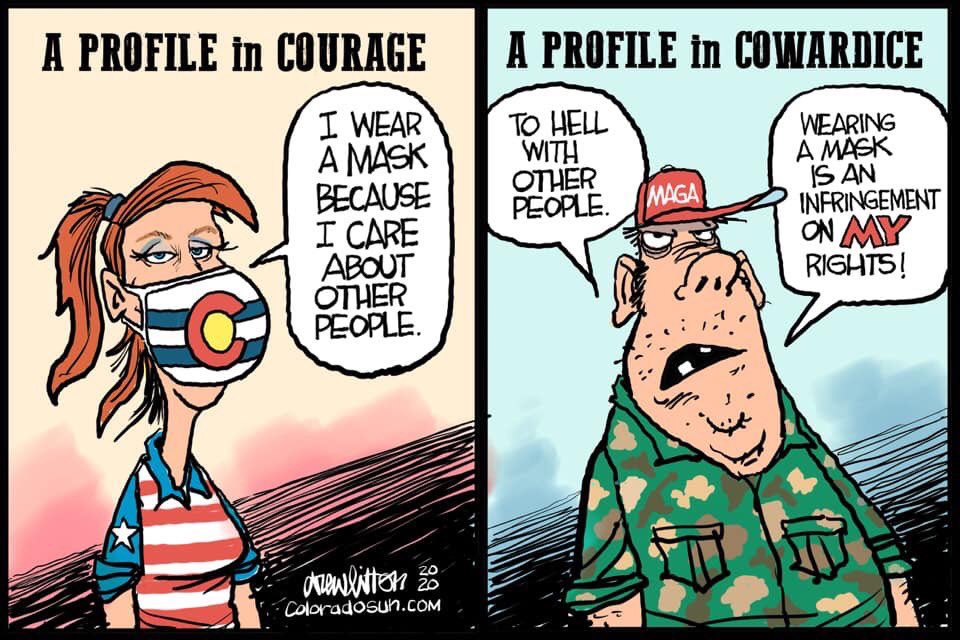
Cartoon – Profile in Courage vs. Cowardice

COVID-19 News - Updated Daily

Prosecuting the case against the COVID response

https://mailchi.mp/647832f9aa9e/the-weekly-gist-august-14-2020?e=d1e747d2d8

Bruce Plante Cartoon: Corona virus denial

This week, in her debut as running mate to presidential candidate Joe Biden, California Sen. Kamala Harris gave a preview of one of the Democratic ticket’s key arguments for the fall campaign, making a full-throated, prosecutorial case against the Trump administration’s handling of the coronavirus pandemic.

“The virus has impacted almost every country,” Harris said, “but there’s a reason it has hit America worse than any other advanced nation. It’s because of Trump’s failure to take it seriously from the start.

After receiving a briefing from public health experts on Thursday, Biden and Harris argued for a more comprehensive, aggressive national strategy to battle the virus, including major federal investment in contact tracing, a national mask mandate, and guaranteed free access to a COVID vaccine when it becomes available.

The remarks came as the US experienced the deadliest day of the summer so far, with nearly 1,500 COVID fatalities on Wednesday, and a seven-day rolling average of over 1,000 deaths per day for the last 17 days. Meanwhile, a new analysis by the New York Times, using data from the Centers for Disease Control and Prevention (CDC), indicated that the true US death toll from COVID may be as much as 35 percent higher than the reported total of 167K—a finding based on “excess deaths” above normal levels since March.

As President Trump continued to urge schools to reopen for in-person instruction nationwide, the White House released new guidance for ensuring students’ safe return to school. The guidance encouraged social distancing, frequent handwashing, better ventilation of school facilities, and the use of outdoor settings wherever possible.

Despite the President’s claim last week that children are “virtually immune” from the virus, a new analysis from the American Academy of Pediatrics and the Children’s Hospital Association showed that 97,000 children tested positive for COVID in the last two weeks of July alone, a 40 percent increase in the total number of known cases over that period.

About 340,000 children have tested positive so far, representing about 9 percent of all US cases. As schools face pressure to reopen, those numbers are likely to mount, and early-opening school districts in Georgia, Tennessee, Indiana, and Mississippi are already struggling to keep schools open amid rising cases.

Federal assistance to help schools deal with what seems like inevitable rounds of positive cases and closures is not forthcoming, however: after failing to reach a deal on another round of COVID relief, lawmakers have left Washington until September.

US coronavirus update: 5.2M cases; 167K deaths; 64.6M tests conducted.


U.S. records deadliest coronavirus day of the summer

https://www.axios.com/1485-us-coronavirus-death-record-5ee493cc-df91-4549-8c9d-43a5fee0bd87.html

U.S. records deadliest coronavirus day of the summer - Axios

The U.S. reported 1,485 deaths due to the coronavirus on Wednesday, COVID Tracking Project data shows.

Why it matters: It’s the highest single-day COVID-19 death toll since May 15, when the country reported 1,507 deaths. The U.S. has seen a total of 157,758 deaths from the virus.

The big picture: Georgia reported 109 deaths on Wednesday — its second triple-digit day in a row.

Go deeper: 5 states set single-day coronavirus case records last week


The two sides of America’s coronavirus response

https://www.axios.com/us-coronavirus-vaccine-testing-science-b656e905-67d1-4836-863e-c91f739cfd1e.html

The two sides of America's coronavirus response - Axios

America’s bungled political and social response to the coronavirus exists side-by-side with a record-breaking push to create a vaccine with U.S. companies and scientists at the center.

Why it matters: America’s two-sided response serves as an X-ray of the country itself — still capable of world-beating feats at the high end, but increasingly struggling with what should be the simple business of governing itself.

What’s happening: An index published last week by FP Analytics, an independent research division of Foreign Policy, ranked the U.S. 31st out of 36 countries in its assessment of government responses to COVID-19.

  • That puts it below developed countries like New Zealand and Denmark, and also lower than nations with fewer resources like Ghana, Kenya and South Africa.
  • The index cited America’s limited emergency health care spending, insufficient testing and hospital beds and limited debt relief.

By the numbers: As my Axios colleague Jonathan Swan pointed out in an interview with President Trump, the U.S. has one of the worst per-capita death rates from COVID-19, at 50.29 per 100,000 population.

Yes, but: Work on a COVID-19 vaccine is progressing astonishingly fast, with the Cambridge-based biotech company Moderna and the National Institutes of Health announcing at the end of July that they had begun Phase 3 of the clinical trial.

  • Their efforts are part of a global rush to a vaccine, and while companies in the U.K. and China are jockeying for the lead, U.S. companies and the NIH’s resources and expertise have been key to the effort.
  • Anthony Fauci has said he expects “tens of millions” of doses to be available by early 2021, a little over a year after the novel coronavirus was discovered.
  • If that turns out to be the case, “the Covid-19 vaccine could take a place alongside the Apollo missions as one of history’s greatest scientific achievements,” epidemiologist Michael Kinch recently wrote in STAT.

So which is the real American response to COVID-19? The bungled testing policies, the politically driven rush to reopen, the tragic racial divide seen in the sick and the dead? Or the warp-speed work to develop a vaccine in a year when most past efforts took decades?

Be smart: It’s both.

The bottom line: It can often feel as if there are two Americas, and not even a virus that has spread around the world seems capable of bridging that gap.


U.S. doing a lot less coronavirus testing

https://www.axios.com/newsletters/axios-vitals-32689a40-e409-4547-8468-b03dc589c082.html

The two sides of America's coronavirus response - Axios

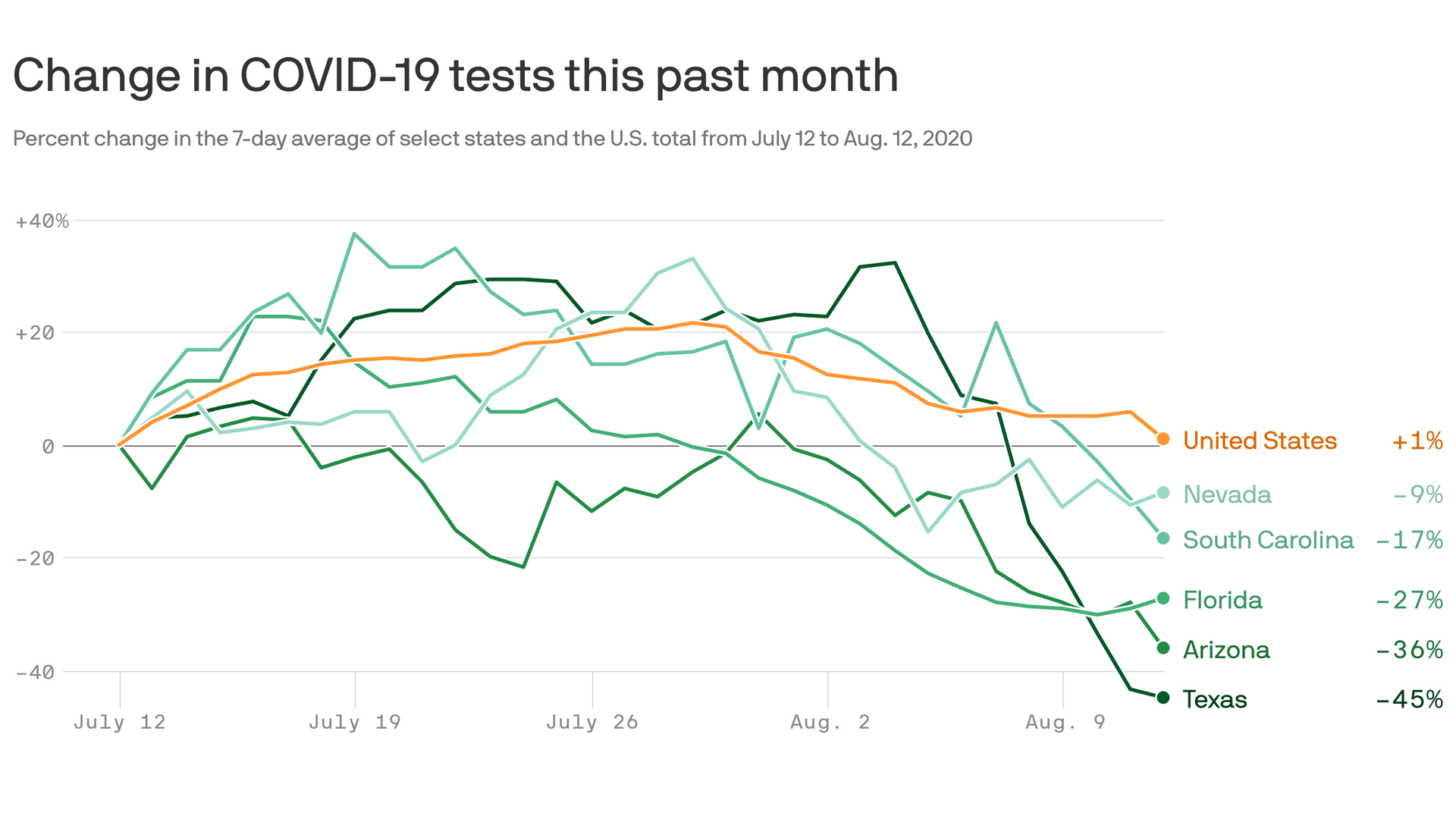
The U.S. is cutting back on coronavirus testing. Nationally, the number of tests performed each day is about 17% lower than it was at the end of July, and testing is also declining in hard-hit states.

Why it matters: This big reduction in testing has helped clear away delays that undermined the response to the pandemic. But doing fewer tests can also undermine the response to the pandemic.

By the numbers: At the end of July, America was doing more than 800,000 tests a day. This week, it’s hovered around 715,000.

  • Even as states with particularly bad outbreaks pull back on their testing, the proportion of tests coming back positive is still high — which would normally be an indication that they need to be doing more tests.
  • In Texas, 19% of tests are coming back positive, according to Nephron Research. In Florida, the rate of positive tests is 18%, and in Nevada, 17%.

Yes, but: Experts have said reducing the demand for testing may be the best way to alleviate long delays, which made tests all but useless. And that appears to be working.

Driving the news: The Department of Health and Human Services estimated this week that nearly 90% of all tests are being completed within three days — a big improvement from turnaround times that had been stretching well over a week.

  • Quest Diagnostics says its expected turnaround time is now 2–3 days, and less for priority patients. LabCorp announced a similar turnaround time last week.

The bottom line: The U.S. is averaging 50,000 new cases a day, and that high caseload is ultimately why the demand for testing is more than the system can handle.

  • We can’t get our caseload under control without fast, widespread testing, but we can’t achieve fast, widespread testing with such a high caseload.


US has averaged over 1,000 coronavirus deaths per day for 16 straight days

https://www.cnn.com/2020/08/12/health/us-coronavirus-wednesday/index.html?utm_source=nl&utm_brand=wired&utm_mailing=WIR_Science_081220&utm_campaign=aud-dev&utm_medium=email&utm_term=WIR_Science&bxid=5db707423f92a422eaeaf234&cndid=54318659&esrc=bounceX&source=EDT_WIR_NEWSLETTER_0_SCIENCE_ZZ

CCR - Who'll Stop The Rain song lyrics music lyrics | Great song ...

Coronavirus continues to spread at high rates across the US South, Midwest and West, even as the total number of new Covid-19 cases has declined since a summer surge.

Nationally, over the last seven days, the US is averaging just under 53,000 new cases of Covid-19 per day, down 11% from the week prior.
As a result of all those cases, deaths from the virus have remained high. The seven-day average of daily coronavirus deaths was just over 1,000 on Tuesday, the 16th consecutive day the US averaged over 1,000 deaths per day.
Adjusting for population, states in the Southeast are seeing the most new cases. Georgia and Florida — states led by Republican governors who have not issued face mask requirements — have the highest per capita new cases over the last seven days, followed by Alabama and Mississippi.
On Wednesday, Florida reported more than 8,000 new cases and 212 new deaths, according to data released by the Florida Department of Health.
Covid-19 causes worse outcomes for older people, but young people are not immune. In Florida, people under 44 make up about 57% of the state’s 545,000 cases, 20% of the state’s 31,900 hospitalizations, and 3% of the state’s 8,765 deaths, according to state data.
Robert Ruiz, 31 and the father of a 3-year-old, was one of the 265 people under 44 who died from coronavirus in Florida.
His sister, Chenique Mills, told CNN he was overweight and had seasonal asthma but otherwise did not smoke or drink and had no underlying health conditions.
“This is all really sudden, unexpected,” she said. “I (saw) him on Friday. I (saw) him on Saturday. He was fine, to say that he was up, and he was walking and he was eating. He was functioning. So for him to be gone on Sunday? It’s just a lot to take in.
“This virus is so serious. It really really is. And I think people (won’t) understand until it hits home, because I would be one to say that I took it really lightly until it hit home.”
The virus’s ongoing spread around the country has frustrated plans to safely reopen schools, forced college football conferences to postpone the lucrative fall season, and caused vast medical and economic pain.
And it will continue to rattle American society until people more seriously adopt recommended public health measures: social distancingavoiding large indoor gatheringshand-washingmask-wearingrapid testing and quarantining the sick.
“We have to figure out how to deal with this as a whole country because as long as there are cases happening in any part, we still have transit, especially now we have students going back to college,” said Dr. Michael Mina, assistant professor of epidemiology at Harvard T.H. Chan School of Public Health. “Any cases anywhere really keep risk pretty high all across the entirety of the United States.”


‘A Smoking Gun’: Infectious Coronavirus Retrieved From Hospital Air

A Smoking Gun': Infectious Coronavirus Retrieved From Hospital Air ...

Airborne virus plays a significant role in community transmission, many experts believe. A new study fills in the missing piece: Floating virus can infect cells.

Skeptics of the notion that the coronavirus spreads through the air — including many expert advisers to the World Health Organization — have held out for one missing piece of evidence: proof that floating respiratory droplets called aerosols contain live virus, and not just fragments of genetic material.

Now a team of virologists and aerosol scientists has produced exactly that: confirmation of infectious virus in the air.

“This is what people have been clamoring for,” said Linsey Marr, an expert in airborne spread of viruses who was not involved in the work. “It’s unambiguous evidence that there is infectious virus in aerosols.”

A research team at the University of Florida succeeded in isolating live virus from aerosols collected at a distance of seven to 16 feet from patients hospitalized with Covid-19 — farther than the six feet recommended in social distancing guidelines.

The findings, posted online last week, have not yet been vetted by peer review, but have already caused something of a stir among scientists. “If this isn’t a smoking gun, then I don’t know what is,” Dr. Marr tweeted last week.

But some experts said it still was not clear that the amount of virus recovered was sufficient to cause infection.

The research was exacting. Aerosols are minute by definition, measuring only up to five micrometers across; evaporation can make them even smaller. Attempts to capture these delicate droplets usually damage the virus they contain.

“It’s very hard to sample biological material from the air and have it be viable,” said Shelly Miller, an environmental engineer at the University of Colorado Boulder who studies air quality and airborne diseases.

“We have to be clever about sampling biological material so that it is more similar to how you might inhale it.”

Previous attempts were stymied at one step or another in the process. For example, one team tried using a rotating drum to suspend aerosols, and showed that the virus remained infectious for up to three hours. But critics argued that those conditions were experimental and unrealistic.

Other scientists used gelatin filters or plastic or glass tubes to collect aerosols over time. But the force of the air shrank the aerosols and sheared the virus. Another group succeeded in isolating live virus, but did not show that the isolated virus could infect cells.

In the new study, researchers devised a sampler that uses pure water vapor to enlarge the aerosols enough that they can be collected easily from the air. Rather than leave these aerosols sitting, the equipment immediately transfers them into a liquid rich with salts, sugar and protein, which preserves the pathogen.

“I’m impressed,” said Robyn Schofield, an atmospheric chemist at Melbourne University in Australia, who measures aerosols over the ocean. “It’s a very clever measurement technique.”

As editor of the journal Atmospheric Measurement Techniques, Dr. Schofield is familiar with the options available, but said she had not seen any that could match the new one.

The researchers had previously used this method to sample air from hospital rooms. But in those attempts, other floating respiratory viruses grew faster, making it difficult to isolate the coronavirus.

This time, the team collected air samples from a room in a ward dedicated to Covid-19 patients at the University of Florida Health Shands Hospital. Neither patient in the room was subject to medical procedures known to generate aerosols, which the W.H.O. and others have contended are the primary source of airborne virus in a hospital setting.

The team used two samplers, one about seven feet from the patients and the other about 16 feet from them. The scientists were able to collect virus at both distances and then to show that the virus they had plucked from the air could infect cells in a lab dish.

The genome sequence of the isolated virus was identical to that from a swab of a newly admitted symptomatic patient in the room.

The room had six air changes per hour and was fitted with efficient filters, ultraviolet irradiation and other safety measures to inactivate the virus before the air was reintroduced into the room.

That may explain why the researchers found only 74 virus particles per liter of air, said John Lednicky, the team’s lead virologist at the University of Florida. Indoor spaces without good ventilation — such as schools — might accumulate much more airborne virus, he said.

But other experts said it was difficult to extrapolate from the findings to estimate an individual’s infection risk.

“I’m just not sure that these numbers are high enough to cause an infection in somebody,” said Angela Rasmussen, a virologist at Columbia University in New York.

“The only conclusion I can take from this paper is you can culture viable virus out of the air,” she said. “But that’s not a small thing.”

Several experts noted that the distance at which the team found virus is much farther than the six feet recommended for physical distancing.

“We know that indoors, those distance rules don’t matter anymore,” Dr. Schofield said. It takes about five minutes for small aerosols to traverse the room even in still air, she added.

The six-foot minimum is “misleading, because people think they are protected indoors and they’re really not,” she said.

That recommendation was based on the notion that “large ballistic cannonball-type droplets” were the only vehicles for the virus, Dr. Marr said. The more distance people can maintain, the better, she added.

The findings should also push people to heed precautions for airborne transmission like improved ventilation, said Seema Lakdawala, a respiratory virus expert at the University of Pittsburgh.

“We all know that this virus can transmit by all these modes, but we’re only focusing on a small subset,” Dr. Lakdawala said.

She and other experts noted one strange aspect of the new study. The team reported finding just as much viral RNA as they did infectious virus, but other methods generally found about 100-fold more genetic matter.

“When you do nasal swabs or clinical samples, there is a lot more RNA than infectious virus,” Dr. Lakdawala said.

Dr. Lednicky has received emails and phone calls from researchers worldwide asking about that finding. He said he would check his numbers again to be sure.

But ultimately, he added, the exact figures may not matter. “We can grow the virus from air — I think that should be the important take-home lesson,” he said.