‘Stealth’ omicron: What you need to know about the subvariant

What you need to know about the 'stealth omicron' subvariant | 13newsnow.com

Scientists and health officials around the world are tracking the BA.2 subvariant of omicron, which has been referred to as “stealth omicron” because it cannot easily be identified via PCR tests.

What is the omicron BA.2 subvariant?

The BA. 2 omicron subvariant is a descendant of the original BA.1 omicron variant that has caused massive global Covid-19 surges. On Monday, the World Health Organization (WHO) urged researchers to prioritize the investigation of BA.2’s characteristics to determine whether it poses new challenges for areas already overwhelmed by the pandemic.

“The BA. 2 descendant lineage, which differs from BA. 1 in some of the mutations, including in the spike protein, is increasing in many countries,” WHO said. “Investigations into the characteristics of BA. 2, including immune escape properties and virulence, should be prioritized independently (and comparatively) to BA. 1.”

Currently, there is no evidence that BA. 2 is more transmissible or evades immunity better than BA. 1, the Washington Post reports.

In fact, experts still know very little about the transmissibility of BA.2 compared with BA.1, said Jeremy Luban, a professor of molecular medicine, biochemistry, and molecular pharmacology at UMass Medical School. And according to Luban, it is too early to determine whether vaccines and existing medications will provide adequate protection against BA.2.

Like the original omicron variant, BA.2 has many mutations, including roughly 20 found in the area targeted by most vaccines. BA.2 also has unique mutations that are not found in BA.1, which could limit the effectiveness of monoclonal antibodies, Luban said.

Further, scientists have found that BA.2 is harder to detect with PCR tests than BA.1. Although researchers were able to quickly differentiate BA.1 from the delta variant using a PCR test, the BA.2 subvariant does not possess the same “S gene target failure” seen in BA.1. As a result, BA.2 looks like the delta variant on the test, according to Wesley Long, a pathologist at Houston Methodist Hospital.

“It’s not that the test doesn’t detect it; it’s just that it doesn’t look like omicron,” Long said. “Don’t get the impression that ‘stealth omicron’ means we can’t detect it. All of our PCR tests can still detect it.”

Where is BA.2 circulating?

So far, BA.2 has been identified in 40 countries, including the United States. Although there are few reported cases of BA.2 in the United States, the subvariant is widely circulating in Asia and Europe

Throughout Europe, BA.2 seems to be the most widespread in Denmark—but experts said that could be because of the country’s robust program of sequencing the virus’s genome, the Post reports. On Jan. 20, health officials said that the BA.2 cases made up more than 50% of the country’s omicron cases.

In the United States, at least three cases have been found at Houston Methodist Hospital in Texas, which is currently studying the genetic makeup of virus samples from its patients, the Post reports.

“The good news is we have only three,” said James Musser, director of the Center for Molecular and Translational Human Infectious Diseases Research at Houston Methodist. “We certainly do not see the 5% and more that is being reported in the U.K. now and certainly not the 40% that is being reported in Denmark.”

In addition, a spokesperson for the Washington Department of Health on Monday told Fox News, “Two cases of BA.2 … were detected earlier this month in Washington.”

BA.2 remains ‘an open question’

Although BA.2 is now on at least four continents, experts say this new subvariant shouldn’t be a cause for panic, as it is expected to be relatively mild, USA Today reports.

“I don’t think it’s going to cause the degree of chaos and disruption, morbidity and mortality that BA.1 did,” said Jacob Lemieux, an infectious disease specialist at Massachusetts General Hospital. “I’m cautiously optimistic that we’re going to continue to move to a better place and, hopefully, one where each new variant on the horizon isn’t news.”

Similarly, Robert Garry, a virologist at Tulane University School of Medicine, said, “Variants have come, variants have gone.” He added, “I don’t think there’s any reason to think this one is a whole lot worse than the current version of omicron.”

Still, Musser argued that BA.2 deserves close attention until scientists can learn more about it.

“We know that omicron … can clearly evade preexisting immunity” from both vaccines and exposure to other variants of the virus, he said. “What we don’t know yet is whether son-of-omicron does that better or worse than omicron. So that’s an open question.”

COVID-19 deaths pass peak from delta surge

https://click1.email.thehill.com/ViewMessage.do;jsessionid=69623F0C51A9AD108D92583CE78B74C7

Welcome to Wednesday’s Overnight Health Care, where we’re following the latest moves on policy and news affecting your health. Subscribe here: thehill.com/newsletter-signup

Masks come to the Super Bowl: Fans attending the big game next month will be given KN95 masks.  

Despite omicron being less severe on average, the sheer number of cases has driven deaths past the peak from last year’s delta surge.  

The average number of U.S. COVID-19 deaths this week surpassed the height of the delta surge earlier this fall and is at its highest point since last winter, when the nation was coming out of the peak winter surge. 

The seven-day average of deaths hit 2,166 on Monday, according to the latest data from the Centers for Disease Control and Prevention (CDC). Average daily deaths in mid-September before the omicron variant was discovered peaked at around 1,900. 

While increasing evidence shows omicron may be less likely to cause death or serious illness than delta, the sheer infectiousness and the speed at which it spreads has overwhelmed hospitals, primarily with people who have not been vaccinated. 

The U.S. saw the highest numbers of deaths in the pandemic just over a year ago, before vaccines were widely available, when the daily average reached 3,400. The last time the U.S. topped 2,000 deaths was last February, as the country was slowly coming down from the January peak. 

Caution urged: Infections are falling in states that were hardest hit earlier, as well as broadly across the nation. Hospitalizations are also falling, but deaths are a lagging indicator and are still increasing. CDC Director Rochelle Walsenky said deaths have increased about 21 percent over the past week. 

The fact that the omicron variant tends to cause less severe disease on average also helped avoid an even greater crisis that would have occurred if it was as severe as the delta variant.  

Long COVID-19: Study author explains four factors that can predict how you get it

https://thehill.com/policy/healthcare/591528-long-covid-study-author-explains-four-factors-that-can-predict-how-you-get?userid=12325

Long COVID-19: Study author explains four factors that can predict how you  get it | KFOR.com Oklahoma City

Long COVID-19 has had an air of mystery around it for months. Doctors have struggled to explain or understand why some people who contract COVID-19 end up having lingering symptoms like fatigue, difficulty thinking clearly, or shortness of breath weeks or even months later.  

A new study published in the journal Cell helps shed some light on the condition, for the first time identifying four factors that can help predict whether someone will develop long COVID-19.  

“Being able to identify the factors that can cause the disease, cause the chronic condition, is the first step towards defining that it actually is a condition that can be treatable,” Jim Heath, president of the Institute for Systems Biology in Seattle, and an author of the study, said in an interview. “And then some of these factors also are in fact the kind of things one can imagine developing treatments for.” 

The most important factor the study identified in predicting long COVID-19 is the presence of certain kinds of antibodies called autoantibodies, which mistakenly attack healthy parts of the body. Autoantibodies are associated with autoimmune diseases, like lupus, where your immune system attacks your own body.  

But someone does not have to have an autoimmune disease to have autoantibodies present and be at higher risk for long COVID-19, Heath said.  

“Most people that have autoantibodies don’t really know it,” he said. “They’re what you call subclinical … maybe you have a risk of some autoimmune disease but it hasn’t developed.” 

Still, he said one practical application of the study is that lupus treatments could be “worth exploring” as treatments for long COVID-19.  

The second factor that can lead to long COVID-19 is the reactivation of a different virus called Epstein-Barr Virus (EBV), which is extremely common, infecting up to 90 percent of people at some point, and often causes only mild symptoms. 

The virus usually becomes inactive in the body following the initial infection, but it can be reactivated when someone gets COVID-19, helping lead to long COVID-19 symptoms.  

Heath said EBV could become reactivated when the immune system is distracted by fighting COVID-19.  

“It could be that the large distraction that’s COVID-19 infection is taking that attention away,” he said.  

The third factor identified is how much of the virus that causes COVID-19, officially called SARS-Cov-2, is present in the blood, known as the “viral load.” 

This factor along with the role of EBV suggests that new antiviral drugs that fight the immediate effects of COVID-19 infection, like the Pfizer pill Paxlovid, might also be useful in treating long COVID-19.  

“Two of these predictive factors are virus levels that are in the blood,” Heath said. “So that suggests that these antivirals that are being used to treat acute disease probably have a role for long COVID as well.” 

The final of the four factors that can predict long COVID-19 is more easily identifiable: if a patient has Type 2 diabetes.  

While these four factors are a step forward in understanding what causes long COVID-19 and helping develop treatments, the mechanism for why they are associated with long COVID-19 is still not fully clear.  

“They have a flavor of mechanistic factors,” Heath said. “The actual mechanism is not clear.” 

The study followed 309 COVID-19 patients, taking blood and swab samples at different points in time.  

In addition, one way to likely cut the risk of long COVID-19 is vaccination. A separate study from the United Kingdom found that vaccinated people were 41 percent less likely to develop long COVID-19.

Biden moves to shore up testing and mask supply as Omicron wave appears to ease

https://mailchi.mp/d57e5f7ea9f1/the-weekly-gist-january-21-2022?e=d1e747d2d8

Covid omicron variant expected to hit New York in 'coming days,' NY health  commissioner says

 This week the Biden Administration unveiled actions to make at-home COVID tests and N95 masks available, free of charge, to hundreds of millions of Americans. However, even as US COVID hospitalizations have now surpassed last winter’s previous peak, two newly-approved COVID antiviral drugs remain scarce. Just as fast as Omicron has surged across the country, it may be starting to recede, with cases beginning to drop in several states in the Northeast. Modelers now project the incredibly contagious variant will infect 40 percent of Americans and more than half the human race by the end of March.

The Gist: Absent another significant variant, experts are cautiously optimistic that enough of the US population will soon have either infection-acquired or vaccine-induced immunity that we may be nearing the end of the pandemic, and the beginning of “endemic COVID.” 

The US must now shift from COVID “war footing” to learning how to live with the virus long term. That will mean tackling difficult and politically-charged decisions, such as what level of testing and masking are sustainable, and how many COVID deaths we are willing to tolerate.

Surgery delays: A pandemic effect patients, care teams dread

Surgery delays: A pandemic effect patients, care teams dread

Omicron and staffing constraints pushed hospitals and health systems to once again suspend nonurgent, elective procedures — a move that hurts patients and their care teams.

Physicians told The Washington Post that notifying patients of their surgeries being postponed is one of the most difficult things they do during the pandemic, and the idea of prolonging patients’ suffering is anguishing. In interviews, a patient rated the pain he felt from a ruptured cervical disk — for which his surgery has been indefinitely postponed at Mercy Health-St. Rita’s Medical Center in Lima, Ohio — as a 12 out of 10. 

In addition to extended pain, pushed back surgeries leave more time for disease advancement. Certain cancers can advance to later stages in four to eight weeks, for instance. Even procedures considered low acuity, such as joint replacements or bariatric cases, will have material implications from delays through reduced activity, mobility and quality of life for patients. Delays in surgery have also been shown to result in higher rates of surgical site infections.

“I’d say it’s a bona fide mess right now,” Kenneth Kaufman, chair and founding partner of Kaufman Hall, told The Washington Post. “We seem to be back to square one. Omicron has significantly compounded staffing shortages in a very profound way.”

Hospitals hit pause on surgeries over the last several weeks as growing COVID-19 inpatient volumes were compounded by omicron sidelining healthcare professionals infected with the virus. Vaccinated healthcare professionals experienced mild breakthrough cases that temporarily took them out of the workforce. 

Cleveland Clinic has extended its postponement of elective surgeries four times over the past month as thousands of employees were sidelined from COVID-19 infection. Hospitals in New YorkChicagoSt. LouisWashington and Virginia are among those that have either moved back surgeries or complied with government officials’ requests to do so in January.   

Healthcare professionals have taken issue with the industry term “elective,” which does not describe the acuity of the medical condition or necessity of the procedure. Rather, the use of “elective” distinguishes these surgeries that are scheduled in advance from emergency surgeries, such as trauma cases. 

University of Utah Hospital in Salt Lake City postponed about 20 percent of its surgeries when at least 500 clinical and nonclinical employees were out sick or isolating from COVID-19 at the start of the month. 

“Around Christmastime and the week after Christmas, we didn’t have to reschedule any operations for a period of three weeks, until January 1. Then the wheels came off,” Robert E. Glasgow, MD, interim chair of the hospital’s surgery department, told The Washington Post

On Jan. 14, the physicians at the hospital learned they could accommodate six additional surgery cases Jan. 18, leaving them in a mad dash to identify priority patients and determine who could present for surgery with less than four days’ notice. 

“How can we find six cases that are most in need and are most able to come?” said Dr. Glasgow said.

Good morning. Omicron is in retreat. What’s next?

Fewer fevers
The latest Omicron developments continue to be encouraging. New Covid-19 cases are plummeting in a growing list of places. The percentage of cases causing severe illness is much lower than it was with the Delta variant. And vaccines — particularly after a booster shot — remain extremely effective in preventing hospitalization and death.
I also think it’s time to begin considering what life after the Omicron wave might look like.
1. Plunging cases
Since early last week, new cases in Connecticut, Maryland, New Jersey and New York have fallen by more than 30 percent. They’re down by more than 10 percent in Colorado, Florida, Georgia, Massachusetts and Pennsylvania. In California, cases may have peaked.
“Let’s be clear on this — we are winning,” Mayor Eric Adams of New York said yesterday. Kathy Hochul, the governor of New York State, said during a budget speech, “We hope to close the books on this winter surge soon.”
If anything, the official Covid numbers probably understate the actual declines, because test results are often a few days behind reality.
The following data comes from Kinsa, a San Francisco company that tracks 2.5 million internet-connected thermometers across the country. It uses that data to estimate the percentage of Americans who have a fever every day. The declines over the past week have been sharp, which is a sign of Omicron’s retreat:

Many hospitals are still coping with a crushing number of patients, because Covid hospitalization trends often trail case trends by about a week. But even the hospital data shows glimmers of good news: The number of people hospitalized with Covid has begun declining over the past few days in places where Omicron arrived first:

The U.S. seems to be following a similar Omicron pattern as South Africa, Britain and several other countries: A rapid, enormous surge for about a month, followed by a rapid decline — first in cases, then hospitalizations and finally deaths.
(Look up official numbers for your state and county.)
2. Low risks
Some of the clearest research on Covid’s risks comes from a team of British researchers led by Dr. Julia Hippisley-Cox of the University of Oxford. The team has created an online calculator that allows you to enter a person’s age, vaccination status, height and weight, as well as major Covid risk factors. (It’s based on an analysis of British patients, but its conclusions are relevant elsewhere.)
A typical 65-year-old American woman — to take one example — is five foot three inches tall and weighs 166 pounds. If she had been vaccinated and did not have a major Covid risk factor, like an organ transplant, her chance of dying after contracting Covid would be 1 in 872, according to the calculator. For a typical 65-year-old man, the risk would be 1 in 434.
Among 75-year-olds, the risk would be 1 in 264 for a typical woman and 1 in 133 for a typical man.
Those are meaningful risks. But they are not larger than many other risks older people face. In the 2019-20 flu season, about 1 out of every 138 Americans 65 and older who had flu symptoms died from them, according to the C.D.C.
And Omicron probably presents less risk than the British calculator suggests, because it uses data through the first half of 2021, when the dominant version of Covid was more severe than Omicron appears to be. One sign of Omicron’s relative mildness: Among vaccinated people in Utah (a state that publishes detailed data), the percentage of cases leading to hospitalization has been only about half as high in recent weeks as it was last summer.
For now, the available evidence suggests that Omicron is less threatening to a vaccinated person than a normal flu. Obviously, the Omicron wave has still been damaging, because the variant is so contagious that it has infected tens of millions of Americans in a matter of weeks. Small individual risks have added up to large societal damage.
3. Effective boosters
The final major piece of encouraging news involves booster shots: They are highly effective at preventing severe illness from Omicron. The protection is “remarkably high,” as Dr. Eric Topol of Scripps Research wrote.
Switzerland has begun reporting Covid deaths among three different groups of people: the unvaccinated; the vaccinated who have not received a booster shot; and the vaccinated who have been boosted (typically with a third shot). The first two shots still provide a lot of protection, but the booster makes a meaningful difference, as Edouard Mathieu and Max Roser of Our World in Data have noted:
The next stage
The Covid situation in the U.S. remains fairly grim, with overwhelmed hospitals and nearly 2,000 deaths a day. It’s likely to remain grim into early February. Caseloads are still high in many communities, and death trends typically lag case trends by three weeks.
But the full picture is less grim than the current moment.
Omicron appears to be in retreat, even if the official national data doesn’t yet reflect that reality. Omicron also appears to be mild in a vast majority of cases, especially for the vaccinated. This combination means that the U.S. may be only a few weeks away from the most encouraging Covid situation since early last summer, before the Delta variant emerged.
If that happens — and there is no guarantee it will, as Katherine Wu of The Atlantic explains — it will be time to ask how society can move back toward normalcy and reduce the harsh toll that pandemic isolation has inflicted, particularly on children and disproportionately on low-income children.
When should schools resume all activities? When should offices reopen? When should masks come off? When should asymptomatic people stop interrupting their lives because of a Covid exposure? Above all, when does Covid prevention do more harm — to physical and mental health — than good?
These are tricky questions, and they could often sound inappropriate during the Omicron surge. Now, though, the surge is receding.

COVID-19 peaking in Northeast + 2 more forecasts to know

COVID-19 Forecasts: Hospitalizations | CDC

COVID-19 hospitalizations are at record high numbers nationwide, though some parts of the country are seeing cases plateau or fall, Surgeon General Vivek Murthy, MD, said Jan. 16 on CNN‘s “State of the Union.”

In New York and other parts of the Northeast, “we are starting to see a plateau and, in some cases, an early decline in cases,” Dr. Murthy said. Daily average cases in New York have fallen 27 percent in the last 14 days, according to Jan. 18 data tracked by The New York Times. New Jersey, Maryland and Washington, D.C., have also seen cases fall in recent days. 

“The omicron wave started later in other parts of the country. So we shouldn’t expect a national peak in the next coming days,” Dr. Murthy said. “The next few weeks will be tough.”

As of Jan. 17, a record 154,335 people were hospitalized with COVID-19 nationwide, HHS data shows. Hospitalizations had previously peaked at 142,273 on Jan. 14, 2021.

Two other forecasts to know: 

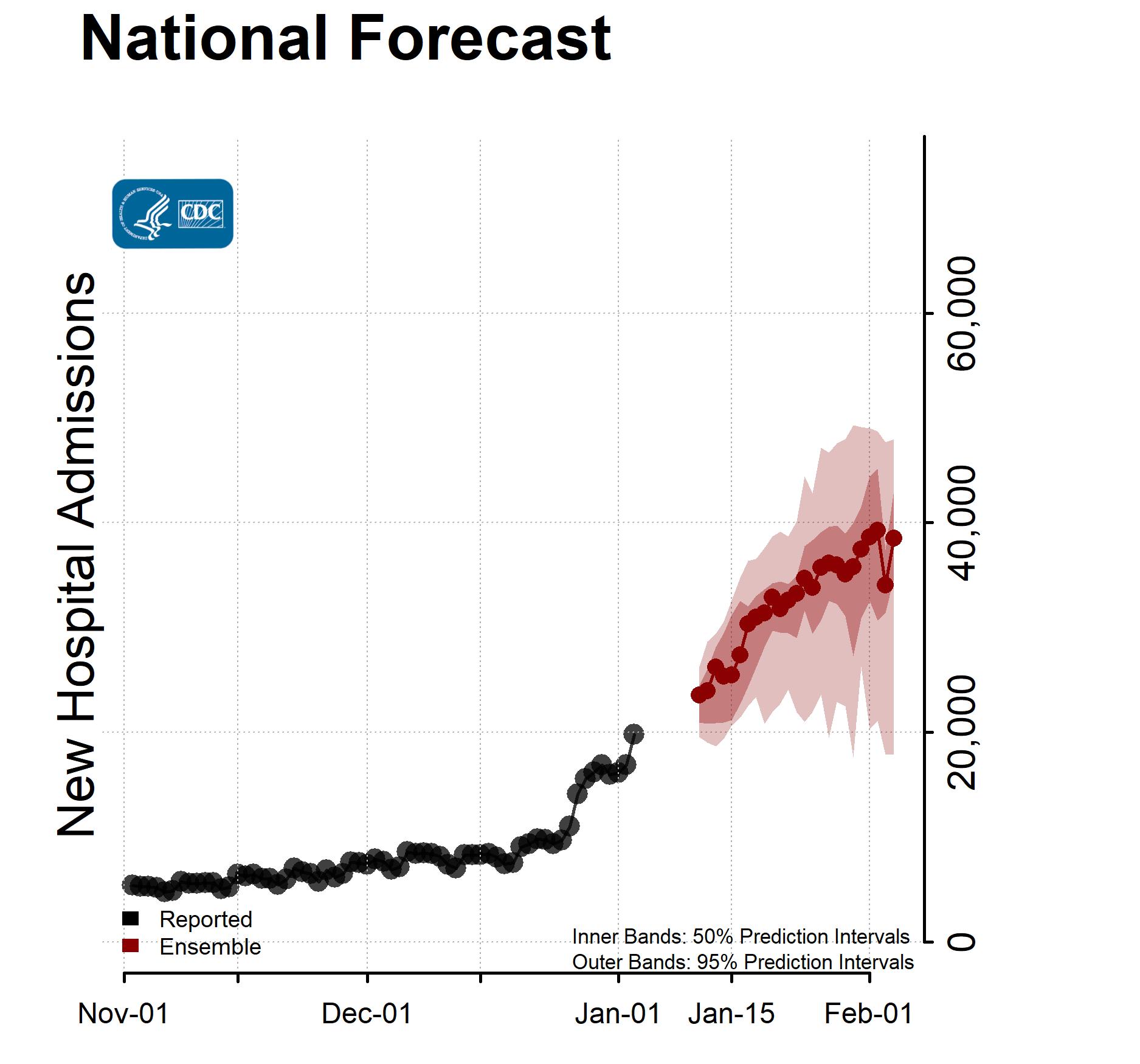
1. Daily COVID-19 hospital admissions will increase over the next four weeks, with 17,900 to 48,000 new admissions likely reported on Feb. 4, according to ensemble forecasts the CDC published Jan. 12. For context, the current seven-day hospitalization average for Jan. 5-11 is 20,637, a 24.5 percent increase from the previous week’s average. 

2. CDC forecasting predicts COVID-19 deathwill increase nationwide over the next month, with 10,400 to 31,000 deaths likely reported in the week ending Feb. 5. Current forecasts should be interpreted with caution, the CDC said, as they may not fully account for omicron’s rapid spread or changes in reporting during the holidays. 

States ranked by COVID-19 hospitalization rates: Jan. 18

New daily COVID-19 hospitalization rates in the U.S. have risen 54 percent over the last two weeks, with all 50 states and the District of Columbia seeing hospitalization rates trend upward, according to data tracked by The New York Times.

Data is taken from HHS and was last updated Jan. 18. States are listed in order of hospitalization rate percent increase over the last two weeks. 

Alabama
14-day change: 133% increase
Hospitalizations per 100,000 people: 50

Louisiana
14-day change: 120% increase
Hospitalizations per 100,000 people: 41

California
14-day change: 118% increase
Hospitalizations per 100,000 people: 35

Mississippi
14-day change: 109% increase
Hospitalizations per 100,000 people: 47

Florida
14-day change: 105% increase
Hospitalizations per 100,000 people: 53

Hawaii
14-day change: 102% increase
Hospitalizations per 100,000 people: 25

South Carolina
14-day change: 102% increase
Hospitalizations per 100,000 people: 43

Washington
14-day change: 99% increase
Hospitalizations per 100,000 people: 31

Alaska
14-day change: 89% increase
Hospitalizations per 100,000 people: 15

Texas
14-day change: 86% increase
Hospitalizations per 100,000 people: 45

Arkansas
14-day change: 81% increase
Hospitalizations per 100,000 people: 43

Nevada
14-day change: 81% increase
Hospitalizations per 100,000 people: 57

Vermont
14-day change: 77% increase
Hospitalizations per 100,000 people: 19

Massachusetts
14-day change: 76% increase
Hospitalizations per 100,000 people: 46

Georgia
14-day change: 71% increase
Hospitalizations per 100,000 people: 57

Tennessee
14-day change: 70% increase
Hospitalizations per 100,000 people: 47

North Carolina
14-day change: 65% increase
Hospitalizations per 100,000 people: 46

Oregon
14-day change: 64% increase
Hospitalizations per 100,000 people: 21

Virginia
14-day change: 58% increase
Hospitalizations per 100,000 people: 46

Rhode Island
14-day change: 57% increase
Hospitalizations per 100,000 people: 51

Utah
14-day change: 57% increase
Hospitalizations per 100,000 people: 22

Wyoming
14-day change: 57% increase
Hospitalizations per 100,000 people: 18

Montana
14-day change: 52% increase
Hospitalizations per 100,000 people: 20

Oklahoma
14-day change: 51% increase
Hospitalizations per 100,000 people: 41

Idaho
14-day change: 50% increase
Hospitalizations per 100,000 people: 22

South Dakota
14-day change: 46% increase
Hospitalizations per 100,000 people: 39

Colorado
14-day change: 45% increase
Hospitalizations per 100,000 people: 31

Connecticut
14-day change: 44% increase
Hospitalizations per 100,000 people: 57

Missouri
14-day change: 44% increase
Hospitalizations per 100,000 people: 61

New York State
14-day change: 40% increase
Hospitalizations per 100,000 people: 67

Kentucky
14-day change: 39% increase
Hospitalizations per 100,000 people: 51

New Jersey
14-day change: 39% increase
Hospitalizations per 100,000 people: 69

District of Columbia
14-day change: 37% increase
Hospitalizations per 100,000 people: 125

Kansas
14-day change: 37% increase
Hospitalizations per 100,000 people: 43

West Virginia
14-day change: 35% increase
Hospitalizations per 100,000 people: 52

Pennsylvania
14-day change: 34% increase
Hospitalizations per 100,000 people: 63

Arizona
14-day change: 33% increase
Hospitalizations per 100,000 people: 44

Maryland
14-day change: 32% increase
Hospitalizations per 100,000 people: 60

Wisconsin
14-day change: 32% increase
Hospitalizations per 100,000 people: 43

Maine
14-day change: 28% increase
Hospitalizations per 100,000 people: 34

Nebraska
14-day change: 28% increase
Hospitalizations per 100,000 people: 35

Iowa
14-day change: 24% increase
Hospitalizations per 100,000 people: 31

Illinois
14-day change: 21% increase
Hospitalizations per 100,000 people: 56

Delaware
14-day change: 20% increase
Hospitalizations per 100,000 people: 64

Minnesota
14-day change: 20% increase
Hospitalizations per 100,000 people: 31

New Mexico
14-day change: 19% increase
Hospitalizations per 100,000 people: 31

North Dakota
14-day change: 19% increase
Hospitalizations per 100,000 people: 34

Michigan
14-day change: 17% increase
Hospitalizations per 100,000 people: 48

New Hampshire
14-day change: 14% increase
Hospitalizations per 100,000 people: 33

Ohio
14-day change: 13% increase
Hospitalizations per 100,000 people: 59

Indiana
14-day change: 8% increase
Hospitalizations per 100,000 people: 49

What “mild” really means when it comes to Omicron

https://www.axios.com/what-mild-really-means-when-it-comes-to-omicron-f808e5ba-5655-4ac5-b057-4afe3b0aa860.html?fbclid=IwAR27eTD0HrjsF_XiS_USEVn9MxermNoLWJNhU10AeIFQV_y59C7Fl3ok9RM

Illustration of a coronavirus cell in curly quotes.

The Omicron variant doesn’t cause as much severe illness as other variants have, but its “mild” symptoms can still be pretty unpleasant.

The big picture: The way health care professionals and doctors differentiate between “mild” and “severe” illness may not align with a layperson’s understanding of those terms.

“To a health care professional, ‘mild’ means you’re not getting hospitalized,” said Megan Ranney, academic dean at the Brown University School of Public Health.

  • But, she said: “Omicron symptoms can range from absolutely no symptoms to a really mild cold to something where you are in bed with shakes and chills, and have a horrible cough and are fatigued and headachy for weeks. Those are all ‘mild.'”
  • A “severe,” illness means you’d likely have symptoms such as very low oxygen levels, kidney damage and heart impairment, she said.

What we’re watching: Omicron is causing a lot less severe illness than previous variants, but a “mild” case can still require about a week away from work, especially in front-line jobs.

  • And because so many people have gotten infected in such a short time, it’s leaving schools, airlines, and other businesses — including, critically, hospitals — with large numbers of workers out sick simultaneously, The Atlantic reported.
  • Then there’s the matter of long COVID. A study published Thursday in Nature Immunology found ongoing, sustained inflammatory responses following even mild-to-moderate COVID-19 cases.

What they’re saying: “It’s going to be a messy few weeks. I don’t think there’s any way around it,” said Joseph Allen, a professor of public health at Harvard, per The Atlantic.

Healthcare workers are hospitals’ greatest concern

https://mailchi.mp/92a96980a92f/the-weekly-gist-january-14-2022?e=d1e747d2d8

As COVID hospitalizations surge to new highs, healthcare workers have become the rate-limiting factor for most hospitals’ ability to deliver care. Using self-reported data collected by the Department of Health and Human Services, the graphic above shows that hospital staffing concerns reached an all-time high this month, with nearly one in three hospitals reporting a critical shortage. (Anecdotal evidence from our conversations with hospital leaders suggests that the actual number in crisis may be even higher, with every system we’ve spoken to in the past month reporting severe staffing challenges.)

During previous surges, COVID hospitalizations and reported staffing shortages have ebbed and flowed together. However, staffing challenges and case numbers became decoupled during the Delta surge, as the percentage of hospitals reporting staffing shortages did not go down as the Delta wave subsided.
 
With a growing number of nurses and other staff choosing early retirement or looking for jobs in other sectors, health systems are navigating the Omicron spike with a smaller pool of workers. And now the high transmissibility of the Omicron variant is forcing healthcare workers to quarantine in droves.

As shown on the map, this is playing out both in highly vaccinated states like Vermont and California, and less-vaccinated places like West Virginia and Wyoming. That’s leading some state health officials and health systems to allow COVID-positive staff who are asymptomatic or experiencing mild symptoms to continue working—a policy which is being sharply criticized by nurses

While the end of the Omicron surge should bring some relief, longer-term staffing challenges will surely remain for most health systems.