These charts show how serious this fall’s Covid-19 surge is in the US

https://www.cnn.com/2020/11/12/health/coronavirus-fall-surge-statistics/index.html
These charts show how serious the fall COVID-19 surge is in the US - Local  News 8

Official Covid-19 cases and hospitalizations in the United States are piling up at record rates — and daily deaths, experts fear, may soon follow.The following charts show how the fall coronavirus wave has put the US on unprecedented ground by some metrics, and with numbers trending up, point to how the situation could get worse while the country awaits a vaccine and distribution of new treatments.

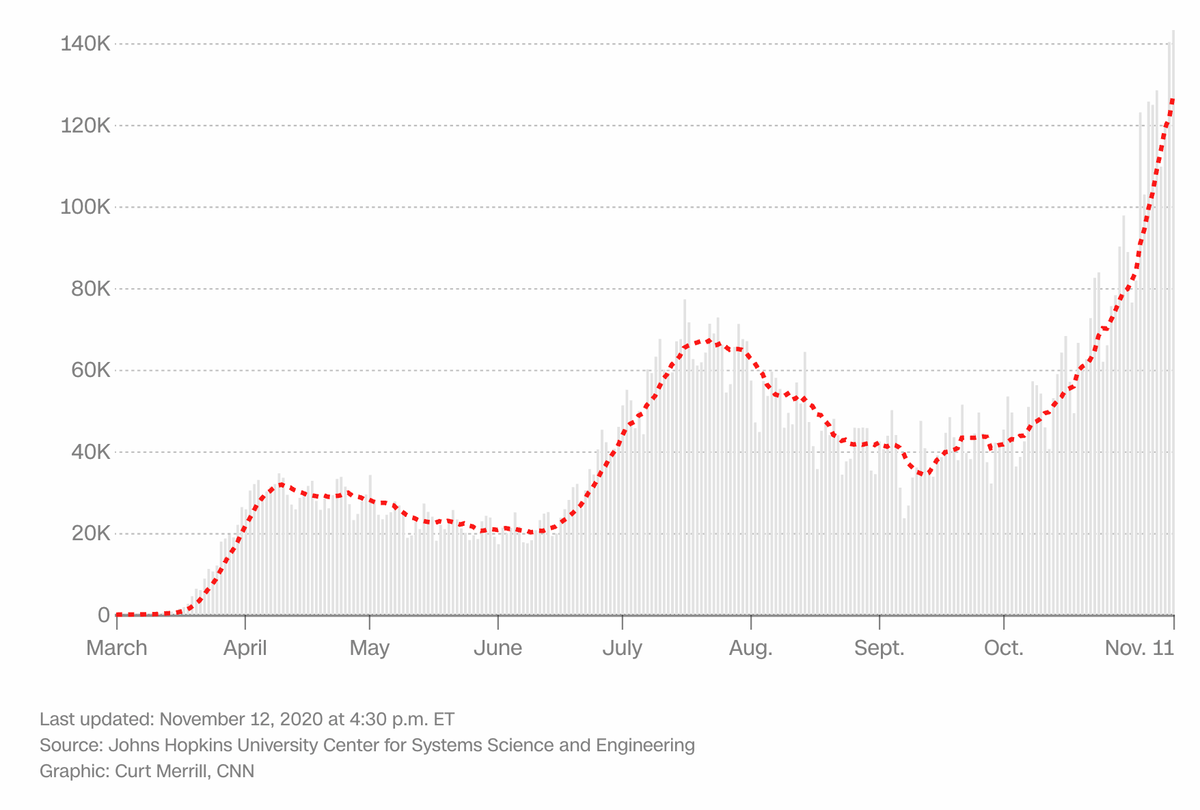
Daily case counts are reaching new highs

Daily cases were dipping as recently as September, as the nation was bouncing back from a summer surge.But infections roared back in a way not recorded before.Thursday brought the United States’ highest one-day infection total (above 153,000) and seven-day average for new daily infections (more than 131,000) on record, according to Johns Hopkins University data.

That average is more than 3.5 times higher than it was on September 12, when it was at a post-summer surge low of 34,198.And it’s well above the summer’s highest seven-day average, which was around 67,100 on July 22.

There has been good news recently:vaccine candidate was reportedly found to be more than 90% effective, and the US Health and Human Services secretary said vaccines could be widely available in the second quarter of 2021. And the Food and Drug Administration this week approved a new antibody treatment that may lower the risk that patients with mild to moderate disease will be hospitalized.But with colder weather potentially driving risky gatherings indoors, and no vaccine available this minute, experts warn daily infections have room to grow.“It will not surprise me if in the next weeks we see over 200,000 new cases a day,” Michael Osterholm, director of the Center for Infectious Disease Research and Policy at the University of Minnesota, told CNN on Monday.We should stress that the chart captures reported cases. Studies have estimated infections were vastly undercounted, especially early in the pandemic, partly because of limited test availability.Some health experts have said hospitalizations can be a truer measure of the pandemic’s severity — though rising cases are a warning sign, since a patient’s hospitalization can come well after diagnosis.

‘Most sensitive indicator’ of infections is up

US test positivity rates are rising

A test positivity rate is the percentage of people who get tested and turn out to be infected. And the US rate has been shooting up in recent weeks.The country’s test positivity rate averaged 8.7% over seven days as of early Thursday, according to the COVID Tracking Project.That’s above a summer’s highest seven-day average of about 7.9% in mid-July.The World Health Organization in May advised governments not to reopen until test positivity rates were 5% or lower for at least 14 days.And the director of the US Centers for Disease Control and Prevention, Dr. Robert Redfield, has suggested that communities’ positivity rates should be below 5% to comfortably have schools open.

White House coronavirus task force coordinator Dr. Deborah Birx has said test positivity rate is the statistic she watches the closest, because it is “the most sensitive indicator” of how the coronavirus situation is unfolding at any particular time and place.

Hospitals have more Covid patients than ever

More Covid-19 patients are reported to be in US hospitals now than at any previous point in the pandemic. About 65,300 coronavirus patients were in those facilities Wednesday, according to the COVID Tracking Project.That’s more than double the number from September 20, when the country was at post-summer-surge low of 28,608.And it’s beyond the summer peak of 59,718 on July 23, and the spring peak of 59,940 on April 15.”The new hospitalization record underscores that we’ve entered the worst period for the pandemic since the original outbreak in the Northeast,” two COVID Tracking Project co-founders wrote in an online post Wednesday.These hospitalization numbers prove that the current surge of Covid-19 cases is not merely the result of increased screening of asymptomatic people. Rather, the cases we’re detecting are a leading indicator that many people are seriously ill,” the post reads.Some hospital systems have said in recent days they are close to being overwhelmed.Seventeen states reported records for Covid-19 hospitalizations on Tuesday: Alaska, Arkansas, Colorado, Indiana, Iowa, Kentucky, Minnesota, Missouri, Montana, Nebraska, Ohio, Oklahoma, Oregon, South Dakota, Tennessee, Wisconsin and Wyoming, the tracking project said.The hospitalization numbers likely have become more accurate over time — Florida didn’t report its hospitalizations until July 10, the COVID Tracking Project notes.

The toll of lives lost is climbing, too

The country’s recent daily Covid-19 death tallies aren’t in record territory, but they are shooting upward.The average number of deaths per day, across a week, rose above 1,000 this week for the first time since the summer.That average was 1,034 on Wednesday — the highest since August 10, Johns Hopkins data shows. More than 1,380 deaths were reported on Wednesday alone.The University of Washington’s Institute for Health Metrics and Evaluation projects the US could average more than 1,650 deaths per day by December 1, and more than 2,200 daily by January 1, if government leaders kept current social distancing mandates and even added some.That would recall the tallies seen early in the pandemic, when 2,000+ deaths were reported daily for a time in April. The highest daily average across a week was 2,241, on April 24.Infections appear to be killing fewer people on average now than early in the pandemic, in part, experts say, because of changes in the way the disease is treated and a rise in the proportion of younger people becoming infected.But as hospitalizations break records, daily death rates could climb further.”The ratio of hospitalizations to deaths has fallen tremendously since the spring,” the COVID Tracking Project’s post from Wednesday reads. “But it is also true that wherever we see hospitalizations go up, deaths rise two to three weeks later.”

‘Covid-hell.’ ‘Humanitarian disaster.’ Experts sound the alarm about U.S. coronavirus outbreak.

Public health experts sound alarm about coronavirus in the United States -  The Washington Post

Public health experts are sounding the alarm about the trajectory of the pandemic in the United States as the coronavirus spreads through the country largely unabated and officials muse aloud about the possibility of fresh lockdowns.

The experts use different language to underscore the situation’s urgency: Former Centers for Disease Control and Prevention director Tom Frieden said the nation is experiencing a “dangerous time.” CNN chief medical correspondent Sanjay Gupta called the crisis a “humanitarian disaster.” Epidemiologist Michael Osterholm, who was recently named to President-elect Joe Biden’s coronavirus task force, described the situation bluntly as “covid-hell.”

Their warnings come amid widespread fatigue with restrictions, even as the virus is nowhere near finished rampaging across the country. Although several states implemented new mitigation measures this week, many people have been letting down their guards or, in some cases, vowing outright to ignore the rules.

Fourteen states, mostly in the Midwest, had reported record numbers of hospitalizations by midday Thursday as the seven-day average number of cases reached highs in 23 states, from Nevada to Maryland, according to data tracked by The Washington Post. Hospital officials predicted that they could soon face excruciating decisions about how to prioritize care as they run short on beds and staff.

“Our hospitals are full,” Megan Ranney, an emergency medicine professor at Brown University, said in an interview. “Our workers are getting sick. And it is simply overwhelming the system.”

The rapid rise in hospitalizations could foreshadow a long period of rising deaths, said Scott Gottlieb, former director of the Food and Drug Administration. Although improvements in care have pushed the mortality rate below 1 percent in the United States, 1,549 people died of the virus Wednesday, the highest toll since April.

The distribution of hospitalizations across the country means it will be hard for health-care workers from one region of the country to serve as backup in another area, Gottlieb wrote on Twitter. The only slightly reassuring news is that most hospitals have not entered true crisis mode, he said Thursday on CNBC’s “Squawk Box.”

“Every hospital system is a little pressed right now,” Gottlieb said. “There’s only a handful that are really overwhelmed: Wisconsin, parts of Texas, Utah, South and North Dakota.”

But the trends suggest that that could change. Osterholm said ballooning numbers of infections nationwide mean more hospitals could soon look like those in El Paso, where health-care workers are bringing in mobile morgues and airlifting patients to other cities.

“We have to tell the story of what’s coming; people don’t want to hear that El Paso isn’t an isolated event,” he told Yahoo Finance on Thursday. “It will become the norm.”

Frieden tweeted that the United States has entered “the exponential phase” of virus spread and that the situation will worsen significantly before it improves. But he emphasized that policy decisions have an impact, and throwing in the towel is the wrong solution.

“Not all of the US is experiencing the same rate of Covid spread — some states are doing much better than others,” he wrote. “For example, South Dakota (the state with the highest rate) has 100 times more spread than Vermont right now.”

Individual decisions also make a difference, Gottlieb said, especially as people prepare to travel and visit people outside their household for Thanksgiving. The transmission of the virus tracks closely with people’s movement in their communities.

“If people on the whole just go to the store one less time a week, you could substantially reduce spread,” Gottlieb said on “Squawk Box.”

The lack of that kind of self-sacrifice is one factor that Ranney said she believes is contributing to the virus surging to a far greater extent than it did in the spring. New rules from local and state governments, such as curfews, have been relatively mild compared to the widespread shutdowns of March and April.

The holiday season, meanwhile, is a looming danger that Ranney expects will lead to a “deadly” spike in infections. The virus’s prevalence across the country means that this is the worst time for people to increase their risk of transmission by attending family-centric celebrations, she said.

The likelihood that there will be an easily available vaccine next year is the light at the end of the tunnel. But in the meantime, Ranney said people need to fight the urge to pretend that life is normal and instead seek ways to socialize more safely — outdoors, at a distance and while wearing masks.

“A vaccine is coming. This is not forever,” she said. “But right now, we’ve got to stop this chain of transmission.”

U.S. lockdown not inevitable, Fauci says. But the numbers are horrendous.

https://www.washingtonpost.com/nation/2020/11/12/coronavirus-covid-live-updates-us/

https://www.washingtonpost.com/video/national/why-experts-say-nationwide-mask-use-is-currently-the-best-strategy-to-combat-coronavirus/2020/11/11/f98b67bf-bb19-4acf-9efb-0ab91a3386dc_video.html

Should I wear a mask? You'll soon face growing pressure, experts say.

The United States’ top infectious-disease expert, Anthony S. Fauci, cautioned against despair as the country endures a surge in covid-19 cases unlike anything it has previously seen. A record high of 145,835 new cases were reported Wednesday, just one week after the U.S. hit 100,000 cases for the first time. At least 65,000 Americans are hospitalized with covid-19, according to The Post’s latest data.

In an interview with “Good Morning America” on Thursday, Fauci insisted that the United States could still make it through the winter without a national lockdown “if we can just hang in there” and adopt stronger social distancing habits until vaccines arrive.

Covid Trends

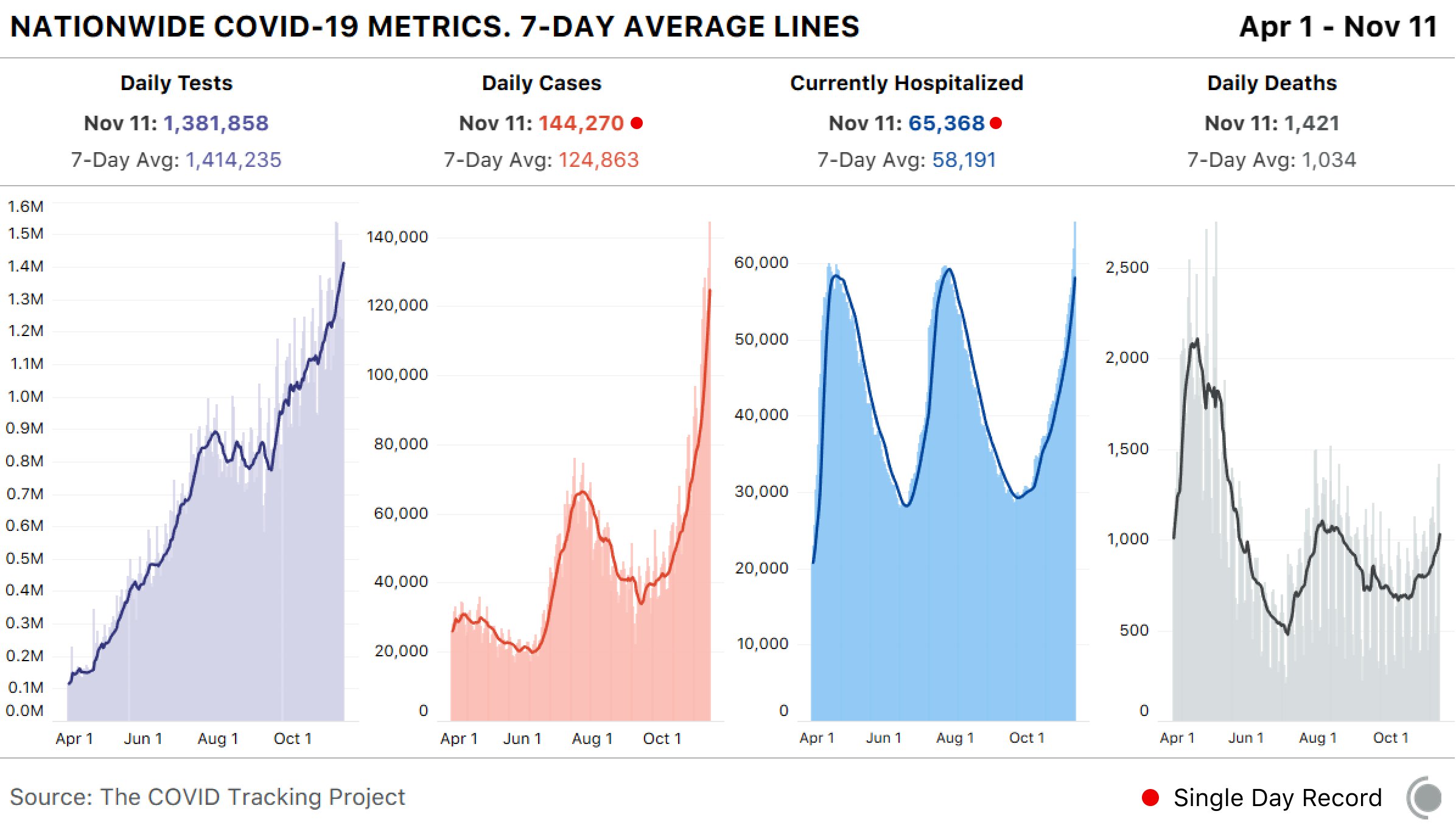
Our daily update is published. States reported 1.4M new tests and 144k cases, another all-time high. 65.4k people are hospitalized, 15k more than on election day. The death toll was 1,421, pushing the 7-day average over 1,000.

4 bar charts showing key COVID-19 metrics for the US over time. Today, states reported 1.4M tests, 144k cases, 65.4k currently hospitalized, and 1,421 deaths.

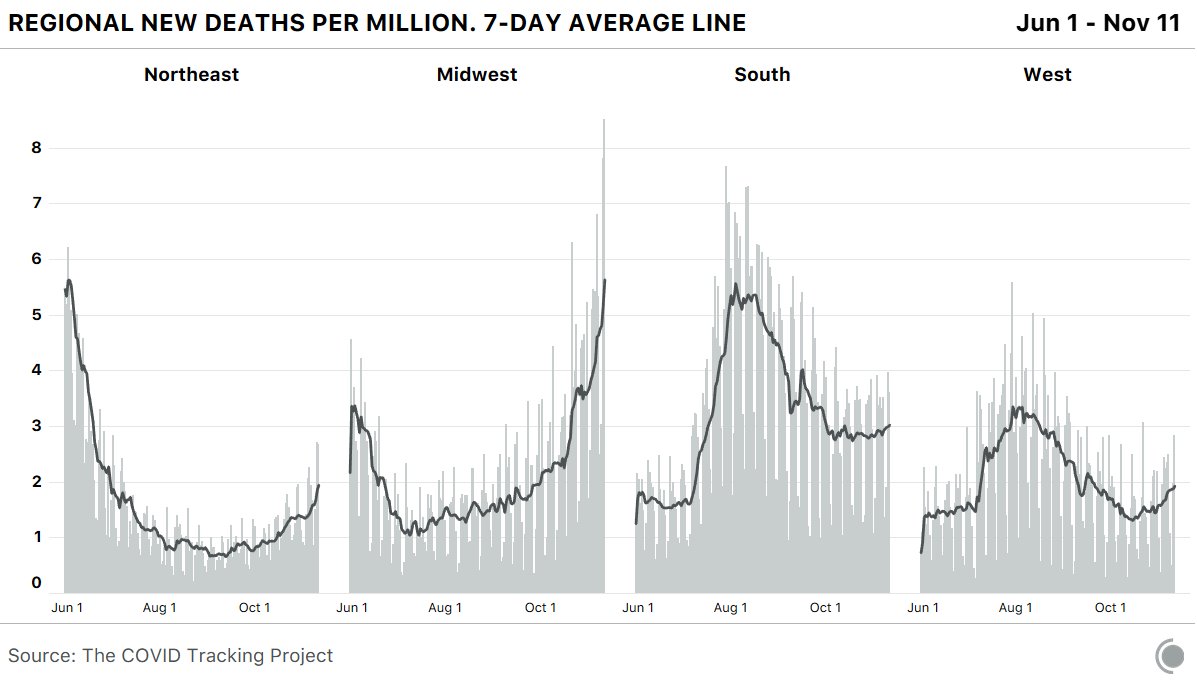
On a per capita basis, more people are now dying across the Midwest than even at the peak of the summer surge in the South.

4 bar charts showing regional new deaths per million with 7-day average lines. The Midwest has now crossed the South's peak over the summer.

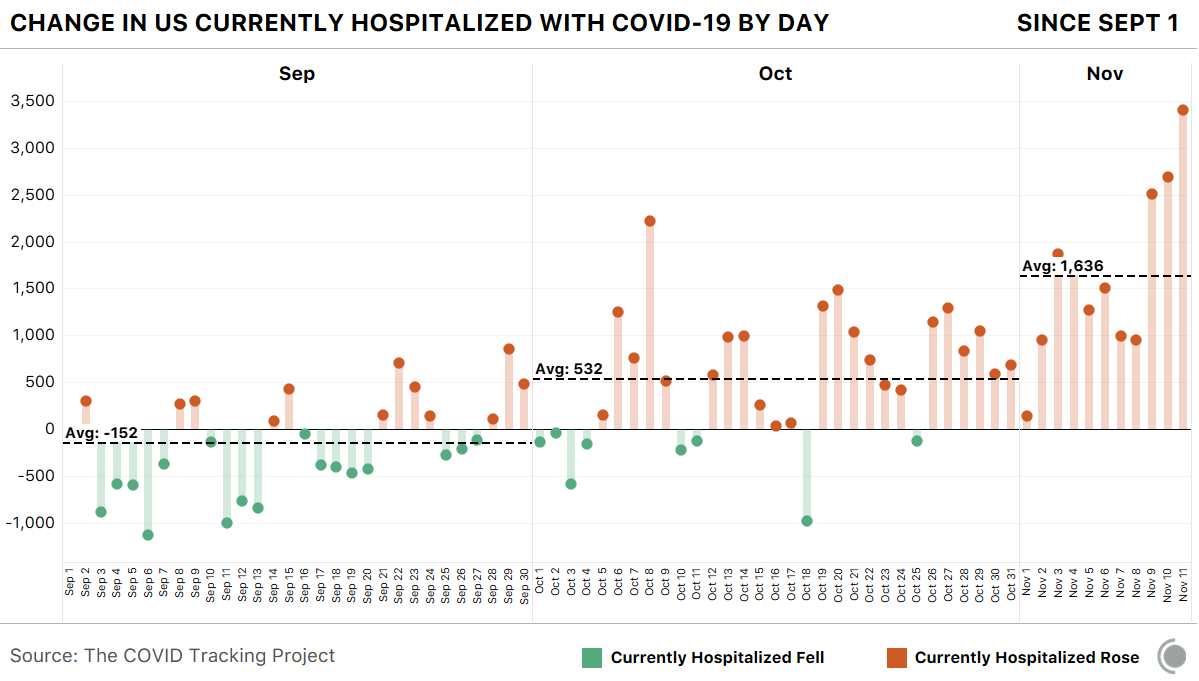
Hospitalizations are now rising very quickly. The last three days standout, but across all of November, we’re averaging 1,636 more current hospitalizations each day.

A chart showing daily hospitalization changes with three monthly average values: September -152, October +532, and November +1,636.

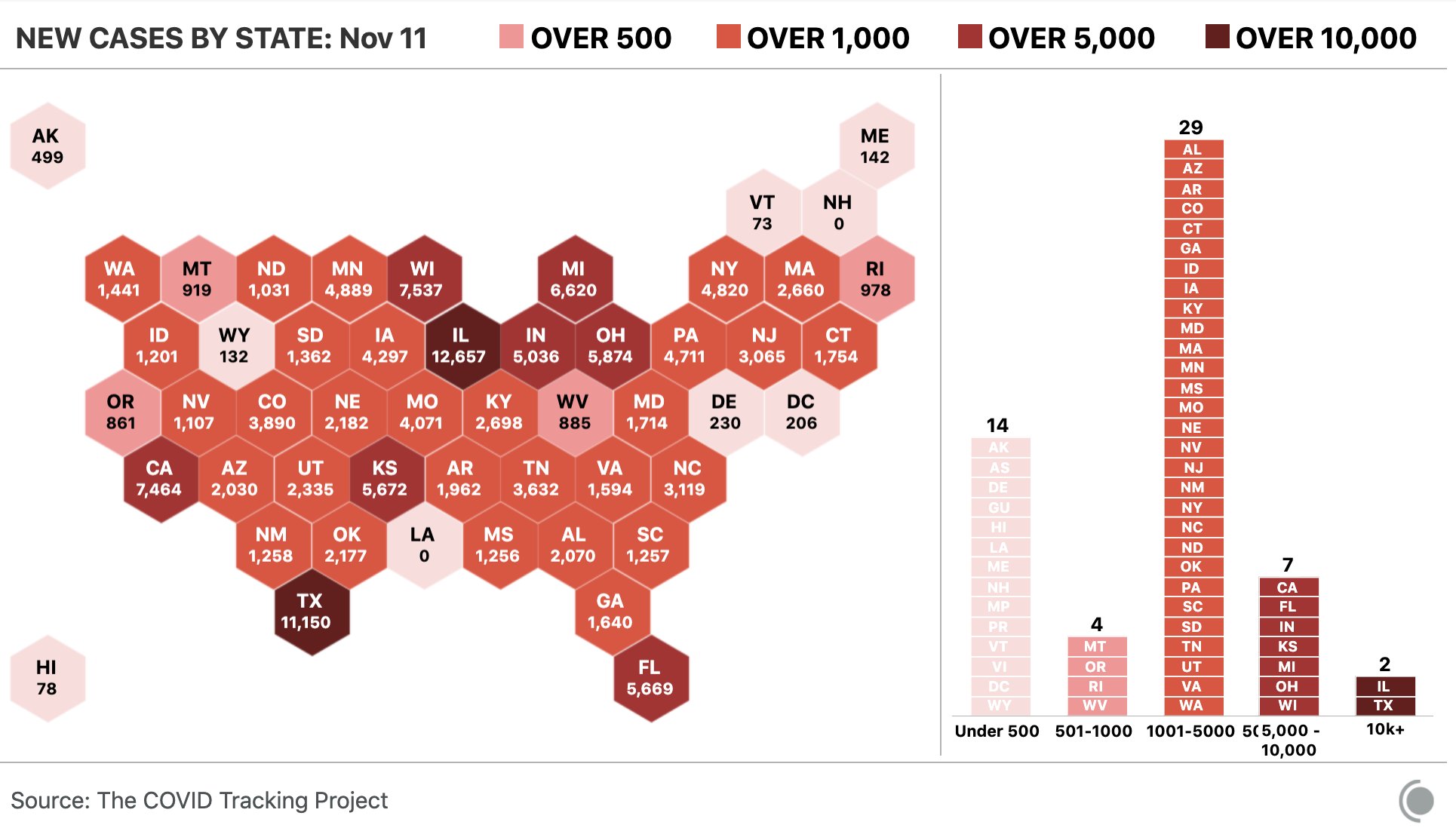
38 states reported over 1,000 cases today.

On the left, a cartogram showing new cases in every U.S. state and the District of Columbia. On the right, a chart with 4 columns showing states grouped into 4 buckets: Under 500 (14 states), 501-1000 (4 states), 1001-5000 (29 states), 5001-10,000 (7 states), 10,000+ (2 states).

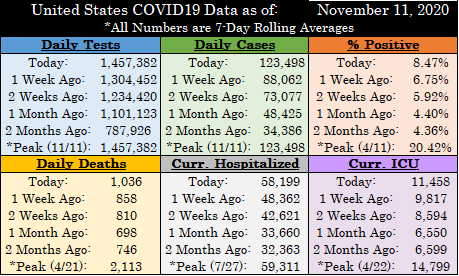
*Today’s #Covid19 Update Thread* (tests, cases, deaths, hospitalizations, ICU, and % testing positive as of Today, 1 week, 2 weeks, 1 month, and 2 months ago—data from @COVID19Tracking)

Image

Cartoon – Rounding the Turn

Rounding the turn - Political cartoons by P. Roka - Medium

Trump Predicted ‘Covid, Covid, Covid’ Would End After The Election. It’s Worse Than Ever

PolitiFact - Trump's claim is False. "Rounding the corner"... | Facebook

TOPLINE

In the days and weeks leading up to Election Day, President Donald Trump claimed that the “fake news media” chose to focus on Covid-19 to damage his campaign, predicting that once November 4th arrived, Americans would not hear about the virus anymore, however, in the seven days since that date, infections and hospitalizations have spiked to unseen levels, shattering previous records.

KEY FACTS

The United States reported a record-setting high of 139,855 new positive cases on Tuesday and 1,448 coronavirus deaths, according to a New York Times database. 

In the seven days since Nov. 4, there has been an average of 123,315 new cases per day (a total of 863,205), which is the highest daily average ever recorded in any nation, and an increase of 69% from the average just two weeks earlier.

According to the Covid Tracking Project, a record high of 61,964 people are currently hospitalized in the United States.

A total of 7,021 Americans have been killed by the virus since November 4th, as the daily average death count has risen above 1,000 for the first time since August. 

CRITICAL QUOTE: 

“That’s all I hear about now. That’s all I hear. Turn on television—’Covid, Covid, Covid, Covid, Covid, Covid.’ A plane goes down. 500 people dead, they don’t talk about it,” Trump told his supporters at a campaign rally in Lumberton, North Carolina, on October 24th. “Covid, Covid, Covid, Covid.’ By the way, on November 4, you won’t hear about it anymore,”

KEY BACKGROUND:

On October 27th, Trump tweeted: “ALL THE FAKE NEWS MEDIA WANTS TO TALK ABOUT IS COVID, COVID, COVID. ON NOVEMBER 4th, YOU WON’T BE HEARING SO MUCH ABOUT IT ANYMORE. WE ARE ROUNDING THE TURN!!! In August, speaking at Republican National Convention, Trump asserted that Democrats were imposing restrictions to damage the economy. He prognosticated that these left-leaning states would reopen after the election. “On November 4th, it will all open up,” said the president, adding, “They want to make our numbers look as bad as possible for the election.” Back in May, Eric Trump, during an appearance on Fox News, said the Democrats “will milk it every single day between now and November 3rd, and guess what, after November 3rd, coronavirus will magically all of a sudden go away and disappear.” In late October, Trump alleged, “Until November 4th., Fake News Media is going full-on Covid, Covid, Covid.” Although the coronavirus is raging out of control, the president has yet to address the pandemic since the election. Trump has tweeted 149 times since Nov. 3 but has not once mentioned Covid, Covid-19, or the coronavirus. Nor has he offered an update to U.S. citizens on how the federal government plans to counteract this most recent nationwide outbreak. 

TANGENT:

Vice President Mike Pence is the head of the White House Coronavirus Task Force. According to the Federal Aviation Administration, Pence was scheduled to vacation in Sanibel, Florida, Tuesday through Saturday this week. However, the Washington Post reported Tuesday that Pence is no longer planning to leave Washington.

BIG NUMBER:

240,000. Since the start of the pandemic, more than 10,331,900 Americans have been infected with the coronavirus, and at least 240,200 have died.

U.S. Breaks Covid Hospitalization Record, Which Had Stood For Almost 7 Months

The U.S. Just Set A Record (Again) For New Coronavirus Cases

TOPLINE

For the first time in the coronavirus pandemic, more than 60,000 Americans are hospitalized for Covid-19, according to The COVID Tracking Project, which also reported yet another record for new cases Tuesday—130,989, as the pandemic continues to worsen.

KEY FACTS

61,964 Covid-19 hospitalizations were reported in the U.S. Tuesday, breaking a record that had stood since April 15, when 59,940 were in the hospital.

The record for new cases was also broken, topping 130,000 for the first time, but the old record had stood for just three days.

1,347 deaths were reported, which is the most since Aug. 19, according to The COVID Tracking Project, which collects its data from local reporting agencies.

WHAT TO WATCH FOR

The grim impacts of the third U.S. coronavirus surge are starting to be felt. Hard-hit El Paso, Texas is running out of morgue space, while Tulsa ran out of ICU beds Monday night. In North Dakota, hospitals are at capacity and the state is now taking the extreme step of allowing Covid-positive nurses to keep working in some cases amid a serious staffing shortage.

KEY BACKGROUND

New cases have been rising exponentially since mid-September, with no signs of slowing up. Hospitalizations starting rising around a week later—a rate that has been on the increase. Deaths, which lag behind rises in other metrics, remained relatively steady until around Oct. 18. The death toll has been on a steady rise ever since, with the 7-day rolling average now just shy of 1,000 per day.

TANGENT

President-elect Joe Biden says that fighting coronavirus is a top priority of his incoming administration. He announced a 12-member Covid task force on Monday, with the goal of coming up with a plan to combat the pandemic. That’s in contrast to President Donald Trump, whose administration has not come up with a national plan while the president has continued to make false statements that the U.S. is “rounding the turn” on coronavirus.

Tenet to lay off workers in Detroit, shed 4 urgent care centers

https://www.beckershospitalreview.com/finance/tenet-to-lay-off-workers-in-detroit-shed-4-urgent-care-centers.html?utm_medium=email

Tenet's Detroit Medical Center plans for more job cuts

Detroit Medical Center is laying off employees, and its parent company, Dallas-based Tenet Healthcare, is planning to sell or close four urgent care centers in the Detroit area, according to Crain’s Detroit Business

Detroit Medical Center officials told Crain’s layoffs have occurred, but they declined to disclose the number of employees affected. Sources told Crain’s several hundred DMC employees have been laid off with more expected this year. Clinical staff, administrative assistants and employees at the management level were reportedly affected by the layoffs. 

“Like many health systems locally and nationally, we continually evaluate and review our staffing needs, which have decreased due to reduced patient demand during the pandemic,” DMC said in a statement to Becker’s Hospital Review. “Our goal is to ensure we are strongly positioned to provide the highest quality and safest care to our patients while making the best use of our resources.”

Tenet is also planning to sell or close its four remaining MedPost urgent care centers in the Detroit area. Tenet has reached agreements to sell three of the urgent care centers in Bloomfield, Livonia and Southfield, Mich., to First Choice Urgent Care, a company spokesperson told Becker’s Hospital Review

“We expect all employees in good standing to be offered positions to remain at the facilities upon completion of the sale, which we anticipate occurring in December,” the spokesperson told Becker’s

The MedPost urgent care center in Rochester Hills, Mich., will close in December, the spokesperson said. Tenet may convert it to a physician office or other type of healthcare facility. 

“We are committed to providing our full support and assistance to employees through the close, and facilitating opportunities for open roles at local Tenet facilities,” the spokesperson told Becker’s

Tenet, a 65-hospital system, operated nine MedPost urgent care centers in the Detroit area at the beginning of the year. It closed five of the centers in April due to challenges linked to the COVID-19 pandemic. The MedPost urgent care centers are not part of DMC. 

Biden’s 7 point plan for the pandemic

https://www.beckershospitalreview.com/hospital-management-administration/biden-s-plan-for-the-pandemic-7-things-to-know.html?utm_medium=email

Trump's And Biden's Coronavirus Plans: Vaccines, Testing : NPR

President-elect Joe Biden and Vice President-elect Kamala Harris have released a seven-point plan regarding the COVID-19 pandemic.

The Biden administration’s seven pandemic plans:

1. Ensure all Americans have access to regular, reliable and free testing by doubling the number of drive-thru testing sites, investing in next-generation testing, developing a pandemic testing board to produce and distribute tests, and establishing a U.S. Public Health Jobs Corps.

2. Provide all states, cities, tribes and territories with critical supplies. Efforts will include full use of the Defense Production Act, building American-sourced and manufactured capabilities. 

3. Provide clear, consistent and evidence-based guidance for how communities should navigate the pandemic. Planned resources will be tailored to the needs of schools, small businesses and families.

4. Plan for effective and equitable distribution of treatments and vaccines. The administration intends to invest in a $25 billion manufacturing and distribution plan to guarantee every American can receive the vaccine for free. The administration also said it will work to ensure that politics won’t play a role in determining the safety and efficacy of vaccines.   

5. Protect older Americans and other high-risk groups. Efforts will include establishing a COVID-19 racial and ethnic disparities task force and a nationwide pandemic dashboard that can be checked in real-time to gauge local transmission.

6. Rebuild and expand defenses to prevent and mitigate pandemic threats, including the restoration of the White House National Security Council Directorate for Global Health Security and Biodefense and the nation’s membership with the World Health Organization.

7. Implement nationwide mask mandates.

Genesis Healthcare warns of possible bankruptcy

https://www.beckershospitalreview.com/finance/genesis-healthcare-warns-of-possible-bankruptcy.html?utm_medium=email

News

Kennett Square, Pa.-based Genesis Healthcare, one of the largest post-acute care providers in the U.S., warned that bankruptcy is possible if its financial losses continue. 

“The virus continues to have a significant adverse impact on the company’s revenues and expenses, particularly in hard-hit Mid Atlantic and Northeastern markets,” Genesis CEO George V. Hager Jr., said in a Nov. 9 earnings release.

Mr. Hager said government stimulus funds the company received in the third quarter of this year fell nearly $60 million short of the company’s COVID-19 costs and lost revenue. 

Genesis said it has taken several steps to help offset the financial damage linked to the pandemic, including delaying payment of a portion of payroll taxes incurred through December. 

But the company warned that bankruptcy is possible if its financial losses continue. 

“Even if the company receives additional funding support from government sources and/or is able to execute successfully all of its these plans and initiatives, given the unpredictable nature of, and the operating challenges presented by, the COVID-19 virus, the company’s operating plans and resulting cash flows, along with its cash and cash equivalents and other sources of liquidity. may not be sufficient to fund operations for the 12-month period following the date the financial statements are issued,” Genesis said. “Such events or circumstances could force the company to seek reorganization under the U.S. Bankruptcy Code.”

Genesis ended the third quarter of this year with a net loss of $62.8 million, compared to net income of $46.1 million in the same period a year earlier.