U.S. Covid Hospitalizations Reach 7-Week High As Cases Surge In Midwest

TOPLINE

More Americans are now in the hospital with Covid-19 than at any other point since late August, causing some states to nearly run out of hospital beds, as coronavirus infections continue to increase nationwide ahead of a potential end-of-year surge.

KEY FACTS

Some 37,048 coronavirus patients were hospitalized as of Wednesday, the highest level in almost two months according to new data from the COVID Tracking Project, though total hospitalizations are still below their mid-April peak of almost 60,000.

Among hospitalized patients, 7,156 were in ICUs and 1,776 are currently on ventilators — both of those numbers have increased slightly in recent weeks.

Texas leads the nation with more than 4,000 patients in hospitals, followed by California and Florida, though all three states’ hospital counts declined since the summer.

Hospitalizations and new cases soared in Wisconsin over the last month, and officials opened an emergency field hospital near Milwaukee this week as medical centers across the state fear they will run out of space.

Hospital numbers are also on the rise across other parts of the Midwest and South: Missouri reported a new record this week, and levels in Kentucky and Ohio are both within striking distance of their summertime peaks.

BIG NUMBER

217,933. That’s the total number of Americans who have died from Covid-19, according to figures from Johns Hopkins University. Daily fatalities are still below their peak in April, but they remain steady at more than 700 per day.

KEY BACKGROUND

When the coronavirus first surged in the New York City area, some hospitals nearly buckled under the pressure, contending with thousands of sick patients and inadequate protective equipment. Covid-19 cases gradually decreased nationwide but never fully subsided. The West Coast and Deep South dealt with cascading upticks after states loosened coronavirus restrictions during the summer, and the Midwest and small states like South Dakota are now struggling to open up more hospital capacity as new infections surge. Some experts warn cases could spike yet again over the fall and winter, straining the nation’s medical system and making it tough to get sick patients the medical attention they need.

CRUCIAL QUOTE

“When we see an overwhelming number of patients get infected, a lot of them are going to need hospitalization and support,” Dara Kass, a New York-based emergency room physician, told CBS News on Thursday. “We’re seeing hospitals in Wisconsin be overwhelmed with no ICU beds … This is a big concern of those of us who are looking to prevent as many deaths as possible.”
Cartoon – State of the Union

ICYMI: Mask Deniers, Mandatory Meat, Gorilla Guardians & More | Sierra Club

Cartoon – Do All Lives Really Matter?

Cartoon – All Lives Matter | HENRY KOTULA

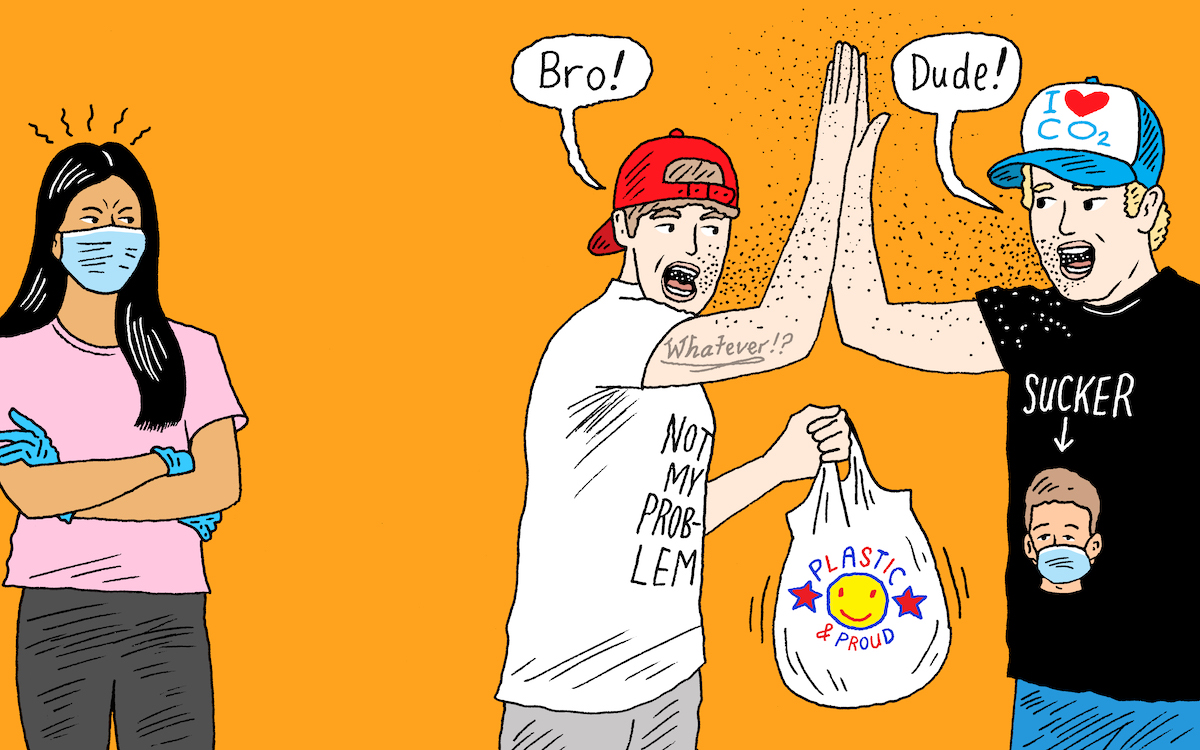
Cartoon – The Maskless Herd

Editorial cartoons

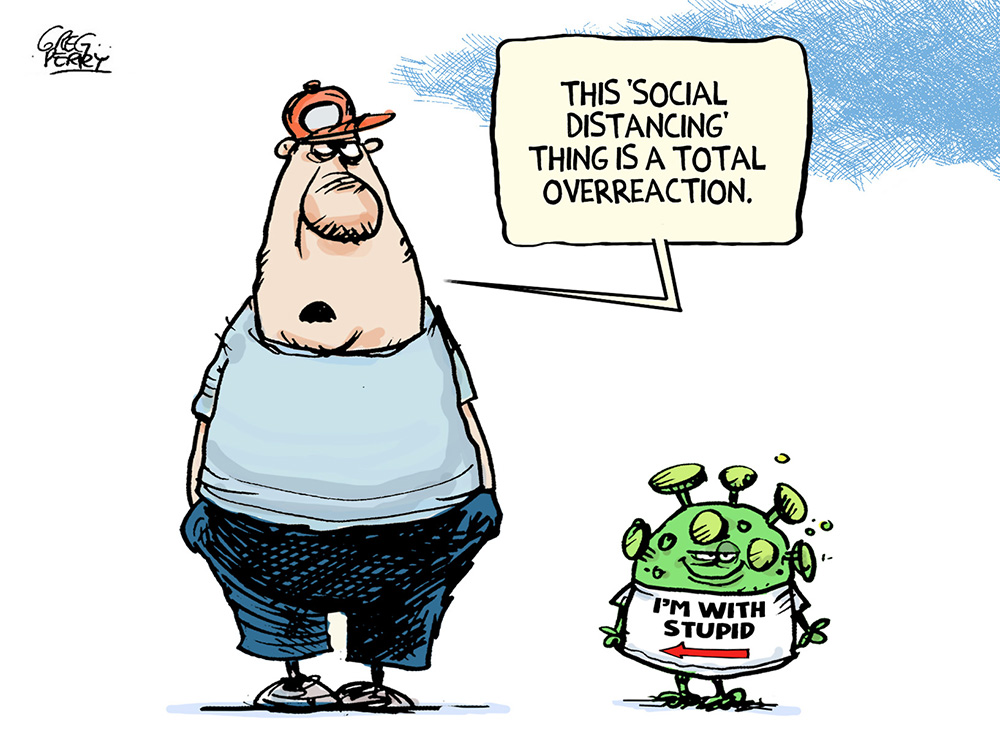
Cartoon – Social Distancing Overreaction

What Should We Do with These Super Spreader Bozos? | The Tyee

Dr. Fauci on COVID surge

Dr. Anthony Fauci, the nation’s top infectious disease expert, tells CBS Evening News anchor and managing editor Norah O’Donnell that Americans need to “double down” on mask-wearing and social distancing to help control a surge in new coronavirus cases.

He also spoke about President Trump’s recovery from COVID-19, progress towards a vaccine, and how the pandemic will affect this year’s holiday gatherings. Watch the full interview.

Fauci on coronavirus herd immunity: ‘That is nonsense and very dangerous’

https://www.yahoo.com/news/fauci-on-coronavirus-herd-immunity-132851933.html

Dr. Anthony Fauci on Thursday denounced the concept of herd immunity — the notion that if a large enough group of people contract an infection, it will ultimately stop the disease from spreading — calling it “nonsense” during an interview with Yahoo News.

“Anybody who knows anything about epidemiology will tell you that is nonsense and very dangerous,” Fauci said, “because what will happen is that if you do that, by the time you get to herd immunity, you will have killed a lot of people that would have been avoidable.”

Fauci, the director of the National Institute of Allergy and Infectious Diseases and member of the White House coronavirus task force, discussed the coronavirus pandemic and the country’s response to it during a live interview Thursday morning with Yahoo News Editor in Chief Daniel Klaidman and Chief Investigative Correspondent Michael Isikoff.

The coronavirus has killed more than 216,000 people in the U.S. and infected almost 8 million, according to data from Johns Hopkins University.

Now, more than seven months after the coronavirus was declared a pandemic, Fauci said Thursday that the U.S. is not in a good place.

“We talk about a second wave,” he said. “We’ve never really gotten out of the first wave. If you look at the baseline number of daily infections that we have had over the last several weeks, [it’s] been around 40,000 per day. It’s now gone up to about 50,000 per day. So right away, we have a very unfortunate baseline from which we need to deal.”

President Trump and his administration have been pushing the herd immunity approach as a possible solution to ending the pandemic, the New York Times reported Wednesday. During a call with reporters, two officials who requested anonymity cited a petition called the Great Barrington Declaration, which calls for states to lift coronavirus restrictions for the bulk of American citizens, the Times reported.

When asked about the herd immunity approach, Fauci said that while he agrees with what the declaration says about protecting the vulnerable and not closing down the country, virtually anyone with a solid understanding of epidemiology would disagree with the idea of letting everyone get infected.

“My position is known. Dr. Deborah Birx’s position is known, and Dr. [Robert] Redfield,” he said. “So you have me as the director of the National Institute of Allergy and Infectious Diseases, Debbie Birx, as the coordinator and a very experienced infectious disease person, the coordinator of the task force — and you have Bob Redfield, who’s the director of the [Centers for Disease Control and Prevention]. All three of us very clearly are against that.”

Experts Slam The White House’s ‘Herd Immunity’ Plan

Experts warn Trump's misinformation about coronavirus is dangerous

The White House is reportedly embracing a herd-immunity approach focused on “protecting the elderly and the vulnerable” but experts are calling the plan dangerous, “unethical”, and equivalent to “mass murder”.

The news comes following a petition titled The Great Barrington Declaration, which argued against lockdowns and school and business closures and got almost 500,000 signatures – although some of them were fake.

“Current lockdown policies are producing devastating effects on short and long-term public health,” the declaration states, adding, “The most compassionate approach that balances the risks and benefits of reaching herd immunity, is to allow those who are at minimal risk of death to live their lives normally to build up immunity to the virus through natural infection, while better protecting those who are at highest risk. We call this Focused Protection.”

Essentially, herd immunity is when enough people are immune to a disease, like Covid-19, that the disease can’t be transmitted as easily and thus provides indirect protection.

It’s been rumoured that the government has been leaning towards this plan of action for some time now, although this is the first real admission.

In response to today’s news, experts around the world have been voicing their concerns.

And this isn’t the first time we’ve heard experts say herd immunity is not a good idea.

For example, the head of the World Health Organization said Monday that allowing the novel coronavirus to spread in an attempt to reach herd immunity was “simply unethical.”

Similarly, the National Institutes of Health (NIH) director Francis Collins also denounced herd immunity as a viable plan.

“What I worry about with this is it’s being presented as if it’s a major alternative view that’s held by large numbers of experts in the scientific community. That is not true. This is a fringe component of epidemiology. This is not mainstream science. It fits into the political views of certain parts of our confused political establishment,” he said in an interview.

Not to mention studies continue to show that Sweden’s attempts at herd immunity have failed and have resulted in a higher Covid-19 death toll than expected.

As more research comes out, scientists are starting to learn that Covid-19 immunity, even in those who were severely infected, can fade after a few weeks.

This is why we’ve seen cases of reinfection and why many experts are advising against a herd immunity plan.  

Currently less than 10% of the population in the U.S. are immune to Covid-19 but for herd immunity to be achieved most experts estimate between 40% to 80% of the population would need to be infected.

To put that into context, that means around 197 million people would need to be infected in America. And assuming that the Covid-19 fatality rate is somewhere between 0.5% and 1%, based on numbers from the World Health Organization (WHO), more than 1 million people would die – at minimum.

William Haseltine, Chair and President of ACCESS Health International, told CNN “herd immunity is another word for mass murder. We are looking at two to six million Americans dead – not just this year but every year.”  

This is an unmitigated disaster for our country – to have people at the highest levels of our government countermanding our best public health officials. We know this epidemic can be put under control. Other countries have done it. We are doing the opposite.”

Cartoon – Pandemic Leadership

Cartoon – Leadership Today | HENRY KOTULA

The coming vaccine chaos

The coming coronavirus vaccine chaos - Axios

The first coronavirus vaccine will likely get authorized within months, but that will only be the beginning of what’s likely to be a long, chaotic vaccination process, the New York Times’ Carl Zimmer reports.

The big picture: The first vaccines probably will offer only moderate protection against the virus, meaning we can’t ditch our masks even if we get one. And we probably won’t have a good way to choose between these vaccines once several of them are on the market.

  • Some vaccines that are in earlier stages of development today may struggle to cross the finish line, even if they work better than earlier vaccines.
  • And some vaccines may be pulled off of the market because they’re unsafe.

Between the lines: Some of this is inherent to the breakneck speed of the vaccination effort, but some of it is a result of how that effort was designed.

  • Earlier this year, some government scientists had wanted to test vaccine candidates against each other, instead of testing all of them against a placebo. But these kinds of trials are risky for drug companies, because they show the value of one vaccine against another.
  • That information could be useful for patients, but is a business risk for manufacturers.
  • You have to have the total cooperation of the pharmaceutical companies to get involved in a master protocol,” top infectious disease expert Anthony Fauci told NYT. “That — I don’t know what the right word is — didn’t turn out to be feasible.”