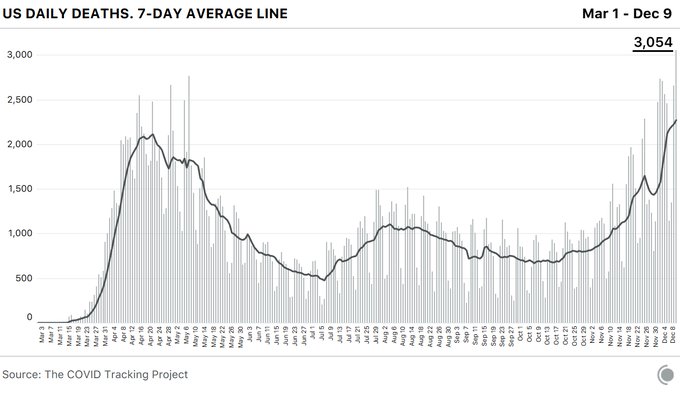
The coronavirus pandemic pushed the U.S. past another dire milestone Wednesday, the highest daily death toll to date, even while the mortality rate has decreased as health experts learn more about the disease.
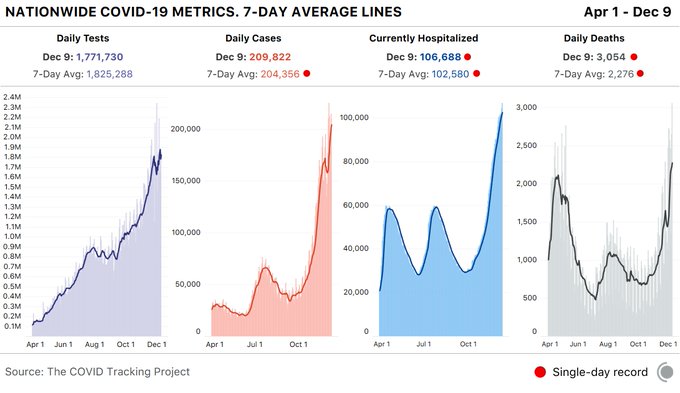
The Covid Tracking Project, which tracks state-level coronavirus data, reported 3,054 COVID-19 related deaths — a significant jump from the previous single-day record of 2,769 on May 7.
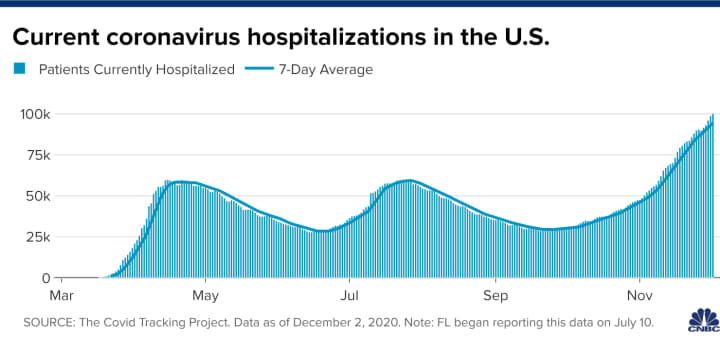
The spread of the disease has shattered another record with 106,688 COVID-19 patients in U.S. hospitals. And overall, states reported 1.8 million tests and 210,000 cases. According to the group, the spike represents more than a 10% increase in cases over the last 7 days.
Additionally, California nearly topped its single-day case record at 30,851. It is the second highest case count since December 6, the organization reported.
The staggering spike in fatalities and infections has overwhelmed hospitals and intensive care units across the nation, an increase attributed by many experts to people relaxing their precautions at Thanksgiving.
But there is still one dark cloud hanging over the vaccines that many people don’t yet understand.
The vaccines will be much less effective at preventing death and illness in 2021 if they are introduced into a population where the coronavirus is raging — as is now the case in the U.S. That’s the central argument of a new paper in the journal Health Affairs. (One of the authors is Dr. Rochelle Walensky of Massachusetts General Hospital, whom President-elect Joe Biden has chosen to run the Centers for Disease Control and Prevention.)
An analogy may be helpful here. A vaccine is like a fire hose. A vaccine that’s 95 percent effective, as Moderna’s and Pfizer’s versions appear to be, is a powerful fire hose. But the size of a fire is still a bigger determinant of how much destruction occurs.
I asked the authors of the Health Affairs study to put their findings into terms that we nonscientists could understand, and they were kind enough to do so. The estimates are fairly stunning:
At the current level of infection in the U.S. (about 200,000 confirmed new infections per day), a vaccine that is 95 percent effective — distributed at the expected pace — would still leave a terrible toll in the six months after it was introduced. Almost 10 million or so Americans would contract the virus, and more than 160,000 would die.
This is far worse than the toll in an alternate universe in which the vaccine was only 50 percent effective but the U.S. had reduced the infection rate to its level in early September (about 35,000 new daily cases). In that scenario, the death toll in the next six months would be kept to about 60,000.
It’s worth pausing for a moment on this comparison, because it’s deeply counterintuitive. If the U.S. had maintained its infection rate from September and Moderna and Pfizer had announced this fall that their vaccines were only 50 percent effective, a lot of people would have freaked out.
But the reality we have is actually worse.
How could this be? No vaccine can eliminate a pandemic immediately, just as no fire hose can put out a forest fire.While the vaccine is being distributed, the virus continues to do damage. “Bluntly stated, we’ll get out of this pandemic faster if we give the vaccine less work to do,” A. David Paltiel, one of the Health Affairs authors and a professor at the Yale School of Public Health, told me.
There is one positive way to look at this:Measures that reduce the virus’s spread — like mask-wearing, social distancing and rapid-result testing — can still have profound consequences. They can save more than 100,000 lives in coming months.
In the past seven days, 15,813 people in the U.S. died from the virus, breaking a record that had stood since mid-April.
More than 100,200 Americans were hospitalized as of Wednesday due to the coronavirus for the first time since the outbreak began in early 2020, per the COVID Tracking Project.
The big picture: The milestone comes as health officials anticipated cases to surge due to holiday travel and gatherings. The impact of the holiday remains notable, as many states across the country are only reporting partial data.
Meanwhile, more hospitals are running out of beds or turning away new patients, limiting the care available to both coronavirus patients and those with other health care emergencies, Axios Caitlin Owens reports.
Flashback:The daily rate of new coronavirus infections rose by about 10% in week leading up to Thanksgiving, continuing a dismal trend that may get even worse in the weeks to come.
More than 100,000 Americans are now in the hospital with coronavirus infections — a new record, an indication that the pandemic is continuing to get worse and a reminder that the virus is still very dangerous.
Why it matters:Hospitalizations are a way to measure severe illnesses — and severe illnesses are on the rise across the U.S. In some areas, health systems and health care workers are already overwhelmed, and outbreaks are only getting worse.
By the numbers: For weeks, every available data point has said the same thing — that the pandemic is as bad as it’s ever been in the U.S.
Yesterday’s grim new milestone represents an 11% increase in hospitalizations over the past week, and a 26% jump over the past two weeks.
Hospitalizations are rising in 38 states, in some cases reaching unsustainable levels.
A staggering 29% of all the hospital beds in Nevada are occupied by coronavirus patients, the highest rate in the country.
That represents an enormous influx of new patients, on top of all the other people who are in the hospital for other reasons — which puts a serious strain on hospitals’ overall capacity, and on the doctors and nurses who staff them.
Fueled by that surge in coronavirus patients, 77% of Nevada’s inpatient beds and 80% of its intensive-care beds are now in use, according to federal data. And coronavirus infections are continuing to rise, so many more beds will soon be full.
Between the lines:Many rural areas already have more patients than they can handle, prompting local hospitals to send their coronavirus patients to the nearest city with some capacity left to spare. But as cases keep rising, everyone’s capacity shrinks.
In New Mexico, for example, coronavirus patients are using 27% of hospital beds. To put that number in perspective: It’s a surge that has left the entire state with just 16 ICU beds left to spare.
Coronavirus patients are also filling 20% of the hospital beds in Colorado and Arizona. And in 32 more states, at least 10% of all hospital beds have a coronavirus patient in them.
How it works: Each week, Axios has been tracking the change in new coronavirus cases. But the Thanksgiving holiday disrupted states’ reporting of those numbers, and we’re afraid that could paint a distorted picture this week.
The holiday led to some significant reporting delays, which would make the number of new cases seem artificially low — and then when states report that backlog of data all at once, the spike in cases could be artificially high.
Hospitalization data is not subject to the same reporting issues, so we’re using that this week as a more reliable measure of where the pandemic stands.









 HENRY KOTULA