Importance of Honesty and Ethics in our Communities

Image may contain: 1 person, standing

Kenyan runner Abel Mutai was just a few feet from the finish line, but became confused with the signage and stopped, thinking he had completed the race. A Spanish runner, Ivan Fernandez, was right behind him and, realizing what was happening, started shouting at the Kenyan to continue running. Mutai didn’t know Spanish and didn’t understand.
Realizing what was taking place, Fernandez pushed Mutai to victory.
A journalist asked Ivan, “Why did you do that?” Ivan replied,
“My dream is that someday we can have a kind of community life where we push and help each other to win.”
The journalist insisted “But why did you let the Kenyan win?” Ivan replied, “I didn’t let him win, he was going to win. The race was his.” The journalist insisted, and again asked, “But you could have won!”
Ivan looked at him and replied,
“But what would be the merit of my victory?
What would be the honor in that medal?
What would my Mother think of that?”
Values are passed on from generation to generation.
This election year, what values are we teaching our children?
Let us not teach our kids the wrong ways and means to WIN.
Instead, let us pass on the beauty and humanity of a helping hand.
Because honesty and ethics are WINNING!

Administration claim that only 6% of dead from Covid-19

President Donald Trump has repeatedly spread a false claim that COVID-19 is not as deadly as his own public health agencies have reported. That’s Pants on Fire! https://bit.ly/3jG7mpJ

INTRODUCING: PolitiFact’s Truth-O-Meter Minute. A fact-checker’s guide to the headlines. For more COVID-19 fact-checks, visit https://politifact.com/coronavirus


Cartoon – Federal Coronavirus Response

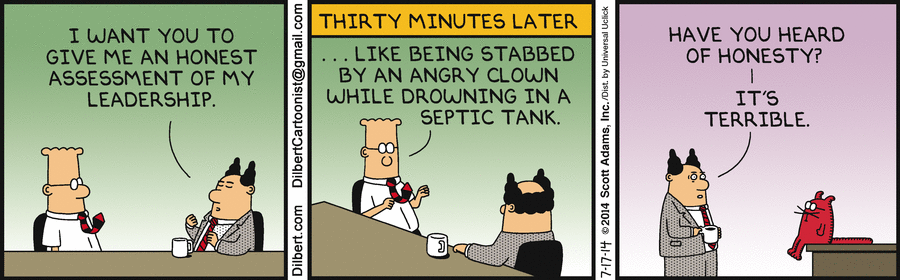
10 Dilbert Cartoons That Get Project Management Just Right

Coronavirus Metric, The Case Fatality, Is Unreliable

https://www.npr.org/2020/07/24/894818106/trumps-favorite-coronavirus-metric-the-case-fatality-is-unreliable?fbclid=IwAR3Zfo29Yhv49yu7ORp9ytjSc8f6uqlhXP0BEFvBGOBUcvXZH0dYrJha2Sc

blog | Teksten, Wijsheid


As the number of coronavirus cases started spiking again this month, the White House keyed in on a different number — one that paints a more rosy picture of the pandemic: the case fatality rate.

When asked about rising cases at a recent briefing, press secretary Kayleigh McEnany quickly parried. “We’re seeing the fatality rate in this country come down,” said McEnany. “That is a very good thing.”

The case fatality rate is the result of a simple mathematical calculation: the number of deaths divided by the number of diagnosed coronavirus cases. But it’s also a moving target. Case numbers are rising fast; deaths are a lagging indicator, running several weeks behind.

“Measuring … mortality rates on any given day is not a reliable way of communicating about this pandemic,” said Dr. Tom Inglesby, director of the Johns Hopkins Center for Health Security.

It is possible that innovations in treatment methods and therapeutic drugs have helped improve the survivability of COVID-19. It is also possible that with more young people being infected in this latest round, they are less likely to die. But medical experts warn it is also just too soon to be sure. And, they say, it’s an unreliable and misleading metric.

But that hasn’t stopped President Trump from boasting about the figure.

“Our case fatality rate has continued to decline and is lower than the European Union and almost everywhere else in the world,” Trump said Tuesday at his first White House coronavirus briefing in nearly three months.

In his interview on Fox News Sunday with Chris Wallace, Trump asked his staff to bring him the “death chart.” He said “the death chart is much more important” as Wallace ticked through 75,000 daily cases and 1,000 daily deaths.

Trump had that chart displayed behind him during the briefing. But this isn’t a metric public health experts have been using.

Inglesby says that by a more direct measure (the sheer number of deaths), and even adjusted for population size, the U.S. is not doing well compared to other countries around the world.

“What national leaders have the obligation to tell people is just the direct truth,” Inglesby said. “If we give them a false sense that things are getting better when they’re not, then they’re going to make decisions that increase the risk of transmission. And they’re also going to stop having confidence in the information they’re being given.”

Focusing on the fatality rate also glosses over other serious problems with the coronavirus, says Dr. David Relman, who specializes in immunology and infectious diseases at Stanford. He says about 20% of people get really sick with potential long-term health consequences. Plus, he says, the coronavirus is stressing the medical system. And as long as it is uncontained, the virus is holding the economy back. So, as he sees it, talking about the case fatality rate is counterproductive.

“What you do instead when you pull out one little piece and dangle it in front of people is to confuse and distract and undermine the overall message,” said Relman.

He says people need to take this virus seriously and take precautions, and that is a sacrifice that requires leaders to get the public on board. For Trump, accentuating the positive might have short-term political benefits, but there are longer-term risks.

“I think it was a mistake early on to be dismissive of the seriousness of it and that it was just going to go away,” said Mike DuHaime, a Republican strategist.

DuHaime gives Trump credit for coming out this week and treating the coronavirus more seriously than he has in the past, telling people to wear masks and avoid crowds. But he readily acknowledges that Trump has gone through other brief spurts urging the public to sacrifice to slow the spread of the virus, only to reverse himself, downplay the severity and pressure states to reopen.

“In order for him to succeed here politically, his credibility has to be as strong as possible,” said DuHaime, who now works at the firm Mercury.

Trump’s credibility has taken a major hit through this crisis. According to the latest Pew Poll, only 30% of Americans trust Trump to get the facts right on the virus. And Trump’s approval rating has tanked too, something he is attempting to repair with the resumed daily briefings.

“At the end of the day, he just needs to do a good job. I know that sounds simplistic, but when you’re an incumbent running for reelection, doing a good job is really the most important thing,” said DuHaime. “And to this point people haven’t seen him do a good job on what they think is the greatest challenge of his presidency.”

DuHaime points out that people are checking the numbers every day — the number of new cases in their city and state, the number of hospitalizations and deaths. Those numbers are all readily available and easier to find than the case fatality rate.


Top U.S. Officials Told C.D.C. to Soften Coronavirus Testing Guidelines

The Centers for Disease Control and Prevention abruptly changed its recommendations, saying people without Covid-19 symptoms should not get tested.

 Trump administration officials on Wednesday defended a new recommendation that people without Covid-19 symptoms abstain from testing, even as scientists warned that the policy could hobble an already weak federal response as schools reopen and a potential autumn wave looms.

The day after the Centers for Disease Control and Prevention issued the revised guidance, there were conflicting reports on who was responsible. Two federal health officials said the shift came as a directive to the Atlanta-based C.D.C. from higher-ups in Washington at the White House and the Department of Health and Human Services.

Adm. Brett P. Giroir, the administration’s coronavirus testing czar, called it a “C.D.C. action,” written with input from the agency’s director, Dr. Robert R. Redfield. But he acknowledged that the revision came after a vigorous debate among members of the White House coronavirus task force — including its newest member, Dr. Scott W. Atlas, a frequent Fox News guest and a special adviser to President Trump.

“We all signed off on it, the docs, before it ever got to a place where the political leadership would have, you know, even seen it, and this document was approved by the task force by consensus,” Dr. Giroir said. “There was no weight on the scales by the president or the vice president or Secretary Azar,” he added, referring to Alex M. Azar II, the secretary of health and human services.

Regardless of who is responsible, the shift is highly significant, running counter to scientific evidence that people without symptoms could be the most prolific spreaders of the coronavirus. And it comes at a very precarious moment. Hundreds of thousands of college and K-12 students are heading back to campus, and broad testing regimens are central to many of their schools’ plans. Businesses are reopening, and scientists inside and outside the administration are growing concerned about political interference in scientific decisions.

Democratic governors who were weighing how to keep the virus contained as their economies and schools come to life said limiting testing for asymptomatic citizens would make the task impossible.

“The only plausible rationale,” Gov. Andrew M. Cuomo of New York told reporters in a conference call from Albany, N.Y., “is that they want fewer people taking tests, because as the president has said, if we don’t take tests, you won’t know the number of people who are Covid-positive.”

Over the weekend, the Food and Drug Administration, under pressure from Mr. Trump, gave emergency approval to expand the use of antibody-rich blood plasma to treat Covid-19 patients. The move came just days after scientists, including Dr. Anthony S. Fauci, the nation’s top infectious disease expert, and Dr. Francis S. Collins, the director of the National Institutes of Health, intervened to stop the practice because of lack of evidence that it worked.

The move echoed a decision by the Food and Drug Administration to grant an emergency use waiver for hydroxychloroquine, a malaria drug repeatedly sold by Mr. Trump as a treatment for Covid-19. The agency revoked the waiver in June, when clinical trials suggested the drug’s risks outweighed any possible benefits.

The testing shift, experts say, was a far more puzzling reversal. Dr. Giroir said the move was “discussed extensively by” members of the White House coronavirus task force, and he named Dr. Redfield, Dr. Atlas, Dr. Fauci and Dr. Stephen M. Hahn, the commissioner of food and drugs. Notably, he did not name Dr. Deborah L. Birx, the White House coronavirus response coordinator. But he said Dr. Fauci was among those who had “signed off.”

In a brief interview, Dr. Fauci said he had seen an early iteration of the guidelines and did not object. But the final debate over the revisions took place at a task force meeting on Thursday, when Dr. Fauci was having surgery under general anesthesia to remove a polyp on his vocal cord. In retrospect, he said, he now had “some concerns” about advising people against getting tested, because the virus could be spread through asymptomatic contact.

“My concern is that it will be misinterpreted,” Dr. Fauci said.

The newest version of the C.D.C. guidelines, posted on Monday, amended the agency’s guidance to say that people who had been in close contact with an infected individual — typically defined as being within six feet of a person with the coronavirus and for at least 15 minutes — “do not necessarily need a test” if they do not have symptoms.

Exceptions might be made for “vulnerable” individuals, the agency noted, or if health care providers or state or local public health officials recommended testing.

Dr. Giroir said the new recommendation matched existing guidance for hospital workers and others in frontline jobs who have “close exposures” to people infected with the coronavirus. Such workers are advised to take proper precautions, like wearing masks, socially distancing, washing their hands frequently and monitoring themselves for symptoms.

He argued that testing those exposed to the virus was of little utility, because tests capture only a single point in time, and that the results could give people a false sense of security.

“A negative test on Day 2 doesn’t mean you’re negative. So what is the value of that?” Dr. Giroir asked, adding, “It doesn’t mean on Day 4 you can go out and visit Grandma or on Day 6 go out without a mask on in school.”

The guidelines come amid growing concern that the C.D.C., the agency charged with tracking and fighting outbreaks of infectious disease, is being sidelined by its parent agency, the Department of Health and Human Services, and the White House. Under ordinary circumstances, administering public health advice to the nation would fall squarely within the C.D.C.’s portfolio.

Experts have called the revisions alarming and dangerous, noting that the United States needs more testing, not less. And they have expressed deep concern that the C.D.C. is posting guidelines that its own officials did not author. A former C.D.C. director, Dr. Thomas R. Frieden, railed against the move on Twitter on Wednesday:

Dr. Tom Frieden
@DrTomFrieden
Two unexplained, inexplicable, probably indefensible changes, likely imposed on CDC’s website. * Dammit, if you come from a place with lots of Covid, quarantine for 14 days * If you’re a contact, get tested. If +, we can trace your contacts and stop chains of spread. A sad day.

Later, in an interview, Dr. Frieden elaborated. He noted that the C.D.C. had recently dropped its recommendation that people quarantine for 14 days after traveling from an area with a high number of cases to one where the virus was less prevalent. And he reiterated that testing the contacts of those infected was an important means of curbing the spread of the virus.

“We don’t know the best protocol for testing of contacts: Should you test all contacts? That’s the kind of study that frankly needs to get done,” Dr. Frieden said. But absent the answer to that question, he added, “I certainly wouldn’t say, ‘Don’t test contacts.’”

Democrats, including Speaker Nancy Pelosi and two governors — Mr. Cuomo and Gavin Newsom of California — were outraged by the changes. Mr. Newsom said California would not follow the new guidelines, and Mr. Cuomo blamed Mr. Trump.

Representative Frank Pallone Jr. of New Jersey, a Democrat and the chairman of the House Energy and Commerce Committee, also chimed in on Twitter: “The Trump Admin has a lot of explaining to do. #COVID19 testing is essential to stopping the spread of the pandemic. I’m concerned that CDC is once again caving to political pressure. This simply cannot stand.”

Mr. Trump has suggested that the nation should do less testing, arguing that administering more tests was driving up case numbers and making the United States look bad. But experts say the true measure of the pandemic is not case numbers but test positivity rates — the percentage of tests coming back positive.

As Dr. Giroir denied that politics was involved, he encouraged the continued testing of asymptomatic people for surveillance purposes — to determine the prevalence of the virus in a given community — and said such “baseline surveillance testing” would still be appropriate in schools and on college campuses.

“We’re trying to do appropriate testing, not less testing,” he said.

Still, the revisions left many public health officials scratching their heads. They might have made sense when the United States was experiencing a shortage of tests, some experts said, but that no longer appears to be the case. Dr. Frieden, however, said it was possible the administration was trying to conserve testing in case of another surge.

“The problem is we have too many cases, so there is basically no way to keep up the testing if you have a huge outbreak,” he said.

Jennifer Nuzzo, an epidemiologist at Johns Hopkins Bloomberg School of Public Health, said she was “not as up in arms about the content of the guidelines” as she was about the idea that the C.D.C.’s own experts did not write them — and that C.D.C. officials were referring all questions about them to the health department in Washington.

“These guidelines are clearly controversial, and many are calling on C.D.C. to explain its rationale for them, but C.D.C. is unable to comment,” she said in an email. “This is really dangerous precedent, and I fear it will erode public trust in C.D.C.”


Six months ago, Trump said that coronavirus cases would soon go to zero. They … didn’t.

https://www.washingtonpost.com/politics/2020/08/26/six-months-ago-trump-said-that-coronavirus-cases-would-soon-go-zero-they-didnt/?utm_campaign=wp_main&utm_medium=social&utm_source=facebook&fbclid=IwAR2-yqYYel73YR3zJXfqtn25DXNEA8Yi1qc0L0RQ3PNP-NqUJ299PFNdeWc


But with new constraints on testing, Trump may get his wish eventually.

It was exactly six months ago Wednesday when the spread of the coronavirus in the United States had become too significant for President Trump to wave away. He and several members of the team planning the administration’s response held a news briefing designed to inform the public about the virus and, more important, to allay concerns.

This was the briefing in which Trump made one of his most wildly incorrect assertions about what the country could expect.

“The level that we’ve had in our country is very low,” Trump said, referring to new confirmed infections, “and those people are getting better, or we think that in almost all cases they’re better, or getting. We have a total of 15. We took in some from Japan — you heard about that — because they’re American citizens, and they’re in quarantine.”

That part was generally true. At the time, there had been only a smattering of confirmed cases, with the addition of passengers from the cruise ship Diamond Princess pushing the confirmed total to more than 50.

“So, again,” he added later, “when you have 15 people, and the 15 within a couple of days is going to be down to close to zero, that’s a pretty good job we’ve done.”

It was a brash prediction and seemingly an off-the-cuff one. Trump’s point was less about what was going to happen than arguing that his administration had done a good job. But by linking those two things, he made it simple for observers to use his assertion that the number of cases would fade as a baseline for measuring everything that followed.

Over time, more cases from the period before Feb. 26 would be discovered, including two early deaths in California from covid-19, the disease caused by the virus. There were actually almost 200 cases that would eventually be confirmed by the time Trump was saying the country would go from 15 to zero.

The experts standing behind Trump would have known that Trump’s claims were inaccurate. As the briefing was underway, The Washington Post reported a confirmed case of “community spread” — a documented infection that couldn’t be traced to international travel. In other words, it was uncontained: The virus was moving from person to person without impediment or detection.

Although about 200 cases in that period eventually would be confirmed, even that number was far lower than the reality. Researchers can use documented cases to estimate the number of cases that weren’t being detected and that also weren’t later confirmed through testing. For example, an estimate produced by data scientist Youyang Gu puts the likely number of new infections on Feb. 26 somewhere in the range of 13,000 to 25,000.

On that day alone.

Within a month, the country would go from Trump’s 15 cases to nearly 88,000 cases. By April 26, the total was nearly a million. By May 26, 1.7 million. The most recent total is north of 5.7 million.

That steady increase is in part a function of Trump repeating the same mistake over and over, portraying the pandemic as ending or functionally ended. As cases faded a bit in May and June, he pushed for a return to normal economic activity, triggering a new surge in confirmed cases. That second increase has been fading for about a month, happily, but the country is still adding 33 percent more confirmed new cases each day than it did at the peak in April.

That’s confirmed cases, a metric that relies on testing. Gu’s estimates of the actual spread of the virus put the country about 40 percent below the peak in daily new cases, which was reached in early July.

Trump, of course, blames testing for revealing the scale of the pandemic in the first place. He has a point, in a way: Had the United States never managed to solve its problems with testing, something that took weeks, there wouldn’t have been millions of confirmed cases. There would still have been millions of cases or, perhaps, tens of millions of cases. We just wouldn’t have known how many there were.

It has been about two months since Trump held a political rally in Tulsa, contributing to a new surge of cases in the city. There, he made a tongue-in-cheek reference to asking his team to slow down on testing, because it was pushing the number of confirmed cases higher. As they say, though, each joke contains a grain of truth, and it was clear that Trump, in fact, would be happy to see the number of tests drop so that the number of confirmed cases did as well.

Data compiled by the COVID Tracking Project show that he has gotten his wish, to a degree. Over the past month, the number of tests being completed each day in the United States has dropped by nearly one-fifth.

Part of this is a function of interference from natural disasters, with storms in Florida and fires in California limiting testing capacity. Part of it, too, is probably a function of the drop in the number of cases coming back positive. Fewer new cases means fewer people feeling sick and seeking tests to confirm an infection. The drop in the percent of tests coming back positive reinforces that trend.

But, increasingly, part of it will stem from the administration de-emphasizing testing. New guidance published by the Centers for Disease Control and Prevention suggested that those who had been in contact with an infected person no longer needed to be tested, particularly when asymptomatic.

This, too, has been something Trump has talked about a lot, complaining that people without symptoms were being tested and confirmed as positive — and added to the total number of infections.

“Many of those cases are young people that would heal in a day,” Trump said in an interview on July 19. “They have the sniffles and we put it down as a test.”

The reason it’s important to track asymptomatic cases, of course, is that those people can still infect others. To defeat the pandemic, we need to contain it, and the new CDC approach runs the significant risk of leaving large holes in that containment effort. But, with the presidential election only about 70 days away, it will mean fewer confirmed cases.

The irony of Trump’s complaints about the virus from the outset is that the United States’ confirmed infection totals already have been minimized because of limited testing. The reason Trump was able to claim that there were only 15 cases six months ago was that the administration had spent the month since the first confirmed case in the country unable to put together a robust testing regimen that would allow the virus to be constrained. South Korea, where such a regimen was quickly implemented, actually did see its virus numbers drop to near zero.

In other words, Trump’s prediction was not only wrong, it was wrong in large part because Trump’s team hadn’t done what would have been needed to make it come true. Trump portrays himself as an unwitting victim of the pandemic, but his comment six months ago Wednesday is a good reminder that he can put a lot of the blame for his position on himself.


Cartoon – The Vagueness Campaign

The Dilbert Strip for September 27, 2012: Social Media Expert This ...

Fake vs genuine people: 10 ways to spot the difference

Fake vs genuine people: 14 ways to spot the difference

Check Out 10 Ways To Identify Fake People - EKSUOLOFOFO

Not sure who you’re dealing with?

Fake vs genuine people may look the same, but with a little bit of knowledge, you can spot the difference.

Fake people are ingenuine and often hypocritical. They do things for their own gain but hide behind altruism.

Genuine people are true to themselves. They do things because they want to, not because they have to. Plus, they enjoy helping people.

Fake people aren’t just frustrating—they can even be damaging to your health.

In this article, I’ll break down the key difference between fake and genuine people, explain how to tell if someone is a genuine person, and share some tips on standing up for yourself.

Let’s begin.

Fake vs genuine people

The key difference between fake and genuine people is honesty.

Fake people aren’t honest with themselves and the people around them. They do things based on lies and deceit.

Genuine people are honest with themselves and others. Their actions are aligned with what they believe.

The problem is that fake people often don’t know they’re being fake. They may be acting based on lies without knowing how hypocritical they are being.

Fake people don’t know they’re fake because of self-deception.

How can you recognize someone is being fake?

5 things fake people often do

1) Lead people on

Fake people often lead people on because they are trying to please everyone. They spend so much time trying to please everyone else that a lot of people get let down in the process.

2) Cancel plans

Whether they never invite you out to do things in the first place or they cancel at the last minute, they’re fake. They’re probably so busy trying to please the other people that they made plans with that they have to cancel yours.

3) Talk about you behind your back

This is what’s really annoying about fake people. To your face, you’re their best friend. But as soon as you’re away, you’re nothing. They sit and gossip about you to make themselves look better to whoever it is they’re trying to impress.

4) Never get mad

You know who gets mad? Real people! Those who claim that they hardly ever get mad or frustrated about things are fake. Everyone is passionate about something, and everyone gets mad.

5) Disappear when you need them

Need help moving? Going through a difficult breakup? Fake people disappear right when you need them. As soon as you ask them for help, they are gone.

How to tell if someone is genuine

It can be hard to tell if someone is a genuinely nice person or if they are only being nice to you because they need something from you.

Unfortunately, many people are only out to help themselves, but there are still lots of genuine people walking around on the planet.

Here’s how you can spot a genuine person from a fake person.

1) Have a few close friends

Those who are authentic to their selves know that they can’t do everything. They can’t commit to dozens of people, so they have a few close friends that they really commit to.

2) Show up

When a true, genuine person makes plans with you, they’re going to show up. They don’t cancel on you last minute, and they aren’t going to make you wait for a “date” that’s never going to happen. They enjoy your company.

3) Admire people

Genuine people don’t gossip. Instead, they admire the positive qualities that they find in people around them. They talk about the positive, not the negative, and like to share good things.

4) Get angry and feel hurt

Real people feel things. They aren’t going to sugarcoat and act as though nothing bothers them. When genuine people are passionate about something, they’re here to show it. They invest their time and energy into their passions, and they’ll make it known.

5) There for you

When you’re hurting, genuine people hurt with you. They aren’t going to make you feel like you have no one. You can rely on them, and when something happens or you need a helping hand, they’ll be there.

Standing up to fake people

If you have fake people in your life, it’s essential to build the courage to stand up for yourself.

It’s not just about not being pushed around by this particular fake person, though this is important.

It’s also important because it teaches you to set boundaries.

This will make a big difference the next time someone fake enters your life.

I learned the importance of boundary-setting in Rudá Iandê’s free masterclass on embracing your inner beast. It’s a brilliant masterclass and completely changed how I see myself.

I used to think it was a bad idea standing up for myself. I would worry so much about what other people think.

By the time I finished watching Rudá Iandê’s masterclass, my perspective had completely shifted.

Are fake people bad for you?

Fake people are annoying, but are they actually bad for your health? Well, yes, they can be.

It takes time and energy to invest in a relationship, and when that investment is in something fake, it’s hurtful. But it goes beyond that.

Plenty of studies have found that there is a link between our relationships and our well-being. When our social relationships are complicated or one-sided, we feel worse. The strength of our connection to people is what really matters.

So, what does this mean?

Basically, if you have 20 friends, but none of them would come and pick you up after you’ve blown a tire, then your relationships aren’t that great.

But if you had just one or two friends that you could count on, that would show up when needed, the strength of that connection is great. This helps you to feel whole and connected to others, which is beneficial to your health.

Why are there so many fake people?

In today’s world, it seems like there are a lot more fake people than ever before. And it may be true. Thanks to social media and the notoriety that a person can gain from it, it seems like everyone wants to be famous.

To be famous, at least some people have to like you. So, a lot of people will act fake in hopes of getting a following and more people to like them. There are a lot of people who use the internet as a means to stop their loneliness, but it can just make it worse for them.

Why do people act fake?

People act fake because:

  • They aren’t happy with who they truly are
  • They want to feel better about themselves
  • They want people to follow them
  • They want to control others
  • They don’t like their life

Everyone is fake sometimes

The truth is when it comes to fake vs genuine people, everyone is fake sometimes. Whether you’re fake to your coworkers or your so-called friends is up to you. But being fake isn’t something that is good for us.

The opposite, being authentic, is what makes us better people. And while I’m going to talk a bit more about authenticity in a moment, I just want to say that anyone who is fake and putting on a show, isn’t worth your time. You make strong connections with others, and those are the friendships to keep.

How do you really know you’re dealing with a fake person? Well, I’m glad you asked. There are 10 easy ways to test whether the person you’re dealing with is fake or genuine.

10 ways to know you’re dealing with a fake person

Every fake person has 10 tell-tale signs that they’re fake. No matter how hard they try to hide how unauthentic they are, these signs say otherwise:

1) Full of themselves

It probably doesn’t come as a surprise, but fake people are full of themselves. They think that they’re better than everyone around them, and they love to brag. If you find that you have that one friend who is always trying to brag about their own accomplishments, they’re not being genuine.

2) Are manipulative

Fake people have a sort of “mob mentality.” They manipulate others and want everyone to believe what they believe. To do this, they will appeal to others’ emotions. Sometimes, they’ll bandwagon behind a “hot issue” or something that will give them the most notoriety.

3) Jaded with emotions

Like I mentioned before, fake people don’t do emotions well. Most of the time, they think that they’re a waste of time. Since it doesn’t get them ahead, they don’t do them.

Sure, they can fake emotions here and there to get a rise out of people and hope for more people to follow them. But, that’s about as far as they get. Their emotions are jaded, and when you come to them for help, they’re going to be emotionally there for you.

4) Judge you

Do you have a friend that is always judging you? A lot of times, fake people are insecure about what they have. They think that if you don’t believe the same things they do, then you’re wrong. To counteract their own insecurity, they judge you.

It doesn’t feel good. They even use this judgment as a way to try and get back control. Since they want to build their own egos up, they think that by putting you down, it makes them look better. This is where all of their energy is focused.

5) Have hostile humor

Though they may plaster on a kind smile and say nice things, when their humor comes out, it’s clear to see that they’re fake. Many people use hostile humor to try and hide the shame that they feel with their own selves.

Since fake people aren’t happy with their true, authentic selves, they use hostile humor to make them feel better. By putting you down, it builds them up. Then when you get mad about their hostile humor, they blow you off or act like it isn’t a big deal. Remember, they don’t “do” emotions.

6) Aren’t consistent

It’s that friend who always has a new idea. One moment they’re investing in stocks, the next moment their opening up an online store, and finally, they’ve found their dream of being a realtor.

Sound familiar?

Those friends who lack consistency and can’t stay still aren’t true to themselves. They’re as fake as they come, and they don’t care if they leave a big mess behind them.

7) Don’t learn lessons

Fake people don’t get a free pass when it comes to their mistakes, but they think that they do. When they do make a mistake, they aren’t going to admit to it. Or even if they do admit to it, they aren’t going to learn from it.

Genuine people recognize their mistakes and learn from them. Fake people would rather act like it never happened in the first place.

8) Unrealistic expectations

Not only do they put you down and try to control you, but fake people also have unrealistic expectations. They expect people to drop everything for them last-minute, but they wouldn’t do the same for you.

On top of that, they expect to have the best of everything. Often times, fake people are constantly buying new things, especially expensive ones. They want to showcase the success that they have, and they believe that their belongings are how they can do that.

9) Always need the attention

Having your engagement party? Well, your fake friend is about to announce a huge promotion. If they have the chance to steal the spotlight, they will. These people want to be the star of the show, and they don’t care what show it is.

Attention always has to be focused on this person because they demand it. They want to be noticed, and they need that praise from others to feel good about themselves. Unfortunately, it leads to a lot of hurt people when they do something toxic like this.

10) Don’t respect your boundaries

Maybe the biggest sign of fake people? They don’t respect your boundaries.

Once you talk to them, they blow you off. This can be if you bring up hurt feelings or some time where they made a mistake. Boundaries are nonexistent to them unless they were the ones that set them.

Because of this, these friendships can be hard to sever, and they can lead to a lot of pain. But anyone who doesn’t respect your boundaries is not worth keeping around in your life.

Be authentic and attract authenticity

When it comes to fake vs genuine people, it can be hard to know which is which. However, the 10 ways I’ve outlined is a great start. Because fake people usually look for people who will follow them or people who are easily controlled, the best way to get rid of fake people is by being authentic yourself.

As Rudá Iandê says, “Our world is full of fake perfection and happiness, but craving for authenticity.” It is by being your authentic self that you will find deep, lasting connections that will help you to lead a happy and healthy life.

Our lives are too short to spend investing in fake people. Choose to be yourself and be authentic, and you’ll find genuine people to share your life with.