The big picture: The data showed nearly a six-fold increase in Omicron’s share of COVID-19 infections in just one week.
The variant was only detected in the U.S. a few weeks ago. Still, the strain has spread rapidly throughout the country and threatens to overturn the new normal.
What they’re saying: “These numbers are stark, but they’re not surprising,” said Rochelle Walensky, the CDC’s director, adding that the growing infections reflect what has been seen in other countries.
While the Delta variant still drives up a lot of new infections, Walensky told AP she anticipates “that over time that Delta will be crowded out by Omicron.”
What’s next: President Biden on Tuesday will deliver a speech outlining new steps the administration will take to address the rapid spread of the new variant.
Nurse Katie Sefton never thought Covid-19 could get this bad — and certainly not this late in the pandemic. “I was really hoping that we’d (all) get vaccinated and things would be back to normal,” said Sefton, an assistant manager at Sparrow Hospital in Lansing, Michigan. But this week Michigan had more patients hospitalized for Covid-19 than ever before. Covid-19 hospitalizations jumped 88% in the past month, according to the Michigan Health & Hospital Association.
“We have more patients than we’ve ever had at any point, and we’re seeing more people die at a rate we’ve never seen die before,” said Jim Dover, president and CEO of Sparrow Health System.
“Since January, we’ve had about 289 deaths; 75% are unvaccinated people,” Dover said. “And the very few (vaccinated people) who passed away all were more than 6 months out from their shot. So we’ve not had a single person who has had a booster shot die from Covid.”
Among the new Covid-19 victims, Sefton said she’s noticed a disturbing trend.
“We’re seeing a lot of younger people. And I think that is a bit challenging,” said Sefton, a 20-year nursing veteran.She recalls helping the family of a young adult say goodbye to their loved one. “It was an awful night,” she said. “That was one of the days I went home and just cried.”
‘We haven’t peaked yet’
It’s not just Michigan that’s facing an arduous winter with Covid-19. Nationwide, Covid-19 hospitalizations have increased 40% compared to a month ago, according to data from the US Department of Health and Human Services. This is the first holiday season with the relentless spread of the Delta variant — a strain far more contagious than those Americans faced last winter.
Sparrow Hospital nurse Danielle Williams said the vast majority of her Covid-19 patients are not vaccinated — and had no idea they could get pummeled so hard by Covid-19.“Before they walked in the door, they had a normal life. They were healthy people. They were out celebrating Thanksgiving,” Williams said. “And now they’re here, with a mask on their face, teary eyed, staring at me, asking me if they’re going to live or not.”
‘The next few weeks look hard’
Dover said he’s saddened but not surprised that his state is getting walloped with Covid-19.“Michigan is not one of the highest vaccination states in the nation. So it continues to have variant after variant grow and expand across the state,” he said.
“The next few weeks look hard. We’re over 100% capacity right now,” Dover said.”Most hospitals and health systems in the state of Michigan have gone to code-red triage, which means they won’t accept transfers. And as we go into the holidays, if the current growth rate that we’re at today, we would expect to see 200 in-patient Covid patients by the end of the month — on a daily basis.”And that would mean “absolutely stretching us to the breaking point,” Dover said.”We’ve already discontinued in-patient elective surgeries,” he said. “In order to create capacity, we took our post-anesthesia recovery care unit and converted it into another critical care unit.”
‘There’s a lot of frustration’
Nurse Leah Rasch is exhausted. She’s worked with Covid-19 patients since the beginning of the pandemic and was stunned to see so many people still unvaccinated enter the Covid unit.
“I did not think we’d be here. I truly thought that people would be vaccinated,” the Sparrow Hospital nurse said.”I don’t remember the last time we did not have a full Covid floor.”The relentless onslaught of Covid-19 patients has impacted Rasch’s own health. “There’s a lot of frustration,” she said. “The other day, I had my first panic attack … I drove to work and I couldn’t get out of the car.”
‘We need everybody to get vaccinated’
Dover said many people have asked how they can support health care workers.”If you really want to support your staff, and you really want to support health care heroes, get vaccinated,” he said. “It’s not political. We need everybody to get vaccinated.”
He’s also urging those who previously had Covid-19 to get vaccinated, as some people can get reinfected.”My daughter’s a good example. She had Covid twice before she was eligible for a vaccine,” Dover said. “She still got a vaccine because we know that if you don’t get the vaccine, just merely having contracted Covid is not enough to protect you from getting it again. And I know that from personal experience. “And those who are unvaccinated shouldn’t underestimate the pandemic right now, Dover said.
“The problem is, it’s not over yet. I don’t know if people realize just how critical it still is,” he said.”But they do realize it when they come into the ER, and they have to wait three days for a bed. And at that point, they realize it.”
COVID-19-related hospitalizations have been on an upward trend in New York state since last month, but there appears to be a drastic divide between the Big Apple and some of the state’s more rural areas, health data shows.
In New York City, the seven-day average of new COVID-19 hospitalizations per 100,000 people rose from 0.5 on Nov. 10 to 1.1 on Dec. 7, the New York State Department of Health said.
The story is different in several counties hundreds of miles north, where new COVID-19 hospitalizations are rising at a higher rate. In the Finger Lakes region, officials in several counties declared a state of emergency after the seven-day average of new COVID-19 hospitalizations per 100,000 people went from 2.9 on Nov. 10 to 4.9 on Dec. 7.
David Larsen, an associate professor of public health at Syracuse University, told ABC News that there are several factors behind this divide, but the most important one is the lower vaccination rates in certain counties upstate.
“At the end of the day, you’re more likely to get severe COVID-19 symptoms and go to the hospital if you’re not vaccinated,” Larsen said.
Health experts and state officials predict the situation upstate is only going to get worse during the holidays and colder months, but the tide can be turned if more people get their shots and heed health warnings.
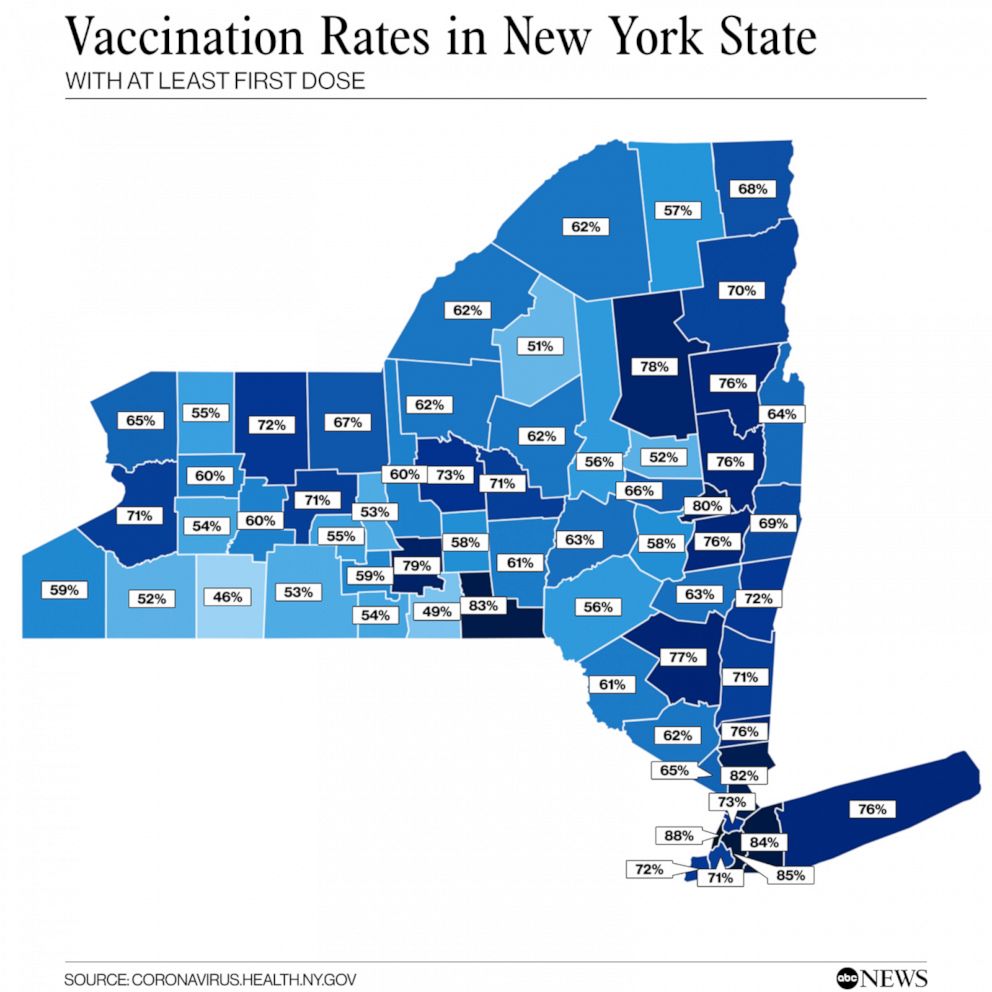
As of Dec. 8, 74.9% of all New York state residents have at least one COVID-19 vaccine dose, but those numbers vary by region, according to state health data.
New York City and Long Island had over 78% of their populations with at least one shot, the state data showed. Further north, the rates for at least one dose in the Mohawk Valley, the Finger Lakes and North Country sections were 60.6%, 68.5%, and 63% respectively.
There is even more division within the regions when it comes to vaccination, the data shows; for example, counties that are along the Interstate 87 corridor, such as Hamilton, Schenectady and Saratoga, all have rate of at least one dose above 75% of their populations.
Counties directly west of those locations, Schoharie, Fulton and Montgomery, have one-dose vaccination rates under 65%, the state data showed.
New York Gov. Kathy Hochul has repeatedly highlighted that the unvaccinated are the ones suffering and being hospitalized.
“It is a conscious decision not to be vaccinated. And the direct result is a higher rate of individuals in those regions upstate as well as it has a direct correlation to the number of hospitalizations,” she said during a Dec. 2 news conference.
Dr. Isaac Weisfuse, an adjunct professor of public health at Cornell University, told ABC News that there are fewer options for upstate residents to turn to for medical help and fewer hospitals in the area are handling patients from more locations.
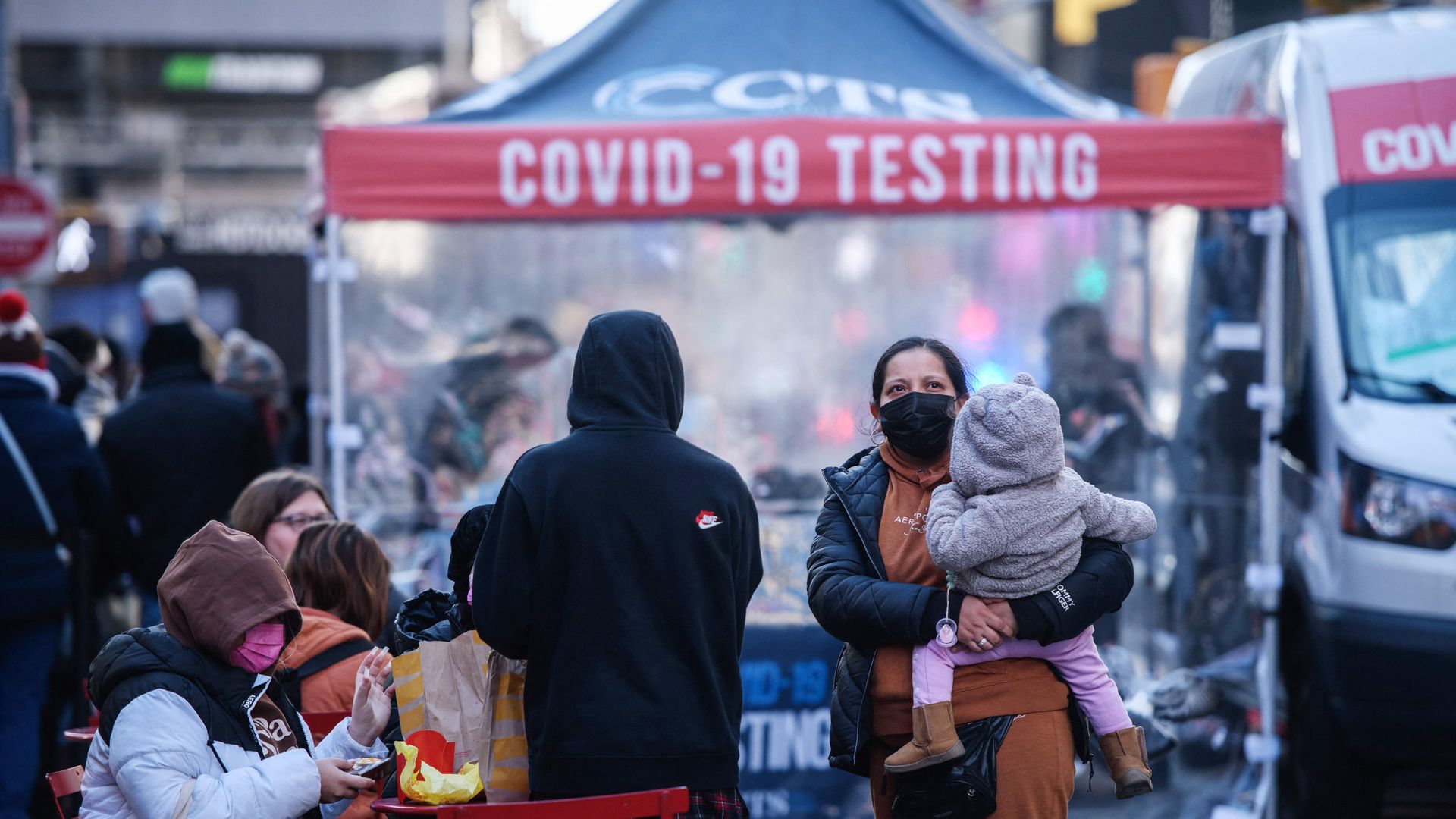
Weisfuse, a former deputy health commissioner for New York City’s Health Department, noted that New York City residents have much closer access to amenities like free testing sites and medical clinics than their upstate counterparts.
“If you live in a rural county in New York state and it takes a while to get to a doctor, you may put it off. So when you do eventually go get care, you may be sicker versus someone who lives closer and gets a quicker diagnosis,” he said.
Larsen added that there has been pandemic fatigue across the country, and many Americans have scaled back on mitigation measures, especially mask-wearing indoors.
“We’re doing less mask wearing. What that does is it increases transmission, which is fine for the vaccinated people but it does go to the unvaccinated people and they are higher risk,” he said.
Weisfuse said the hospitalizations are likely to grow upstate and have ripple effects for those regions. The governor has ordered elective surgeries to be postponed at 32 hospitals upstate that have seen their available beds decrease.
State officials said they are beefing up their marketing efforts to encourage eligible New Yorkers to get their shots.
Weisfuse said this outreach needs to be done meticulously if upstate officials want to avoid more overcrowded emergency rooms this winter.
“The state needs to take a good look at the pockets of non-vaccination,” he said. “They need to make some targeted intervention in those neighborhoods.”
Anyone who needs help scheduling a free vaccine appointment can log onto vaccines.gov.
Top US scientist Anthony Fauci said Tuesday that while it would take weeks to judge the severity of the new Covid-19 variant Omicron, early indications suggested it was not worse than prior strains, and possibly milder.
Speaking to AFP, President Joe Biden’s chief medical advisor broke down the knowns and unknowns about Omicron into three major areas: transmissibility, how well it evades immunity from prior infection and vaccines, and severity of illness.
The new variant is “clearly highly transmissible,” very likely more so than Delta, the current dominant global strain, Fauci said.
Accumulating epidemiological data from around the world also indicates re-infections are higher with Omicron.
Fauci, the long-time director of the National Institute of Allergies and Infectious Diseases (NIAID), said lab experiments that tested the potency of antibodies from current vaccines against Omicron should come in the “next few days to a week.”
On the question of severity, “it almost certainly is not more severe than Delta,” said Fauci.
“There is some suggestion that it might even be less severe, because when you look at some of the cohorts that are being followed in South Africa, the ratio between the number of infections and the number of hospitalizations seems to be less than with Delta.”
But he added it was important to not over-interpret this data because the populations being followed skewed young, and were less likely to become hospitalized.
“I think that’s going to take another couple of weeks at least in South Africa,” where the variant was first reported in November, he said.
“As we get more infections throughout the rest of the world, it might take longer to see what’s the level of severity.”
Fauci said a more transmissible virus that doesn’t cause more severe illness and doesn’t lead to a surge of hospitalizations and deaths was the “best case scenario.”
“The worst case scenario is that it is not only highly transmissible, but it also causes severe disease and then you have another wave of infections that are not necessarily blunted by the vaccine or by people’s prior infections,” he added.
“I don’t think that worst case scenario is going to come about, but you never know.”
The healthcare industry’s staffing shortage crisis has had clear consequences for care delivery and efficiency, forcing some health systems to pause nonemergency surgeries or temporarily close facilities. Less understood is how these shortages are affecting care quality and patient safety.
A mix of high COVID-19 patient volume and staff departures amid the pandemic has put hospitals at the heart of a national staffing shortage, but there is little national data available to quantify the shortages’ effects on patient care.
The first hint came last month from a CDC report that found healthcare-associated infections increased significantly in 2020 after years of steady decline. Researchers attributed the increase to challenges related to the pandemic, including staffing shortages and high patient volumes, which limited hospitals’ ability to follow standard infection control practices.
“That’s probably one of the first real pieces of data — from a large scale dataset — that we’ve seen that gives us some sense of direction of where we’ve been headed with the impact of patient outcomes as a result of the pandemic,” Patricia McGaffigan, RN, vice president of safety programs for the Institute for Healthcare Improvement, told Becker’s. “I think we’re still trying to absorb much of what’s really happening with the impact on patients and families.”
An opaque view into national safety trends
Because of lags in data reporting and analysis, the healthcare industry lacks clear insights into the pandemic’s effect on national safety trends.
National data on safety and quality — such as surveys of patient safety culture from the Agency for Healthcare Research and Quality — can often lag by several quarters to a year, according to Ms. McGaffigan.
“There [have been] some declines in some of those scores more recently, but it does take a little while to be able to capture those changes and be able to put those changes in perspective,” she said. “One number higher or lower doesn’t necessarily indicate a trend, but it is worth really evaluating really closely.”
For example, 569 sentinel events were reported to the Joint Commission in the first six months of 2021, compared to 437 for the first six months of 2020. However, meaningful conclusions about the events’ frequency and long-term trends cannot be drawn from the dataset, as fewer than 2 percent of all sentinel events are reported to the Joint Commission, the organization estimates.
“We may never have as much data as we want,” said Leah Binder, president and CEO of the Leapfrog Group. She said a main area of concern is CMS withholding certain data amid the pandemic. Previously, the agency has suppressed data for individual hospitals during local crises, but never on such a wide scale, according to Ms. Binder.
CMS collects and publishes quality data for more than 4,000 hospitals nationwide. The data is refreshed quarterly, with the next update scheduled for October. This update will include additional data for the fourth quarter of 2020.
“It is important to note that CMS provided a blanket extraordinary circumstances exception for Q1 and Q2 2020 data due to the COVID-19 pandemic where data was not required nor reported,” a CMS spokesperson told Becker’s. “In addition, some current hospital data will not be publicly available until about July 2022, while other data will not be available until January 2023 due to data exceptions, different measure reporting periods and the way in which CMS posts data.”
Hospitals that closely monitor their own datasets in more near-term windows may have a better grasp of patient safety trends at a local level. However, their ability to monitor, analyze and interpret that data largely depends on the resources available, Ms. McGaffigan said. The pandemic may have sidelined some of that work for hospitals, as clinical or safety leaders had to shift their priorities and day-to-day activities.
“There are many other things besides COVID-19 that can harm patients,” Ms. Binder told Becker’s. “Health systems know this well, but given the pandemic, have taken their attention off these issues. Infection control and quality issues are not attended to at the level of seriousness we need them to be.”
What health systems should keep an eye on
While the industry is still waiting for definitive answers on how staffing shortages have affected patient safety, Ms. Binder and Ms. McGaffigan highlighted a few areas of concern they are watching closely.
The first is the effect limited visitation policies have had on families — and more than just the emotional toll. Family members and caregivers are a critical player missing in healthcare safety, according to Ms. Binder.
When hospitals don’t allow visitors, loved ones aren’t able to contribute to care, such as ensuring proper medication administration or communication. Many nurses have said they previously relied a lot on family support and vigilance. The lack of extra monitoring may contribute to the increasing stress healthcare providers are facing and open the door for more medical errors.
Which leads Ms. Binder to her second concern — a culture that doesn’t always respect and prioritize nurses. The pandemic has underscored how vital nurses are, as they are present at every step of the care journey, she continued.
To promote optimal care, hospitals “need a vibrant, engaged and safe nurse workforce,” Ms. Binder said. “We don’t have that. We don’t have a culture that respects nurses.”
Diagnostic accuracy is another important area to watch, Ms. McGaffigan said. Diagnostic errors — such as missed or delayed diagnoses, or diagnoses that are not effectively communicated to the patient — were already one of the most sizable care quality challenges hospitals were facing prior to the pandemic.
“It’s a little bit hard to play out what that crystal ball is going to show, but it is in particular an area that I think would be very, very important to watch,” she said.
Another area to monitor closely is delayed care and its potential consequences for patient outcomes, according to Ms. McGaffigan. Many Americans haven’t kept up with preventive care or have had delays in accessing care. Such delays could not only worsen patients’ health conditions, but also disengage them and prevent them from seeking care when it is available.
Reinvigorating safety work: Where to start
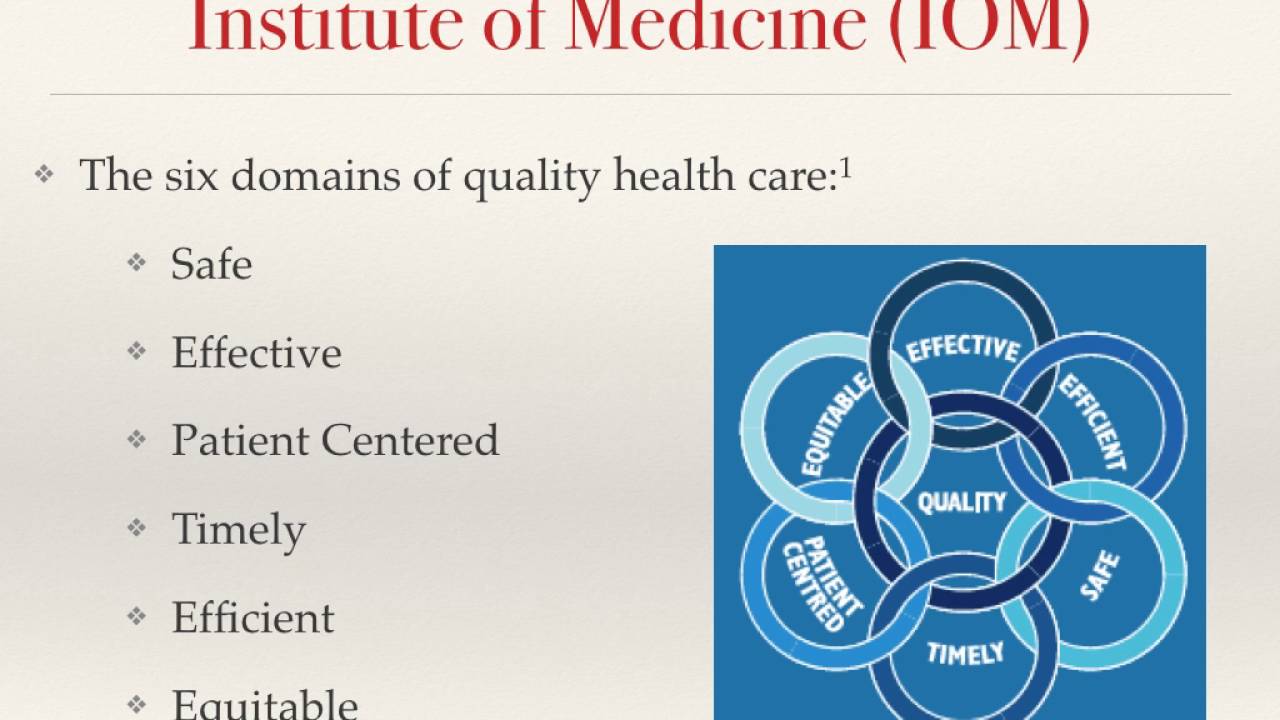
Ms. McGaffigan suggests healthcare organizations looking to reinvigorate their safety work go back to the basics. Leaders should ensure they have a clear understanding of what their organization’s baseline safety metrics are and how their safety reports have been trending over the past year and a half.
“Look at the foundational aspects of what makes care safe and high-quality,” she said. “Those are very much linked to a lot of the systems, behaviors and practices that need to be prioritized by leaders and effectively translated within and across organizations and care teams.”
She recommended healthcare organizations take a total systems approach to their safety work, by focusing on the following four, interconnected pillars:
Culture, leadership and governance
Patient and family engagement
Learning systems
Workforce safety
For example, evidence shows workforce safety is an integral part of patient safety, but it’s not an area that’s systematically measured or evaluated, according to Ms. McGaffigan. Leaders should be aware of this connection and consider whether their patient safety reporting systems address workforce safety concerns or, instead, add on extra work and stress for their staff.
Safety performance can slip when team members get busy or burdensome work is added to their plates, according to Ms. McGaffigan. She said leaders should be able to identify and prioritize the essential value-added work that must go on at an organization to ensure patients and families will have safe passage through the healthcare system and that care teams are able to operate in the safest and healthiest work environments.
In short, leaders should ask themselves: “What is the burdensome work people are being asked to absorb and what are the essential elements that are associated with safety that you want and need people to be able to stay on top of,” she said.
To improve both staffing shortages and quality of care, health systems must bring nurses higher up in leadership and into C-suite roles, Ms. Binder said. Giving nurses more authority in hospital decisions will make everything safer. Seattle-based Virginia Mason Hospital recently redesigned its operations around nurse priorities and subsequently saw its quality and safety scores go up, according to Ms. Binder.
“If it’s a good place for a nurse to go, it’s a good place for a patient to go,” Ms. Binder said, noting that the national nursing shortage isn’t just a numbers game; it requires a large culture shift.
Hospitals need to double down on quality improvement efforts, Ms. Binder said. “Many have done the opposite, for good reason, because they are so focused on COVID-19. Because of that, quality improvement efforts have been reduced.”
Ms. Binder urged hospitals not to cut quality improvement staff, noting that this is an extraordinarily dangerous time for patients, and hospitals need all the help they can get monitoring safety. Hospitals shouldn’t start to believe the notion that somehow withdrawing focus on quality will save money or effort.
“It’s important that the American public knows that we are fighting for healthcare quality and safety — and we have to fight for it, we all do,” Ms. Binder concluded. “We all have to be vigilant.”
Conclusion
The true consequences of healthcare’s labor shortage on patient safety and care quality will become clear once more national data is available. If the CDC’s report on rising HAI rates is any harbinger of what’s to come, it’s clear that health systems must place renewed focus and energy on safety work — even during something as unprecedented as a pandemic.
The irony isn’t lost on Ms. Binder: Amid a crisis driven by infectious disease, U.S. hospitals are seeing higher rates of other infections.
“A patient dies once,” she concluded. “They can die from COVID-19 or C. diff. It isn’t enough to prevent one.”
“Please pass the green beans.” “What kind of pie is that?”“What about spike proteins!?”These are some of the phrases that may be uttered during your Thanksgiving and holiday dinners this season. But! We have prepared a glossary for you. Swipe through a quick guide to some of the most misused terms around vaccines that PolitiFact has noticed in our fact-checking. And because we know that shouts of “that’s wrong!” don’t go over smooth like gravy, we’re including an expert’s advice on how to talk about vaccine falsehoods with family and friends.The big thing to know: It’s better to respond with facts than to offer corrections.”If they said something like ‘the vaccine is dangerous,’ include a statistic about how 75% of the people in their state have gotten vaccinated and none have died, or how severe and dangerous COVID-19 is,” said Rupali Limaye, an associate scientist at Johns Hopkins School of Public Health. “And, ultimately, make sure you’re saying it all with empathy.”
Two-in-three Americans will celebrate this Thanksgiving with friends or family outside their immediate households, and about half of those say their gatherings could include unvaccinated people, according to the latest installment of the Axios/Ipsos Coronavirus Index.
Why it matters: Vaccinations and booster shots are giving more people confidence to resume traditions like sitting around a packed table with masks off. But many are doing so with heightened awareness of what they don’t know when it comes to their holiday companions.
This year, 31% see a large or moderate risk in seeing friends or family for Thanksgiving — way down from 64% a year ago.
People’s assessment of overall risk of returning to their normal pre-COVID lives is also down, with 44% seeing it as a large to moderate risk this year compared with 72% last year.
But when Americans are asked how concerned they still feel about the virus, the numbers haven’t diminished all that much: 69% compared with 85% a year ago.
What they’re saying: “We’re just in a holding pattern,” said Cliff Young, president of Ipsos U.S. Public Affairs.
“They’re going to Thanksgiving because they have to, they have to see their family and friends, it’s human nature,” Young said. “But Americans are still deploying mitigating strategies.”
Ipsos pollster and senior vice president Chris Jackson said the vaccines “have attenuated some of that risk. But there’s a larger sense of anxiety or concern that hasn’t been dealt with.”
By the numbers: 67% of U.S. adults surveyed said they’ll see friends or family outside their households. That’s 73% of Republicans, 70% of independents and 63% of Democrats.
30% of them said the guests will include unvaccinated people, and another 17% said they don’t know whether other guests will be vaccinated or not.
38% said they’ll be with people who don’t regularly wear masks outside the home, while another 21% said they didn’t know if their guests regularly wear masks.
4% said they’ll be seeing people who’ve been exposed to COVID-19 in the last two weeks; another 28% aren’t sure if people at their gatherings have been exposed.
Between the lines: There’s a modest partisan gap around openness to returning to the communal Thanksgiving table — but a gulf around who you’re willing to sit with.
41% of Republicans expect to spend the holiday with someone who’s unvaccinated, compared with 17% of Democrats.
When we asked unvaccinated respondents, 56% of those who will celebrate Thanksgiving with friends and family outside the home expect the guests to include other unvaccinated people.
The big picture: This week’s findings show overwhelming support (86%) for every vaccinated American who wants a booster being able to get one. But only about one in four respondents said they knew much about an anti-viral COVID-19 pill awaiting FDA approval.
23% hadn’t heard about the pill at all, and half had heard of it but said they didn’t know much about it.
When the unvaccinated were asked whether they’d rather get a shot to prevent the virus, or wait to catch the virus and then take an approved pill to treat it, the pill drew a slight edge (17% versus 12%) and 15% had no preference, while a majority — 53% — said they’d prefer to take neither.
That suggests the pill won’t be a silver bullet — and offers more evidence that there is a segment of American society that doesn’t trust science or government to tell them what to do.
Federal officials waited months before making all American adults eligible for a COVID-19 booster shot — meaning millions of Americans may not have the strongest possible protection as they head into holiday travel.
Why it matters: Critics say the confusing process undermined what has now become a critical effort to stave off another wave of the pandemic.
Most vaccinated people, even without a booster, still have very strong protection against serious illness or death. But a third shot drastically increases people’s defenses against even mild infections, which could in turn help reduce the virus’ spread.
And some vulnerable vaccinated adults are at risk of serious breakthrough cases.
What they’re saying: “We have a consensus. Boosters are very important in maintaining people’s defenses against COVID. We need to get as many people vaccinated and boosted [as possible] as the winter sets in,” David Kessler, the chief science officer of Biden’s COVID response, said in an interview.
Context: Preliminary data released months ago suggested a significant decline in the vaccines’ effectiveness at preventing infection, although they held up well against severe disease.
Based on that data, the Biden administration had hoped to begin allowing booster shots in September for any American adult who was at least eight months removed from their second dose.
The CDC and the FDA opted instead to only authorize boosters for seniors, people with high-risk medical conditions and people at high risk of infection, before opening them last week to everyone at least six months out from their initial shots.
In the meantime, red and blue states alike decided to ignore the CDC and open up booster eligibility on their own, and breakthrough infections have become increasingly common.
Millions of people who weren’t technically eligible for boosters got them anyway, and a large portion of the most vulnerable patients still haven’t gotten one.
Where it stands: Only 41% of vaccinated Americans 65 and older have received a booster shot, as have 20% of all vaccinated adults, per the CDC.
“Some of us were there several months ago. Some wanted more data. In the end, there’s a convergence of opinions. It’s the way an open scientific public health process should work,” Kessler said.
Between the lines: The U.S. drug approval process — with its insistence on high-quality data and careful expert reviews — is the world’s gold standard precisely because it moves deliberately. Regulators have been trying this whole time to figure out how to adapt that system to a fast-moving pandemic.
Some federal officials, as well as many outside experts, said there wasn’t enough data to make a broad booster recommendation earlier this fall.
Early on, many public health experts also argued that it was unethical to give Americans a third shot while much of the rest of the world awaited their first shots.
Israel embraced boosters before the U.S. beginning over the summer, and its emerging data has been key to making the case that boosters are needed and can help bring surges under control. However, experts still don’t know how long the enhanced protection they give will last.
What they’re saying: “Some argued early on that the primary series was good enough and we should conserve doses for the world. What’s emerging is that all people in the world are going to need to be boosted,” a senior administration official said.
“Everyone has a different threshold for how much data they need in making a decision,” the official added. “What made this different is that there’s a pandemic underway, and many saw we were heading into a winter surge.”
Some 30% of U.S. healthcare workers employed at hospitals remained unvaccinated as of Sept. 15, according to an analysis of Centers for Disease Control and Prevention data published Thursday by the Association for Professionals in Infection Control and Epidemiology.
The findings include data from 3.3 million healthcare workers at more than 2,000 hospitals, collected between Jan. 20 and Sept. 15.
Healthcare personnel working in children’s hospitals had the highest vaccination rates, along with those working in metropolitan counties.
Dive Insight:
The vaccination rate for healthcare workers is roughly in line with that of the general population, though the risk of exposure and transmission can be higher in settings where infected COVID-19 patients are treated, Hannah Reses, CDC epidemiologist and lead author of the analysis, said.
When the shots were initially rolled out, vaccination rates climbed among healthcare workers, rising from 36% to 60% between January and April of 2021, the analysis found. But a major slowdown occurred shortly after.
From April to August, vaccination rates rose just 5%. They then rose 5% again in just one month — from August to September — likely due to the delta variant and more systems implementing their own mandates, the report said.
Researchers also found discrepancies in vaccination rates based on the type of hospitals and their geographic locations.
By September, workers at children’s hospitals had the highest vaccination rates (77%), followed by those at short-term acute care hospitals (70%), long-term care facilities (68.8%), and critical access hospitals (64%).
Among healthcare workers at facilities in metropolitan areas, about 71% were vaccinated by September, compared to 65% of workers at rural facilities.
The findings come as health systems work to comply with new vaccination mandates from the Biden administration.
Healthcare facilities must follow the CMS rule, which stipulates employees must be fully vaccinated by Jan. 4 or risk losing Medicare and Medicaid funding. Unlike the Occupational Safety and Health Administration’s rule that applies to businesses with 100 employees or more but excludes healthcare providers, the CMS rule does not allow for a testing exception.
Both agencies’ rules were met with pushback. The attorneys general of 10 mostly rural states — Missouri, Nebraska, Arkansas, Kansas, Iowa, Wyoming, Alaska, South Dakota, North Dakota and New Hampshire — filed a lawsuit on Oct. 10 against CMS for its rule and said the mandates would exacerbate existing staffing shortages.
“Requiring healthcare workers to get a vaccination or face termination is unconstitutional and unlawful, and could exacerbate healthcare staffing shortages to the point of collapse, especially in Missouri’s rural areas,” the state’s attorney general, Eric Schmitt, said in a statement.
But some regional systems that implemented their own mandates have seen positive results.
After UNC Health and Novant Health in North Carolina required the shots, staff vaccination rates rose to 97% and 99%, respectively, according to a White House report.
Among Novant Health’s 35,000 employees, about 375 were suspended for not complying, and about 200 of those suspended employees did end up getting vaccinated so they could return to work, according to the report.
And some major hospital chains across the country are joining suit with the looming deadline, including HCA with its 183 hospitals and more than 275,000 employees.
The chain is requiring employees be fully vaccinated by the CMS deadline on Jan. 4, a spokesperson said in an email statement.
At the same time, this year’s flu season is difficult to predict, though, “the number of influenza virus detection reported by public health labs has increased in recent weeks,” Reses said.
“The CDC is preparing for flu and COVID to circulate along with other respiratory viruses, and so flu vaccination therefore will be really important to reduce the risk of flu and potentially serious complications, particularly in combination with COVID-19 circulating,” Reses said.
A first COVID shot will give kids some protection, but none of them will be fully vaccinated until the beginning of December.
For many, many months now, 7-year-old Alain Bell has been keeping a very ambitious list of the things he wants to do after he gets his COVID-19 shots: travel (to Disneyworld or Australia, ideally); play more competitive basketball; go to “any restaurants that have french fries, which are my favorite food,” he told me over the phone.
These are very good kid goals, and they are, at last, in sight. On Tuesday evening, about as early as anyone in the general public could, Alain nabbed his first dose of Pfizer’s newly cleared pediatric COVID-19 vaccine. The needle delivered “a little poke,” he said, but also a huge injection of excitement and relief. Since his father, a critical-care physician, was vaccinated last December (the first time I interviewed Alain), “I’ve been impatient,” Alain said. “I really wanted to get mine.” Now he is finally on his way to joining the adults. When he heard on Tuesday that his shot was imminent, he let out a scream of joy, at “a pitch I have never heard him use before,” his mother, Kristen, told me.
There’s an air of cheer among the grown-ups as well. “It’s cause for celebration,” says Angie Kell, who lives in Utah with her spouse and their soon-to-be-vaccinated 6-year-old son, Beck. Their family, like many others, has been reining in their behavior for months to accommodate their still-vulnerable kid, unable to enjoy the full docket of post-inoculation liberties that so many have. Once Beck is vaccinated, though, they can leave mixed-immunity limbo: “We might have an opportunity to live our lives,” Kell told me.
The past year has been trying for young children, a massive test of patience—not always a kid’s strongest skill. And there’s yet another immediate hurdle to clear: the plodding accumulation of immunological defense. Alain has another 15 days to go until his second dose; after that, it’ll be two more weeks before he reaches a truly excellent level of protection. Only then, on December 7, will he count as fully vaccinatedby CDC standards and be able to start adopting the behavioral changes the agency has green-lit. In the intervening weeks, he and the many other 5-to-11-year-olds in his position will remain in a holding pattern. Their wait isn’t over yet.
The timing of this semi-immune stretch might feel particularly frustrating, especially with the winter holidays approaching: At this point, essentially no young kids are slated to be fully vaccinated by Thanksgiving or Hanukkah, except the ones who were enrolled in clinical trials. One shot can offer a level of protection, but experts advise waiting to change behavior for a reason—the extra safeguards that set in about two weeks after the second shot really are that much better, and absolutely worth sitting tight for.
“It takes time for immune cells to get into a position where they’re ready to pounce,” Gigi Gronvall, a senior scholar at the Johns Hopkins Center for Health Security, told me. COVID-19 vaccines teach immune cells to thwart the coronavirus, a process that, like most good boot camps, takes many days to unfold. The second shot is essential to clinch the lesson in the body’s memory, encouraging cells to take the threat more seriously for longer. Immune cells also improve upon themselves over time—the more, the better in these early stages. Gronvall’s own 11-year-old son is also about to get his first shot, and she doesn’t want to risk stumbling so close to the finish line. “I can’t know exactly what his immune system is going to do” after the first dose alone, she said.
Evidence from Pfizer’s original clinical trial, conducted only in adults, hinted that a first, decent defensive bump takes hold after the first shot. Kit Longley, Pfizer’s senior manager of science media relations, pointed to those data when I asked how kids at various points along the vaccination timeline should be approaching behavioral change. “Protection in the vaccinated cohort begins to separate from the placebo arm as early as 12 to 14 days after the first dose,” he told me.
The adult clinical-trial data were collected last year, though, long before the rise of the Delta variant. A more recent study, conducted in the United Kingdom, showed that one dose of Pfizer reduced the risk of symptomatic COVID-19 by only 35.6 percent when the cause was Delta, and by only 47.5 percent with Alpha. (And remember that those numbers apply best on a population scale—not for a single, individual child.) After adding a second dose, though, effectiveness rocketed up to about 90 or 95 percent against either variant. “You really need two doses for adequate, good protection,” Samuel Dominguez, a pediatric-infectious-disease specialist at Children’s Hospital Colorado, told me.
Immunity is so far looking strong in young kids: In a recent trial of thousands of children ages 5 to 11, Pfizer’s vaccine was more than 90 percent effective at blocking symptomatic cases of COVID-19, including ones caused by Delta. Longley said Pfizer expects that the timing of protection will be similar between children and adults—a first dose should lower everyone’s risk to some degree. But the company’s pediatric trial picked up only a few COVID-19 cases; none of them occurred until about three weeks after the first dose was given, or later. So it’s hard to say anything definitive about when “enough” immunity really kicks in for kids.
Some parents are counting on a level of early protection from one shot, including my cousin Joanne Sy, whose 8-year-old son, Jonah, received his first injection on Friday. “He will have good immunity after one dose,” she told me, hopefully enough to guard him on a trip they’re taking to New York for Thanksgiving two weeks from now. “We’re still going to be cautious,” Sy told me: They’ll be watching the Macy’s Thanksgiving Day Parade from a hotel room rather than the streets, and wearing masks, at least on the plane. “But we just need to move forward.”
The calculus is playing out differently for Christy Robinson of Arlington, Virginia, who will again be “hunkering down” with her husband and two daughters, June and Iris, 7 and 5, respectively, this Thanksgiving. The kids got their first Pfizer shot on Saturday, setting their household up for full, full vaccination by mid-December, just in time to hold an indoor gathering with their aunts, uncles, and cousins for Christmas. (Some quick arithmetic: To be fully vaccinated by December 25, a kid would need their first dose by November 20.) June’s also eager to “see my friends inside, because it’s cold outside,” she told me—plus go to movie theaters, and Build-A-Bear, and a trampoline park, and IHOP, and the nail salon.
By the end of this conversation, Robinson looked amused and maybe a little regretful that my question had prompted such an extravagant list. As their mother, she’s especially excited for the possibility of no longer having to quarantine her daughters after viral exposures at school. Heftier decisions are ahead too. She and her husband are still weighing whether to bring their daughters into closer, more frequent indoor contact with their grandparents, who are vaccinated but could still get seriously sick if someone ferries the virus into their midst.
And that risk—of transmitting the virus—is worth keeping in mind, with so much SARS-CoV-2 “still circulating around,” cautions Tina Tan, a pediatrician and infectious-disease specialist at Northwestern University. Immunized people are at much lower risk of picking up the virus and passing it on. There still aren’t enough of them, though, to reliably tamp down spread; uptake of shots among young kids, too, is expected to be sluggish in the months to come. Even fully vaccinated families won’t be totally in the clear while our collective defenses remain weak.
That doesn’t mean Thanksgiving has to be a bust—or even a repeat of 2020, before the vaccines rolled out. The Bells will be cautiously gathering with a few loved ones; all the adults in attendance will be immunized and everyone will get tested beforehand. “Then they can come inside the house, mask off,” Taison Bell, Alain’s father, told me. None of those measures is completely reliable on its own; together, though, they’ll hopefully keep the virus out.
The road ahead might feel a little bumpy for Alain, who’s celebrating his 8th birthday at the end of November, a few days after his second shot. (He’s getting the gift of immunity this year, his father joked.) The Bells will do something special “around when he hits full vaccination,” Kristen said, “with something Alain hasn’t gotten to do in the last two years.” But Alain, who has asthma, which can make COVID-19 worse, knows that his own injections won’t wipe the slate clean for him, or those around him. Some people in his neighborhood have caught the virus even after getting vaccinated, and he understands that he could too.
Alain will keep masking, and treading carefully at school, and even a bit at home. His 3-year-old sister, Ruby, hasn’t yet been able to get a shot. (I asked her how she felt about Alain’s vaccine; she responded, almost imperceptibly, “Jealous.”) Until another regulatory green light comes, she will still be waiting, which means that her family will be too.








 HENRY KOTULA