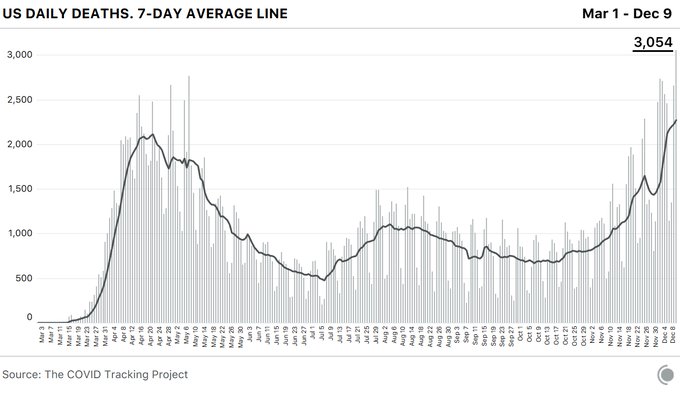
The coronavirus pandemic pushed the U.S. past another dire milestone Wednesday, the highest daily death toll to date, even while the mortality rate has decreased as health experts learn more about the disease.
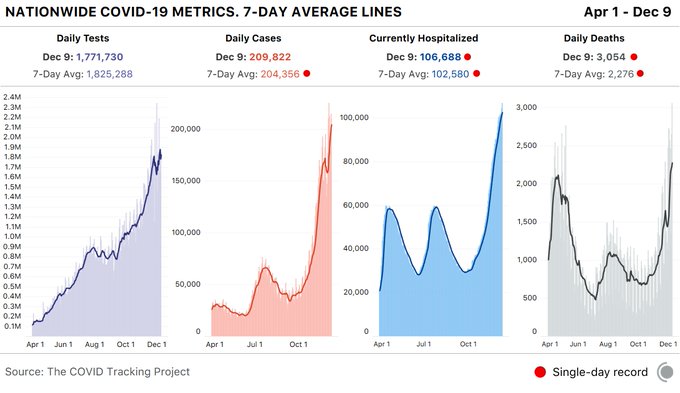
The Covid Tracking Project, which tracks state-level coronavirus data, reported 3,054 COVID-19 related deaths — a significant jump from the previous single-day record of 2,769 on May 7.
The spread of the disease has shattered another record with 106,688 COVID-19 patients in U.S. hospitals. And overall, states reported 1.8 million tests and 210,000 cases. According to the group, the spike represents more than a 10% increase in cases over the last 7 days.
Additionally, California nearly topped its single-day case record at 30,851. It is the second highest case count since December 6, the organization reported.
The staggering spike in fatalities and infections has overwhelmed hospitals and intensive care units across the nation, an increase attributed by many experts to people relaxing their precautions at Thanksgiving.
But there is still one dark cloud hanging over the vaccines that many people don’t yet understand.
The vaccines will be much less effective at preventing death and illness in 2021 if they are introduced into a population where the coronavirus is raging — as is now the case in the U.S. That’s the central argument of a new paper in the journal Health Affairs. (One of the authors is Dr. Rochelle Walensky of Massachusetts General Hospital, whom President-elect Joe Biden has chosen to run the Centers for Disease Control and Prevention.)
An analogy may be helpful here. A vaccine is like a fire hose. A vaccine that’s 95 percent effective, as Moderna’s and Pfizer’s versions appear to be, is a powerful fire hose. But the size of a fire is still a bigger determinant of how much destruction occurs.
I asked the authors of the Health Affairs study to put their findings into terms that we nonscientists could understand, and they were kind enough to do so. The estimates are fairly stunning:
At the current level of infection in the U.S. (about 200,000 confirmed new infections per day), a vaccine that is 95 percent effective — distributed at the expected pace — would still leave a terrible toll in the six months after it was introduced. Almost 10 million or so Americans would contract the virus, and more than 160,000 would die.
This is far worse than the toll in an alternate universe in which the vaccine was only 50 percent effective but the U.S. had reduced the infection rate to its level in early September (about 35,000 new daily cases). In that scenario, the death toll in the next six months would be kept to about 60,000.
It’s worth pausing for a moment on this comparison, because it’s deeply counterintuitive. If the U.S. had maintained its infection rate from September and Moderna and Pfizer had announced this fall that their vaccines were only 50 percent effective, a lot of people would have freaked out.
But the reality we have is actually worse.
How could this be? No vaccine can eliminate a pandemic immediately, just as no fire hose can put out a forest fire.While the vaccine is being distributed, the virus continues to do damage. “Bluntly stated, we’ll get out of this pandemic faster if we give the vaccine less work to do,” A. David Paltiel, one of the Health Affairs authors and a professor at the Yale School of Public Health, told me.
There is one positive way to look at this:Measures that reduce the virus’s spread — like mask-wearing, social distancing and rapid-result testing — can still have profound consequences. They can save more than 100,000 lives in coming months.
In the past seven days, 15,813 people in the U.S. died from the virus, breaking a record that had stood since mid-April.
Hospitals across the country are reaching their breaking point on ICU and bed capacity as COVID surges, forcing many health systems to begin diverting patients from emergency rooms and ration care, Axios’ Orion Rummler reports.
What’s happening:
Pennsylvania: “Most hospitals in Montgomery County are at or near capacity,” county commissioners’ chair Valerie Arkoosh said in Norristown, Pennsylvania, last Wednesday.
Georgia: Major hospitals, including Grady Memorial and Emory University, have had to turn away patients brought in ambulances, the Atlanta-Journal Constitution reports.
South Dakota: The Monument Health Rapid City Hospital and Sanford USD Medical Center — some of the biggest in the state — say they have no more ICU beds, the Mitchell Republic reports.
Colorado: More than a third of hospitals across the state said in a survey they expect staffing shortages this week, Colorado Public Radio reports.
Context:White House coronavirus task force coordinator Deborah Birx noted on Sunday’s “Meet the Press” that U.S. hospitals are usually anywhere from 80 to 90% full in the fall and winter — and “when you add 10, 15, 20% COVID-19 patients on top of that, that’s what puts them at the breaking point.”
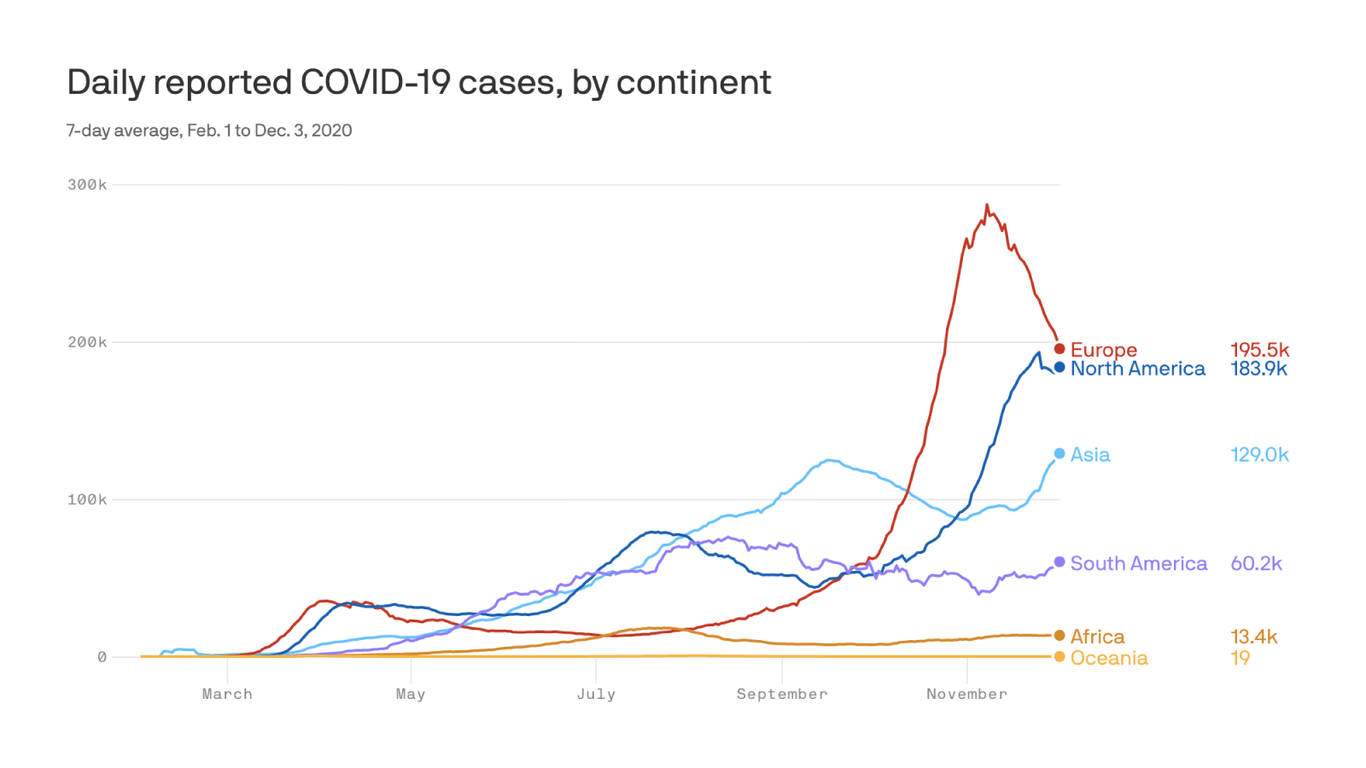
While the U.S. continues to set records for new coronavirus cases, European countries have managed to turn their own terrifying spikes around.
The big picture:As some states in the U.S. crack down to head off the worst, the debate in countries like the U.K. and France has shifted to whether and how to lighten their own restrictions before the holidays.
America’s surge lagged two to three weeks behind Europe’s, with a similarly worrying trajectory. However, responses in U.S. states have been uneven and generally less severe than in most European countries.
Daily case counts are already rising significantly in most U.S. states, and they’re likely to tick up further following Thanksgiving gatherings around the country.
Much of Europe returned to some form of lockdown in the fall, but the restrictions tended to be less restrictive than in the spring. They certainly haven’t been in place as long.
Many countries closed bars and restaurants, and nearly all at least limited their opening hours. Social gatherings were also limited — in Germany’s case, to groups of up to five from a maximum of two households (children are exempted).
But schools have remained open across nearly all of the continent, and the disruption to economic activity, while highly significant, hasn’t been quite as severe (though many governments have faced anti-lockdown protests).
The fact that countries like Italy were able to bend the curve so quickly with partial lockdowns is encouraging, says Stephen Kissler, a researcher at Harvard who models the spread of diseases, including COVID-19.
“The evidence shows that these full lockdowns we underwent in the spring aren’t necessary now,” he says.
“We have so much more information now that we can respond a lot more quickly and in a more targeted manner — really just shutting down the types of activities that contribute most to the spread.”
Test positivity rates are falling significantly in many EU countries — another sign that the current wave is subsiding.
In Belgium, for example, the positivity rate fell from 21% to 8% over the past three weeks, with similar trends in France and the Netherlands.
The outlook is a bit darker in Central Europe. The Czech Republic still has a positivity rate of 21%, while Poland’s 49% rate is higher than every U.S. state but Idaho.
Reality check:Europe is far from out of the woods. Deaths and hospitalizations lag behind spikes in cases, and those numbers are falling much later and less sharply.
Italy recorded a record-high death toll on Thursday, three weeks after case numbers peaked.
And while the trajectory on cases is positive, public health experts fear a swift reversal if countries open up too quickly.
Governments in the U.K., France and elsewhere had promised the measures would be temporary and Christmas celebrations would still be possible. They’re now attempting a difficult balancing act with the virus still spreading rampantly.
The U.K. is introducing the “Christmas bubble,” which will allow up to three households to gather together over the Christmas period.
Spain is increasing the maximum gathering size from 6 to 10.
Germany plans to tighten restrictions through Dec. 20 and then allow groups of up to 10 to gather.
The bottom line:In Europe, those decisions are being made with cases on the decline and the outlook improving. That’s not the case in the U.S.
Roommates Madilyn Dennington, Bailey Mills and Olivia Noe, all 23, were issued misdemeanor citations in connection with an Oct. 31 football watch party at their East Nashville home on the 1200 block of Boscobel Street south of Fatherland Street.
Police spokesman Don Aaron said the women were served with court summonses on Monday and are slated to appear on the charges Dec. 16.
According to an arrest affidavit, officers responded about 6:30 p.m. to a complaint about a loud party at the home, heard music blaring and saw several people in the yard. In all, police said they found more than 100 people inside and outside the home.
When officers spoke to Dennington, Mills and Noe outside, they told police they had organized a watch party at their home for a football game, the affidavit states. The officers told the women that at that time, no more than 25 people were permitted to gather in Davidson County unless the gathering was approved by the city.
The women then went inside and told everyone to leave, police reported.
Police then alerted Metro Health officials about the party. Hugh Atkins, Metro Health’s environmental health services director, confirmed the Health Department did not receive an event application for the gathering.
On Tuesday, Davidson County reportedan increase of 851 cases in 24 hours — the second-highest ever daily increase. So far 369 people in Nashville have died from the virus.
Dennington is a registered nurse at TriStar Skyline Medical Center, authorities said.
It was not immediately known whether the hospital had taken any disciplinary action against Dennington. She did not return an immediate request for comment and blocked her Facebook page from a Tennessean reporter shortly after being contacted.
“Properly following pandemic regulations is extremely important to help reduce the spread of COVID-19,” Anna-Lee Cockrill, a spokeswoman for TriStar, said regarding the party. “We are looking into this further.”
According to their social media pages, all three roommates formerly attended the University of Mississippi before moving to Nashville, and Dennington and Noe both graduated from the University of Mississippi Medical Center.
Noe and Mills also could not immediately be reached for comment.
More than 50 arrests, 315 citations
Police data shows at least 50 people have been arrested and more than 315 have been cited under local emergency health orders that went into effect earlier this year.
As of Tuesday, only one of the arrested defendants had pleaded guilty: Jeffrey Mathews, a 36-year-old Goodlettsville dentist arrested for throwing an Aug. 1 house party on Fern Avenue in East Nashville. He was one of two men criminally charged for the party that drew hundreds.
More than 100,200 Americans were hospitalized as of Wednesday due to the coronavirus for the first time since the outbreak began in early 2020, per the COVID Tracking Project.
The big picture: The milestone comes as health officials anticipated cases to surge due to holiday travel and gatherings. The impact of the holiday remains notable, as many states across the country are only reporting partial data.
Meanwhile, more hospitals are running out of beds or turning away new patients, limiting the care available to both coronavirus patients and those with other health care emergencies, Axios Caitlin Owens reports.
Flashback:The daily rate of new coronavirus infections rose by about 10% in week leading up to Thanksgiving, continuing a dismal trend that may get even worse in the weeks to come.






 HENRY KOTULA