New report says coronavirus pandemic could last for two years – and may not subside until 70% of the population has immunity

https://www.cbsnews.com/news/coronavirus-pandemic-update-two-years-70-percent-immunity/

Coronavirus (COVID-19) Recovery Depends on Herd Immunity, Doctor Says

As coronavirus restrictions around the world are being lifted, a new report warns the pandemic that has already killed more than 230,000 people likely won’t be contained for two years. The modeling study from the Center for Infectious Disease Research and Policy (CIDRAP) at the University of Minnesota also says that about 70% of people need to be immune in order to bring the virus to a halt.

For the study, experts looked at eight major influenza pandemics dating back to the 1700s, as well as data about the new coronavirus, to help forecast how COVID-19 may spread over the coming months and years. Out of the eight past flu pandemics, scientists said seven had a second substantial peak about six months after the first one. Additionally, some had “smaller waves of cases over the course of 2 years” after the initial outbreak.

A key factor in their prediction for the current pandemic revolves around herd immunity, which refers to the community-wide resistance to the spread of a contagious disease that results when a high percentage of people are immune to it, either through vaccination or prior exposure. 

“The length of the pandemic will likely be 18 to 24 months, as herd immunity gradually develops in the human population,” the report says. “Given the transmissibility of SARS-CoV-2” — the virus that causes COVID-19 — “60% to 70% of the population may need to be immune to reach a critical threshold of herd immunity to halt the pandemic.”

It will take time to reach that point, since data from blood tests show only a small fraction of the overall population has been infected so far, and a possible vaccine is still months if not a year or more away. It is not yet clear whether people who’ve recovered from the infection will be immune or how long such protection would last.

The report lays out several possible scenarios, including one in which a larger wave of illnesses may happen in the fall or winter of 2020 and then subsequent smaller waves in 2021. The researchers say this model — similar to the pattern seen in the devastating 1918 Spanish flu pandemic — would “require the reinstitution of mitigation measures in the fall in an attempt to drive down spread of infection and prevent healthcare systems from being overwhelmed.” 

Two other scenarios in the report involve either recurring peaks and valleys of outbreaks, or smaller waves of illness over the next two years.

In any case, the researchers said people must be prepared for “at least another 18 to 24 months of significant COVID-19 activity, with hot spots popping up periodically” in different geographic areas.

As the virus continues to circulate among the human population and outbreaks finally start to wane, they say it will likely “synchronize to a seasonal pattern with diminished severity over time.”


8 states reporting spikes in COVID-19 cases, deaths

https://www.beckershospitalreview.com/public-health/8-states-reporting-spikes-in-covid-19-cases-deaths.html?utm_medium=email

The week began with sharp increase in prices :: CottonYarn

The following eight states have reported sharp increases in new coronavirus cases and deaths:

1. On May 2, for the third day in a row, Texas reported more than 1,000 new coronavirus cases, according to CNBC. The state’s health department reported 1,293 new positive cases of COVID-19, the first weekend of the state’s limited reopening.

2. On May 2, New York reported 831 new cases of the coronavirus and 299 deaths, according to The Hill. Gov. Andrew Cuomo called the number of new COVID-19 deaths in the state “obnoxiously and terrifyingly high.”

3. Nearly 13 percent of all tests for the new coronavirus came back positive May 1 in Wisconsin, indicating a spike in new cases, WISN-TV, an ABC affiliate reports.

4. Georgia reported two days of nearly 1,000 new coronavirus cases on April 30 and May 1, according to The Atlanta Journal-Constitution. The confirmed case count reached 28,332 May 2, and the death toll from the disease increased to 1,174.

5. With 516 more cases confirmed in Tennessee May 3, the total number of positive cases in the state has jumped to 13,177, according to News Channel 5 Nashville.

6. On May 3, Missouri reported more than 200 new coronavirus cases, for the third day in a row, bringing the state’s total to 8,386 cases, KSDK, an NBC affiliate reports. St. Louis alone reported nearly 100 new COVID-19 cases May 3, CBS affiliate KMOV reports.

7. Pennsylvania reported 49,267 confirmed COVID-19 cases, as of May 3, according to CBS Pittsburgh. The state reported 962 new positive cases of the new virus and 26 more deaths, bringing the statewide death toll to 2,444.

8. The number of coronavirus cases in Massachusetts rose by 1,824, officials reported May 3, and the death toll increased by 158, bringing the statewide total to 68,087 cases and 4,004 deaths, NBC Boston reports.


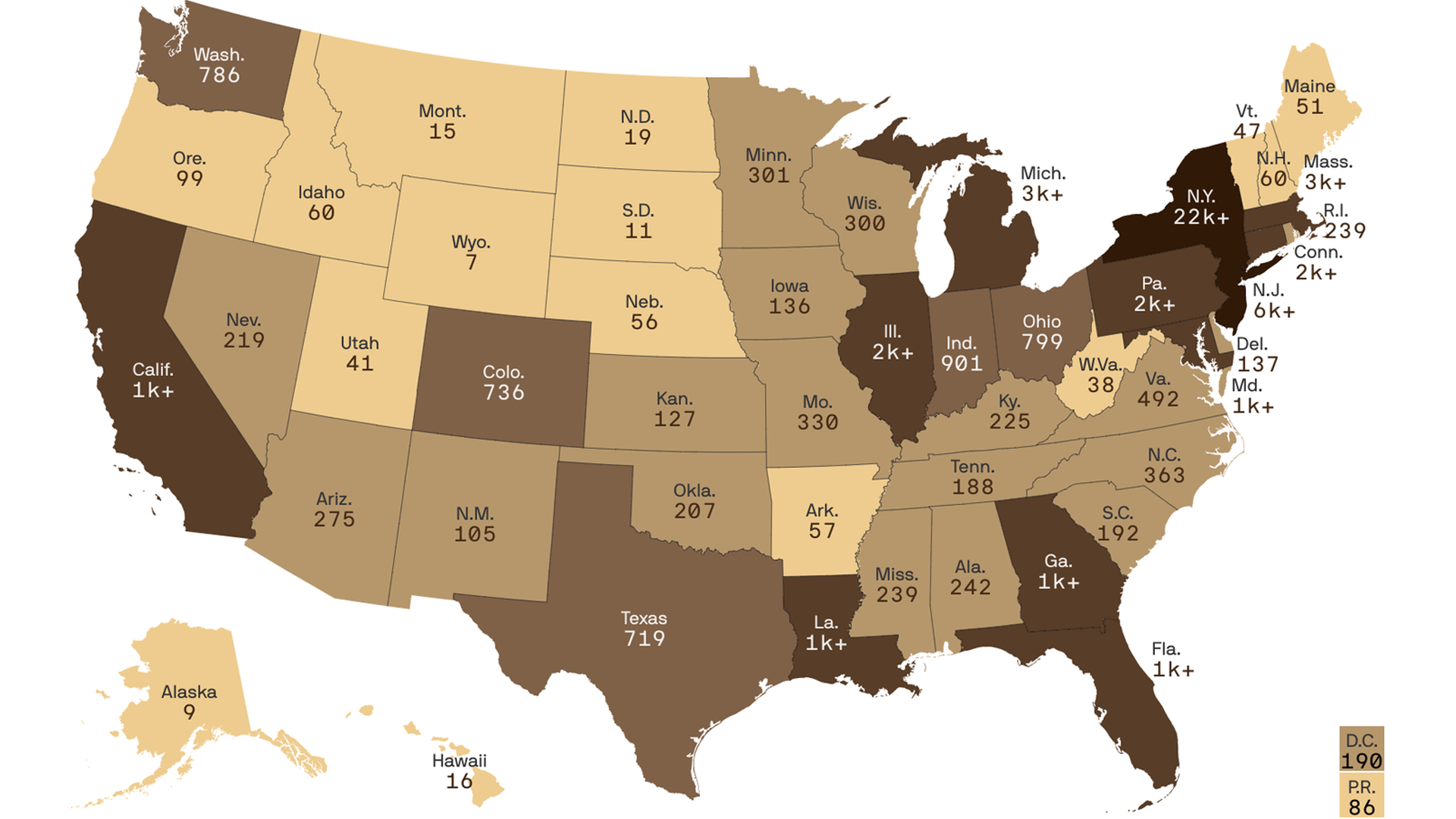
U.S. Coronavirus Updates

https://www.axios.com/coronavirus-west-virginia-first-case-ac32ce6d-5523-4310-a219-7d1d1dcb6b44.html

COVID-19 in the U.S.

As of May 3, 11pm EDT

Deaths     Confirmed cases

67,682         1,158,040

Kudlow defends claiming U.S. had coronavirus "contained" in ...


Former FDA commissioner Scott Gottlieb said on Sunday that despite widespread mitigation efforts, the coronavirus has exhibited “persistent spread” that could mean a “new normal” of 30,000 new cases and over 1,000 deaths a day through the summer.

The big picture: COVID-19 has killed over 66,000 Americans and infected over 1.1 million others in less than three months since the first known death in the U.S., Johns Hopkins data shows.

By the numbers: As states try to mitigate the spread of the coronavirus while easing restrictions, unemployment filings in the U.S. topped 30 million in six weeks, and the number of unemployed could be higher than the weekly figures suggest.

  • Over 175,000 Americans have recovered from the virus and over 6.8 million tests have been conducted in the U.S. as of Sunday.

Catch up quick: The number of deaths in states hit hardest by the coronavirus is well above the normal range, according the CDC.

Lockdown measures: Dozens of states have outlined plans to ease coronavirus restrictions, but the pandemic’s impact on our daily lives, politics, cities and health care will outlast stay-at-home orders.


Reopening is a risk for Republican governors

https://www.axios.com/coronavirus-reopening-republican-governors-cases-deaths-c0233fd4-8f92-448e-a11c-ec5bded1def1.html

Coronavirus reopening is a risk for Republican governors - Axios

Republican governors run a big risk — both to public health and their own political fortunes — if they open up their economies too soon, without adequate safeguards.

The big picture: The hardest-hit areas so far have mostly been in states with Democratic governors. But the number of coronavirus cases is now increasing more quickly in states with Republican governors.

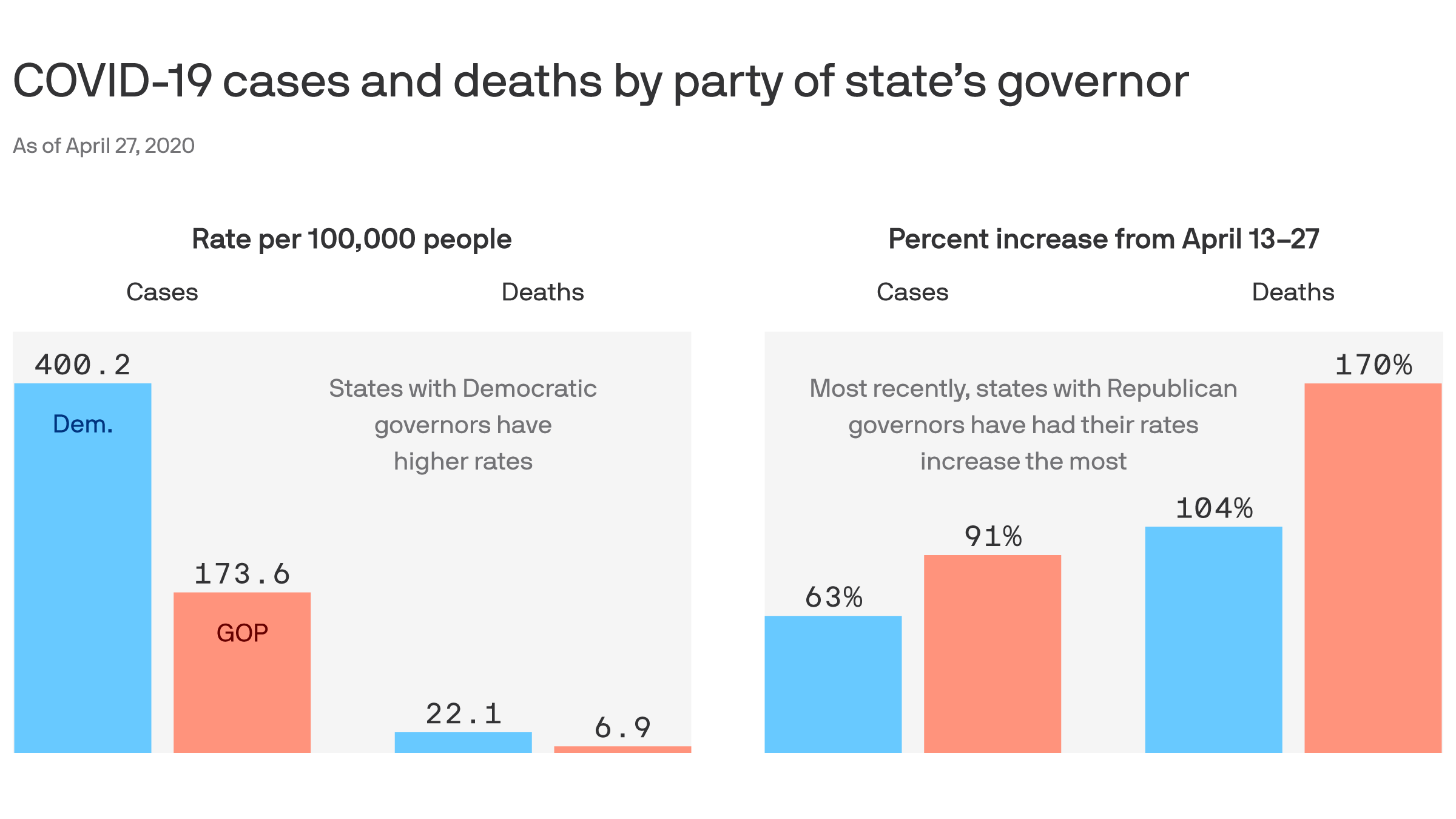
By the numbers: Coronavirus cases and deaths are both higher in Democratic states than in Republican ones, even after adjusting for population.

  • However, over the last two weeks, reported infections have increased 91% in red states versus 63% in blue states.
  • We see the same pattern for COVID-19 deaths: 170% growth in red states vs. 104% in blue states.

Driving the news: Texas has begun easing its lockdown measures, and other red states are also moving quickly. Florida has reopened some beaches, and some southern states in particular never locked down as tightly as the Northeast and West coast.

  • Yes. but: Every governor wants to open up when they can to get the economy going, and there are some Democratic governors who are also taking steps to ease distancing measures.

Between the lines: The core of the Republican base in white, rural areas is at risk.

  • 20% of people living in non-metro areas are older than 65, compared with 15% in metro areas.
  • And rural residents under 65 are more likely to have pre-existing health conditions (26%), compared to their urban counterparts (20%).

The bottom line: Polls show that Republicans are far more likely than Democrats to think that the worst is behind us when it comes to COVID-19.

  • That may be partly because they, and the Republican governors, think this is largely someone else’s problem. It isn’t.


U.S. coronavirus caseload has held steady

https://www.axios.com/newsletters/axios-vitals-5da91be0-bb6c-44a4-8571-d723352e6ef9.html?utm_source=newsletter&utm_medium=email&utm_campaign=newsletter_axiosvitals&stream=top

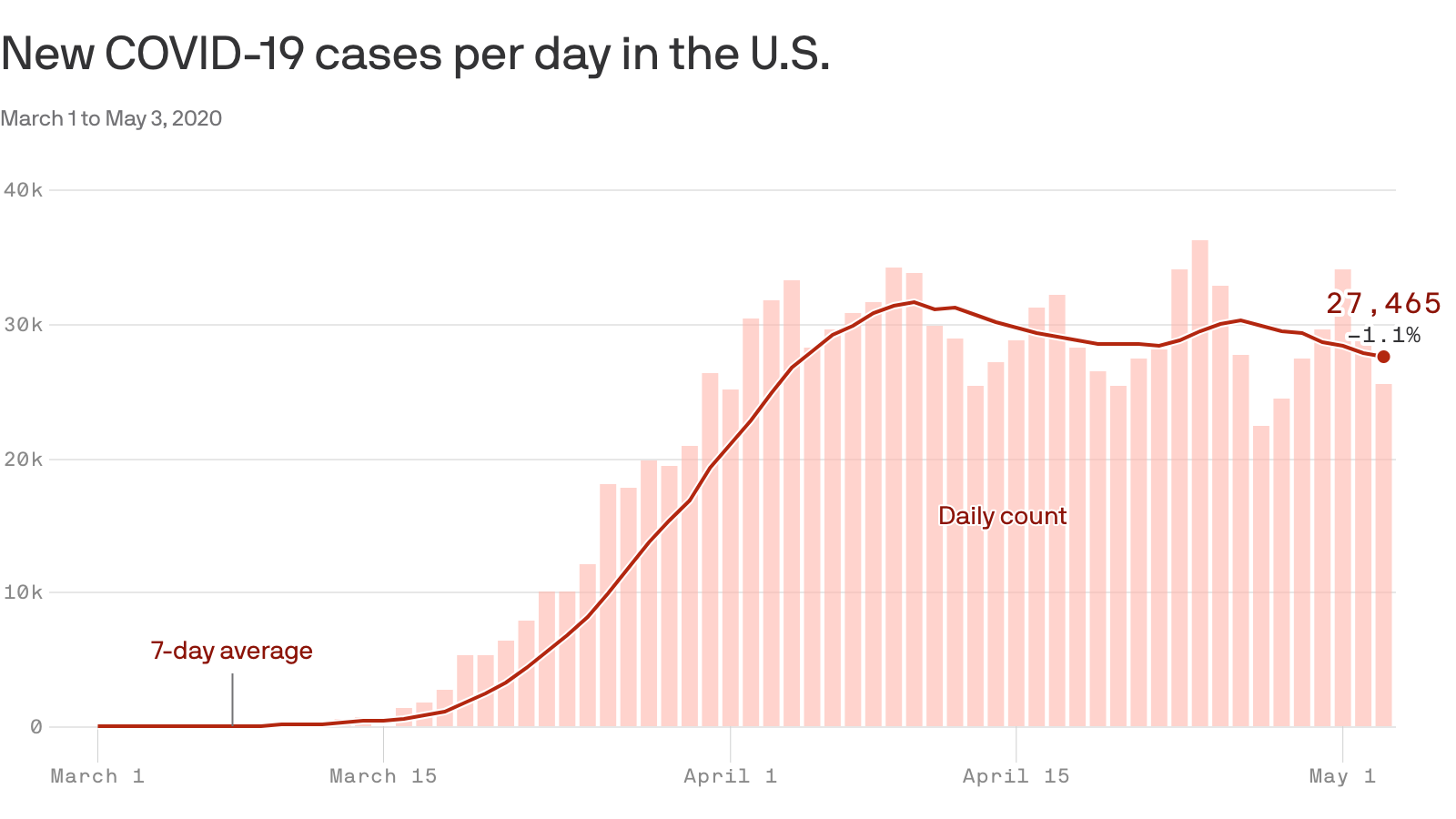
The number of new coronavirus cases in the U.S. has held steady ...

The number of new coronavirus cases nationally hovered around 30,000 a day during the entire month of April, meaning that the virus has managed to spread in spite of stringent social distancing measures.

Why it matters: Many states have already started to lift these measures, which will enable the virus to spread even faster.

Between the lines: Many Americans — like health care workers, grocery workers and emergency personnel — haven’t been able to stay home, as their jobs are considered essential. That’s enabled the virus to spread among these populations.

  • It has also been able to spread among people who live close together, like nursing home residents.

The big picture: The fewer people who have the virus once society reopens, the easier it will be to control. That’s part of why we shut down — the caseload had already outgrown our public health infrastructure’s ability to respond to it.

  • We’ve built up our testing capacity over the last several weeks and are starting to do the same with contact tracing, but these tools can only do so much against exponential spread — even when fully developed, which they’re not yet.
  • Even if we’re able to keep the caseload at current levels, that’s still an enormously challenging reality to live with.

What they’re saying: “Continuing spread at something near current levels may become the cruel ‘new normal.’ Hospitals and public-health systems will have to contend with persistent disease and death,” former FDA commissioner Scott Gottlieb wrote in a Wall Street Journal op-ed yesterday.

The bottom line: April was tough, but as states begin to reopen, we don’t yet know what lies ahead of us.

  • Things could get worse, or today’s status quo could be in place for a long time.
  • What happens will look different from one community to another.


How Long Will a Vaccine Really Take?

Health - Digg

A vaccine would be the ultimate weapon against the coronavirus and the best route back to normal life. Officials like Dr. Anthony S. Fauci, the top infectious disease expert on the Trump administration’s coronavirus task force, estimate a vaccine could arrive in at least 12 to 18 months.

The grim truth behind this rosy forecast is that a vaccine probably won’t arrive any time soon. Clinical trials almost never succeed. We’ve never released a coronavirus vaccine for humans before. Our record for developing an entirely new vaccine is at least four years — more time than the public or the economy can tolerate social-distancing orders.

But if there was any time to fast-track a vaccine, it is now. So Times Opinion asked vaccine experts how we could condense the timeline and get a vaccine in the next few months instead of years.

Here’s how we might achieve the impossible.

Normally, researchers need years to secure funding, get approvals and study results piece by piece. But these are not normal times.

There are already at least 254 therapies and 95 vaccines related to Covid-19 being explored.

“If you want to make that 18-month timeframe, one way to do that is put as many horses in the race as you can,” said Dr. Peter Hotez, dean of the National School of Tropical Medicine at Baylor College of Medicine.

Despite the unprecedented push for a vaccine, researchers caution that less than 10 percent of drugs that enter clinical trials are ever approved by the Food and Drug Administration.

The rest fail in one way or another: They are not effective, don’t perform better than existing drugs or have too many side effects.

Fortunately, we already have a head start on the first phase of vaccine development: research. The outbreaks of SARS and MERS, which are also caused by coronaviruses, spurred lots of research. SARS and SARS-CoV-2, the virus that causes Covid-19, are roughly 80 percent identical, and both use so-called spike proteins to grab onto a specific receptor found on cells in human lungs. This helps explain how scientists developed a test for Covid-19 so quickly.

There’s a cost to moving so quickly, however. The potential Covid-19 vaccines now in the pipeline might be more likely to fail because of the swift march through the research phase, said Robert van Exan, a cell biologist who has worked in the vaccine industry for decades. He predicts we won’t see a vaccine approved until at least 2021 or 2022, and even then, “this is very optimistic and of relatively low probability.”

And yet, he said, this kind of fast-tracking is “worth the try — maybe we will get lucky.”

The next step in the process is pre-clinical and preparation work, where a pilot factory is readied to produce enough vaccine for trials. Researchers relying on groundwork from the SARS and MERS outbreaks could theoretically move through planning steps swiftly.

Sanofi, a French biopharmaceutical company, expects to begin clinical trials late this year for a Covid-19 vaccine that it repurposed from work on a SARS vaccine. If successful, the vaccine could be ready by late 2021.

As a rule, researchers don’t begin jabbing people with experimental vaccines until after rigorous safety checks.

They test the vaccine first on small batches of people — a few dozen during Phase 1, then a few hundred in Phase 2, then thousands in Phase 3. Months normally pass between phases so that researchers can review the findings and get approvals for subsequent phases.

But “if we do it the conventional way, there’s no way we’re going to be reaching that timeline of 18 months,” said Akiko Iwasaki, a professor of immunobiology at Yale University School of Medicine and an investigator at the Howard Hughes Medical Institute.

There are ways to slash time off this process by combining several phases and testing vaccines on more people without as much waiting.

Last week the National Academy of Sciences showed an overlapping timeline, describing it as moving at “pandemic speed.”

It’s here that talk of fast-tracking the timeline meets the messiness of real life: What if a promising vaccine actually makes it easier to catch the virus, or makes the disease worse after someone’s infected?

That’s been the case for a few H.I.V. drugs and vaccines for dengue fever, because of a process called vaccine-induced enhancement, in which the body reacts unexpectedly and makes the disease more dangerous.

Researchers can’t easily infect vaccinated participants with the coronavirus to see how the body behaves. They normally wait until some volunteers contract the virus naturally. That means dosing people in regions hit hardest by the virus, like New York, or vaccinating family members of an infected person to see if they get the virus next. If the pandemic subsides, this step could be slowed.

“That’s why vaccines take such a long time,” said Dr. Iwasaki. “But we’re making everything very short. Hopefully we can evaluate these risks as they occur, as soon as possible.”

This is where the vaccine timelines start to diverge depending on who you are, and where some people might get left behind.

If a vaccine proves successful in early trials, regulators could issue an emergency-use provision so that doctors, nurses and other essential workers could get vaccinated right away — even before the end of the year. Researchers at Oxford announced this week that their coronavirus vaccine could be ready for emergency use by September if trials prove successful.

So researchers might produce a viable vaccine in just 12 to 18 months, but that doesn’t mean you’re going to get it. Millions of people could be in line before you. And that’s only if the United States finds a vaccine first. If another country, like China, beats us to it, we could wait even longer while it doses its citizens first.

You might be glad of that, though, if it turned out that the fast-tracked vaccine caused unexpected problems. Only after hundreds or thousands are vaccinated would researchers be able to see if a fast-tracked vaccine led to problems like vaccine-induced enhancement.

“It’s true that any new technology comes with a learning curve,” said Dr. Paul Offit, the director of the Vaccine Education Center at the Children’s Hospital of Philadelphia. “And sometimes that learning curve has a human price.”

Once we have a working vaccine in hand, companies will need to start producing millions — perhaps billions — of doses, in addition to the millions of vaccine doses that are already made each year for mumps, measles and other illnesses. It’s an undertaking almost unimaginable in scope.

Companies normally build new facilities perfectly tailored to any given vaccine because each vaccine requires different equipment. Some flu vaccines are produced using chicken eggs, using large facilities where a version of the virus is incubated and harvested. Other vaccines require vats in which a virus is cultured in a broth of animal cells and later inactivated and purified.

Those factories follow strict guidelines governing biological facilities and usually take around five years to build, costing at least three times more than conventional pharmaceutical factories. Manufacturers may be able to speed this up by creating or repurposing existing facilities in the middle of clinical trials, long before the vaccine in question receives F.D.A. approval.

“They just can’t wait,” said Dr. Iwasaki. “If it turns out to be a terrible vaccine, they won’t distribute it. But at least they’ll have the capability” to do so if the vaccine is successful.

The Bill and Melinda Gates Foundation says it will build factories for seven different vaccines. “Even though we’ll end up picking at most two of them, we’re going to fund factories for all seven, just so that we don’t waste time,” Bill Gates said during an appearance on “The Daily Show.”

In the end, the United States will have the capacity to mass-produce only two or three vaccines, said Vijay Samant, the former head of vaccine manufacturing at Merck.

“The manufacturing task is insurmountable,” Mr. Samant said. “I get sleepless nights thinking about it.”

Consider just one seemingly simple step: putting the vaccine into vials. Manufacturers need to procure billions of vials, and billions of stoppers to seal them. Sophisticated machines are needed to fill them precisely, and each vial is inspected on a high-speed line. Then vials are stored, shipped and released to the public using a chain of temperature-controlled facilities and trucks. At each of these stages, producers are already stretched to meet existing demands, Mr. Samant said.

It’s a bottleneck similar to the one that caused a dearth of ventilators, masks and other personal protective equipment just as Covid-19 surged across America.

If you talk about vaccines long enough, a new type of vaccine, called Messenger RNA (or mRNA for short), inevitably comes up. There are hopes it could be manufactured at a record clip. Mr. Gates even included it on his Time magazine list of six innovations that could change the world. Is it the miracle we’re waiting for?

Rather than injecting subjects with disease-specific antigens to stimulate antibody production, mRNA vaccines give the body instructions to create those antigens itself. Because mRNA vaccines don’t need to be cultured in large quantities and then purified, they are much faster to produce. They could change the course of the fight against Covid-19.

“On the other hand,” said Dr. van Exan, “no one has ever made an RNA vaccine for humans.”

Researchers conducting dozens of trials hope to change that, including one by the pharmaceutical company Moderna. Backed by investor capital and spurred by federal funding of up to $483 million to tackle Covid-19, Moderna has already fast-tracked an mRNA vaccine. It’s entering Phase 1 trials this year and the company says it could have a vaccine ready for front-line workers later this year.

“Could it work? Yeah, it could work,” said Dr. Fred Ledley, a professor of natural biology and applied sciences at Bentley University. “But in terms of the probability of success, what our data says is that there’s a lower chance of approval and the trials take longer.”

The technology is decades old, yet mRNA is not very stable and can break down inside the body.

“At this point, I’m hoping for anything to work,” said Dr. Iwasaki. “If it does work, wonderful, that’s great. We just don’t know.”

The fixation on mRNA shows the allure of new and untested treatments during a medical crisis. Faced with the unsatisfying reality that our standard arsenal takes years to progress, the mRNA vaccine offers an enticing story mixed with hope and a hint of mystery. But it’s riskier than other established approaches.

Imagine that the fateful day arrives. Scientists have created a successful vaccine. They’ve manufactured huge quantities of it. People are dying. The economy is crumbling. It’s time to start injecting people.

But first, the federal government wants to take a peek.

That might seem like a bureaucratic nightmare, a rubber stamp that could cost lives. There’s even a common gripe among researchers: For every scientist employed by the F.D.A., there are three lawyers. And all they care about is liability.

Yet F.D.A. approvals are no mere formality. Approvals typically take a full year, during which time scientists and advisory committees review the studies to make sure that the vaccine is as safe and effective as drug makers say it is.

While some steps in the vaccine timeline can be fast-tracked or skipped entirely, approvals aren’t one of them. There are horror stories from the past where vaccines were not properly tested. In the 1950s, for example, a poorly produced batch of a polio vaccine was approved in a few hours. It contained a version of the virus that wasn’t quite dead, so patients who got it actually contracted polio. Several children died.

The same scenario playing out today could be devastating for Covid-19, with the anti-vaccination movement and online conspiracy theorists eager to disrupt the public health response. So while the F.D.A. might do this as fast as possible, expect months to pass before any vaccine gets a green light for mass public use.

At this point you might be asking: Why are all these research teams announcing such optimistic forecasts when so many experts are skeptical about even an 18-month timeline? Perhaps because it’s not just the public listening — it’s investors, too.

“These biotechs are putting out all these press announcements,” said Dr. Hotez. “You just need to recognize they’re writing this for their shareholders, not for the purposes of public health.”

What if It Takes Even Longer Than the Pessimists Predict?

Covid-19 lives in the shadow of the most vexing virus we’ve ever faced: H.I.V. After nearly 40 years of work, here is what we have to show for our vaccine efforts: a few Phase 3 clinical trials, one of which actually made the disease worse, and another with a success rate of just 30 percent.

Researchers say they don’t expect a successful H.I.V. vaccine until 2030 or later, putting the timeline at around 50 years.

That’s unlikely to be the case for Covid-19, because, as opposed to H.I.V., it doesn’t appear to mutate significantly and exists within a family of familiar respiratory viruses. Even still, any delay will be difficult to bear.

But the history of H.I.V. offers a glimmer of hope for how life could continue even without a vaccine. Researchers developed a litany of antiviral drugs that lowered the death rate and improved health outcomes for people living with AIDS. Today’s drugs can lower the viral load in an H.I.V.-positive person so the virus can’t be transmitted through sex.

Therapeutic drugs, rather than vaccines, might likewise change the fight against Covid-19. The World Health Organization began a global search for drugs to treat Covid-19 patients in March. If successful, those drugs could lower the number of hospital admissions and help people recover faster from home while narrowing the infection window so fewer people catch the virus.

Combine that with rigorous testing and contact tracing — where infected patients are identified and their recent contacts notified and quarantined — and the future starts looking a little brighter. So far, the United States is conducting fewer than half the number of tests required and we need to recruit more than 300,000 contact-tracers. But other countries have started reopening following exactly these steps.

If all those things come together, life might return to normal long before a vaccine is ready to shoot into your arm.


The audacity of those comparing ‘open up’ protesters to Rosa Parks

https://www.washingtonpost.com/politics/2020/05/01/problems-with-holding-up-open-up-protesters-legacy-rosa-parks/?fbclid=IwAR0Ve3Ezq3qEmOAYJ9WDH1NETrIv13pgmObPlNxmfKpaQXaZX36fjUE8vw0&utm_campaign=wp_main&utm_medium=social&utm_source=facebook

Civil Rights Movement Timeline From 1951 to 1959

President Trump has a couple of times now encouraged or praised the Americans protesting government-issued stay-at-home orders and other recommendations from medical experts in a tone that is quite different from how he talks about protesters who aren’t aligned with him politically.

The response to the movement by some conservatives suggests that they are willing to wield the legacies of civil rights icons when it benefits them politically while blasting Americans whose activism actually aligns more closely with the work of those historical figures.

After demonstrators filled the streets near the several state capitols last month demanding that their political leaders reopen the states, Trump was asked his view on the protesters, many of whom were photographed carrying Make America Great Again signs. He appeared to embrace them: “They seem to be protesters that like me.”

“These are people expressing their views,” he also told reporters on April 17. “I see where they are, and I see the way they’re working. They seem to be very responsible people to me, but they’ve been treated a little bit rough.”

Shortly after, he took to Twitter and seemed to affirm their protests by calling for these states’ liberation.

Other Trump allies have compared protesters to civil rights activists protesting racism — despite some of them carrying Confederate flags and flags with swastikas.

Stephen Moore, a member of the White House council to reopen the country, praised those taking to the streets.

“I call these people the modern-day Rosa Parks — they are protesting against injustice and a loss of liberties,” he told The Washington Post earlier this month.

Trump was asked about Moore’s words the following day at a White House news briefing. “Yeah, I can see where he’s coming from. Strong statement. Strong statement,” Trump said.

And GOP-endorsed Houston City Council member Michael Kubosh invoked Parks as he violated a stay-at-home order this past weekend in a restaurant.

“Sometimes civil disobedience is required to move things forward, and so that’s why we remember Rosa Parks,” he told Houston’s NBC affiliate.

Conservative radio host Dennis Prager, who has questioned the constitutionality of the government advising Americans to stay at home, also invoked Parks while discussing his plans to rebut some recommendations from the Centers for Disease Control and Prevention to slow the spread of the coronavirus.

“Civil disobedience in the United States has a very, very, very noble history,” he said Thursday. “Rosa Parks wouldn’t sit in the back of the bus because the disgusting law of blacks had to sit in the back of the bus in some Southern cities in the United States. Should she have obeyed the law?”

Parks protested discrimination by refusing to give up her seat on a bus in Montgomery, Ala. Her defiant act is largely viewed as the beginning of the civil rights movement. But when it comes to modern-day protests about racial injustice, Trump and his allies often respond harshly.

After NFL players grabbed headlines for regularly taking a knee during the national anthem to protest racism and police brutality, Trump said they should be fired. At a September 2017 rally in Huntsville, Ala., the president said: “Wouldn’t you love to see one of these NFL owners, when someone disrespects our flag, to say: ‘Get that son of a bitch off the field right now. Out. He’s fired. He’s fired.’ ”

Moore, who served as an economic adviser to Trump, also criticized these athletes’ protests, calling them “shameful and unpatriotic antics.” And Prager called them “divisive.”

And when Black Lives Matter activists interrupted a Bernie Sanders rally in August 2015, Trump suggested that he might respond violently to protesters doing the same to him.

“That will never happen with me,” he told reporters. “I don’t know if I’ll do the fighting myself or if other people will, but that was a disgrace. I felt badly for him. But it showed that he’s weak.”

And multiple personalities on Fox News have praised the “open up” protesters, comparing them to disadvantaged groups around the world.

Yet the same network has regularly showed its most prominent voices criticizing Americans protesting historically marginalized groups.

In June 2018, Fox host Laura Ingraham said athletes critical of Trump and his attacks on athletes protesting racism were “bratty”:

It’s not about bowing down to the president. He doesn’t want you to disrespect the country, the flag, the anthem, which is what these bratty players are doing, using the excuse of Black Lives Matter or some other issue that they probably haven’t even read up on. They just repeat whatever Colin Kaepernick says on any given day. And they think they’re a member of a cool club by doing this. It’s ridiculous.

The inconsistency in approach to these protesters is sparking frustration with many black Americans, a demographic that overwhelmingly disapproves of Trump but that his campaign is hoping to make some gains with in 2020. To many black Americans, Parks is an icon whose act was a pivotal step in helping eradicate American laws that made treating black people as second-class citizens legal. Whatever issues Americans have with government leaders mandating that people stay home, it is quite a stretch to compare those orders to the state-sanctioned racism that Parks was combating.


In educated and affluent Massachusetts, coronavirus cases surged. The decline has yet to come.

https://www.washingtonpost.com/national/coronavirus-massachusetts-cases-high/2020/05/01/8b7b748c-8b2b-11ea-8ac1-bfb250876b7a_story.html?fbclid=IwAR1Hon5rQwU9Tf5b2HQZktH2i8VbLURJomAkHzGmwde1J6N1rkqlaUaVup4&utm_campaign=wp_main&utm_medium=social&utm_source=facebook

Coronavirus cases surged in educated and affluent Massachusetts ...

Massachusetts has one of the most educated and affluent populations in the country. It’s home to some of the nation’s most preeminent medical centers. And it has political leaders who have worked cooperatively, across party lines, in the face of a crisis.

Massachusetts also has the third-highest number of confirmed state coronavirus cases, along with the fourth-highest death toll. And despite predictions that numbers would be falling by now after a month and a half of people staying at home, new case counts have instead remained stubbornly high.

The state’s struggle to combat the coronavirus reflects just what a tenacious adversary it really is. Even for a place that has a lot going for it, the toll has been severe — and it is growing by the day.

As of Friday, Massachusetts had more than 64,000 cases — behind only New York and New Jersey, its larger northeastern neighbors. New cases totaled 2,106, continuing a dismal streak lasting more than two weeks of at least 1,500 additional cases per day. Deaths hit 3,716, behind only New York, New Jersey and Michigan.

Even as many states began opening up their economies Friday — allowing restaurants, shopping malls and hair salons to do business — that remained a distant prospect in Massachusetts. Instead, Gov. Charlie Baker (R) on Friday was announcing new restrictions, including a requirement that people wear masks while in public.

“This is going to be a way of life,” Baker said. “No ifs, no ands, no buts, no doubts.”

The persistence with which people keep getting sick in Massachusetts has been matched in other hard-hit states. Rather than a precipitous decline, the number of new cases in places such as Illinois, California and the D.C. metro area has instead been leveling off slowly.

Experts say that is to be expected, even if it means a long road ahead.

“If social distancing is done well — and Massachusetts has done it pretty well — the effect is going to be to flatten the curve and spread it out over more time,” said David Hamer, professor of global health at Boston University and an infectious-disease physician at Boston Medical Center. “Instead of a peak, it’s a prolonged plateau. It’s going to be a gradual decline.”

Like other states, Massachusetts has avoided some of the most dire projections about how many people would fall ill. Its social distancing measures also have prevented hospitals from becoming overwhelmed.

But actually pushing down the rate — rather than treading water — will be tricky to pull off, because of the nature of who is getting sick.

More than half the state’s deaths have been people in long-term-care facilities, such as nursing homes. The elderly make up a slightly higher share of the Massachusetts population than the national average.

Essential workers — who have to commute to their jobs each day and often are in close quarters with others — also have been hit hard.

“Some people have been able to completely shelter at home. Their risk of getting anything is very low indeed,” said Jeffrey K. Griffiths, who teaches public health at Tufts University. “But there are other groups of people that man the gas stations, the grocery stores, the hospitals. They’re police and firefighters. They still have to go to work.”

And then there are the poor, for whom social distancing at home is particularly challenging.

Geralde Gabeau, an advocate for the state’s Haitian community, said she knows of immigrant families that are living 10 to a two-bedroom apartment and sharing a single bathroom.

“If one person gets infected, the likelihood of everyone being infected is very high,” she said. “There is no room for people to isolate.”

Gabeau said the immigrant assistance group she runs, Immigrants Family Services Institute-USA, has gone from helping 60 families to more than 300. “Our phone never stops,” she said.

And she hesitates before opening Facebook: “All you see is RIP,” she said. “Every single day, people are losing their grandparents. Yesterday we lost a young man, 34 years old. A family in Boston lost four people. The Haitian community is mourning like crazy.”

Immigrant groups say Massachusetts needs to do a better job circulating information about the coronavirus in multiple languages. Though much of the literature is translated into Spanish, that accounts for only about 40 percent of the state’s population that is not proficient in English. Gabeau said she has taken it upon herself to produce videos in Creole to help spread the truth about the virus for the Haitian community, which makes up a significant share of the state’s 1 million-plus foreign-born residents.

Massachusetts was among the earliest states to reckon with a coronavirus outbreak, recording its first case on Feb. 1. But Hamer said the virus was probably present far earlier, and it was far more widespread than anyone knew when Baker declared a state of emergency on March 10. With everyone cooped up indoors for the New England winter but without official mandates to socially distance, the virus had ample opportunity to spread.

Many of the cases from early March were traced back to a late-February conference hosted by a biotech company, Biogen.

Experts say that on the whole, the state has done well with its response. Baker is a Republican, while Democrats dominate the legislature. The two sides have worked cooperatively, with little partisan rancor.

“I would say that as a state we are doing this right,” said Maryanne Bombaugh, president of the Massachusetts Medical Society. “It’s a very positive example of how you can work together and make a difference for your people.”

Bombaugh cited in particular the prevalence of testing in Massachusetts, including of the asymptomatic, which she said accounts at least in part for the state’s relatively high infection levels. The state also is tracing those who come into close contact with people who have tested positive, a vital step in containing future outbreaks.

Unlike states that have been besieged by protests, there has been comparatively little pressure in Massachusetts to reopen before public health experts give the all clear. The state is among a coalition, led by New York, that is trying to coordinate reopenings across the Northeast rather than acting individually, as many states have done.

The state’s nonessential-business closure extends until at least May 18, with an advisory group due to report back to Baker by then on the best way to gradually reopen.

The governor on Friday said he was encouraged by a slight decrease in the percentage of coronavirus-positive patients requiring hospitalization. “Overall, this is a very good sign,” he said.

Yet testing is still below what epidemiologists would like to see before stay-at-home restrictions can be lifted. A sustained drop in positive results is another prerequisite. And although experts say it is probably coming, it will take some time to get there.

“The plateau is telling us that we’re getting there,” Griffiths said. “But if we were to open up again while we’re at that plateau, we would just see another sharp spike up.”


There’s a more accurate way to compare coronavirus deaths to the flu

https://www.washingtonpost.com/business/2020/05/02/theres-more-accurate-way-compare-coronavirus-deaths-flu/?fbclid=IwAR3OAIJLKvmK5f9lwxCbBsxdt3EbqsyRXEaWj1I_TWXyJahAHue8ABrPUCI&utm_campaign=wp_main&utm_medium=social&utm_source=facebook

Flu vs Covid19 death rate by age per CDC : Coronavirus

If we measure flu mortality the same way we count covid-19 deaths, the picture becomes very stark.

Months into the coronavirus pandemic, some politicians and pundits continue to promote ham-handed comparisons between covid-19 and the seasonal flu to score political points.

Though there are many ways to debunk this fundamentally flawed comparison, one of the clearest was put forth this week by Jeremy Samuel Faust, an emergency room physician at Brigham and Women’s Hospital at Harvard Medical School.

As Faust describes it, the issue boils down to this: The annual flu mortality figures published by the Centers for Disease Control and Prevention are estimates produced by plugging laboratory-confirmed deaths into a mathematical model that attempts to correct for undercounting. Covid-19 death figures represent a literal count of people who have either tested positive for the virus or whose diagnosis was based on meeting certain clinical and epidemiological criteria.

Such a comparison is of the apples to oranges variety, Faust writes, as the former are “inflated statistical estimates” and the latter are “actual numbers.”

To get a more accurate comparison, one must start with the number of directly confirmed flu deaths, which the CDC tracks on an annual basis. In the past seven flu seasons, going back to 2013, that tally fluctuated between 3,448 and 15,620 deaths.

Note that these numbers are very different from the CDC’s final official flu death estimates. For 2018-2019, for instance, the 7,172 confirmed flu deaths translated to a final estimate of between 26,339 and 52,664 deaths. Again, that’s because the CDC plugs the confirmed deaths into a model that attempts to adjust for what many epidemiologists believe is a severe undercount.

Now, let’s add a bar for this season’s covid-19 deaths, which as of this writing stands at 63,259, and which will be even higher by the time you read this. Note the drastic change in the y-axis to accommodate the scale of covid-19 mortality.

This year’s data are necessarily incomplete, as 22 weeks remain in the flu season. There are not likely to be many more flu deaths, as we are well past the worst of the season. But covid-19 mortality has plateaued at around 2,000 deaths per day. Where it will head next is anyone’s guess.

Using an apples-to-apples comparison, we can say that the coronavirus has already killed eight times as many people as the flu. By the time we get data for the entire season, the difference appears likely to be at least tenfold, or a full order of magnitude.

The coronavirus, Faust writes, “is not anything like the flu: It is much, much worse.”

One of the most challenging things about this pandemic is making sense of the profound uncertainty surrounding the many quantities that might appear, at first glance, to be rock solid. On the surface, comparing flu and coronavirus deaths seems like a simple proposition: dig up the official numbers of both and see which is greater.

But that effort gets complicated as soon as you realize that flu mortality is not reported as a tally but as an estimated range, which is far different from the individual counts, based on testing and diagnoses, used for covid-19. And because we can’t test and diagnose everyone, those covid-19 deaths are probably undercounted as well. Soon, what once appeared to be a simple mathematical exercise turns into a mess of algorithms, estimates and uncertainty.

People encountering that uncertainty for the first time, as many of us are during this pandemic, are likely to react in one of two ways. Some cherry-pick a single number that comports with their biases, creating an artificial certainty to score political points or avoid upsetting their preconceptions. That’s what the politicians and talking heads using faulty flu data to downplay the outbreak are doing. Others throw their hands up and declare the truth to be unknowable, indulging in the cynicism that believes you can “make statistics say whatever you want.”

But rather than try to make sense of this uncertainty ourselves, there’s a third option: turning to the experts who’ve devoted their entire careers to these questions. We can listen to the epidemiologists and physicians, people like Faust and his colleagues, who are trained to draw the best possible conclusions out of uncertain data, understanding that those conclusions may have to be updated as new information comes in.

And while the experts might not all agree on some points, something like a critical consensus emerges if we listen to enough of them. Then, that consensus can be used to inform policy that helps save lives and protect the economy.