Trump sidelines public health advisers in growing rift over coronavirus response

https://www.washingtonpost.com/health/trump-sidelines-public-health-advisers-in-growing-rift-over-coronavirus-response/2020/07/09/ad803218-c12a-11ea-9fdd-b7ac6b051dc8_story.html?fbclid=IwAR0MI5VGiJQmUsyEpzYDj09Q0VVxxYMlHwx-UjfHdmMu1PdGD6uIzv8R2fM&utm_campaign=wp_main&utm_medium=social&utm_source=facebook

The Health 202: Health officials promise to ramp up pandemic ...

The June 28 email to the director of the Centers for Disease Control and Prevention was ominous: A senior adviser to a top Health and Human Services Department official accused the CDC of “undermining the President” by putting out a report about the potential risks of the coronavirus to pregnant women.

The adviser, Paul Alexander, criticized the agency’s methods, and said its warning to pregnant women “reads in a way to frighten women . . . as if the President and his administration can’t fix this and it is getting worse.”

As the country enters a frightening phase of the pandemic with new daily cases surpassing 62,000 on Wednesday, the CDC, the nation’s top public health agency, is coming under intense pressure from President Trump and his allies, who are downplaying the dangers in a bid to revive the economy ahead of the Nov. 3 election. In a White House guided by the president’s instincts, rather than by evidence-based policy, the CDC finds itself forced constantly to backtrack or sidelined from pivotal decisions.

The latest clash between the White House and its top public health advisers erupted Wednesday, when the president slammed the agency’s recommendation that schools planning to reopen should keep students’ desks six feet apart, among other steps to reduce infection risks. In a tweet, Trump — who has demanded schools at all levels hold in-person classes this fall — called the advice “very tough & expensive.”

“While they want them open, they are asking schools to do very impractical things. I will be meeting with them!!!” Trump tweeted Wednesday. Within hours, Vice President Pence had asserted the agency would release new guidance next week.

“The president said today we just don’t want the guidance to be too tough,” Pence told reporters. “And that’s the reason next week the CDC is going to be issuing a new set of tools.”

Analysts say the deepening divide is undermining the authority of one of the world’s premier public health agencies, which previously led fights against malaria, smallpox and HIV/AIDS. Amid the worst public health crisis in a century, the CDC has in recent months altered or rescinded recommendations on topics including wearing masks and safely reopening restaurants and houses of worship as a result of conflicts with top administration officials.

“At a time when our country needs an orchestrated, all-hands-on deck response, there is simply no hand on the tiller,” said Beth Cameron, former senior director for global health security and biodefense on the White House National Security Council.

In the absence of strong federal leadership, state and local officials have been left to figure things out for themselves, leading to conflicting messaging and chaotic responses. Trump’s decision to pull the U.S. out of the World Health Organization further undermined efforts to influence global strategies against the coronavirus, including how vaccines will be distributed.

The CDC, meanwhile, is increasingly isolated — a function both of its growing differences with the White House and of its own significant missteps earlier in the outbreak.

Those stumbles include the botched rollout of test kits likely contaminated at a CDC lab in late January, which led to critical delays in states’ ability to know where the virus was circulating. And the CDC’s initial decision to test only a narrow set of people gave the virus a head start spreading undetected across the country.

During a May lunch with Senate Republicans, Trump told the group the CDC “blew it” on the coronavirus test and that he’d installed a team of “geniuses” led by his son-in-law Jared Kushner to handle much of the response,” according to two people familiar with the lunch who spoke on the condition of anonymity.

“There is a view the CDC is staffed with deep state Democrats that are trying to tweak the administration,” said one adviser who also spoke on the condition of anonymity to reveal private conversations.

White House officials, who see the president’s reelection prospects tied to economic recovery, also say they’ve been deeply frustrated by what they view as career staffers at the agency determined “to keep things closed,” according to a senior administration official who spoke on the condition of anonymity to reveal internal deliberations.

Trump believes the CDC is “ineffective” and a “waste of time,” but doesn’t blame CDC Director Robert Redfield and generally likes him, said another official speaking on the condition of anonymity. “He just thinks he is a poor communicator,” the official added.

Joe Grogan, former head of the White House Domestic Policy Council, said Redfield had fans inside the White House who work on “addiction issues, on life issues, on HIV issues,” among other topics.

But he said Redfield has few political appointees to help him run a complex agency. “How do you run a place like that with … [few] appointees?” Grogan asked.

HHS Secretary Alex Azar called the director “a key scientific guide for the President and his administration, a trusted source for the American people, and a closely engaged partner of state and local governments.”

But Redfield is not a voice in coronavirus task force meetings, and “is never really in the Oval [Office] with the president,” said another senior administration official, who also spoke on the condition of anonymity to discuss the internal dynamics.

Even Redfield’s supporters say he has failed to be an effective advocate for the agency.

“Bob Redfield’s commitment to public health is completely strong,” said William Schaffner, a veteran infectious-disease specialist at Vanderbilt University. But he said Redfield lacks the standing, deftness, and communication capacity to persuade skeptical audiences, including those in the White House, that protecting public health and fostering economic recovery are not opposing goals.

Redfield, for his part, downplayed Trump’s criticism of the CDC school reopeniing guidelines after a coronavirus task force briefing Wednesday, saying the agency and the president were “totally aligned.”

“We’re both trying to open the schools,” he said.

White House spokesman Judd Deere also disputed big differences, saying in a statement the White House and the CDC “have been working together in partnership since the very beginning of this pandemic to carry out the President’s highest priority: the health and safety of the American public.

“The CDC is the nation’s trusted health protection agency and its infectious disease and public health experts have helped deliver critical solutions to save lives. We encourage all Americans to continue to follow the CDC’s guidelines and use best-practices they have learned, such as social distancing, face coverings, and good hygiene, to maintain public health and continue our Transition to Greatness.”

But some health experts were indignant the agency had been ordered to rewrite guidance to reopen schools to “make it easier and cost less” — a demand that effectively “turns science on its head,” said Tom Inglesby, director of Johns Hopkins University’s Center for Health Security.

“CDC should be giving their best judgments on how to lower risks to make schools safer,” he said. “That’s their job. If they aren’t allowed to do that, the public will lose confidence in the guidance.”

Why are they ‘not shouting “fire”?’

The diminished role of the 74-year-old agency has bewildered infectious-disease experts, as well as members of the public seeking guidance.

After six states set one-day case records on July 3, Carlos del Rio, executive associate dean at Emory University’s School of Medicine, tweeted at Tom Frieden, a former CDC director, “Tom, where is @CDCgov ? Why are they not out there shouting ‘fire’?”

Frieden shot back: “They are still there, still doing great work, just not being allowed to talk about it, not being allowed to guide policy, not being allowed to develop, standardize, and post information that would give, by state and county, the status of the epidemic and of our control measures.”

Jeffrey Duchin, the health officer at Seattle and King County health department, added: “Agree. Muzzled, neutered and exiled.”

The agency has been largely invisible. After more than three months of silence, it resumed briefings for the public last month. There have been two.

By comparison, when the H1N1 swine flu pandemic hit the United States in the spring of 2009, the CDC held briefings almost every day for six consecutive weeks.

During this outbreak, the agency’s regular briefings ended abruptly after White House officials were angered when a top CDC leader warned that Americans could face “significant disruption” to their lives as a result of the virus’s spread to the United States.

CDC officials say they are still getting their message out, pointing to more than 2,000 documents providing pandemic-related information about reopening and staying safe for dozens of groups and venues, including funeral home directors, amusement parks, and pet owners. Each Friday, the CDC also posts CovidView, a weekly report of selected data and trends on testing, hospitalizations, and reported deaths.

But the information is posted without additional explanation or analysis.

“I want to hear a real person give me three minutes based on these findings,” said del Rio, also a global health and infectious-disease professor at Emory. “I want to see them in the news, being interviewed, giving us the data.”

Scientists at the CDC and former colleagues speak of deep frustration and low morale over its inability to fully share and explain scientific and medical information.

Researchers are fearful for their jobs and want to protect the integrity of the data they release. “If you want to say something, you’re thinking, ‘what’s the White House going to say and how are they going to use it,’ ” said one longtime scientist who spoke on the condition of anonymity for fear of retaliation.

The lack of briefings has fostered misunderstandings at times. In early April, for instance, when the agency reversed its position and recommended the use of cloth face coverings, CDC scientists gave no public briefings explaining why they made the change.

“It’s not rocket science,” said Nancy Cox, a virologist and former CDC official who led the influenza program for 22 years and was part of the agency’s response during the 2009 H1N1 swine flu pandemic. “But the reasoning behind those changes should be explained as clearly as possible and then you can get everyone on board.”

In the CDC’s absence, academic medical centers, public health and professional disease groups have filled the void by holding coronavirus briefings and providing analysis of key issues, data and research studies. Frieden, the president of Resolve to Save Lives, a New York nonprofit, has also been posting long Twitter threads analyzing the weekly CDC data released on Fridays.

Speaking ‘with an unfettered voice’

Alarmed at the agency’s diminished role, nearly 350 public health organizations sent a letter Tuesday to Azar urging him to advocate for the CDC. The agency must be allowed to speak based on the best available science “and with an unfettered voice,” said John Auerbach, president and chief executive of Trust for America’s Health, a public health nonprofit that led the effort.

House Democrats echoed those concerns in a separate letter to Azar last month. Reps. Diana DeGette of Colorado and Frank Pallone Jr. of New Jersey, who chairs the House Energy and Commerce Committee, said they were troubled by reports that administration officials are considering narrowing the CDC’s mission and embedding more political appointees at the Atlanta-based agency.

Traditionally the CDC has one political appointee, the director. Now it has Redfield and five other political appointees, including two advisers who were added in recent weeks.

“Now more than ever, the American people need a robust and effective CDC that is not repeatedly undermined by others in the administration, including the President and the Vice President,” the letter said.

White House Chief of Staff Mark Meadows views the agency as a problem and has criticized the CDC repeatedly to other administration officials, said a senior administration official.

White House and HHS officials are discussing what the CDC’s “core mission needs to be,” said one adviser familiar with the talks who spoke on the condition of anonymity to comment on policy deliberations. The discussions were first reported by Politico.

Over the years, the agency that was founded to fight malaria now works on virtually every aspect of public health. “It has tried to be everything to everyone,” the adviser said, suggesting the agency might need to refocus more narrowly.

On the global front, administration officials are also weighing a $2.5 billion initiative called the President’s Response to Outbreaks that would move a significant portion of national and international pandemic responses to the State Department, according to a draft obtained by The Post. Details were first reported by Devex.

“There is no clear leadership role for CDC” in this plan, said Jennifer Kates, a senior vice president for global health and HIV policy at the Kaiser Family Foundation. “In global health, you need an engaged CDC.”

Taken together, the administration efforts seem “designed to position CDC to the margins,” said one federal health official who spoke on the condition of anonymity for fear of retaliation.

‘Boogeyman where there aren’t any’

The report that drew the email attack, accusing the agency of undermining the president, had provided detailed but incomplete information about pregnancy risks related to the coronavirus. It found pregnant women with covid-19 were more likely to be hospitalized, admitted to an intensive care unit, and to need ventilator support than infected women who are not pregnant.

The sender, Alexander, a specialist in health research methods, is a senior adviser to Michael Caputo, a longtime Trump ally who was recently appointed assistant HHS secretary for public affairs , which includes the CDC.

The email was directed to Redfield and Caputo.

Even amid the intense criticism of the agency, the email “crosses the line,” said the official, who was aware of the content.

Like all of the CDC’s reports, the analysis itself noted several limitations. One key one that researchers acknowledged was that they did not have data to indicate whether the pregnant women were hospitalized because of labor and delivery, or because they had covid-19.

Administration officials are “seeing political boogeymen where there aren’t any,” the federal health official said, adding that such narratives could further hamper the U.S. response.

“It could feed the fire to limit the flow of scientific data and communication to the general population,” the official said. “People are getting sick and dying. Can we just focus on the science?”

Alexander said in his email that the lack of data about why women were hospitalized was a “key issue.”

“The CDC is undermining the President by what they put out, this is my opinion and sense, and I am reading it and can see the subtle and direct hits,” he wrote.

Alexander, also a part-time assistant professor at McMaster University in Hamilton, Ontario, did not respond to emails and telephone calls seeking comment.

Caputo said in an interview that he agreed with Alexander. The CDC represents itself as the gold standard for public health agencies, he said, “but in the case of pregnancy analysis, it wasn’t even bronze.”

He called CDC’s track record “spotty” and “questionable,” pointing to Zika diagnostic testing errors in 2016.

“In many cases over the years, regardless of administration, the CDC has undermined presidents and themselves,” Caputo said, referring to leaked drafts of CDC guidances. “Who says the CDC is the sole font of wisdom when it comes to detecting and fighting deadly pathogens?”

Experts say that even with some big unanswered questions, the pregnancy findings represent the best available evidence and are important. The lack of data reflects decades of long-neglected national surveillance on pregnancy.

“I don’t think this is frightening women,” said Denise Jamieson, who heads the obstetrics and gynecology department at Emory University and Emory Healthcare. True, the report “suffers from completeness of data,” she said. But now doctors can be more confident that pregnant women are more likely to have severe disease and use “this really important information” to counsel patients, she said.



Why our “starved” public health system was unprepared for COVID-19

https://mailchi.mp/7d224399ddcb/the-weekly-gist-july-3-2020?e=d1e747d2d8

Exclusive: Health spending in Brazil states as small as USD 20 ...

The American public health system has long been considered one of the best in the world, but decades of underfunding have left states and counties woefully ill-equipped to handle the worst pandemic in a century.

An extensive analysis by Kaiser Health News and the Associated Press found that over the past ten years, per-capita spending by state and local public health departments has dropped by 16 and 18 percent, respectively, leaving our public health system “underfunded and under threat, unable to protect the nation’s health”.

Public health departments are mandated to provide a laundry list of critical functions, from restaurant inspections and water testing to immunizations. But over time, many of these functions have been privatized, and staff and budgets reduced. Both were cut further as state budgets tightened.

The federal government has extended $13B in emergency funding, but many local public health departments have still been forced to furlough workers during the pandemic. Citing comparisons to the funding extended during other crises like Zika and the H1N1 influenza, experts are concerned that baseline budgets will continue to decline.

Moreover, public health workers face unprecedented cultural challenges, and are often disrespected by political and clinical leaders. And as public health workers are putting themselves at risk of COVID exposure just to do their jobs, many face resentment and anger from angry citizens who blame them for the policies they are charged to enforce—with some local public health leaders even resigning due to threats and intimidation.

The current crisis has shown that we need a more expansive, and better coordinated public health infrastructure. Getting there will require not just more investment, but repairs to the foundation of this critical national asset.


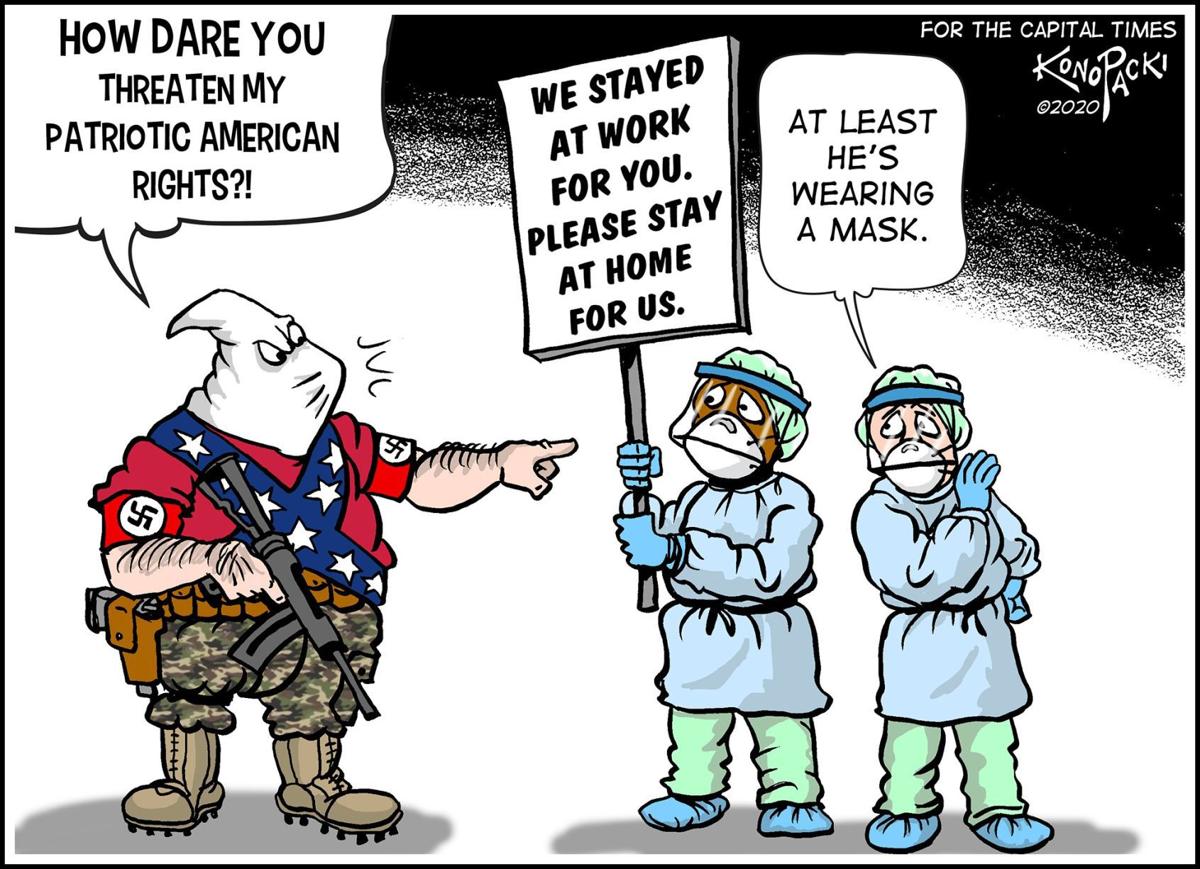
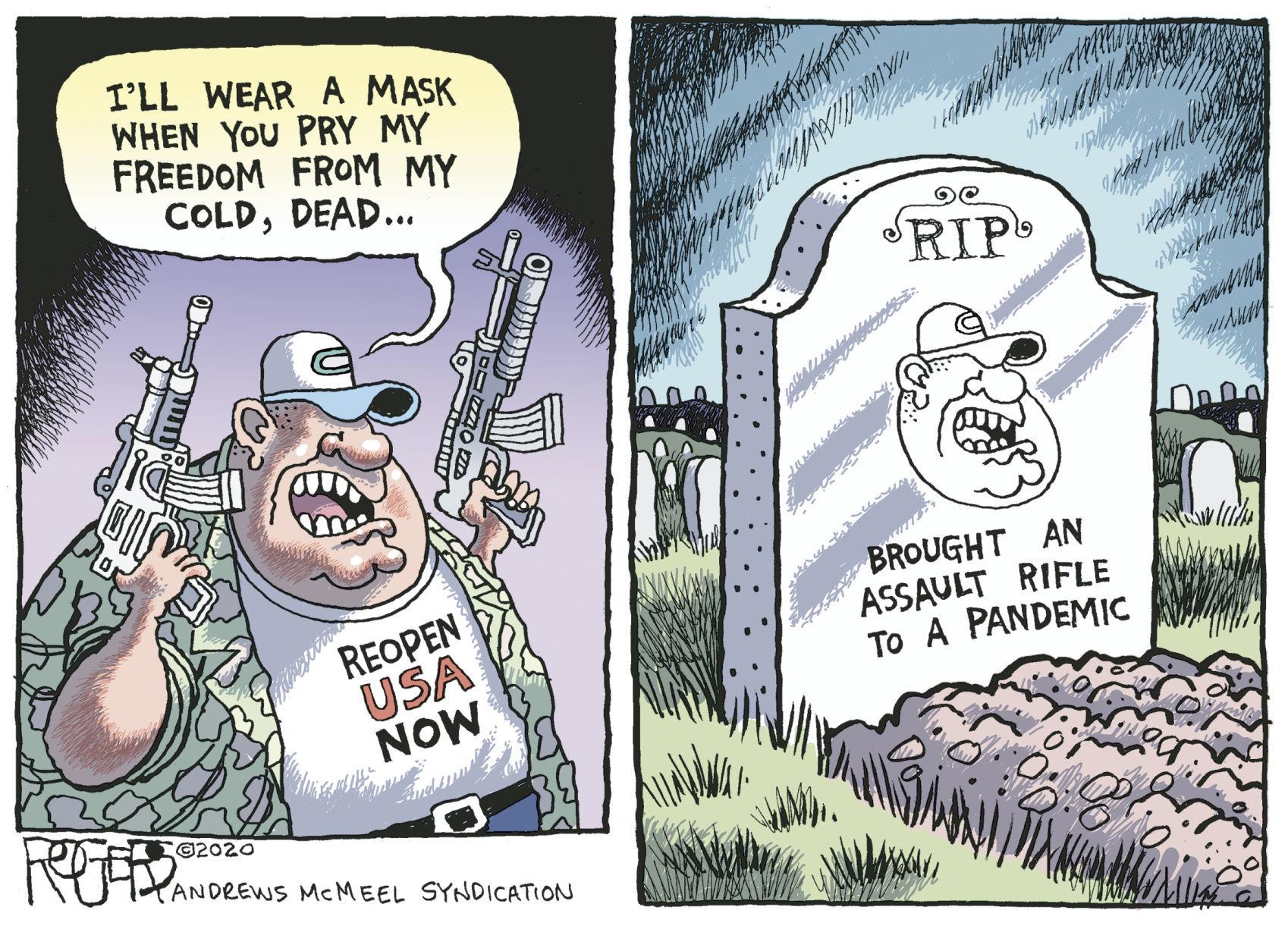
Cartoon – Price of Pandemic Freedom

Editorial cartoon: Rob Rogers (May 16, 2020) | | yakimaherald.com

Cartoon – Current State of the Union

Plain Talk: Refusing to wear a mask isn't patriotic, it's just ...

Public Health Officials Face Wave Of Threats, Pressure Amid Coronavirus Response

Public Health Officials Face Wave Of Threats, Pressure Amid Coronavirus Response

Public health officials face wave of threats, pressure amid ...

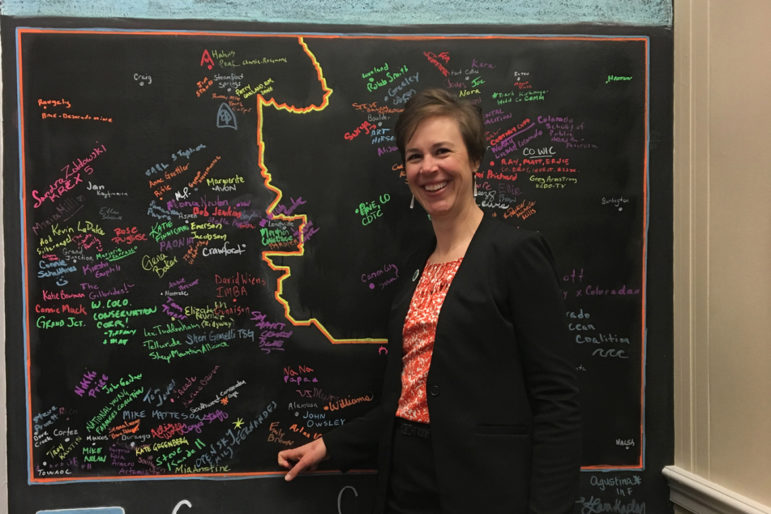
Emily Brown was director of the Rio Grande County Public Health Department in Colorado until May 22, when the county commissioners fired her after battling with her over coronavirus restrictions. “They finally were tired of me not going along the line they wanted me to go along,” she says.

Emily Brown was stretched thin.

As the director of the Rio Grande County Public Health Department in rural Colorado, she was working 12- and 14-hour days, struggling to respond to the pandemic with only five full-time employees for more than 11,000 residents. Case counts were rising.

She was already at odds with county commissioners, who were pushing to loosen public health restrictions in late May, against her advice. She had previously clashed with them over data releases and had haggled over a variance regarding reopening businesses.

But she reasoned that standing up for public health principles was worth it, even if she risked losing the job that allowed her to live close to her hometown and help her parents with their farm.

Then came the Facebook post: a photo of her and other health officials with comments about their weight and references to “armed citizens” and “bodies swinging from trees.”

The commissioners had asked her to meet with them the next day. She intended to ask them for more support. Instead, she was fired.

“They finally were tired of me not going along the line they wanted me to go along,” she said.

In the battle against COVID-19, public health workers spread across states, cities and small towns make up an invisible army on the front lines. But that army, which has suffered neglect for decades, is under assault when it’s needed most.

Officials who usually work behind the scenes managing everything from immunizations to water quality inspections have found themselves center stage. Elected officials and members of the public who are frustrated with the lockdowns and safety restrictions have at times turned public health workers into politicized punching bags, battering them with countless angry calls and even physical threats.

On Thursday, Ohio’s state health director, who had armed protesters come to her house, resigned. The health officer for Orange County, California, quit Monday after weeks of criticism and personal threats from residents and other public officials over an order requiring face coverings in public.

As the pressure and scrutiny rise, many more health officials have chosen to leave or been pushed out of their jobs. A review by KHN and The Associated Press finds at least 27 state and local health leaders have resigned, retired or been fired since April across 13 states.

In California, senior health officials from seven counties, including the Orange County officer, have resigned or retired since March 15. Dr. Charity Dean, the second in command at the state Department of Public Health, submitted her resignation June 4.

These officials have left their posts due to a mix of backlash and stressful, nonstop working conditions, all while dealing with chronic staffing and funding shortages.

Some health officials have not been up to the job during the biggest health crisis in a century. Others previously had plans to leave or cited their own health issues.

But Lori Tremmel Freeman, CEO of the National Association of County and City Health Officials, said the majority of what she calls an “alarming” exodus resulted from increasing pressure as states reopen. Three of those 27 were members of her board and well known in the public health community — Rio Grande County’s Brown; Detroit’s senior public health adviser, Dr. Kanzoni Asabigi; and the head of North Carolina’s Gaston County Department of Health and Human Services, Chris Dobbins.

Asabigi’s sudden retirement, considering his stature in the public health community, shocked Freeman. She also was upset to hear about the departure of Dobbins, who was chosen as health director of the year for North Carolina in 2017. Asabigi and Dobbins did not reply to requests for comment.

“They just don’t leave like that,” Freeman said.

Public health officials are “really getting tired of the ongoing pressures and the blame game,” Freeman said. She warned that more departures could be expected in the coming days and weeks as political pressure trickles down from the federal to the state to the local level.

From the beginning of the coronavirus pandemic, federal public health officials have complained of being sidelined or politicized. The Centers for Disease Control and Prevention has been marginalized; a government whistleblower said he faced retaliation because he opposed a White House directive to allow widespread access to the malaria drug hydroxychloroquine as a COVID-19 treatment.

In Hawaii, U.S. Rep. Tulsi Gabbard called on the governor to fire his top public health officials, saying she believed they were too slow on testing, contact tracing and travel restrictions. In Wisconsin, several Republican lawmakers have repeatedly demanded that the state’s health services secretary resign, and the state’s conservative Supreme Court ruled 4-3 that she had exceeded her authority by extending a stay-at-home order.

With the increased public scrutiny, security details — like those seen on a federal level for Dr. Anthony Fauci, the top infectious disease expert — have been assigned to state health leaders, including Georgia’s Dr. Kathleen Toomey after she was threatened. Ohio’s Dr. Amy Acton, who also had a security detail assigned after armed protesters showed up at her home, resigned Thursday.

In Orange County, in late May, nearly a hundred people attended a county supervisors meeting, waiting hours to speak against an order requiring face coverings. One person suggested that the order might make it necessary to invoke Second Amendment rights to bear arms, while another read aloud the home address of the order’s author — the county’s chief health officer, Dr. Nichole Quick — as well as the name of her boyfriend.

Quick, attending by phone, left the meeting. In a statement, the sheriff’s office later said Quick had expressed concern for her safety following “several threatening statements both in public comment and online.” She was given personal protection by the sheriff.

But Monday, after yet another public meeting that included criticism from members of the board of supervisors, Quick resigned. She could not be reached for comment. Earlier, the county’s deputy director of public health services, David Souleles, retired abruptly.

An official in another California county also has been given a security detail, said Kat DeBurgh, the executive director of the Health Officers Association of California, declining to name the county or official because the threats have not been made public.

DeBurgh is worried about the impact these events will have on recruiting people into public health leadership.

“It’s disheartening to see people who disagree with the order go from attacking the order to attacking the officer to questioning their motivation, expertise and patriotism,” said DeBurgh. “That’s not something that should ever happen.”

Many local health leaders, accustomed to relative anonymity as they work to protect the public’s health, have been shocked by the growing threats, said Theresa Anselmo, the executive director of the Colorado Association of Local Public Health Officials.

After polling local health directors across the state at a meeting last month, Anselmo found about 80% said they or their personal property had been threatened since the pandemic began. About 80% also said they’d encountered threats to pull funding from their department or other forms of political pressure.

To Anselmo, the ugly politics and threats are a result of the politicization of the pandemic from the start. So far in Colorado, six top local health officials have retired, resigned or been fired. A handful of state and local health department staff members have left as well, she said.

“It’s just appalling that in this country that spends as much as we do on health care that we’re facing these really difficult ethical dilemmas: Do I stay in my job and risk threats, or do I leave because it’s not worth it?” Anselmo asked.

Some of the online abuse has been going on for years, said Bill Snook, a spokesperson for the health department in Kansas City, Missouri. He has seen instances in which people took a health inspector’s name and made a meme out of it, or said a health worker should be strung up or killed. He said opponents of vaccinations, known as anti-vaxxers, have called staffers “baby killers.”

The pandemic, though, has brought such behavior to another level.

In Ohio, the Delaware General Health District has had two lockdowns since the pandemic began — one after an angry individual came to the health department. Fortunately, the doors were locked, said Dustin Kent, program manager for the department’s residential services unit.

Angry calls over contact tracing continue to pour in, Kent said.

In Colorado, the Tri-County Health Department, which serves Adams, Arapahoe and Douglas counties near Denver, has also been getting hundreds of calls and emails from frustrated citizens, deputy director Jennifer Ludwig said.

Some have been angry their businesses could not open and blamed the health department for depriving them of their livelihood. Others were furious with neighbors who were not wearing masks outside. It’s a constant wave of “confusion and angst and anxiety and anger,” she said.

Then in April and May, rocks were thrown at one of their office’s windows — three separate times. The office was tagged with obscene graffiti. The department also received an email calling members of the department “tyrants,” adding “you’re about to start a hot-shooting … civil war.”  Health department workers decamped to another office.

Although the police determined there was no imminent threat, Ludwig stressed how proud she was of her staff, who weathered the pressure while working round-the-clock.

“It does wear on you, but at the same time we know what we need to do to keep moving to keep our community safe,” she said. “Despite the complaints, the grievances, the threats, the vandalism — the staff have really excelled and stood up.”

The threats didn’t end there, however: Someone asked on the health department’s Facebook page how many people would like to know the home addresses of the Tri-County Health Department leadership. “You want to make this a war??? No problem,” the poster wrote.

Back in Colorado’s Rio Grande County, some members of the community have rallied in support of Brown with public comments and a letter to the editor of a local paper. Meanwhile, COVID-19 case counts have jumped from 14 to 49 as of Wednesday.

Brown is grappling with what she should do next: dive back into another strenuous public health job in a pandemic, or take a moment to recoup?

When she told her 6-year-old son she no longer had a job, he responded: “Good — now you can spend more time with us.”


Mapped: The State of Press Freedom Around the World

Mapped: The State of Press Freedom Around the World

Mapped: The State of Press Freedom Around the World - Visual ...

Mapped: The State of Press Freedom Around the World

View a more detailed version of the above map by clicking here

In many Western countries, it’s easy to take press freedom for granted.

Instances of fake news, clickbait, and hyper-partisan reporting are points of consternation in the modern media landscape, and can sometimes overshadow the greater good that unrestricted journalism provides to society.

Of course, the ability to do that important work can vary significantly around the world. Being an investigative journalist in Sweden comes with a very different set of circumstances and considerations than doing the same thing in a country such as Saudi Arabia or Venezuela.

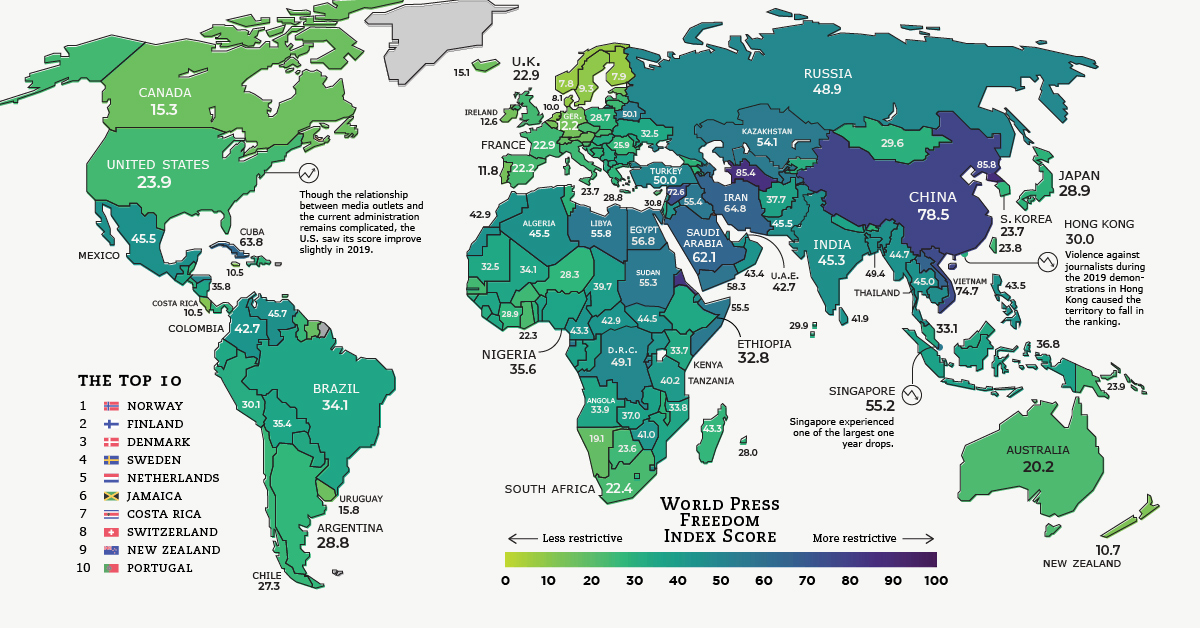
Today’s map highlights the results of the 2020 Global Press Freedom Index, produced by Reporters Without Borders. The report looks at press freedom in 180 countries and territories.

A Profession Not Without Its Risks

Today, nearly 75% of countries are in categories that the report describes as problematic, difficult, and very serious.

While these negative forces often come in the form of censorship and intimidation, journalism can be a risky profession in some of the more restrictive countries. One example is Mexico, where nearly 60 journalists were killed as a direct result of their reporting over the last decade.

journalists killed around the world

There is good news though: the number of journalists killed last year was the lowest since the report began in 2002.

Even better, press freedom scores increased around the world in the 2020 report.

Press Freedom: The Good, The Bad, The Ugly

Here are the scores for all 180 countries and territories covered in the report, sorted by 2020 ranking and score:

Which countries stood out in this year’s edition of the press freedom rankings?

Norway: Nordic Countries have topped the Press Freedom Index since its inception, and Norway (Rank: #1) in particular is an example for the world. Despite a very free media environment, the government recently mandated a commission to conduct a comprehensive review of the conditions for freedom of speech. Members will consider measures to promote the broadest possible participation in the public debate, and means to hamper the spread of fake news and hate speech.

Malaysia: A new government ushered in a less restrictive era in Malaysia in 2018. Journalists and media outlets that had been blacklisted were able to resume working, and anti-fake news laws that were viewed as problematic were repealed. As a result, Malaysia’s index score has improved by 15 points in the past two years. This is in sharp contrast to neighbor, Singapore, which is ranked 158th out of 180 countries.

Ethiopia: When Abiy Ahmed Ali took power in Africa’s second most populous country in 2018, his government restored access to over 200 news websites and blogs that had been previously blocked. As well, many detained journalists and bloggers were released as the chill over the country’s highly restrictive media environment began to thaw. As a result, Ethiopia (#99) jumped up eleven spots in the Press Freedom Index in 2020.

The Middle East: Though the situation in this region has begun to stabilize somewhat, restrictions still remain – even in relatively safe and stable countries. Both Saudi Arabia (#170) and Egypt (#166) have imprisoned a number of journalists in recent years, and the former is still dealing with the reputational fallout from the assassination of Saudi dissident and Washington Post columnist, Jamal Khashoggi.

China: Sitting near the bottom of the list is China (#176). More than 100 journalists and bloggers are currently detained as the country maintains a tight grip over the press – particularly as COVID-19 began to spread. Earlier this year, the Chinese government also expelled over a dozen journalists representing U.S. publications.

2020: A Pivotal Year for the Press

As the world grapples with a deadly pandemic, a global economic shutdown, and a crucial election year, the media could find itself in the spotlight more than in previous years.

How the stories of 2020 are told will influence our collective future – and how regimes choose to treat journalists under this atypical backdrop will tell us a lot about press freedom going forward.