Allina Health doctors unionize over health system’s objections

Dive Brief:

  • The National Labor Relations Board has certified the union election of more than 130 Allina Health doctors at Mercy and Unity Hospitals, nearly a year after they voted to join the Doctors Council Service Employees International Union (SEIU).
  • The certification follows objections from the Minneapolis-based nonprofit health system, which said that physicians active in the union drive held supervisor or managerial positions and may have unlawfully pressured colleagues into supporting the union. The NLRB rejected that claim.
  • It’s another victory for Doctors Council SEIU at Allina facilities. In October, more than 500 Allina doctors, physician assistants and nurse practitioners at over 60 facilities voted to join the union, according to NLRB documents.

Dive Insight:

Allina doctors and physician assistants said that chronic understaffing, high levels of burnout and compromised patient safety due to the corporatization of care motivated them to seek union representation.

“We have been seeing the shift of healthcare control going to corporations and further and further away from patient voices and patient advocacy. That really fell apart during the pandemic,” said Allina physician Liz Koffel during a press conference on Aug. 15 announcing primary care physicians’ unionization drive.

Koffel detailed workplace grievances that she said occurred due to Allina’s push for profits, including high productivity demands backed by few support staff and the health system’s now-abandoned policy of interrupting non-emergency medical care for patients with high levels of debt

In a statement to Healthcare Dive, an Allina spokesperson said the system had “committed to taking steps to make sure the National Labor Relations Board’s process was fair to all involved,” and that it would not take further procedural action against the union.

Across the country, physicians’ feelings of limited autonomy is driving similar interest in unionization, according to John August, director of healthcare labor relations at Cornell’s School of Industrial and Labor Relations. 

“Frankly, I’ve never seen anything like it in my whole career — where so many people are saying exactly the same thing at the same time, from a profession that heretofore has been essentially not unionized,” he said.

Although doctors have historically shown little interest in unionization — the physician unionization rate was under 6% nationwide in 2021 — the tide is beginning to turn

Doctors are increasingly working in consolidated hospitals owned by larger health systems or private equity firms. They report consolidation limits the influence they have on their day-to-day jobs, according to a December study from the Physician Advocacy Institute.

In addition, other options, such as physician-owned practices, are disappearing, with the percentage of owned practices falling 13% between 2012 and 2022, according to an analysis from the American Medical Association.

Elsewhere in the healthcare industry, unionization and strikes have led to gains for workers.

Last year, nurses at Robert Wood Johnson University Hospital successfully negotiated nurse-to-patient ratios by holding the picket line for nearly four months in New Jersey, and more than 75,000 healthcare workers secured a 20% raise over four years at Kaiser Permanente by staging the largest healthcare strike in recent history.

Starbucks softens its union stance

Starbucks is softening its stance toward unionization after years of pushing back.

Why it matters: 

It’s a potentially huge shift for the chain and a signal of the staying power of the labor movement that surged in the wake of the pandemic.

  • “They know this isn’t going away,” said Nick Setyan, an equity analyst at Wedbush who covers Starbucks. He called the company’s new posture “capitulation.”
  • Setyan said recent worker walkouts were a turning point. Also, at least five more stores this month voted to unionize.

Zoom out: 

Union organizing efforts have been a public relations headache for Starbucks since at least 2021 when a store in Buffalo became the first to vote for a union. Meanwhile, pressure from labor regulators isn’t slowing.

Zoom in: 

Starbucks’ strategy shift began in March when Laxman Narasimhan took the CEO reins from founder Howard Schultz, who had repeatedly clashed with workers over unionizing. The new CEO spoke of the need to care for customer-facing staff, per Reuters.

  • It’s accelerated over the past week — last Friday, Starbucks vice president Sara Kelly sent a letter to Workers United (the union that reps workers), saying the company wanted to restart bargaining.
  • The union has yet to bargain a contract. Starbucks now says it wants an agreement by next year.
  • On Wednesday, the company released an audit on its labor relations practices that was commissioned by Starbucks — after a shareholder vote forced its hand — and conducted by a former management-side lawyer.
  • Though the report asserted Starbucks didn’t have an “anti-union playbook,” it did find the company was unprepared to deal with its unionizing workforce and acknowledged that store managers made mistakes in how they handled the situation.
  • The report offers recommendations for improvement — including better training. Change starts with “tone from the top,” the audit says, suggesting that the company should reach agreements with the union “expeditiously.”

What happened: 

Starbucks initially believed it could fend off unionization by messaging about best-in-class wages and benefits, Setyan said, noting that it’s true the chain offers better compensation than competitors.

  • “Internally, they felt kind of aggrieved,” he said, that workers who management perceived as well-compensated would want to organize.
  • For a while it seemed like the messaging campaign was working, but the Red Cup Rebellion walkout last month and a flurry of new union votes changed minds.
  • Starbucks has historically been very sensitive to public relations — and it became clear pushing back isn’t great for its image, Setyan said.

The other side: 

Union representatives are skeptical of Starbucks’ new position.

  • “We are hopeful your letter is indeed the beginning of a sincere effort, and not a publicity move in the face of pressure from partners, Wall Street, shareholders, and others,” Workers United president Lynne Fox, said in a letter to Kelly last week.

What to watch: 

If Starbucks’ change in tone is a sign that the company will finally come to terms with these workers, and agree to a contract, or just a shift in its public stance while it continues efforts to avoid a deal.

Thousands of US health care workers go on strike in multiple states over wages and staff shortages

https://apnews.com/article/kaiser-health-care-workers-strike-b8b40ce8c082c0b8c4f1c0fb7ec38741

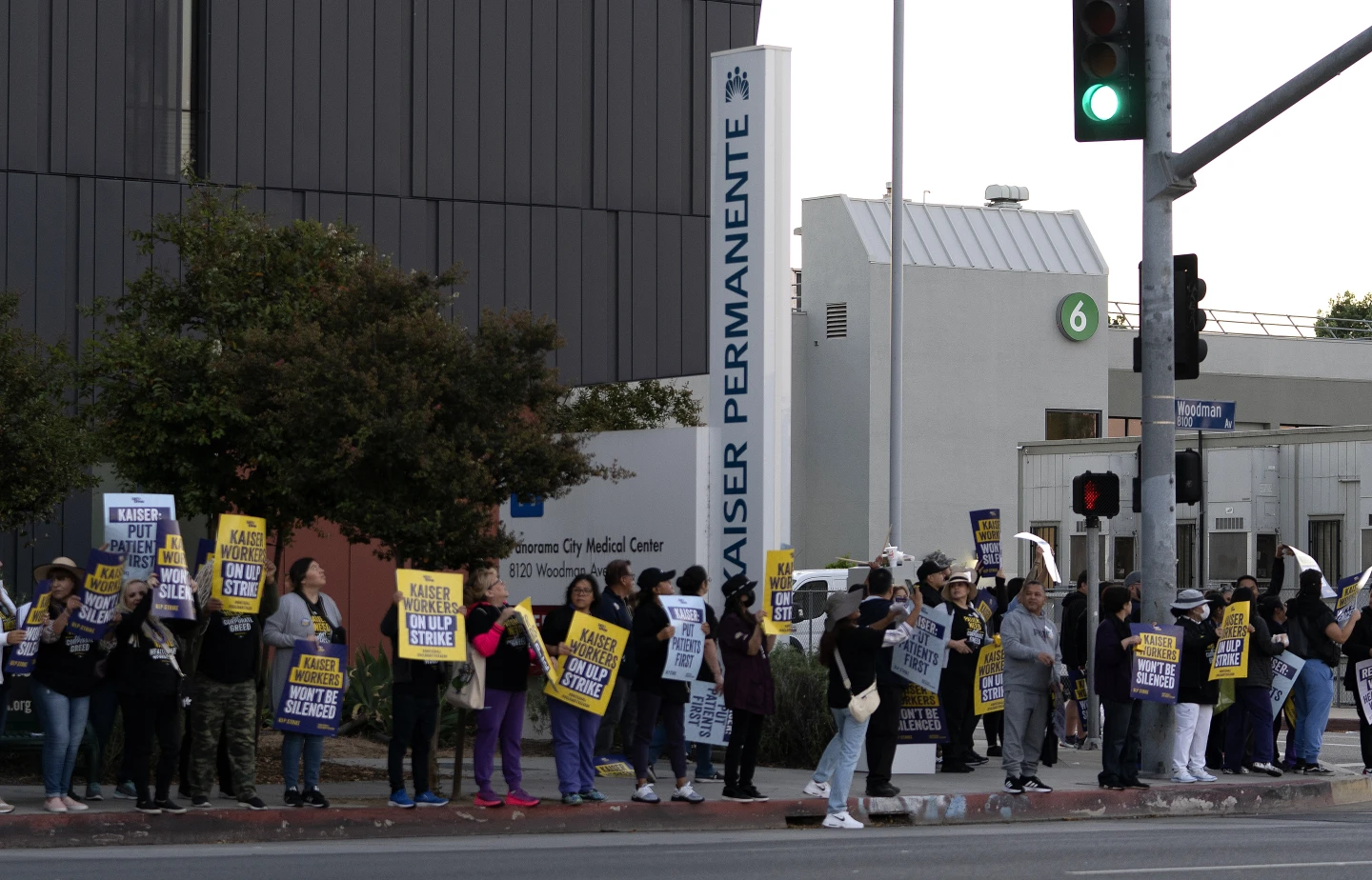
Picketing began Wednesday at Kaiser Permanente hospitals as some 75,000 health care workers went on strike in Virginia, California and three other states over wages and staffing shortages, marking the latest major labor unrest in the United States.

Kaiser Permanente is one of the country’s larger insurers and health care system operators, with 39 hospitals nationwide. The nonprofit company, based in Oakland, California, provides health coverage for nearly 13 million people, sending customers to clinics and hospitals it runs or contracts with to provide care.

The Coalition of Kaiser Permanente Unions, representing about 85,000 of the health system’s employees nationally, approved a strike for three days in California, Colorado, Oregon and Washington, and for one day in Virginia and Washington, D.C.

A cheer went up from union members outside Kaiser Permanente Los Angeles Medical Center when the strike deadline arrived before dawn.

The strikers include licensed vocational nurses, home health aides and ultrasound sonographers, as well as technicians in radiology, X-ray, surgical, pharmacy and emergency departments.

Doctors are not participating, and Kaiser says its hospitals, including emergency rooms, will remain open during the picketing. The company said it was bringing in thousands of temporary workers to fill gaps during the strike. But the strike could lead to delays in getting appointments and non-urgent procedures being rescheduled.

It comes amid unprecedented worker organizing — from strike authorizations to work stoppages — within multiple industries this year, including, transportationentertainment and hospitality.

Wednesday’s strike is the latest one for the health care industry this year as it continues to confront burnout with the heavy workloads — problems that were exacerbated greatly by the pandemic.

Unions representing Kaiser workers in August asked for a $25 hourly minimum wage, as well as increases of 7% each year in the first two years and 6.25% each year in the two years afterward.

They say understaffing is boosting the hospital system’s profits but hurting patients, and executives have been bargaining in bad faith during negotiations.

“They’re not listening to the frontline health care workers,” said Mikki Fletchall, a licensed vocational nurse based in a Kaiser medical office in Camarillo, California. “We’re striking because of our patients. We don’t want to have to do it, but we will do it.”

Kaiser has proposed minimum hourly wages of between $21 and $23 next year depending on the location.

Since 2022, the hospital system has hired 51,000 workers and has plans to add 10,000 more people by the end of the month.

Kaiser Permanente reported $2.1 billion in net income for this year’s second quarter on more than $25 billion in operating revenue. But the company said it still was dealing with cost headwinds and challenges from inflation and labor shortages.

Kaiser executive Michelle Gaskill-Hames defended the company and said its practices, compensation and retention are better than its competitors, even as the entire sector faces the same challenges.

“Our focus, for the dollars that we bring in, are to keep them invested in value-based care,” said Gaskill-Hames, president of Kaiser Foundation Health Plan and Hospitals of Southern California and Hawaii.

She added that Kaiser only faces 7% turnover compared to the industry standard of 21%, despite the effects of the pandemic.

“I think coming out of the pandemic, health care workers have been completely burned out,” she said. “The trauma that was felt caring for so many COVID patients, and patients that died, was just difficult.”

The workers’ last contract was negotiated in 2019, before the pandemic.

Hospitals generally have struggled in recent years with high labor costs, staffing shortages and rising levels of uncompensated care, according to Rick Gundling, a senior vice president with the Healthcare Financial Management Association, a nonprofit that works with health care finance executives.

Most of their revenue is fixed, coming from government-funded programs like Medicare and Medicaid, Gundling noted. He said that means revenue growth is “only possible by increasing volumes, which is difficult even under the best of circumstances.”

Workers calling for higher wages, better working conditions and job security, especially since the end of the pandemic, have been increasingly willing to walk out on the job as employers face a greater need for workers.

The California legislature has sent Democratic Gov. Gavin Newsom a bill that would increase the minimum wage for the state’s 455,000 health care workers to $25 per hour over the next decade. The governor has until Oct. 14 to decide whether to sign or veto it.

Britain’s National Health Service (NHS) workers stage largest-ever strike

https://mailchi.mp/d62b14db92fb/the-weekly-gist-february-10-2023?e=d1e747d2d8

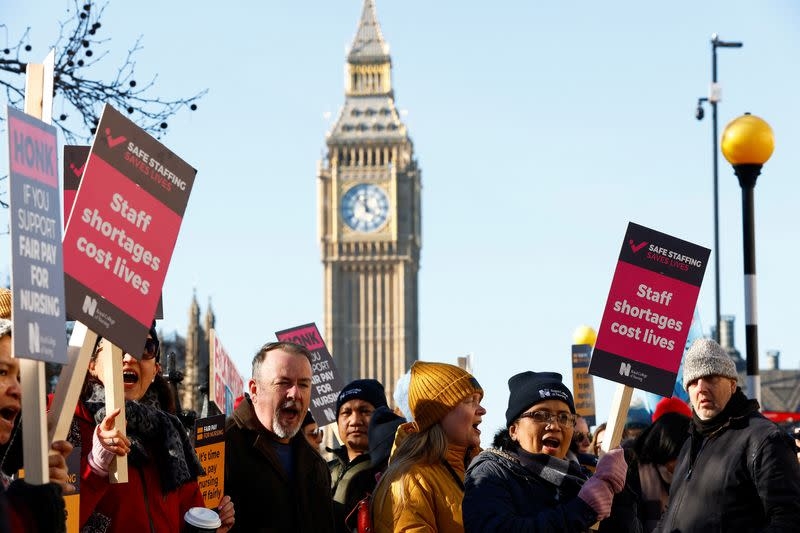
Monday’s walkout of tens of thousands of nurses and ambulance staff was the largest in the NHS’s 75-year history.

Labor demonstrations have been ongoing across the past few months, as workers demand higher pay and better working conditions amid rampant national inflation and increased workloads.

Specific demands vary by union and nation within the United Kingdom. Welsh nurses called off their strike this week to review a proposal from Wales’ Labour Party-run government, while the Royal College of Nurses, the UK’s largest nursing union, has countered a nominal 5 percent pay increase proposal with demands for a five percent pay raise on top of inflation, which topped 10 percent in Britain in December. 

The Gist: A glance at our neighbors across the pond shows that the US healthcare system is not the only one currently experiencing a labor crisis.

The UK’s nationalized system has also failed to shield its workers from the combined impact of COVID burnout and inflation. But the NHS, as the UK’s largest employer and perennial object of political maneuvering, is more susceptible to organized labor actions. 

In contrast, American healthcare unions, which only covered 17 percent of the country’s nurses in 2021, must negotiate with local employers, whose responses to their demands vary.

While this may enhance the bargaining power of US health system leaders, it also heightens the risk that we will fail to adequately secure our nursing workforce, a key national resource already in short supply, for the longer term. 

Residents at New York City hospitals seek union recognition

https://mailchi.mp/cfd0577540a3/the-weekly-gist-november-11-2022?e=d1e747d2d8

 Last week, over 1,200 resident physicians and interns at Montefiore Medical Center, one of the largest employers in New York City, with four hospitals in the Bronx, held an organizing vote and requested voluntary recognition of their bargaining unit. The residents organized under the Committee of Interns and Residents, a unit of the Service Employees International Union that claims 22K members and has established unions at five hospitals this year. Roughly seven percent of practicing doctors were unionized as of 2019; that number has grown in the wake of pandemic-induced burnout and industry consolidation. Montefiore Medical Center declined to voluntarily recognize the union and has requested that the union re-form via a secret ballot election.

The Gist: Health system executives may see the possibility of resident unions as another headache amid the ongoing labor crisis, but the drivers of the crisis—burnout, workplace safety concerns, work-life balance, and real-wage erosion—are responsible for the growing appeal of unions for physicians. Fueled by economy-wide stressors, unionization has been growing in nontraditional labor sectors, including among baristas and tech workers, and medical residents may be the next to join that wave.

Health systems worried about resident unionization should address residents’ concerns about working conditions proactively, which may involve reevaluating wages in light of residents’ significant contributions to operational and financial success.  

COVID-fatigued health workers are mobilizing

https://www.axios.com/2022/06/02/health-care-workers-unions-covid-fatigue

Health care workers nationwide are organizing and pushing for workplace changes like better pay or more favorable staffing ratios after waves of pandemic-fueled burnout and frustration.

Why it matters: COVID-19 and its aftereffects triggered an exodus of health care workers. Those who stayed are demanding more from health systems that claim to be reaching their own breaking points.

  • “The pandemic exacerbated a crisis that was already there,” Michelle Boyle, a Pittsburgh nurse told Axios. “It went from being a crisis to being a catastrophic freefall in staffing.”

Driving the news: About 1,400 resident physicians in public Los Angeles County hospitals have authorized a strike if their demands for pay parity with other local facilities aren’t met in contract negotiations this week.

  • Nurses demonstrated across Pennsylvania in early May, protesting one state lawmaker’s inaction on legislation that would have set nurse-to-patient ratios.
  • A fight is brewing in Minnesota as contracts covering 15,000 nurses in several hospital systems are expiring.
  • Some 2,000 resident physicians and interns at Stanford University and the University of Vermont Medical Center joined an affiliate of the SEIU for medical workers that claims more than 20,000 members nationwide.
  • In North Carolina, where union membership is low, staff at Mission Health in Asheville voted to unionize largely over staffing concerns.

Less than half of the of nearly 12,000 nurses polled by the American Nurses Association last year believe their employer cares about their concerns, and 52% of those surveyed said they intend to leave their jobs or are considering doing so.

The other side: Hospital operators generally oppose unionization efforts, as well as mandated staffing ratios.

  • “The last thing we need is requirements set by somebody in Washington as to exactly how many nurses ought to be providing service at any given time,” said Chip Kahn, CEO of the Federation of American Hospitals. “That ought to be a local decision based on the need in the hospital at the time.”
  • The American Organization for Nursing Leadership, an affiliate of the American Hospital Association, also opposes staffing ratios.
  • The industry says decisions on staffing and workplace rules are best left to local executives who need to be flexible to meet shifting demand for care.
  • “You’re basically taking away the flexibility of those on the scene to determine what it takes to provide the needed patient care,” Kahn said.

Go deeper: The pandemic drove up labor costs significantly for hospitals that were forced to pay travel nurses to fill workforce gaps during COVID surges.

  • April marked the fourth month in a row this year that major hospitals and health care systems reported negative margins, a Kaufman Hall report found. And executives say things could worsen amid inflation and stubborn supply chain woes.

And yet, some big hospital chains like Tenet reported strong earnings in the first quarter.

Between the lines: California is the only state to have set staffing ratios for nurses, but hospital unions in other states have fought for similar requirements in their contracts.

  • In California, every nurse on a general hospital floor has no more than five patients to care for at a time; nurses in ICUs should care for no more than two patients.
  • Nurses want look-alike standards in states like Pennsylvania, where only some hospitals have staffing ratios, saying short-staffing threatens patients’ well-being.

What we’re watching: While many legislative proposals failed this year, unions representing health care workers say their message is getting across.

  • Unions in Illinois, Pennsylvania and Washington state are redoubling efforts for staffing ratio legislation modeled on California’s.
  • In New York, nurses passed a law that took effect in January mandating staffing committees at hospitals.

The bottom line: The labor tension is a sobering coda to a health crisis that’s stretched health systems and workers alike in unprecedented ways.

“What you’re seeing is nurses finally saying enough is enough and this system is broken and we need it to be fixed,” said Denelle Korin, a nurse alliance coordinator with Nurses of Pennsylvania.

More than 4K Stanford nurses vote to strike in California

UPDATE: April 14, 2022: Nurses will begin striking April 25 if they are unable to reach a deal with the system by then, according to a Wednesday statement from the union. The two sides have met with a federal mediator three times, and the strike would be open-ended.

Dive Brief:

  • Unionized nurses at Stanford hospitals in California voted in favor of authorizing a strike Thursday, meaning more than 4,500 nurses could walk off the job in a bid for better staffing, wages and mental health measures in new contracts.
  • Some 93% of nurses represented by the Committee for Recognition of Nursing Achievement voted in favor of the work stoppage, though the union did not set a date, according to a union release. It must give the hospitals 10 days notice before going on strike.
  • Nurses’ contracts expired March 31 and the union and hospital have engaged in more than 30 bargaining sessions over the past three months, including with a federal mediator, according to the union.

Dive Insight:

As the COVID-19 pandemic has worsened working conditions for nurses, some unions have made negotiating contracts a priority. Better staffing is key, along with higher wages and other benefits to help attract and retain employees amid ongoing shortages.

The California nurses’ demands in new contracts focus heavily on recruitment and retention of nursing staff “amid an industry-wide shortage and nurses being exhausted after working through the pandemic, many in short-staffed units,” the union said in the release.

They’re also asking for improved access to time off and more mental health support.

Nurses say their working conditions are becoming untenable and relying on travel staff and overtime shifts is not sustainable, according to the release.

The hospitals are taking precautionary steps to prepare for a potential strike and will resume negotiations with the union and a federal mediator Tuesday, according to a statement from Stanford.

But according to CRONA, nurses have filed significantly more assignment despite objections documents from 2020 to 2021 — forms that notify hospital supervisors of assignments nurses take despite personal objections around lacking resources, training or staff.

And a survey of CRONA nurses conducted in November 2021 founds that as many as 45% were considering quitting their jobs, according to the union.

That’s in line with other national surveys, including one from staffing firm Incredible Health released in March that found more than a third of nurses said they plan to leave their current jobs by the end of this year.

The CRONA nurses “readiness to strike demonstrates the urgency of the great professional and personal crisis they are facing and the solutions they are demanding from hospital executives,” the union said in the release.

No major strikes among healthcare workers have occurred so far this year, though several happened in 2021 and in 2020, the first year of the pandemic.

Kaiser Permanente union in California nearing strike

Dive Brief:

  • A union representing 24,000 Kaiser Permanente clinicians in California has put a pause on its 24-year partnership with management, the group said Friday.
  • Leadership of the union voted last week to move forward with a membership vote that would authorize the bargaining team to call a strike.
  • The United Nurses Associations of California/Union of Health Care Professionals said in a press release Kaiser Permanente is planning “hefty cuts” to nurse wages and benefits despite the ongoing COVID-19 pandemic and high levels of burnout among nurses.

Dive Insight:

Union activity at hospitals has been ramping up since the onset of the pandemic, as front-line healthcare workers have been stretched to the brink with full ICUs, worries of infection and sick coworkers.

Now, Kaiser Permanente nurses in California are saying they’re not being appreciated for their efforts.

“How do you tell caregivers in one breath you’re our heroes, we’re invested in you, I want to protect you, but in the next say I want to take away your wages and benefits? Even say you’re a drag on our bottom line,” Charmaine Morales, executive vice president of the union, said in a press release. “For the first time in 26 years, we could be facing a strike.”

The most recent bargaining session between the health system and the union was Sept. 10. Another one hasn’t been scheduled, despite most contracts being set to expire at the end of the month, the union said.

The labor management partnership started in the 1990s as an attempt for the union and management to share information and decision-making, the union said.

But they also said company leaders have not been invested in the agreement recently.

“Kaiser Permanente has stepped back from the principles of partnership for some time now, and they have violated the letter of our partnership agreement in the lead up to our present negotiations,” union president Denise Duncan said in the press release. “Despite that, we are here and ready to collaborate again if KP leaders find their way back to the path — where patient care is the true north in our value compass, and everything else falls in line behind that principle. Patient care is Kaiser Permanente’s core business, or at least we thought so.”

The press release cites Kaiser’s profitability, as the system’s net income was nearly $3 billion in the second quarter of this year. However, that was a decrease of more than a third from the prior-year period.

It also noted multiple lawsuits alleging Kaiser tried to game the Medicare Advantage program by submitting inaccurate diagnosis codes. The Department of Justice has joined six of those lawsuits.

Kaiser Permanente did not respond to a request for comment by time of publication.

Where did Labor Day come from?

OUR MESSAGE FOR LABOR DAY | Here and Sphere

Labor Day Quotes

Labor Day Quotes to Remember