Fauci’s warning about reopening may have more influence over Americans than governors

https://www.washingtonpost.com/politics/2020/05/12/faucis-warning-about-reopening-may-have-more-influence-over-americans-than-governors/?fbclid=IwAR0eDoGHpOUI1Ty2RdCoKcxSzwne2NscJfoVGQXnEH8ud2s5MEKIunzXuRA

White House coronavirus expert Dr Anthony Fauci says world may ...

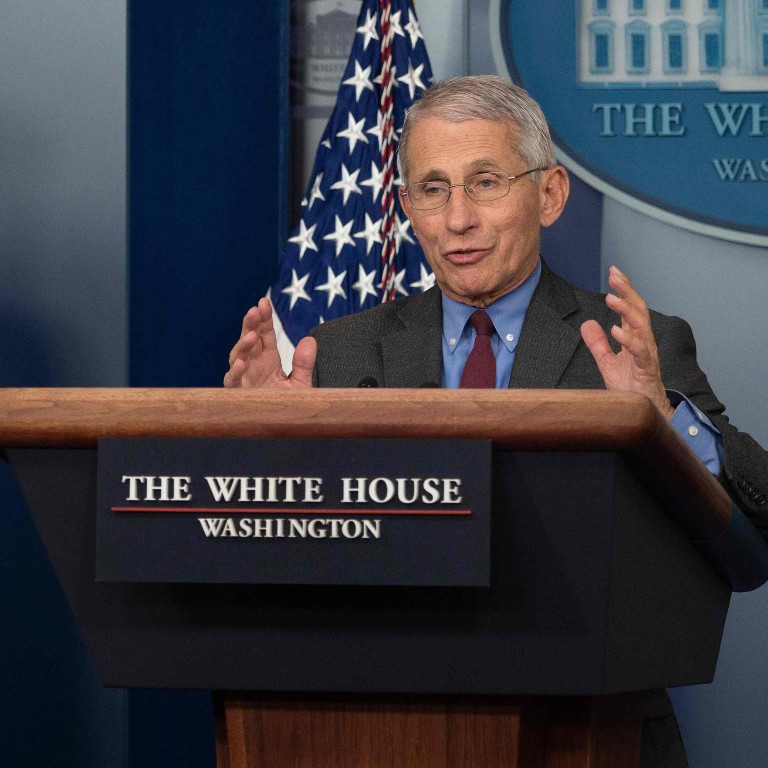
It’s one of those moments that, even as it occurs, seems definitive. The country’s leading infectious-disease expert, Anthony S. Fauci, offering testimony before a Senate committee about a virus that’s infected more than a million Americans — but doing so remotely, because of his own contact with an infected individual. Speaking from quarantine, Fauci will offer a grim warning: Attempting to return economic activity to normal levels too quickly will “result in needless suffering and death” and itself result in negative effects for the economy.

Fauci’s warning stands in obvious contrast to the assertions of his boss, President Trump. As he has so often over the course of the pandemic, Trump waves away questions about whether states are ready to resume normal economic activity, insisting that many places are ready to gear back up. His White House released a set of recommendations for doing so, recommendations to which Fauci will refer. But even as those recommendations were introduced, Trump undercut them. He quickly embraced anti-social-distancing protests in states with blue governors — states where things were not yet ready to return to normal.

The recommendations espoused by Fauci (and, ostensibly, Trump) set an initial baseline of data that states should meet before taking even introductory steps toward reopening their economies. They’re centered on three categories benchmarks: coronavirus symptoms, actual cases and hospital capacity. The initial presentation from the White House explained how those benchmarks could be met:

For the first two, we have publicly available data that allows us to evaluate how states are doing. In the case of demonstrated symptoms, the data are somewhat old, with the most recent metrics reflecting the week of May 2. What’s more, data on the number of people showing up to emergency rooms with symptoms reflecting possible covid-19 cases (the disease caused by the coronavirus) are compiled only by region. Nonetheless, we can get a sense for how many people in each place are showing symptoms as well as up-to-date information on the number of cases and positive tests in each state.

By now, many states appear to meet the benchmarks on these two conditions. (Again, given the limits on the symptomatic data, it’s tricky to say how each fares in the moment.) A number of states that have already begun to reopen, though, don’t. In Texas, for example, the number of new cases is up and the percent of positive tests is flat. In Georgia, the number of new cases is flat and the rate of positive tests has been variable. Both states are nonetheless reopening.

Georgia’s been in the process of reopening for about three weeks, despite missing the basic benchmarks even when that process began. Gov. Brian Kemp (R) made a blanket determination that things could get back to normal, ignoring the sort of regionalized shifts that Trump himself has advocated.

New York, the state hit hardest by the virus, has implemented a deliberate, region-by-region plan for reopening. Gov. Andrew M. Cuomo (D) has outlined seven different criteria in each region of the state before it can resume some normal economic activity (though not all). (Among those? A program sufficient to trace the contacts of individuals with newly confirmed infections.) As of Monday, only three regions met the seven conditions. New York City hit four of the seven.

This is presumably how states are encouraged to reopen to avoid Fauci’s most dire predictions. It’s no guarantee that outbreaks won’t emerge, but New York’s plan is predicated on safety over normalcy while Georgia’s appears to be the opposite.

That’s the important context for Fauci’s testimony. His warnings about moving slowly are not new — though, in the past, they’ve mostly been tempered by the looming physical presence of a president who’s not very interested in diluting his optimistic economic assumptions. Fauci’s language about the ramifications is strong, but the message is consistent.

It also comes a bit too late for states such as Georgia — at least at the official level. One effect of the effort to get the state back to normal is that many Georgians aren’t ready to do so. Economic data shows that, despite businesses being open, they’re often not seeing many customers. The state’s residents are skeptical about getting back to normal. A new Post-Ipsos poll suggests that they are also skeptical of their governor.

Those participating in protests against social distancing are a small minority. Most Americans understand the thrust of Fauci’s concerns and are willing to support continued social distancing measures. While governors are occasionally skipping over the guidelines offered by Fauci and his team, the consumers who can return the economy to normal are still wary — and may be the best audience for Fauci’s warnings.


The White House said it was following health experts’ advice. Then we learned it isn’t approving a key CDC document.

https://www.washingtonpost.com/politics/2020/05/07/white-house-said-it-was-following-health-experts-advice-then-we-learned-it-isnt-approving-key-cdc-document/?fbclid=IwAR1TRmiDX4IF5WgkAEVT0BeV0qnYxHCZhF1YwfWrmM79FmS6UOivaFbNBA4&utm_campaign=wp_main&utm_medium=social&utm_source=facebook

Diseases & Conditions | CDC

White House press secretary Kayleigh McEnany made a point at the start of Wednesday’s news briefing to emphasize that President Trump is following health experts’ advice as we enter what Trump has labeled the “next stage” of the coronavirus response — reopening the economy.

“As you are well aware, President Trump has consistently sided with the experts and always prioritized the health and safety of the American people,” McEnany said.

Several hours later, we got another example of the White House resisting what those health experts are advising.

The Associated Press reported around midnight that the White House had shelved planned guidelines from the Centers for Disease Control and Prevention. The document, which was due nearly a week ago, was aimed at providing local authorities with step-by-step guidance on how to reopen:

The 17-page report by a Centers for Disease Control and Prevention team, titled “Guidance for Implementing the Opening Up America Again Framework,” was researched and written to help faith leaders, business owners, educators and state and local officials as they begin to reopen.
It was supposed to be published last Friday, but agency scientists were told the guidance “would never see the light of day,” according to a CDC official. The official was not authorized to talk to reporters and spoke to The Associated Press on the condition of anonymity.

A coronavirus task force official told The Washington Post that the document has not been completely shelved but was in the process of being revised because it was “overly specific.” The official also indicated that it was felt the document was too broad, as “guidance in rural Tennessee shouldn’t be the same guidance for urban New York City.”

The denial, though, reinforces that the White House is reluctant to submit to the CDC’s more detailed prescriptions for reopening the economy. And it’s difficult to divorce the delay in this document’s publication from Trump’s anxiety to reopen the economy — and the tension that has created with past guidelines.

The administration in mid-April issued phased advice on when areas should start to reopen places such as restaurants and other nonessential businesses. But many states have moved forward with certain elements of reopening without actually satisfying those guidelines. Most notably, they have begun to reopen without meeting the Phase One guideline that they should see a decrease in confirmed coronavirus cases over a 14-day period.

As The Post’s Philip Bump reported, some states that have pushed forward with reopening have also seen an increase in cases — which would prevent them from satisfying the requirement for moving into Phase Two. That requirement is that the decline should continue for another 14 days after Phase One begins.

Issuing a detailed document would seemingly complicate further reopenings, because it would again restrict what states and local authorities are supposed to do.

The Washington Post’s Lena H. Sun and Josh Dawsey previewed what the document was set to look like last week. And they also obtained a draft of the document. The new guidelines were to go beyond the initial ones in prescribing specific actions that could be taken in each phase of the reopening. Advocates for reopening have worried that strict guidance could make it difficult for businesses, churches, child-care centers and other facilities to actually function.

Trump, who has long signaled a desire to begin reopening that economy sooner rather than later, has doubled down on that rhetoric in recent days. Despite a steady national death rate that approached previous highs on Tuesday and Wednesday, and even though cases continue to increase outside the major U.S. hotbed of New York City, Trump on Tuesday signaled that we are entering the “next stage” of reopening the economy.

“Thanks to the profound commitment of our citizens, we’ve flattened the curve, and countless American lives have been saved,” Trump said. “Our country is now in the next stage of the battle: a very safe phased and gradual reopening. So, reopening of our country — who would have ever thought we were going to be saying that? A reopening. Reopening.”

Trump has been resistant to the advice of the health officials around him, from the early days of the outbreak when he continuously downplayed the severity of the situation. On several occasions, this tension has boiled over.

We’re also hearing from those officials less and less. The CDC long ago ceased holding briefings on the coronavirus outbreak, and the White House coronavirus task force briefings, which often featured health experts Anthony S. Fauci and Deborah Birx, have now been halted in favor of less-frequent and less-coronavirus-focused briefings from McEnany. Fauci has also been prevented from testifying to the Democratic-controlled House, although he is still slated to testify in the GOP-controlled Senate and has continued doing some interviews. The cumulative effect is that these health experts aren’t on the record as much as the effort to reopen the economy begins in earnest.

In the place of those public comments, the CDC guidelines were to provide firm and detailed advice from those officials for the new stage. But for reasons that seem pretty conspicuous, we still don’t have them.


The Inside Story Of How The Bay Area Got Ahead Of The COVID-19 Crisis

https://khn.org/news/the-inside-story-of-how-the-bay-area-got-ahead-of-the-covid-19-crisis/

The Inside Story Of How The Bay Area Got Ahead Of The COVID-19 ...

Sunday was supposed to be a rare day off for Dr. Tomás Aragón after weeks of working around-the-clock.

Instead, the San Francisco public health officer was jolted awake by an urgent 7:39 a.m. text message from his boss.

“Can you set up a call with San Mateo and Santa Clara health officers this a.m., so we can discuss us all getting on the same page this week with aggressive actions, thanks,” said the message from Dr. Grant Colfax, director of San Francisco’s Department of Public Health.

“Will do, getting up now,” Aragón responded.

It was March 15, two days before St. Patrick’s Day, a heavy partying holiday and nightmare scenario for public health officials.

The novel coronavirus was spreading stealthily across the San Francisco Bay Area and public health officials were alarmed by the explosion of deaths in Italy and elsewhere around the globe. Silicon Valley would be next, case counts indicated.

Until then, they had primarily focused on banning mass gatherings. But they knew more had to be done — and wanted to present a united front.

Within a few hours of the text, Bay Area public health leaders jumped on a series of calls to debate options, including the most dramatic — a lockdown order that would shutter businesses, isolate families and force millions of residents to stay home.

They decided they had no choice. And they were able to move swiftly because they had a secret weapon: a decades-long alliance seeded in the early days of the AIDS epidemic that shields them from political blowback when they need to make difficult decisions.

Together, they would issue the nation’s first stay-at-home order, likely saving thousands of lives and charting the course for much of the country. Three days later, Gov. Gavin Newsom followed with his own order for California. New York came next, as have dozens of states since.

“This was one exhausting and difficult day for all of us,” Aragón later wrote in his journal. “We all wish we did not have to do this.”

Now, officials nationwide are weighing how to lift isolation orders as the rate of COVID-19 transmission slows — and protests against the orders mount. The Bay Area is again poised to lead, but with a warning: All of this could be for naught if it isn’t done right.

The coalition of county public health officers didn’t set out to lock down the Bay Area that fateful Sunday morning in mid-March. But as they discussed the exponential increase in Santa Clara County cases, where the hospitals were becoming overwhelmed by infected patients falling ever sicker, what they needed to do “started to crystalize,” said Dr. Sara Cody, the county’s public health officer.

“It felt huge to me,” she recalled, “because I knew how disruptive it would be.”

Elsewhere in the region, diagnosed cases were sparse. But decades of experience had shown the health officers that while they represent different jurisdictions, they are one region when it comes to infectious diseases. “We knew that it would be a matter of time before that was our experience,” said Dr. Matt Willis, Marin County’s public health officer, who contracted COVID-19 days later.

Cody told her colleagues that Italy was under siege, and her county was just two weeks away from a similar fate. If she could have locked down sooner, she told them, she would have.

“That was compelling,” said Dr. Lisa Hernandez, the public health officer for the city of Berkeley, which had not yet recorded any cases of community transmission. “We knew there was going to be St. Patrick’s Day parades and celebrations, so the timing was critical.”

Dr. Scott Morrow, California’s longest-serving public health officer, who heads operations in San Mateo County, said he also felt the urgency. “We thought, ‘Yes, the clock is ticking,’” he recalled.

County health officers in California have immense power to act independently in the interest of public health, including the authority to issue legally binding directives. They don’t need permission from the governor or mayors or county supervisors to act.

Even for this group, though, with all its collective strength, telling millions of Californians to shelter in place seemed risky at first. But the health officers involved had grown to trust one another, even if they don’t always see eye to eye.

For instance, they currently disagree on whether to require residents to wear face coverings. Some counties, including San Francisco and Marin, are requiring them in public, while others, like Santa Clara, are not.

On the first Sunday morning call, Aragón floated the idea of developing a coordinated recommendation that Bay Area residents stay at home. By the next confab, Cody, Santa Clara County’s health official, made the case that for social distancing to work, it had to be an order.

“Sara Cody was the courageous leader!” Aragón later wrote in his journal.

So forceful a move can be unpopular, but evidence shows it can also be the most effective, in the absence of treatment or a vaccine. “Here’s the rub on these methods — they only work if you do it really early,” said Dr. Howard Markel, a medical historian at the University of Michigan and an expert on the 1918 flu pandemic.

“When you do a quarantine, you stop the commerce, you stop the flow of money,” he said. “But on the other side of that are those whose lives are saved.”

This isn’t the group’s first pandemic. The alliance, formally called the Association of Bay Area Health Officials, was born in 1985 in the early days of the AIDS epidemic.

Dr. David Werdegar, who became health officer for San Francisco that year, was analyzing AIDS data for surrounding counties and asked their health officers to join him for dinner at Jack’s, an old bordello-turned-political hangout in the city that has since shuttered.

Most of the infectious disease research was happening in San Francisco at the time, but HIV was spreading, and one city couldn’t fight it alone.

“It was important that we share all the information we had,” said Werdegar, now in his 80s and retired.

Dr. Robert Melton, a former Monterey County health officer, said that working for nearly two decades with Bay Area public health giants taught him tremendous lessons. “Camaraderie is important in maintaining the energy to be able to focus on the common good, through good and bad,” he said.

That close-knit relationship among the 13 health officers — representing counties stretching across a large swath of Northern California from Napa to Monterey — continues to this day. Collectively, their public health actions touch about 8.5 million people.

They meet monthly and communicate regularly on Slack, a messaging app. Their diverse backgrounds and expertise, especially in an era of funding cuts, provide a deep well of public health knowledge from which to draw. Together, the group has joined forces to combat youth vaping, air pollution and measles outbreaks.

And they have also tackled various influenza scares, which is why they had an emergency response blueprint at the ready when cases of what would later be called COVID-19 first cropped up in Wuhan, China.

“We spent a couple years as a region thinking about pandemic planning, and that really helped us come a long way thinking about these policies for COVID-19,” said Dr. Erica Pan, the interim health officer for Alameda County.

So when they jumped on the call that Sunday, they were already in mid-conversation about how to respond. They brought their lawyers and, working into the predawn hours, translated their lockdown plan into legalese, one that would be enforceable with fines and misdemeanor charges.

They would make prime-time announcements across the region the next day, alongside elected officials. “This is not the moment for half-measures,” said San Jose Mayor Sam Liccardo. “History won’t forgive us for waiting an hour more.”

At first, the stay-at-home order applied just to the “Big Seven” counties surrounding the San Francisco Bay, whose officers peeled off from the larger group to issue it first. They shared their model ordinance with the others, who quickly followed.

Dr. Gail Newel, an OB-GYN and Santa Cruz County’s health officer, is not an infectious disease expert. She has relied heavily on the group’s expertise throughout her career, and especially now.

“It’s this incredible bank of knowledge and wisdom and experience that’s freely shared among the members,” she said. “And the whole Bay Area benefits by that shared knowledge bank.”

Roughly one month after they made the unprecedented decision to close the local economy, the risk seems to have paid off. It will be years before researchers have fully analyzed its impact, but officials across the Bay Area are cautiously optimistic. Others haven’t been so lucky.

Though there are important differences between the two regions, New York City, which issued a stay-at-home order four days after the Bay Area, saw its hospitals completely overwhelmed and had recorded more than 14,600 deaths as of Monday.

By comparison, the counties represented by the alliance have documented more than 215 deaths and hospitals haven’t been overtaken by a surge. In fact, hospitals brought online specifically to accommodate an overflow of patients are sitting largely empty.

Even within California, communities that waited to issue lockdown orders have emerged as COVID-19 hot spots, including Los Angeles, where Mayor Eric Garcetti followed suit three days after the Bay Area.

Internally, some of the Bay Area health officials have wondered if they made the right call. But “anytime I have any doubt, I just read another news report from New York or Detroit or New Orleans,” said Dr. Chris Farnitano, Contra Costa County’s health officer.

And the close-knit band is already undertaking its next task: reopening the economy without causing another spike in cases.

Before the orders are lifted, the officials say there must be rapid, widespread testing across the population. They want to hire disease investigators by the hundreds, if not the thousands, to trace the virus and quarantine those who have been infected. And until there is a vaccine, they may ask people to wear masks in public and continue social distancing, even in bars, restaurants and schools when they reopen.

“I was concerned that we might get a lot of resistance and it might get interpreted as alarmist and overreach,” said Marin County’s Willis. “Time has shown that it was really a vital step to take when we took it.”


Bill Gates says the world is entering ‘uncharted territory’ because it wasn’t prepared for a pandemic like COVID-19

https://www.businessinsider.com/bill-gates-warns-world-is-entering-uncharted-territory-coronavirus-2020-4

5 Books Bill Gates Wants You to Read This Summer | Time

  • Microsoft cofounder Bill Gates said the world was entering into “uncharted territory” because it was not prepared for a pandemic like COVID-19, the disease caused by the novel coronavirus.
  • Speaking to “BBC Breakfast” by video chat on Sunday, Gates said the world should’ve invested more in mitigating a global health crisis.
  • “There is the period where the virus shows up in those first few months,” he said. “Were the tests prepared? Did countries think through getting their ICU and ventilator capacity up?”
  • He added that once the crisis is over “very few countries are going to get an A grade” for their handling of the outbreak.

Microsoft cofounder Bill Gates said the world was entering into “uncharted territory” because it was not prepared for a pandemic like COVID-19, the disease caused by the novel coronavirus.

Gates, who has been warning about the risk of a pandemic disease for years and who has poured millions into fighting the new coronavirus outbreak, told “BBC Breakfast” on Sunday that the world should have invested more into mitigating a global health crisis.

“Well, there was a period when I and other health experts were saying that this was the greatest potential downfall the world faced,” he told the BBC in an interview on Sunday, highlighting his previous warnings against the possibility of a deadly pandemic.

“So we definitely will look back and wish we had invested more,” he said, “so that we could quickly have all the diagnostics, drugs, and vaccines. We underinvested,” he said.

The 67-year-old billionaire warned that in the period before COVID-19 became a public-health crisis, countries could have better prepared their testing capabilities and made sure hospitals were stocked with ventilators and other necessary health supplies.

“There is the period where the virus shows up in those first few months,” he said. “Were the tests prepared? Did countries think through getting their ICU and ventilator capacity up?”

He added that once the crisis is over “very few countries are going to get an A grade” for their handling of the outbreak.

“Now, here we are, we didn’t simulate this, we didn’t practice,” he said. “So both in health policies and economic policies, we find ourselves in uncharted territory.”

Gates has become an outspoken advocate for preparing for a global health crisis like COVID-19.

Speaking to the Financial Times earlier this month, Gates said that COVID-19 was the “biggest event that people will experience in their entire lives” and world leaders and global policymakers have “paid many trillions of dollars more than we might have had to if we’d been properly ready.”

He told FT he was confident that lessons learned from this outbreak would encourage people to better prepare for next time but lamented that the cost this time around was too high.

“It shouldn’t have required a many trillions of dollars loss to get there,” he said. “The science is there. Countries will step forward.”


Trump retweeted a threat to fire Fauci after he said the US’s slow response to COVID-19 has cost lives

https://www.businessinsider.com/trump-retweets-threat-fire-fauci-2020-4

Coronavirus: Trump retweets call to fire Dr Fauci who said US ...

  • On Sunday, President Trump retweeted a call to fire Dr. Anthony Fauci to his 76.8 million followers.
  • Earlier in the day, Fauci had told CNN that “no one is going to deny” that lives could’ve been saved if the US had implemented containment measures earlier in the novel coronavirus outbreak.
  • A week ago, at a White House briefing, Trump stopped Fauci from weighing in on using hydroxychloroquine, a malaria drug, for people with COVID-19, the illness caused by the coronavirus.
  • It’s unclear whether his retweet was more than a vague threat, but Trump has fired several government officials over the past few weeks.

President Donald Trump on Sunday retweeted a call to fire Dr. Anthony Fauci, the US government’s top infectious-disease expert who has so far lasted six presidential administrations, to his 76.8 million followers.

The Trump administration has been in damage-control mode over the slow response to dealing with the coronavirus outbreak. Fauci, who has been the director of the National Institute of Allergy and Infectious Diseases since 1984, helping to tackle AIDS, Zika, and Ebola outbreaks, is one of the top experts on the White House’s coronavirus task force.

The tweet, written by DeAnna Lorraine, a Republican who ran for Congress in California, said: “Fauci is now saying that had Trump listened to the medical experts earlier he could’ve saved more lives. Fauci was telling people on February 29th that there was nothing to worry about and it posed no threat to the US public at large. Time to #FireFauci.”

It’s been about two months since the US’s first coronavirus case was reported. According to data from Johns Hopkins University, as of Sunday night more than 22,000 people had died from the virus in the US and more than 555,300 had been infected.

A week ago, during a White House briefing, Trump stopped Fauci from telling reporters what he thought about using hydroxychloroquine, a antimalaria drug, for people with COVID-19, the illness caused by the virus. Trump has been vocal about his support for the drug — though it is not approved for treating COVID-19 — repeatedly saying, “What do you have to lose?”

It’s unclear whether Trump’s retweet was more than a vague threat, but he has fired several government officials in the past few weeks.

Five days ago, he got rid of Glenn Fine, the acting inspector general at the Department of Defense, who had been tasked with overseeing the implementation of the $2 trillion coronavirus stimulus package. On April 3, he fired Michael Atkinson, the intelligence community inspector general who alerted Congress about the whistleblower complaint that accused Trump of soliciting election interference from Ukraine.

Fauci had spoken to CNN earlier on Sunday, and he was quoted in a New York Times report on Saturday that outlined recommendations he backed on February 21.

The Times reported that — in stark contrast to Lorraine’s tweet — Fauci, along with the Trump administration’s other top public-health experts, said on February 21 that the administration needed to announce aggressive social-distancing policies, even at the cost of disrupting normal life and the US economy.

On Sunday, Fauci said on CNN’s “State of the Union” that “no one is going to deny” that lives could have been saved if the US had implemented containment measures earlier in the novel coronavirus outbreak.

Fauci suggested that fewer people would have died if the Trump administration had announced isolation measures in February instead of in mid-March after warnings from public-health officials.

“As I’ve said many times, we look at it from a pure health standpoint,” he said. “We make a recommendation. Often, the recommendation is taken. Sometimes it’s not. But it is what it is. We are where we are right now.”