President Trump on Monday moved to lift restrictions imposed on travelers to the U.S. from much of Europe and Brazil that were implemented last year to slow the spread of the novel coronavirus, though the action is expected to be stopped by the incoming Biden administration.
Trump issued an executive order terminating the travel restrictions on the United Kingdom, Ireland, Brazil and the countries in Europe that compose the Schengen Area effective Jan. 26. The order came two days before Trump leaves office. President-elect Joe Biden’s team immediately signaled they would move to reverse the order.
“With the pandemic worsening, and more contagious variants emerging around the world, this is not the time to be lifting restrictions on international travel,” tweeted incoming White House press secretary Jen Psaki.
“On the advice of our medical team, the Administration does not intend to lift these restrictions on 1/26. In fact, we plan to strengthen public health measures around international travel in order to further mitigate the spread of COVID-19,” Psaki continued.
The order states that Trump’s action came at the recommendation of outgoing Health and Human Services Secretary Alex Azar.The memo cites the new order from the Centers for Disease Control and Prevention (CDC) that requires passengers traveling by air to the U.S. to receive a negative COVID-19 test within three days before their flight departs, saying it will help prevent travelers from spreading the virus.
The Trump administration’s travel restrictions on China and Iran will remain in place, however, because, the order states, the countries “repeatedly have failed to cooperate with the United States public health authorities and to share timely, accurate information about the spread of the virus” and therefore cannot be trusted to implement the CDC’s order.
“Accordingly, the Secretary has advised me to remove the restrictions applicable to the Schengen Area, the United Kingdom, the Republic of Ireland, and the Federative Republic of Brazil, while leaving in place the restrictions applicable to the People’s Republic of China and the Islamic Republic of Iran,” Trump’s order states. “I agree with the Secretary that this action is the best way to continue protecting Americans from COVID-19 while enabling travel to resume safely.”
Though Trump signed the order on Monday, the action does not take effect until six days after he leaves office and Biden is inaugurated.
The order comes as coronavirus cases and deaths continue to hit worrisome, record-high levels on a daily basis. Nearly 400,000 people in the U.S. and more than 2 million people globally have died from COVID-19. While two vaccines have been approved for emergency use in the U.S., the Trump administration has fallen far short of early targets in distributing and administering the vaccine.
The order will be one of the final actions that Trump takes with respect to the pandemic, after being widely criticized for regularly minimizing the threat posed by the virus.
Trump announced in mid-March of last year that he would impose travel restrictions on individuals entering the United States from the 26 countries that compose the Schengen Area, weeks after the first case was reported in the U.S. The move initially attracted scrutiny because it did not include the U.K. or Ireland, and the Trump administration later moved to restrict travel from those countries as well.
Trump later placed travel restrictions on Brazil at the end of May.
The executive order lifting the travel restrictions was one of several released by the White House on Monday as the final hours of Trump’s presidency wind down. Trump is also expected to grant a final slew of pardons before he leaves office on Wednesday.
The state has lost a greater share of its nursing home residents to COVID-19 than any other state this fall.
On October 9, an employee in the business office at Tieszen Memorial Home in Marion, South Dakota, tested positive for the coronavirus. She was sent home immediately, but three days later, a nursing aide and a housekeeper both tested positive.
Marion, a town of fewer than 1,000 residents, was experiencing a sharp uptick in cases — what scientists call community spread. It became more and more likely that the nursing home’s employees had become infected while, for example, grocery shopping.
On October 16, COVID-19 killed its first Tieszen resident. At that point, about thirteen of the home’s 55 residents had tested positive.
Nursing home administrator Laura Wilson called the days that followed the worst of her career.
“You almost feel like a battle zone,” she said. “We said, ‘You know, right now, we just need to survive.’”
South Dakota Republican Gov. Kristi Noem has taken a notably relaxed approach to the pandemic. This autumn, months deep into this pandemic, nursing homes there have seen a larger share of their residents die than any other state.
At Jenkin’s Living Center in Watertown, 24 residents have died from COVID-19 since the last week of October — about a fifth of the residents there — data submitted to the federal government show. Thirteen patients at Weskota Manor in Wessington Springs — more than a third of its patients — died from COVID-19 this autumn, most of them in one week. Walworth County Care Center in Selby, a 50-bed facility, saw COVID-19 kill 12 patients this autumn, an administrator said. Overall, more than 40 percent of South Dakota nursing homes have lost a tenth or more of their patients to the coronavirus, according to a Center for Public Integrity analysis of data from the federal Centers for Medicare and Medicaid Services.
Nationwide, more than 100,000 residents of long-term care facilities have died of COVID-19, making up 38% of the nation’s virus deaths, according to The Atlantic’s Covid Tracking Project, even though they represent less than 1 percent of the population.
The federal government has made protecting the elderly a priority, shipping millions of rapid tests to nursing homes across the country. Public health experts spent the first nine months of the pandemic perfecting strategies to keep the virus from spreading in close quarters. But, as researchers have learned, whether nursing home residents die from COVID-19 depends less on what happens inside than outside. Once COVID-19 permeates a town, there’s a limit to what nursing homes alone can do.
And that has made South Dakota an especially deadly place.
A LONG STRING OF DEATHS
During Tieszen’s outbreak, the nursing home was eerily quiet. On a normal day, “The Price is Right” might blare from a room, echoing down the hallways. But when the coronavirus hit, all the residents’ doors had to be closed to try to control the spread.
Before October, Tieszen had pandemic challenges but not mass tragedy. Wilson was forced to hunt for N95 masks on eBay, even though South Dakota is home to a 3M factory that makes them. She relied on her son, who works at Sam’s Club, to buy one pack of disinfecting wipes every day for the nursing home’s stockpile. Back when she was using lab-confirmed tests to screen her staff, she had trouble getting test results back within the time recommended by federal guidelines, as the Sioux Falls lab she had contracted with was swamped. And she says, like always, staffing was a problem: Tieszen told the federal government it was short on nurses and aides every week in October and November.
Wilson, who has worked at the nursing home for 42 years, said her staff did everything it could during the outbreak. Indeed, Tieszen, a small nonprofit that has earned five stars in the federal government’s nursing home quality rankings, passed three state inspections of its infection-control program between May and November, records show. It received roughly $70,000 in CARES Act incentive payments from the federal government in September based on good performance.
When the coronavirus hit, the nursing home dedicated two of its wings to COVID-19 patients, isolating them from other residents, until so many contracted the virus that they had to stay in their rooms. The entire nursing home, essentially, became a COVID ward. Wilson’s own 85-year-old father tested positive. Nurses worked overtime; Wilson put in 80-hour weeks and hired temporary help. Staff served residents’ meals on paper plates instead of dishes that might retain the virus. They conducted weekly audits of how often staff were washing their hands. They tested workers and residents at any sign of a sniffle, as well as regularly regardless of symptoms, using equipment shipped to the nursing home from the federal government. They followed up positive rapid test results with lab-confirmed PCR tests.
Despite all of these measures, the virus spread quickly.
The week after Tieszen’s first death on October 16, five more residents died, Wilson said. Among them was 89-year-old Maxine Ortman, a former teacher suffering from dementia whose husband would visit often, before the pandemic, from his home across the street.
The following week, seven more died.
In November, another seven died. They included 68-year-old Larry Johnson, a diabetic and former mechanic whose sense of humor and work ethic drew customers from all over northeastern South Dakota, his family wrote in his obituary.
And they included Randy Wieman, 64. He had Down syndrome, and died a week after testing positive for the virus, said his older sister, Carol Husby. He loved music, dancing and his many nieces and nephews. A normal December would find them celebrating Wieman’s birthday with chocolate cake.
“He would call me every morning to ask if I was up,” Husby said. “Randy was an amazing individual.”
In total, 20 residents died of the coronavirus — more than a third of those living at the Tieszen nursing home — in the space of five weeks.
OUT-OF-CONTROL SPREAD
Tamara Konetzka, a health researcher at the University of Chicago, has been studying the fate of nursing homes in the pandemic since the spring.
Her conclusion: “Nothing much has changed.”
Despite more testing and efforts to hone infection control practices, despite nine months of scientific study of the virus, nursing home residents are still at the mercy of their surrounding communities. “If they’re in virus hotspots, they’re going to be at risk,” Konetzka said. “The idea that we have found the secret to preventing nursing home cases and death is a little crazy.”
And this autumn, nearly all of South Dakota has been a hotspot. The state has ranked at or near the top of all 50 states in new coronavirus cases and deaths for months in reports issued to governors by the White House Coronavirus Task Force. During one week prior to Thanksgiving, South Dakota had 988 new coronavirus cases per 100,000 residents — more than double the national average. It had 19.6 deaths per 100,000 residents — the worst rate in the nation and more than six times the national average.
The state’s governor, Noem, is widely believed to have national political ambitions. She has proudly shunned strict measures to curb the virus. “Rather than following the pack and mandating harsh rules,” she wrote in The Wall Street Journal earlier this month, “we ask all South Dakotans to take personal responsibility for their health …. The state hasn’t issued lockdowns or mask mandates. We haven’t shut down businesses or closed churches.”
South Dakota Republican Gov. Kristi Noem has taken a relaxed approach to the pandemic, shunning strict measures to curb the virus. (AP Photo/James Nord, File)
Many South Dakotans have refused to wear masks or socially distance. In September, Wilson spoke at a meeting of local business owners in Marion and urged them to take mask-wearing seriously. She was met with blank stares.
“When I left that meeting I had basically resigned myself to the fact that I am living in a different world, and they don’t get it,” she said. “I’d be the only person in the grocery store with a mask on.”
Though limiting community spread is the best way to protect nursing homes, researchers said, some measures — especially having enough staff — can affect the severity of outbreaks. Here is where the federal government failed spectacularly, experts said. “What they needed — damn it — they needed money for more staffing,” said Larry Polivka, executive director of the aging-focused Claude Pepper Center at Florida State University. “And they needed all of the PPE. They needed massive testing capacity as quickly as possible in the spring — they didn’t get it.”
Wilson said the South Dakota Department of Health was helpful when she called or emailed with questions. The state continued to inspect nursing homes for infection control practices, and just 14 South Dakota nursing homes were cited by inspectors for inadequate infection control between March and October, according to federal data. The state has a program to recruit retired nurses and doctors to help work in healthcare settings. The federal government sent a “strike team” to South Dakota in October to help nursing homes tackle the coronavirus, a spokesman for CMS said in an email, and federal officials have offered training and guidance.
But it’s unclear what else, if anything, South Dakota did to help nursing homes weather the brutal autumn. For nine weeks in October and November, on average, nearly a quarter of all nursing homes in South Dakota told the federal government they were short on nursing staff, far more than the 16 percent that did so nationwide. On average, more than 40 percent of South Dakota nursing homes reported shortages of aides, more than double the nationwide figure. And 13 percent of South Dakota nursing homes during that time reported shortages of PPE — roughly the same as did nationwide.
Policymakers of all stripes, even those who embrace a controversial “herd immunity” strategy and wish the virus to run free through the population, stress the need to protect long-term-care residents. Noem has not explicitly endorsed a herd immunity approach but has emphasized that the coronavirus is less likely to harm young people. She has acknowledged that the elderly face greater risks from the coronavirus.
Yet the governor’s spokesperson did not answer questions from the Center for Public Integrity regarding nursing homes or respond to requests for comment. Noem’s health secretary did not respond to a request for an interview. The South Dakota Department of Health declined to answer multiple emails sent by Public Integrity over multiple weeks. The state’s long-term-care ombudsman refused through an agency spokesman to answer questions. When pressed, the spokesman said he did not know the reason but was given orders to decline the interview.
Even supposed advocates for nursing homes are reluctant to speak about the toll the coronavirus is taking on South Dakota’s elderly. Two trade associations representing nursing homes in the state declined interviews. One of them, the South Dakota Health Care Association, recommended that a reporter speak to the state department of health instead. Another lobbyist, who wished to remain anonymous to avoid angering the Noem administration, said people fear upsetting the governor’s office, known for its guarded approach to dealing with the media.
The state also waited until September to decide how to spend nearly $600 million in CARES Act funding approved by Congress in March. Noem finally set aside $115 million for nursing homes and other local health providers. But nursing homes had to apply for the funding during an 11-day period in October and meet strict qualifications. Tieszen applied but was not granted funds. Documents from the South Dakota Legislature dated Dec. 7 show that 115 health care organizations applied for the funding, and 47 were approved. But just $1.9 million had been handed out as of Dec. 18. The state is now proposing another grant program to distribute the money to health organizations based on bed numbers.
But for many nursing homes, the money comes too late to save lives. South Dakota may be past the worst of this COVID-19 surge. New coronavirus cases in the state are on the wane; vaccines are perhaps weeks away for nursing home residents at Tieszen and elsewhere.
All told, the state lost roughly one out of every 10 nursing home residents to COVID-19, according to federal data.
“I don’t understand why people didn’t take it seriously right from the beginning,” Husby said. “It just breaks my heart because it didn’t have to be this way.”
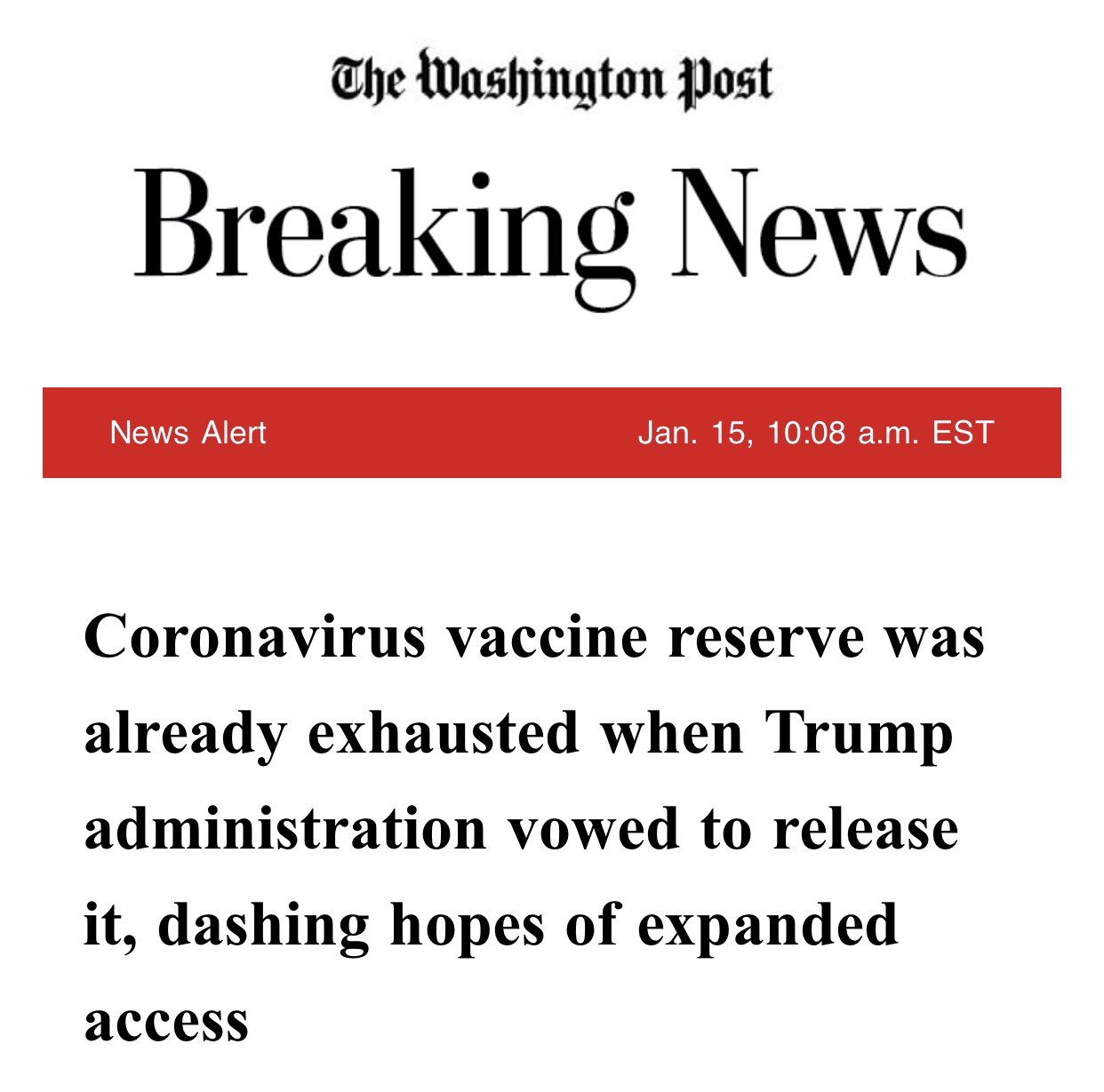
States were anticipating a windfall after federal officials said they would stop holding back second doses. But the approach had already changed, and no stockpile exists.
When Health and Human Services Secretary Alex Azar announced this week that the federal government would begin releasing coronavirus vaccine doses that had been held in reserve for second shots, no such reserve existed, according to state and federal officials briefed on distribution plans. The Trump administration had already begun shipping out what was available, starting at the end of December, taking second doses for the two-dose regimen directly off the manufacturing line.
Now, health officials across the country who had anticipated their extremely limited vaccine supply as much as doubling beginning next week are confronting the reality that their allocations will remain largely flat, dashing hopes of dramatically expanding access for millions of elderly people and those with high-risk medical conditions. Health officials in some cities and states were informed in recent days about the reality of the situation, while others were still in the dark Friday.
Because both of the vaccines authorized for emergency use in the United States are two-dose regimens, the Trump administration’s initial policy was to hold back second doses to protect against manufacturing disruptions. But that approach shifted in recent weeks, according to the officials, who spoke on the condition of anonymity because they were not authorized to discuss the matter.
Operation Warp Speed, which is overseeing vaccine distribution, stopped stockpiling second doses of the Pfizer-BioNTech vaccine at the end of last year, those officials were told. Shipping of the last reserve doses of Moderna’s supply, meanwhile, began over the weekend.
The shift, in both cases, had to do with increased confidence in the supply chain, so Operation Warp Speed leaders felt they could reliably anticipate the availability of doses for booster shots — required three weeks later in the case of the Pfizer-BioNTech product and four weeks later under Moderna’s protocol.
But it also meant there was no stockpile of second doses waiting to be shipped, as Trump administration officials suggested this week. Azar, at a briefing Tuesday, said, “Because we now have a consistent pace of production, we can now ship all of the doses that had been held in physical reserve.” He explained the decision as part of the “next phase” of the nation’s vaccination campaign.
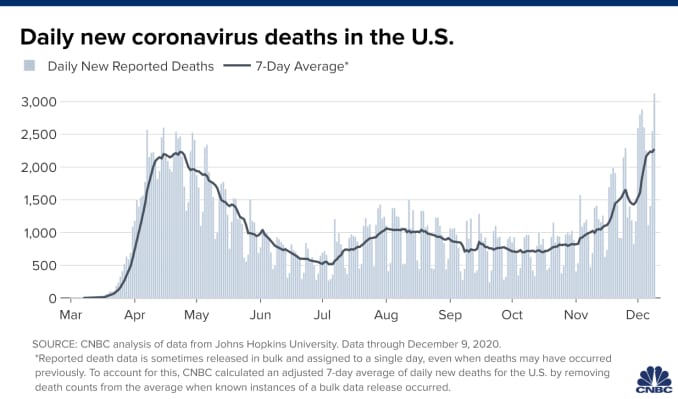
Those in line for their second shots are still expected to get them on schedule because second doses are prioritized over first shots and states are still receiving regular vaccine shipments. But state and local officials say they are angry and bewildered by the shifting directions and changing explanations about supply. Their anxiety was deepened by projections that a highly contagious virus variant would spread rapidly throughout the United States and as daily covid-19 deaths averaged 3,320 this week.
The health director in Oregon, Patrick M. Allen, was so disturbed that he wrote Azar on Thursday demanding an explanation. In his letter, he recounted how Gustave F. Perna, the chief operating officer of Operation Warp Speed, had “informed us there is no reserve of doses, and we are already receiving the full allocation of vaccines.”
“If true, this is extremely disturbing, and puts our plans to expand eligibility at grave risk,” Allen wrote. “Those plans were made on the basis of reliance on your statement about ‘releasing the entire supply’ you have in reserve. If this information is accurate, we will be unable to begin vaccinating our vulnerable seniors on Jan. 23, as planned.”
HHS spokesman Michael Pratt confirmed in an email that the final reserve of second doses had recently been released to states but did not address Azar’s comments, saying only, “Operation Warp Speed has been monitoring manufacturing closely, and always intended to transition from holding second doses in reserve as manufacturing stabilizes and we gained confidence in the ability for a consistent flow of vaccines.”
But the explanations by the federal government were conflicting. The 13 million doses made available for states to order this week — for delivery next week — represented “millions more” than in previous weeks, Pratt said. He also said states have not requested the full amount they have been allocated.
Guidance circulated Friday among HHS officials acknowledged, however, that “the notion that there is a large bolus of second doses that will be released to jurisdictions is not accurate.” And state and municipal health officials said their allocations for next week had increased only marginally, if at all.
Chicago Public Health Commissioner Allison Arwady said her city’s share had gone from about 32,000 doses to 34,000 doses. “I have stopped paying a whole lot of attention to what is being said verbally at the federal level right now,” she said.
Nirav Shah, the director of Maine’s Center for Disease Control and Prevention, said he learned only Friday, by calling his state’s designated contact at Warp Speed, that the reserve no longer existed.
Maine still plans to broaden vaccination next week to those 70 and older. “Who is in line will not change,” Shah said. “The velocity of that line will change because this bolus of doses that we intuited was coming based on Azar’s comments is not coming.”
In an email that reached some state officials Friday morning, Christopher Sharpsten, an Operation Warp Speed director, called it a “false rumor” that “the federal government was holding back vaccine doses in warehouses to guarantee a second/booster dose.”
In fact, that information had come fromAzar, who said Tuesday that the “next phase” of the country’s vaccination campaign involved “releasing the entire supply we have for order by states, rather than holding second doses in physical reserve.”
Azar’s comments Tuesday followed a Jan. 8 announcement by President-elect Joe Biden’s transition team that his administration would move to release all available doses rather than holding half in reserve for booster shots. Biden’s advisers said the move would be a way to accelerate distribution of the vaccine, which is in short supply across the country.
Azar initially said the Biden plan was shortsighted and potentially unethical in putting people at risk of missing their booster shots. When he embraced the change four days later, however, he did not say that the original policy had already been phased out or that the stockpile had been exhausted. Trump administration officials and Biden’s team alike have sought to reassure the public that increasing the pace of immunizations would not endanger booster shots.
Azar also signaled to states that they would soon see expanded supply, urging them to begin vaccinating adults 65 and older and those under 64 with high-risk medical conditions. Officials in some states embraced that directive, while others said that suddenly putting hundreds of thousands of additional people at the front of the line would overwhelm their capacity.
In subsequent conversations with state and local authorities, federal officials sought to temper those instructions, said people who participated in the conversations. Perna, for instance, spoke directly to officials in at least two of the jurisdictions receiving vaccine supply, explaining that allocations would not increase and that they did not have to broaden eligibility as they had previously been told, according to a health official who was not authorized to discuss the matter.
The revised instructions led some state and local officials to hold off on changes. One state health official noted that the updated eligibility guidance announced Tuesday did not appear on the website of the CDC, even though it was stated as federal policy by Azar and by Robert R. Redfield, the CDC director, in their remarks. Under the original recommendations, adults 65 and older and front-line essential workers were to comprise the second priority group, known as Phase 1b, after medical workers and residents and staffers of long-term-care facilities.
There was additional confusion from another change Azar announced this week — making allocation of doses dependent on how quickly states administer them. He originally said that would not take effect for two weeks.
But Connecticut Gov. Ned Lamont (D) on Thursday tweeted that federal officials had notified him that the state would receive an additional 50,000 doses next week “as a reward for being among the fastest states” to get shots into arms. West Virginia, meanwhile, which is moving at the fastest clip, according to CDC data, did not get any additional doses, said Holli Nelson, a spokeswoman for the state’s National Guard.
In a sign that the incentive structure may not be long-lived, a senior Biden transition official, speaking on the condition of anonymity to address ongoing deliberations, said this week that the team did not look kindly on a system that “punishes states.”
Biden has said he wants to see 100 million shots administered within his first 100 days — an aim that will depend on quickly accelerating the pace of immunization. Together, Pfizer and Moderna have agreed to sell 200 million doses to the United States by the end of March, which is enough to fully vaccinate 100 million people.
A Florida taxi driver and his wife had seen enough conspiracy theories online to believe the virus was overblown, maybe even a hoax. So no masks for them. Then they got sick. She died. A college lecturer had trouble refilling her lupus drug after the president promoted it as a treatment for the new disease. A hospital nurse broke down when an ICU patient insisted his illness was nothing worse than the flu, oblivious to the silence in beds next door.
Lies infected America in 2020. The very worst were not just damaging, but deadly.
President Donald J. Trump fueled confusion and conspiracies from the earliest days of the coronavirus pandemic. He embraced theories that COVID-19 accounted for only a small fraction of the thousands upon thousands of deaths. He undermined public health guidance for wearing masks and cast Dr. Anthony Fauci as an unreliable flip-flopper.
But the infodemic was not the work of a single person.
Anonymous bad actors offered up junk science. Online skeptics made bogus accusations that hospitals padded their coronavirus case numbers to generate bonus payments. Influential TV and radio opinion hosts told millions of viewers that social distancing was a joke and that states had all of the personal protective equipment they needed (when they didn’t).
It was a symphony of counter narrative, and Trump was the conductor, if not the composer. The message: The threat to your health was overhyped to hurt the political fortunes of the president.
Every year, PolitiFact editors review the year’s most inaccurate statements to elevate one as the Lie of the Year. The “award” goes to a statement, or a collection of claims, that prove to be of substantive consequence in undermining reality.
It has become harder and harder to choose when cynical pundits and politicians don’t pay much of a price for saying things that aren’t true. For the past month, unproven claims of massive election fraud have tested democratic institutions and certainly qualify as historic and dangerously bald-faced. Fortunately, the constitutional foundations that undergird American democracy are holding.
Meanwhile, the coronavirus has killed more than 300,000 in the United States, a crisis exacerbated by the reckless spread of falsehoods.
PolitiFact’s 2020 Lie of the Year: claims that deny, downplay or disinform about COVID-19.
‘I always wanted to play it down’
On Feb. 7, Trump leveled with book author Bob Woodward about the dangers of the new virus that was spreading across the world, originating in central China. He told the legendary reporter that the virus was airborne, tricky and “more deadly than even your strenuous flus.”
Trump told the public something else. OnFeb. 26, the president appeared with his coronavirus task force in the crowded White House briefing room. A reporter asked if he was telling healthy Americans not to change their behavior.
“Wash your hands, stay clean. You don’t have to necessarily grab every handrail unless you have to,” he said, the room chuckling. “I mean, view this the same as the flu.”
Three weeks later, March 19, he acknowledged to Woodward: “To be honest with you, I wanted to always play it down. I still like playing it down. Because I don’t want to create a panic.”
His acolytes in politics and the media were on the same page. Rush Limbaugh told his audience of about 15 million on Feb. 24 that coronavirus was being weaponized against Trump when it was just “the common cold, folks.” That’s wrong — even in the early weeks, it was clear the virus had a higher fatality rate than the common cold, with worse potential side effects, too.
As the virus was spreading, so was the message to downplay it.
“There are lots of sources of misinformation, and there are lots of elected officials besides Trump that have not taken the virus seriously or promoted misinformation,” said Brendan Nyhan, a government professor at Dartmouth College. “It’s not solely a Trump story — and it’s important to not take everyone else’s role out of the narrative.”
The skeptics cited Centers for Disease Control and Prevention data to claim that only 6% of COVID-19 deaths could actually be attributed to the virus. On Aug. 24, BlazeTV host Steve Deace amplified it on Facebook.
“Here’s the percentage of people who died OF or FROM Covid with no underlying comorbidity,” he said to his 120,000 followers. “According to CDC, that is just 6% of the deaths WITH Covid so far.”
That misrepresented the reality of coronavirus deaths. The CDC had always said people with underlying health problems — comorbidities — were most vulnerable if they caught COVID-19. The report was noting that 6% died even without being at obvious risk.
But for those skeptical of COVID-19, the narrative confirmed their beliefs. Facebook users copied and pasted language from influencers like Amiri King, who had 2.2 million Facebook followers before he was banned. The Gateway Pundit called it a “SHOCK REPORT.”
“I saw a statistic come out the other day, talking about only 6% of the people actually died from COVID, which is very interesting — that they died from other reasons,” Trump told Fox News host Laura Ingraham on Sept. 1.
Fauci, director of the National Institute of Allergy and Infectious Diseases, addressed the claim on “Good Morning America” the same day.
“The point that the CDC was trying to make was that a certain percentage of them had nothing else but just COVID,” he said. “That does not mean that someone who has hypertension or diabetes who dies of COVID didn’t die of COVID-19 — they did.”
Trump retweeted the message from an account that sported the slogans and symbols of QAnon, a conspiracy movement that claims Democrats and Hollywood elites are members of an underground pedophilia ring.
False information moved between social media, Trump and TV, creating its own feedback loop.
“It’s an echo effect of sorts, where Donald Trump is certainly looking for information that resonates with his audiences and that supports his political objectives. And his audiences are looking to be amplified, so they’re incentivized to get him their information,” said Kate Starbird, an associate professor and misinformation expert at the University of Washington.Weakening the armor: misleading on masks
At the start of the pandemic, the CDC told healthy people not to wear masks, saying they were needed for health care providers on the frontlines. But on April 3 the agency changed its guidelines, saying every American should wear non-medical cloth masks in public.
Trump announced the CDC’s guidance, then gutted it.
“So it’s voluntary. You don’t have to do it. They suggested for a period of time, but this is voluntary,” Trump said at a press briefing. “I don’t think I’m going to be doing it.”
Rather than an advance in best practices on coronavirus prevention, face masks turned into a dividing line between Trump’s political calculations and his decision-making as president. Americans didn’t see Trump wearing a mask until a July visit to Walter Reed National Military Medical Center.
In September, the CDC reported a correlation between people who went to bars and restaurants, where masks can’t consistently be worn, and positive COVID-19 test results. Bloggers and skeptical news outlets countered with a misleading report about masks.
On Oct. 13, the story landed on Fox News’ flagship show, “Tucker Carlson Tonight.” During the show, Carlson claimed “almost everyone — 85% — who got the coronavirus in July was wearing a mask.”
“So clearly (wearing a mask) doesn’t work the way they tell us it works,” Carlson said.
That’s wrong, and it misrepresented a small sample of people who tested positive. Public health officials and infectious disease experts have been consistent since April in saying that face masks are among the best ways to prevent the spread of COVID-19.
But two days later, Trump repeated the 85% stat during a rally and at a town hall with NBC’s Savannah Guthrie.
“I tell people, wear masks,” he said at the town hall. “But just the other day, they came out with a statement that 85% of the people that wear masks catch it.”
The assault on hospitals
On March 24, registered nurse Melissa Steiner worked her first shift in the new COVID-19 ICU of her southeast Michigan hospital. After her 13-hour day caring for two critically ill patients on ventilators, she posted a tearful video.
“Honestly, guys, it felt like I was working in a war zone,” Steiner said. “(I was) completely isolated from my team members, limited resources, limited supplies, limited responses from physicians because they’re just as overwhelmed.”
“I’m already breaking, so for f—’s sake, people, please take this seriously. This is so bad.”
Steiner’s post was one of manyemotionalpleas offered by overwhelmed hospital workers last spring urging people to take the threat seriously. The denialists mounted a counter offensive.
On March 28, Todd Starnes, a conservative radio host and commentator, tweeted a video from outside Brooklyn Hospital Center. There were few people or cars in sight.
“This is the ‘war zone’ outside the hospital in my Brooklyn neighborhood,” Starnes said sarcastically. The video racked up more than 1.5 million views.
Starnes’ video was one of the first examples of #FilmYourHospital, a conspiratorial social media trend that pushed back on the idea that hospitals had been strained by a rapid influx of coronavirus patients.
Several internet personalities asked people to go out and shoot their own videos. The result: a series of user-generated clips taken outside hospitals, where the response to the pandemic was not easily seen. Over the course of a week, #FilmYourHospital videos were uploaded to YouTube and posted tens of thousands of times on Twitter and Facebook.
Nearly two weeks and more than 10,000 deaths later, Fox News featured a guest who opened a new misinformation assault on hospitals.
Dr. Scott Jensen, a Minnesota physician and Republican state senator, told Ingraham that, because hospitals were receiving more money for COVID-19 patients on Medicare — a result of a coronavirus stimulus bill — they were overcounting COVID-19 cases. He had no proof of fraud, but the cynical story took off.
Trump used the false report on the campaign trail to continue to minimize the death toll.
“Our doctors get more money if somebody dies from COVID,” Trump told supporters at a rally in Waterford, Mich., Oct. 30. “You know that, right? I mean, our doctors are very smart people. So what they do is they say, ‘I’m sorry, but, you know, everybody dies of COVID.’”
The real fake news: The Plandemic
The most viral disinformation of the pandemic was styled to look like it had the blessing of people Americans trust: scientists and doctors.
In a 26-minute video called “Plandemic: The Hidden Agenda Behind COVID-19,” a former scientist at the National Cancer Institute claimed that the virus was manipulated in a lab, hydroxychloroquine is effective against coronaviruses, and face masks make people sick.
Judy Mikovits’ conspiracies received more than 8 million views in May thanks in part to the online outrage machine — anti-vaccine activists, anti-lockdown groups and QAnon supporters — that push disinformation into the mainstream. The video was circulated in a coordinated effort to promote Mikovits’ book release.
A couple of months later, a similar effort propelled another video of fact-averse doctors to millions of people in only a few hours.
On July 27, Breitbart publisheda clipof a press conference hosted by a group called America’s Frontline Doctors in front of the U.S. Supreme Court. Looking authoritative in white lab coats, these doctors discouraged mask wearing and falsely said there was already a cure in hydroxychloroquine, a drug used to treat rheumatoid arthritis and lupus.
Trump, who had been talking up the drug since March and claimed to be taking it himself as a preventive measure in May, retweeted clips of the event before Twitter removed them as misinformation about COVID-19. He defended the “very respected doctors” in a July 28 press conference.
When Olga Lucia Torres, a lecturer at Columbia University, heard Trump touting the drug in March, she knew it didn’t bode well for her own prescription. Sure enough, the misinformation led to a run on hydroxychloroquine, creating a shortage for Americans like her who needed the drug for chronic conditions.
A lupus patient, she went to her local pharmacy to request a 90-day supply of the medication. But she was told they were only granting partial refills. It took her three weeks to get her medication through the mail.
“What about all the people who were silenced and just lost access to their staple medication because people ran to their doctors and begged to take it?” Torres said.No sickbed conversion
On Sept. 26, Trump hosted a Rose Garden ceremony to announce his nominee to replace the late Ruth Bader Ginsburg on the U.S. Supreme Court. More than 150 people attended the event introducing Amy Coney Barrett. Few wore masks, and the chairs weren’t spaced out.
In the weeks after, more than two dozen people close to Trump and the White House became infected with COVID-19. Early Oct. 2, Trump announced his positive test.
Those hoping the experience and Trump’s successful treatment at Walter Reed might inform his view of the coronavirus were disappointed.
Trump snapped back into minimizing the threat during his first moments back at the White House. He yanked off his mask and recorded a video.
“Don’t let it dominate you. Don’t be afraid of it,” he said, describing experimental and out-of-reach therapies he received. “You’re going to beat it.”
In Trump’s telling, his hospitalization was not the product of poor judgment about large gatherings like the Rose Garden event, but the consequence of leading with bravery. Plus, now, he claimed, he was immune from the virus.
On the morning after he returned from Walter Reed, Trump tweeted a seasonal flu death count of 100,000 lives and added that COVID-19 was “far less lethal” for most populations. More false claims at odds with data — the U.S. average for flu deaths over the past decade is 36,000, and experts said COVID-19 is more deadly for each age group over 30.
When Trump left the hospital, the U.S. death toll from COVID-19 was more than 200,000. Today it is more than 300,000. Meanwhile, this month the president has gone ahead with a series of indoor holiday parties.
The vaccine war
The vaccine disinformation campaign started in the spring but is still underway.
In April, blogs and social media users falsely claimed Democrats and powerful figures like Bill Gates wanted to use microchips to track which Americans had been vaccinated for the coronavirus. Now, false claims are taking aim at vaccines developed by Pfizer and BioNTech and other companies.
A blogger claimed Pfizer’s head of research said the coronavirus vaccine could cause female infertility. That’s false.
An alternative health website wrote that the vaccine could cause an array of life-threatening side effects, and that the FDA knew about it. The list included all possible — not confirmed— side effects.
Social media users speculated that the federal government would force Americans to receive the vaccine. Neither Trump nor President-elect Joe Biden has advocated for that, and the federal government doesn’t have the power to mandate vaccines, anyway.
As is often the case with disinformation, the strategy is to deliver it with a charade of certainty.
“People are anxious and scared right now,” said Dr. Seema Yasmin, director of research and education programs at the Stanford Health Communication Initiative. “They’re looking for a whole picture.”
Most polls have shown far from universal acceptance of vaccines, with only 50% to 70% of respondents willing to take the vaccine. Black and Hispanic Americans are even less likely to take it so far.
Meanwhile, the future course of the coronavirus in the U.S. depends on whether Americans take public health guidance to heart. The Institute for Health Metrics and Evaluation projected that, without mask mandates or a rapid vaccine rollout, the death toll could rise to more than 500,000 by April 2021.
“How can we come to terms with all that when people are living in separate informational realities?” Starbird said.








 HENRY KOTULA