


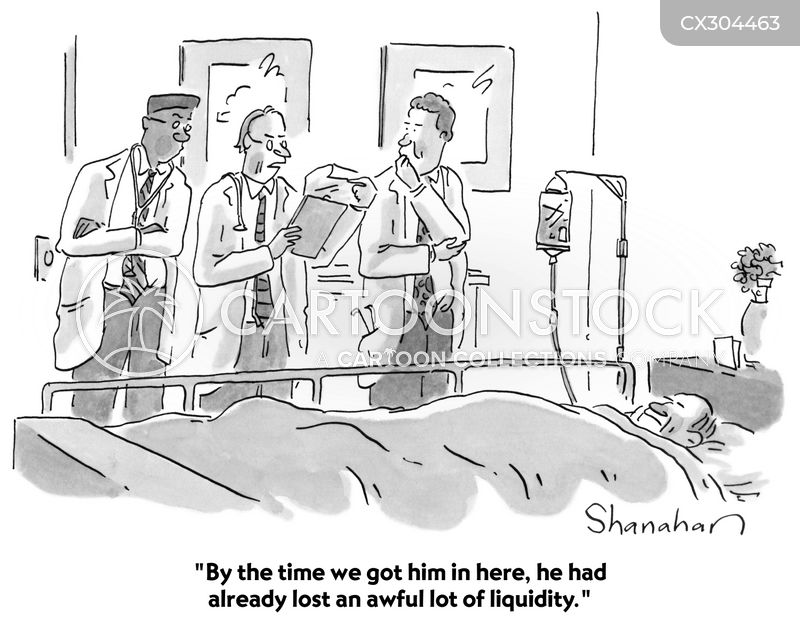
Cartoon – Our Cash Flow Problem
https://www.kaufmanhall.com/insights/blog/days-cash-hand-does-not-tell-full-liquidity-story

Days cash on hand is one of the most important metrics in hospital credit analysis. The ratio calculates an organization’s unrestricted cash and investments relative to daily operating expenses.
Here’s a computation commonly used to calculate days cash on hand:
[Unrestricted cash and investments*365 days] / [Annual operating expenses – non-cash expenses]
Math aside, let’s unpack what days cash on hand really tells us. Days cash on hand gives an indication of a hospital’s flexibility and financial health. Essentially, it tells us how long a hospital could continue to operate if cash flow were to stop. From a ratings perspective, the higher the days cash, the better, to create a cushion or rainy-day fund for unexpected events.
While the sheer abatement of cash flow feels like a doomsday scenario, we don’t have to look far back to see examples. The shutdown in the early days of Covid and the recent Change Healthcare cyberattack are examples of events that can materially impact cash flow. While these may be considered extreme, there are plenty of more common events that can disrupt cash flow, including a delay in supplemental funding, an IT installation, a change in Medicare fiscal intermediary, an escalation in construction costs, or the bankruptcy of a payer.
Size and diversified business enterprises can impact days cash on hand. For example, small hospitals with outsized cash positions relative to operations often report a dizzying level of days cash on hand. Health systems with wholly owned health plans often show lower days cash when compared to like-sized peers without health plans. Analysts will also review a hospital’s cash-to-debt ratio, which is an indication of leverage and compares absolute unrestricted cash to long-term obligations. Cash-to-debt creates a more comparable ratio across the portfolio.
In the years leading up to the pandemic, the days cash on hand median increased steadily as the industry went through a period of stable financial performance and steady equity market returns. Hospitals took advantage of an attractive debt market to fund large capital projects or reimburse for prior capital spending. The median crested over 200 days. As discussed during our March 20, 2024, rating agency webinar, days cash median for 2023 is expected to decline or remain flat at best, not because of an increase in capital spending or deficit operations, but because daily expenses (mainly driven by labor) will grow faster than absolute cash. Expenses will outrun the bear, so to speak.
Days cash on hand will remain a pillar liquidity ratio for the industry, but equally important is the concept of liquidity. Days cash on hand doesn’t tell the whole story regarding liquidity. A hospital may compute that it has, say, 200 days cash on hand, but that calculation is based on total unrestricted cash and investments, which usually includes long-term investment pools. A sizable portion of that 200 days may not be accessible on a daily basis.
Recall that during the 2008 liquidity crisis, many hospitals had large portions of their unrestricted investment pools tied up in illiquid investments. When you needed it the most, you couldn’t get it. 2008 was a watershed moment that starkly showed the difference between wealth and liquidity and the growing importance of the latter. Days cash on hand didn’t necessarily mean “on hand.” Many hospitals scrambled for liquidity, which came in the form of expensive bank lines because liquidating equity investments in a down market would come at a huge cost.
Nearly overnight, daily liquidity became a fundamental part of credit analysis.
While the events were different, Covid and Change Healthcare followed the same fact pattern: crisis occurred, cash flow abated, and hospitals scrambled for liquidity, drawing on lines of credit to fund operating needs. Within a quick minute healthcare went “back to the future,” and undoubtedly, there will be another liquidity crisis ahead.
Rating reports now include information on investment allocation and diversification within those investments, and report new ratios such as monthly liquidity to total cash and investments. A hospital with below average days cash on hand or cash-to-debt may receive more attention in the rating report regarding immediately accessible funds.
Irrespective of a high or low cash position or rating category, providing rating analysts with a schedule highlighting where management would turn to when liquidity is needed would be well received. For example, do you draw on lines of credit, hit depository accounts, pause capital, extend payables, or liquidate investments, and in what order? Some health systems are taking this a step further with an in-depth sophisticated analysis to quantify their operating risks and size their liquidity needs accordingly, which we call Strategic Resource Allocation. This analysis would boost an analyst’s confidence in management’s preparedness for the next crisis with the segmenting of true cash “on hand.” It would also help ensure that, when the next crisis arrives, management will know where to turn to maintain liquidity and meet daily cash needs.

Here are 30 health systems with strong operational metrics and solid financial positions, according to reports from credit rating agencies Fitch Ratings and Moody’s Investors Service released in 2024.
Avera Health has an “AA-” rating and a stable outlook with Fitch. The rating reflects the Sioux Falls, S.D.-based system’s strong operating risk and financial profile assessments, and significant size and scale, Fitch said.
Cedars-Sinai Health System has an “AA-” rating and a stable outlook with Fitch. The rating reflects the Los Angeles-based system’s consistent historical profitability and its strong liquidity metrics, historically supported by significant philanthropy, Fitch said.
Children’s Health has an “Aa3” rating and stable outlook with Moody’s. The rating reflects the Dallas-based system’s continued strong performance from a focus on high margin and tertiary services, as well as a distinctly leading market share, Moody’s said.
Children’s Hospital Medical Center of Akron (Ohio) has an “Aa3” rating and stable outlook with Moody’s. The rating reflects the system’s large primary care physician network, long-term collaborations with regional hospitals and leading market position as its market’s only dedicated pediatric provider, Moody’s said.
Children’s Hospital of Orange County has an “AA-” rating and a stable outlook with Fitch. The rating reflects the Orange, Calif.-based system’s position as the leading provider for pediatric acute care services in Orange County, a position solidified through its adult hospital and regional partnerships, ambulatory presence and pediatric trauma status, Fitch said.
Children’s Minnesota has an “AA” rating and stable outlook with Fitch. The rating reflects the Minneapolis-based system’s strong balance sheet, robust liquidity position and dominant pediatric market position, Fitch said.
Cincinnati Children’s Hospital Medical Center has an “Aa2” rating and stable outlook with Moody’s. The rating is supported by its national and international reputation in clinical services and research, Moody’s said.
Cook Children’s Medical Center has an “Aa2” rating and stable outlook with Moody’s. The ratings agency said the Fort Worth Texas-based system will benefit from revenue diversification through its sizable health plan, large physician group, and an expanding North Texas footprint.
El Camino Health has an “AA” rating and a stable outlook with Fitch. The rating reflects the Mountain View, Calif.-based system’s strong operating profile assessment with a history of generating double-digit operating EBITDA margins anchored by a service area that features strong demographics as well as a healthy payer mix, Fitch said.
Hoag Memorial Hospital Presbyterian has an “AA” rating and stable outlook with Fitch. The Newport Beach, Calif.-based system’s rating is supported by its strong operating risk assessment, leading market position in its immediate service area and strong financial profile,” Fitch said.
Inspira Health has an “AA-” rating and stable outlook with Fitch. The rating reflects Fitch’s expectation that the Mullica Hill, N.J.-based system will return to strong operating cash flows following the operating challenges of 2022 and 2023, as well as the successful integration of Inspira Medical Center of Mannington (formerly Salem Medical Center).
JPS Health Network has an “AA” rating and stable outlook with Fitch. The rating reflects the Fort Worth, Texas-based system’s sound historical and forecast operating margins, the ratings agency said.
Mass General Brigham has an “Aa3” rating and stable outlook with Moody’s. The rating reflects the Somerville, Mass.-based system’s strong reputation for clinical services and research at its namesake academic medical center flagships that drive excellent patient demand and help it maintain a strong market position, Moody’s said.
McLaren Health Care has an “AA-” rating and stable outlook with Fitch. The rating reflects the Grand Blanc, Mich.-based system’s leading market position over a broad service area covering much of Michigan, the ratings agency said.
Med Center Health has an “AA-” rating and stable outlook with Fitch. The rating reflects the Bowling Green, Ky.-based system’s strong operating risk assessment and leading market position in a primary service area with favorable population growth, Fitch said.
Nicklaus Children’s Hospital has an “AA-” rating and stable outlook with Fitch. The rating is supported by the Miami-based system’s position as the “premier pediatric hospital in South Florida with a leading and growing market share,” Fitch said.
Novant Health has an “AA-” rating and stable outlook with Fitch. The ratings agency said the Winston-Salem, N.C.-based system’s recent acquisition of three South Carolina hospitals from Dallas-based Tenet Healthcare will be accretive to its operating performance as the hospitals are highly profited and located in areas with growing populations and good income levels.
Oregon Health & Science University has an “Aa3” rating and stable outlook with Moody’s. The rating reflects the Portland-based system’s top-class academic, research and clinical capabilities, Moody’s said.
Orlando (Fla.) Health has an “AA-” rating and stable outlook with Fitch. The rating reflects the health system’s strong and consistent operating performance and a growing presence in a demographically favorable market, Fitch said.
Presbyterian Healthcare Services has an “AA” rating and stable outlook with Fitch. The Albuquerque, N.M.-based system’s rating is driven by a strong financial profile combined with a leading market position with broad coverage in both acute care services and health plan operations, Fitch said.
Rush University System for Health has an “AA-” rating and stable outlook with Fitch. The rating reflects the Chicago-based system’s strong financial profile and an expectation that operating margins will rebound despite ongoing macro labor pressures, the rating agency said.
Saint Francis Healthcare System has an “AA” rating and stable outlook with Fitch. The rating reflects the Cape Girardeau, Mo.-based system’s strong financial profile, characterized by robust liquidity metrics, Fitch said.
Saint Luke’s Health System has an “Aa2” rating and stable outlook with Moody’s. The Kansas City, Mo.-based system’s rating was upgraded from “A1” after its merger with St. Louis-based BJC HealthCare was completed in January.
Salem (Ore.) Health has an”AA-” rating and stable outlook with Fitch. The rating reflects the system’s dominant marketing positive in a stable service area with good population growth and demand for acute care services, Fitch said.
Seattle Children’s Hospital has an “AA” rating and a stable outlook with Fitch. The rating reflects the system’s strong market position as the only children’s hospital in Seattle and provider of pediatric care to an area that covers four states, Fitch said.
SSM Health has an “AA-” rating and stable outlook with Fitch. The St. Louis-based system’s rating is supported by a strong financial profile, multistate presence and scale with good revenue diversity, Fitch said.
St. Elizabeth Medical Center has an “AA” rating and stable outlook with Fitch. The rating reflects the Edgewood, Ky.-based system’s strong liquidity, leading market position and strong financial management, Fitch said.
Stanford Health Care has an “Aa3” rating and positive outlook with Moody’s. The rating reflects the Palo Alto, Calif.-based system’s clinical prominence, patient demand and its location in an affluent and well insured market, Moody’s said.
University of Colorado Health has an “AA” rating and stable outlook with Fitch. The Aurora-based system’s rating reflects a strong financial profile benefiting from a track record of robust operating margins and the system’s growing share of a growth market anchored by its position as the only academic medical center in the state, Fitch said.
Willis-Knighton Medical Center has an “AA-” rating and positive outlook with Fitch. The outlook reflects the Shreveport, La.-based system’s improving operating performance relative to the past two fiscal years combined with Fitch’s expectation for continued improvement in 2024 and beyond.

Long-term debt has long been a staple in healthcare, but many hospitals and health systems are responding to the increasing cost of debt and debt service in the rising rates environment.
Highly levered health systems are looking to sell hospitals, facilities or business lines to reduce their debt leverage and secure long-term sustainability, which creates significant growth opportunities for systems with balance sheets on a more solid financial footing.
Forty-three health systems ranked by their long-term debt:
Note: This is not an exhaustive list. The following long-term debt figures are taken from each health system’s most recent financial report.
1. HCA Healthcare (Nashville, Tenn.): $37.2 billion
2. CommonSpirit (Chicago): $15.3 billion
3. Tenet Healthcare (Dallas): $14.9 billion
4. Community Health Systems (Franklin, Tenn.): $11.5 billion
5. Kaiser Permanente (Oakland, Calif.): $10.6 billion
6. Providence (Renton, Wash.): $8.1 billion
7. Trinity Health (Livonia, Mich.): $6.8 billion
8. UPMC (Pittsburgh): $6.6 billion
9. Ascension (St. Louis): $6.1 billion
10. Mass General Brigham (Boston): $5.5 billion
11. Universal Health Services (King of Prussia, Pa.): $4.7 billion
12. Banner Health (Phoenix): $4.4 billion
13. Cleveland Clinic: $4.3 billion
14. Bon Secours Mercy Health (Cincinnati): $4.2 billion
15. Mayo Clinic (Rochester, Minn): $4.1 billion
16. Intermountain Health (Salt Lake City): $3.8 billion
17. Baylor Scott & White (Dallas): $3.8 billion
18. NYU Langone (New York City): $3.1 billion
19. Advocate Health (Charlotte, N.C.): $2.9 billion
20. IU Health (Indianapolis): $2.3 billion
21. Stanford Health Care (Palo Alto, Calif.): $2.3 billion
22. Orlando (Fla.) Health: $2.7 billion
23. Montefiore (New York City): $2 billion
24. BJC HealthCare (St. Louis): $1.9 billion
25. Christus Health (Irving, Texas): $1.9 billion
26. MedStar Health (Columbia, Md.): $1.8 billion
27. ProMedica (Toledo, Ohio): $1.8 billion
28. Northwestern Medicine (Chicago): $1.7 billion
29. Geisinger (Danville, Pa.): $1.7 billion
30. Allina Health (Minneapolis): $1.7 billion
31. OSF HealthCare (Peoria, Ill.): $1.7 billion
32. Norton Healthcare (Louisville, Ky.): $1.6 billion
33. Beth Israel Lahey Health (Cambridge, Mass.): $1.6 billion
34. SSM Health (St. Louis): $1.6 billion
35. Scripps Health (San Diego): $1.5 billion
36. Henry Ford Health (Detroit): $1.4 billion
37. Sanford Health (Sioux Falls, S.D.): $1.4 billion
38. Prisma Health (Greenville, S.C.): $1.4 billion
39. Allegheny Health Network (Pittsburgh): $910.5 million
40. HonorHealth (Scottsdale, Ariz.): $898.7 million
41. Sharp HealthCare (San Diego): $866.5 million
42. Premier Health (Dayton, Ohio): $850 million
43. Tufts Medicine (Boston): $782.3 million
The deal is expected to generate approximately $1.1 billion in in cash for the liquidity-strapped hospital landlord.
MPT is on a selling spree in order to free up liquidity.
The Birmingham, Alabama-based real estate investment trust has said it’s been heavily exposed during the Dallas-based Steward Health Care’s financial meltdown.
Steward accounted for 19.2% of MPT’s assets as of Dec. 31 and was the largest tenant in its portfolio, according to MPT’s 2023 annual report. The for-profit physician owned network began delaying rent payments to MPT in September, and only paid $16 million of its required $70 million of rent during the fourth quarter. At the same time, MPT was funding multiple rounds of asset-backed loans to Steward, according to the filing.
MPT reported a net loss of $556 million for fiscal year 2023, citing the Steward shortfall as a significant contributor to the results.
The loss of Steward’s rent cushion — coupled with increasing interest rates and $1.3 billion of debt coming due within the next year — motivated the company to pursue several sales early this year, MPT said.
During its fourth quarter earnings call, investors asked whether Steward’s financial instability could play out in the their dividend checks moving forward.
“The dividend is not dependent on Steward’s rent. It’s more dependent on our ability to close some of these liquidity transactions,” MPT CEO Edward K. Aldag Jr. said. MPT announced its quarterly dividend of $0.15 per share alongside the Utah deal.
Aldag said the company hoped to sell enough property to shore up at least $2 billion in liquidity. With the Utah deal closed, the CEO said in a release that he is now “confident” MPT will exceed that threshold.
MPT’s stock price was up 20.8% when the markets opened Monday morning, trading at $4.80 per share.

Here is a summary of recent credit downgrades and outlook revisions for hospitals and health systems.
The downgrades and downward revisions reflect continued operating challenges many nonprofit systems are facing, with multiyear recovery processes expected.
Downgrades:
Yale New Haven (Conn.) Health: Operating weakness and elevated debt contributed to the downgrade of bonds held by Yale New Haven (Conn.) Health, Moody’s said May 5. The bond rating slipped from “Aa3” to “A1,” and the outlook was revised to stable from negative.
The system saw a second downgrade as its default rating and that on a series of bonds were revised one notch to “A+” from “AA-” amid continued operating woes, Fitch said June 28.
Not only have there been three straight years of such challenges, but the operating environment continues to cast a pall into the second quarter of the current fiscal year, Fitch said.
UC Health (Cincinnati): The system was downgraded on a series of bonds, Moody’s said May 10.
The move, which involved a lowering from a “Baa2” to “Baa3” grade, refers to such bonds with an overall value of $580 million.
In February, UC Health suffered a similar downgrade from “A” to “BBB+” on its overall rating and on some bonds because of what S&P Global termed “significantly escalating losses.”
UNC Southeastern (Lumberton, N.C.): The system, which is now part of the Chapel Hill, N.C.-based UNC Health network, saw its ratings on a series of bonds downgraded to “BB” amid operating losses and sustained weakness in its balance sheet, S&P Global said June 23.
While UNC Southeastern reported an operating loss of $74.8 million in fiscal 2022, such losses have continued into fiscal 2023 with a $15 million loss as of March 31, S&P Global said. The system had earlier been placed on CreditWatch but that was removed with this downgrade.
Butler (Pa.) Health: The system, now merged with Greensburg, Pa.-based Excela Health to form Independence Health System, saw its credit rating downgraded significantly, falling from “A” to “BBB.”
The move reflects continued operating challenges and low patient volumes, Fitch said June 26.
Such operating challenges, including low days of cash on hand, could result in potential default of debt covenants, Fitch warned.
Redeemer Health (Meadowbrook, Pa.): The system had its outlook revised to negative amid “persistent operating losses,” Fitch Ratings said June 14. The health system, anchored by a 260-bed acute care hospital, reported a $37 million operating loss in the nine months ending March 31, Fitch said.
Thomas Jefferson University (Philadelphia): The June 9 downward revision of its outlook, which includes both the health system and the university’s academic sector, was due to sustained operating weakness, S&P Global said.
IU Health (Indianapolis): While it saw ratings affirmed at “AA,” the 16-hospital system had its outlook downgraded amid persistent inflationary pressures and large capital expense, Fitch said May 31.
UofL Health (Louisville, Ky.): Slumping operating income and low days of cash on hand (42.8 as of March 31) contributed to S&P Global revising its outlook for the six-hospital system to negative May 24.

Inflation, labor pressures, and general economic uncertainty have created
significant financial strain for hospitals in the wake of the COVID pandemic.
Compressed operating margins and weakened liquidity have left many
hospitals in a precarious economic situation, with some entities deciding to delay or even cancel planned capital expenditures or capital raising. Given these tumultuous times, hospital entities could look to the realm of the higher education sector for a playbook on how to leverage non-core assets to unlock significant unrealized value and strengthen financial positions, in the form of public-private partnerships.
These structures, also known as P3s, involve collaborative agreements between public entities, like hospitals, and private sector partners who possess the expertise to unlock the value of non-core assets. A special purpose vehicle (SPV) is created, with the sole purpose of delivering the responsibilities outlined under the project agreement. The SPV is typically owned by equity members. The private sector would be responsible for raising debt to finance the project, which is secured by the obligations of the project agreement (and would be non-recourse to the hospital). Of note, the SPV undergoes the rating process, not the hospital entity. Even more importantly, the hospital retains ownership of the asset while benefiting from the expertise and resources of the private sector.
Hospitals can utilize P3s to capitalize on already-built assets, in what is known as a “brownfield” structure. A brownfield structure would typically result in an upfront payment to the hospital in exchange for the right of a private entity to operate the asset for an agreed-upon term. These upfront payments can range from tens of millions to hundreds of millions of dollars.
Alternatively, hospitals can engage in “greenfield” structures where the underlying asset is either not yet built or needs significant capital investment. Greenfield structures typically do not result in an upfront payment to the hospital entity. Instead, (in the example of a new build) private partners would typically design, build, finance, operate and maintain the asset. The hospital still retains ownership of the underlying asset at the completion of the agreed upon term.
P3 structures can be individually tailored to suit the unique needs of the hospital entity, and the resulting benefits are multifaceted. Financially, hospitals can increase liquidity, lower operating expenses, increase debt capacity, and create headroom for financial covenants. These partnerships provide a means to raise funds without directly accessing the capital markets or undergoing the rating process. Upfront payments represent unrestricted funds and can be used as the hospital entity sees fit to further its core mission. Operationally, infrastructure P3s offer hospitals the opportunity to address deferred maintenance needs, which may have accumulated over time. Immediate capital expenditure on infrastructure facilities can enhance reliability and efficiency and contribute to meeting carbon reduction or sustainability goals. Furthermore, these structures provide a means for the hospital to transfer a meaningful amount of risk to private partners via operation and maintenance agreements.
For years, various colleges and universities have adopted the P3 model, which is emerging as a viable solution for hospitals as well.
Examples of recent structures in the higher education sector include:

Not-for-profit hospitals and health systems rely on
three interdependent functions to contribute to the
financial resilience of the organization: namely, the
ability to withstand adverse changes to these core
functions and continue to provide services to the
community (Figure above).
The Operating Function:
The Operating Function
manages the portfolio of clinical services and
strategic initiatives that define the charitable mission
of the organization. Clinical services generate
patient revenue, and if that revenue creates a
positive margin (i.e., exceeds expenses), that excess
is invested back into the health system. Operating
margins are, on average, very low in not-for-profit
healthcare. For example, for the not-for-profit
hospitals and health systems rated by Moody’s
Investors Service, median operating margins from
2017–2021 ranged between 2.1% and 2.9%. These
rated organizations represent only a few hundred
of the thousands of hospitals and health systems
in the country and are among the most financially
healthy. A 2018 study of a wider group of more than
2,800 hospitals found an average clinical operating
margin of -2.7%.
The Finance Function:
Because the positive margins
generated by the Operating Function are rarely
enough to support the intensive capital needs of
maintaining and improving acute-care facilities, care
delivery models, and technology, not-for-profit health
systems rely on the Finance Function for internal
and external capital formation. The Finance Function
builds cash reserves and secures external financing
(e.g., bond proceeds, bank lines of credit) to support
the capital spending needs of the organization. The
cash reserves maintained by the Finance Function
also help the organization meet daily expenses at
times when expenses exceed revenues.
The Investment Function:
Not-for-profit hospitals
and health systems will also endeavor to invest
some of their cash reserves to generate returns
that, first, act as an additional hedge against
potential risks that could disrupt operations or cash
flow, and second, pursue independent returns.
Any independent returns generated serve as an
important supplement to revenues generated
through the Operating Function.
The three functions described above are common to
all not-for-profit organizations. The main differences
are mostly within the Operating Function. In higher
education, for example, tuition revenue takes the
place of clinical revenue. While higher education also
maintains enterprise risk, the Operating Function
for colleges and universities is less vulnerable to
volume swings as enrollment is typically steady and
predictable. Likewise, higher education is less labor
intensive than healthcare.
Financial reserves include all liquid cash resources
and unrestricted investments held in the Finance and
Investment Functions. These reserves are equivalent
to the emergency funds individuals are encouraged
to maintain to help them meet living expenses for
six to twelve months in case of a job loss or other
disruption to income.
Absolute reserve levels are important, as discussed
above, but they must also be viewed relative to
a hospital’s daily operating expenses. A common
metric used to describe these reserves is Days Cash
on Hand. If an organization has 250 Days Cash on
Hand, that means that it would be able to meet its
operating expenses for 250 days if revenue was
suddenly shut off. The size of Days Cash on Hand will
be proportionate to the size of the hospital and health
system. Some of the largest not-for-profit health
systems have annual operating expenses approaching
$30 billion annually: meeting those expenses for 250
days would require Days Cash on Hand of more than
$20 billion.
The shutdown that occurred in the early days of the
pandemic (March through May 2020) is an example
of a time when cash flow nearly shut off for most
hospitals (except for emergency care). Reserves,
measured in absolute and relative terms such as
Days Cash on Hand, allowed hospitals that were
nearly empty to maintain staffing and operations
throughout the period. Other hospitals that were
inundated with patients during the initial surge
were able to fund increased staffing and personal
protective equipment costs through their reserves.
Other examples of how reserves provide a buffer
against unexpected events include natural disasters
such as hurricanes, tornadoes, deep freezes, and
wildfires, which can require the temporary shutdown
of operations; cyberattacks, which can halt a hospital’s
ability to provide services; a defunct payer that is unable
to reimburse hospitals for care already provided; or an
escalation in labor costs as experienced by many during 2022.
Without the reserves to pay for contract labor or
premium pay, many hospitals would have undoubtedly
had to close or limit services to their community.
KEY TAKEAWAYS
Financial reserves are created through the
interdependent relationship of operating, finance,
and investment functions in not-for-profit health
systems.
These reserves build financial resilience: the ability
to withstand adverse changes to core functions and
continue to provide services to the community.
Financial reserves play an important role in
supplementing any shortfalls in revenue or capital
formation in one or more of these three functions.
Financial reserves are equivalent to individual
emergency funds—both are intended to cover
expenses if income or revenue flows are
significantly disrupted.
A common metric used to describe financial
reserves is Days Cash on Hand: an organization’s
combined liquid, unrestricted cash resources and
investments, measured by how many days these
reserves could cover operating expenses if cash
flows were suddenly shut off.
Financial reserves, measured in absolute
and relative terms such as Days Cash
on Hand, allowed hospitals that were
nearly empty during the early days of
the pandemic to maintain staffing and
operations throughout the period. Other
hospitals that were inundated with patients
during the initial surge were able to fund
increased staffing and personal protective
equipment costs through their reserves.
A Comparison: Financial Reserves and Higher Education Not-for-Profits
Not-for-profit hospitals and health systems are
not alone in their reliance on financial reserves;
most not-for-profit organizations carry reserves
that enable them to maintain operations and
make needed investments even in times of weaker
operating performance. Higher education is
probably most comparable to healthcare, with
significant overlaps between the two sectors.
Moody’s Investors Service, one of the three major
rating agencies, notes that 16% of its rated higher
education institutions have affiliated academic
medical centers (AMCs), and revenue from patient
care at these AMCs contributes to 28% of the
overall revenues for the higher education sector.
The magnitude of Days Cash on Hand levels
varies by industry; financial reserves maintained
by private not-for-profit higher education
institutions, for example, are significantly greater
than those maintained by not-for-profit hospitals
and health systems. For comprehensive private
universities across all rating categories, Moody’s
reports median Days Cash on Hand in 2021 of 498
days for assets that could be liquidated within a
year. This compares with a median 265 Days Cash
on Hand in 2021 across all freestanding hospitals,
single-state, and multi-state healthcare systems
rated by Moody’s.
Financial reserves are a critical measure of
financial health across both healthcare and higher
education. They help ensure that not-for-profit
colleges, universities, hospitals, and health systems
can continue to fulfill their vital societal functions
when operations are disrupted, or when they are
experiencing a period of sustained financial distress.

Credit rating downgrades for several hospitals and health systems were tied to cash flow issues in recent months.
The following seven hospital and health system credit rating downgrades occurred since February:
1. Jupiter (Fla.) Medical Center — lowered in June from “BBB+” to “BBB” (Fitch Ratings)
“The ‘BBB’ rating reflects JMC’s increased leverage profile with the issuance of $150 million in additional debt to fund various campus expansion and improvement projects,” Fitch said. “While favorable population growth in the service area and demonstrated demand for services in an increasingly competitive market justify the overall strategic plan and project, the additional debt weakens JMC’s financial profile metrics and increases the overall risk profile.”
2. ProMedica (Toledo, Ohio) — lowered in May from “BBB-” to “BB+” (Fitch Ratings)
“The long-term ‘BB+’ rating and the assigned outlook to negative on ProMedica Health System’s debt reflects the system’s significant financial challenges as result of continued pressure of the coronavirus pandemic and escalating expenses, with ProMedica reporting a $252 million operating loss that follows several years of weak performance,” Fitch said.
3. Providence (Renton, Wash.) — lowered in April from “Aa3” to to “A1” (Moody’s Investors Service); lowered from “AA-” to “A+” (Fitch Ratings)
“The downgrade to ‘A1’ is driven by the disaffiliation with Hoag Hospital, and the expectation that weaker operating, balance sheet, and debt measures will continue for the time being,” Moody’s said.
4. San Gorgonio Memorial Healthcare District (Banning, Calif.) — lowered in May from “Ba1” to “Ba2” (Moody’s Investors Service)
“The downgrade to Ba2 reflects the district’s tenuous cash position and weak finances that have contributed to difficulty in securing a bridge loan financing for liquidity needs pending the delayed receipt of approximately $8 million to $9 million in intergovernmental transfers beyond the end of the fiscal year,” Moody’s said.
5. Willis-Knighton Medical Center (Shreveport, La.) — lowered in March from “A1” to “A2” (Moody’s Investors Service)
“The downgrade to A2 reflects expectations that Willis-Knighton will continue to face challenges in achieving budgeted operating cash flow margins due to heightened wage pressures and volume softness,” Moody’s said.
6. OU Health (Oklahoma City) — lowered in March from “Baa3” to “Ba2” (Moody’s Investors Service)
“The magnitude of the downgrade to Ba2 reflects projected cashflow in fiscal 2022 that will be materially below prior expectations, from an escalation of labor costs, and reliance on a financing to avoid a further decline in already weak liquidity and potential covenant breach,” Moody’s said. “Also, the rating action reflects execution risk given a prolonged period of management turnover with several key positions unfilled or filled with interim leaders, a governance consideration under Moody’s ESG classification.”
7. Catholic Health System (Buffalo, N.Y.) — lowered in February from “Baa2” to “B1” (Moody’s Investors Service)
“The downgrade to ‘B1’ anticipates minimal cashflow and a further significant decline in liquidity this year, following material losses in fiscal 2021 from a 40-day labor strike and the disproportionately severe impact of the pandemic, both social risks under Moody’s ESG classification,” the credit rating agency said.
 HENRY KOTULA