Can the F.T.C. Spur Healthcare Reform?

“Follow the money,” was the advice of Deep Throat to the Watergate journalists. But now, new Federal Trade Commission Chair Lina Khan says that’s not enough when analyzing monopolies in both healthcare and rest of the economy. Follow the algorithms and follow the power, too, not just the money.

We all know how monopolies harm consumers with higher prices. But monopolies and powerful corporations cause harm in other ways. Some examples:

Not all of these examples are linked directly to potentially illegal anticompetitive activities. But all are linked to the exercise of insufficiently checked corporate power. Commissioner Khan has signaled that she will consider such harms when analyzing mergers and other potentially anticompetitive activities.

This expanded view of anticompetitive harm is a departure from Robert Bork’s more narrow approach to antitrust enforcement taken by the F.T.C. since publication of Bork’s 1978 book The Antitrust Paradox. Bork noted that in many cases, mergers resulted in economies of scale that lowered prices for consumers. By his standard, such mergers were permissible as benefiting the consumer.

But now Commissioner Khan – and others like-minded theorists called neo-Brandeisians – point to the other harmful effects beyond the seeming benefit of lower prices. For example, the flip-side of a monopoly’s position as seller is its monopsony as a purchaser of labor. If there is only one big potential employer, workers do not have a competitive labor market, depressing their bargaining power and wages. In the digital economy there is also potential jeopardy to data privacy and security, and coercion to use certain digital products. Think the teenage girls on Instagram.

Employees of a single powerful employer are also inhibited from rocking the boat with innovations, critiques, or whistleblowing. This enervates a truly competitive marketplace.

Commissioner Khan views the antitrust issue not as being one of bigness but rather of power, power that reduces true competition. Beyond merely looking at prices, she seeks to identify and quantify the other elements of power and competition.

This blog has implicated healthcare monopolies as one direct cause of relentless increases in spending. It has also embraced the view of Steven Brill that “over the last five decades a new ‘best and brightest’ meritocracy rigged not only healthcare, but also the entire American financial, legal, and political system to build ‘moats’ of protection to perpetuate their wealth and power.

Commissioner Khan is now highlighting a key mechanism – anticompetitive political and financial power — by which healthcare corporations rig healthcare and by which other corporations have blocked reform in pursuit of short-sighted profits. She summarizes the remedy:

If you allow unfettered monopoly power to concentrate, its power can rival that of the state., right? And historically, the antitrust laws have a rich tradition and rich history, and a key goal was to ensure that our commercial sphere was characterized by the same types of checks and balances and protections against concentration of economic power that we had set up in our political and governance sphere. And so the desire to kind of check those types of concentrations of power, I think, is deep in the American tradition.

This blog thinks she is on the right track. Because healthcare reform is in the public interest and must be pursued even in the face of powerful special interests.

Take Action

Now, take action.
7 health systems reported profits over $1B in 2021

While many hospitals face financial hardships and rising expenses from the COVID-19 pandemic, several large health systems ended 2021 with profits above $1 billion.

These big health systems attributed the financial performance to several factors, including bigger investment gains and higher-acuity patients. 

Seven health systems that posted net income of $1 billion last year:

1. Pittsburgh-based UPMC, an integrated delivery system with 40 hospitals, recorded a net income of $1.1 billion in 2021, driven by an operating income of $843 million and nonoperating gains of $810 million.

2. AdventHealth, a 48-hospital system based in Altamonte Springs, Fla., recorded a net income of $1.5 billion in 2021. The net income included an operating income of $994.6 million and investment gains of $517.7 million. In 2020, the health system’s net income was $914.8 million.

3. Cleveland Clinic reported a 66.7 percent increase in net income for the 12 months ended Dec. 31. The 19-hospital system saw its net income hit $2.2 billion, including an operating income of $746.3 million and investment gains of $1.4 billion. 

4. Rochester, Minn.-based Mayo Clinic’s net income for 2021 was $3.6 billion, up from $2.5 billion a year earlier. The results included an operating income of $1.2 billion. 

5. Driven by strong investment gains, Oakland, Calif.-based Kaiser Permanente recorded a net income of $8.1 billion in 2021, an increase of $1.7 billion from 2020. The sharp rise in net income from the integrated delivery system with 39 hospitals included $7.5 billion in other income, including investment gains, and $611 million in operating income for 2021. 

6. Nashville, Tenn.-based HCA Healthcare, a 182-hospital system, reported a net income of $7.7 billion in 2021, including investment gains and operating profits. 

7. Tenet Healthcare, a 60-hospital system based in Dallas, reported net income of $1.5 billion on revenues of $19.5 billion in 2021. Tenet ended the 12-month period with an operating income of $2.9 billion, up from $2 billion recorded one year before. It also recorded losses on nonoperating activities and said its results for the year ending Dec. 31 included a pretax gain of $406 million associated with the divestiture of five Miami area hospitals, as well as stimulus funds totaling $205 million.

What is an insurance company in 2022?

https://mailchi.mp/7788648545f0/the-weekly-gist-february-25-2022?e=d1e747d2d8

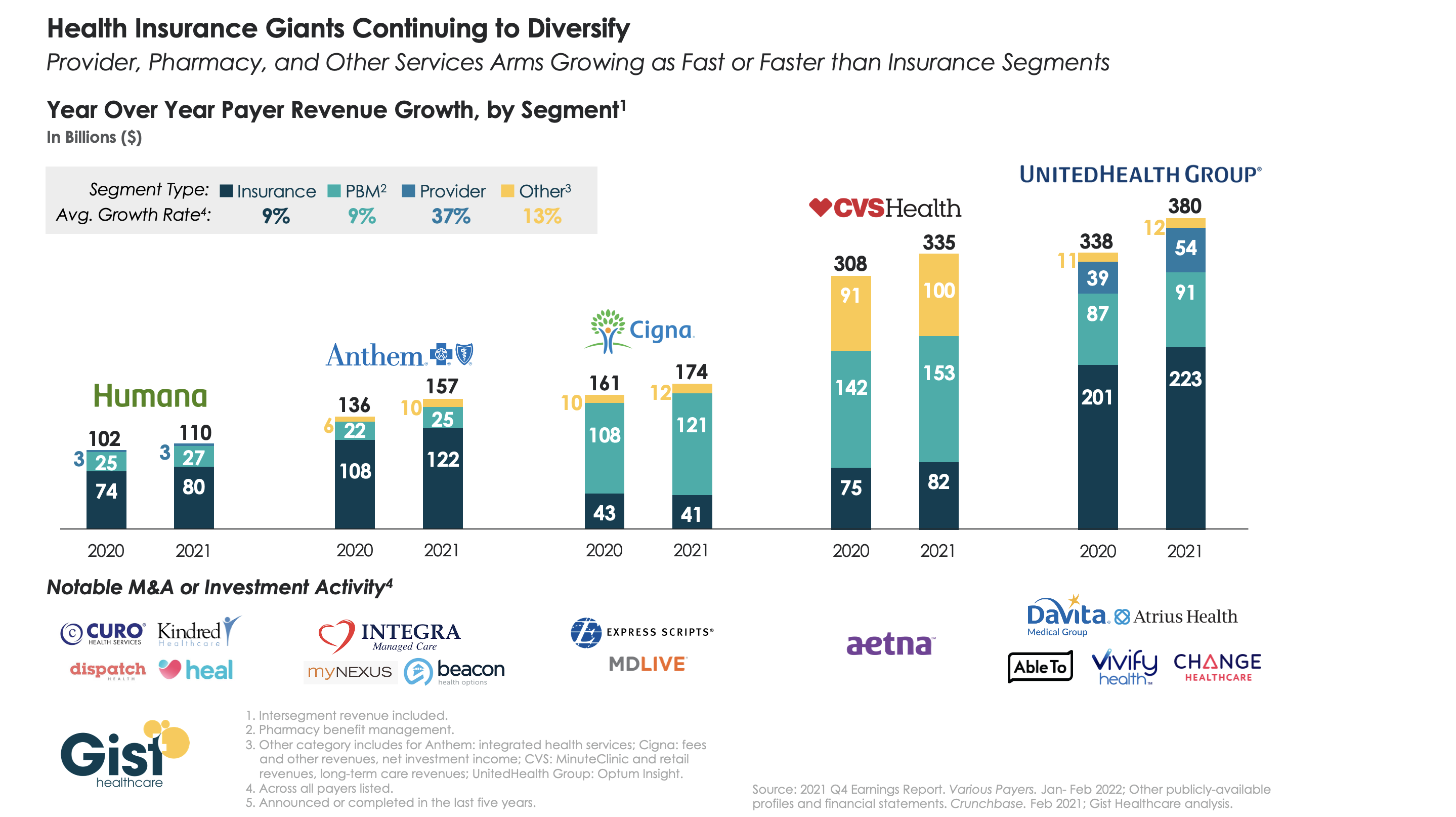
The largest health insurers are quickly becoming vertically integrated healthcare organizations that span the care and coverage continuum. While 2021 was a mixed year for these companies as healthcare volumes bounced back, their diversified portfolios helped cushion losses from higher claims.

The graphic above analyzes revenue growth by segment for the five largest insurers across the last two years. On average the insurance and pharmacy benefit management components of the companies grew at nine percent, while care delivery and integrated health services grew at much higher rates. UnitedHealth Group (UHG) and Anthem boasted the highest year-over-year revenue growth, driven by UHG’s Optum subsidiary and Anthem’s integrated health services.

Cigna and CVS Health each earned less than a quarter of their total revenue from their insurance arms last year. While Humana lags the others in topline revenue, it has assembled a robust portfolio of care delivery investments and partnerships, surpassed only by UHG. 

As antitrust scrutiny on vertical integration increases (case in point: the DOJ is now challenging UHG’s acquisition of Change Healthcare), insurers will face the hard task of integrating their portfolio of service—and demonstrating that they deliver value to consumers and patients.

Department of Justice (DOJ) files suit to block UnitedHealth Group (UHG)’s $13B acquisition of Change Healthcare

https://mailchi.mp/7788648545f0/the-weekly-gist-february-25-2022?e=d1e747d2d8

DOJ alleges that allowing UHG’s Optum subsidiary to acquire Change, a direct competitor used by most large commercial insurers for healthcare claims solutions, would give UHG 75 percent of the healthcare claims processing and management market. This would significantly reduce competition, the DOJ claims, while simultaneously giving UHG access to its competitors’ sensitive plan design and pricing information. UHG called the DOJ’s position ‘deeply flawed’ and promised to fight the case. 

The Gist: This is the second big move by antitrust regulators in a week to put the brakes on consolidation in healthcare: shortly after the DOJ sued to block Rhode Island’s two largest health systems, Care New England and Lifespan, from merging, those systems abandoned plans to combine. 

We are seeing the first real signs that the Biden administration is following through on plans to more closely scrutinize healthcare deals, including payer-led vertical integration. For both payers and providers, increased scrutiny will place a premium on the consumer value proposition of any combination—and force merging companies to deliver on the benefits of scale. 

FTC sues to block Rhode Island’s largest health systems from merging

Dive Brief:

  • The Federal Trade Commission is suing to block Rhode Island’s two largest health systems from merging, alleging the tie-up between Lifespan and Care New England would increase prices and diminish the quality of care.
  • In the state’s own review, Rhode Island’s attorney general said the union would result in “extraordinary market power” and denied the merger application under state law that requires a review of such tie-ups. Rhode Island’s attorney general will join FTC’s federal lawsuit seeking to block the deal.
  • The FTC alleges that, together, Lifespan and Care New England would control at least 70% of Rhode Island’s market for inpatient hospital services and also reduce competition in several nearby Massachusetts communities.

Dive Insight:

The union between Lifespan, the state’s largest health system, and Care New England, the second largest, quickly raised alarms in Rhode Island.

A 25-page report from the state’s insurance department found that the merger would “significantly alter” the state’s healthcare market, which currently enjoys a “relatively competitive” market. State regulators were also concerned about the control the new system would have over physician services. Given these risks, the state insurance commissioner proposed a set of conditions on the deal including price caps. Health system executives were open to working under certain conditions.

However, executives seemed surprise by Thursday’s announcement that the deal to create an integrated academic medical system with Brown University at the forefront would be blocked.

“On four separate occasions in prior years, the FTC reviewed the same proposed merger and allowed it to proceed,” a joint statement released Thursday said. The management teams said they offered up 30 conditions to regulators to satisfy antitrust concerns about the merger, “but neither the FTC or the AG ever discussed these conditions or others with the two systems prior to today’s decisions,” according to the statement.

After flirting with the idea of combining the systems for years, Lifespan and Care New England inked a deal to merge last February after the coronavirus pandemic revived talks.

The two touted the deal as a way to create an integrated academic health system with Brown University’s medical school in a central role. Brown University committed $125 million to the creation of the new system.

However, FTC commissioners voted unanimously to block the union over concerns it would extinguish competition between the two.

And although regulators have long leaned on the argument that hospital mergers lead to higher prices, a joint letter from FTC Chair Lina Khan and Commissioner Rebecca Kelly Slaughter points to the harmful effects consolidation has on labor markets, an argument growing in importance within the agency

“Just as we want firms to compete with each other to sell goods and services to their customers, we want employers to compete with each other to attract and retain workers,” the letter states. “Indeed, there is a growing body of empirical research about the potential for competitive harm to labor markets from consolidation and concentration.”

The news follows reports that the Department of Justice is preparing to sue to stop UnitedHealth Group’s blockbuster acquisition of Change Healthcare, a healthcare technology firm. Concerned about the “massive consolidation” of healthcare data, the American Hospital Association urged antitrust regulators to thoroughly examine the proposed transaction in a letter sent to DOJ last spring.

After taking office, President Joe Biden has signaled his administration would take an aggressive antitrust stance, including getting tough on hospital mergers. Last summer, the president issued an executive order that called on antitrust regulators to “review and revise” merger guidelines to ensure patients are not harmed by proposed deals.

Biden specifically called out the healthcare industry, rife with consolidation and accompanying research that shows hospital unions lead to higher prices.

“Thanks to unchecked mergers, the ten largest healthcare systems now control a quarter of the market,” the release from the White House said.

Still, the FTC has become overwhelmed by the sheer number of proposed transactions. In August, the agency said it was hit by a “tidal wave” of merger filings and warned applicants it may not vet all submissions before the applicable deadlines. But in letters sent to merging companies, the FTC warned the delay should not be interpreted as a green light for any deal.

“Companies that choose to proceed with transactions that have not been fully investigated are doing so at their own risk,” the regulator said in a statement.

A year of fewer, but larger, health system deals 

https://mailchi.mp/d57e5f7ea9f1/the-weekly-gist-january-21-2022?e=d1e747d2d8

Overall health sector M&A activity bounced back in 2021 across nearly every subsector except one: hospitals, which saw a significant decrease in deal volume. Drawing on data from Kaufman Hall, the graphic above shows the scale of the most recent wave of health system consolidation, driven by last year’s eight “mega-mergers” between entities with over $1B in annual revenue each. 

While the total number of hospital transactions decreased, the average seller size increased, with the total valuation of all hospital M&A activity nearly tripling from 2020 to 2021. With a dwindling number of independent hospitals left, health systems are pursuing larger combinations with their peers, to achieve greater scale and maintain economic “relevance.”

But as systems who have struggled to complete such mergers can attest, getting a larger deal across the finish line isn’t easy. The path to hospital consolidation now hinges on navigating complex organizational structures and issues of cultural compatibility, in addition to simply identifying “synergies” and avoiding antitrust pitfalls.

CVS wants to employ doctors. Should health systems be worried?

https://mailchi.mp/96b1755ea466/the-weekly-gist-november-19-2021?e=d1e747d2d8

HealthHUB | CVS Health

We recently caught up with a health system chief clinical officer, who brought up some recent news about CVS. “I was really disappointed to hear that they’re going to start employing doctors,” he shared, referring to the company’s announcement earlier this month that it would begin to hire physicians to staff primary care practices in some stores. He said that as his system considered partnerships with payers and retailers, CVS stood out as less threatening compared to UnitedHealth Group and Humana, who both directly employ thousands of doctors: “Since they didn’t employ doctors, we saw CVS HealthHUBs as complementary access points, rather than directly competing for our patients.” 

As CVS has integrated with Aetna, the company is aiming to expand its use of retail care sites to manage cost of care for beneficiaries. CEO Karen Lynch recently described plans to build a more expansive “super-clinic” platform targeted toward seniors, that will offer expanded diagnostics, chronic disease management, mental health and wellness, and a smaller retail footprint. The company hopes that these community-based care sites will boost Aetna’s Medicare Advantage (MA) enrollment, and it sees primary care physicians as central to that strategy.

It’s not surprising that CVS has decided to get into the physician business, as its primary retail pharmacy competitors have already moved in that direction. Last month, Walgreens announced a $5.2B investment to take a majority stake in VillageMD, with an eye to opening of 1,000 “Village Medical at Walgreens” primary care practices over the next five years. And while Walmart’s rollout of its Walmart Health clinics has been slower than initially announced, its expanded clinics, led by primary care doctors and featuring an expanded service profile including mental health, vision and dental care, have been well received by consumers. In many ways employing doctors makes more sense for CVS, given that the company has looked to expand into more complex care management, including home dialysis, drug infusion and post-operative care. And unlike Walmart or Walgreens, CVS already bears risk for nearly 3M Aetna MA members—and can immediately capture the cost savings from care management and directing patients to lower-cost servicesin its stores.

But does this latest move make CVS a greater competitive threat to health systems and physician groups? In the war for talent, yes. Retailer and insurer expansion into primary care will surely amp up competition for primary care physicians, as it already has for nurse practitioners. Having its own primary care doctors may make CVS more effective in managing care costs, but the company’s ultimate strategy remains unchanged: use its retail primary care sites to keep MA beneficiaries out of the hospital and other high-cost care settings.

Partnerships with CVS and other retailers and insurers present an opportunity for health systems to increase access points and expand their risk portfolios. But it’s likely that these types of partnerships are time-limited. In a consumer-driven healthcare market, answering the question of “Whose patient is it?” will be increasingly difficult, as both parties look to build long-term loyalty with consumers.