Mayo Clinic halts scheduling of out-of-network Medicare Advantage patients

https://www.healthcarefinancenews.com/news/mayo-clinic-halts-scheduling-out-network-medicare-advantage-patients

The Mayo Clinic in Minnesota is no longer scheduling appointments for patients in most Medicare Advantage plans, and has been gradually notifying patients throughout the year, in a move that could have consequences for insurers operating plans in the area, according to a Mayo Clinic spokesperson.

Some insurers, such as UnitedHealthcare, have been negotiating with the Mayo Clinic to bring them in-network for Medicare Advantage, in some cases asking them to outline their requested terms, but Mayo to date has yet to send out proposals.

Mayo has long been out of network for most Medicare Advantage plans, but has historically treated out-of-network MA patients and accepted their benefits, according to Mayo Clinic spokesperson Karl Oestreich.

According to the Star Tribune, the change occurred because Mayo saw a significant increase in patients covered by “non-contract” MA insurers. That increase, officials said, threatens to crowd out patients covered by in-network insurers.

Non-contract MA plans are those in which insurance companies have not negotiated payment rates for services with Mayo.

UnitedHealthcare, which has been out of network, is negotiating to bring Mayo in-network for MA members, according to Dustin Clark, vice president for communications at UHC.

“We have asked Mayo Clinic to outline requested terms to join our network for Medicare Advantage and haven’t received a proposal,” he told Healthcare Finance News. “We are committed to reaching an agreement at an affordable cost for the people we serve. We stand at the ready to work with Mayo to end this disruption.”

For UHC, it’s especially important that MA patients who traditionally received care at Mayo can continue to do so in the future.

Although Mayo Clinic does not participate in our network for Medicare Advantage, many of our members have received treatment from its physicians as part of their out-of-network benefits,” said Clark. “We understand how difficult this situation is for some of our members, which is why we are working with Mayo to ensure our Medicare Advantage members who are currently undergoing treatment or have an established relationship with the clinic can continue to see their physician.”

Mayo Clinic spokesperson Karl Oestreich said that medical need is the primary criteria for obtaining an appointment.

“In situations where medical need does not apply and to ensure appointments remain available for our Mayo Clinic patients, we no longer schedule routine visits for those whose coverage does not include Mayo Clinic,” he said. “Continuity of care and relationships with existing local and regional patients won’t be compromised.”

The primary issue, said Oestreich, is capacity, not reimbursement. He said Mayo doesn’t have the capacity to serve an ever-increasing number of patients, and needs to remain a good steward with its contracted plans.

“There was not a policy change, but a shift in enforcement to ensure Mayo has access for our contracted plans (not just Medicare) and those who truly need Mayo’s medical expertise,” he said. “This long-standing policy applies to all payers, not just Medicare Advantage.”

“The impact is to non-contract Medicare Advantage plans,” said Oestrich. “Mayo does not have contracts with these plans. Mayo is open to entering new contracts, but also must keep in mind the impact on capacity to ensure that we can continue to see those patients (regardless of payer) who are in the greatest need of the care Mayo provides.

“We understand that affected patients may be disappointed and frustrated. Patients should always ask their brokers and insurers whether their plans specifically have in-network coverage at Mayo Clinic.”

THE LARGER TREND

UnitedHealthcare, which already has significant market control with its MA plans, said it will strengthen its foothold in the space by expanding its MA plans in 2022, adding a potential 3.1 million members and reaching 94% of Medicare-eligible consumers in the U.S.

While UnitedHealthcare has a massive foothold in the Medicare Advantage space, it underwent scrutiny from the federal government earlier this month, when the Centers for Medicare and Medicaid Services blocked four Medicare Advantage plans from enrolling new members in 2022 because they didn’t spend the minimum threshold on medical benefits. Three UnitedHealthcare plans and one Anthem plan failed to hit the required 85% mark three years in a row.

Medicare Advantage plans are required to spend a minimum of 85% of premium dollars on medical expenses. Failure to do so for three consecutive years triggers the sanctions.

For UHC, the penalties apply to its MA plans in Arkansas, New Mexico and the Midwest, which encompasses Missouri, Kansas, Nebraska and Iowa. UHC plans cover about 83,000 members, and the Anthem plan covers about 1,200 members. They cannot offer select plans to members until 2023, assuming they hit the 85% threshold next year – what’s called the medical loss ratio. If they fail to hit the threshold for five years in a row, the government will terminate the contracts.

UHC representatives told Bloomberg that it missed the 85% benchmark in certain markets in part because of patients deferring medical care due to the COVID-19 pandemic.

Oak Street faces DOJ inquiry into third-party marketing, transportation relationships

Dive Brief:

  • Oak Street Health, a value-based primary care network for adults on Medicare, is facing a Department of Justice inquiry into its relationships with third-party marketing agents and its provision of free transportation for members.
  • The DOJ is investigating whether Oak Street violated the False Claims Act, per a regulatory filing published Monday. On a call with investors Tuesday, management declined to provide additional information into the government’s request, saying it was too early to know for sure what exactly the agency is investigating but that they’re working to comply.
  • Otherwise, the provider had a generally solid third quarter with better-than-expected revenue and well-controlled medical costs, analysts said. Oak Street increased its full-year 2021 guidance following the results, which beat Wall Street expectations with topline revenue of $389 million, up 78% year over year and a quarterly record for the company.

Dive Insight:

The federal government is increasingly cracking down on alleged fraud, especially in the Medicare Advantage program. In privately run MA plans, CMS pays companies on a per-member basis, then adjusts payments based on the acuity or severity of their member’s health status, as supported by provider data like diagnostic codes. Generally, the sicker the member, the higher the plan’s reimbursement.

That’s led to allegations of plans hiking risk scores to overinflate members’ health needs, resulting in higher payments from CMS. Watchdogs have been finding higher incidence of fraud and abuse as the MA program becomes more popular, growing to cover more than 40% of all Medicare beneficiaries.

Oak Street isn’t a traditional plan itself, but enters into full-risk contracts with Medicare Advantage plans, and via CMS’ direct contracting program, in which it assumes full responsibility for patients’ medical expenses in exchange for a fixed per-member, per-month payment. The Chicago-based company is the latest target of a federal inquiry into whether it violated the False Claims Act.

According to the primary care company, the DOJ sent a civil investigative demand on Nov. 1 asking for information about Oak Street’s relationships with third-party marketers and transportation partners.

Oak Street does provide patients transportation to appointments when they need it and has various ways for finding new patients, including community partnerships, but it’s unclear what the DOJ is specifically investigating, CEO Mike Pykosz told investors.

“We have had no meaningful conversations with the government,” Pykosz said. “I’m not really sure what the link is.”

The CEO noted it’s not unusual for such inquiries to take months to resolve, particularly in the hyper-regulated healthcare industry, but said he wouldn’t speculate further.

A civil investigative demand is a form of administrative subpoena, and doesn’t denote any regulatory or legal action itself. However, it is used by the government to kick off investigating potential False Claims violations, and determine whether there’s sufficient evidence to warrant filing an action, according to the National Law Review.

Penalties for violating the act could range from $11,655 to $23,331 per violation, plus triple damages. Total penalties have resulted recently in some significant payouts from MA participants. Notably, in late August, integrated health system Sutter Health agreed to pay $90 million to settle whistleblower allegations of risk adjustment fraud, in the largest False Claims Act settlement against a hospital system in the MA program.

Analysts noted the inquiry, while in early stages, is a point of concern for Oak Street’s future stock performance.

“This creates a new potential risk factor that we are unlikely to get clarity on for some time,” SVB Leerink analyst Whit Mayo wrote in a note.

Oak Street, which also provides services to patients with a range of insurance options, had an otherwise solid quarter, eclipsing $1 billion of year-to-date revenue for the first time in the company’s history.

The highly infectious delta variant did contribute to higher expenses, as it has with other providers.

Oak Street reported $15 million in costs from COVID-19 admissions in the first half of the year, and another $10 million in the third quarter. COVID-19-related expenses surged in the latter half of August and continued into September, but tailed off early into the fourth quarter, CFO Tim Cook said.

The majority of Oak Street’s patients are in northern U.S. markets, however, which experienced coronavirus surges last year during the winter as more people stayed indoors.

“We will see what happens in November and December,” Cook said. “While COVID costs are going to be lower in Q4, unfortunately we’re not in a world where they’re going to be zero.”

In the quarter, the primary care provider’s medical claims expense doubled year over year to almost $310 million. Oak Street’s medical loss ratio of 82.2% was lower than analysts expected, though management said they expected it to be higher in the fourth quarter.

Pykosz and Cook called out medical costs from new patients brought in during 2021 as a system-wide stressor.

Because diagnoses from 2020 claims are used to determine 2021 risk scores, fewer claims last year could mean lower risk scores and lower payments for plans this year. Oak Street’s patients, especially older adults in low-income communities, used fewer services last year during COVID-19, which resulted in lower revenues this year even as costs expanded.

Management said they expected to get back on track in 2022 as patients new to Oak Street this year will contribute to higher reimbursement next year, closing the current medical-cost gap between tenured and new patients.

“This is certainly an outlier year from every other year we’ve had results,” Pykosz said.

Oak Street, which was founded in 2012 and went public in August 2020 at a $9 billion valuation, reported a net loss of almost $110 million in the quarter, compared to a loss of $59 million at the same time last year.

Oak Street continued expanding its membership and network in the quarter, reporting 69% at-risk patient growth and opening 15 new centers in seven new markets.

Oak Street’s competition in the value-based primary care space has ramped up this year, as peers One Medical acquired a rival value-based medical chain and VillageMD got a hefty new investment from drugstore partner Walgreens.

But Pykosz pointed to Oak Street’s exclusive relationship with senior group AARP and its acquisition of specialty telehealth provider RubiconMD as differentiators, while noting there’s room for a number of players in the space.

“At this point we don’t feel there’s a lot of pressure or competitive dynamics pressuring our performance,” Pykosz said.

In the third quarter, Oak Street served 100,500 risk-based patients, representing 76% of its total patient base. The company expects at-risk patient volume to grow to between 111,500 and 113,500 patients this year.

If Economists Chose the Health Care System

If Economists Chose the Health Care System - YouTube

Health economists study the economic determinants of health. They also analyze how health care resources are utilized and allocated, and how health care policies and quality of care can be improved. In this episode, we discuss what exactly a healthcare system would look like if these professionals were calling all the shots.

An epic ACA trilogy draws to a close

https://mailchi.mp/bade80e9bbb7/the-weekly-gist-june-18-2021?e=d1e747d2d8

Supreme Court dismisses challenge to Affordable Care Act, leaving it in  place | News | albanyherald.com
\

Ruling by a decisive 7-2 margin, in what dissenting Justice Samuel Alito described as the third in “our epic Affordable Care Act trilogy”, the Supreme Court rejected the latest—and likely the last—effort to overturn the 2010 health reform law. Holding that the states and individuals that brought the latest challenge to the law did not have “standing”—the legal right to sue—the high court effectively closed the book on a decade-long series of challenges to the Affordable Care Act (ACA). Those efforts have included two previous Supreme Court cases, numerous promises to “repeal and replace” Obamacare, and the neutering of the law’s “individual mandate” to buy health insurance, which led to this latest case, Texas v. California.

At issue in the case was whether, by zeroing out the penalty for not purchasing insurance, Congress effectively removed the ACA’s status as a taxation measure, which the Court had previously held as central to the constitutionality of the law. In Alito’s dissenting opinion, the full implications of the issue are laid out: in his view, by invalidating the mandate, Congress rendered the entire law unconstitutional, meaning that it should be overturned. But a majority of seven Justices, including Kavanaugh and Barrett (both appointed by President Trump) disagreed, joining Justice Breyer in his opinion that no harm had been done to the states that brought the suit, and ordering that the case be returned to the lower court for dismissal.
 
More than ten years after the passage of the ACA, it now (finally) seems as though the law is here to stay. Bolstering its central provisions—subsidized individual insurance coverage, expanded Medicaid benefits, protections for those who purchase insurance—is a centerpiece of the Biden administration’s policy program, featured first in the American Rescue Plan Act, and now in the recovery legislation currently being debated. Republicans, who had long opposed the ACA, barely mentioned it during the last presidential campaign, instead turning their focus to thwarting Democrats’ plans to expand coverage by lowering the Medicare eligibility age or implementing a government-run “public option”.

Given the evenly split makeup of the Senate, however, we continue to believe the greatest hurdle such proposals will face is not Republican opposition, but reluctance on the part of conservative Democrats, like Sen. Joe Manchin (WV), whose votes will be needed for any legislation to pass.

With the Supreme Court calling a third strike against challenges to the ACA, and the new administration eager to advance its other priorities (infrastructure, childcare, jobs), for the first time in over a decade, we might just be in for a period of relative calm on the healthcare policy front.

Five takeaways on the Supreme Court’s Obamacare decision

Obamacare Returns as Galvanizing Issue After Ginsburg Death and Barrett  Nomination - The New York Times

In what has become something of a Washington tradition, the Supreme Court again upheld the Affordable Care Act on Thursday, in the third major case from Republican challengers to reach the high court. 

The margin this time was larger, 7-2, as the High Court appears less and less interested in revisiting the health care law through the judiciary. 

Democrats hailed the ruling as a boost to their signature law, and Republicans were left to figure out a path forward on health care amid another defeat. 

Here are five takeaways:

This could be the last gasp of repeal efforts

It is impossible to ever fully rule out another lawsuit challenging the health law or another repeal push if Republicans win back Congress. 

But after more than 10 years of fighting the Affordable Care Act, GOP efforts at fighting the law are seriously deflated, as many Republicans themselves acknowledge. 

“It’s been my public view for some time that the Affordable Care Act is largely baked into the health care system in a way that it’s unlikely to change or be eliminated,” said Sen. Roy Blunt (Mo.), a member of Senate GOP leadership. 

Asked if he still wanted to repeal and replace the law, which was the GOP rallying cry for years, Sen. Chuck Grassley (R-Iowa) said instead, “I think I want to make sure it works,” before attacking former President Obama’s promises about the law’s benefits. 

Even Sen. Josh Hawley (R-Mo.), who helped bring the lawsuit against the health law as attorney general of Missouri, said Thursday that the Supreme Court had made clear “they’re not going to entertain a constitutional challenge to the ACA.”

Supporters of the law said it is now even more entrenched, despite years of GOP attacks

“The war appears to be over and the Affordable Care Act has won,” said Stan Dorn, senior fellow at the health care advocacy group Families USA. 

Still, not all Republicans are throwing in the towel on at least verbally attacking the law. 

“The ruling does not change the fact that Obamacare failed to meet its promises and is hurting hard-working American families,” said House GOP leaders Kevin McCarthy (Calif.), Steve Scalise (La.) and Elise Stefanik (N.Y.). 

And there is at least one ACA-related lawsuit still working its way through the lower courts. Kelley v. Becerra challenges provisions of the health law around insurance plans covering preventive care including birth control.

The Supreme Court was fairly united 

The margin of victory for the health law was fairly large, with even more conservative justices such as Clarence ThomasAmy Coney BarrettBrett Kavanaugh and John Roberts ruling to uphold the law, joining the opinion from liberal Justice Stephen Breyer

The court’s other two liberals, Sonia Sotomayor and Elena Kagan, also joined the majority of seven. Two conservatives, Justices Samuel Alito and Neil Gorsuch, dissented and would have struck down the law. 

Through the three major Supreme Court cases on ObamaCare, the margin of victory has risen from 5-4 to 6-3 to 7-2. 

“There’s a real message there about the Supreme Court’s willingness to tolerate these kinds of lawsuits,” Andy Pincus, a visiting lecturer at Yale Law School, said of the growing margin of victory. 

The case was decided on fairly technical grounds. The Court ruled that the challengers did not have standing to sue, given that the penalty for not having health insurance at the center of the case had been reduced to zero, so it was not causing any actual harm that could be the basis for a lawsuit. 

Republicans did get some vindication in that Democrats had fiercely attacked Barrett during her confirmation hearings for being a vote to overturn the health law, when in fact she ended up voting to maintain the law. 

The ACA is stabilizing

The early years of the Affordable Care Act were marked with the turbulence of a website that failed at launch, premium increases, and major insurers dropping out of the markets given financial losses. 

Now, though, the markets are far more stable. For example, 78 percent of ACA enrollees now have the choice of three or more insurers, up from 57 percent in 2017, according to the Kaiser Family Foundation. 

Democrats, now in control of the House, Senate and White House, were able to pass earlier this year expansions of the law’s financial assistance to help further bring down premium costs. 

The Biden administration announced earlier this month that a record 31 million people were covered under the ACA, including both the private insurance marketplaces and the expansion of Medicaid. 

“We are no longer in the Affordable Care Act, ‘How’s it going to go? Is it going to survive?’ mode,” said Frederick Isasi, executive director of Families USA. “We really are in a whole new phase. It really is: ‘How do we improve it?’”

Republicans face questions on their health care message

The Republican health care message for years was summed up with the simple slogan “repeal and replace.

But now those efforts have failed in Congress, in 2017, and have failed for a third time in the courts. 

That leaves uncertainty about what the Republican health care message is. The party has famously struggled to unite around an alternative to the ACA, so there is no consensus alternative for the party to turn to. 

The statement from McCarthy, Scalise, and Stefanik calling the ACA “failed,” shows that party leaders are not fully ready to accept the law.

The leaders added that “House Republicans are committed to actually lowering health care costs,” which has been a possible area for the party to focus that is not simply about repealing the ACA. 

But any discussion of health care costs is fraught with complications. Republicans, for example, overwhelmingly oppose House Democrats’ legislation to allow the government to negotiate lower drug prices, arguing it would harm innovation from the pharmaceutical industry. 

Grassley reached a bipartisan deal on somewhat less sweeping drug pricing legislation with Sen. Ron Wyden (D-Ore.) in 2019, but that bill went too far for many Republicans as well. 

Democrats want to go farther, but face an uphill climb

With the ACA further entrenched, and control of the House, Senate and White House, Democrats are looking at ways to build on the health law. 

The main health care proposal from the presidential campaign, a government-run “public option” for health insurance, has faded from the conversation and is not expected to be a part of a major legislative package on infrastructure and other priorities Democrats are pushing for this year. 

While the health care industry has largely made its peace with the ACA, pushing for a public option or lowering health care costs means taking on a fight with powerful industry groups. 

Progressives like Sen. Bernie Sanders (I-Vt.) have instead poured their energy into expanding Medicare benefits to include dental, vision, and hearing coverage, and lowering the eligibility age to 60. 

Allowing the government to negotiate lower drug prices also could make it into the package.

“Now, we’re going to try to make it bigger and better — establish, once and for all, affordable health care as a basic right of every American citizen,” said Senate Majority Leader Charles Schumer (N.Y.). “What a day.”

Supreme Court upholds ACA in 7-2 decision, leaving intact landmark US health law during pandemic

The Supreme Court on Thursday issued an opinion upholding the Affordable Care Act by a 7-2 vote, allowing millions to keep their insurance coverage amid the coronavirus pandemic.

In the decision, the court reversed a lower court ruling finding the individual mandate unconstitutional. However, the court did not get to the key question of whether the individual mandate is severable from the rest of the law. Instead, the court held the plaintiffs do not have standing in the case, or a legal right to bring the suit.

Justice Stephen Breyer wrote the opinion while Justices Samuel Alito and Neil Gorsuch filed dissenting opinions.

Breyer wrote that a court must address a plaintiffs’ injuries. But Breyer found there were no injuries, so he asked: “What is that relief? The plaintiffs did not obtain damages.” Breyer added, “There is no one, and nothing, to enjoin.”

A wide swath of industry cheered Thursday’s news.

The American Medical Association called it a victory for patients, so too did America’s Essential Hospitals, a safety net trade group that called it a win. The American Hospital Association said the more than 30 million of Americans who obtained coverage from the law can “breathe a sigh of relief.”

Millions of Americans gained health insurance coverage as a result of the Affordable Care Act, President Barack Obama’s landmark law passed in 2010 and reshaped virtually every corner of American healthcare. The latest challenge threatened to undo coverage gains under the law that helped drive down the uninsured rate to a record low.

Proponents feared the law was in greater jeopardy following the death of Supreme Court Justice Ruth Bader Ginsburg, part of the court’s liberal wing, which shrunk to just three of a total of nine justices without her.

Those fears now seem to be overblown. Chief Justice John Roberts joined the courts liberals in upholding the law, as did two of President Donald Trump’s Supreme Court picks, Justices Brett Kavanaugh and Amy Coney Barrett.

In a rare move, Trump’s DOJ declined to defend the ACA, when the challenge was brought by a group of red states and two men with marketplace plans. Former California Attorney General Xavier Becerra, now HHS secretary, led a group of blue states to defend the law in federal court. 

Recap of the controversial case

The case centers on the individual mandate, the part of the law that compelled Americans to purchase health insurance or pay a fee. The framers of the ACA believed the mandate would help drive healthy people to ensure they weren’t just filled with sick people, risking higher costs and adverse selection for insurers.

Congress effectively killed the mandate in 2017 by setting the penalty to $0.

The plaintiffs’ legal argument was strategic. They directly targeted the linchpin that saved the law in 2012. The Supreme Court largely upheld the ACA in 2012 when it ruled the mandate could be considered a tax and therefore was constitutional. Roberts infuriated conservatives by siding with liberals in that case.

Take that penalty away, by zeroing it out, and the plaintiffs argue the law is no longer constitutional because it can no longer be considered a tax if no money is collected

The key question before the Supreme Court was whether they could simply pluck the individual mandate from the remainder of the monumental health law, throw the entire law out or find some middle ground. 

The plaintiffs have argued that the individual mandate is so intertwined and closely linked to the rest of the law that the entire piece of legislation must fall if the individual mandate is ruled unconstitutional.

Before arriving at the Supreme Courta lower court ruled in 2019 the mandate was unconstitutional but sent back the key question of whether the mandate could be extracted from the remainder of the law back to the district court. The federal appeals court ruling by a three-judge panel came down along party lines: two Republicans and one Democrat.     

A question of standing

Some legal experts have criticized the challenge because the individual plaintiffs, two Texas men, no longer face any financial penalty if they were to forgo coverage. SCOTUS’ ruling agrees with that logic.

The two men joined the case originally brought by a group of red states. Legal experts said it would have been harder for the group of red states to prove an injury than the two men, John Nantz and Neill Hurley.    

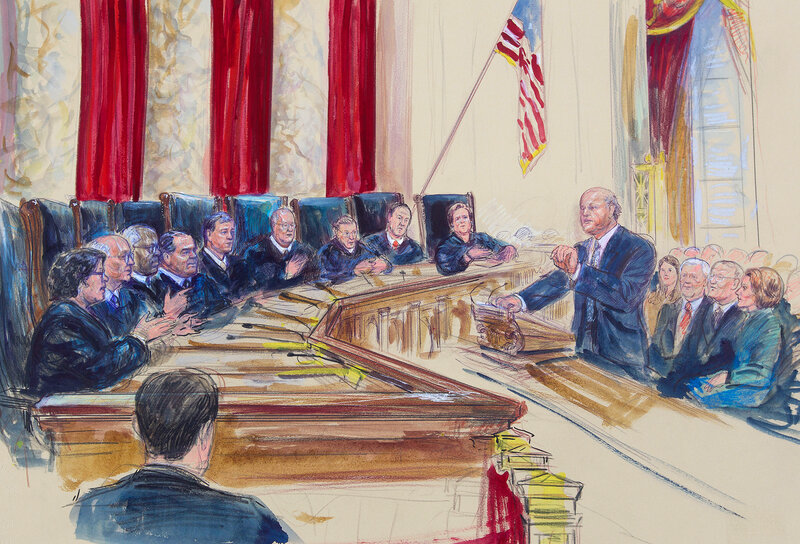
The court seemed skeptical of whether the plaintiffs had standing to bring the case during oral arguments in November. Justices spent a large portion of the two-hour hearing on the topic. 

The word standing was mentioned at least 59 times, according to the court’s transcript of the hearing, outnumbering other key words such as severability, another important legal concept in the case. 

In one now-telling exchange from oral arguments, Gorsuch seemed confused over the premise of the challenge to begin with: “I guess I’m a little unclear who exactly they want me to enjoin and what exactly do they want me to enjoin them from doing?”

Supreme Court upholds Affordable Care Act

https://www.healthcarefinancenews.com/news/supreme-court-upholds-affordable-care-act

The Supreme Court has upheld the constitutionality of the Affordable Care Act in a decision released this morning. 

The Republican state plaintiffs, led by Texas, have failed to show they have standing to attack as unconstitutional the ACA’s minimum essential coverage provision, the justices said. 

“Therefore, we reverse the Fifth Circuit’s judgment in respect to standing, vacate the judgment, and remand the case with instructions to dismiss,” they said.

Justice Stephen Breyer delivered the majority opinion, in which Chief Justice John Roberts and Justices Clarence Thomas, Sonia Sotomayor, Elena Kagan, Brett Kavanaugh and Amy Coney Barrett joined. 

Justice Samuel Alito filed the dissenting opinion in which Judge Neil Gorsuch joined. 

Supreme Court’s ACA ruling looms

Some States Make Obamacare Backup Plans, As Supreme Court Decision Looms :  Shots - Health News : NPR

The U.S. Supreme Court is heading into the last month of its current term with one major healthcare case, the move to invalidate the ACA, yet to be decided, The New York Times reported June 1. 

A coalition of Republican-leaning states, led by Texas, have asked the court to strike down the ACA, signed into law in 2010. The states argue that the entire ACA is invalid because, in December 2017, Congress eliminated the law’s tax penalty for failing to purchase health insurance. The states argue that the individual mandate requiring Americans to gain health insurance or pay a penalty is inseparable from the rest of the law and became unconstitutional when the tax penalty was eliminated.

The Supreme Court heard oral arguments in the case in November, and at least five Supreme Court justices indicated support for not striking down the entire ACA.

The court is expected to rule on the matter before its nine-month term ends at the end of June, Reuters reported. 

The risky politics of reopening the ACA debate

https://www.axios.com/newsletters/axios-vitals-67f21192-7818-4d03-9c4c-5c2e3a7b4091.html?utm_source=newsletter&utm_medium=email&utm_campaign=newsletter_axiosvitals&stream=top

The sudden threat to the ACA is risky for Republicans in 2020 election -  Axios

The sudden uncertainty surrounding the future of the Affordable Care Act could be an enormous political liability for Republicans in key states come November.

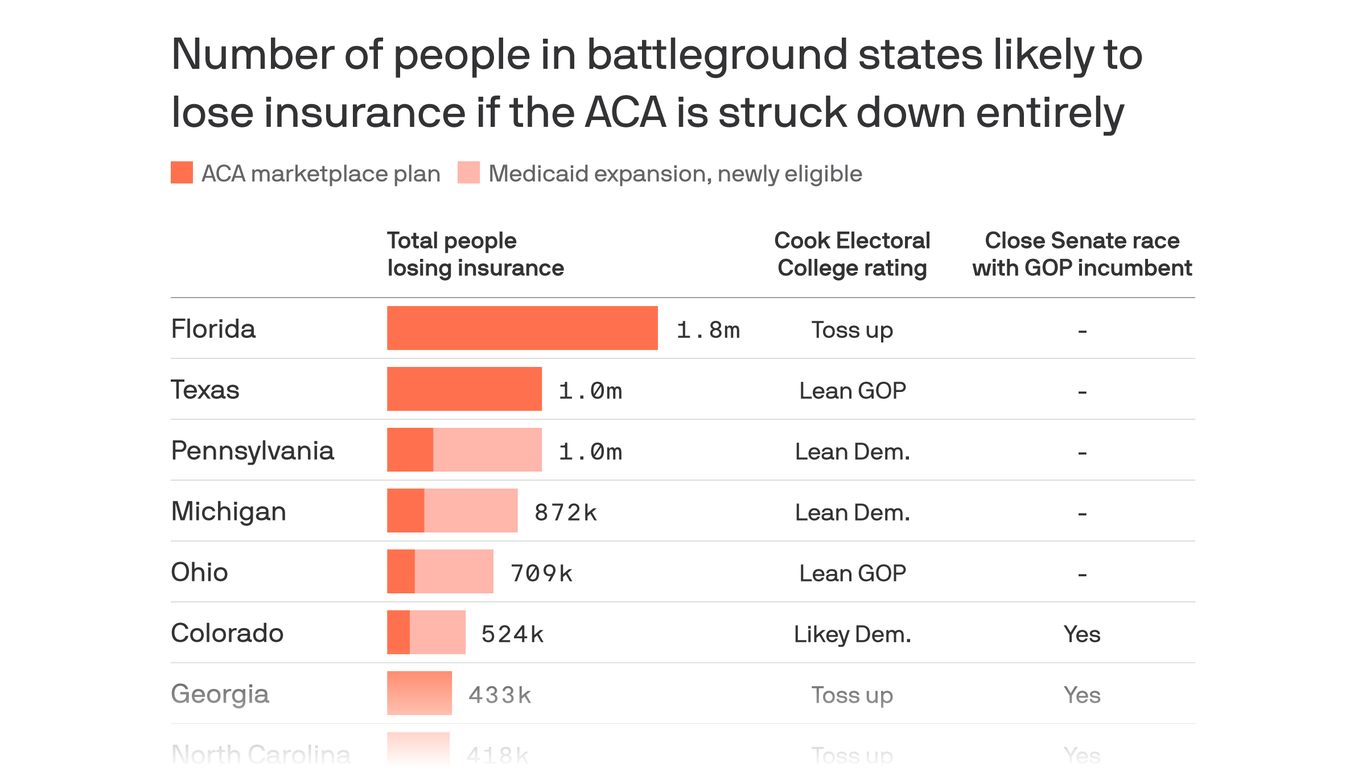
Between the lines: Millions of people in crucial presidential and Senate battlegrounds would lose their health care coverage if the Supreme Court strikes down the law, as the Trump administration is urging it to.

The chart above shows the number of people enrolled in the ACA’s insurance marketplaces or covered through its Medicaid expansion.

  • These options have become especially important over the last six months, as millions of Americans lost their jobs — and thus their employer insurance — due to the pandemic.
  • And more than a quarter of non-elderly Americans have a pre-existing condition that insurers in the individual market could refuse to cover without the ACA, per the Kaiser Family Foundation.

The big picture: Republicans paid a steep electoral price for trying to repeal parts of the ACA in 2017. Republicans’ lawsuit against the health care law, if it succeeds, would boot even more people off of their coverage and undo even more of the ACA’s regulations.

What to watch: Several vulnerable Republicans, including Sens. Susan Collins, Martha McSally, and Cory Gardner, represent purple states that expanded Medicaid and would therefore see steep coverage losses. And the broader fight over the Supreme Court has made it impossible to ignore those stakes.

  • “With the Court setting Nov. 10 as the date for hearing California v. Texas, Republicans caught a break not having it front and center right before the election.  Now it is very much front and center,” said Rodney Whitlock, a former health aide for Sen. Chuck Grassley.
  • “Debates over protection of pre-existing conditions have generally not gone positively for Republicans in purple states/district,” he added.