Coronavirus live updates: New York activates quarantine for travelers from hotspots as Florida shatters daily record

https://www.cnbc.com/2020/06/24/coronavirus-live-updates.html?utm_source=&utm_medium=email&utm_campaign=30961

Chart of daily new coronavirus cases in the United States through June 23, 2020.

The coronavirus continues to surge in states around the country, mostly in the South and West. Testifying before members of Congress on Tuesday, White House health adviser Dr. Anthony Fauci said parts of the U.S. are beginning to see a “disturbing surge” and described the overall situation as a “mixed bag” across different regions and states.

  • Global cases: More than 9.29 million
  • Global deaths: At least 478,289
  • U.S. cases: More than 2.34 million
  • U.S. deaths: At least 121,279

The data above was compiled by Johns Hopkins University.

California reports more than 7,000 cases, biggest daily jump so far

3:30 p.m. ET — California reported an additional 7,149 Covid-19 cases since Tuesday, a 69% increase in two days, bringing the state’s total to 190,222 cases, according to the state’s health department.

While the daily case numbers are growing, Gov. Gavin Newsom said that the state performed a record number of tests in the last 24 hours. However, the percent of tests coming back positive has slightly increased in the last two weeks, sitting at 5.1% on a 14-day average, he said.

Hospitalizations from Covid-19 in California have also increased 29% in the last 14 days, totaling 4,095 as of Tuesday, Newsom said.

“We cannot continue to do what we have done over the last number of weeks. Many of us understandably developed a little cabin fever, some I would argue developed a little amnesia, others have frankly taken down their guard,” Newsom said at press briefing. —Noah Higgins-Dunn

The pandemic still hasn’t peaked in the Americas, WHO says

2:30 p.m. ET — Coronavirus outbreaks in the Americas, which include North, South and Central America, haven’t reached their peaks yet, the World Health Organization warned.

Over a third of the new cases reported Tuesday were from five countries in the Americas, according to WHO data. The U.S. reported the most cases and is the worst-hit country in the world with more than 2.3 million cases and at least 121,279 deaths as of Wednesday.

The comment by the WHO came a day after Dr. Anthony Fauci, the United States’ leading infectious disease expert, expressed concern a “disturbing surge” in coronavirus infections as states continue to reopen.

One WHO official said that parts of the Americas had not “reached a low enough level of transmission “with which we can achieve a successful exit of successful and social distancing measures.” —Berkeley Lovelace Jr.

The entrance to the Magic Kingdom at Disney World is seen on the first day of closure as theme parks in the Orlando area suspend operations for two weeks in an effort to curb the spread of the coronavirus (COVID-19). Paul Hennessy/SOPA Images/LightRocket via Getty Images)

1:04 p.m. ET — More than 7,000 people have signed an online petition urging Disney and local government officials to reconsider the reopening of Disney World next month.

The petition comes as coronavirus cases in the state are rapidly rising.

It is difficult to determine how many of the signees of the online petition are actually Walt Disney employees or if the petition is union-backed. There is no mention in the petition itself of any affiliation with an employee union.

“The safety and well being of our cast members and guests are at the forefront of our planning, and we are in active dialogue with our unions on the extensive health and safety protocols, following guidance from public health experts, which we plan to implement as we move toward our proposed, phased reopening,” Disney said in a statement to CNBC. —Sarah Whitten

Florida shatters record for new cases in a day

People wait for a health assessment check-in before entering Jackson Memorial Hospital, as Miami-Dade County eases some of the lockdown measures put in place during the coronavirus disease (COVID-19) outbreak, in Miami, Florida, U.S., June 18, 2020.

12:15 p.m. ET — The Florida Department of Health reported 5,508 new coronavirus cases, surpassing the previous record single-day increase of 4,049 new cases reported on Saturday.

Florida is among a handful of states that includes Arizona and Texas that are experiencing expanding outbreaks of the virus.

As cases continue to rise by the thousands every day in Florida, the percent of total tests coming back positive has also risen. On Wednesday, the state reported that 15.91% of all tests came back positive, up from 10.82%. That increase indicates that the surge in new cases is not due solely to ramped up testing. —Will Feuer

NY, NJ and CT impose quarantine on travelers from hotspot states

11:51 a.m. ET — The governors of New York, New Jersey and Connecticut jointly announced a 14-day quarantine for travelers entering the states from coronavirus hotspots.

The Northeastern bloc of states has successfully combated their own outbreaks, having brought peak infection rates down considerably, and are now worried about visitors reintroducing high transmission rates.

“We worked very hard to get the viral transmission rate down. We don’t want to see it go up because a lot of people come into this region and they can literally bring the infection with them,” New York Gov. Andrew Cuomo said at a press conference with New Jersey Gov. Phil Murphy and Connecticut Gov. Ned Lamont.

The hotspot states included in the advisory so far are: Alabama, Arizona, Arkansas, Florida, North Carolina, South Carolina, Texas, Utah and Washington. —Sara Salinas

New York City Marathon canceled

Lelisa Desisa of Ethiopia crosses the finish line to win the Men's Division during the 2018 TCS New York City Marathon in New York on November 4, 2018.

10:29 a.m. ET — The 2020 TCS New York City Marathon has been canceled amid the ongoing coronavirus pandemic, according to an announcement from the race’s organizers. Scheduled for Nov. 1, the event was supposed to commemorate the 50th running of the marathon.

New York Road Runners, which organizes the race, said the decision was made from a health perspective in partnership with the New York City Mayor’s Office.

“While the marathon is an iconic and beloved event in our city, I applaud New York Road Runners for putting the health and safety of both spectators and runners first,” said Mayor Bill de Blasio in a statement.

NYRR said runners will receive a full refund of their entry fee or complimentary entry for 2021, 2022 or 2023. They will also be invited to participate in a virtual marathon event taking place from Oct. 17 to Nov. 1.

The New York City race is the world’s largest marathon and counted 53,640 finishers in 2019, according to NYRR. —Hannah Miller

More states are reporting increases in new Covid-19 cases as U.S. 7-day average continues to grow

A patient is wheeled into Houston Methodist Hospital as storm clouds gather over the Texas Medical Center, amid the global outbreak of the coronavirus disease (COVID-19), in Houston, Texas, U.S., June 22, 2020.

0:11 a.m. ET — As of Tuesday, the seven-day average of daily new Covid-19 cases in the U.S. increased by more than 32% compared to one week ago, according to a CNBC analysis of data compiled by Johns Hopkins University.

Cases are growing by 5% or more in 30 states across the country, including Arizona, Texas, Montana and Idaho. Since Monday, four more states have seen growth in their 7-day average of daily new cases.

Texas health officials reported an all-time high of 5,489 new cases on Tuesday, surpassing 5,000 cases in a single day. The state has also been seeing record spikes in hospitalizations in recent weeks. As of Tuesday, there are 3,335 people currently hospitalized in Texas based on a 7-day moving average, which is a 49% increase compared with a week ago, according to Covid Tracking Project data.

California also broke its record for daily number of positive cases on Tuesday, adding 6,712 new cases, according to Johns Hopkins data. The state surpassed 6,000 new cases for the first time on Monday. —Jasmine Kim

IMF slashes forecasts for U.S. economy, GDP

9:47 a.m. ET — The International Monetary Fund slashed its economic estimates for global GDP and the U.S. economy amid the ongoing coronavirus pandemic, and warned that governments’ debt levels will continue to soar as they combat the crisis.

The IMF forecast a contraction of 4.9% in global GDP and estimated that the U.S. economy will contract by 8% in 2020, CNBC’s Silvia Amaro reports. The new estimates were downward revisions from what the IMF forecast in April.

The Washington-based institution said the new figures were due to expectations that social-distancing measures will likely remain in place during the second half of 2020, hurting productivity and supply chains.

The Fund also downgraded its 2020 estimates for the euro zone and its GDP forecast for 2021. —Hannah Miller

The U.S. will eclipse its first peak, Dr. Scott Gottlieb says

8:20 a.m. ET — Daily new cases of coronavirus will surpass the country’s first peak in April, former Food and Drug Administration Commissioner Dr. Scott Gottlieb told CNBC.

“We’re going to eclipse the totals in April, so we’ll eclipse 37,000 diagnosed infections a day,” he said on CNBC’s “Squawk Box.” “But in April we were only diagnosing 1 in 10 to 1 in 20 infections, so those 37,000 infections represented probably half a million infections at the peak.“

Since April, the U.S. has significantly ramped up the country’s capacity to test broadly for the virus, including among asymptomatic and pre-symptomatic patients. That means even though confirmed cases will likely peak again, the underlying outbreak probably isn’t as large as it was in April, Gottlieb said.

“The total number of deaths is falling because the total infection burden in the country is a lot lower now than it was in April,” he said. —Will Feuer

Most recent 1 million cases were reported in just a week, WHO says

Chart of global daily new coronavirus cases by region

8:08 am ET — The pandemic is still accelerating, with the most recent 1 million cases being reported in one week, World Health Organization Director-General Tedros Adhanom Ghebreyesus said, according to Reuters.

During a virtual conference on vaccine development and access across the continent, Tedros added that every country in Africa has now developed laboratory capacity to conduct diagnostic testing for the virus.

The virus has sickened more than 9.27 million people around the world and killed at least 477,807 people. There is still no U.S.-approved treatment or vaccine for the disease. —Will Feuer

India reports record single-day spike in cases
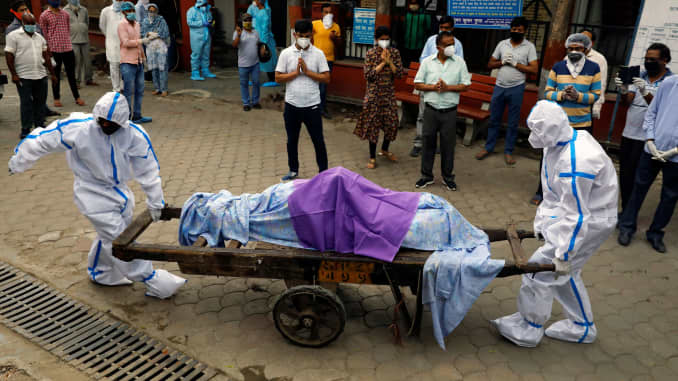
Health workers wearing Personal Protective Equipment (PPE) carry the body of a person who who died due to the coronavirus disease (COVID-19), at a crematorium in New Delhi, India, June 24, 2020.

7:12 a.m. ET — India has reported its highest spike of new cases of infections since the virus took hold in the country of more than 1.3 billion people, according to The Associated Press. 

In 24 hours, the country reported 15,968 new cases and 465 deaths, the AP reported. That means the virus has now infected more than 456,183 people in India, killing at least 14,476, according to data compiled by Johns Hopkins University.

Maharashtra, New Delhi and Tamil Nadu are the hardest-hit states, making up almost 60% of all confirmed cases in the country. New Delhi, in particular, is emerging as a cause for concern in the federal government, the AP reported, due to poor contact tracing infrastructure and limited hospital capacity.

India has the fourth worst coronavirus outbreak in the world, based on total number of confirmed cases, behind only the U.S., Brazil and Russia. —Will Feuer

The EU is discussing reopening its borders, but US citizens could remain barred

A general view of almost desert Pantheon square during Italy's lockdown due to Covid-19 pandemic.

6:51 a.m. ET — The European Union is discussing how to reopen its external borders as the region looks to revive its economies, but visitors from the U.S., and elsewhere, could be barred from entering the bloc for now.

Thirty European countries decided to close their external borders back in March to contain the spread of Covid-19, but that measure is due to be lifted on Tuesday. Representatives of the EU governments are discussing the criteria to lift the travel restrictions from abroad, and at the moment, the main requirement is the coronavirus infection rate in the country of origin.

This means that countries with high rates, such as the United States and Brazil, could remain barred from entering European nations, at least for some time. —Silvia Amaro


WHO Reports Largest Single-Day Spike In Coronavirus Cases

https://talkingpointsmemo.com/news/who-reports-largest-single-day-spike-in-coronavirus-cases

WHO reports largest single-day increase in coronavirus cases

The World Health Organization on Sunday reported the largest single-day increase in coronavirus cases by its count, at more than 183,000 new cases in the latest 24 hours.

The UN health agency said Brazil led the way with 54,771 cases tallied and the U.S. next at 36,617. Over 15,400 came in in India.

Experts said rising case counts can reflect multiple factors including more widespread testing as well as broader infection.

Overall in the pandemic, WHO reported 8,708,008 cases — 183,020 in the last 24 hours — with 461,715 deaths worldwide, with a daily increase of 4,743.

More than two-thirds of those new deaths were reported in the Americas.

In Spain, officials ended a national state of emergency after three months of lockdown, allowing its 47 million residents to freely travel around the country for the first time since March 14. The country also dropped a 14-day quarantine for visitors from Britain and the 26 European countries that allow visa-free travel.

But there was only a trickle of travelers at Madrid-Barajas Airport, which on a normal June day would be bustling.

“This freedom that we now have, not having to justify our journey to see our family and friends, this was something that we were really looking forward to,” Pedro Delgado, 23, said after arriving from Spain’s Canary Islands.

Spanish Prime Minister Pedro Sánchez urged people to take maximum precautions: “The virus can return and it can hit us again in a second wave, and we have to do whatever we can to avoid that at all cost.”

At a campaign rally in Tulsa, Oklahoma, Trump said Saturday the U.S. has tested 25 million people, but the “bad part” is that it found more cases.

“When you do testing to that extent, you’re going to find more people, you’re going to find more cases,” Trump said. “So I said to my people, ‘Slow the testing down, please.’″

White House trade adviser Peter Navarro said on CNN that Trump was being “tongue-in-cheek” and made the comment in a “light mood.”

Democratic rival Joe Biden’s campaign accused Trump of “putting politics ahead of the safety and economic well-being of the American people.”

The U.S. has the world’s highest number of reported infections, over 2.2 million, and the highest death toll, at about 120,000, according to Johns Hopkins. Health officials say robust testing is vital for tracking outbreaks and keeping the virus in check.

In England, lockdown restrictions prevented druids, pagans and party-goers on Sunday from watching the sun rise at the ancient circle of Stonehenge to mark the summer solstice, the longest day of the year in the Northern Hemisphere. English Heritage, which runs the site, livestreamed it instead. A few people gathered outside the fence.

“You can’t cancel the sunrise,” druid Arthur Pendragon told the BBC.

The number of confirmed virus cases is still growing rapidly not only in the U.S. but in Brazil, South Africa and other countries, especially in Latin America.

Brazil’s Health Ministry said the total number of cases had risen by more than 50,000 in a day. President Jair Bolsonaro has been downplaying the risks even as his country has seen nearly 50,000 fatalities, the second-highest death toll in the world.

South Africa reported a one-day high of almost 5,000 new cases on Saturday and 46 deaths. Despite the increase, President Cyril Ramaphosa announced a further loosening of one of the world’s strictest lockdowns. Casinos, beauty salons and sit-down restaurant service will reopen.

In the United States, the virus appears to be spreading across the West and South. Arizona reported over 3,100 new infections, just short of Friday’s record, and 26 deaths. Nevada also reported a new high of 445 cases.

In Europe, a single meatpacking plant in Germany has had over 1,000 cases, so the regional government issued a quarantine for all 6,500 workers, managers and family members.

In Asia, China and South Korea reported new coronavirus cases Sunday in outbreaks that threatened to set back their recoveries.

Chinese authorities recorded 25 new confirmed cases — 22 in Beijing. In the past week, Beijing tightened travel controls by requiring anyone who wants to leave the Chinese capital, a city of 20 million people, to show proof they tested negative for the virus.

In South Korea, nearly 200 infections have been traced to employees at a door-to-door sales company in Seoul, and at least 70 other infections are tied to a table tennis club there. But South Korean officials are reluctant to enforce stronger social distancing to avoid hurting the economy.


Nebraska governor says he’ll withhold federal money from counties that require masks

https://www.latimes.com/world-nation/story/2020-06-18/nebraska-governor-mask-requirement-will-cost-counties-money

Nebraska governor: Mask rules will cost counties money meant to ...

Nebraska’s governor told local governments they will not receive any federal money to help fight the effects of the coronavirus pandemic if they require people to wear masks in public buildings.

The mandate from Republican Gov. Pete Ricketts seems at odds with his usual message, often delivered at his regular news conferences to address the COVID-19 outbreak, encouraging people to wear masks to slow the spread of the virus, the Omaha World-Herald reported.

Ricketts stands by that advice, his spokesman Taylor Gage said. Local governments can encourage mask-wearing in courthouses and other county government buildings, he said, but the governor “does not believe that failure to wear a mask should be the basis for denying taxpayers’ services.”

“Counties are not prohibited from requiring masks, but if they want CARES Act money, they have to be fully open, and that means they cannot deny service for not wearing a mask,” Gage said.

The mandate is drawing objections from county officials, who say it runs counter to Nebraska’s long-held bent toward local control and the advice of public health officials.

In Lincoln, officials planned to require all visitors to wear masks when entering the City-County Building, but those rules were dropped when officials learned that doing so would cost Lancaster County any chance at the $100 million that has been allotted to Nebraska counties as part of the federal economic rescue law.

“We’d like to have a little bit more ability to call the shots in our courthouse, but we realize that he has the right to set the rules,” said Deb Schorr, a longtime Lancaster County Board member.

Dakota County Assessor Jeff Curry said the order could have dire consequences in his county, which is home to a Tyson Foods meatpacking plant and has been one of the hardest-hit counties in the nation for the virus.

Curry said he was hoping that a mask requirement could be in place for the courthouse through July 1.

Nebraska continues to pull back on restrictions meant to slow the spread of the virus, even as more cases are recorded. On Wednesday, the state saw nearly 200 news cases of the virus reported, bringing Nebraska’s total to 17,226, according to the state’s online virus tracker. Nebraska has seen a total to 234 deaths related to the COVID-19 virus.


Fauci: US seeing ‘disturbing’ new surge of infections

https://thehill.com/policy/healthcare/504087-fauci-country-seeing-disturbing-new-urge-of-infections?userid=12325

Fauci: US seeing 'disturbing' new surge of infections | TheHill

Anthony Fauci, the administration’s top infectious disease doctor, told a House panel on Tuesday that the country’s response to the COVID-19 pandemic has been a “mixed bag,” adding that a new increase in cases is “disturbing.”

“In some respects, we’ve done very well,” Fauci said during an Energy and Commerce Committee hearing, specifically praising the way New York has been containing the worst outbreak in the country to date.

“However, in other areas of the country, we are now seeing a disturbing surge of infections that looks like it’s a combination, but one of the things is an increase in community spread. And that’s something I’m really quite concerned about,” Fauci said.

There are now about 30,000 new cases per day in the United States. The number of new cases had leveled off at about 20,000, and stayed there for weeks before rising this past weekend.

The rise in the U.S. comes as the Trump administration has sought to paint a rosier picture of the U.S. outlook. Both President Trump and Vice President Pence have inaccurately tried to attribute the increase in cases to more tests being performed.

The new spike in the U.S. is being driven in part by worsening outbreaks across the South and Southwest, including in Arizona, Texas, Florida and the Carolinas, even as the situation has greatly improved in once hard-hit states in the Northeast like New York and Massachusetts.

Many of the states now being hit hard were on the more aggressive side in reopening their economies.  

“Right now, the next couple of weeks are going to be critical in our ability to address those surgings in Florida, in Texas, in Arizona, and in other states,” Fauci said on Tuesday.


Cartoon – Flattening the I.Q. Curve

Editorial cartoons

Trump says Covid-19 is ‘dying out.’ Experts fear his dismissiveness could prolong the crisis

Trump says Covid-19 is ‘dying out.’ Experts fear his dismissiveness could prolong the crisis

The Trump Administration Paid Millions for Test Tubes — and Got ...

The White House is taking a new position on the coronavirus pandemic: a daily count of 750 deaths is a testament to the federal government’s successful pandemic response.

On Wednesday, when U.S. health officials reported nearly 27,000 new Covid-19 cases, President Trump said in a television interview that the virus was “dying out.” He brushed off concerns about an upcoming rally in Tulsa, Okla., because the number of cases there is “very miniscule,” despite the state’s surging infection rate. In a Wall Street Journal interview Wednesday, Trump argued coronavirus testing was “overrated” because it reveals large numbers of new Covid-19 cases, which in turn “makes us look bad,” and suggested that some Americans who wear masks do so not only to guard against the virus, but perhaps to display their anti-Trump animus.

But a range of public health experts told STAT that this messaging not only diverts attention from a pandemic that has already caused 120,000 U.S. deaths, but has more practical implications: It could make it difficult for local governments to enlist the public in the mitigation measures necessary to reduce the continued spread of the virus.

“The science behind how people process public warnings in a crisis supports this: You have to have people speaking with one voice,” said Monica Schoch-Spana, a medical anthropologist at the Johns Hopkins Center for Health Security. “You need a chorus.”

Conflicting directives can make it more difficult for recommendations coming from state and local leaders to have an impact, said Sara Bleich, a professor of public health policy at Harvard’s T.H. Chan School of Public Health.

“It sends a mixed message, which is confusing, particularly because while many people will get infected, most will not get severely sick, so it’s easy to say this won’t happen to me,” she said. “And it’s that sort of attitude that will keep us in this situation for a very long time.”

While the president has for weeks, if not months, underplayed the pandemic, his sharp and repeated remarks this week represent a remarkable attempt from the leader of American government to effectively declare the U.S. Covid-19 epidemic over.

The president’s rhetoric comes at a time that his coronavirus task force, which once conducted daily briefings, has not addressed the public since May. The president’s resumption of campaign rallies flouts federal guidance that encourages mask use (Trump’s campaign will hand out masks and hand sanitizer at the rally, but has not said it will require attendees to use them) and discourages large indoor gatherings. And the president has repeatedly claimed, misleadingly, that persistently high U.S. case totals are simply the result of increased testing.

Health experts say that political leaders preaching caution and modeling proper behavior — such as wearing a mask and demonstrating proper hand hygiene — can send a powerful signal to people that these steps can not only protect them, but their communities. They say that, essentially, national and state leaders need to walk the walk in a situation when individual behavior, like staying home when sick and cooperating with contact tracing, can make a large impact in curbing contagion.

Trump’s counterproductive behavior, Schoch-Spana said, extends far beyond the consistently dismissive tone he has taken toward the health risks of Covid-19. With few exceptions, the president has refused to wear a mask in public, and has insisted on continuing in-person briefings and White House events that effectively defy federal health guidance about gathering indoors in large groups.

“It’s not just words, it’s actions,” she said. “So when you have the nation’s top executive refusing to wear a mask, holding meetings where people are shoulder to shoulder, where he’s signing executive orders — that is also a form of communication.”

Experts also say continued federal commitments to combating the virus are crucial as the public grows tired of abatement measures. Instead, Trump has only elevated his monthslong campaign of downplaying the virus.

And Vice President Mike Pence, in a Wall Street Journal op-ed, framed the declines in cases and deaths since April as “testament to the leadership of President Trump” — even as hundreds of Americans are still dying every day and cases are not dropping further.

Rep. Donna Shalala (D-Fla.), who served as health secretary during the Clinton administration, said she hoped Americans would listen to public health guidance from local officials, not Trump and Pence.

“The president of the United States is dangerous to the health of the people of my district, because he’s giving out misinformation and false hope,” she said. “For those that believe him, they’re putting themselves and their families at risk.”

Public health experts have raised a number of issues with the administration’s messaging.

For one, a plateau of cases and deaths should not be celebrated, they say. While some countries in Europe and Asia have not only flattened their curve but driven them down, that hasn’t happened in the United States. Daily cases and deaths dipped from the peak in April, but have averaged about 20,000 and 800, respectively, for weeks.

Beyond those numbers representing real people getting sick and dying, there are other problems with sustained high levels of spread. The more cases there are, the more difficult it is for the surveillance system, including contact tracing, to keep up. It’s also more likely that some of the cases will spiral into explosive spread; 20,000 cases can turn into 40,000 a lot faster than one case can turn into 20,000.

Plus, a failure to suppress spread now could lead to more prolonged disruptions to daily life. If transmission rates come fall are still what they are now in certain communities, that makes it harder to reopen schools, for example.

Experts also point to evidence suggesting that the daily case and death numbers won’t stay flat for long. While new cases in the Northeast and Midwest are declining, a number of states in the West and South — Arizona, Texas, Florida, California, and Oregon among them — have reported record number of new cases this week. What worries public health officials is that, without measures to stem those increases, those outbreaks could keep growing. Those thousands of new cases also signal that, in a week or two, some portion of those people will show up in the hospital, and, about a week after that, a number of them will be dead, even as clinicians have learned more about treating severe Covid-19.

Some states in the South and West are already reporting record hospitalizations from Covid-19.

The White House’s shrug has been echoed by some governors, who insist, like Pence and Trump, that increased testing explains away the rise in cases. That is certainly one reason; testing has become more widespread, so states are capturing a more accurate reading of their true case burden.

But experts say increased testing can only account for some of the data states are reporting. Other metrics — including rising hospitalizations, filling ICUs, and the increasing rate of tests that are positive for the virus — signal broader spread.

Until Wednesday, leaders of Texas and Arizona also bristled at efforts from city and county officials to institute mask requirements, but acceded to growing pressure even as they have not ordered statewide mandates.

Cameron Wolfe, an infectious disease expert at Duke University, said he was seeing a growing “fatigue” among the public to keep up with precautionary steps like physical distancing and mask wearing. People letting down their guard was coinciding with an increase of cases in states, including North Carolina.

He said medical experts and health workers needed to model proper behavior to show others that the coronavirus epidemic was still something that required action. But, he added, “that also comes from political leaders buying into this.”

Federal and state authorities, he said, need to be “taking this to heart. That has not yet happened. That needs to change if we’re going to get people to buy into this.”


Mask-wearing becomes political even as some governors ease resistance

Mask-wearing becomes political even as some governors ease resistance

More US states mandate wearing masks | The Canberra Times ...

Some state and local leaders are softening their resistance to issuing public masking requirements as emerging research shows face coverings can slow the spread of COVID-19, even as others are doubling down on their opposition.

The debate over whether to require face coverings in public has become increasingly politicized in recent weeks, even as COVID-19 cases have increased in the Sun Belt and some other parts of the country as lockdowns across the country have greatly eased.

Governors in southern, conservative states have been reluctant to issue statewide mandates on public mask-wearing, and in some cases have prevented local governments from taking stronger actions. 

“We want to make sure that individual liberty is not infringed upon by government and hence government cannot require individuals to wear a mask,” Texas Gov. Greg Abbott (R) said Wednesday in an interview with Waco television station KWTX.

Abbott, who frequently recommends mask-wearing, has resisted calls from local leaders to require it, and has also prohibited them from enforcing local orders with civil or criminal penalties on individuals.

However, two Texas counties on Wednesday announced businesses must impose a mask rule on staff and customers or face fines of up to $1,000, which Abbott said would be allowed under his executive order.

“Businesses … they’ve always had the opportunity and the ability, just like they can require people to wear shoes and shirts, these businesses can require people to wear face masks if they come into their businesses. Now local officials are just now realizing that that was authorized,” he said.

Texas has experienced a rapid increase in COVID-19 cases that experts say is likely related to the state’s decision to lift lockdown measures ahead of Memorial Day. The state reported 3,129 new COVID-19 cases Wednesday, its largest single-day increase. Nearly 2,800 people were hospitalized with COVID-19 as of Wednesday, a new high for the state.

In Arizona, which has also seen a surge in cases, Gov. Doug Ducey (R) on Wednesday again resisted calls to issue a statewide masking requirement, but in a reversal, said he would allow local governments to take their own actions. Larger cities including Phoenix and Tucson plan to do so.

“Every Arizonan should wear a face mask,” he said at a Wednesday press conference. “This is an issue of personal responsibility, and we’re asking Arizonans to make responsible decisions to protect the most vulnerable in our communities.” 

While a number of coastal states and cities led by Democrats have strict mask requirements when in public settings such as grocery stores, where staying six feet away from others may not be possible, some Republicans appear to see it as a restriction on freedom and have emphasized individual responsibility.

Trump has almost exclusively declined to wear a mask, and has criticized his political rival Joe Biden, the Democratic candidate for president, for wearing one. 

“I see Biden. It’s like his whole face is covered,” Trump said in an interview published Thursday in The Wall Street Journal. “It’s like he put a knapsack over his face. He probably likes it that way. He feels good that way because he does. He seems to feel good in a mask, you know, feels better than he does without the mask, which is a strange situation.”

The debate of whether to wear masks has sparked division on Capitol Hill, where two Republicans this week refused to follow a new directive from House Speaker Nancy Pelosi (D-Calif.) 

“I consider masks much more effective at spreading panic and much less effective at stopping a virus,” said Rep. Tom McClintock (R-Calif.), during a hearing yesterday. He later put on a mask. 

Polls have shown Democrats are more likely to wear masks in public than Republicans; a Gallup poll conducted in April found 75 percent of Democrats have worn a mask in public, compared to half of Republicans.

However, emerging evidence shows face coverings can slow the transmission of COVID-19. A study published in Health Affairs this week found that mandated use of face masks in public was associated with a reduction in the daily COVID-19 growth rate in 15 states and Washington, D.C., compared to states that did not have such requirements.

Governors of other states experiencing outbreaks, including Henry McMaster (R) of South Carolina, have recommended but don’t require people to wear face masks in public. City council members in Columbia, S.C., however, are reportedly considering a requirement for the state’s largest city.

Alabama Gov. Kay Ivey (R) hasn’t issued a statewide mask requirement for the public, but employees of certain businesses are required to wear them while working.

In Montgomery, Ala., which has the largest COVID-19 outbreak in the state, Mayor Steven Reed (D) issued an executive order Wednesday requiring face coverings be worn in public after a similar ordinance failed to pass the city’s council.

Florida Gov. Ron DeSantis (R) has also resisted a statewide mask requirement, though localities can require their use in public. On Tuesday, he encouraged people to wear masks when social distancing isn’t possible but said it would not be a requirement.

“In terms of forcing that under penalty of criminal law, we’re not going to be doing that. I think it would be applied unevenly and I just don’t think it would end up working,” DeSantis said at a press conference.

The state is also seeing an increase in cases, which DeSantis ties to increased testing. However, public health experts note that the percentage of tests coming back positive is also increasing, a sign of ongoing community transmission. 

In Nebraska, where the rate of COVID-19 transmission has been declining, Gov. Pete Ricketts (R) encourages the use of masks in public but has threatened to withhold federal relief funding from localities that require their use in government buildings.

“The governor encourages people to wear a mask but does not believe that failure to wear a mask should be the basis for denying taxpayers’ services,” spokesman Taylor Gage told the Omaha World-Herald.

Not all Republican governors have resisted masking mandates. Maryland Gov. Larry Hogan and Massachusetts Gov. Charlie Baker were early to issue wide-ranging mask requirements in their states.

Meanwhile, Democratic governors are mandating mask requirements or say they are seriously considering it. 

As cases continue to climb in North Carolina, Gov. Roy Cooper (D) said this state leaders are considering making mask-wearing in public settings mandatory but has not done so yet.

Oregon Gov. Kate Brown (D) announced Wednesday that people living in seven of the state’s counties will have to wear masks in public beginning June 24 as the state sees an increase in cases.

Democratic governors of states hit hard early in the pandemic including New York, Washington and New Jersey have required the use of face coverings in public for several weeks.

California Gov. Gavin Newsom (D) issued a statewide mask order Thursday amid an increase in COVID-19 cases in his state.

“Science shows that face coverings and masks work,” Newsom said Thursday. “They are critical to keeping those who are around you safe, keeping businesses open and restarting our economy.” 


In countries keeping the coronavirus at bay, experts watch U.S. case numbers with alarm

https://www.washingtonpost.com/world/2020/06/19/countries-keeping-coronavirus-bay-experts-watch-us-case-numbers-with-alarm/?utm_campaign=wp_post_most&utm_medium=email&utm_source=newsletter&wpisrc=nl_most

Experts abroad watch U.S. coronavirus case numbers with alarm ...

As coronavirus cases surge in states across the South and West of the United States, health experts in countries with falling case numbers are watching with a growing sense of alarm and disbelief, with many wondering why virus-stricken U.S. states continue to reopen and why the advice of scientists is often ignored.

“It really does feel like the U.S. has given up,” said Siouxsie Wiles, an infectious-diseases specialist at the University of Auckland in New Zealand — a country that has confirmed only three new cases over the last three weeks and where citizens have now largely returned to their pre-coronavirus routines.

“I can’t imagine what it must be like having to go to work knowing it’s unsafe,” Wiles said of the U.S.-wide economic reopening. “It’s hard to see how this ends. There are just going to be more and more people infected, and more and more deaths. It’s heartbreaking.”

China’s actions over the past week stand in stark contrast to those of the United States. In the wake of a new cluster of more than 150 new cases that emerged in Beijing, authorities sealed off neighborhoods, launched a mass testing campaign and imposed travel restrictions.

Meanwhile, President Trump maintains that the United States will not shut down a second time, although a surge in cases has convinced governors in some states, including Arizona, to walk back their opposition to mandatory face coverings in public.

Commentators and experts in Europe, where cases have continued to decline, voiced concerns over the state of the U.S. response. A headline on the website of Germany’s public broadcaster read: “Has the U.S. given up its fight against coronavirus?” Switzerland’s conservative Neue Zürcher Zeitung newspaper concluded, “U.S. increasingly accepts rising covid-19 numbers.”

“The only thing one can say with certainty: There’s nothing surprising about this development,” a journalist wrote in the paper, referring to crowded U.S. beaches and pools during Memorial Day weekend in May.

Some European health experts fear that the rising U.S. caseloads are rooted in a White House response that has at times deviated from the conclusions of leading scientists.

“Many scientists appeared to have reached an adequate assessment of the situation early on [in the United States], but this didn’t translate into a political action plan,” said Thomas Gerlinger, a professor of health sciences at the University of Bielefeld in Germany. For instance, it took a long time for the United States to ramp up testing capacity.

Whereas the U.S. response to the crisis has at times appeared disconnected from American scientists’ publicly available findings, U.S. researchers’ conclusions informed the actions of foreign governments.

“A large portion of [Germany’s] measures that proved effective was based on studies by leading U.S. research institutes,” said Karl Lauterbach, a Harvard-educated epidemiologist who is a member of the German parliament for the Social Democrats, who are part of the coalition government. Lauterbach advised the German parliament and the government during the pandemic.

Despite its far older population, Germany has confirmed fewer than 9,000 coronavirus-linked deaths, compared to almost 120,000 in the United States. (Germany has about one-fourth of the United States’ population.)

Lauterbach cited in particular the work of Marc Lipsitch, a professor of epidemiology at Harvard University, whose research with colleagues recently suggested that forms of social distancing may have to remain in place into 2022. Lipsitch’s work, Lauterbach said, helped him to convince German Vice Chancellor Olaf Scholz that the pandemic will be “the new normal” for the time being, and it impacted German officials’ thinking on how long their strategy should be in place.

Regarding the effectiveness of face masks, Lauterbach added, “we almost entirely relied on U.S. studies.” Germany was among the first major European countries to make face masks mandatory on public transport and in supermarkets.

Lipsitch said Thursday that he was not previously aware of the impact of his research on German decision-making, but added that he has spoken to representatives of several other foreign governments in recent weeks, including Israeli Prime Minister Benjamin Netanyahu and officials or advisers from Canada, New Zealand and South Korea.

Even though Lipsitch cautioned it was impossible for him to say how or if his conversations influenced foreign governments’ thinking, he credited the overall European response as “science-based and a sincere effort to find out what experts in the field believe is a range of possible scenarios and consequences of decisions.”

Lipsitch said he presented some of his research to a White House group in the early stages of the U.S. outbreak but said the Trump administration’s response to the pandemic did not reflect his conclusions. “I think they have cherry-picked models that at each point looked the most rosy, and fundamentally not engaged with the magnitude of the problem,” he said.

The White House has defended its approach as science-based. After a study by Imperial College London predicted 510,000 deaths in Britain and 2.2 million in the United States if the pandemic remained fully uncontrolled, for instance, the Trump administration indicated that it was taking the research into account.

“If we didn’t act quickly and smartly, we would have had, in my opinion and in the opinion of others, anywhere from 10 to 20 and maybe even 25 times the number of deaths,” Trump said two months later,

But European researchers dispute that the U.S. government’s reliance on scientists to inform decision-making comes anywhere near the degree to which many European policymakers have relied on researchers.

After consulting U.S. research and German studies, for instance, German leaders agreed to make reopening dependent on case numbers, meaning restrictions snap back or reopening gets put on hold if the case numbers in a given region exceed a certain threshold.

Meanwhile, several U.S. states have reopened despite rising case numbers.

“I don’t understand that logic,” said Reinhard Busse, a health management professor a the Technical University of Berlin.

Lauterbach said that while most Germans disapproved of Trump before the pandemic, even his staunchest critics in Germany were surprised by how even respected U.S. institutions including the Centers for Disease Control and Prevention (CDC) struggled to respond to the crisis.

The CDC, for instance, initially botched the rollout of test kits in the early stages of the outbreak.

“Like many other aspects of our country, the CDC’s ability to function well is being severely handicapped by the interference coming from the White House,” said Harvard epidemiologist Lipsitch. “All of us in public health very much hope that this is not a permanent condition of the CDC.”

Some observers fear the damage will be difficult to reverse. “I’ve always thought of the CDC as a reliable and trusted source of information,” said Wiles, the New Zealand specialist. “Not anymore.”


Cartoon – Sheep at a Crossroads

Florida needs an executive order requiring wearing of face masks

Here Are All The States Where Coronavirus Cases Are Spiking

https://www.forbes.com/sites/sarahhansen/2020/06/13/here-are-all-the-states-where-coronavirus-cases-are-spiking/?utm_source=newsletter&utm_medium=email&utm_campaign=dailydozen&cdlcid=5d2c97df953109375e4d8b68#31fb4d452dd5

Here Are All The States Where Coronavirus Cases Are Spiking

TOPLINE

Some states are seeing a dramatic surge in new coronavirus infections even as reopening measures continue across the country, raising tough questions about whether those reopening efforts were premature and how officials will balance maintaining public safety with preventing more economic damage.  


KEY FACTS

Texas and Florida—two of the first states to reopen—both hit new daily highs last week. 

California also hit a record daily high last week, though one official attributed the spike to increased testing (Florida’s governor has also attributed his state’s spike to more testing).

Arkansas, Alabama, North Carolina, South Carolina, Utah and Alaska have also seen surging case numbers over the last week.

On Friday, the CDC released new forecasts that singled out six states—Arizona, Arkansas, Hawaii, North Carolina, Utah and Vermont—where the coronavirus death toll is likely to rise over the next month. 

Some states and cities have walked back reopening measures in response to surging cases: Oregon’s governor put the reopening process on pause on Friday after the state saw its highest level of new cases since the start of the pandemic; Utah’s governor issued a similar order, as did the mayor of Nashville, Tennessee.

According to data compiled by Johns Hopkins, more than 2 million Americans have contracted Covid-19, the disease caused by the coronavirus, since the beginning of the pandemic, and more than 114,000 have died. 


KEY BACKGROUND

Even though news of states hitting record levels of coronavirus cases day after day might make it seem like the U.S. is headed for a second wave of the virus, the country is still situated very firmly within the “first wave.” New infections peaked around 36,000 cases a day in April, according to New York Times data, and over the last month the number of new daily cases has held relatively steady around 20,000. Cases in former hot spots like New York and New Jersey have fallen dramatically while cases in many areas of the South and West continue to rise. For a true “second wave” of the virus to be possible, the virus would need to subside and then reappear. 


CRUCIAL QUOTE

“We really never quite finished the first wave,” Dr. Ashish Jha, a professor of global health at Harvard University, told NPR. “And it doesn’t look like we are going to anytime soon.”