Delta variant wallops job market

https://click1.email.thehill.com/ViewMessage.do;jsessionid=F9613966312B9A8532D428B13E03C0A9

Today’s Big Deal: A dismal August jobs report.

Economy adds just 235K jobs in August as delta hammers growth

That’s it for today. Thanks for reading and check out The Hill’s Finance page for the latest news and coverage. We’ll see you Friday.

The U.S. added 235,000 jobs in August and the unemployment rate fell to 5.2 percent as the economy appeared to falter under surging coronavirus cases, according to data released Friday by the Labor Department.

  • Economists had expected employment growth to slow slightly in August to a gain of roughly 750,000 jobs, according to consensus forecasts, amid falling consumer confidence and disruptive school closures. 
  • Declines in restaurant reservations, air travel and other key drivers of the recovery also raised red flags about the August jobs haul.

“Today’s report has the delta variant written all over it. It is clear that the recent surge in COVID-19 cases is a strong headwind to the labor market,” wrote Nick Bunker, economic research director at Indeed. I break it down here.

Delta homes in on pandemic-sensitive industries: The August jobs report showed setbacks in sectors of the economy hit hardest by the pandemic and crucial to the comeback from its economic blow.

  • The leisure and hospitality sector did not add any net jobs in August as a 42,000-job decline in restaurants and bars wiped out a 36,000-job gain in arts and entertainment. 
  • Employment in retail, another hard-hit sector, also fell by 29,000 thanks to steep losses at grocery stores and building material and garden supply stores. 

“The industry breakdown in employment growth shows clear signs that the increased COVID-19 spread is behind this relatively weak number,” Bunker wrote. “Yet, the labor market is still recovering.”

Signs of resilience: While job growth slowed significantly in August, the first full month since the delta surge picked up in mid-July, the labor market still showed signs of holding strong.

  • Labor force participation stayed even at 61.7 percent in August and the employment to population ratio — a broader gauge of job market strength — ticked up 0.1 percentage points to 58.5 percent. 
  • The number of Americans who have been jobless for 27 weeks or longer, known as the “long-term unemployed,” also dropped from 3.4 million to roughly 3.2 million. Those who suffer long-term unemployment often struggle to return to work and are hired at lower rates than those without long periods of joblessness.

Stronger days…behind? Upward revisions to June and July’s blockbuster jobs gains were another positive sign for the economy. June’s job haul was revised up from 938,000 to 962,000, and July’s was revised up from 943,000 to 1,053,000 — the first seven-digit job gain since August 2020.  

“The underlying momentum is still there. We just have to see if we can keep up the pace until this surge is behind us,” Bunker said.
The largest risk-group we must reach to reduce COVID vaccination disparities

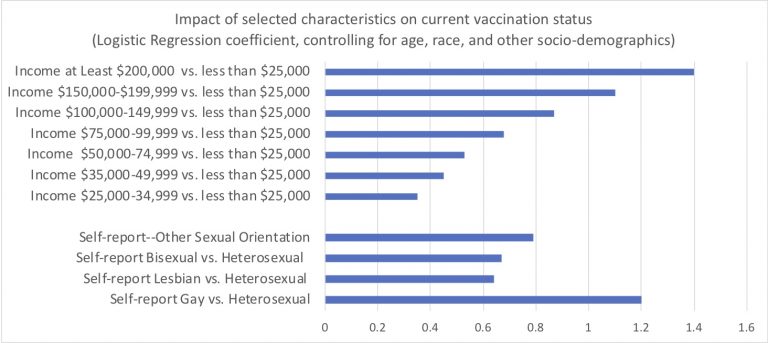
Last night I downloaded the latest Census Bureau July-August week 34 PULSE data. Over two cups of coffee, I ran the obvious multivariable logistic regressions to examine who is now fully vaccinated against COVID.  See the above of this post for the full set of resulting Logit coefficients.

I’m sure Reviewer 2 would order due refinements to my quick analysis, were it immediately submitted for peer-review publication. My capacious study limitations section would note the inherent challenges of population surveys to gauge contentious questions like this. These data surely include response biases and likely overstate the true prevalence of COVID vaccination.

The overall patterns and disparities remain clear enough. Of course, we see huge disparities across regions, by education and by income. A bit more surprising: One group appears especially vulnerable and requires specific outreach…Yup. We must formulate culturally competent public health messaging for heterosexual non-Hispanic white Americans. This group conspicuously lags in vaccination status.

Among self-identified male respondents, heterosexual men were almost four times as likely to report not to be fully vaccinated (19%) as were gay men (5%)–an absolute different quite similar to the gradient observed between men with incomes less than $25,000 and those with incomes between $75,000 and $100,000.

I know that there daunting obstacles to reaching this disparity-population of heterosexual American men. We can’t let these barriers deter us. I’m joking–sort of. OK not really.

Political and social polarization are serious obstacles to our COVID efforts. Tribalization of public health may ironically increase vaccination rates among sexual and gender minorities, the educated, residents of blue states, and the socially liberal. We must find ways to push past these divides.

Cartoon – The Kid’s Point of View

May be a cartoon of standing and text

Cartoon- Bearing the Burden of Anti Mask/Vax Freedom

Recognizing the importance of aerosol transmission

https://mailchi.mp/13ef4dd36d77/the-weekly-gist-august-27-2021?e=d1e747d2d8

Droplets vs Aerosols: What's More Important in COVID-19 Spread? | MedPage  Today

Droplets, fomites, aerosols…these terms describing the kinds of particles which can spread virus particles rose to the top of our lexicon last year. Initially we focused on fomites, infectious particles deposited on surfaces, and worried that touching our groceries and mail could spread the coronavirus.

Scientists were convinced that most COVID transmission occurred via droplets, large respiratory particles exhaled in a cough or a sneeze that traveled only a short distance from an infected person, which led to the guidance that staying six feet apart would keep us safe. But worrisome case reports of a single individual passing the virus to a roomful of people, and the mitigating effects of ventilation, began to hint at aerosol transmission, a much more insidious type of spread in which the virus is transmitted through much smaller particles, which travel longer distances and can linger in the air for hours.

Aerosol spread is not only worrisome because it makes a pathogen more contagious, but smaller aerosol particles can be inhaled more deeply into the lungs, potentially causing more severe illness. A new review in Science evaluates the current data on COVID transmission and the advances made over the past year in understanding airflow and aerosol spread, making the bold statement that aerosol transmission is not only the main mechanism for COVID-19 spread, but is likely the primary mode of transmission for the vast majority of respiratory diseases.
 
Today, our lack of attention to ventilation, air purification and other means to reduce aerosol spread means that we are woefully unprepared for children to return to school—and underscores the need for extensive masking to mitigate transmission. But in the long run, better understanding the mechanisms for preventing airborne transmission could allow us to reduce susceptibility to a host of respiratory diseases. Take complications from asthma, which dropped dramatically during the pandemic—leading researchers to posit that viral infections, rather than environmental triggers, could be the more common cause behind exacerbations. 

Harnessing this new knowledge will require further research to quantify the effects of spread and mitigation—and the willingness to invest in preventive measures in schools and other public spaces, yet another domain in which bolstering public health could have a meaningful long-term impact on our lives.

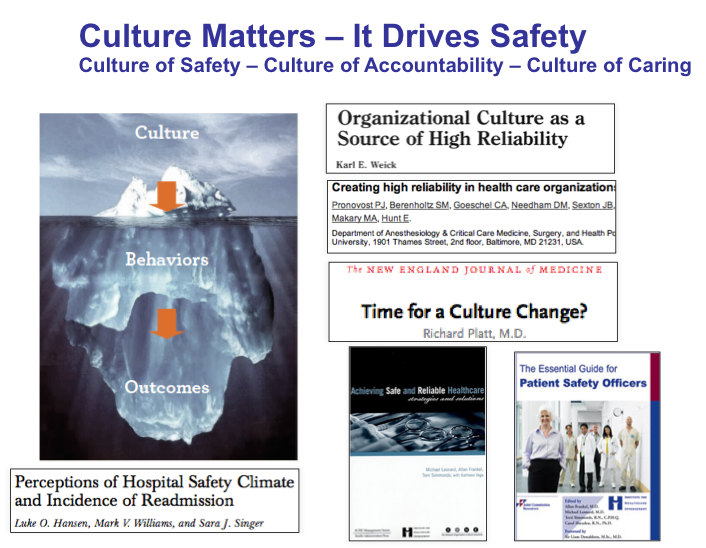
Is the perception of safety in healthcare settings declining?

https://mailchi.mp/13ef4dd36d77/the-weekly-gist-august-27-2021?e=d1e747d2d8

Improving Patient Safety—Why Data Matters

When COVID volumes waned in the spring and early summer, most health systems “de-escalated” dedicated COVID testing and triage facilities. But with the Delta variant surging across the country, consumers are now once again looking for services like drive-through testing, which is perceived as more convenient and safer.

One physician leader told us patients in the ED are asking why the hospital got rid of the “COVID tent”, which provided a separate pathway for patients with respiratory and other COVID symptoms—and a highly visible signal that the rest of the department was as COVID-free as possible.

Another system is now fielding questions from the media about whether they’ll bring back their dedicated COVID hospital: “We spent a lot of time last year convincing the community that the dedicated hospital was key to safely managing care during the pandemic. Now we’ve got almost as many COVID admissions spread across our hospitals.” 

Over the past year, providers have learned how to safely manage COVID care and prevent spread in healthcare settings—but consumers may perceive the lack of dedicated facilities as a decline in safety. 

Unlike last year, hospitals are full of non-COVID patients, as those who delayed care reemerge. And with the current surge likely to continue into flu season, emergency rooms will only get more crowded, necessitating a new round of communication describing how hospitals are keeping patients safe, and reassuring patients that healthcare settings remain one of the safest places to visit in the community. 

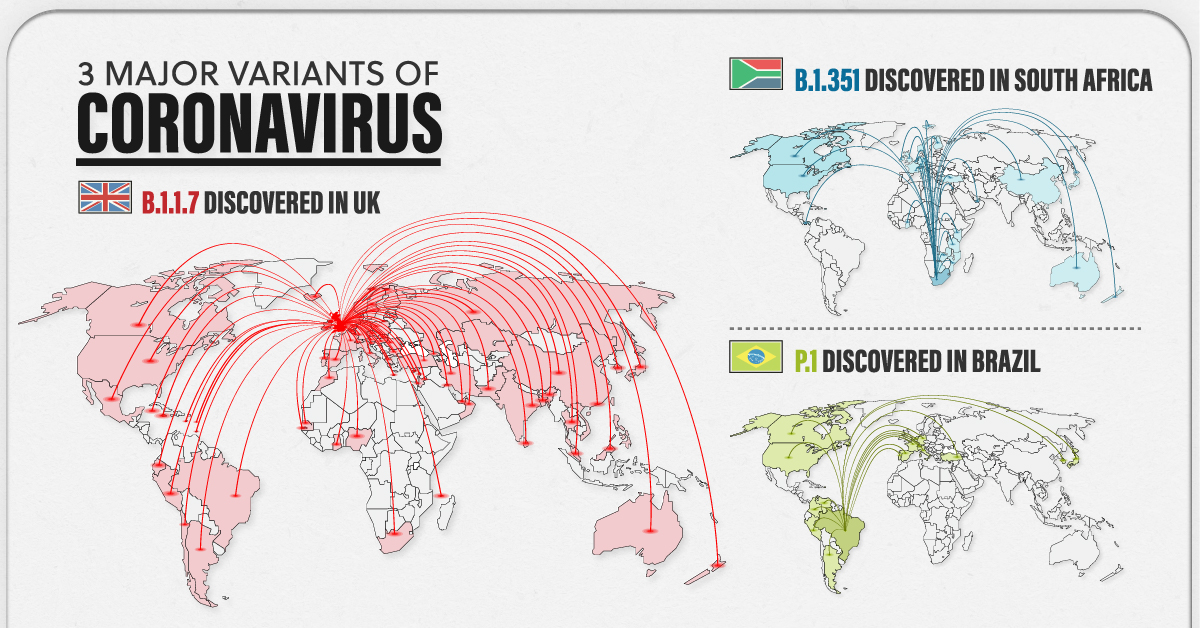
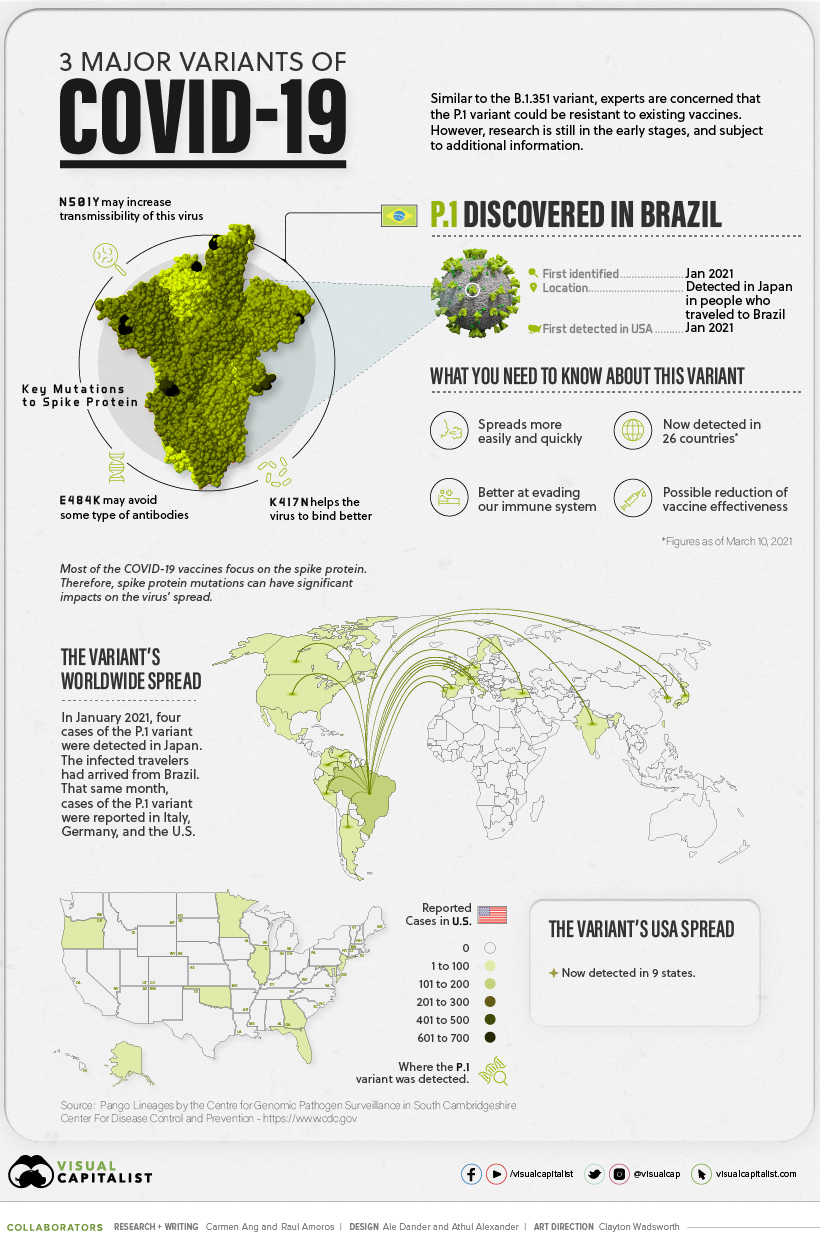
Explained: The 3 Major COVID-19 Variants

Explained: The 3 Major COVID-19 Variants

As billions of people gear up for widespread vaccination against COVID-19, another issue has reared its head. Three major COVID-19 variants have emerged across the globe—and preliminary research suggests these variants may be cause for concern.

But what makes them different from the original strain?

The following visualizations answer some key questions, including when these variants were first discovered, how far they’ve spread worldwide, and most importantly, their potential impact on the population.

Some Context: What is a Variant?

Before diving in, it’s important to understand why viruses mutate in the first place.

To infect someone, a virus takes over a host cell and uses it to replicate itself. But nature isn’t perfect, and sometimes, mistakes are made during the replication process—those mistakes are called mutations.

A virus with one or more mutations is referred to as a variant. Most of the time, variants do not affect a virus’s physical structure, and in those instances, they eventually disappear. However, there are certain cases when a mutation impacts part of a virus’s genetic makeup that does change its behavior.

According to the U.S. Centers for Disease Control (CDC) a change in behavior can alter:

  • Rate of transmission
  • Deadliness
  • Ability to potentially infect someone with natural or vaccine-induced immunity

Preliminary research has detected some of these changes in the three major COVID-19 variants—B.1.1.7B.1.351, and P.1.

The 3 Major COVID-19 Variants

The three major variants emerged at different times, and in different parts of the world. Here’s an overview of each variant, when they were discovered, and how far they’ve spread so far.

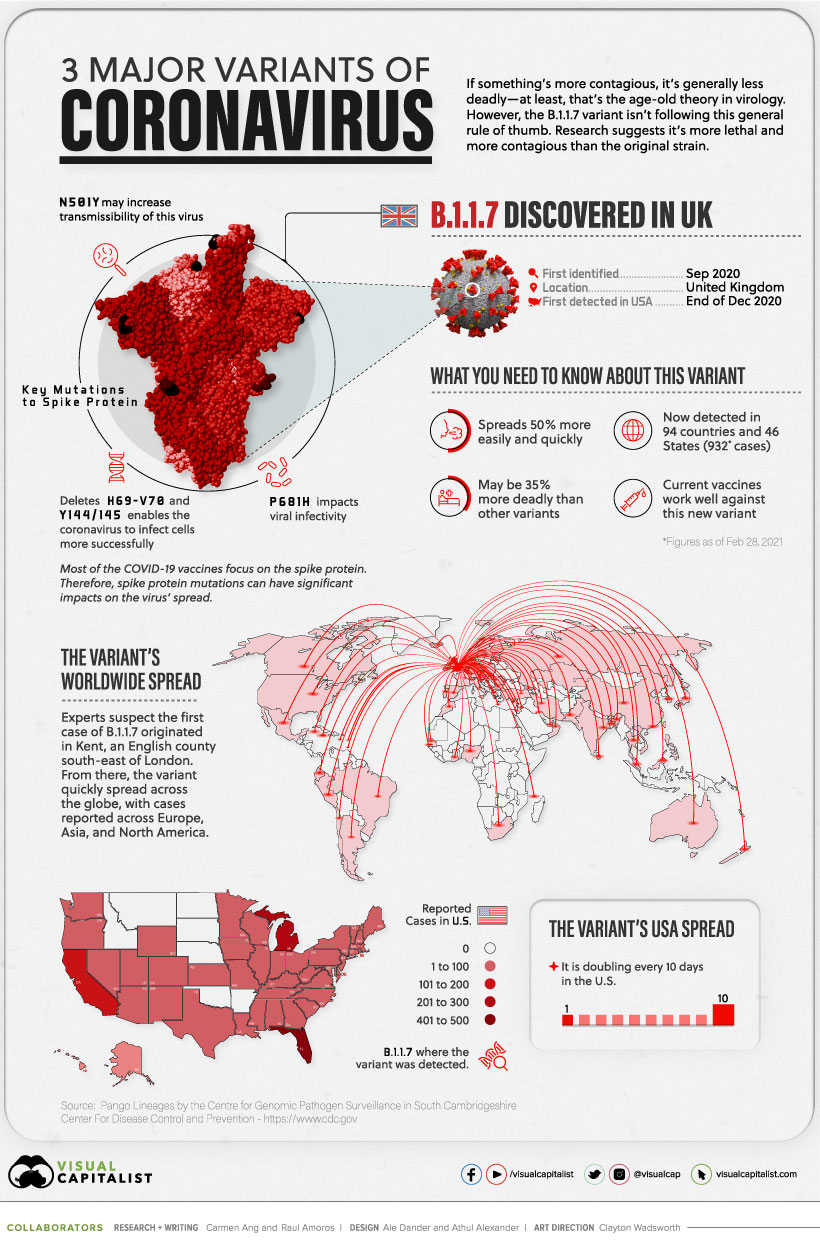
B.1.1.7

The B.1.1.7 variant was detected in the UK in the fall of 2020. By December 2020, it had spread across the globe, with cases emerging across Europe, North America, and Asia.

Currently, the variant has been reported in roughly 94 countries.

Early research suggests it’s 50% more transmissible than other variants, and potentially 35% more deadly than the standard virus. Luckily, studies suggest that some of the existing vaccines work well against it.

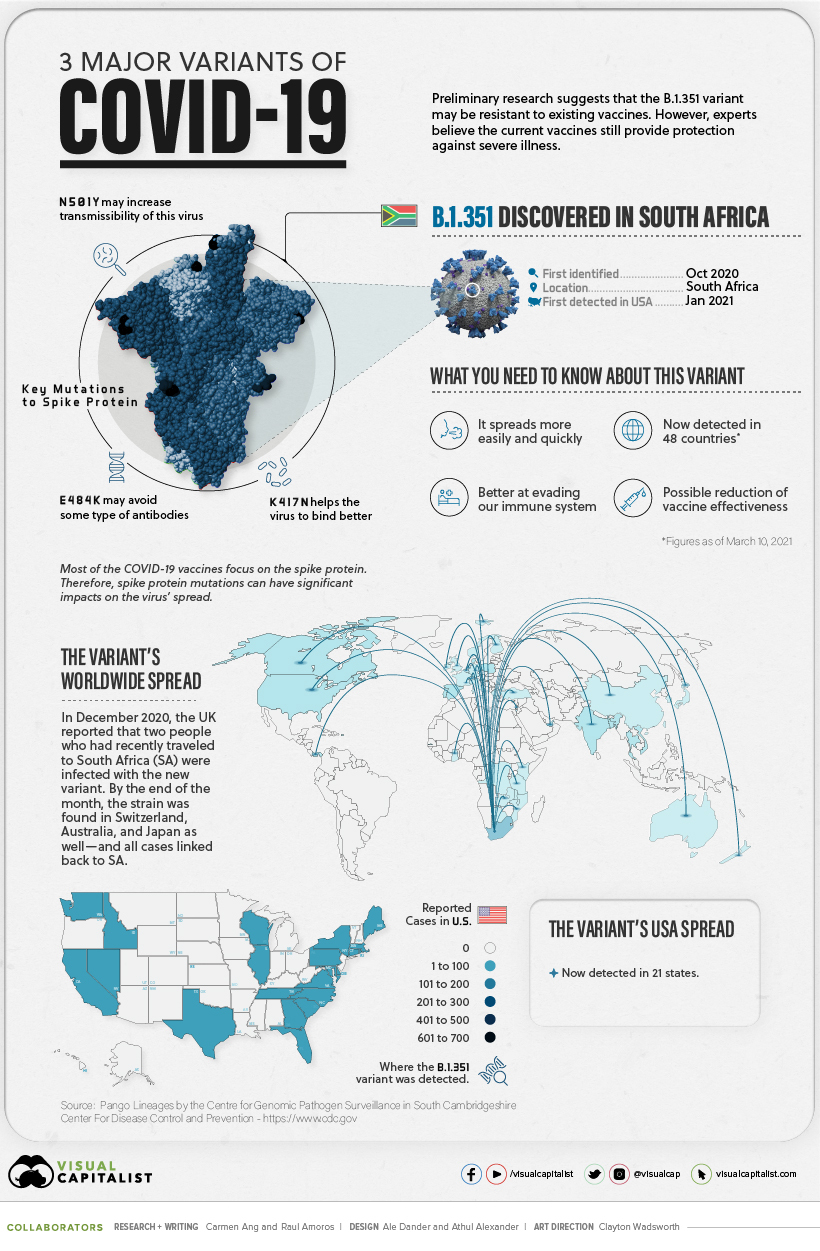
B.1.351

In October 2020, the second major variant was discovered—B.1.351. It was first identified in South Africa, but by end of the year, it had spread to the UK, Switzerland, Australia, and Japan.

There are approximately 48 countries with reported cases, and research suggests several of the existing COVID-19 vaccines may not be as effective against this variant.

P.1

The P.1 variant was the last to arrive on the scene.

It was first discovered in January 2021, when Japan reported four cases of the variant, which was found in travelers who had arrived from Brazil.

Approximately 25 countries have reported cases of the P.1 variant, and early research suggests this variant is not only more contagious, but could also have the ability to infect people with natural immunity who had already recovered from the original strain.

Still Early Days

While there have been preliminary studies showing a dip in vaccine effectiveness, some experts emphasize that it’s too early to tell for certain. More data is needed to gain a deeper and more accurate understanding.

In the meantime, experts are emphasizing the importance of following our current public health strategies, which include physical distancing, vaccination, washing your hands, and using masks.

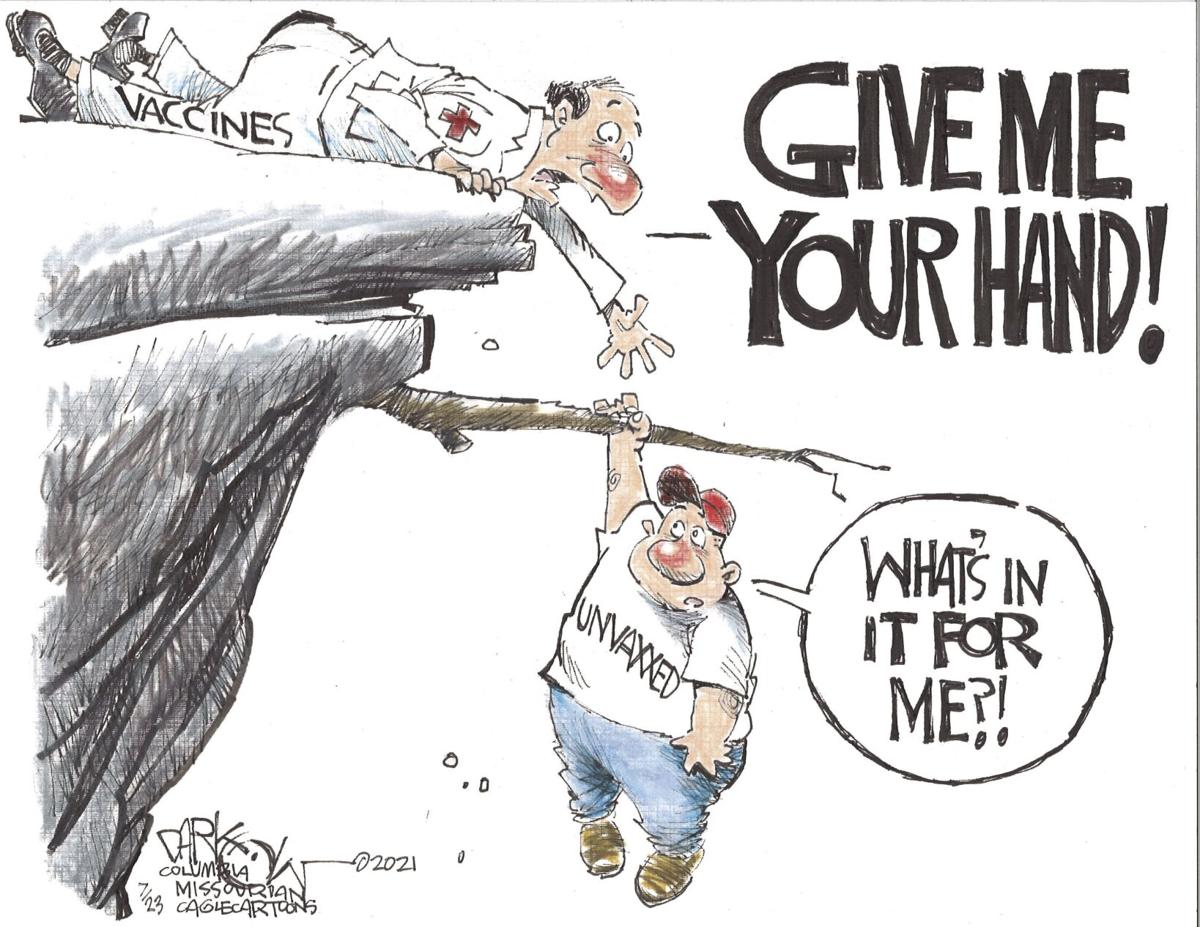
Cartoon – What’s in it for ME?

Editorial Cartoon: The unvaccinated | Opinion | dailyastorian.com

Cartoon – State of the Union (On Science)

New York City to Require Proof of Coronavirus Vaccination for Indoor  Activities | Health News | US News