White House plans to scale back coronavirus task force

https://thehill.com/homenews/administration/496211-white-house-signals-it-will-wind-down-coronavirus-task-force

Anthony Fauci - Axios

The White House is in the early stages of winding down its coronavirus task force, Vice President Pence’s office confirmed Tuesday.

The surprise decision comes as most states are preparing to loosen restrictions meant to slow the spread of the virus, while a number of areas continue to see increases in new COVID-19 cases and deaths.

Pence’s office confirmed to The Hill that the vice president told reporters at a limited briefing that his plan is to scale back the task force’s role by Memorial Day. Pence has been leading the task force since late February.

Members are likely to return to their respective departments and manage the coronavirus response from there.

Dr. Deborah Birx, who was brought in from the State Department to coordinate the White House virus response, will “continue to review and analyze data and work with the departments in agencies to help that data inform their decision making processes,” a spokesman for Pence’s office said.

The New York Times first reported on the expected demise of the task force.

The task force, which includes nearly two dozen officials from various government agencies, held near-daily press briefings for more than a month but has been less visible in recent weeks as President Trump and others transition their focus to the economic consequences of the pandemic.

There have been no coronavirus task force briefings in more than a week, and the daily meetings have become less frequent. The group was scheduled to meet Tuesday afternoon.

But the decision to formally disband the task force is sure to raise concern among public health experts who have warned the coronavirus will likely be part of life in the U.S. until there is a widely available vaccine, which could take a year or longer to develop.


White House prohibits coronavirus task force members from testifying before Congress in May

https://thehill.com/homenews/administration/496016-white-house-prohibits-coronavirus-task-force-members-from-testifying?userid=12325

White House prohibits coronavirus task force members from ...

White House coronavirus task force members are prohibited from testifying before Congress this month under new guidance issued by the Trump administration Monday.

Task force members and key deputies have been instructed not to accept invitations to participate in congressional hearings in May, while other agencies responding to the pandemic are being advised to limit the number of hearings they attend.

Top administration officials argue the coronavirus task force and the primary agencies responding to the pandemic need to focus their attention and resources on response efforts, and that having them testify could use up critical hours.

“We’re telling agencies that during this unprecedented time our resources need to be dedicated toward the coronavirus. At this stage we really need everybody manning their stations and prioritizing coronavirus response work,” a senior administration official told The Hill.

The move comes just days after the White House blocked Anthony Fauci, the nation’s top infectious disease expert and a task force member, from testifying before a House panel.

The White House shot back at allegations it was attempting to silence officials, arguing it will allow for testimony at a later date.

“While the Trump Administration continues its whole-of-government response to COVID-19, including safely opening up America again and expediting vaccine development, it is counter-productive to have the very individuals involved in those efforts appearing at Congressional hearings,” White House deputy press secretary Judd Deere said in a statement last week.

According to the new guidance, “no more than one COVID-related hearing should be agreed to with the department’s primary House and Senate authorizing committee and appropriations subcommittee for the Department of Health and Human Services, Department of Homeland Security and the State Department” with a cap of four coronavirus-related hearings departmentwide through the end of the month.

White House chief of staff Mark Meadows is authorized to approve exemptions to the new protocol, and administration officials noted the guidance will be revisited and could change depending on the circumstances.

The new guidance comes as the Senate comes back into session and the House grapples with how to best bring members back to Washington safely amid the pandemic.

Fauci is currently slated to appear before the Senate Health, Education, Labor and Pensions Committee for a coronavirus-related hearing on May 12.

Other agencies and departments are permitted to accept hearing invitations but have been advised that they should prioritize putting resources toward pandemic response efforts.

“The demands on agencies’ staff and resources are extraordinary in this current crisis. Agencies must maximize their resources for COVID-19 response efforts and treat hearing requests accordingly,” the guidance says.

“Given these competing demands in these unprecedented times, it is reasonable to expect that agencies will have to decline invitations to hearings to remain focused on implementing of COVID-19 response, including declining to participate in multiple hearings on the same or overlapping topics.”

The administration previously issued guidance pulling back on hearings related to COVID-19 in March.


Reopening is a risk for Republican governors

https://www.axios.com/coronavirus-reopening-republican-governors-cases-deaths-c0233fd4-8f92-448e-a11c-ec5bded1def1.html

Coronavirus reopening is a risk for Republican governors - Axios

Republican governors run a big risk — both to public health and their own political fortunes — if they open up their economies too soon, without adequate safeguards.

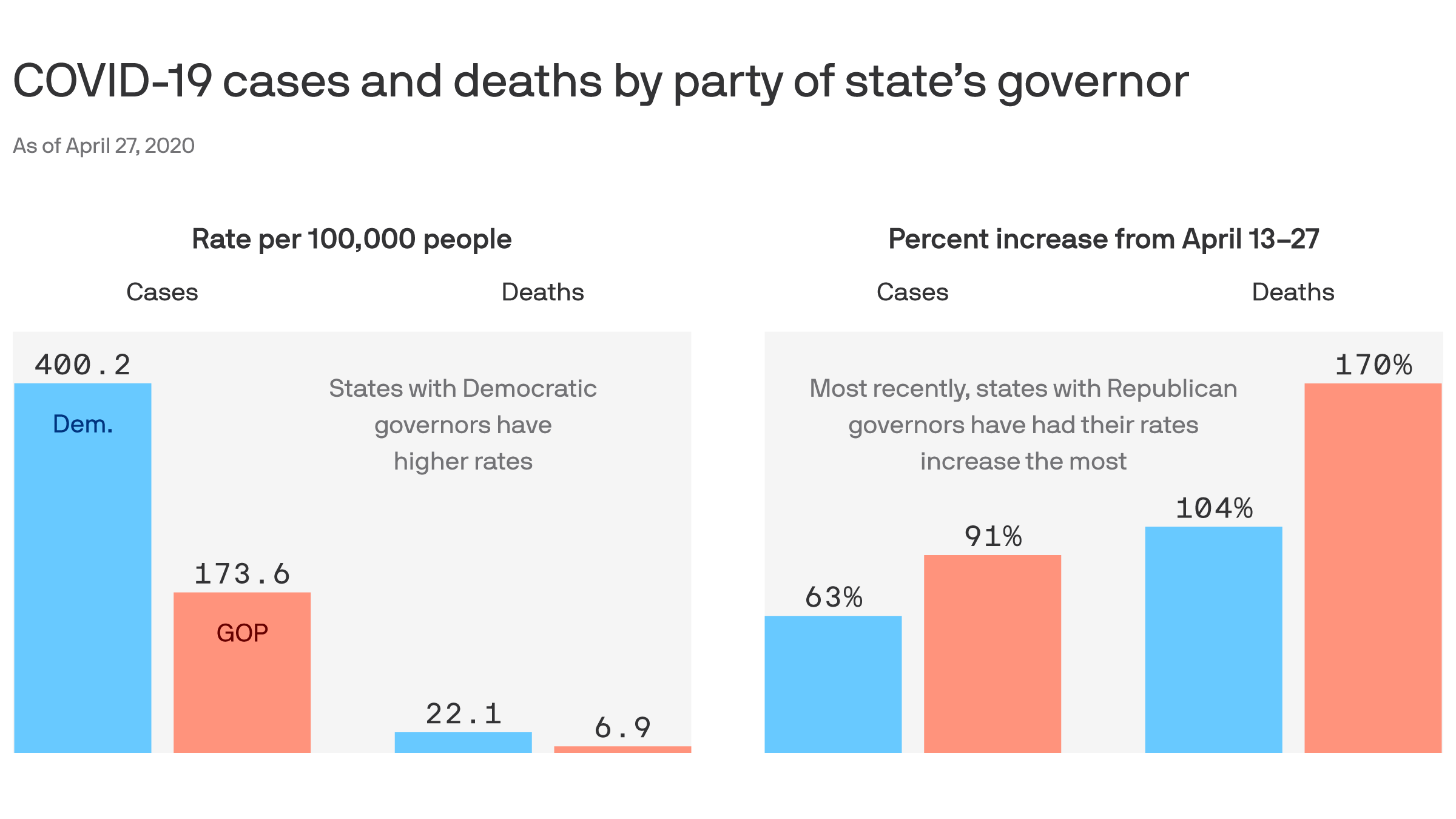
The big picture: The hardest-hit areas so far have mostly been in states with Democratic governors. But the number of coronavirus cases is now increasing more quickly in states with Republican governors.

By the numbers: Coronavirus cases and deaths are both higher in Democratic states than in Republican ones, even after adjusting for population.

  • However, over the last two weeks, reported infections have increased 91% in red states versus 63% in blue states.
  • We see the same pattern for COVID-19 deaths: 170% growth in red states vs. 104% in blue states.

Driving the news: Texas has begun easing its lockdown measures, and other red states are also moving quickly. Florida has reopened some beaches, and some southern states in particular never locked down as tightly as the Northeast and West coast.

  • Yes. but: Every governor wants to open up when they can to get the economy going, and there are some Democratic governors who are also taking steps to ease distancing measures.

Between the lines: The core of the Republican base in white, rural areas is at risk.

  • 20% of people living in non-metro areas are older than 65, compared with 15% in metro areas.
  • And rural residents under 65 are more likely to have pre-existing health conditions (26%), compared to their urban counterparts (20%).

The bottom line: Polls show that Republicans are far more likely than Democrats to think that the worst is behind us when it comes to COVID-19.

  • That may be partly because they, and the Republican governors, think this is largely someone else’s problem. It isn’t.


In educated and affluent Massachusetts, coronavirus cases surged. The decline has yet to come.

https://www.washingtonpost.com/national/coronavirus-massachusetts-cases-high/2020/05/01/8b7b748c-8b2b-11ea-8ac1-bfb250876b7a_story.html?fbclid=IwAR1Hon5rQwU9Tf5b2HQZktH2i8VbLURJomAkHzGmwde1J6N1rkqlaUaVup4&utm_campaign=wp_main&utm_medium=social&utm_source=facebook

Coronavirus cases surged in educated and affluent Massachusetts ...

Massachusetts has one of the most educated and affluent populations in the country. It’s home to some of the nation’s most preeminent medical centers. And it has political leaders who have worked cooperatively, across party lines, in the face of a crisis.

Massachusetts also has the third-highest number of confirmed state coronavirus cases, along with the fourth-highest death toll. And despite predictions that numbers would be falling by now after a month and a half of people staying at home, new case counts have instead remained stubbornly high.

The state’s struggle to combat the coronavirus reflects just what a tenacious adversary it really is. Even for a place that has a lot going for it, the toll has been severe — and it is growing by the day.

As of Friday, Massachusetts had more than 64,000 cases — behind only New York and New Jersey, its larger northeastern neighbors. New cases totaled 2,106, continuing a dismal streak lasting more than two weeks of at least 1,500 additional cases per day. Deaths hit 3,716, behind only New York, New Jersey and Michigan.

Even as many states began opening up their economies Friday — allowing restaurants, shopping malls and hair salons to do business — that remained a distant prospect in Massachusetts. Instead, Gov. Charlie Baker (R) on Friday was announcing new restrictions, including a requirement that people wear masks while in public.

“This is going to be a way of life,” Baker said. “No ifs, no ands, no buts, no doubts.”

The persistence with which people keep getting sick in Massachusetts has been matched in other hard-hit states. Rather than a precipitous decline, the number of new cases in places such as Illinois, California and the D.C. metro area has instead been leveling off slowly.

Experts say that is to be expected, even if it means a long road ahead.

“If social distancing is done well — and Massachusetts has done it pretty well — the effect is going to be to flatten the curve and spread it out over more time,” said David Hamer, professor of global health at Boston University and an infectious-disease physician at Boston Medical Center. “Instead of a peak, it’s a prolonged plateau. It’s going to be a gradual decline.”

Like other states, Massachusetts has avoided some of the most dire projections about how many people would fall ill. Its social distancing measures also have prevented hospitals from becoming overwhelmed.

But actually pushing down the rate — rather than treading water — will be tricky to pull off, because of the nature of who is getting sick.

More than half the state’s deaths have been people in long-term-care facilities, such as nursing homes. The elderly make up a slightly higher share of the Massachusetts population than the national average.

Essential workers — who have to commute to their jobs each day and often are in close quarters with others — also have been hit hard.

“Some people have been able to completely shelter at home. Their risk of getting anything is very low indeed,” said Jeffrey K. Griffiths, who teaches public health at Tufts University. “But there are other groups of people that man the gas stations, the grocery stores, the hospitals. They’re police and firefighters. They still have to go to work.”

And then there are the poor, for whom social distancing at home is particularly challenging.

Geralde Gabeau, an advocate for the state’s Haitian community, said she knows of immigrant families that are living 10 to a two-bedroom apartment and sharing a single bathroom.

“If one person gets infected, the likelihood of everyone being infected is very high,” she said. “There is no room for people to isolate.”

Gabeau said the immigrant assistance group she runs, Immigrants Family Services Institute-USA, has gone from helping 60 families to more than 300. “Our phone never stops,” she said.

And she hesitates before opening Facebook: “All you see is RIP,” she said. “Every single day, people are losing their grandparents. Yesterday we lost a young man, 34 years old. A family in Boston lost four people. The Haitian community is mourning like crazy.”

Immigrant groups say Massachusetts needs to do a better job circulating information about the coronavirus in multiple languages. Though much of the literature is translated into Spanish, that accounts for only about 40 percent of the state’s population that is not proficient in English. Gabeau said she has taken it upon herself to produce videos in Creole to help spread the truth about the virus for the Haitian community, which makes up a significant share of the state’s 1 million-plus foreign-born residents.

Massachusetts was among the earliest states to reckon with a coronavirus outbreak, recording its first case on Feb. 1. But Hamer said the virus was probably present far earlier, and it was far more widespread than anyone knew when Baker declared a state of emergency on March 10. With everyone cooped up indoors for the New England winter but without official mandates to socially distance, the virus had ample opportunity to spread.

Many of the cases from early March were traced back to a late-February conference hosted by a biotech company, Biogen.

Experts say that on the whole, the state has done well with its response. Baker is a Republican, while Democrats dominate the legislature. The two sides have worked cooperatively, with little partisan rancor.

“I would say that as a state we are doing this right,” said Maryanne Bombaugh, president of the Massachusetts Medical Society. “It’s a very positive example of how you can work together and make a difference for your people.”

Bombaugh cited in particular the prevalence of testing in Massachusetts, including of the asymptomatic, which she said accounts at least in part for the state’s relatively high infection levels. The state also is tracing those who come into close contact with people who have tested positive, a vital step in containing future outbreaks.

Unlike states that have been besieged by protests, there has been comparatively little pressure in Massachusetts to reopen before public health experts give the all clear. The state is among a coalition, led by New York, that is trying to coordinate reopenings across the Northeast rather than acting individually, as many states have done.

The state’s nonessential-business closure extends until at least May 18, with an advisory group due to report back to Baker by then on the best way to gradually reopen.

The governor on Friday said he was encouraged by a slight decrease in the percentage of coronavirus-positive patients requiring hospitalization. “Overall, this is a very good sign,” he said.

Yet testing is still below what epidemiologists would like to see before stay-at-home restrictions can be lifted. A sustained drop in positive results is another prerequisite. And although experts say it is probably coming, it will take some time to get there.

“The plateau is telling us that we’re getting there,” Griffiths said. “But if we were to open up again while we’re at that plateau, we would just see another sharp spike up.”


The pandemic didn’t come out of nowhere. The U.S. ignored the warnings.

https://www.washingtonpost.com/opinions/global-opinions/the-pandemic-didnt-come-out-of-nowhere-the-us-ignored-the-warnings/2020/04/21/3bf37566-7db3-11ea-a3ee-13e1ae0a3571_story.html?utm_campaign=wp_opinions&utm_medium=email&utm_source=newsletter&wpis

The pandemic didn't come out of nowhere. The U.S. ignored the ...

“CAME OUT of nowhere,” President Trump said March 6 of the coronavirus pandemic. “I just think this is something . . . that you can never really think is going to happen.” A few weeks later, he added, “I would view it as something that just surprised the whole world.” Mr. Trump also said, “Nobody knew there would be a pandemic or epidemic of this proportion.”

Of course, no one can pinpoint the exact moment that lightning will strike. But a global pandemic? Experts have predicted it, warned about the preparedness gaps and urged action. Again and again and again.

Just look at 2019. In January, the U.S. intelligence community issued its annual global threat assessment. It declared, “We assess that the United States and the world will remain vulnerable to the next flu pandemic or large-scale outbreak of a contagious disease that could lead to massive rates of death and disability, severely affect the world economy, strain international resources, and increase calls on the United States for support. . . . The growing proximity of humans and animals has increased the risk of disease transmission. The number of outbreaks has increased in part because pathogens originally found in animals have spread to human populations.”

In September, the Johns Hopkins Center for Health Security issued a report titled “Preparedness for a High-Impact Respiratory Pathogen Pandemic.” The report found that if such a pathogen emerged, “it would likely have significant public health, economic, social, and political consequences. . . . The combined possibilities of short incubation periods and asymptomatic spread can result in very small windows for interrupting transmission, making such an outbreak difficult to contain.” The report pointed to “large national and international readiness gaps.”

In October, the Nuclear Threat Initiative, working with the Johns Hopkins center and the Economist Intelligence Unit, published its latest Global Health Security Index, examining open-source information about the state of health security across 195 nations, and scoring them. The report warned, “No country is fully prepared for epidemics or pandemics, and every country has important gaps to address.” The report found that “Fewer than 5 percent of countries scored in the highest tier for their ability to rapidly respond to and mitigate the spread of an epidemic.”

In November, the Center for Strategic and International Studies published a study by its Commission on Strengthening America’s Health Security. It warned, “The American people are far from safe. To the contrary, the United States remains woefully ill-prepared to respond to global health security threats. This kind of vulnerability should not be acceptable to anyone. At the extreme, it is a matter of life and death. . . . Outbreaks proliferate that can spread swiftly across the globe and become pandemics, disrupting supply chains, trade, transport, and ultimately entire societies and economies.” The report recommended: “Restore health security leadership at the White House National Security Council.”

Came out of nowhere? Not even close. The question that must be addressed in future postmortems is why all this expertise and warning was ignored.


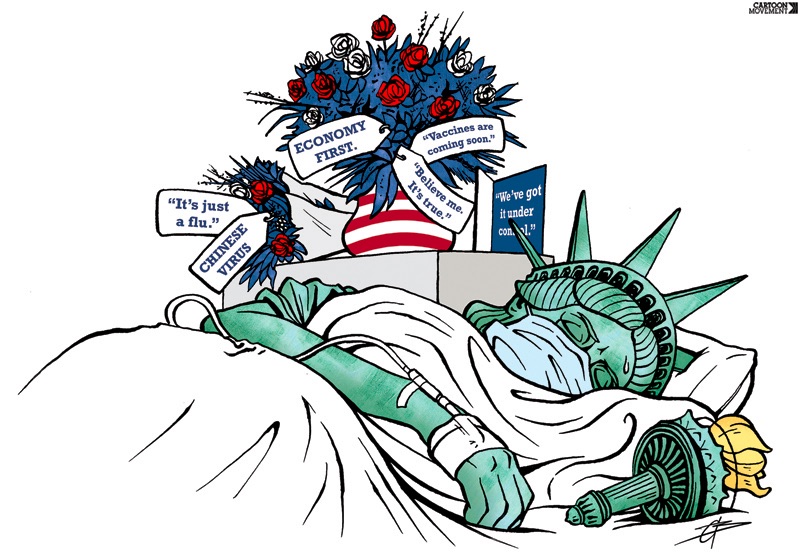
Cartoon – State of the Union

iroon.com: Cartoons


Cartoon – Coronavirus Prevention Today

College Signals Concern over Coronavirus Outbreak Cooks Adresses ...

70% Of Americans Want Officials To Prioritize Public Health Over Restarting Economy

https://www.forbes.com/sites/arielshapiro/2020/04/23/70-of-americans-want-officials-to-prioritize-public-health-over-restarting-economy-trump-kemp/?utm_source=newsletter&utm_medium=email&utm_campaign=news&utm_campaign=news&cdlcid=#74a9d5ce68d3

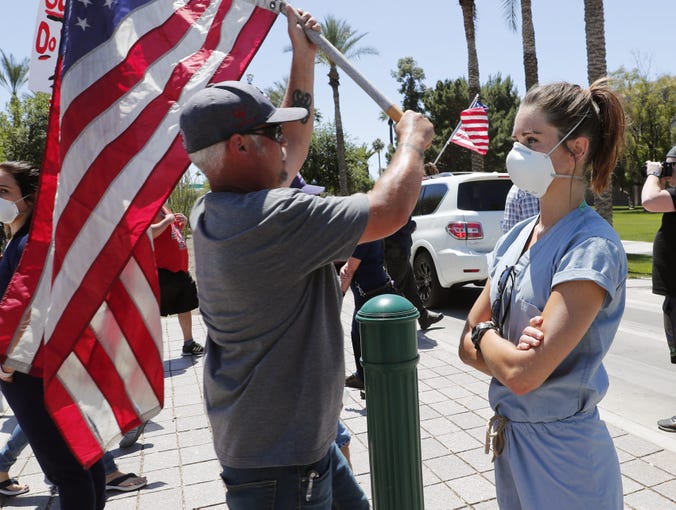
The ICU nurse who stood masked and silent at the rally to open Arizona

A wide majority of Americans are not ready to resume public life, according to a poll released Thursday by CBS News and YouGov, as governors in Georgia, Tennessee and South Carolina plan to allow stay-at-home orders to expire next week.

KEY FACTS

Only 30% of people surveyed said the government’s priority should be restarting the economy; 70% said the focus should be on slowing the virus through social distancing measures.

The polling shows a partisan divide—while 91% of Democrats and 69% of Independents favor focusing on public health, 52% of Republicans say the economy should take precedence.

29% of those polled said they would feel comfortable eating at a restaurant; Georgia Governor Brian Kemp will allow certain businesses, including restaurants, to open on April 27, 2020.

A minority of respondents said they would be comfortable going to work right now (44%) and even fewer said they would attend a large entertainment or sports event (13%), but the social isolation is taking its toll—54% said they would be willing to visit their friends.

KEY BACKGROUND

Protests against stay-at-home orders have cropped up around the country in states like California and Michigan, initially with President Donald Trump’s support. Although the movement is vocal, its support is limited. Less than a quarter of the poll’s respondents said they support the protests, and only 7% think that Trump should encourage them. The president is starting to change his tune, criticizing Georgia Governor Kemp’s plan to reopen businesses at the White House briefing on Wednesday.

WHAT TO WATCH FOR

Florida Governor Ron DeSantis said he is coordinating with neighboring governors on how to proceed, but has not yet announced whether he will extend the state’s stay-at-home order or let it expire. Florida has had more than 28,000 cases of COVID-19, more than any other southern state. A Quinnipiac poll released Wednesday shows that Florida residents’ opinions on reopening the economy reflect those of the country: Only 22% said that the state should loosen social distancing rules at the end of the month. As a first step, DeSantis allowed localities to reopen their beaches last week, and some, notably those in Jacksonville, were crowded.


The South is vulnerable to a coronavirus nightmare

https://www.axios.com/newsletters/axios-vitals-d53939d5-90fb-4aef-a87d-30cf2b0ceebf.html?utm_source=newsletter&utm_medium=email&utm_campaign=newsletter_axiosvitals&stream=top

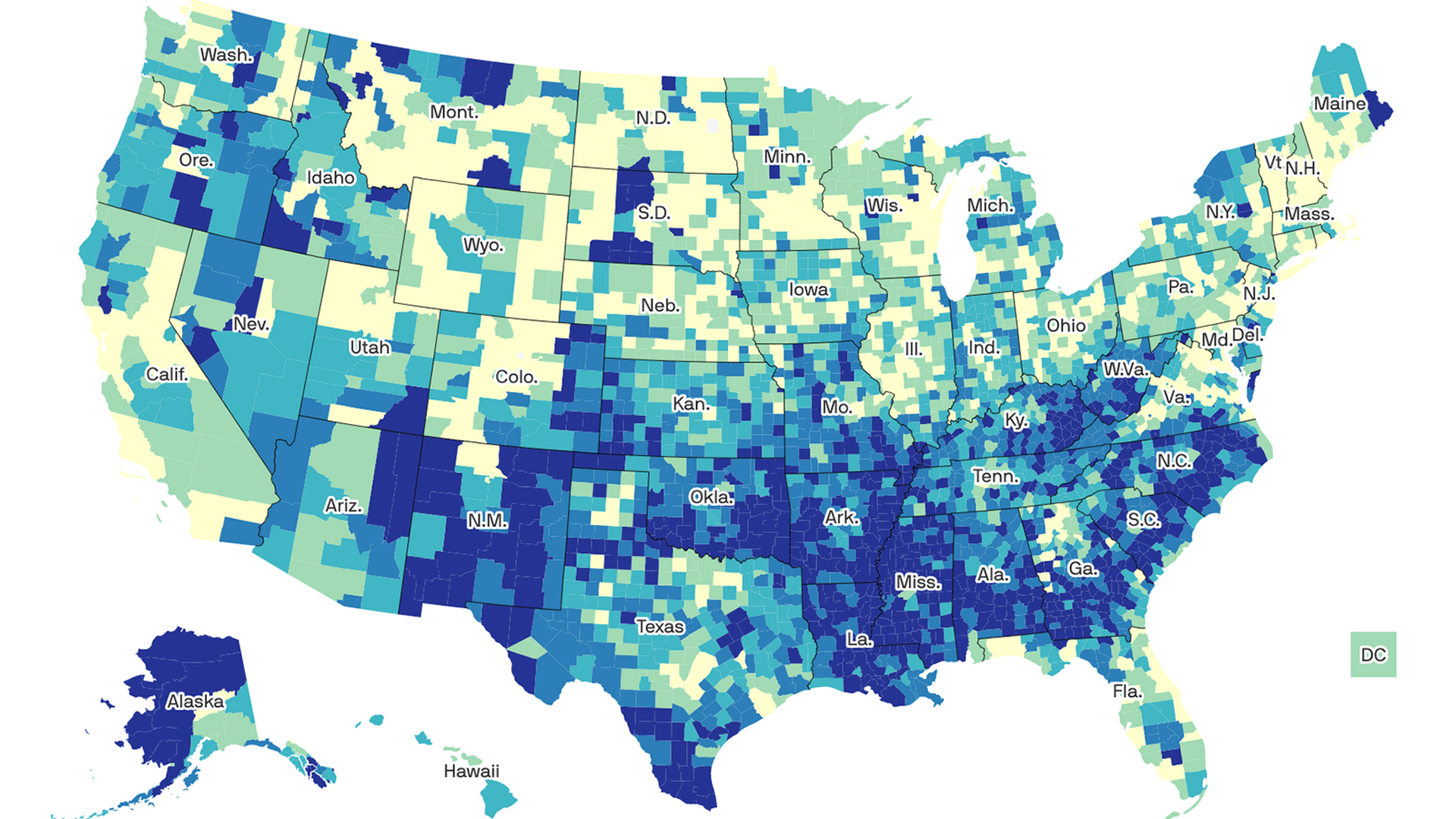
COVID-19 vulnerability index, by county

Arrow


The South is at risk of being devastated by the coronavirus.

Why it matters: Southern states tend to have at-risk populations and weak health care systems — and they’re the ones moving fastest to loosen social distancing rules. That puts them at risk for the worst-case coronavirus scenarios.

The big picture: To stop the spread of the coronavirus, there are really only two options: stringent social distancing, or stringent public health measures.

Driving the news: Several southern states including Georgia, Tennessee and South Carolina have recently announced that they’re starting to back off of social distancing.

  • Our national testing capacity is still nowhere near where experts say it needs to be, and only some communities have announced efforts to build up contact tracing.

Between the lines: The Surgo Foundation created a coronavirus community vulnerability index that takes into account factors like socioeconomic status, minority status, housing type, epidemiologic factors and health care system factors.

The bottom line: The South is already worse off in almost every way, partially due to policy choices made in these states. Its comparatively unhealthy population is vulnerable to more serious illness, and looser social distancing will enable the virus’ spread.


Interim Coronavirus Relief Bill

https://heathercoxrichardson.substack.com/p/april-23-2020

Congress expected to announce deal on latest coronvirus relief bill

Today the House of Representatives passed a new $484 billion coronavirus relief bill by a vote of 388-5. The Senate passed it Tuesday. $381 billion is for small businesses left out in the cold when the money from the previous coronavirus relief package quickly ran dry. Republicans wanted to stop there, but Democrats demanded $75 billion for hospitals, and $25 billion for coronavirus testing, as well as a requirement that the administration figure out a strategy to get tests to states.

The relief bill comes as more than 26 million Americans are out of work and almost 50,000 Americans have died of Covid-19. The representatives had to drive to Washington, D.C., or fly unusual routes because regular flights are canceled. They arrived for the vote in the Capitol building in alphabetical groups of 50 to 60 so they could keep their distance from each other. A number of Republicans refused to wear masks during the vote, while all but one Democrat wore one.

Democrats inserted into the bill a new committee to oversee the administration’s “preparedness for and response to the coronavirus crisis,” chaired by Jim Clyburn (D-SC). The committee has the power to subpoena witnesses and documents. Republicans and Trump objected.

But the Democrats did not get any more aid to states, crippled by the crisis, than the $150 billion previously provided. The bipartisan National Governors Association, headed by Maryland Governor Larry Hogan, a Republican, has asked for $500 billion to help the states replace lost tax revenues. Democrats wanted such aid, but Republicans refused.

Senate Majority Leader Mitch McConnell (R-KY) went on talk radio host Hugh Hewitt’s show on Wednesday and tried to make the question of state aid partisan. He said that he opposed granting money to states whose problems, he said, stemmed from their underfunded state pension plans. Instead, the states should consider bankruptcy. A document put out by McConnell’s office called aid to the states a “blue state bailout.”

In fact, Michael Leachman, the senior director of state fiscal research at the Center on Budget and Policy Priorities, said that McConnell has it wrong. States have not been overspending; their expenses for education and infrastructure are actually significantly below what they were in 2008, despite more inhabitants, and they have put about 7.6% of their budgets into rainy day funds, a historic high, up from the previous high of 5% they held in reserve in 2006 before the Great Recession.

The problem is that states have to balance their budgets annually, and they depend on sales and income taxes for 70% of their revenue. The shutdowns have decimated tax revenues as shopping ends and people lose their jobs. At the same time, unemployment claims are climbing dramatically. States are looking at a $500 billion loss between now and 2022.

States need money to avoid massive layoffs and deep spending cuts, actions that would make the economic crisis continue much longer than it would if they do not have to make them. They would not use bailout money on pensions, Leachman writes, but put it in state general funds, which are collapsing. Pensions come out of a separate trust fund (although the general fund does put money toward future pensions, that’s less than 5% spending from the general fund). Federal bankruptcy law currently does not allow states to declare bankruptcy, but in any case, Leachman writes, there is no need for it. Bankruptcy relieves high debt levels, but state debt is not high, and once the pandemic passes, the states should be financially sound again.

If Leachman’s explanation was scholarly, New York Governor Andrew Cuomo was blunt. “New York puts into that federal pot $116B more than we take out. Kentucky takes out $148B more than they put in,” he said at a press conference. “Senator McConnell, who’s getting bailed out here? It’s your state that’s living on the money that we generate.” A recent study by the Rockefeller Institute of Government shows that New Yorkers as a group pay in to the federal government $1,792 per capita more than they take out, while for every dollar Kentucky puts in, it gets $2.61 back.

Cuomo called McConnell out for trying to turn the crisis into a political fight: “That’s not what this country is all about,” Cuomo said. “It’s not red and blue, it’s red, white and blue.”

Today’s other big news was Trump’s suggestion at his coronavirus briefing that it would be worth studying whether injecting disinfectant into patients would kill the novel coronavirus. “And then I see the disinfectant where it knocks it out in a minute. One minute. And is there a way we can do something like that, by injection inside or almost a cleaning?” he said. “Because, you see, it gets on the lungs, and it does a tremendous number on the lungs. So it’d be interesting to check that. So that you’re going to have to use medical doctors, but it sounds — it sounds interesting to me.” He also suggested using heat and light to kill the virus.

Doctors were horrified at his comment, calling it irresponsible and dangerous. Disinfectants are poisonous and are deadly if they are used inappropriately. “To be clear:” emergency medicine physician Dara Kass tweeted, “Intracavitary UV light and swallowing bleach or isopropyl alcohol can kill you. Don’t do it.”

Trump’s emphasis on dramatic cures for Covid-19 reinforces his disagreement with health experts that we must dramatically increase our testing for the disease so we can identify hot spots and isolate them before they spread. At today’s briefing, Trump disagreed with Dr. Anthony Fauci, the director of the National Institute of Allergy and Infectious Diseases and one of the administration’s top medical advisors about the pandemic, who recently said “We absolutely need to significantly ramp up, not only the number of tests but the capacity to actually perform them.” Today, Trump said: “I don’t agree with him on that, no, I think we’re doing a great job on testing.”

In fact, the U.S. lags behind other nations in per capita tests, and Trump’s continuing reluctance to support getting them seems to me mystifying. It is this odd gap Congress is trying to address with its requirement in the new coronavirus package that the administration must figure out a strategy to get tests to states. The bill now heads to the Oval Office for Trump’s signature.

For all the dark nitty-gritty of politics today, it is also a day that begins a joyous month, and that seems to me a far better way to leave you all tonight than with the day’s troubles. For those who celebrate, Ramadan Mubarak.