15 innovative ideas for fixing healthcare from 15 brilliant minds

https://www.linkedin.com/pulse/15-innovative-ideas-fixing-healthcare-from-brilliant-pearl-m-d-/

After 18 years as CEO in Kaiser Permanente, I set my sights on improving the heatlh of the nation, hoping to find a way to achieve the same quality, technology and affordability our medical group delivered to 5 million patients on both coasts.

That quest launched the Fixing Healthcare podcast in 2018, and it inspired interviews with dozens of leaders, thinkers and doers, both in and around medicine. These experts shared innovative ideas and proven solutions for achieving (a) superior quality, (b) improved patient access, (c) lower overall costs, and (d) greater patient and clinician satisfaction.

This month, after 150 combined episodes, three questions emerged:

  • Which of the hundreds of ideas presented remain most promising?
  • Why, after five years and so many excellent solutions, has our nation experienced such limited improvements in healthcare?
  • And finally, how will these great ideas become reality?

To answer the first question, I offer 15 of the best Fixing Healthcare recommendations so far. Some quotes have been modified for clarity with links to all original episodes (and transcripts) included.

Fixing the business of medicine

1. Malcolm Gladwell, journalist and five-time bestselling author: “In other professions, when people break rules and bring greater economic efficiency or value, we reward them. In medicine, we need to demonstrate a consistent pattern of rewarding the person who does things better.”

2. Richard Pollack, CEO of the American Hospital Association (AHA): “I hope in 10 years we have more integrated delivery systems providing care, not bouncing people around from one unconnected facility to the next. I would hope that we’re in a position where there’s a real focus on ensuring that people get care in a very convenient way.”

Eliminating burnout

3. Zubin Damania, aka ZDoggMD, hospitalist and healthcare satirist: “In the culture of medicine, specialists view primary care as the weak medical students, the people who couldn’t get the board scores or rotation honors to become a specialist. Because why would you do primary care? It’s miserable. You don’t get paid enough. It’s drudgery. We must change these perceptions.”

4. Devi Shetty, India’s leading heart surgeon and founder of Narayana Health: “When you strive to work for a purpose, which is not about profiting yourself, the purpose of our action is to help society, mankind on a large scale. When that happens, cosmic forces ensure that all the required components come in place and your dream becomes a reality.”

5. Jonathan Fisher, cardiologist and clinician advocate: “The problem we’re facing in healthcare is that clinicians are all siloed. We may be siloed in our own institution thinking that we’re doing it best. We may be siloed in our own specialty thinking that we’re better than others. All of these divides need to be bridged. We need to begin the bridging.” 

Making medicine equitable

6. Jen Gunter, women’s health advocate and “the internet’s OB-GYN”: “Women are not listened to by doctors in the way that men are. They have a harder time navigating the system because of that. Many times, they’re told their pain isn’t that serious or their bleeding isn’t that heavy. We must do better at teaching women’s health in medicine.”

7. Amanda Calhoun, activist, researcher and anti-racism educator: “A 2015 survey showed that white residents and medical students still thought Black people feel less pain, which is wild to me because Black is a race. It’s not biological. This is actually an historical belief that persists. One of the biggest things we can do as the medical system is work on rebuilding trust with the Black community.”

Addressing social determinants of health

8. Don Berwick, former CMS administrator and head of 100,000 Lives campaign: “We know where the money should go if we really want to be a healthy nation: early childhood development, workplaces that thrive, support to the lonely, to elders, to community infrastructures like food security and transportation security and housing security, to anti-racism and criminal-justice reform. But we starve the infrastructures that could produce health to support the massive architecture of intervention.”

9. David T. Feinberg, chairman of Oracle Health: “Twenty percent of whether we live or die, whether we have life in our years and years in our life, is based on going to good doctors and good hospitals. We should put the majority of effort on the stuff that really impacts your health: your genetic code, your zip code, your social environment, your access to clean food, your access to transportation, how much loneliness you have or don’t have.”

Empowering patients

10. Elisabeth Rosenthal, physician, author and editor-in-chief of KHN“To patients, I say write about your surprise medical bills. Write to a journalist, write to your local newspaper. Hospitals today are very sensitive about their reputations and they do not want to be shamed by some of these charges.”

11. Gordon Chen, ChenMed CMO: “If you think about what leadership really is, it’s influence. Nothing more, nothing less. And the only way to achieve better health in patients is to get them to change their behaviors in a positive way. That behavior change takes influence. It requires primary care physicians to build relationship and earn trust with patients. That is how both doctors and patients can drive better health outcomes.”

Utilizing technology

12. Vinod Khosla, entrepreneur, investor, technologist: “The most expensive part of the U.S. healthcare system is expertise, and expertise can relatively be tamed with technology and AI. We can capture some of that expertise, so each oncologist can do 10 times more patient care than they would on their own without that help.”

13. Rod Rohrich, influential plastic surgeon and social media proponent: “Doctors, use social media to empower your audience, to educate them, and not to overwhelm them. If you approach social media by educating patients about their own health, how they can be better, how can they do things better, how they can find doctors better, that’s a good thing.”

Rethinking medical education

14. Marty Makary, surgeon and public policy researcher: “I would get rid of all the useless sh*t we teach our medical students and residents and fellows. In the 16 years of education that I went through, I learned stuff that has nothing to do with patient care, stuff that nobody needs to memorize.”

15. Eric Topol, cardiologist, scientist and AI expert: “It’s pretty embarrassing. If you go across 150 medical schools, not one has AI as a core curriculum. Patients will get well versed in AI. It’s important that physicians stay ahead, as well.”

Great ideas, but little progress

Since 2018, our nation has spent $20 trillion on medical care, navigated the largest global pandemic in a century and developed an effective mRNA vaccine, nearly from scratch. And yet, despite all this spending and scientific innovation, American medicine has lost ground.  

American life expectancy has dropped while maternal mortality rates have worsened. Clinician burnout has accelerated amid a growing shortage of primary care and emergency medicine physicians. And compared to 12 of its wealthiest global peers, the United States spends nearly twice as much per person on medical care, but ranks last in clinical outcomes.

Guests on Fixing Healthcare generally agree on the causes of stagnating national progress.

Healthcare system giants, including those in the drug, insurance and hospital industries, find it easier to drive up prices than to prevent disease or make care-delivery more efficient. Over the past decade, they’ve formed a conglomerate of monopolies that prosper from the existing rules, leaving them little incentive to innovate on behalf of patients. And in this era of deep partisan divide, meaningful healthcare reforms have not (and won’t) come from Congress.  

Then who will lead the way?

Industry change never happens because it should. It happens when demand and opportunity collide, creating space for new entrants and outsiders to push past the established incumbents. In healthcare, I see two possibilities:   

1. Providers will rally and reform healthcare

Doctors and hospitals are struggling. They’re struggling with declining morale and decreasing revenue. Clinicians are exiting the profession and hospitals are shuttering their doors. As the pain intensifies, medical group leaders may be the ones who decide to begin the process of change.

The first step would be to demand payment reform.

Today’s reimbursement model, fee-for-service, pays doctors and hospitals based on the quantity of care they provide—not the quality of care. This methodology pushes physicians to see more patients, spend less time with them, and perform ever-more administrative (billing) tasks. Physicians liken it to being in a hamster wheel: running faster and faster just to stay in place.

Instead, providers of care could be paid by insurers, the government and self-funded businesses directly, through a model calledcapitation.” With capitation, groups of providers receive a fixed amount of money per year. That sum depends on the number of enrollees they care for and the amount of care those individuals are expected to need based on their age and underlying diseases.

This model puts most of the financial risk on providers, encouraging them to deliver high-quality, effective medical care. With capitation, doctors and hospitals have strong financial incentives to prevent illnesses through timely and recommended preventive screenings and a focus on lifestyle-medicine (which includes diet, exercise and stress reduction). They’re rewarded for managing patients’ health and helping them avoid costly complications from chronic diseases, such as heart attacks, strokes and cancer.

Capitation encourages doctors from all specialties to collaborate and work together on behalf of patients, thus reducing the isolation physicians experience while ensuring fewer patients fall through the cracks of our dysfunctional healthcare system. The payment methodology aligns the needs of patients with the interests of providers, which has the power to restore the sense of mission and purpose medicine has lost.

Capitation at the delivery-system level eliminates the need for prior authorization from insurers (a key cause of clinician burnout) and elevates the esteem accorded to primary care doctors (who focus on disease prevention and care coordination). And because the financial benefits are tied to better health outcomes, the capitated model rewards clinicians who eliminate racial and gender disparities in medical care and organizations that take steps to address the social determinants of health.

2. Major retailers will take over

If clinicians don’t lead the way, corporate behemoths like Amazon, CVS and Walmart will disrupt the healthcare system as we know it. These retailers are acquiring the insurance, pharmacy and direct-patient-care pieces needed to squeeze out the incumbents and take over American healthcare.

Each is investing in new ways to empower patients, provide in-home care and radically improve access to both in-person and virtual medicine. Once generative AI solutions like ChatGPT gain enough computing power and users, tech-savvy retailers will apply this tool to monitor patients, enable healthier lifestyles and improve the quality of medical care compared to today.

When Fixing Healthcare debuted five years ago, none of the show’s guests could have foreseen a pandemic that left more than a million dead. But, had our nation embraced their ideas from the outset, many of those lives would have been saved. The pandemic rocked an already unstable and underperforming healthcare system. Our nation’s failure to prevent and control chronic disease resulted in hundreds of thousands of unnecessary deaths from Covid-19. Outdated information technology systems, medical errors and disparities in care caused hundreds of thousands more. As a nation, we could have done much better.

With the cracks in the system widening and the foundation eroding, disruption in healthcare is inevitable. What remains to be seen is whether it will come from inside or outside the U.S. healthcare system.
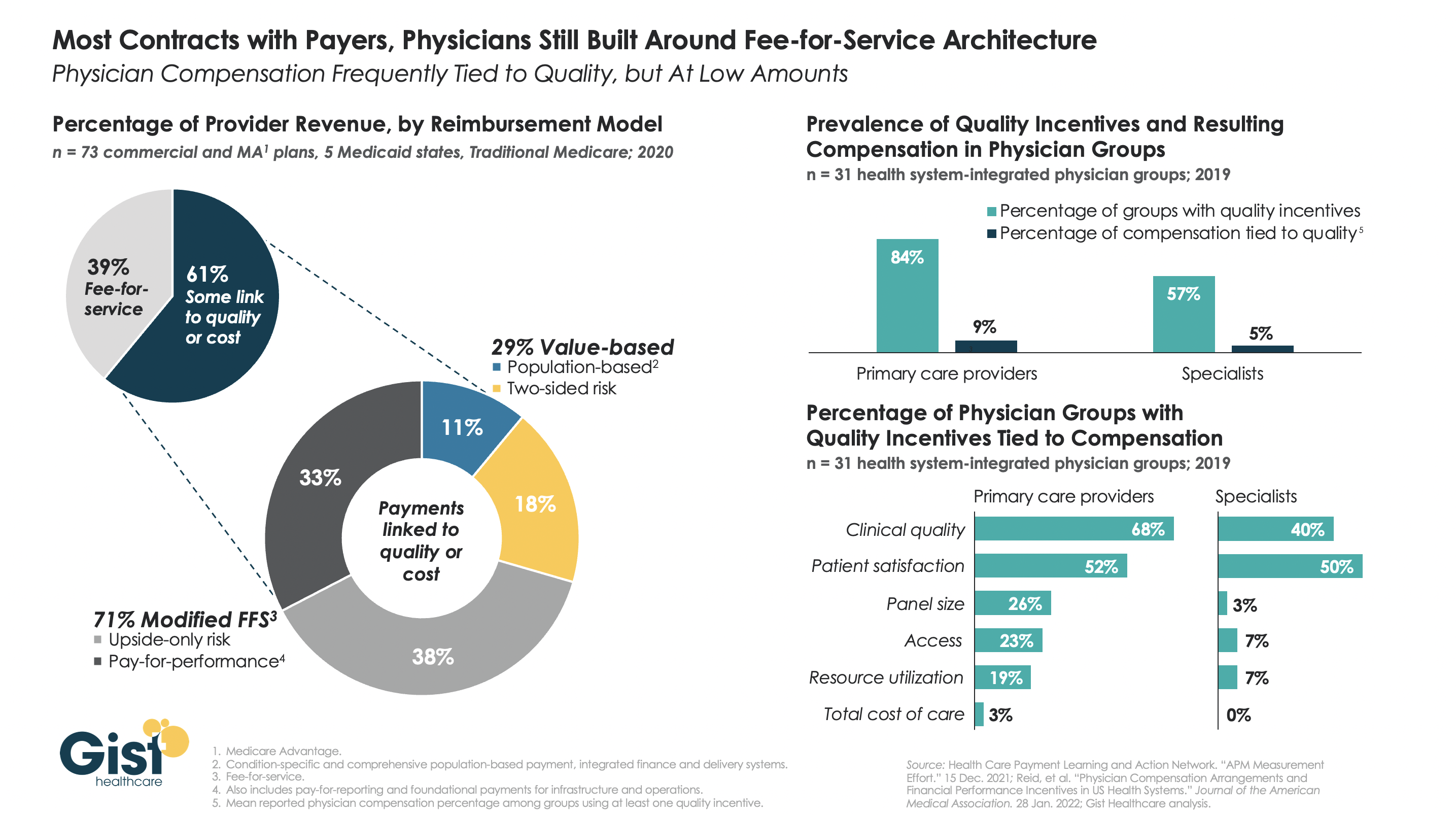
Payer contracts, physician pay still anchored in fee-for-service

The healthcare industry has made some strides in the “journey to value” across the last decade, but in reality, most health systems and physician groups are still very much entrenched in fee-for-service incentives.

While many health plans report that significant portions of their contract dollars are tied to cost and quality performance, what plans refer to as “value” isn’t necessarily “risk-based.” 

The left-hand side of the graphic below shows that, although a majority of payer contracts now include some link to quality or cost, over two-thirds of those lack any real downside risk for providers. 

Data on the right show a similar parallel in physician compensation. While the majority of physician groups have some quality incentives in their compensation models, less than a tenth of individual physician compensation is actually tied to quality performance. 

Though myriad stakeholders, from the federal government to individual health systems and physician groups, have collectively invested billions of dollars in migrating to value-based payment over the last decade, we are still far from seeing true, performance-based incentives translate into transformation up and down the healthcare value chain.  

UnitedHealthcare’s policy will limit outpatient surgery payments to hospitals

https://www.beckershospitalreview.com/finance/unitedhealthcare-s-policy-will-limit-outpatient-surgery-payments-to-hospitals.html?oly_enc_id=2893H2397267F7G

Related image

UnitedHealthcare has expanded prior authorization requirements and site of service medical necessity reviews for certain surgeries in an effort to shift surgical procedures to less expensive locations, according to Modern Healthcare.

The outpatient surgery policy will limit the circumstances under which UnitedHealthcare will pay for certain surgeries in a hospital outpatient setting.

Taking effect in November for fully insured groups in most states, UnitedHealthcare will only pay for a surgical procedure performed in an outpatient hospital setting if the insurer determines the site of service for the procedure is medically necessary, UnitedHealthcare told Becker’s Hospital Review.

“Medical necessity reviews for site of service occur during our prior authorization process and are only conducted if the surgical procedure will be performed in an outpatient hospital setting,” UnitedHealthcare said. “We utilize our Outpatient Surgical Procedures – Site of Service Utilization Review Guideline to help make our site of service medical necessity determinations. Site of service medical necessity reviews are currently being conducted for certain surgical procedures and will apply to additional surgical procedures beginning on Nov. 1, 2019 for most states.”

In California, Colorado, Connecticut, New Jersey and New York, medical necessity reviews will begin for certain surgeries occurring on or after Dec. 1, according to a UnitedHealthcare bulletin. Site of service medical necessity reviews do not apply to providers in Alaska, Kentucky, Massachusetts, Maryland and Texas.  

With the outpatient surgery policy, the insurer said it hopes to reduce healthcare spending by guiding patients toward ambulatory surgery centers, where care may be cheaper when there isn’t a substantial medical reason for the surgery to be performed in a hospital outpatient setting.

The U.S. has fantastic health care, the problem is….

Click to access wf1341834-cmo-campaign-wyatt-decker-article-part1.pdf

Image result for The U.S. has fantastic  health care, the problem is….

In part 1 of an executive interview series, CEO and physician Wyatt Decker discusses his perspectives on today’s challenges and opportunities for reinventing health care.

IMAGINE THIS SCENARIO: there are 200 people in a room and each person has a serious health condition. Cost is not a barrier to each of these people receiving their prescribed treatment. A question is asked — how many of you would book a flight to a different country to get your care? You guessed it. No hands go up.

Dr. Wyatt Decker is chief executive officer of OptumHealth and an emergency medicine physician who brings more than two decades of service within the Mayo Clinic. He held dual roles as chief medical information officer for Mayo Clinic and CEO of Mayo Clinic in Arizona. Dr. Decker often conducts this experiment with audiences to underscore the quality of care delivered in the United States. We often hear about the problems of health care. No doubt, there are deep and serious problems. However, in scenarios like the one above, we understand that the quality of care delivered by our nation’s physicians is among the finest available. So why do we hear so much about what’s wrong?

According to Dr. Decker, the real opportunities for reinventing health care lie in improving system access, increasing affordability and meeting consumer preferences. “ All of these things really require us to think deeply about how health care is delivered and how can we do it better,” he says.  In part 1 of a recent conversation, Dr. Decker shares lessons learned and offers his perspective on where today’s health care executives and clinical leaders should focus.


What is your take on the state of the health care industry today? What challenges are driving the need to rethink health care systems and delivery?


THE CHALLENGE OF HEALTH CARE ACCESS:  “ People want to get to a doctor or a health care team and they can’t. Either because they are underinsured or they don’t have the financial resources. They don’t know where to go or sometimes there just aren’t enough doctors or the right type of doctor, whether it’s primary care or a specialist available in their area to see.”

THE CHALLENGE OF HEALTH CARE AFFORDABILITY:
“ We hear a lot about affordability of health care and outof-pocket cost can be very high, but also the health care system itself is very expensive. So how do we make it more affordable for large employers, individuals, consumers and even the government itself? Can we get on a more sustainable path?”

THE CHALLENGE OF CONSUMER PREFERENCES:  “ Most people who’ve experienced the health care system feel that it isn’t focused around their needs, schedules or preferences. We’re entering an era where in most other industries there’s lots of personalization and consumer focus. Health care has been very slow to evolve. We need to make it an experience where people feel appreciated, valued and respected. Not just that they’re getting great quality care, but also that their preferences and needs are being met.”

“ Our nation’s care providers are deeply committed and among the best-trained in the world. But I also see them in a system that is struggling. Emergency departments are, at times, the last resort for people who lack resources and access to care. I’ve seen patients struggle to manage chronic conditions without the right support and how the absence of good guidance can create confusion.”

Clearly, the need to reinvent in all aspects of health care is top of mind for many. But it can be difficult to figure out where to start. Can you discuss where you think it’s smart for leaders to focus?


“ We should all be thinking about how we drive towards a health care system that really creates and adds value to people’s lives,” says Dr. Decker. Here’s his advice on key areas of focus.


PAYMENT MODELS:  “ Move towards payment models that actually reward the correct behaviors in health care. What do I mean by that? The pay-per-value model — rewarding groups of providers to keep people well and healthy — is far more powerful than the traditional fee-for-service model.”


LOCAL ECOSYSTEMS:  “ Recognize that health care is local. It’s important to create ecosystems that deliver great, connected care for individuals throughout the health spectrum. This means the patient and their health data move seamlessly between specialists, hospitals, ambulatory care centers, and so on. These kinds of networks and interoperability of data is crucial to create a successful health care system.”

SOCIAL DETERMINANTS OF HEALTH:  “ Health care outcomes are driven not only by the quality and capabilities of the health care provider, but also by social determinants of health. Good health care addresses things like access to good nutrition, social connections, transportation and more that can limit the ability for a person to get and stay healthy. For example, in-home health visits to help patients who have difficulty traveling or easily obtained referrals to social and community services can really enable success.”


From your perspective, what could health  care reinvention mean to a patient, provider  or health plan?


TO PATIENTS:  “ It means a health care system where instead of waiting for something to go wrong, there is a team helping you proactively flourish and be healthy. It means a simple phone call or an app or a video chat could advise you on when you might be at risk of developing a serious condition before you develop it. It means a system that  is always there for you, almost like a guardian angel. It helps you navigate the system and your journey towards health and wellness. It means all of this in a health care system that is easy to access, affordable, high-quality  and compassionate.”


TO PROVIDERS:  “ Providers have high rates of frustration and even burnout with their own profession. Reinvention looks to reduce the very heavy clerical burden driving these trends. Doctors today spend about two hours of clerical and non-visit care for every hour of direct patient care that they provide. However, when you talk to doctors, they find the most fulfillment in engaging directly with patients and making a difference in their care. Reinvention means relieving exhausted providers of administrative and clerical duties that don’t bring enjoyment or result in improved care  and outcomes.”


TO HEALTH PLANS:  “ Health plans are frustrated because they pay for a lot of care that evidence shows doesn’t improve outcomes or help patients on their journey to health and wellness. Payers are happy to pay for health care if it’s necessary. But it doesn’t make sense to pay for care that doesn’t add value. Reinvention means reducing this financial waste to bring down the cost of coverage for everyone.”

“ We have an opportunity now to make the health care system work better for everyone. Improve access and affordability for patients, allow doctors to spend more time with patients, and increase efficiencies within health plans. There’s an opportunity to help people connect the dots and get everyone working together.”

You’ve been a practicing physician and a business leader. Tell us the lessons learned from this unique vantage point.
“ I have spent most of my career as a practicing physician in busy, level 1 trauma centers and emergency departments. In that environment, you see health care at its finest and also how the health system can be challenging. I think in amazement of the times I’ve seen teams of people —  multiple physicians, nurses and technicians — come together as one unit to save someone from a major trauma. I also have great admiration for the persistence of doctors who save lives by diagnosing life-threatening conditions through nuanced symptoms.
I’m a deep believer that in health care, we need to place the patient at the center of everything we do. I always remind young doctors and medical students…imagine for a moment that your patient is you or a loved one. You’d want the doctor to listen and explain things in a compassionate and thoughtful manner. You’d want them to be focused. You’d want them to recognize your unique history and what’s important to you. The notion of putting the patient at the center of everything is something that I have carried with me throughout my career. I have also dedicated myself to developing better models of care and systems that allow doctors and care teams to function seamlessly, be high-performing and deliver great outcomes for patients.”

“ I have an appreciation for how powerful it can be when you work to reduce waste, create care that’s efficient and care that is patient-focused. Today I’m focused on an interesting juxtaposition — creating the right mix of scalable innovations that help our whole nation succeed in health care while also improving the personal and individual patient health care experience.”

STAY TUNED FOR PART 2  of this executive interview series to learn more about Dr. Wyatt Decker’s perspectives on the intersection of technology and health care, the human impact of transformation and physician burn-out.