Cartoon – I’m DONE wearing a MASK

Editorial cartoon for June 19, 2020 | West Central Tribune

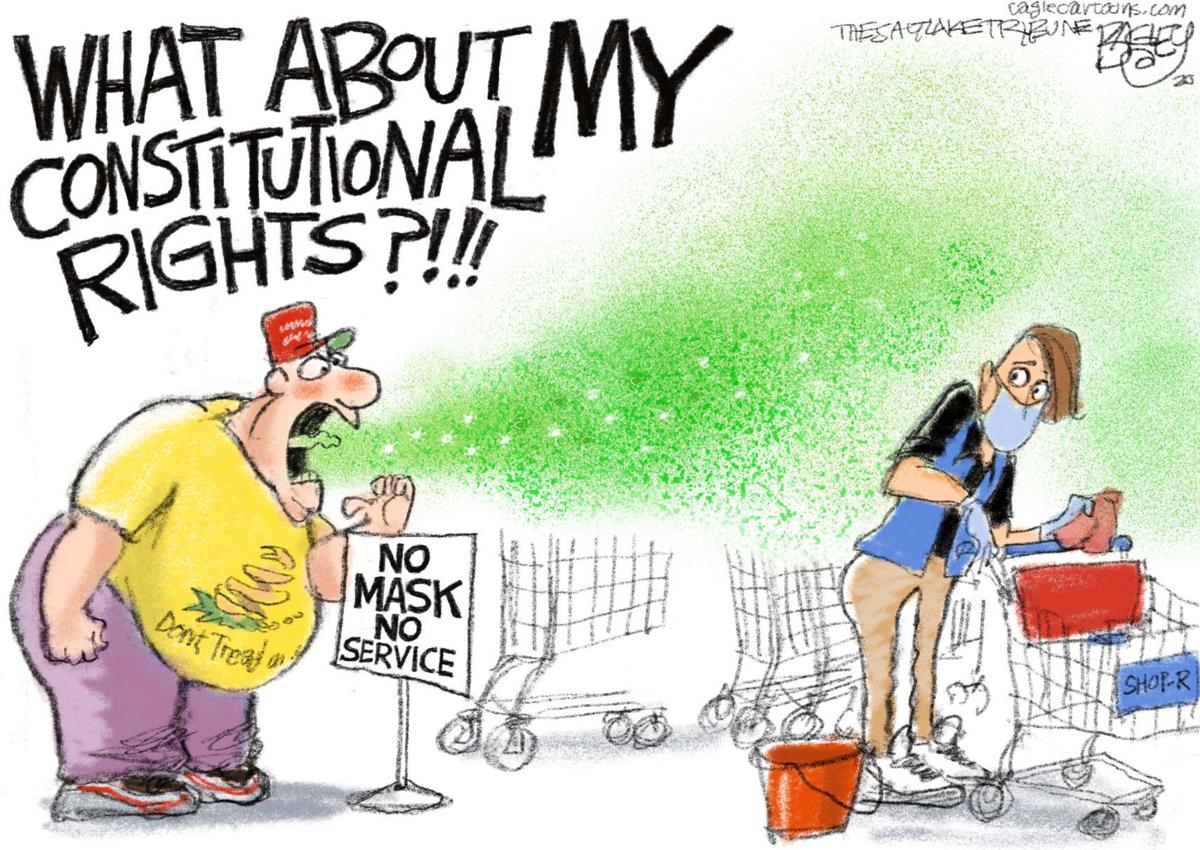
Cartoon – Constitutional Rights vs. Civility

Saturday cartoon

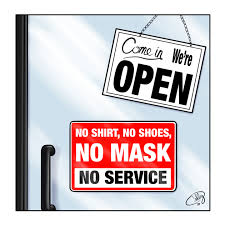
Cartoon – Come in We’re Open

No mask, no service | Opinion | dailyindependent.com

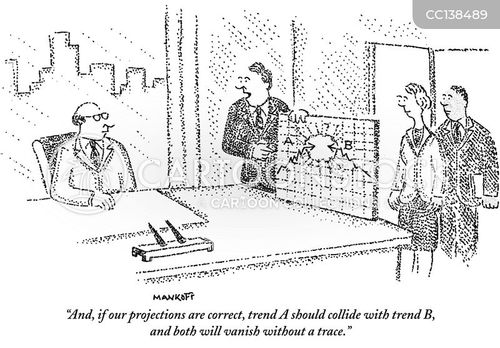
Cartoon – Coronavirus Projections

Cartoon – Coronavirus Projections | HENRY KOTULA

U.K. upgrades COVID alert level as Europe sees worrying rise in infections

https://www.axios.com/coronavirus-united-kingdom-european-cdc-4856ab47-29b2-43f2-b6c4-9a62d6867830.html

U.K. upgrades COVID alert level as Europe sees worrying rise in infections  - Axios

The U.K. could see up to 50,000 coronavirus cases per day by mid-October if current growth continues, top scientific advisers warned in a televised address from Downing Street on Monday.

The big picture: The U.K. has upgraded its coronavirus alert level from three to four as infections appear to be “high or rising exponentially.” Meanwhile, recent European Center for Disease Prevention and Control (ECDC) data shows that over half of all European Union countries are seeing an increase in COVID-19 cases.

What they’re saying: “At the moment, we think that the epidemic is doubling roughly every seven days” in the U.K., chief scientific adviser Patrick Vallance said.

  • England’s chief medical officer Chris Whitty stressed that unemployment and poverty are risks of taking strong action against the virus — like enforcing stay-at-home orders — but that more deaths will occur if aggressive action is not taken.

Where it stands: ECDC data shows that Spain, France, the Czech Republic, Croatia and Romania have recorded more than 120 confirmed COVID-19 cases per 100,000 inhabitants in the last 14 days, according to AP.

  • In Madrid, the rate of infection is nearly three times higher than the national average, at 683 cases per 100,000 inhabitants, per AP. Spain, one of the first epicenters of the virus in Europe, is faring the worst of countries tracked by the ECDC.
  • France has seen 31,285 deaths since the start of the pandemic, one of the highest death tolls in Europe. This weekend, France reported a record 13,000 new infections in 24 hours.
  • The Czech Republic reported 3,000 new cases on Thursday, almost as many as the country saw in all of March.
  • Croatia has recorded over 14,000 new COVID-19 cases per day since Sept. 16, while Romania is seeing over 11,000 new infections per day, according to Johns Hopkins data.

What to watch: Analysts expect the British government to announce short-term restrictions after Prime Minister Boris Johnson met with ministers over the weekend, AP reports.

  • German Chancellor Angela Merkel is planning second-wave prevention with her “Coronavirus Cabinet.” These plans include walk-in “fever clinics” to separate coronavirus patients from others.
  • Police in Madrid are limiting travel in working-class neighborhoods that have seen high transmission rates, while parks are closed and restaurants and shops must limit their occupancy at 50%.
  • Czech Republic’s Health Minister Adam Vojtech resigned Monday because of rising cases.
  • There are 20 new testing centers set to open in Paris and surrounding suburbs this week.


U.S. reaches 200,000 coronavirus deaths

https://www.axios.com/united-states-200000-coronavirus-deaths-17dc9d72-933b-473d-aa65-b7887eafffa2.html?stream=top&utm_source=alert&utm_medium=email&utm_campaign=alerts_all

The U.S. now has more than 200,000 coronavirus deaths - Axios

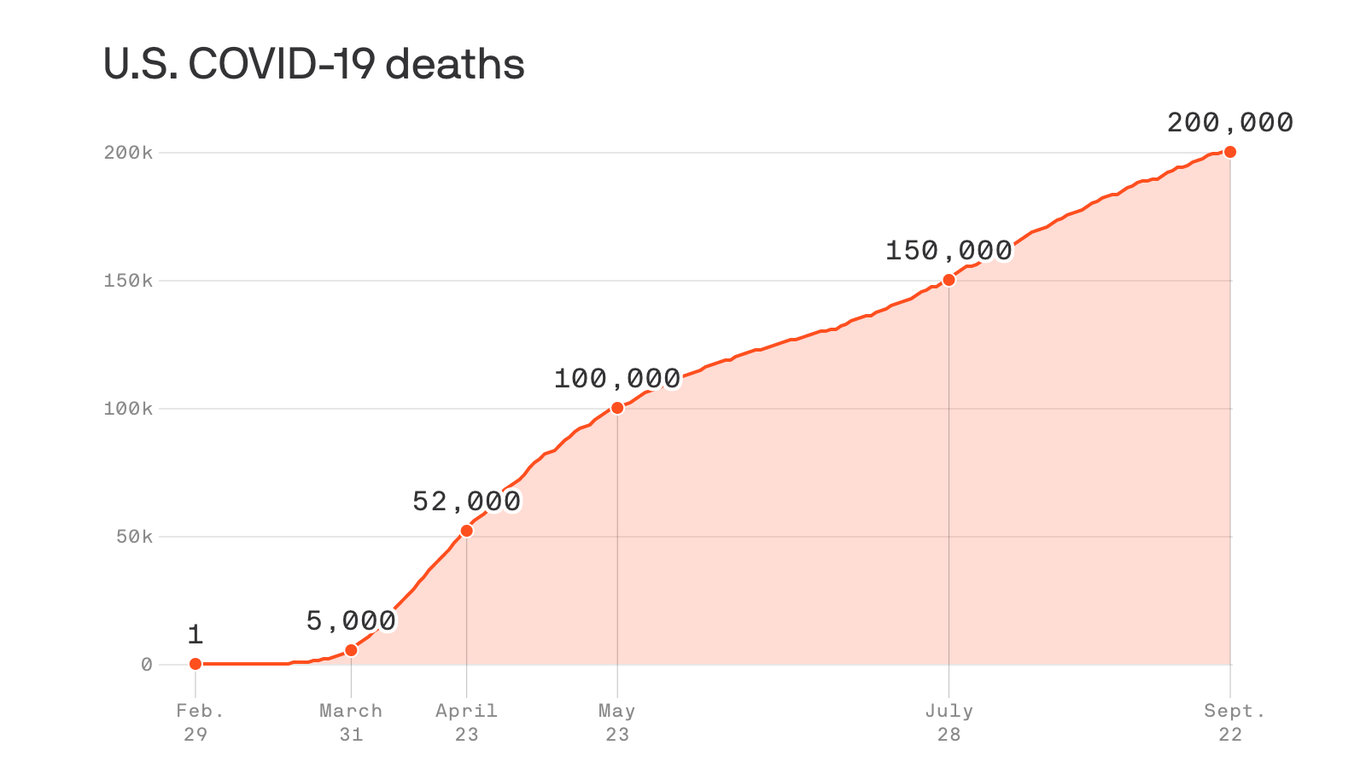
The coronavirus has now killed 200,000 Americans, according to Johns Hopkins data.

The big picture: Whatever context you try to put this in, it is a catastrophe of historic proportions — and is yet another reminder of America’s horrific failure to contain the virus.

  • The coronavirus has killed a bigger share of the American population than it has in almost any other wealthy country.
  • The death toll here is equivalent to roughly 65 Sept. 11 attacks. Three times more Americans have died from COVID than died in the Vietnam war — in only a fraction of the time.

This crisis has hit people of color especially hard.

  • Black and Latino Americans are dying at about three times the rate of white Americans.
  • They have also suffered far more from the economic fallout, which has fallen largely on lower-wage, service-industry workers.

And deaths keep coming — we’re averaging roughly 830 per day — even as the country increasingly sees the pandemic as background noise, as live sports resume and schools reopen and interest in news about the pandemic wanes.

Between the lines: The percentage of infected people who ultimately die from the coronavirus is lower now than it was in the outbreak’s earliest months, partly because doctors have gotten better at treating the virus and partly because outbreaks are now occurring within younger and lower-risk groups.

  • Overall cases are on a downward trajectory right now, following an enormous spike over the summer.
  • But the U.S. has never managed to get the virus firmly under control. Cases and deaths could get worse again as the weather gets colder and people move indoors, and the onset of flu season could make treatment more difficult.


COVID-19 vaccine verdicts loom as next big market risk

https://finance.yahoo.com/news/covid-19-vaccine-verdicts-loom-050615809.html

Optimism that vaccines are on the way to end the coronavirus pandemic has been a major factor in this year’s U.S. stock resurgence. That will face a critical test in coming weeks, as investors await clinical data on whether they actually work.

A UBS analysis found that about 40% of the market’s gains since May can be pegged to hopes for vaccines to protect against COVID-19, which has killed over 960,000 worldwide and rocked the global economy.

Global efforts to develop a vaccine are coming to a head, with late-stage data on trials by companies such as Pfizer Inc <PFE.N> and Moderna Inc <MRNA.O> possible as soon as October or November. Disappointing results could further shake markets that have recently grown turbulent on worries over fiscal stimulus delays and uncertainty around the Nov. 3 U.S. presidential election.

“The anticipation is that this stuff is going to work,” said Walter Todd, chief investment officer at Greenwood Capital in South Carolina. “So any news to the contrary could be a risk to the market.”

The number of vaccines in development could blunt the negative market impact of any single setback. More than a half-dozen vaccines globally are in late-stage trials out of over 30 currently being tested in humans, according to the World Health Organization.

“We are setting ourselves up for success in the sense of if you throw enough spaghetti at the wall, hopefully at least one noodle sticks,” said Liz Young, director of market strategy at BNY Mellon Investment Management.

That could explain why stocks overall barely reacted earlier this month, when AstraZeneca Plc <AZN.L> and partner Oxford University paused global trials of one of the leading vaccine candidates after a participant in its U.K. trial became seriously ill. The trials have resumed in Britain, Brazil and South Africa, but remain on hold in the United States.

Some forecasts on vaccine availability have grown less optimistic. Good Judgment, a company whose forecasters make predictions based on publicly available evidence, put the chances that a vaccine will be widely distributed in the United States by the end of March at 54%. That is up from an estimate of less than 20% in early July, but down from above 70% earlier this month.

Pfizer and Moderna could report initial efficacy results in October or November based on an early read of data, followed by data from companies such as AstraZeneca, Johnson & Johnson <JNJ.N> and Novavax Inc <NVAX.O>.

An approval or emergency use authorization this year could lead to a surge in travel, leisure and other stocks that have been decimated by pandemic-related shutdowns, while also fueling a long-awaited shift into value stocks from tech and other growth names that have led the market for years.

Even if a vaccine is approved, questions persist about how easily and quickly it can be distributed. President Trump and his health officials have issued conflicting predictions about when the general public could have access.

“The potential for market disappointment will likely come from the realization that manufacturing and broad distribution will take longer,” said Art Hogan, chief market strategist at National Securities.

An approved, broadly distributed and accepted vaccine could result in a gain of about 300 points to the S&P 500, or more than 8% at the index’s current level, according to Keith Parker, head of U.S. and global equity strategy at UBS.

If a vaccine is widely distributed in the first quarter, BofA Global Research projects global gross domestic product (GDP) growth of 6.3% in 2021, compared with 5.6% if that does not occur until the third quarter.

Disappointing clinical trial news could result in a loss of 100 points from the S&P 500, or about 3%, Parker estimates.

While the market might be able to handle one vaccine setback “reasonably well,” several setbacks could cause a rethink of the vaccine race, he said.


Bill Gates: U.S. Needs To ‘Own Up To The Fact That We Didn’t Do A Good Job’

https://www.forbes.com/sites/mattperez/2020/09/20/bill-gates-us-needs-to-own-up-to-the-fact-that-we-didnt-do-a-good-job/?utm_source=newsletter&utm_medium=email&utm_campaign=coronavirus&cdlcid=5d2c97df953109375e4d8b68#54d6544f3fb8

TOPLINE

The United States needs to “own up to the fact that we didn’t do a good job” up until this point of the Covid-19 pandemic, billionaire and philanthropist Bill Gates said during a Fox News Sunday interview, adding that the slow turnaround for testing results remains “outrageous.”

KEY FACTS

“Unfortunately we did a very poor job and you can just see that in the numbers,” Gates said.

Despite having around 4% of the world’s population, the U.S. has around 22% of all cases with 6,782,083 and about 21% of all reported deaths with 199,411.

The inability to create a testing structure as seen in countries like South Korea “led to us having not just a bad spring, we’ve had a pretty tough summer and sadly because of the seasonality, until we get these new tools, the fall is looking to shape up as pretty tough as well,” Gates said.

“Part of the reluctance I think to fix the testing system now is that nobody wants to admit that it’s still outrageous,” Gates said, adding, “The U.S. has more of these machines, more capacity than other countries by a huge amount, and so partly the reimbursement system is creating perverse incentive.”

After remaining fairly stagnant through the end of summer into September, the U.S. performed a record 1,061,106 Covid-19 tests on Saturday, according to Johns Hopkins University, but labs are still dealing with supply shortages and delays in results.

“We’ll have time to look at those mistakes, which in February and March were really super unfortunate, but we can’t pretend like we get a good grade even today,” Gates said.

CRUCIAL QUOTE

“Even today, people don’t get their results in 24 hours, which it’s outrageous that we still have that,” Gates said.

BIG NUMBER

4.7%. That’s the average positivity percentage in the past week, according to Johns Hopkins.

TANGENT

President Trump has excused the world-leading cases of the coronavirus as a result of the number of tests performed in the country, even saying that he instructed officials to slow testing down. The Centers for Disease Control and Prevention sparked outrage in August when it published new guidelines on testing, recommending people exposed to the virus but not showing symptoms should not get tested. Reports indicate that the guidance was dictated by the Health and Human Services and Trump administration as opposed to CDC scientists. The guidelines were changed again on Friday.


COVID-19 Goes Viral on College Campuses

COVID-19 Goes Viral on College Campuses
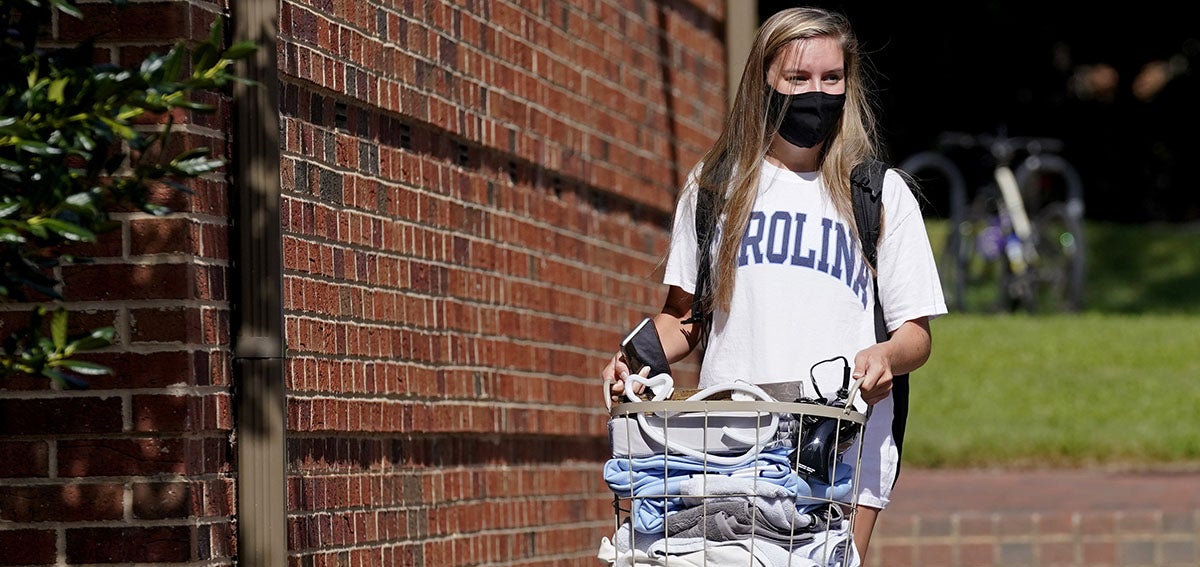
Freshman Sarah Anne Cook carries her belongings as she packs to leave the University of North Carolina at Chapel Hill, on August 18, because of a COVID-19 outbreak. All in-person undergraduate learning was canceled.

On August 10, students at the University of North Carolina at Chapel Hill (UNC) began the fall semester in person. Freshman Jasmine Baker was cautiously optimistic — as an incoming student in the Hussman School of Journalism, she was excited to experience college and get to know her suitemates. But she also worried that the university’s health and safety protocols would not prevent the spread of the coronavirus on campus.

She was right. Just one week after classes started, UNC announced that all undergraduate classes would move to remote learning for an indefinite period following a surge of COVID-19 cases. The case positivity rate on campus jumped from 2.8% to nearly 14%, Colleen Flaherty reported in Inside Higher Ed. After the second week, the positivity rate skyrocketed to 31%.

Baker, an out-of-state student, learned about the change in learning plans while attending an in-person class. “The email was very vague about housing,” she told Slate. “There were no specifics. Everyone kind of started freaking out. . . . We learned about it at the same time the professors did.” To top it off, she and a roommate soon tested positive for COVID-19. “We were all in such close quarters,” Baker said. “I know people that barely left their dorms, and they still ended up catching it.”

The situation at UNC is not unique.New York Times tracker has revealed at least 88,000 COVID-19 cases and 60 deaths at American colleges since the pandemic began. Photos and videos of students flouting public health guidelines at indoor parties or other gatherings have gone viral. Some university administrators have condemned the socializing as “reprehensible” and reprimanded students for “disrespectful, selfish, and dangerous” behavior.

Experts like Julia Marcus, PhD, MPH, an epidemiologist at Harvard Medical School, and Jessica Gold, MD, MS, a psychiatrist at Washington University, saw this coming from a mile away.Students will get infected, and universities will rebuke them for it; campuses will close, and students will be blamed for it,” they warned in the Atlantic over the summer. “Relying on the self-control of young adults, rather than deploying the public-health infrastructure needed to control a disease that spreads easily among people who live, eat, study, and socialize together, is not a safe reopening strategy.”

If you put 10,000 [students] in a small space, eating, sleeping, and socializing together, there’ll be an explosion of cases. . . . I don’t know what colleges were expecting.

—UNC epidemiologist Whitney Robinson

As the Editorial Board of the Daily Tar Heel, UNC’s student newspaper, wrote one week into the semester, “Reports of parties throughout the weekend come as no surprise. Though these students are not faultless, it was the University’s responsibility to disincentivize such gatherings by reconsidering its plans to operate in person earlier on.” The local health department recommended that UNC implement remote learning for the first five weeks of the fall term, but administrators ignored that advice.

Lack of Guidelines for Safe Return

Throughout the summer, even as COVID-19 hot spots emerged across the country, President Donald Trump aggressively pushed for schools to reopen in person. Without federal guidance on how to do this safely, university administrators were left to cobble together their own plans for preventing coronavirus from spreading into the community.

“I don’t think there are two universities that have the same protocol,” Irwin Redlener, director of the Pandemic Resource and Response Initiative at Columbia University, told Politico. “It’s national chaos.

Universities have a strong financial incentive to reopen in person. Many are hoping to recover revenue from housing fees and out-of-state tuition payments that were lost when the pandemic forced them to suspend in-person classes in March. But as many universities have learned in recent weeks, reopening in person comes at a cost to the health of students, faculty members, and the surrounding community.

The New York Times reviewed 203 counties in which college students comprise at least 10% of the population and found that about half experienced their worst weeks of the pandemic after August 1, around the time students returned to campus. An analysis by USA Today revealed that communities with a significant college student population represent 19 of the 25 largest current coronavirus outbreaks in the US.

What has happened on campus hasn’t stayed on campus,” Shawn Hubler and Anemona Hartocollis wrote in the New York Times.

California Fares Better Than Other States

While California is not represented on USA Today’s list of big outbreaks, it is dealing with surges on some campuses. According to the New York Times campus tracker, there are nearly 2,600 coronavirus cases at 57 schools in California. (Because there is no national tracking system for coronavirus cases on college campuses, the New York Times is believed to have the most comprehensive count available.)

I expect this will blow up outbreaks in places that never had outbreaks, or in places that had outbreaks under control.

—Boston University epidemiologist
Eleanor Murray

With 444 confirmed cases, San Diego State University tops the list among California schools, followed by the University of Southern California with 358 cases and UC San Diego with 237. By comparison, North Carolina has nearly 5,200 coronavirus cases at 42 schools, including 1,150 cases at UNC.

California’s relative success at mitigating the spread of COVID-19 on campus can be attributed in part to the conservative reopening plans of many schools. The California State University (CSU) system, California Community Colleges, and University of California (UC) schools moved nearly all fall classes online. UC Berkeley is fully remote for the fall semester. Stanford University planned to have half of its undergraduate students on campus during different quarters, but it switched to mostly remote learning as coronavirus cases continued to rise in the Bay Area over the summer.

Even a hybrid learning model, however, has failed to stave off new coronavirus cases on campuses. Chico State University and San Diego State University, both part of the CSU system, became the first and second California campuses to pause in-person classes after COVID-19 cases spiked, Ashley Smith reported for EdSource.

Resources are a factor in prevention efforts. Chico State’s health center doesn’t have coronavirus tests for students. San Diego State, which has more resources, has two coronavirus testing sites on campus. Across the CSU system, only 2 out of 23 campuses (CSU Maritime Academy and Humboldt State University) have tested all students living in dorms, according to CalMatters. The UC system, which has a budget roughly four times that of the CSU system, is testing all students living in dorms across all 10 campuses. (The UC system has restricted on-campus housing to students who have no alternative housing options.)

An Avoidable Situation

With the academic year off to a rocky start and students being sent home amid coronavirus outbreaks on campuses, experts across the country are nervously tracking the spread of the virus. “I expect this will blow up outbreaks in places that never had outbreaks, or in places that had outbreaks under control,” Eleanor Murray, ScD, MPH, an epidemiologist at Boston University, told Ed Yong in the Atlantic.

COVID-19 surges on college campuses were preventable. “If you put 10,000 [students] in a small space, eating, sleeping, and socializing together, there’ll be an explosion of cases,” Whitney Robinson, PhD, an epidemiologist at UNC, told Yong. “I don’t know what colleges were expecting.”


CDC pulls revised guidance on coronavirus from website

https://thehill.com/policy/healthcare/517387-cdc-says-revised-guidance-on-airborne-coronavirus-transmission-posted-in

National coronavirus updates: CDC provides detailed guidance on reopening -  ExpressNews.com

The Centers for Disease Control and Prevention (CDC) said Monday pulled revised guidance from its website that had said airborne transmission was thought to be the main way the coronavirus spreads, saying it was “posted in error.”

The sudden change came after the new guidance had been quietly posted on the CDC website on Friday.

“CDC is currently updating its recommendations regarding airborne transmission of SARS-CoV-2 (the virus that causes COVID-19),” the CDC wrote. “Once this process has been completed, the update language will be posted.”

The CDC guidance on the coronavirus is now the same as it was before the revisions.

The change and the the reversal comes as the CDC comes under extensive scrutiny over whether decisions by and guidance from government scientists are being affected by politics.

Just last week, President Trump contradicted CDC Director Robert Redfield on the timing of a vaccine and the necessity of wearing masks. 

Public health experts were pleased with the updated guidance, saying evidence shows COVID-19 can be spread through the air and that the public should be made aware of that fact. 

The World Health Organization issued a warning in July, saying that coronavirus could be spread through people talking, singing and shouting after hundreds of scientists released a letter urging it to do so.

The CDC said the guidance posted Friday was a “draft version of proposed changes.”

It is not clear if that draft will eventually become the CDC’s guidance, or if it will go through additional changes.

CNN first reported the new guidance on Sunday.

The now-deleted guidance had noted that the coronavirus could spread through airborne particles when an infected person “coughs, sneezes, sings, talks or breaths.”

“There is growing evidence that droplets and airborne particles can remain suspended in the air and be breathed in by others, and travel distances beyond 6 feet (for example, during choir practice, in restaurants, or in fitness classes),” the agency had written. “In general, indoor environments without good ventilation increase this risk.”

“These particles can be inhaled into the nose, mouth, airways, and lungs and cause infection,” the deleted guidance said. “This is thought to be the main way the virus spreads.”