Vaccine skepticism and disregard for containment efforts go hand in hand

It seems pretty clear the path the United States is on. Within a few months, everyone who wants to be vaccinated against the coronavirus will be, save for those below the minimum age for which vaccines are available. For everyone else, the pandemic Wild West will continue, with the country hopefully somewhere near the level of immunity that will keep the virus from spreading wildly but with large parts of the population — again, including kids — susceptible to infection.

That really gets at one of the two outstanding questions: How many Americans won’t get the vaccine? If the figure is fairly low, the ability of the virus to spread will be far lower. If it’s high, we have a problem. And that’s the other outstanding question: How big of a problem will the virus be, moving forward?

We know that even as vaccines are being rolled out, cases are slowly climbing. While the number of new infections recorded each day is well off the highs seen in the winter, we’re still averaging more cases on a daily basis than we saw even a month into the third wave that began in September. A lot of people are still getting sick, and, even with most elderly Americans now protected with vaccine, a lot more people will probably die.

Data released by Gallup this week shows that both of the questions posed above share a common component. It is, as you probably suspected, those who are least willing to get vaccinated who are also least likely to take steps to contain the virus.

Gallup asked Americans about their vaccination status, finding that about a fifth had been fully vaccinated and an additional 13 percent partially vaccinated. More than a quarter of respondents, though, said they didn’t plan to get vaccinated. It was those in that latter group who were least likely to say that they were completely or mostly isolating in an effort to prevent the virus spreading.

It was also those skeptics who were least likely to say that, in the past seven days, they had avoided crowds, group gatherings or travel. If you’re not inclined to get vaccinated, it is at least consistent that you would be similarly disinclined to take other steps aimed at limiting the spread of the virus.

Gallup didn’t break out those groups by party, but it’s clear that few of them are Democrats. Data from YouGov, compiled on behalf of Yahoo News, shows that Democrats (and those who voted for Joe Biden in particular) are more likely to say that they have already received a vaccine dose.
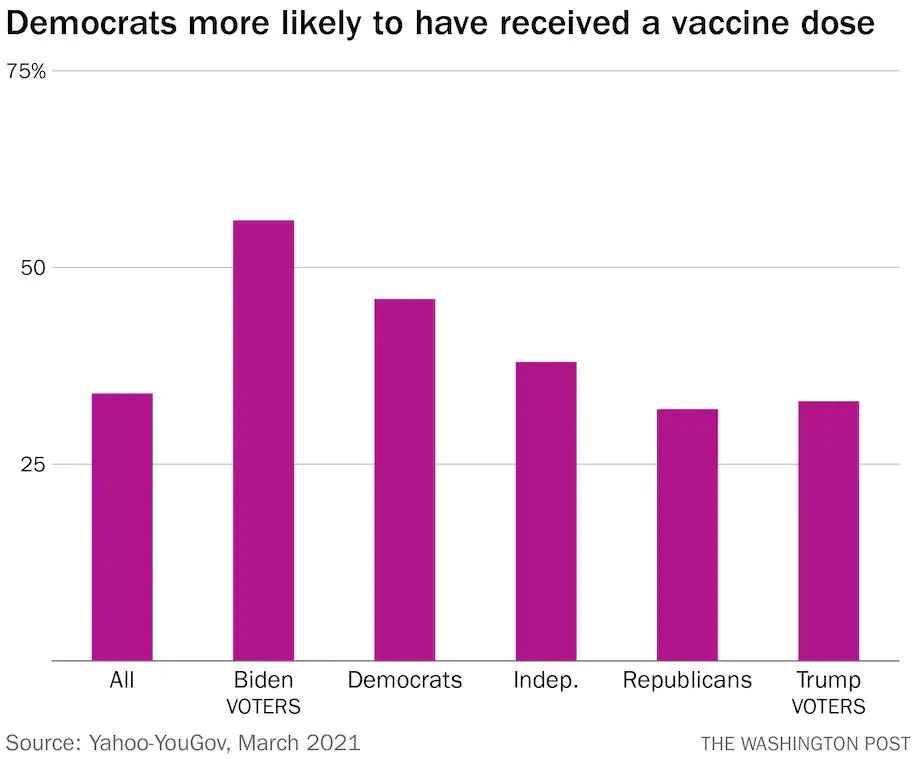
Among those who hadn’t yet received a dose, Democrats were far more likely to indicate that they planned to do so as soon as possible. Among Republicans, half of those who haven’t been vaccinated say that they don’t have any plans to do so at all.

One reason is that Republicans are simply less worried about the virus. More than half say that they’re not very worried about it or not worried at all. Among those who voted for Donald Trump, the figure is over two-thirds. By contrast, more than three-quarters of Democrats say that they are at least somewhat worried about the virus.
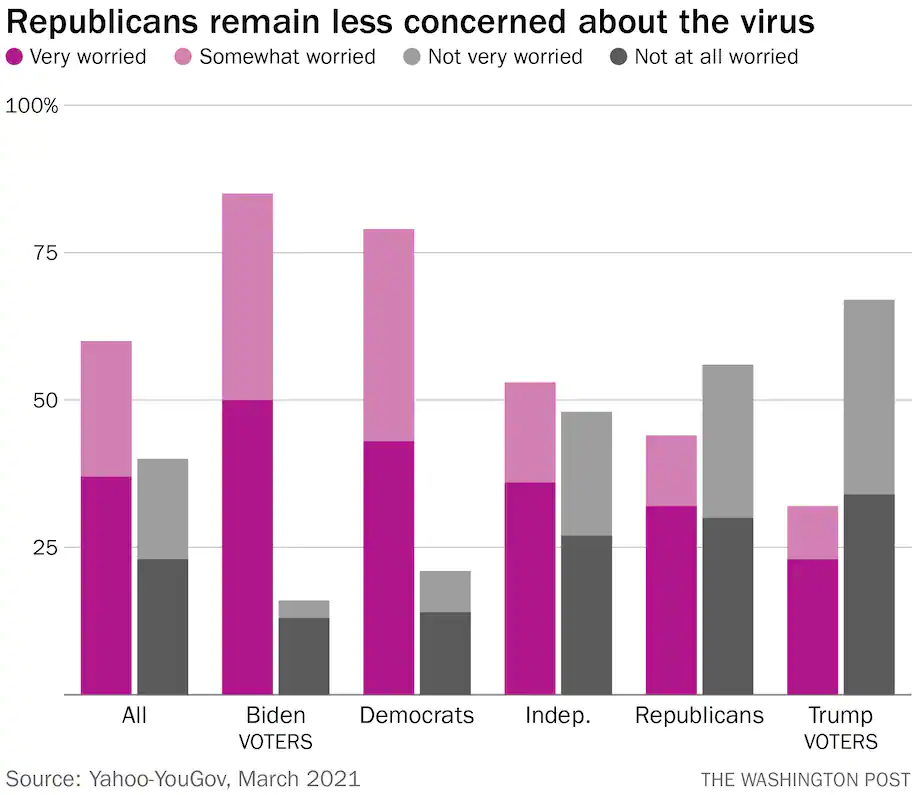
In the YouGov polling, 60 percent of Republicans say that the worst of the pandemic is behind us. They’re also much more likely to say that restrictions aimed at preventing the spread of the virus — mask mandates, limits on indoor dining — should be lifted immediately.

As we mentioned Thursday, there are two ways to achieve herd immunity. One is fast and safe: widespread vaccinations. The other — people contracting the virus — is slow and dangerous. The path the United States is on will take us to a place where much of the country has opted for the first option and the rest, the latter.

So the question again becomes: How many people will die, both over the short term and the long term, as a result of those choices?

One-third of small businesses say health insurance is a top concern during COVID-19: survey

Dive Brief:

  • Small businesses are struggling to cover the high costs of healthcare for their employees after a year of COVID-19, according to a new poll sponsored by the Small Business Majority and patient advocacy group Families USA.
  • More than one in three small businesses owners said it’s a challenge getting coverage for themselves and their workers. That pain is particularly acute among Black, Asian American and Latino businesses, which have fewer resources than their White counterparts, SBMfound.
  • As a result, small businesses want policymakers to expand coverage access and lower medical costs, beyond the temporary fixes included in the sweeping $1.9 trillion American Rescue Plan passed by Congress earlier this month.

Dive Insight:

Providing health insurance can be pricey for small employers, a challenge that’s been exacerbated by the pandemic and its subsequent economic downturn.

Accessing health insurance has been a major barrier over the course of COVID-19, the national survey of 500 businesses with 100 employees or fewer in November found. The poll, conducted by Lake Research Partners for SBM and Families USA, found many such businesses have had to slash benefits during the pandemic. Among small business owners that have reduced insurance benefits, 36% have trimmed their employer contribution for medical premiums and 56% switched to a plan with a lower premium.

Additionally, one in five small business owners say they plan to change or lower coverage in the next few months, while only about a quarter have been able to maintain coverage for temporarily furloughed employees.

The situation is bleaker for minority-owned small businesses. Overall, 34% say accessing health insurance has been a top barrier during COVID-19, but that figure rises to 50%, 44% and 43% for Black, Asian American and Latino business respondents, SBM, which represents some 80,000 small businesses nationwide, said.

That’s in line with past SBM polling finding non-white entrepreneurs are more likely to face temporary or permanent closure in the next few months than their white counterparts, and are also more likely to struggle with rent, mortgage or debt repayments.

Though employers expect a more stabilized business environment starting in the second quarter, many are still reeling from difficult economic circumstances last year. COVID-19 capsized normal efforts to calculate medical cost trends for 2021, complicating financial planning for the year ahead — especially for fragile small businesses.

Washington did allocate a significant amount of financial aid for small businesses last year, and the ARP includes numerous provisions including increased subsidies for health insurance premiums for two years, and extended COBRA coverage for laid off employees through September.

But respondents to this latest polling urged for more long-term support.

The most popular policy proposal was bringing down the cost of prescription drugs, with 90% of businesses saying they supported the measure and 54% saying they were in strong support. Protecting coverage for people with pre-existing conditions was also popular, with 87% of small business owners in total support and 51% strongly supporting.

Three-fourths of small business owners strongly support a public health insurance option, while 73% support expanding Medicaid eligibility in all states and 66% support letting people buy into Medicare starting at age 55.

Both a public option and lower age of eligibity for Medicare are key tenets of President Joseph Biden’s healthcare plan — though getting both through Congress is unlikely. And long-time business groups like the Chamber of Commerce and the National Federation for Independent Business hold major sway on such issues and tend to be more recalcitrant on progressive policy changes.

Still, calls have been mounting for employers, which insure more than half of the U.S., to do more to move the needle on medical costs, as price increases outpace overall inflation.

A survey of large to mid-size employers from the National Alliance of Healthcare Purchaser Coalitions published Wednesday found at least three-fourths of employers support drug price regulation, surprise billing regulation, hospital price transparency and hospital rate regulation.

Experts warn US risks delaying ‘normal’ summer

Experts warn US risks delaying ‘normal’ summer

Overnight Health Care: Experts warn US risks delaying 'normal' summer |  Alabama GOP governor extends mask mandate | Senate votes to take up relief  bill | TheHill


President Biden‘s announcement that there will be enough vaccines for all adults by May is raising hopes for a return to normal soon.

But the next few months in the pandemic are critical. Concern is growing over moves by some states to lift restrictions already, while new variants of the virus are on the rise in the U.S. Experts warn that actions taken now risk delaying getting back to some semblance of normal.

Health officials are urging restrictions to remain in place for the final stretch, saying that it will not be much longer before the situation markedly improves, and it does not make sense to lift all restrictions when widespread vaccinations are in sight.    

Biden on Wednesday issued his most forceful comments to date, calling out the governors of Texas and Mississippi for lifting their states’ mask mandates and all capacity limits on businesses. 

He noted that vaccinations for all adults are on the horizon.

The last thing we need is Neanderthal thinking that in the meantime everything’s fine, take off your mask, forget it,” he said. “It still matters.”

Estimates differ on when exactly the country might return to something like “normal,” though many say they expect this summer will be much better.

Former Food and Drug Administration Commissioner Scott Gottlieb said on CNBC on Wednesday that he thinks even as soon as April will be “profoundly better,” given that vaccine supply will have ramped up significantly, allowing vaccine availability to be “wide open” by then.

Centers for Disease Control and Prevention Director Rochelle Walensky on Wednesday put the time frame at three months until the country could be vaccinated. 

“The next three months are pivotal,” she said.   

Thomas Tsai, a researcher at the Harvard T.H. Chan School of Public Health, said that by summer, “I think we can have a much more, I don’t want to say normal, but at least a ‘new normal’ summer.”

But experts warn that the return to normal could actually be delayed if restrictions are lifted too soon, causing a new spike in cases in the near term. 

Tsai likened the current situation to the seventh inning stretch of a baseball game. “Progress has been made; it’s OK to take stock of that,” he said. “How we play the next two innings determines if this is a single game or turns into a doubleheader.”

Maintaining restrictions as people get fatigued and see the end in sight could be a challenge, though, particularly in red states that were skeptical of instituting health restrictions from the start. 

Texas Gov. Greg Abbott and Mississippi Gov. Tate Reeves, both Republicans, pointed to the ongoing vaccination campaign in saying that the time has come to end restrictions. 

“With the medical advancements of vaccines and antibody therapeutic drugs, Texas now has the tools to protect Texans from the virus,” Abbott said Tuesday. “We must now do more to restore livelihoods and normalcy for Texans by opening Texas 100 percent.”

Responding to Biden’s criticism on Wednesday, Reeves added: “Mississippians don’t need handlers.” 

“As numbers drop, they can assess their choices and listen to experts,” he added. “I guess I just think we should trust Americans, not insult them.”

Gottlieb argued for a middle ground, saying that public health officials risk having the public simply ignore all guidance if they do not provide a “realistic glide path to a better future,” though March is “a little bit premature” to lift all restrictions. 

“March really is a difficult month,” he said. “It sits between two worlds. February was a raging epidemic, it was very clear we needed to have measures in place. I think April’s going to be profoundly better, and March is sitting in the middle.”

Variants of the virus also pose a threat that adds another degree of uncertainty. The most common variant spreading in the US, known as B117, or the United Kingdom variant, responds well to vaccines, but is more infectious. 

“The B117 hyper-transmissible variant looms ready to hijack our successes to date,” Walensky said. 

Variants first identified in Brazil and South Africa also pose a risk of reducing the effectiveness of the vaccines, though the extent is not fully clear, and vaccine manufacturers are preparing backup plans to provide booster shots or updated vaccines if necessary. 

“We are at a critical nexus in the pandemic,” Walensky said. “So much can turn in the next few weeks.”

After weeks of declines, both cases and deaths are ticking up. According to CDC data, the seven-day average of new cases per day, at 66,000, is up 3.5 percent from the past week, and deaths, at just over 2,000 per day, are up 2.2 percent. 

Barbara Alexander, president of the Infectious Diseases Society of America, issued a statement Wednesday calling on people to continue wearing masks, distancing from others, and avoiding large gatherings. 

“All of these measures together will bring us closer to ending the pandemic,” she said. “Abandoning them now will postpone the day we can put COVID-19 behind us.”  

Still, the declines in past weeks and the increasing pace of vaccinations is offering some hope after a long year.

“I’m more optimistic than I have been in the last year,” Tsai said. 

Cartoon – It’s not the Heat, it’s the Stupidity!

How cartoons are chronicling the battle between mask wearers and Trump -  The Washington Post

Cartoon – We’re all in this together

Not all in this together - ND Cartoons

The danger of a fourth wave

Change in new COVID-19 cases in the past week

Percent change of the 7-day average of new cases

on Feb. 23 and March 2, 2021

The U.S. could be in danger of a fourth coronavirus wave - Axios

The U.S. may be on the verge of another surge in coronavirus cases, despite weeks of good news.

The big picture: Nationwide, progress against the virus has stalled. And some states are ditching their most important public safety measures even as their outbreaks are getting worse.

Where it stands: The U.S. averaged just under 65,000 new cases per day over the past week. That’s essentially unchanged from the week before, ending a six-week streak of double-digit improvements.

  • Although the U.S. has been moving in the right direction, 65,000 cases per day is not a number that indicates the virus is under control. It’s the same caseload the U.S. was seeing last July, at the height of the summer surge in cases and deaths.

What we’re watching: Texas Gov. Greg Abbott on Tuesday rescinded the state’s mask mandate and declared that businesses will be able to operate at full capacity, saying risk-mitigation measures are no longer necessary because of the progress on vaccines.

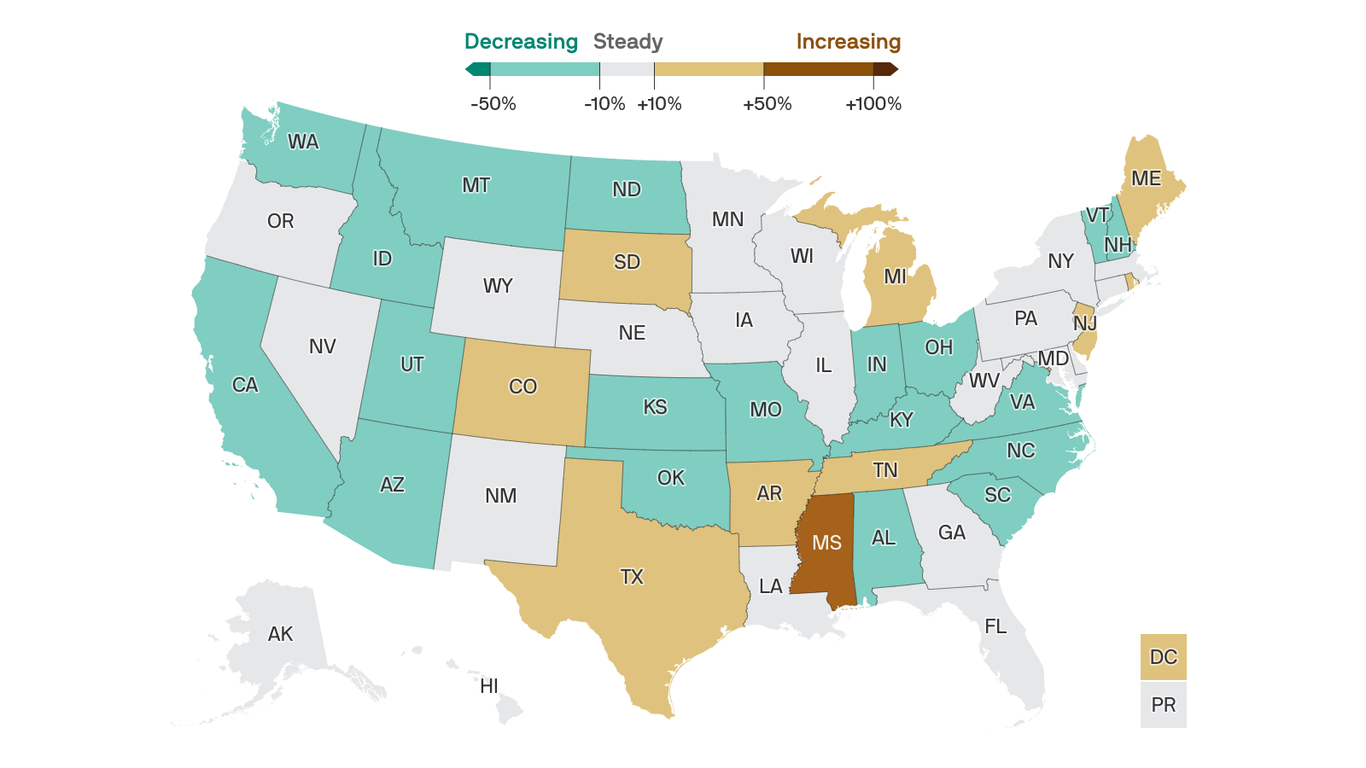
  • But the risk in Texas is far from over. In fact, its outbreak is growing: New cases in the state rose by 27% over the past week.
  • Mississippi Gov. Tate Reeves also scrapped all business restrictions, along with the state’s mask mandate, on Tuesday. New cases in Mississippi were up 62% over the past week, the biggest jump of any state.
  • The daily average of new daily cases also increased in eight more states, in addition to Mississippi and Texas.

How it works: If Americans let their guard down too soon, we could experience yet another surge — a fourth wave — before the vaccination campaign has had a chance to do its work.

  • The vaccine rollout is moving at breakneck speed. The U.S. should have enough doses for every adult who wants one by May, President Biden said this week.
  • At the same time, however, more contagious variants of the coronavirus are continuing to gain ground, meaning that people who haven’t gotten their vaccines yet may be spreading and contracting the virus even more easily than before.

What’s next: The bigger a foothold those variants can get, the harder it will be to escape COVID-19 — now or in the future.

  • The existing vaccines appear to be less effective against two variants, discovered in South Africa and Brazil, which means the virus could keep circulating even in a world where the vast majority of people are vaccinated.
  • And that means it’s increasingly likely that COVID-19 will never fully go away — that outbreaks may flare up here and there for years, requiring vaccine booster shots as well as renewed protective measures.

The bottom line: Variants emerge when viruses spread widely, which is also how people die.

  • Whatever “the end of the pandemic” looks like — however good it’s possible for things to get — the way to get there is through ramping up vaccinations and continuing to control the virus through masks and social distancing. Not doing those things will only make the future worse.
  • “Getting as many people vaccinated as possible is still the same answer and the same path forward as it was on December 1 or January 1 … but the expected outcome isn’t the same,” Shane Crotty, a virologist at the La Jolla Institute for Immunology in San Diego, told Reuters.

The Pandemic is a long way from over

May be an image of text

The pandemic’s coming new normal

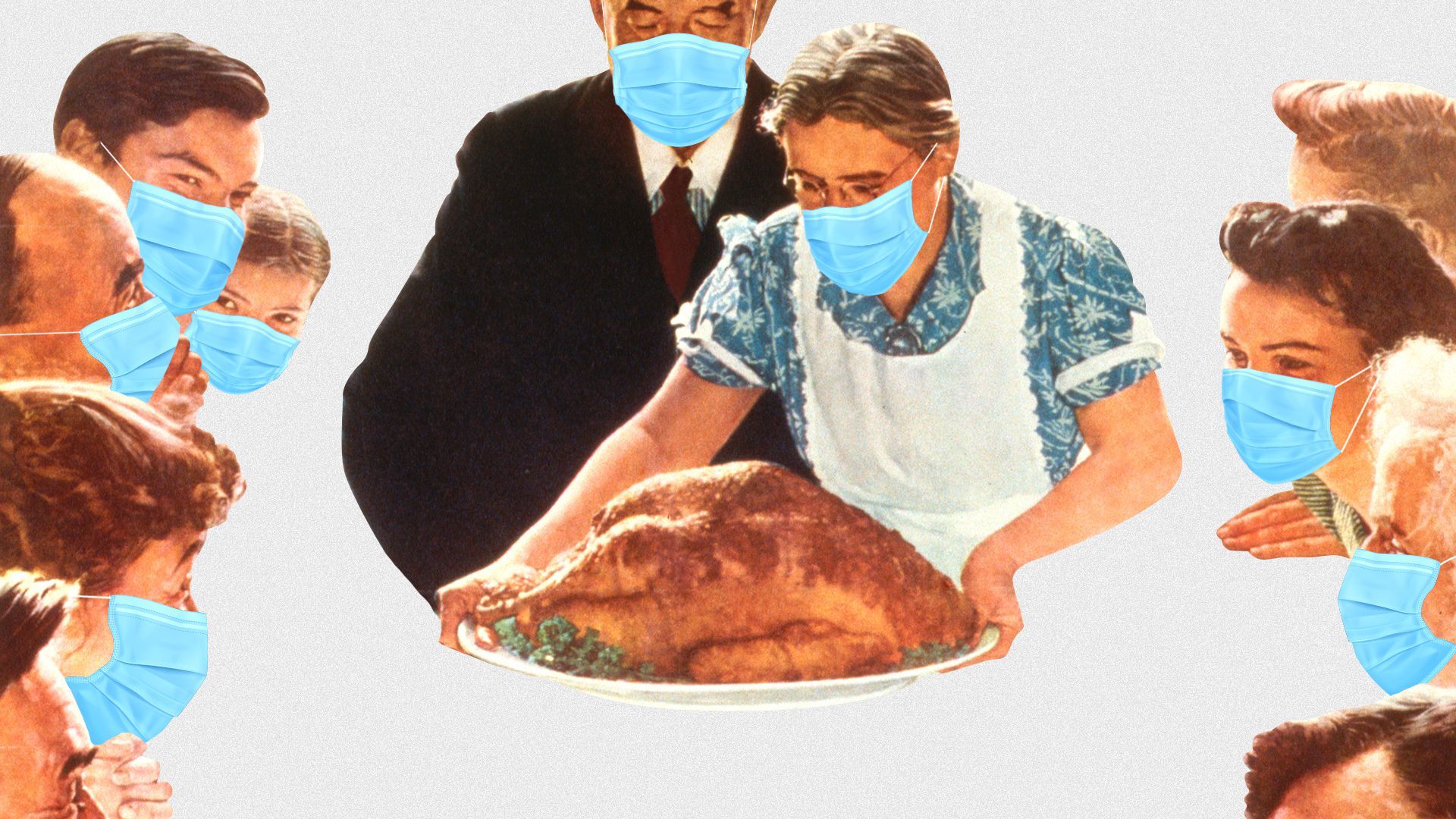
Photo illustration of the Freedom from Want image by Norman Rockwell with all the participants of the dinner wearing surgical masks.

As both vaccinations and acquired immunity spread, life will likely settle into a new normal that will resemble pre-COVID-19 days— with some major twists.

The big picture: While hospitalizations and deaths are tamped down, the novel coronavirus should recede as a mortal threat to the world. But a lingering pool of unvaccinated people — and the virus’ own ability to mutate — will ensure SARS-CoV-2 keeps circulating at some level, meaning some precautions will be kept in place for years.

Driving the news: On Tuesday, Johnson & Johnson CEO Alex Gorsky told CNBC that people might well need a new coronavirus vaccine annually in the years ahead, much as they do now for the flu.

  • Gorsky’s comments were one of the clearest signals that even as the number of vaccinated people rises, the mutability of SARS-CoV-2 means the virus will almost certainly be with us in some form for years to come.

Be smartThat sounds like bad news — and indeed, it’s much less ideal than a world in which vaccination or infection conferred close to lifelong immunity and SARS-CoV-2 could be definitively conquered like smallpox.

  • With more contagious variants spreading rapidly, “the next 12 weeks are likely to be the darkest days of the pandemic,” says Michael Osterholm, the director of the University of Minnesota’s Center for Infectious Disease Research and Policy.
  • But the apparent effectiveness of the vaccines in preventing hospitalizations and death from COVID-19 — even in the face of new variants — points the way toward a milder future for the pandemic, albeit one that may be experienced very differently around the world.

Details: From studying what happened after new viruses emerged in the past, scientists predict SARS-CoV-2 will eventually become endemic, most likely in a seasonal pattern similar to the kind of coronaviruses that cause the common cold.

  • That’s nothing to sneeze at — literally, it will make us sneeze — but as immunity levels accumulate throughout the population, our experience of the virus will attenuate, and we’ll be highly unlikely to experience the severe death tolls and overloaded hospitals that marked much of the past year.

Yes, but: The existence of a stubborn pool of Americans who say they won’t get vaccinated — as well as the fact that it may take far longer for children, whom the vaccines have yet to be tested on, to get coverage — will give the virus longer legs than it would otherwise have.

  • “This will be with us forever,” says Osterholm. “That’s not even a debate at this point.”

What’s next: This means we can expect the K-shaped recovery that has marked the pandemic to continue, says Ben Pring, who leads Cognizant’s Center for the Future of Work.

  • With the virus likely to remain a threat, even if a diminished one, “those who are more stuck in the analog world are really going to continue to struggle,” he says.
  • Health security will also become a more ingrained part of daily life and work, which means temperature checks, masks, frequent COVID-19 testing and even vaccine passports for travel are here to stay.

The catch: That’s not all bad — the measures put in place to slow COVID-19 have stomped the flu and other seasonal respiratory viruses, and if we can hold onto some of those benefits in the future, we can save tens of thousands of lives and billions of dollars.

  • If the inequalities seen in the early phase of the vaccine rollout persist, COVID-19 could become a disease of the poor and disadvantaged, argues Mark Sendak, the co-founder and scientific adviser for Greenlight Ready, a COVID-19 resilience system that grew out of Duke Health.
  • Sendak points to the example of HIV, a disease that is entirely controllable with drugs but continues to exert a disproportionate toll on Black Americans, who take pre-exposure prophylactic medicine at much lower rates.

“If we go back to ‘normal,’ then we have failed.”

— Mark Sendak

What to watch: Whether the vaccine rollout can be adapted to reach hard to find and hard to persuade populations.

  • The Biden administration announced yesterday that it will start delivering vaccines directly to community health centers next week in an effort to promote more equity in the vaccine distribution process.
  • As the administration rolls out new COVID-19 plans, it needs to “invest in the community health care personnel” who can ensure that no one is left behind, says Sendak.

The bottom line: While SARS-CoV-2 has proven it can adapt to a changing environment, so can we. But we have to do so in a way that is fairer than our experience of the pandemic has been so far.

Where the pandemic has been deadliest

Image result for Ratio of COVID-19 deaths to population Map: Michelle McGhee and Andrew Witherspoon/Axios

In the seven states hit hardest by the pandemic, more than 1 in every 500 residents have died from the coronavirus.

Why it matters: The staggering death toll speaks to America’s failure to control the virus.

Details: In New Jersey, which has the highest death rate in the nation, 1 out of every 406 residents has died from the virus. In neighboring New York, 1 out of every 437 people has died.

  • In Mississippi, 1 out of every 477 people has died. And in South Dakota, which was slammed in the fall, 1 of every 489 people has died.

States in the middle of the pack have seen a death rate of around 1 in 800 dead.

  • California, which has generally suffered severe regional outbreaks that don’t span the entire state, has a death rate of 1 in 899.
  • Vermont had the lowest death rate, at 1 of every 3,436 residents.

The bottom line: Americans will keep dying as vaccinations ramp up, and more transmissible variants of the coronavirus could cause the outbreak to get worse before it gets better.

  • Experts also say it’s time to start preparing for the next pandemic — which could be deadlier.

“I got the vaccine…now what can I do?”

https://mailchi.mp/85f08f5211a4/the-weekly-gist-february-5-2021?e=d1e747d2d8

Image result for after the vaccine covid

A family member in her 70s called with the great news that she received her first dose of the COVID vaccine this week. She mentioned that she was hoping to plan a vacation in the spring with a friend who had also been vaccinated, but her doctor told her it would still be safest to hold off booking travel for now: “I was surprised she wasn’t more positive about it. It’s the one thing I’ve been looking forward to for months, if I was lucky enough to get the shot.” 

It’s not easy to find concrete expert guidance for what it is safe (or safer?) to do after receiving the COVID vaccine. Of course, patients need to wait a minimum of two weeks after receiving their second shot of the Pfizer or Moderna vaccines to develop full immunity.

But then what? Yes, we all need to continue to wear masks in public, since vaccines haven’t been proven to reduce or eliminate COVID transmission—and new viral variants up the risk of transmission. But should vaccinated individuals feel comfortable flying on a plane? Visiting family? Dining indoors? Finally going to the dentist?
 
It struck us that the tone of much of the available guidance speaks to public health implications, rather than individual decision-making. Take this tweet from CDC director Dr. Rochelle Walensky. A person over 65 asked her if she could drive to visit her grandchildren, whom she hasn’t seen for a year, two months after receiving her second shot. Walensky replied, “Even if you’ve been vaccinated, we still recommend against traveling until we have more data to suggest vaccination limits the spread of COVID-19.” 

From a public health perspective, this may be correct, but for an individual, it falls flat. This senior has followed all the rules—if the vaccine doesn’t enable her to safely see her grandchild, what will? It’s easy to see how the expert guidance could be interpreted as “nothing will change, even after you’ve been vaccinated.”

Debates about masking showed us that in our individualistic society, public health messaging about slowing transmission and protecting others sadly failed to make many mask up.

The same goes for vaccines: most Americans are motivated to get their vaccine so that they personally don’t die, and so they can resume a more normal life, not by the altruistic desire to slow the spread of COVID in the community and achieve “herd immunity”. 

In addition to focusing on continued risk, educating Americans on how the vaccinated can make smart decisions will motivate as many people as possible to get their shots.