COVID-19 sparks national security concerns with top brass in quarantine

COVID-19 sparks national security concerns with top brass in quarantine

COVID-19 sparks national security concerns with top brass in quarantine

The quarantining of most of the Joint Chiefs of Staff, coming on the heels of President Trump’s COVID-19 diagnosis, is raising fears that U.S. adversaries might seek to exploit a perceived weakness.

Few expect any sort of overt military action, but there are other ways to wreak havoc on the United States.

Chief among them is disinformation. Experts have been warning ever since Trump tested positive for the coronavirus last week that disinformation is likely to kick into overdrive.

Now, with six of the seven members of the Joint Chiefs of Staff waylaid at home, warnings are being amplified about the national security implications of the growing COVID-19 outbreak among U.S. leadership.

“All these kinds of things are just a huge distraction for us where our national security apparatus is consumed with matters domestic and internal,” former Director of National Intelligence James Clapper said at a Washington Post event after news broke of the Joint Chiefs quarantining. “So this is an ideal time for adversaries, particularly in adversary intelligence services, to look for ways to further confuse us, to distract us.”

Adding that “you can bet particularly our good friends the Russians are doing this,” Clapper warned of them “further sowing seeds of disinformation.” 

“They will appeal to all the various tribes and continue to capitalize on the polarization in this country,” he said. “So it is a vulnerable time, and it’s an opportunity for them while we’re not looking and not being alert to further sow seeds of disinformation, casting doubt, discord, distrust in the country.”

The quarantining of top military officers stems from the Coast Guard’s No. 2 admiral contracting COVID-19. The Coast Guard announced Tuesday that its vice commandant, Adm. Charles Ray, tested positive for the coronavirus on Monday after feeling mild symptoms over the weekend.

The test result came after Ray met with most of the Joint Chiefs of Staff at the Pentagon on Friday.

That put Joint Chiefs of Staff Chairman Gen. Mark Milley into quarantine, as well as the chiefs of the Army, Navy, Air Force, Space Force and National Guard. The vice chairman, Gen. John Hyten, was also in the meetings and is quarantining.

The only member of the Joint Chiefs who didn’t meet with Ray was Marine Corps Commandant Gen. David Berger, who was traveling.

Berger’s deputy, Gen. Gary Thomas, met with Ray instead and went into quarantine Tuesday. The Marine Corps announced Wednesday evening that he has tested positive for the virus.

Gen. Paul Nakasone, commander of U.S. Cyber Command and director of the National Security Agency, also met with Ray and went into quarantine.

It’s unclear exactly where Ray caught the virus, but his schedule within the incubation period included a visit to the White House, which is now considered the epicenter of a coronavirus outbreak that includes Trump himself.

Ray — along with Milley, Defense Secretary Mark Esper and other top defense officials — attended a White House ceremony for Gold Star families on Sept. 27.

The event happened the day after Trump announced he was nominating Amy Coney Barrett for the Supreme Court, a gathering for which several attendees have since been diagnosed with COVID-19.

Since Trump’s diagnosis, the Department of Defense has sought to allay any national security concerns.

When Trump’s positive test was first announced last week, the Pentagon insisted there has been “no change to DoD alert levels.”

After news broke Tuesday of the Joint Chiefs quarantining, chief Pentagon spokesman Jonathan Hoffman reiterated that “there is no change to the operational readiness or mission capability of the U.S. Armed Forces.”

“Senior military leaders are able to remain fully mission capable and perform their duties from an alternative work location,” Hoffman said in a statement.

The military chiefs are well-equipped to work from home, and besides Ray and Thomas, none have tested positive for the virus yet.

But the development has raised questions about whether adversaries will try to take advantage of the situation nonetheless.

After the military quarantines were revealed, House Armed Services Committee Chairman Adam Smith (D-Wash.) said “the national security implications of the president’s recklessness cannot be overstated” even though the military “can still operate while leadership is quarantined.”

“Since announcing that he tested positive for the virus, the president’s antics have been downright reckless and harmful,” Smith said in a statement. “Our adversaries are always looking for any weakness to exploit. President Trump’s pathetic attempts to exude strength aren’t fooling anyone — Americans know he is weak and so do those who wish us harm.”

Rep. Jackie Speier (D-Calif.), another senior member of the Armed Services Committee, questioned why so many senior military leaders were meeting in person in the first place, as well as attending a White House reception in which they were pictured maskless.

“What if the Joint Chiefs’ responsibilities cannot be done remotely while they are isolating?” Speier wrote in a series of questions on Twitter. “How many other senior military leaders have tested positive? Why weren’t we safeguarding the health of senior military leaders like the natural security asset that it clearly is?”

Barry Pavel, senior vice president and director of the Atlantic Council’s Scowcroft Center for Strategy and Security, stressed that there is “no degradation in operational command and control” from the Joint Chiefs quarantining.

But, he added, adversaries such as Russia and China could misperceive that the United States is distracted and decide to act. For example, he cited concerns about China moving against Taiwan or Russia trying to grab more territory.

Pavel also listed what he called Russia’s “non-kinetic war” against the United States in the cybersecurity, influence and disinformation realm.

“This is a KGB officer’s most wildest dream coming true almost on a daily basis,” he said. “And so I think it’s a big threat. Who knows what proportion of our current public divisions are sown by Russian influence and bots or are just part of our current division. I don’t know the answer to that question. But they’re certainly right now exploiting it.”

To diminish those concerns, Pavel said, the Pentagon should keep emphasizing its military readiness, as well as demonstrating it by taking actions like publicizing a previously planned exercise.

“It’s probably a good idea to keep repeating those messages,” he said, “to be reiterating those messages, sending them publicly, privately, by third parties and through various forms of military activity so adversaries have no misunderstanding about our readiness and capabilities despite the chairman being quarantined in his quarters.”

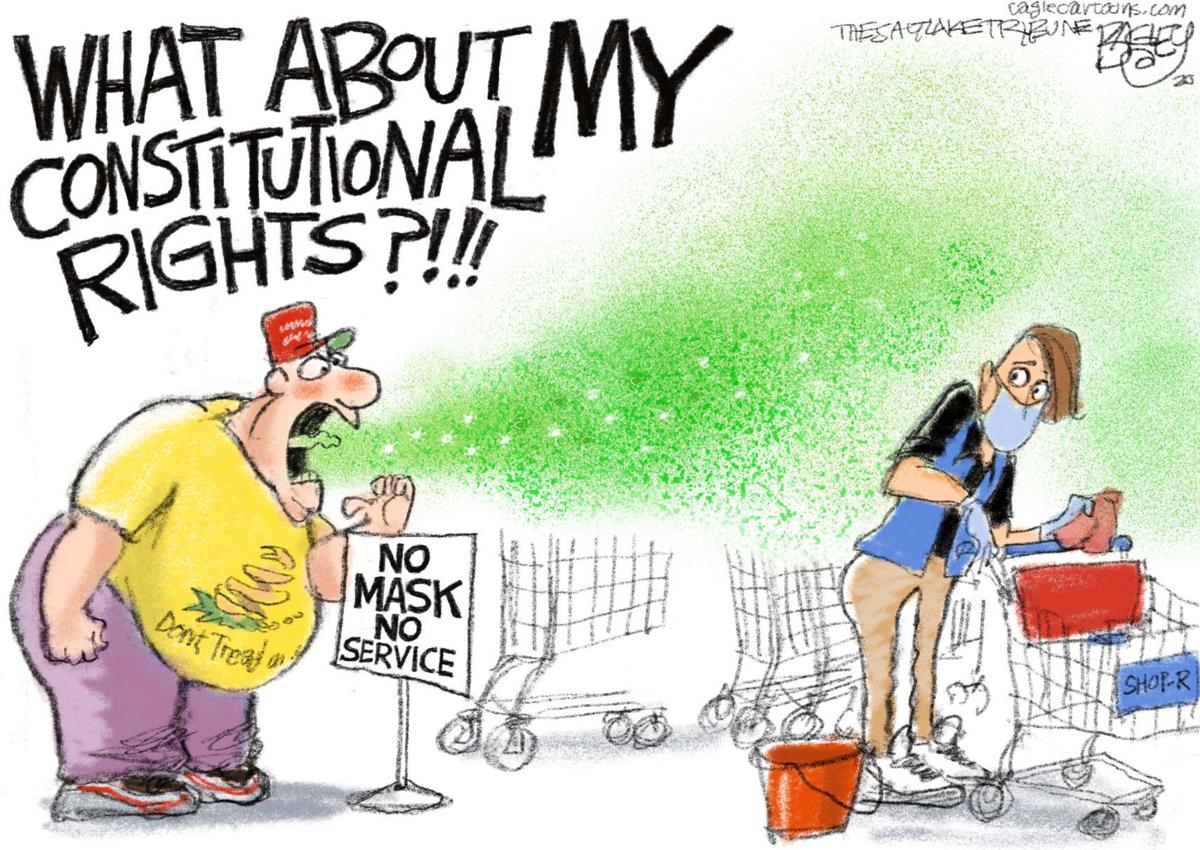
Cartoon – Anti-Science or Pro-Myth?

Twitter | Daily cartoon, Editorial cartoon, Cartoon

Cartoon – I’m DONE wearing a MASK

Editorial cartoon for June 19, 2020 | West Central Tribune

Cartoon – Constitutional Rights vs. Civility

Saturday cartoon

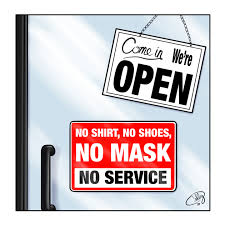
Cartoon – Come in We’re Open

No mask, no service | Opinion | dailyindependent.com

Indiana hospital employee fired after speaking to New York Times

https://www.beckershospitalreview.com/hr/indiana-hospital-employee-fired-after-speaking-to-new-york-times.html?utm_medium=email

Hospital Employee Is Fired After Speaking to The New York Times - The New  York Times

NeuroBehavioral Hospital in Crown Point, Ind., terminated the employment of a discharge planner last week after she spoke to the New York Times about nursing homes discharging unprofitable patients, a practice known as “patient dumping,” the NYT reports.

In the Sept. 19 NYT article, Kimberly Jackson said that during the pandemic nursing homes in Illinois and Michigan have repeatedly sent elderly and disabled Medicaid patients to NeuroBehavioral Hospital, a psychiatric facility, even though they were not experiencing psychosis, seemingly in an effort to get rid of patients who are not lucrative for reimbursement or require extra care. 

“The homes seem to be purposely taking symptoms of dementia as evidence of psychosis,” Ms. Jackson is quoted in the article.

She was fired from NeuroBehavioral Hospital Sept. 24. Rebecca Holloway, the hospital’s corporate director of human resources, told the NYT that Ms. Jackson violated the hospital’s media policy. 

Ms. Jackson told the newspaper she was shocked to be fired for speaking to the media.

“I saw something that was wrong, and I called it out,” she said.

NeuroBehavioral Hospital is part of NeuroPsychiatric Hospitals. The South Bend, Ind.-based network has five facilities in Indiana, two in Texas and one in Arizona.  


Cartoon – Coronavirus Projections

Cartoon – Coronavirus Projections | HENRY KOTULA

Striking nurses at Illinois hospital return to work without new contract

https://www.healthcaredive.com/news/university-illinois-nurses-back-to-work-after-strike/585631/?utm_source=Sailthru&utm_medium=email&utm_campaign=Issue:%202020-09-22%20Healthcare%20Dive%20%5Bissue:29794%5D&utm_term=Healthcare%20Dive

Dive Brief:

  • Nurses at the University of Illinois Hospital in Chicago returned to work Monday following a weeklong strike over their new contract. The two sides were unable to reach an agreement despite negotiations “that ran well into the evening” each night of the strike and planned to resume talks Monday.
  • They made some progress on key issues. The hospital agreed to hire more than 200 nurses to quell staff-to-patient ratio concerns at the forefront of the strike, according to the Illinois Nurses Association. UIH also proposed slight wage increases for nurses opposed to previously offered freezes, though the union countered with larger increases, INA said.
  • UIH agreed that it’s closer to making a deal on the contract despite not reaching a tentative agreement. Nurses will report to work under the existing terms of their past contract until a new deal is reached.

Dive Insight:

Nurse staffing levels have been an issue since long before the COVID-19 pandemic, but the crisis has accelerated those concerns, along with labor activity, as clinicians on the front lines have faced grueling conditions.

Before the strike began, UIH said staff-patient ratios are too rigid and remove flexibility, instead favoring acuity-based models focused on “obtaining the right nurse at the right time for each patient.”

But it amended that proposal last week, now agreeing to hire 200 nurses “to improve the staffing ratio, addressing the most important issue the nurses insisted on as a primary reason to strike,” according to INA.

Illinois has a Safe Patient Limits bill before its legislature that would spell out the maximum number of patients who may be assigned to a registered nurse in specified situations. HB 2604 was introduced in February 2019 and is currently before the House rules committee, though it has not received a full vote.

On Sept. 11, the day before the UIH strike began, a judge granted a temporary restraining order forbidding nurses in certain critical care units from going on strike.

The lawsuit, filed by the University of Illinois Board of Trustees, claimed a work stoppage among those nurses would endanger public safety due to the unique nature of the services provided in the units, specialized needs of patients they serve and lack of qualified substitutes to perform nurses’ duties.

About 525 nurses out of 1,400 represented by INA were barred from striking at UIH, according to the union.

Two days after UIH nurses walked off the job, service workers at the university main campus, hospital and various other facilities also went on strike.

Some 4,000 clerical, professional, technical, service and maintenance workers represented by Service Employees International Union 73 went on strike Sept. 14 over similar issues as the nurses, mainly staffing and pay.

The planned duration of the SEIU strike is unclear, though it’s been a week since it began.

“As UIC nurses return to work, we will continue our strike,” the union said in a statement. “We won’t quit until UIC respects us, protects us and pays us. Working through a pandemic and seeing our co-workers die has stiffened our resolve to fight for however long it takes to ensure the safety of all workers and those we serve.”


U.K. upgrades COVID alert level as Europe sees worrying rise in infections

https://www.axios.com/coronavirus-united-kingdom-european-cdc-4856ab47-29b2-43f2-b6c4-9a62d6867830.html

U.K. upgrades COVID alert level as Europe sees worrying rise in infections  - Axios

The U.K. could see up to 50,000 coronavirus cases per day by mid-October if current growth continues, top scientific advisers warned in a televised address from Downing Street on Monday.

The big picture: The U.K. has upgraded its coronavirus alert level from three to four as infections appear to be “high or rising exponentially.” Meanwhile, recent European Center for Disease Prevention and Control (ECDC) data shows that over half of all European Union countries are seeing an increase in COVID-19 cases.

What they’re saying: “At the moment, we think that the epidemic is doubling roughly every seven days” in the U.K., chief scientific adviser Patrick Vallance said.

  • England’s chief medical officer Chris Whitty stressed that unemployment and poverty are risks of taking strong action against the virus — like enforcing stay-at-home orders — but that more deaths will occur if aggressive action is not taken.

Where it stands: ECDC data shows that Spain, France, the Czech Republic, Croatia and Romania have recorded more than 120 confirmed COVID-19 cases per 100,000 inhabitants in the last 14 days, according to AP.

  • In Madrid, the rate of infection is nearly three times higher than the national average, at 683 cases per 100,000 inhabitants, per AP. Spain, one of the first epicenters of the virus in Europe, is faring the worst of countries tracked by the ECDC.
  • France has seen 31,285 deaths since the start of the pandemic, one of the highest death tolls in Europe. This weekend, France reported a record 13,000 new infections in 24 hours.
  • The Czech Republic reported 3,000 new cases on Thursday, almost as many as the country saw in all of March.
  • Croatia has recorded over 14,000 new COVID-19 cases per day since Sept. 16, while Romania is seeing over 11,000 new infections per day, according to Johns Hopkins data.

What to watch: Analysts expect the British government to announce short-term restrictions after Prime Minister Boris Johnson met with ministers over the weekend, AP reports.

  • German Chancellor Angela Merkel is planning second-wave prevention with her “Coronavirus Cabinet.” These plans include walk-in “fever clinics” to separate coronavirus patients from others.
  • Police in Madrid are limiting travel in working-class neighborhoods that have seen high transmission rates, while parks are closed and restaurants and shops must limit their occupancy at 50%.
  • Czech Republic’s Health Minister Adam Vojtech resigned Monday because of rising cases.
  • There are 20 new testing centers set to open in Paris and surrounding suburbs this week.


U.S. reaches 200,000 coronavirus deaths

https://www.axios.com/united-states-200000-coronavirus-deaths-17dc9d72-933b-473d-aa65-b7887eafffa2.html?stream=top&utm_source=alert&utm_medium=email&utm_campaign=alerts_all

The U.S. now has more than 200,000 coronavirus deaths - Axios

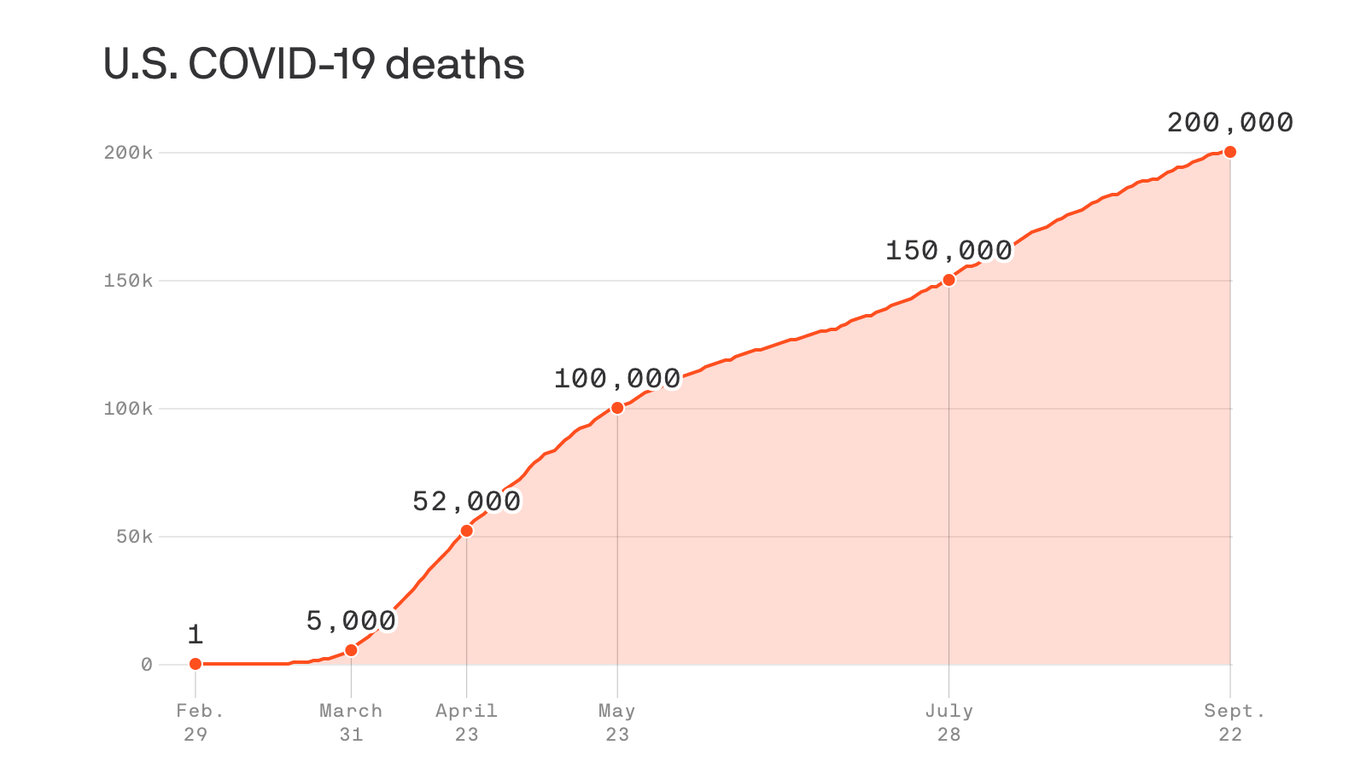
The coronavirus has now killed 200,000 Americans, according to Johns Hopkins data.

The big picture: Whatever context you try to put this in, it is a catastrophe of historic proportions — and is yet another reminder of America’s horrific failure to contain the virus.

  • The coronavirus has killed a bigger share of the American population than it has in almost any other wealthy country.
  • The death toll here is equivalent to roughly 65 Sept. 11 attacks. Three times more Americans have died from COVID than died in the Vietnam war — in only a fraction of the time.

This crisis has hit people of color especially hard.

  • Black and Latino Americans are dying at about three times the rate of white Americans.
  • They have also suffered far more from the economic fallout, which has fallen largely on lower-wage, service-industry workers.

And deaths keep coming — we’re averaging roughly 830 per day — even as the country increasingly sees the pandemic as background noise, as live sports resume and schools reopen and interest in news about the pandemic wanes.

Between the lines: The percentage of infected people who ultimately die from the coronavirus is lower now than it was in the outbreak’s earliest months, partly because doctors have gotten better at treating the virus and partly because outbreaks are now occurring within younger and lower-risk groups.

  • Overall cases are on a downward trajectory right now, following an enormous spike over the summer.
  • But the U.S. has never managed to get the virus firmly under control. Cases and deaths could get worse again as the weather gets colder and people move indoors, and the onset of flu season could make treatment more difficult.