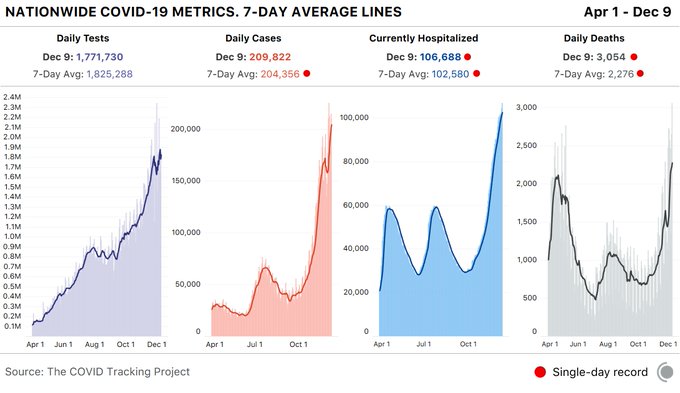
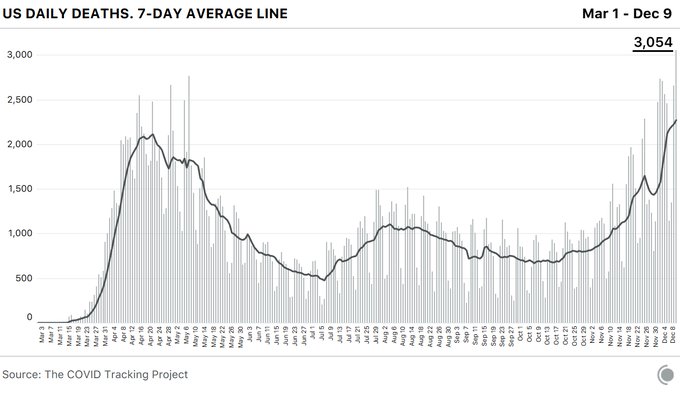
The coronavirus pandemic pushed the U.S. past another dire milestone Wednesday, the highest daily death toll to date, even while the mortality rate has decreased as health experts learn more about the disease.
The Covid Tracking Project, which tracks state-level coronavirus data, reported 3,054 COVID-19 related deaths — a significant jump from the previous single-day record of 2,769 on May 7.
The spread of the disease has shattered another record with 106,688 COVID-19 patients in U.S. hospitals. And overall, states reported 1.8 million tests and 210,000 cases. According to the group, the spike represents more than a 10% increase in cases over the last 7 days.
Additionally, California nearly topped its single-day case record at 30,851. It is the second highest case count since December 6, the organization reported.
The staggering spike in fatalities and infections has overwhelmed hospitals and intensive care units across the nation, an increase attributed by many experts to people relaxing their precautions at Thanksgiving.
Dean Baquet, The Times’s executive editor, believes that 2020 will go down as a signature year in history, alongside years like 1968, 1945 and 1865. “It will long be remembered and studied as a time when more than 1.5 million people globally died during a pandemic, racial unrest gripped the world, and democracy itself faced extraordinary tests,” he writes.
Those words come from Dean’s introduction to The Times’s annual Year in Pictures feature. Here, my colleagues on The Morning and I have chosen a dozen of those pictures that we think best summarize 2020. But we obviously have room here for only a fraction of the year’s photographs — so I encourage you to check out the full selection.
As you do, ask yourself which pictures you would have selected if you had to pick only 12 to sum up 2020.
Early in the year, the virus hit Western Europe harder than any other place in the world. In March, a coronavirus patient was examined at his home in Cenate Sotto, Italy.The pandemic forced people to find new ways to socialize. Circles painted on the grass at Domino Park in Brooklyn helped people spend time safely outdoors in May.Donald Trump became only the fourth elected president in the last century not to win re-election, joining Herbert Hoover, Jimmy Carter and George H.W. Bush. Trump departed Air Force One in August after returning from a campaign rally.Joe Biden struggled badly early in the Democratic primaries, only to rally to win the nomination and the presidency. He prayed at the Corinthian Baptist Church in Des Moines in January.Climate change wrought destruction on the planet in multiple ways during 2020. In Azusa, Calif., a wildfire burned more than 4,200 acres during the most active wildfire year on record for the West Coast.The killing of George Floyd in May inspired mass demonstrations against police brutality across the country. In Minneapolis, officers confronted protesters on May 31.Protesters marched in New York in June as anger spread across the country.Around the world, people spent far more time at home this year than usual. In São Paulo, Brazil, residents gathered at their windows in March to protest the government’s pandemic response.The pandemic led to a sharp economic downturn in much of the world. In May, people lined up for food distribution at a church in Brooklyn.More than 1.5 million people around the world have died from Covid complications. Mourners gathered in April at a cemetery in Brazil where workers were busy digging lines of open graves.Amid illness, death and separation in 2020, people also experienced great joys — even if they sometimes required adaptation. In April, Precious Anderson, a Covid-19 patient, was shown her newborn baby for the first time with the help of a live video feed at a hospital in Brooklyn.
But there is still one dark cloud hanging over the vaccines that many people don’t yet understand.
The vaccines will be much less effective at preventing death and illness in 2021 if they are introduced into a population where the coronavirus is raging — as is now the case in the U.S. That’s the central argument of a new paper in the journal Health Affairs. (One of the authors is Dr. Rochelle Walensky of Massachusetts General Hospital, whom President-elect Joe Biden has chosen to run the Centers for Disease Control and Prevention.)
An analogy may be helpful here. A vaccine is like a fire hose. A vaccine that’s 95 percent effective, as Moderna’s and Pfizer’s versions appear to be, is a powerful fire hose. But the size of a fire is still a bigger determinant of how much destruction occurs.
I asked the authors of the Health Affairs study to put their findings into terms that we nonscientists could understand, and they were kind enough to do so. The estimates are fairly stunning:
At the current level of infection in the U.S. (about 200,000 confirmed new infections per day), a vaccine that is 95 percent effective — distributed at the expected pace — would still leave a terrible toll in the six months after it was introduced. Almost 10 million or so Americans would contract the virus, and more than 160,000 would die.
This is far worse than the toll in an alternate universe in which the vaccine was only 50 percent effective but the U.S. had reduced the infection rate to its level in early September (about 35,000 new daily cases). In that scenario, the death toll in the next six months would be kept to about 60,000.
It’s worth pausing for a moment on this comparison, because it’s deeply counterintuitive. If the U.S. had maintained its infection rate from September and Moderna and Pfizer had announced this fall that their vaccines were only 50 percent effective, a lot of people would have freaked out.
But the reality we have is actually worse.
How could this be? No vaccine can eliminate a pandemic immediately, just as no fire hose can put out a forest fire.While the vaccine is being distributed, the virus continues to do damage. “Bluntly stated, we’ll get out of this pandemic faster if we give the vaccine less work to do,” A. David Paltiel, one of the Health Affairs authors and a professor at the Yale School of Public Health, told me.
There is one positive way to look at this:Measures that reduce the virus’s spread — like mask-wearing, social distancing and rapid-result testing — can still have profound consequences. They can save more than 100,000 lives in coming months.
In the past seven days, 15,813 people in the U.S. died from the virus, breaking a record that had stood since mid-April.
Americans have made no secret of their skepticism of COVID-19 vaccines this year, with fears of political interference and a “warp speed” timeline blunting confidence in the shots. As recently as September, nearly half of U.S. adults said they didn’t intend to be inoculated.
But with two promising vaccines primed for release, likely within weeks, experts in ethics and immunization behavior say they expect attitudes to shift quickly from widespread hesitancy to urgent, even heated demand.
“People talk about the anti-vaccine people being able to kind of squelch uptake. I don’t see that happening,” Dr. Paul Offit, a vaccinologist with Children’s Hospital of Philadelphia, told viewers of a recent JAMA Network webinar. “This, to me, is more like the Beanie Baby phenomenon. The attractiveness of a limited edition.”
Reports that vaccines produced by drugmakers Pfizer and BioNTech and Moderna appear to be safe and effective, along with the deliberate emphasis on science-based guidance from the incoming Biden administration, are likely to reverse uncertainty in a big way, said Arthur Caplan, director of the division of medical ethics at New York University School of Medicine.
“I think that’s going to flip the trust issue,” he said.
The shift is already apparent. A new poll by the Pew Research Center found that by the end of November 60% of Americans said they would get a vaccine for the coronavirus. This month, even as a federal advisory group met to hash out guidelines for vaccine distribution, a long list of advocacy groups — from those representing home-based health workers and community health centers to patients with kidney disease — were lobbying state and federal officials in hopes their constituents would be prioritized for the first scarce doses.
“As we get closer to the vaccine being a reality, there’s a lot of jockeying, to be sure,” said Katie Smith Sloan, chief executive of LeadingAge, a nonprofit organization pushing for staff and patients at long-term care centers to be included in the highest-priority category.
Certainly, some consumers remain wary, said Rupali Limaye, a social and behavioral health scientist at the Johns Hopkins Bloomberg School of Public Health. Fears that drugmakers and regulators might cut corners to speed a vaccine linger, even as details of the trials become public and the review process is made more transparent. Some health care workers, who are at the front of the line for the shots, are not eager to go first.
“There will be people who will say, ‘I will wait a little bit more for safety data,” Limaye said.
But those doubts likely will recede once the vaccines are approved for use and begin to circulate broadly, said Offit, who sits on the FDA advisory panel set to review the requests for emergency authorization Pfizer and Moderna have submitted.
He predicted demand for the COVID vaccines could rival the clamor that occurred in 2004, when production problems caused a severe shortage of flu shots just as influenza season began. That led to long lines, rationed doses and ethical debates over distribution.
“That was a highly desired vaccine,” Offit said. “I think in many ways that might happen here.”
Initially, vaccine supplies will be tight, with federal officials planning to ship 6.4 million doses within 24 hours of FDA authorization and up to 40 million doses by the end of the year. The CDC panel recommended that the first shots go to the 21 million health care workers in the U.S. and 3 million nursing home staff and residents, before being rolled out to other groups based on a hierarchy of risk factors.
Even before any vaccine is available, some people are trying to boost their chances of access, said Dr. Allison Kempe, a professor of pediatrics at the University of Colorado School of Medicine and expert in vaccine dissemination. “People have called me and said, ‘How can I get the vaccine?’” she said. “I think that not everyone will be happy to wait, that’s for sure. I don’t think there will be rioting in the streets, but there may be pressure brought to bear.”
That likely will include emotional debates over how, when and to whom next doses should be distributed, said Caplan. Under the CDC recommendations, vulnerable groups next in line include 87 million workers whose jobs are deemed “essential” — a broad and ill-defined category — as well as 53 million adults age 65 and older.
“We’re going to have some fights about high-risk groups,” said Caplan of NYU.
The conversations will be complicated. Should prisoners, who have little control over their COVID exposure, get vaccine priority? How about professional sports teams, whose performance could bolster society’s overall morale? And what about residents of facilities providing care for people with intellectual and developmental disabilities, who are three times more likely to die from COVID-19 than the general population?
Control over vaccination allocation rests with the states, so that’s where the biggest conflicts will occur, Caplan said. “It’s a short fight, I hope, in the sense in which it gets done in a few months, but I think it will be pretty vocal.”
Once vaccine supplies become more plentiful, perhaps by May or June, another consideration is sure to boost demand: requirements for proof of COVID vaccination for work and travel.
“It’s inevitable that you’re going to see immunity passports or that you’re required to show a certificate on the train, airplane, bus or subway,” Caplan predicted. “Probably also to enter certain hospitals, probably to enter certain restaurants and government facilities.”
But with a grueling winter surge ahead, and new predictions that COVID-19 will fell as many as 450,000 Americans by February, the tragic reality of the disease will no doubt fuel ample demand for vaccination.
“People now know someone who has gotten COVID, who has been hospitalized or has unfortunately died,” Limaye said.
“We’re all seeing this now,” said Kempe. “Even deniers are beginning to see what this illness can do.”
They have been at this for almost a year. While politicians argued about masks, superspreader weddings made the news, a presidential election came and went, and at least 281,000 Americans died, nurses reported for work. The Post asked seven ICU nurses what it’s been like to care for the sickest covid patients. This is what they want you to know.
As of Dec. 7, Idaho has seen 110,510 total confirmed cases, 1,035 deaths, and 477 people are currently hospitalized with the virus.
Kori Albi, 31
Covid unit intensive care nurse and unit supervisor, Saint Alphonsus Regional Medical Center
Our staff are getting sick. Our physicians are getting sick. And they’re not getting it from the hospital. They’re getting it from the community. We are almost lucky to care for the covid patients because we know who they are. Anytime we go into these rooms, we know exactly what we need to do. We have all the PPE we need. And as long as we are diligent and follow all the processes that are in place, we can keep ourselves safe. That’s not what worries me at all. Going out into the community is scarier than coming into work every day. Because you don’t know who has it.
This virus has caused this feeling, this sense of isolation. The covid unit is an isolated desert. Every door is shut. Every room has negative airflow. By the time you put your N95 mask on and then your surgical mask over the top of that, then you put your isolation gown on and your face shield on top of that, you can’t tell who is who. So much of health care is about that personal touch — now, our patients can’t even see our name badges because they are on under our gowns. All they see are our eyes through our face mask.
A lot of families are hesitant to have Zoom calls with patients because it can be uncomfortable and awkward. Especially if these patients are sedated and intubated. There’s always that awkwardness of: Can they hear you? Can they not hear you? Even as nurses, we feel like we’re talking to the wall. But we talk to them just as if they were awake. Allowing families to play their music that they like or pray with them or just talk to them can absolutely help. You see vital signs change.
One patient, all she wanted to do was have her son sing her a song. I think I spent over an hour in the room listening to him play the guitar and sing her a song. He sang her mostly hymns.
Death is a very intimate event that normally involves a lot of family members that help bring closure and that helps everyone process. In normal circumstances, health care providers form these relationships with the family at the bedside. All of that has been removed. And we now have to try to form those relationships over the telephone. It’s a traumatic experience. And it’s a long drawn-out process. A lot of people don’t make it out of here. It’s a slow, lonely death.
The amount of death with covid is profound. As nurses, we have learned to process death, but the amount of death has happened in such a short span of time — that’s what’s been overwhelming. I had a patient that we did a Zoom call with. His four-year-old granddaughter lived with him. And she brought tears to the room. The naivete of a four-year-old. Her grandfather was intubated so he couldn’t talk. But he could kind of look around the room. But the innocence of her, saying, “Come home, Pa. I miss you, Pa. I love you Pa,” all through a video screen. The 14-year-old that also lived with them couldn’t formulate words to say anything, and he didn’t know what to do or say in that video. But the four-year-old was telling Pa to come home.
JACKSON, MISS.
As of Dec. 7, Mississippi has seen 166,194 total confirmed cases, 3,961 deaths, and 1,157 people are currently hospitalized with the virus.
Catie Carrigan, 28
ICU, University of Mississippi Medical Center
There are some patients who have been in their younger 20s and their younger 30s, and I think maybe those are the hardest cases. They have families and they have kids just like I do, and it’s hard coming into work and taking care of them. Knowing they’re supposed to be going to college, they’re supposed to be getting married, they’re supposed to be having kids and, instead, they’re laying in a hospital bed on a ventilator fighting for their life.
They have their whole entire lives ahead of them, and then they get hit with this disease that everybody thinks is a hoax and then they die.
I worked in the ER a month ago, so I know exactly what’s going on down there, and now I work in the ICU, so I know exactly what’s going on on both sides of it. There are no ICU beds in the hospital. None. When there are no ICU beds, we hold them in the ER, or we hold them in the PACU (post-anesthesia care unit). The ER still has to treat our trauma patients, our car accidents, our gunshot victims. So when we have those ICU holds in the ER, it obviously makes the jobs of nurses and doctors in the ER way more difficult than it needs to be. We are treating patients in the hallway. They’re just trying to do the best they can with the resources that we have.
There is no room left, essentially, and I think that’s really what people don’t seem to understand. And I get it, when you’re not in health care you don’t really see our side of it, but we’re seeing the worst of it. It’s hard for us to convey that to the public because they don’t seem to want to take our word for it — but take our word for it. Take our word for it.
IOWA CITY
As of Dec. 7, Iowa has seen 244,844 total confirmed cases, 2,717 deaths, and 898 people are currently hospitalized with the virus.
Allison Wynes, 39
Medical intensive care unit, University of Iowa Hospitals and Clinics
I cry every day when I walk in to work, and I cry every day when I walk to my car after work.
You get it out of your system before you show up and you do your job and you’re fine. Then, you go home and you cry before you get home. And then you go home and be mom.
My 9-year-old daughter asks frequently, “Mommy, how many patients were there today? Mommy, how many sick ones were there today? Were you safe? Was everything okay? Do you have to go to work again? How many patients?” She gets it.
I think one thing that people do not appreciate is it’s not only the number or volume of patients that comes through — it’s the level of care that they require, which is so much greater than a standard patient in the ICU or a standard patient in the floor, because they can get very, very sick very quickly.
We were walking a patient who was on ECMO, which is extracorporeal membrane oxygenation, and it took five people to walk her. That’s not normal.
I work in the MICU, so it’s never like a party up in here, but it used to at least be, nine times out of ten, calm and controlled and tidy and clean. Occasionally stuff would go bad and we would all run and help, and then we would all go about our days. Now it just feels like, especially of late, there is equipment everywhere. There are gowns everywhere. There are gloves everywhere, there are people everywhere, and there are fires everywhere.
I’m actually scared, and I’ve never been scared at work before. I am scared that we will lose control.
It’s the human resources we are running low on. We can make a bed, we can find a ventilator, we have PPE. But it’s the human cost of caring for these patients that has been keeping me up at night the past couple of weeks and really making me nauseous every day.
I didn’t think it would be over by now, but I didn’t think we’d be getting hit this hard this late. I thought we’d still just be smoldering. I didn’t know that we would just be a raging fire at this point in time. We’re not prepared for that, but here we are.
After this, I’m going to take my kids to a beach or somewhere.
GLENVIEW, ILL.
As of Dec. 7, Illinois has seen 796,264 total confirmed cases, 14,216 deaths, and 5,190 people are currently hospitalized with the virus.
Luisa Alog Penepacker, 51
ICU, Glenbrook Hospital
I’ve taken care of a lot of husband-wife patients, unfortunately. One of the cases was one in which the husband had tested positive for covid first, but he was a mild case. She was a little bit more serious. She ended up on our unit.
The husband ended up in the hospital the next day, but he was on the step-down unit. When I admitted her, she was terrified, especially knowing that her husband was upstairs in another unit. She was having a hard time breathing, and she grabbed onto my hand and looked at me. She goes, “Am I gonna die?” I mean, I didn’t know what to say. And I just told her, “Not on my watch.” So we just kept on going. But unfortunately, she got intubated the next day.
Then I was sent to work upstairs on the step-down unit. I had her husband that next day, and he was actually quite happy that I saw her. He goes, “You took care of my wife, how is she? I heard that she’s not doing well.” I didn’t know what to say to him, either. I just said, “You know, she’s in the best of care. We’ll take really good care of her.” And he looked really relieved. He goes, “I’m just so glad that someone who had seen her is here now to talk to me.” And my heart broke with that.
She ended up passing. A few days after, he went home, and I didn’t see him, so I don’t know how he took it. He wasn’t able to see her before she passed.
We wear personal air purification respirators on our heads — these big white domes over our heads with a respirator hose going to a machine strapped around our waist, and we look like astronauts walking through the unit, going in and out of patients’ rooms with our plastic gowns and gloves.
It can be frightening to family members if they’re allowed to come to visit and definitely for patients because we’re kind of scary-looking. It can be frantic at times. You walk through the hall, and you see a lot of patients on ventilators. You hear a lot of beeping. People are rounding constantly to check on patients. It’s a busy place.
You don’t know what to tell family members when you see them. What can you say? You just say, “I’m sorry.” You can’t even hug them. I used to be able to hug family members, but you can’t with all the gear.
When patients are scared, I will hold their hand even though I’m wearing gloves. I look them in the eyes as much as I can because really, that’s all you can see. You can’t see our faces. You can barely even hear past the mask. So I’ll make sure to look at them. I try to make an effort to smile with my eyes and to just hold their hand if they need it.
MURRAY, UTAH
As of Dec. 7, Utah has seen 215,407 total confirmed cases and 939 deaths.
Tammy Kocherhans, 41
Respiratory ICU, Intermountain Healthcare
These patients are different than the typical patient. They’re very complex. They can change in the blink of an eye. And it’s very hard as a nurse when you wrap your heart and soul into taking care of these patients. I started noticing that I was emotionally tired. I was physically completely exhausted. And I was beginning to question whether or not I could continue forward being a nurse at all. I was past my physical capacity.
I happened to be working a day where another health care worker who was a veteran said that this was like a combat zone, and for some reason in my head, that validated the way that I was feeling. So I reached out to one of my best friends who is a veteran, a flight medic, and he said, “I meditate and do yoga.”
Once I started doing that, I was able to handle the emotional crises, the physical pain of working so, so many long, hard hours. We do something called proning, where you take patients and flip them over onto their bellies. And that sounds really easy, but it takes a team of a minimum of five people. It is extremely taxing on your body. It hurts. And I lift weights! The meditation and yoga really has saved my life, my mental capacity, my spiritual capacity, my physical capacity, everything that is required to give to these patients.
Hopefully by 8 p.m., I’m out in the parking lot and spend a minute in my car to unload from my day. It’s all about taking a moment to breathe for myself and then going through whatever came up that day that I need to let go of. It depends on how complicated my patient was that day, whether I can let my whole day go or if I have to spend time to go through each piece and work it down to: What did I do right? Did I miss something? Sometimes I just can’t let some details go quickly, and I have to work them down to allow myself to say I did everything that I possibly could for this individual this day, in this time, in this situation. And whatever the outcome was or is, I followed protocol. I did everything that I knew how to do. And it’s going to be OK.
I find it very frustrating when I go out and about on my days off and I see people very blatantly not wearing masks or trying to tell me how come they don’t work or telling me that this pandemic isn’t real. I find it completely disrespectful to the work we do to save people’s lives, to have people think that this pandemic isn’t real, to show utter disregard for people around them, not trying to do their part.
And I really wish that I could take people on a day with me so that they can see what I see. So that they can feel your feet ache so bad that you wish they’d just fall off, because you’re on that concrete for so many hours. Your back aches because you’re wearing equipment to save your life — so that you can save somebody else’s life. And your head hurts. I’ve never had so many headaches in my life because part of the equipment sits on your head, and after 12 hours, it starts to exert so much pressure that you start to have a headache, and you’re dehydrated.
Early in the pandemic, I remember walking into this room, and this young patient was crying and asked me if they were going to die. And I’m a mom of teenagers. For me, that was awful because this patient was all alone, and we as staff were minimizing contact because we didn’t want to get the virus.
This patient started physically trembling in the bed. I couldn’t take it anymore, and I went over and just held this patient because that’s what I’d want somebody to do for my children. That was my first patient that I held like that. And there have been many since.
MURRAY, UTAH
As of Dec. 7, Utah has seen 215,407 total confirmed cases and 939 deaths.
Nate Smithson, 28
Respiratory ICU, IntermountainHealthcare
A few weeks ago, my wife and I were on a date at a restaurant. And in the middle of nowhere, I had this panic attack and went and hid in the bathroom stall for half an hour. I have no idea what brought it on. I just couldn’t handle being there right then, which was weird for me. That’s the first time anything like that has happened. But since then, it’s happened multiple times, where the anxiety and stress is overwhelming, and I can’t handle it. So I have to go and excuse myself for a little bit.
Balancing work and life is something that used to seem possible. Now it doesn’t seem like there is any difference between the two. I fall asleep and I dream about my patients.
When we got our first covid patient in February in the hospital, in the ICU, we all kind of thought it was a little bit of a joke, to be honest. I had this patient, and he was sitting there with minimal amounts of oxygen in the room just watching TV. He’s like, “I’m fine. I don’t know why everyone’s freaking out about this.” And I thought the same thing. And then a few hours later, he stands to go pee, and I’m looking at his monitor. And it drops down to the low 90s. Ninety-two is about as low as you want to go. And then it starts dropping down lower, to about the 70s. Then it gets down into the 60s and 50s. And that’s dangerous territory. That’s where brain cells start dying and you start having some serious problems.
I run into the room. We get him back into bed and throw all the oxygen that we have in the room on him, crank everything up, and he’s not recovering from it. We had to intubate right then and there. And about an hour later, he finally starts recovering a little bit. But at this point, he’s sedated, he’s on the ventilator. Everything is worse. And that’s the first time where it’s like: Oh, crap, this is serious. This is something else. I’ve never seen anything like that before.
If a patient’s heart stops or if they stop breathing, we call a code blue, and that’s when the doctor, respiratory therapist, nurses, everybody comes into the room. We start chest compressions or CPR or that kind of stuff. This one patient’s heart is not working. So I call the code blue. We all get in there. We start doing the chest compressions. Five minutes later, we get the patient back. We all go back about our work. Twenty minutes later, same thing happens again. We start doing the chest compressions. We start pushing medications as fast as we can to get the patient back again.
The spouse comes into the hospital. I explain: “Just so you know, this is what happened before. It could possibly happen again. If it does, I’m going to need you to step outside of the room.” And as I’m explaining this, sure enough, it happens again. We lose the pulse. We lose the heartbeat. So I ask her to leave the room. Everyone gets in there, and we start going for it. We went for almost two hours: chest compressions, pushing medications, shocking the patient’s heart.
The doctor is ultimately the one who makes the decision about when we stop, and they call time of death. But typically in situations like that, where it’s unexpected and sudden, they want to make sure that everybody can go home that night feeling OK about what they did, knowing that they did everything. And after an hour, he stops, turns to the room and asks: Does anyone have a problem with us stopping?
I didn’t have a problem, but then as he’s saying that, I look out the window, and the patient’s wife is just watching us. She’s been sitting out there watching us for an hour, and no one’s saying anything.
And I ask them to keep going.
So we did. We went almost for another hour after that, and we didn’t get the patient back. He ended up dying.
But I think for me, that was important — to keep going. Not because we thought we would get them back, but so that his wife would know that we did everything we could.
I still go to bed with her face kind of burned into my mind, of just seeing her sitting out there watching us, and that’s what kills me.
COLUMBUS, OHIO
As of Dec. 7, Ohio has seen 475,024 total confirmed cases and 6,959 deaths.
Kahlia Anderson, 32
ICU, Ohio State University Wexner Medical Center
I graduated from nursing school in May 2019. I started here at the Wexner in August. Our orientation is a 20-week program, and so I came out on my own Jan. 12, 2020. The pandemic hit us at the end of February.
In nursing school, I think your biggest fears are making med errors, or harming your patient in some way, or just not knowing how to do everything. Did I check my patient’s blood pressure before I gave this blood pressure medication, or did I give the correct dose of a specific medication? I had heard stories about that on the unit, like make sure you’re careful with the needle stick, or make sure you’re careful with this medication. And I don’t even think about those kinds of things anymore.
Now it’s the fear of the unknown. It’s the fear that anything could happen because of this virus and my patient could die regardless of what I do.
When I got my first covid-positive patient, I remember thinking: Somebody did the assignment wrong because there’s no way that they believe that I should be taking care of this patient. I can remember the feeling. I can remember the day. It was a weekend. I was on a day shift. And I was thinking to myself: Who trusted me, the new nurse to take care of a covid-positive patient? How am I going to do this? How am I going to keep this patient safe? How am I going to keep myself safe? Am I safe? Wait, who cares about me? Let’s get back to the patient. What do they need?
At the time, I didn’t even understand some of the ventilator settings because I was still that new, and it was still that fresh to me. And I thought: This machine is doing that much work for them, and I don’t know enough about it, but I’m going to make sure that I get it done and I’m going to figure it out today to make sure that this patient gets everything that they need. And I’m going to call their family and double check with them and check in with them and call them.
That patient is alive. That patient is no longer in the hospital. As far as I know, that patient is home and safe with family.
I would feel like: There’s someone more experienced. There’s someone more adequate to deal with this. And I was like — oh, it’s me. This is me, I’m doing this, and I’ve been doing it ever since.
I saw new nurses come out of orientation, and I saw the type of assignments that they would get. So my mind fixated on like: I’m going to get patients that are ready to transfer out. They can talk, they can eat. They’re just waiting for a bed on another unit. Or maybe it’s a patient who needs long-term care. So they’re waiting to go to a facility to be discharged. And so I was thinking to myself: I’m going to get my feet wet. It’s going to be great. I’m going to build up this experience, and then I’m going to start getting sicker patients, and I’m going to be ready.
Once covid hit, there was no room for those types of patients anymore. Everyone had covid, everyone was sick, everyone was intubated or approaching intubation.
And for me, I just wanted my first experience. I wanted to have the simple experience of building and getting better. But that’s not what was in store. And I can’t say that I’m upset about it today. I’m grateful for this experience. I don’t wish this pandemic on anyone. I wish it was not here. I wish that it was different. But as a nurse, as a new nurse, these experiences are unique to me. It’s making me a better nurse. It’s made me a better person, and I can only continue to just be.
We did cry in the beginning, and now not so much. I think we all struggled when we had a young death. Someone in their 20s was very difficult for us. Because you think: That was a young life. What a young life that was, and they’re not here anymore. Because of a virus. That’s hard. It’s very hard.








 HENRY KOTULA