The rising danger of private equity in healthcare

Private equity (PE) acquisitions in healthcare have exploded in the past decade. The number of private equity buyouts of physician practices increased six-fold from 2012-2021. At least 386 hospitals are now owned by private equity firms, comprising 30% of for-profit hospitals in the U.S. 

Emerging evidence shows that the influence of private equity in healthcare demands attention. Here’s what’s in the latest research.

What is private equity?

There are a few key characteristics that differentiate private equity firms from other for-profit companies. At a 2023 event hosted by the NIHCM Foundation, Assistant Professor of Health Care Management at The Wharton School at the University of Pennsylvania Dr. Atul Gupta explained these factors:

  1. Financial engineering. PE firms primarily use debt to finance acquisitions (that’s why they’re often known as “leveraged buyouts”). But unlike in other acquisitions, this debt is placed on the balance sheet of the the target company (ie. the physician practice or hospital). 
  2. Short-term goals. PE firms make the majority of their profits when they sell, and they look to exit within 5-8 years. That means they generally look for ways to cut costs quickly, like reducing staff or selling real estate. 
  3. Moral hazard. PE companies can make a big profit even if their target firm goes bankrupt. This is different from most investments where the success of the investor depends on how well the target company does.

The nature of private equity itself has serious implications for healthcare, in which the health of communities depends on the long-term sustainability and quality improvement of hospitals and physician practices. But are these concerns borne out in the real world?   

PE acquisition and adverse events

recent study in JAMA from researchers at Harvard Medical School and the University of Chicago analyzed patient mortality and the prevalence of adverse events at hospitals acquired by private equity compared to non-acquired hospitals. The study used Medicare claims from more than 4 million hospitalizations from 2009-2019, comparing claims at 51 PE-acquired hospitals and 249 non-acquired hospitals to serve as controls.

In-hospital mortality decreased slightly at PE-acquired hospitals compared to controls, but not 30-day mortality. This may be because the patient mix at PE-acquired hospitals shifted more toward a lower-risk group, and transfers to other acute care hospitals increased. 

However, there were concerning results for patient safety. The rate of adverse events at PE-acquired hospitals compared to control hospitals increased by 25%, including a 27% increase in falls, 38% increase in central line-associated bloodstream infections (CLABSI), and double the rate of surgical site infections. The authors found the rates of CLABSI and surgical site infections at PE-acquired hospitals alarming because overall surgical volume and central line placements actually decreased. 

What could be behind these higher rates of adverse events after PE acquisition? In a Washington Post op-ed, Dr. Ashish Jha, dean of the School of Public Health at Brown University, writes that it’s down to two things: staffing levels and adherence to patient safety protocols. “Both cost money, and it is not a stretch to connect cuts in staffing and a reduced focus on patient safety with an increased risk of harm for patients,” he writes.   

Social responsibility impact

Private equity acquisitions may have a negative effect on patient safety, but what about social responsibility? In a recent report from PE Stakeholder on the impact of Apollo Global Management’s reach into healthcare, the authors use the Lown Institute Hospitals Index to understand hospitals owned by Apollo perform on social responsibility. Lifepoint Health, a health system owned by Apollo, was ranked 222 out of 296 systems on social responsibility nationwide. And in Virginia, North Carolina, and Arizona, some of the worst-ranked hospitals in the state for social responsibility are those owned by Lifepoint Health, the PE Stakeholder report shows.

Apollo Global Management is the second largest private equity firm in the United States, with $598 billion total assets under management, according to the report. The PE stakeholder report outlines concerning practices by Apollo, including putting high levels of debt that lowers hospitals’ credit ratings and increases their interest rates, cutting staff and essential healthcare services, and selling off real estate for a quick buck. If we care about hospital social responsibility we should clearly be concerned about private equity acquisitions. 

The bigger picture

Private equity buyouts did not come from out of nowhere, so what does this trend tell us about our healthcare system? PE acquisitions are in many ways a symptom of larger issues in healthcare, such as increasing administrative burden, tight margins, and lack of regulation on consolidation. For owners of private physician practices that face a lot of administrative work, deciding to sell to a PE firm to reduce this workload and focus on patient care (not to mention, getting a hefty payout) is a tempting proposal

In the Washington Post, Ashish Jha describes what made his colleague decide to sell his practice to a PE firm: “The price he was getting was very good, and he was happy to outsource the headache of running the business (managing billing, making sure there was adequate coverage for nights and weekends, etc.).”

In many ways, private equity is both a response to and an accelerator of broader health system trends – one in which consolidation is happening quickly, care is being delivered by larger and larger entities, and corporate influence is growing.”Jane M. Zhu, MD, MPP, MSHP, Associate Professor of Medicine at Oregon Health & Science University, at NIHCM Foundation Event

PE buyouts are also indicative of a larger trend, what some researchers call the “financialization” of health. As Dr. Joseph Bruch at the University of Chicago and colleagues describe in the New England Journal of Medicine, financialization refers to the “transformation of public, private, and corporate health care entities into salable and tradable assets from which the financial sector may accumulate capital.”  

Financialization is a sort of merging of the financial and healthcare sectors; not only are financial actors like private equity buying up healthcare providers, but healthcare institutions are also acting like financial firms. For example, 22 health systems have investment arms, including nonprofit system Ascension, which has its own private equity operation worth $1 billion. The financialization of healthcare is also reflected in the boards of nonprofit hospitals. A 2023 study of US News top-ranked hospitals found that a plurality of their board members (44%) were from the financial sector. 

What we can do about it?

What can we do to mitigate harms caused by PE acquisitions? In Health Affairs Forefront, executive director of Community Catalyst Emily Stewart and executive director of the Private Equity Stakeholder Project Jim Baker provide some policy ideas to stop the “metastasizing disease” of private equity:

  • Joint Liability. Currently PE firms can put all of their debt on the balance sheet of the firm they acquire, letting them off the hook for this debt and making it harder for the acquired company to succeed. “Requiring private equity firms to share in the responsibility of the debt…would prevent them from making huge profits while they are saddling hospitals and nursing homes with debts that ultimately impact worker pay and cut off care to patients,” write Stewart and Baker.
  • Regulate mergers. Private equity acquisitions often go under the radar because the acquisitions are small enough to not be reported to authorities. But the U.S. Federal Trade Commission could be more aggressive in evaluating mergers and buyouts by PE, as they have done recently in Texas, where a PE firm has been buying up numerous anesthesia practices. 
  • Transparency of PE ownership. It can be hard to know when hospitals are bought by a PE firm. The Department of Health and Human Services could require disclosure of PE ownership for hospitals as they have done for nursing homes.
  • Remove tax loopholes. The carried interest loophole allows PE management fees to be taxed at as capital gains, which is a lower rate than corporate income. Closing this loophole would remove a big incentive that makes PE buyouts so attractive for firms.  

“It is clear that the problem is not the lack of solutions but rather the lack of political will to take on private equity,” write Steward and Baker.

We need not to not only stem the tide of PE acquisitions sweeping through healthcare, but address the financialization of healthcare more broadly, to put patients back at the center of our health system.

Two lawmakers test positive for coronavirus, one after receiving both doses of vaccine

Politics - The Washington Post

Two members of Congress from Massachusetts have tested positive for the coronavirus, one after receiving both doses of the vaccine, a reminder that people can still be vulnerable to infection after being vaccinated, particularly in the two weeks after receiving the second dose.

Rep. Stephen F. Lynch (D-Mass.) tested positive for the virus on Friday afternoon after a staff member in his Boston office tested positive earlier in the week, his spokeswoman Molly Rose Tarpey said.

Lynch received a second dose of the Pfizer-BioNTech vaccine before the inauguration of President Biden on Jan. 20, but his office declined to specify the date it was administered. Lynch had tested negative for the virus before attending the inaugural ceremonies, Tarpey said.

“While Mr. Lynch remains asymptomatic and feels fine, he will self-quarantine and will vote by proxy in Congress during the coming week,” she said.

Tarpey added that Lynch “has followed CDC guidelines and continues to do so since he received the vaccine.”

Another Democrat from Massachusetts, Rep. Lori Trahan, announced Thursday that she had tested positive for the virus and was asymptomatic. Trahan, whose staff members have been working remotely, also said she planned to vote by proxy next week.

“I encourage everyone to continue taking this virus seriously and to follow the science and data-driven guidance to wear a mask, maintain a safe social distance from others, avoid large gatherings and stay home whenever possible,” Trahan said.

Trahan received her first shot of one of the vaccines last week, spokeswoman Francis Grubar told The Washington Post.

Occasional cases of people testing positive after receiving one or both doses are not unexpected, medical experts say. Clinical trial data published by Pfizer show that the vaccine is about 52 percent effective at preventing illness after the first shot, compared to 95 percent effectiveness seven days after the second dose.

A small number of patients can still become mildly sick even after they are fully vaccinated. But only one of the roughly 20,000 people who received both doses in the clinical trial developed severe covid-19, suggesting the vaccine is powerful protection against the most dangerous cases of the disease.

Members of Congress began getting vaccinated as early as Dec. 18, but Lynch at the time said he was “waiting for the vaccine to be first offered to health care personnel, first responders and vulnerable seniors” in his district, the Boston Herald reported. It is unclear when Lynch ultimately received his first dose of the vaccine; he would have received the second dose of the Pfizer-BioNTech vaccine about three to four weeks after the first.

Public health experts have emphasized that it usually takes one week after the second dose of the Pfizer-BioNTech vaccine to reach 95 percent efficacy and two weeks after the second dose of the Moderna vaccine to reach 94 percent efficacy.

“There’s no vaccine that I know that protects you the same day you get it,” Onyema Ogbuagu, the principal investigator for Pfizer’s vaccine trial at Yale University, told The Post’s Allyson Chiu. “On a population level, 95% efficacy still translates to 5/100, or 50/1,000, or 500/10,000 vaccinated persons still being vulnerable to symptomatic disease and maybe even more having asymptomatic carriage.”

At least 23.2 million people in the United States have received one or both doses of the vaccine. The Centers for Disease Control and Prevention recommends that vaccinated people continue to wear masks, socially distance, avoid poorly ventilated spaces and wash their hands frequently to prevent the spread of the virus.

“We also don’t yet know whether getting a covid-19 vaccine will prevent you from spreading the virus that causes covid-19 to other people, even if you don’t get sick yourself,” CDC guidelines state. “While experts learn more about the protection that covid-19 vaccines provide under real-life conditions, it will be important for everyone to continue using all the tools available to help stop this pandemic.”

Mask-wearing in particular has become politicized, including in the hallways of Congress. After the Jan. 6 siege at the Capitol, several Democrats said they feared they had been exposed to the virus after sheltering with Republican lawmakers who refused to wear masks. In the following, at least three lawmakers tested positive for the virus.

On Friday, Rep. Cori Bush (D-Mo.) accused Rep. Marjorie Taylor Greene (R-Ga.) of berating her in the hallways after she told Greene to put on a mask. The incident, coupled with other hostile rhetoric and Greene’s refusal to abide by rules and protocols put in place because of the pandemic, prompted Bush to decide to move her office away from Greene’s for safety reasons, the Missouri lawmaker said.

Mask resistance during a pandemic isn’t new – in 1918 many Americans were ‘slackers

https://theconversation.com/mask-resistance-during-a-pandemic-isnt-new-in-1918-many-americans-were-slackers-141687?utm_medium=email&utm_campaign=The%20Weekend%20Conversation%20-%201680716207&utm_content=The%20Weekend%20Conversation%20-%201680716207+Version+A+CID_c211e1b0b6c4b69b3a29a9d1624a2ab6&utm_source=campaign_monitor_us&utm_term=Mask%20resistance%20during%20a%20pandemic%20isnt%20new%20%20in%201918%20many%20Americans%20were%20slackers

Mask resistance during a pandemic isn't new – in 1918 many ...

We have all seen the alarming headlines: Coronavirus cases are surging in 40 states, with new cases and hospitalization rates climbing at an alarming rate. Health officials have warned that the U.S. must act quickly to halt the spread – or we risk losing control over the pandemic.

There’s a clear consensus that Americans should wear masks in public and continue to practice proper social distancing. While a majority of Americans support wearing masks, widespread and consistent compliance has proven difficult to maintain in communities across the country. Demonstrators gathered outside city halls in Scottsdale, ArizonaAustin, Texas; and other cities to protest local mask mandates. Several Washington state and North Carolina sheriffs have announced they will not enforce their state’s mask order.

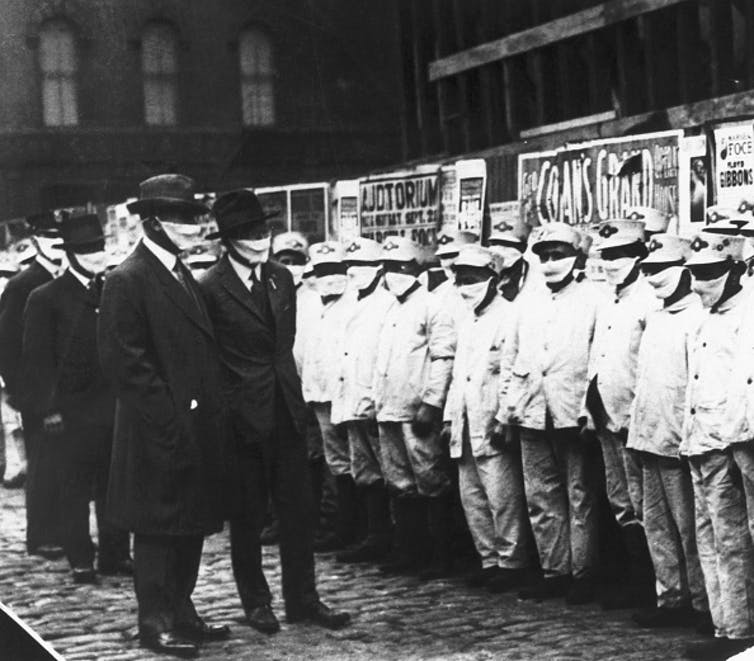
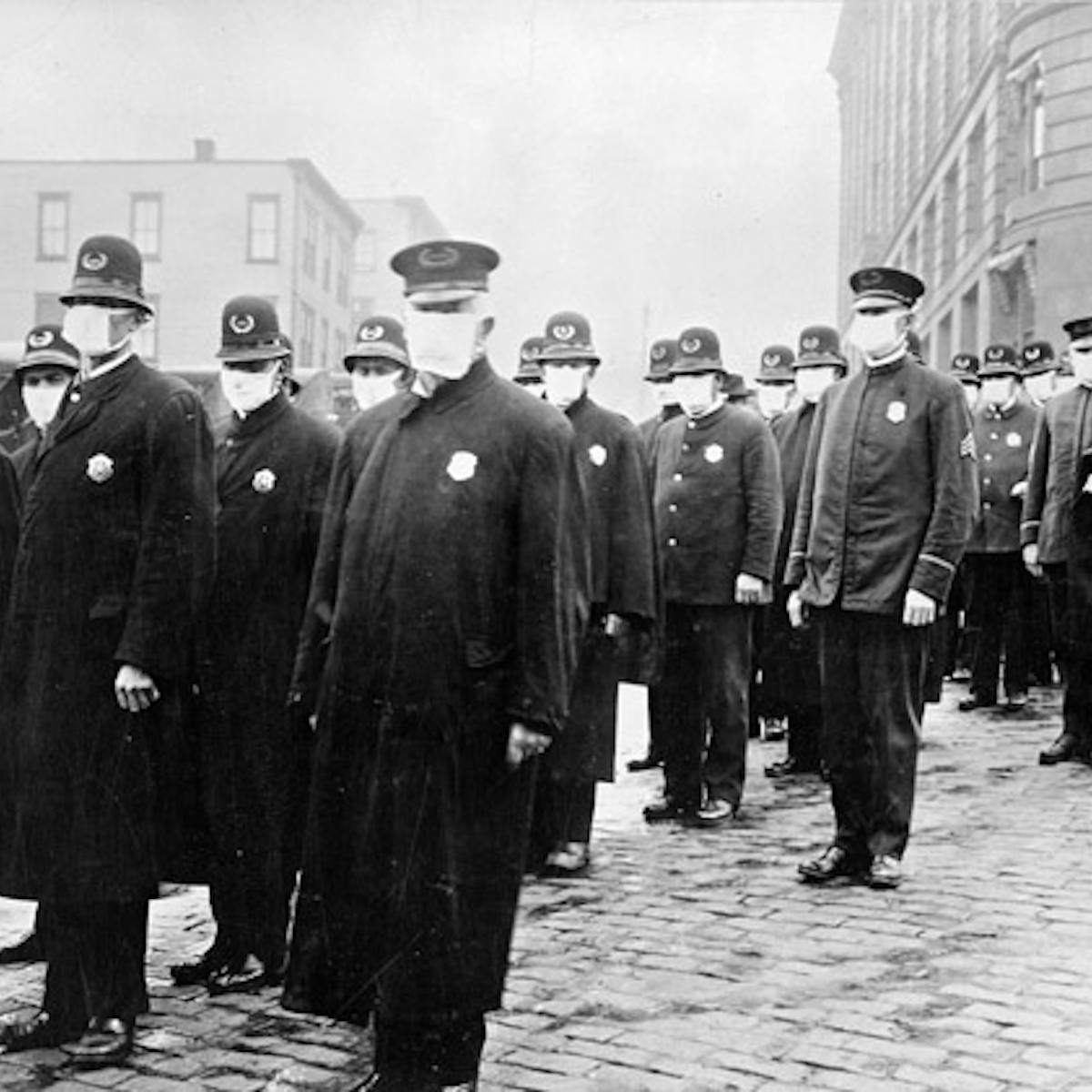
I’ve researched the history of the 1918 pandemic extensively. At that time, with no effective vaccine or drug therapies, communities across the country instituted a host of public health measures to slow the spread of a deadly influenza epidemic: They closed schools and businesses, banned public gatherings and isolated and quarantined those who were infected. Many communities recommended or required that citizens wear face masks in public – and this, not the onerous lockdowns, drew the most ire.

Mask resistance during a pandemic isn't new – in 1918 many ...

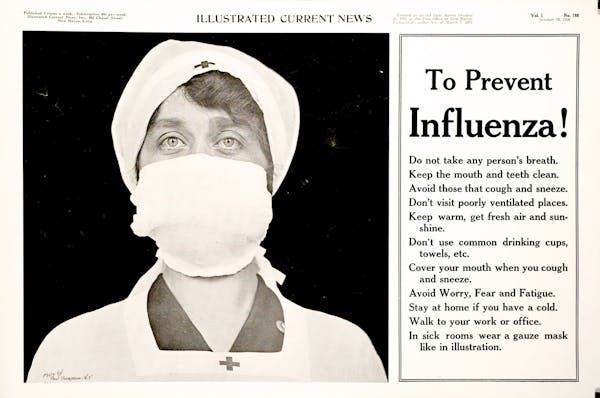
In mid-October of 1918, amidst a raging epidemic in the Northeast and rapidly growing outbreaks nationwide, the United States Public Health Service circulated leaflets recommending that all citizens wear a mask. The Red Cross took out newspaper ads encouraging their use and offered instructions on how to construct masks at home using gauze and cotton string. Some state health departments launched their own initiatives, most notably California, Utah and Washington.

Nationwide, posters presented mask-wearing as a civic duty – social responsibility had been embedded into the social fabric by a massive wartime federal propaganda campaign launched in early 1917 when the U.S. entered the Great War. San Francisco Mayor James Rolph announced that “conscience, patriotism and self-protection demand immediate and rigid compliance” with mask wearing. In nearby Oakland, Mayor John Davie stated that “it is sensible and patriotic, no matter what our personal beliefs may be, to safeguard our fellow citizens by joining in this practice” of wearing a mask.

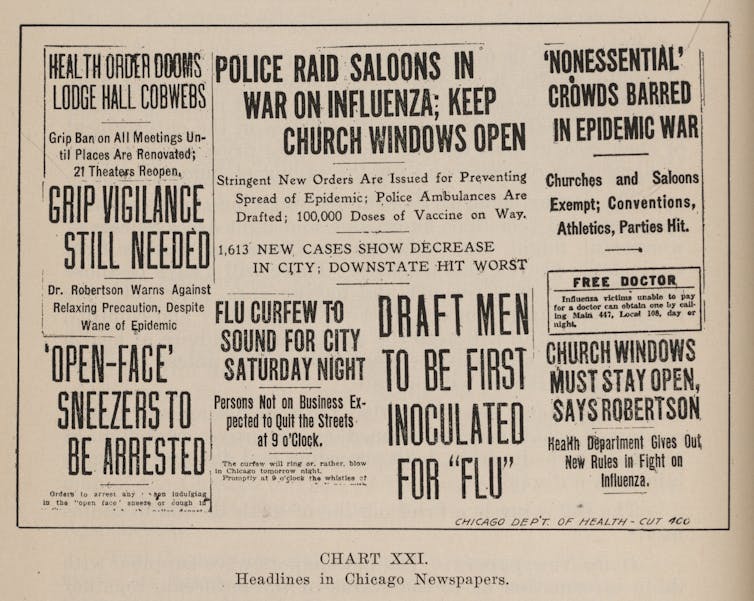
Health officials understood that radically changing public behavior was a difficult undertaking, especially since many found masks uncomfortable to wear. Appeals to patriotism could go only so far. As one Sacramento official noted, people “must be forced to do the things that are for their best interests.” The Red Cross bluntly stated that “the man or woman or child who will not wear a mask now is a dangerous slacker.” Numerous communities, particularly across the West, imposed mandatory ordinances. Some sentenced scofflaws to short jail terms, and fines ranged from US$5 to $200.

Mask resistance during a pandemic isn't new – in 1918 many ...

Passing these ordinances was frequently a contentious affair. For example, it took several attempts for Sacramento’s health officer to convince city officials to enact the order. In Los Angeles, it was scuttled. A draft resolution in Portland, Oregon led to heated city council debate, with one official declaring the measure “autocratic and unconstitutional,” adding that “under no circumstances will I be muzzled like a hydrophobic dog.” It was voted down.

Utah’s board of health considered issuing a mandatory statewide mask order but decided against it, arguing that citizens would take false security in the effectiveness of masks and relax their vigilance. As the epidemic resurged, Oakland tabled its debate over a second mask order after the mayor angrily recounted his arrest in Sacramento for not wearing a mask.prominent physician in attendance commented that “if a cave man should appear…he would think the masked citizens all lunatics.”

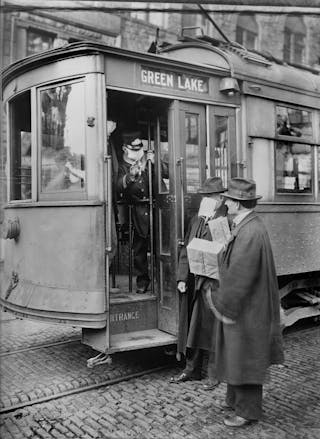
In places where mask orders were successfully implemented, noncompliance and outright defiance quickly became a problem. Many businesses, unwilling to turn away shoppers, wouldn’t bar unmasked customers from their stores. Workers complained that masks were too uncomfortable to wear all day. One Denver salesperson refused because she said her “nose went to sleep” every time she put one on. Another said she believed that “an authority higher than the Denver Department of Health was looking after her well-being.” As one local newspaper put it, the order to wear masks “was almost totally ignored by the people; in fact, the order was cause of mirth.” The rule was amended to apply only to streetcar conductors – who then threatened to strike. A walkout was averted when the city watered down the order yet again. Denver endured the remainder of the epidemic without any measures protecting public health.

Mask resistance during a pandemic isn't new – in 1918 many ...

In Seattle, streetcar conductors refused to turn away unmasked passengers. Noncompliance was so widespread in Oakland that officials deputized 300 War Service civilian volunteers to secure the names and addresses of violators so they could be charged. When a mask order went into effect in Sacramento, the police chief instructed officers to “Go out on the streets, and whenever you see a man without a mask, bring him in or send for the wagon.” Within 20 minutes, police stations were flooded with offenders. In San Francisco, there were so many arrests that the police chief warned city officials he was running out of jail cells. Judges and officers were forced to work late nights and weekends to clear the backlog of cases.

Many who were caught without masks thought they might get away with running an errand or commuting to work without being nabbed. In San Francisco, however, initial noncompliance turned to large-scale defiance when the city enacted a second mask ordinance in January 1919 as the epidemic spiked anew.

Many decried what they viewed as an unconstitutional infringement of their civil liberties. On January 25, 1919, approximately 2,000 members of the “Anti-Mask League” packed the city’s old Dreamland Rink for a rally denouncing the mask ordinance and proposing ways to defeat it. Attendees included several prominent physicians and a member of the San Francisco Board of Supervisors.

It is difficult to ascertain the effectiveness of the masks used in 1918. Today, we have a growing body of evidence that well-constructed cloth face coverings are an effective tool in slowing the spread of COVID-19. It remains to be seen, however, whether Americans will maintain the widespread use of face masks as our current pandemic continues to unfold.

Deeply entrenched ideals of individual freedom, the lack of cohesive messaging and leadership on mask wearing, and pervasive misinformation have proven to be major hindrances thus far, precisely when the crisis demands consensus and widespread compliance.

This was certainly the case in many communities during the fall of 1918. That pandemic ultimately killed about 675,000 people in the U.S. Hopefully, history is not in the process of repeating itself today.