Federal system for tracking hospital beds and COVID-19 patients provides questionable data

https://www.sciencemag.org/news/2020/11/federal-system-tracking-hospital-beds-and-covid-19-patients-provides-questionable-data?fbclid=IwAR0E66OcpYN6ZvT4OLRStyaOANpUlDBUbOrnF4xV63icIsYYrYsPMAkH1A0

In mid-November, as the United States set records for newly diagnosed COVID-19 cases day after day, the hospital situation in one hard-hit state, Wisconsin, looked concerning but not yet urgent by one crucial measure. The main pandemic data tracking system run by the Department of Health and Human Services (HHS), dubbed HHS Protect, reported that on 16 November, 71% of the state’s hospital beds were filled. Wisconsin officials who rely on the data to support and advise their increasingly strained hospitals might have concluded they had some margin left.

Yet a different federal COVID-19 data system painted a much more dire picture for the same day, reporting 91% of Wisconsin’s hospital beds were filled. That day was no outlier. A Science examination of HHS Protect and confidential federal documents found the HHS data for three important values in Wisconsin hospitals—beds filled, intensive care unit (ICU) beds filled, and inpatients with COVID-19—often diverge dramatically from those collected by the other federal source, from state-supplied data, and from the apparent reality on the ground.

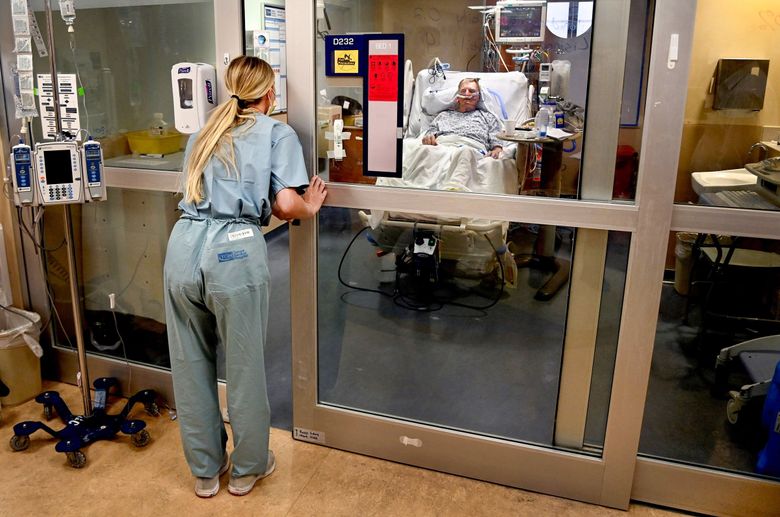
“Our hospitals are struggling,” says Jeffrey Pothof, a physician and chief quality officer for the health system of the University of Wisconsin (UW), Madison. During recent weeks, patients filled the system’s COVID-19 ward and ICU. The university’s main hospital converted other ICUs to treat the pandemic disease and may soon have to turn away patients referred to the hospital for specialized care. Inpatient beds—including those in ICUs—are nearly full across the state. “That’s the reality staring us down,” Pothof says, adding: The HHS Protect numbers “are not real.”

HHS Protect’s problems are a national issuean internal analysis completed this month by the Centers for Disease Control and Prevention (CDC) shows. That analysis, other federal reports, and emails obtained by Science suggest HHS Protect’s data do not correspond with alternative hospital data sources in many states (see tables, below). “The HHS Protect data are poor quality, inconsistent with state reports, and the analysis is slipshod,” says one CDC source who had read the agency’s analysis and requested anonymity because of fear of retaliation from the Trump administration. “And the pressure on hospitals [from COVID-19] is through the roof.”

Both federal and state officials use HHS Protect’s data to assess the burden of disease across the country and allocate scarce resources, from limited stocks of COVID-19 medicines to personal protective equipment (PPE). Untrustworthy numbers could lead to supply and support problems in the months ahead, as U.S. cases continue to rise during an expected winter surge, according to current and former CDC officials. HHS Protect leaders vigorously defend the system and blame some disparities on inconsistent state and federal definitions of COVID-19 hospitalization. “We have made drastic improvements in the consistency of our data … even from September to now,” says one senior HHS official. (Three officials from the department spoke with Science on the condition that they not be named.)

CDC had a long-running, if imperfect, hospital data tracking system in place when the pandemic started, but the Trump administration and White House Coronavirus Task Force Coordinator Deborah Birx angered many in the agency when they shifted much of the responsibility for COVID-19 hospital data in July to private contractors. TeleTracking Technologies Inc., a small Pittsburgh-based company, now collects most of the data, while Palantir, based in Denver, helps manage the database. At the time, hundreds of public health organizations and experts warned the change could gravely disrupt the government’s ability to understand the pandemic and mount a response

The feared data chaos now seems a reality, evident when recent HHS Protect figures are compared with public information from states or data documented by another hospital tracking system run by the HHS Office of the Assistant Secretary for Preparedness and Response (ASPR). ASPR manages the Strategic National Stockpile of medicines, PPE—in perilously short supply in many areas—and other pandemic necessities. ASPR collects data nationwide, although it is more limited than what HHS Protect compiles, to help states and hospitals respond to the pandemic.

In Alabama, HHS Protect figures differ by 15% to 30% from daily state COVID-19 inpatient totals. Karen Landers, assistant state health officer, said nearly all of the state’s hospitals report data to HHS via the Alabama Department of Public Health. Although reporting delays sometimes prevent the systems from syncing precisely, Landers says, she cannot account for the sharp differences. 

Many state health officials contacted by Science were reluctant to directly criticize HHS Protect or attribute supply or support problems to its data. Landers notes that Alabama relies on its own collected data, rather than HHS Protect’s, for its COVID-19 response. “We are very confident in our data,” she says, because the state reporting system was developed over several years and required little adjustment to add COVID-19. HHS, she adds, has generally been responsive to state requests for medicines and supplies, although Alabama has not always gotten all the PPE it has requested.

Other states, however, say they do rely on HHS Protect. A spokesperson for the Wisconsin Department of Health Services wrote in a response to questions, “When making decisions at the state level we use the HHS Protect data,” but declined to comment about its accuracy. HHS informed Wisconsin officials it distributes scarce supplies based on need indicated by HHS Protect data, the spokesperson wrote.

Pothof says UW’s hospital system has its own sophisticated data dashboard that draws on state, local, and internal sources to plan and cooperate on pandemic response with other hospitals. But small hospitals in Wisconsin—now experiencing shortages of some medicines, PPE, and other supplies—are more dependent on federal support largely based on HHS Protect data. Help might not arrive, Pothof says, if the data show “things look better than they are.”

If the HHS Protect data are suspect, “that’s a very large problem,” says Nancy Cox, former director of CDC’s influenza division and now an affiliated retiree of the agency. If HHS officials use bad data, they will not distribute medicines and supplies equitably, Cox notes, adding: “Undercounting in the hardest hit states means a lower level of care and will result in more severe infections and ultimately in more deaths.”

Birx and the other managers of HHS Protect “really had no idea what they were doing,” says Tom Frieden, CDC director under former President Barack Obama. (Birx declined to comment for this article.) Frieden cautions that ASPR data might also be erroneous—pointing to the need for an authoritative and clear federal source of hospital data. The original CDC system, called the National Healthcare Safety Network (NHSN), should be improved, he said, but it handles nursing home COVID-19 data skillfully and could do the same with hospitals. NHSN is “not just a computer program. It’s a public health program” built over 15 years and based on relationships with individual health facilities, Frieden says. (CDC insiders say HHS officials recently interfered with publication of an analysis showing that NHSN performed well early in the pandemic [see sidebar, below]).

An HHS official says HHS Protect’s data are complex and the department can’t verify any findings in the reports reviewed by Science without conducting its own analysis, which it did not do. But the official says HHS Protect has improved dramatically in the past 2 months and provides consistent and reliable results.

As for the difference between state and HHS Protect data, an HHS official contends state numbers “are always going to be lower” by up to 20%. That’s because hospitals could lose Medicare funding if they do not report to HHS, the official says, but face no penalty for failing to report to the state. So rather than expect identical numbers, HHS looks for state and federal data to reflect the same trajectory—which they do in all cases for COVID-19 inpatient data, according to another confidential CDC analysis of HHS Protect, covering all 50 states.

Yet the same analysis found 27 states recently alternated between showing more or fewer COVID-19 inpatients than HHS Protect—not always just fewer, as HHS says should be the case. Thirty states also showed differences between state and HHS Protect figures that were frequently well above the 20% threshold cited by HHS, and HHS Protect data fluctuated erratically in 21 states (see chart, below).

“Hospital capacity metrics can and should be a national bellwether,” the CDC data expert says. “One important question raised by the discordant data reported by HHS Protect and the states is whether HHS Protect is systematically checking data validity.” HHS has not provided its methodology for HHS Protect data estimates for review by independent experts. But an HHS official says a team of data troubleshooters, including CDC and ASPR field staff, work to resolve anomalies and respond to spikes in cases in a state or hospital.

Out of sync

Tracking hospital inpatients who have COVID-19 has become a crucial measure of the pandemic’s severity. Department of Health and Human Services (HHS) data from the HHS Protect system often diverge sharply from state-supplied data. This chart, drawn from a data analysis from the Centers for Disease Control and Prevention, summarizes some of the similarities and differences for COVID-19 inpatient totals over the past 2 months.

Along with improving trust in its data, HHS Protect needs to make it more accessible, CDC data scientists say. The publicly accessible HHS Protect data are far less complete than the figures in its password-protected database. This effectively hides from public view key pandemic information, such as local supplies of protective equipment.

The site also does not provide graphics highlighting patterns and trends. This might explain, in part, why most media organizations—as well as President-elect Joe Biden’s transition team—instead have relied on state or county websites that vary widely in completeness and quality, or on aggregations such as The Atlantic magazine’s COVID Tracking Project, which collects, organizes, and standardizes state data. (In comparing state and federal data, CDC also used the COVID Tracking Project.)

Frieden and other public health specialists call reliable, clear federal data essential for an effective pandemic response. “The big picture is that we’re coming up to 100,000 hospitalizations within the next few weeks. Hospital systems all over the country are going to be stressed,” Frieden says. “There’s not going to be any cavalry coming over the hill from somewhere else in the country, because most of the country is going to be overwhelmed. We’re heading into a very hard time with not very accurate information systems. And the government basically undermined the existing system.”

Biden’s Panel Outlines Proactive Pandemic Response as COVID-19 Toll Soars

Essential Coverage

On the morning of November 7, major news networks starting with CNN called the presidential election for Joe Biden. Although the election has yet to be officially certified, Biden and Vice President-elect Kamala Harris have wasted no time preparing their response to the rapidly worsening coronavirus pandemic.

Over the past week, the US has averaged more than 150,000 new COVID-19 cases per day, an increase of 81% from the average on November 1. The US had a record 181,200 new reported cases on November 13. Over 11 million Americans have been infected, and the nation is nearing a grim milestone of 250,000 deaths. Experts warn that the worst is yet to come. As temperatures drop and family-centric holidays approach, people are likely to spend more time socializing indoors with non-household members, increasing the risk for COVID-19 transmission.

Mitigating the spread of the coronavirus and preventing more deaths are top priorities for the incoming Biden-Harris administration. Biden’s campaign team published a seven-point plan to beat COVID-19, and on November 9, the Biden-Harris transition team named a COVID-19 Advisory Council tasked with guiding the federal response to the pandemic immediately after the inauguration.

The council “will be consulting with state and local officials to gauge public-health steps needed to bring the virus under control,” Evan Halper and Noam Levey reported in the Los Angeles Times. “The board will also focus on racial and ethnic disparities in how, where, and how quickly the virus is spreading.”

Innovative Plan: Tell the Truth

The Biden-Harris plan sets a new tone for the nation’s coronavirus response, using federal powers and leadership to centralize the acquisition and distribution of personal protective equipment (PPE), along with the coordination of testing and contact tracing, instead of leaving those vital resources to be led in 50 different ways by state governors. It emphasizes evidence-based guidance and empowers public health officials and scientists to guide and revise the nation’s reopening strategy as the pandemic evolves.

You’ll immediately see a change of tone, a change in communication,” Ezekiel Emanuel, MD, PhD, the vice provost for global initiatives at the University of Pennsylvania, told Politico. “This is the stuff of real leadership: telling the truth, modeling the right behaviors like wearing a mask, only having small crowds, putting the scientists out there.”

The first priority in the plan is to ensure that all Americans have access to regular, reliable, and free coronavirus testing. Rapid testing is vital for identifying, isolating, and treating new cases of COVID-19, but the US has been crippled by continuing test shortages and long lag times before results are reported. Biden plans to double the number of drive-through testing sites while scaling up next-generation solutions like home tests.

Contact tracing goes hand-in-hand with testing in the public health response to COVID-19, and the plan would establish a US Public Health Job Corps to train and mobilize 100,000 Americans to perform culturally competent contact tracing in communities most affected by COVID-19.

The second priority is to fix the nation’s PPE problems. N95 masks, gloves, gowns, and other PPE used by health care staff are still in short supply. AARP reported that one in four nursing homes ran short of PPE between August 24 and September 20. (Nursing homes continue to be a hot spot for coronavirus transmission.) Biden would use the Defense Production Act to increase production of PPE and distribute the supply to states instead of leaving states to fend for themselves.

For the third priority, Biden would tap the nation’s wealth of science experts to provide clear public guidance on how communities should navigate the pandemic. The US Centers for Disease Control and Prevention (CDC) would lead this effort, with an emphasis on helping communities determine when it is safe to reopen schools and various types of businesses.

Navigating Hurdles to Safe, Effective, Accepted Vaccine

Although the pharmaceutical company Pfizer announced on November 9 that its coronavirus vaccine trial showed positive early results, the road to vaccinating all Americans is tortuous. Pfizer still needs to seek emergency use authorization from the Food and Drug Administration (FDA) and ramp up vaccine production to meet the global need. In the meantime, Biden plans to invest $25 billion in a vaccine manufacturing and distribution plan that ensures every American can get vaccinated for free. This fourth priority would make the vaccine accessible to all people and communities regardless of income or any other factor.

The fifth priority is to protect Americans who are at high risk of getting seriously ill or dying from COVID-19. This includes people over 65, nursing home residents, and people living in neighborhoods with higher rates of COVID-19. Biden would establish a COVID-19 Racial and Ethnic Disparities Task Force (PDF) to report on disparities in COVID-19 infection, hospitalization, and death rates, as well as to provide recommendations to Congress and the Federal Emergency Management Agency on how best to distribute resources and relief funds to combat these disparities. The plan also calls for strengthening the Affordable Care Act to ensure that during the pandemic, Americans have health insurance coverage.

During the presidential campaign, Biden called for a national mask mandate based on the growing body of evidence that mask-wearing can considerably reduce the transmission of respiratory viruses like the one that causes COVID-19. Biden plans to coordinate with governors and mayors to convince Americans to wear a mask when they are around people outside their household. Currently, 34 states and the District of Columbia mandate face masks in public, but there is no nationwide requirement.

Finally, the plan takes the long view on pandemic threats by rebuilding and reinvesting in defenses that will help the world predict and prevent future pandemics. The Biden administration has declared that the US will rejoin the World Health Organization, restore the White House National Security Council Directorate for Global Health Security and Biodefense, which was eliminated by the Trump administration in 2018, and shore up CDC’s global corps of disease detectives.

Public Health Experts at the Helm

The newly announced COVID-19 Advisory Council is a who’s who of public health experts, former government officials, and doctors, including several from California. The panel currently comprises 13 members, but Biden has said it may be expanded.

The three cochairs of the advisory board are former surgeon general Vivek Murthy, MD; former FDA commissioner David Kessler, MD, a UCSF professor of pediatrics, and of epidemiology and biostatistics; and Marcella Nunez-Smith, MD, MPH, an associate professor of internal medicine, public health, and management at Yale University whose research focuses on health disparities.

The other members appointed so far include:

  • Luciana Borio, MD, vice president at the venture capital firm In-Q-It. Borio served in multiple leadership roles in the Trump and Obama administrations in the National Security Council and FDA.
  • Rick Bright, PhD, director of the Biomedical Advanced Research and Development Authority under Trump and Obama. Bright resigned from the government in October after being removed from his vaccine development role by President Trump.
  • Ezekiel Emanuel, MD, PhD, the vice provost for global initiatives at the University of Pennsylvania. Emanuel served in the Obama administration as special advisor for health policy to Peter Orszag, PhD, the former director of the Office of Management and Budget.
  • Atul Gawande, MD, MPH, a professor at Harvard Medical School and the Harvard T.H. Chan School of Public Health. Gawande is a staff writer covering health and medicine at the New Yorker and served in the Clinton administration as senior adviser in the Department of Health and Human Services.
  • Eric Goosby, MD, a professor of medicine at UCSF. Goosby, an expert on HIV/AIDS, led policy work in this field under Clinton and Obama.
  • Celine Gounder, MD, a clinical assistant professor of internal medicine and infectious diseases at New York University.
  • Julie Morita, MD, executive vice president of the Robert Wood Johnson Foundation and former commissioner of the Chicago Department of Public Health.
  • Michael Osterholm, PhD, MPH, director of the Center for Infectious Disease Research and Policy at the University of Minnesota.
  • Loyce Pace, MPH, president and executive director of the Global Health Council.
  • Robert Rodriguez, MD, a professor of emergency medicine at UCSF.

What Do You Want?

Coronavirus cases exceed 100,000 in one day for the first time, even as the nation is split on the pandemic vs. the economy

https://www.washingtonpost.com/health/covid-19-cases-record-100000/2020/11/04/9733adcc-1ec8-11eb-b532-05c751cd5dc2_story.html

COVID-19 cases exceed 100,000 a day for the first time, even as the nation  is split on the pandemic versus the economy | The Seattle Times

The coronavirus pandemic reached a dire milestone Wednesday when the number of new U.S. infections topped 100,000 in one day for the first time, continuing a resurgence that showed no sign of slowing.

The pandemic is roaring across the Midwest and Plains states. Seven states set records for hospitalizations for covid-19, the disease caused by the virus. And Connecticut, Iowa, Maine, Michigan, Minnesota, Nebraska and North Dakota saw jumps of more than 45 percent in their seven-day rolling average of new infections, considered the best measure of the spread of the virus.

The record, 104,004 cases, was reached a day after the deeply divided nation went to the polls to choose between President Trump and Democratic nominee Joe Biden, an election widely seen as a choice between fully reopening the economy and aggressively quelling the outbreak.

Just as they split almost down the middle on the two candidates, voters broke into almost equal camps on how to address the pandemic that has killed more than 233,000 people and infected nearly 9.5 million people in the United States.

“It’s clear we’re heading into a period where we’re going to see increasing hospitalization and deaths in the U.S. And it worries me how little we’re doing about it,” said Tom Frieden, director of the Centers for Disease Control and Prevention during the Obama administration. “We know by now how fast this virus can move. You have to get ahead of it.”

After more than nine months of restrictions, some state leaders are hesitant to risk further pandemic fatigue, Frieden said.

But if case counts continue rising at the current rate and strong action isn’t taken, viral transmission may soon reach a point in some areas where nothing will stop the virus except another shutdown, he said.

“The numbers keep going up, and we’re only getting closer and closer to Thanksgiving and Christmas,” when some families are expected to congregate indoors and risk spreading the virus further, said Eleanor Murray, an assistant professor of epidemiology at Boston University. “For so many reasons, the next few weeks are going to be bad for us and good for covid.”

With Trump and his aides fighting to hold on to the White House, the federal response to the pandemic, which already leaves major responsibilities to the states, may be even more fractured, Murray said.

“Something that deeply worries me is either way this election goes, Trump will still be in charge the next few weeks, when cases are higher than they’ve ever been,” she said. “And he’s made clear there will be no top-down, coordinated action coming from the federal government.”

Despite months of surveys that clearly indicated strong voter disapproval of the president’s response to the pandemic could weigh heavily against his reelection effort, more voters chose the economy as the primary issue in casting their ballots, exit polling showed.

Even if Biden captures the White House, the results appear to signal that, for many people, covid-19 is not as daunting as the prospect of being unable to pay their bills or send their children to school.

“I got news for you, pal. Covid-19 is over. It’s done,” said Nick Arnone, owner of HLSM, a software company for the power sports industry in Plains, Pa. “We have therapeutics, so deaths are way down. We are very close to a vaccine. We’ve got to ride it out now.

About 35 percent of voters said the economy was the most important issue for them, while about 17 percent cited the pandemic and about 2 in 10 were motivated most by racial inequality.

At the same time, however, just over half the voters said it is more important to contain the virus, even if that hurts the economy, while slightly more than 4 in 10 said rebuilding the economy is most critical, even if that impairs work to quell the virus.

In El Paso, where the pandemic is surging, James Clark said he voted for Biden because of the uncontrolled outbreak.

Covid was the main reason . . . and the things he was saying specifically about it,” Clark said. “I mean there were some things Trump was doing well, too, but overall it was covid.”

Some analysts were surprised and concerned that voters appeared to view the decision before them as a choice between the virus and their livelihoods, rather than as intertwined problems that could be solved together.

“That was shocking to me, that Trump could convince so many people it was a choice between the economy and pandemic,” said Eric Topol, a cardiologist and head of the Scripps Research Translational Institute in San Diego. “I’m amazed the extent he pulled that off, because it’s so obviously a false dichotomy. There’s no way for the economy to thrive unless we get control of the pandemic.”

On the campaign trail, Biden warned voters of a “dark winter” and invoked empty chairs in homes where families grieved the death of a loved one. He suggested he would follow science and tighten restrictions in places where that was necessary.

Trump repeatedly declared that the country was “rounding the turn” on the pandemic and said a vaccine was almost ready to be distributed. “You know what we want? We want normal,” Trump said this past weekend in Butler, Pa.

The two political messages were consistent with the viewpoints of each candidate’s base, said Kathleen Hall Jamieson, director of the Annenberg Public Policy Center at the University of Pennsylvania.

Biden has much more support among urban voters and people of color who, until recently, have been hit harder by the pandemic. Trump’s base is more White and rural, constituencies that have been slammed by the virus only in recent weeks, as the number of infections soared in the Upper Midwest and Plains states, she said.

“Who’s more likely to know someone’s who’s died? People who are already more likely to be Democrats than Republicans,” Jamieson said. “The lived experience of the two constituencies, the base vote for each side, is different.”

In Florida, which Trump carried more easily than expected, Biden’s emphasis on the pandemic hampered grass-roots campaigning, said Susan MacManus, an emerita professor of political science at the University of South Florida. With Biden emphasizing social distancing, the Democratic campaign there followed his lead.

“The Republicans never let their foot off the pedal in terms of continuing to register [voters] and going door to door, all through the covid,” she said. “The Democrats, once covid hit, they made a conscious effort, not going door to door.”

Rep. Donna Shalala (D-Fla.), who appeared to be headed toward losing her seat to television newscaster Maria Elvira Salazar (R) in Miami, campaigned heavily on Trump’s response to the virus.

Stefan Baral, a physician and epidemiologist at Johns Hopkins School of Public Health, Wednesday faulted Democrats’ pandemic messaging, saying Biden did not adequately express empathy for the economic hardships caused by the pandemic-related shutdowns.

“This is a terrible virus. But empathy for all the folks who have lost their jobs and lost their opportunities and kids who are out of school — I just never felt that message of empathy come across at all,” Baral said.

When some people heard Biden talk about the dark winter ahead, they thought, “The first thing he’s going to do is close my business,” Baral said.

Voters also had to make up their minds amid a torrent of misinformation and purposeful distortion about the pandemic, said Matthew Seeger, a risk communication expert at Wayne State University in Michigan, who helped the CDC develop its past communications plans.

“The messaging around the pandemic has been deliberately confused and strategically manipulated to downplay its significance,” Seeger said. “You combine that with the fact that this is a slow-moving crisis with risk fatigue starting to settle in, and you can see why public perception is what it is.”

In Chandler, Ariz., a suburb southeast of Phoenix last week, Al Fandick said he considers the pandemic wildly overblown and masks largely pointless. Fandick, 53, who runs a transport company, said he found it absurd that he was required to wear a mask to enter a restaurant but could remove the face covering once he sat down.

“Having a face mask on while I walk into that restaurant, but then I can take that face mask off, that’s like having a peeing section in a pool,” Fandick said.

Aside from trips to visit people in the hospital, he never wore a mask until Maricopa County began mandating it for public spaces, a policy he vehemently opposes, he said.

“Don’t need the hassle,” he said.

On the other side of the gulf are those who see the accelerating pandemic and a possibly very deadly period ahead.

“It is demoralizing to feel like: Here we are in November. A third surge is not just underway, but has already surpassed past surges. And people still don’t understand what’s happening and what’s at stake,” said Murray of Boston University.

“We are in the middle of an emergency. We have cases higher than they have ever been since this pandemic started, and yet you will have people paying less attention than ever to covid,” Murray said. “We as a country are not in a place right now where it’s safe to do that.”