


The Trap of Thinking

https://www.vox.com/policy-and-politics/2018/6/11/17441858/obamacare-repeal-debate-lawsuit
/cdn.vox-cdn.com/uploads/chorus_image/image/60001297/699349132.jpg.0.jpg)
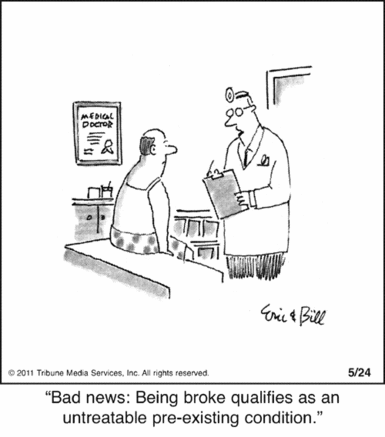
President Trump and Republicans are so committed to killing Obamacare they’ve decided, just months before the midterm elections, to take aim at the most popular part of the law: coverage for preexisting conditions.
The Trump administration signed on to a long-shot lawsuit this week that would overturn the parts of the law that require insurers to cover preexisting conditions and not charge more for them.
The lawsuit, which you can read more about from Vox’s Dylan Scott, is, in some ways, a perplexing move mere months before midterm elections. Polling finds that both Democrats and Republicans think it’s a good idea to ensure that sick people have access to health insurance.
Politically, though, Republicans spent eight years campaigning on a promise to repeal Obamacare. They believe they have a responsibility to do something, even if the something doesn’t poll well.
But after eight years of covering the Affordable Care Act, I think there is a much deeper tension that keeps the fight over Obamacare alive. It is a persistent, unresolved split in how we think about who deserves health insurance in the United States: Is insurance a privilege to be earned through hard work? Or is it a right?
Since World War II, the United States has had a unique health insurance system that tethers access to medical care to employment. Changes to the tax code created strong incentives for companies to provide health coverage as a benefit to workers. Now most Americans get their insurance through their employer, and, culturally, health insurance is thought of as a benefit that comes with a job.
Over time, the government did carve out exceptions for certain categories of people. Older Americans, after all, wouldn’t be expected to work forever, so they got Medicare coverage in 1965. Medicaid launched the same year, extending benefits to those who were low-income and had some other condition that might make it difficult to work, such as blindness, a disability, or parenting responsibilities.
Then the Affordable Care Act came along with a new approach. The law aimed to open up the insurance market to anybody who wanted coverage, regardless of whether he or she had a job.
It created a marketplace where middle-income individuals could shop on their own for private health coverage without the help of a large company. It expanded Medicaid to millions of low-income Americans. Suddenly, a job became a lot less necessary as a prerequisite for gaining health insurance.
This, I think, is the divide over health insurance in America. It’s about whether we see coverage as part of work. In my reporting and others’, I’ve seen significant swaths of the country where people push back against this. They see health as something you ought to work for, a benefit you get because of the contribution you make by getting up and going to a job each day.
This came out pretty clearly in an interview I did in late 2016 with a woman I met on a reporting trip to Kentucky whom I’ll call Susan Allen. (She asked me not to use her real name because she didn’t want people to know that she uses the Affordable Care Act for coverage.)
Allen used to do administrative work in an elementary school but now is a caregiver to her elderly mother. Her husband has mostly worked in manual labor jobs, including the coal industry.
Allen told me a story about when she worked in the school. At Christmas, there would be a drive to collect present for the poorest families, presents she sometimes couldn’t afford for her own kids. It made her upset.
”These kids that get on the list every year, I’d hear them saying, ‘My mom is going to buy me a TV for Christmas,’” Allen says. “And I can’t afford to buy my kid a TV, and he’s in the exact same grade with her.”
Allen saw her health insurance as the same story: She works really hard and ends up with a health insurance plan that has a $6,000 deductible. Then there are people on Medicaid who don’t work and seem to have easier access to the health care system than she does.
”The ones that have full Medicaid, they can go to the emergency room for a headache,” she says. “They’re going to the doctor for pills, and that’s what they’re on.”
More recently, Atul Gawande wrote a piece for the New Yorker exploring whether Americans view health care as a right or a privilege.
He reported the story in his hometown in Appalachian Ohio, where he kept running into this same idea: that health insurance is something that belongs to those who work for it.
One woman he interviewed, a librarian named Monna, told him, “If you’re disabled, if you’re mentally ill, fine, I get it. But I know so many folks on Medicaid that just don’t work. They’re lazy.”
Another man, Joe, put it this way: “I see people on the same road I live on who have never worked a lick in their life. They’re living on disability incomes, and they’re healthier than I am.”
As Gawande noted in his piece, “A right makes no distinction between the deserving and undeserving.” But he often found this to be the key dividing line when he asked people whether everyone should have health coverage. Often, it came down to whether that person was the type who merited such help.
This isn’t a debate that happens in most other industrialized countries. If you asked a Canadian who deserves health care, you’d probably get a baffled look in return. Our northern neighbors decided decades ago that health insurance is something you get just by the merit of living in Canada. It’s not something you earn; it’s something you’re entitled to.
But in the United States, we’ve never resolved this debate. Our employer-sponsored health care system seems to have left us with some really deep divides over the fundamental questions that define any health care systems.
Those are the questions we’ll need to resolve before the debate over Obamacare ever ends.

Good leadership advice is meant to be shared. Here eight healthcare leaders — including CEOs, CFOs and chief strategy officers — offer the No. 1 piece of advice they would give other leaders in their field.
1. Rob Bloom, CFO of Carthage (N.Y.) Area Hospital. “The best advice I have is to find the courage to change what must be changed and accept those things that cannot be changed in the short term. Regardless of whether a hospital is profitable or struggling, there will be challenges. The difficult task is to determine where to focus resources while accepting criticism for problems that will not change the short-term viability of the organization. You have to learn to trust your judgment and resist pressures from others that might tempt you to alter your course based on their lack of understanding. It is very much a triage process: Stop the bleeding first, then worry about infection later.”
2. Mona Chadha, chief strategy officer of San Francisco-based Dignity Health’s Bay Area. “One of the key strengths of being a good leader is really listening and leading people by example. That to me is one of the successes. Then, do some thinking outside of the box. That’s been my mantra of success in the past.”
3. JoAnn Kunkel, CFO of Sioux Falls, S.D.-based Sanford Health. “The very first CFO I worked for in 1990 always said, ‘you’re only as good as your team. … I’d never be able to be successful without having you and the team working with me.’ [That CFO] was a very thoughtful and inclusive leader. He gave me opportunities to be part of the team and think strategically and develop into a leader. So since then, it’s always been my belief that we have a very strong team that should always participate. If we have someone that needs help, we have multiple individuals ready to step up. And working together makes us all better. My advice would be: It’s important to remember you are only as good as your team. Sometimes I think when you get into these leadership roles you can forget that. You always want to be inclusive, give credit to the work and the team and the efforts that help make you successful in your role.”
4. Michael McAnder, CFO of Atlanta-based Piedmont Healthcare. “I think what I’d say is try and look for the long-term play. You can’t manage this business on a day-to-day basis. You have to have a clear direction and stick with it. I think that’s probably the thing our CEO Kevin Brown has done really well. I have never worked at an organization with a one-page strategic plan before. Every meeting starts with it, and we use it at every presentation. That consistency has brought clarity. It’s also why we’ve gone from five hospitals to 11 in the three years I’ve been here. That resonates with other organizations when we talk about our plan. It’s really important. In addition, obviously, you have to act with integrity and character. If you’re in a position where you can’t do that, you have to make a different decision about whether you can keep working for someone.”
5. Alan B. Miller, CEO of King of Prussia, Pa.-based Universal Health Services. “I often give a few pieces of advice to other CEOs and leaders, including:
6. David Parsons, MD, CMO of Portland-based Northwest Permanente. “Listen to the people you lead and be honest about which problems you can solve and which ones you can’t. People usually don’t mind being told no as long as you are direct and honest about the reasons why. People detest ambivalence.”
7. Mike Pykosz, CEO and founder of Chicago-based Oak Street Health. “Be persistent and be motivated by your mission. One thing we found really early was everything is a lot harder and takes a lot longer than you think it will. Things that make a lot of sense to you and are super logical will always take a little longer. [Success] requires breaking down a lot of little barriers, including a lot of inefficiencies, a lot of complexities and mindshare. But whatever it is, be persistent and have faith that if you’re trying to do the right thing, and if you stay at it, you’ll be able to break down those barriers and accomplish these things.”
8. Michael Wallace, president and CEO of Fort Atkinson, Wis.-based Fort HealthCare. “I’d say visualize the outcome you want and then go get it. I also like the phrase ‘try hard, fail fast, move on, start over.’ You’re one step closer to a solution if the last one didn’t work. But don’t let perfect get in the way of good. I like to be 8 for 10 rather than 3 for 3. Failure is the byproduct of trying to move an organization forward. If I get 8 of 10 things right, I am going to end up further along, closer to my vision than if I wait to be sure about everything to get that perfect 3 for 3.”

On May 23, the Congressional Budget Office (CBO) released updated projections of federal spending and tax expenditures related to supporting enrollment in health insurance, along with a new forecast of the number of Americans younger than age 65 who will have coverage or will be uninsured in the coming years.
The bottom line: The CBO continues to expect that the Affordable Care Act’s (ACA’s) markets will have relatively stable enrollment, more states will expand their Medicaid programs, and per-person health costs will rise at rates that exceed economic growth. Federal spending on subsidies for health insurance enrollment, along with tax breaks for employer coverage, will continue to grow at a rapid rate, thus intensifying pressure within the overall federal budget.
While the CBO’s new forecast looks in many ways quite similar to previous projections, the agency has revised its views on one very important aspect of its forecast—the effectiveness of the individual mandate—and also updated its forecast to reflect the effects of relevant executive decisions and proposed regulations by the Trump administration. These revisions and updates to the forecast are the primary reasons the current baseline does not differ more than it does from those issued by the CBO previously.
The most notable change in the CBO’s new forecast is the agency’s revised view of the effectiveness of the ACA’s individual mandate. During 2017, as Republicans in Congress attempted to pass legislation substantially rolling back and replacing the ACA, the CBO estimated that these efforts would dramatically increase the number of Americans going without insurance coverage. For instance, in July 2017, the CBO estimated that the version of repeal and replace assembled by Senate Majority Leader Mitch McConnell (R-KY) would have increased the number of uninsured from 28 million in 2017 to 41 million in 2018 and 50 million in 2026. There were several reasons that the McConnell proposal would have led to more people going without coverage, but the CBO specifically cited the planned repeal of the individual mandate as the most important factor.
In December, Congress repealed the penalty associated with the individual mandate as part of the sweeping individual and corporate tax reform law. At the time of enactment, the CBO estimated that the repeal would eventually lead to an increase in the number of people going without health insurance by 13 million people annually.
The CBO’s new forecast, however, places less weight on the importance of the mandate. The agency states that, for a number of reasons, it now believes that the mandate’s role in expanding coverage after 2013 is only about two-thirds of what it previously assumed. So instead of repeal adding 13 million more people to the ranks of the uninsured, the CBO now estimates the effect at slightly more than 8 million people.
The CBO cites a number of considerations for making this important revision to its forecast. Among other things, the agency is placing more emphasis on the financial reasons for expanded enrollment into coverage after 2013, such as the ACA’s subsidy structure, instead of nonfinancial factors, such as the expectation, or social norm, of insurance enrollment that the mandate was intended to create.
In the aggregate, the CBO’s updated projections of health insurance enrollment and federal subsidies for coverage do not differ all that much from previous projections. What’s different are some of the assumptions. The CBO expects there will be more uninsured in the future than is the case today, but the agency does not expect a reversion back to the uninsured levels of the pre-ACA era. Furthermore, because of changes in policies set in motion by the Trump administration, there are likely to be more people enrolled in non-ACA compliant insurance plans than is the case today, and that coverage, while different, will still provide a reasonable level of financial protection to enrollees.

California Attorney General Xavier Becerra pledged Friday to redouble his efforts as the Affordable Care Act’s leading defender, saying attacks by the Trump Administration threaten health care for millions of Americans.
Becerra’s pledge came in response to an announcement from the administration Thursday that it would not defend key parts of the Affordable Care Act in court. The administration instead called on federal courts to scuttle the health law’s protection for people with preexisting medical conditions and its requirement that people buy health coverage.
Becerra accused the administration of going “AWOL.” It “has decided to abandon the hundreds of millions of people who depend on” the law, he said in an interview with California Healthline.
“It’s, simply put, an attack on the health care that millions of Americans have come to count on, and California, being the most successful state in implementing the Affordable Care Act, stands to lose perhaps more than anyone else.”
About 1.5 million Californians buy coverage through the state’s ACA exchange, Covered California, and nearly 4 million have joined Medicaid as a result of the program’s expansion under the law.
The state has been at the forefront in resisting many Trump Administration policies, including on health care and immigration.
“This is not a new experience for us under this new Trump era of having to defend Californians,” Becerra said. In the case of health care, “fortunately we have 16 other [Democratic attorneys general] who are prepared to do it with us. ”
At issue is a lawsuit filed by 20 Republican state attorneys general on Feb. 26, which charged that Congress’ changes to the law in last year’s tax bill rendered the entire ACA unconstitutional. In the tax law, Congress repealed the penalty for people who fail to have health insurance starting in 2019.
Becerra is leading an effort by Democratic attorney generals from others states and the District of Columbia to defend the ACA against that lawsuit. In May, the court allowed them to “intervene” in the case.


In Eleven States, 3 in 10 Non-Elderly Adults Would Likely Be Denied Individual Insurance Under Medical Underwriting Practices.
A new Kaiser Family Foundation analysis finds that 52 million adults under 65 – or 27 percent of that population — have pre-existing health conditions that would likely make them uninsurable if they applied for health coverage under medical underwriting practices that existed in most states before insurance regulation changes made by the Affordable Care Act.
In eleven states, at least three in ten non-elderly adults would have a declinable condition, according to the analysis: West Virginia (36%), Mississippi (34%), Kentucky (33%), Alabama (33%), Arkansas (32%), Tennessee (32%), Oklahoma (31%), Louisiana (30%), Missouri (30%), Indiana (30%) and Kansas (30%).
States with the most people estimated to have the conditions include: California (5,865,000), Texas (4,536,000), and Florida (3,116,000).
Using data from two large government surveys, the analysis estimates the total number of nonelderly adults in each state with a health condition that could lead to a denial of coverage in the individual insurance market, based on pre-ACA field underwriting guides for brokers and agents. The results are conservative because the data don’t include some declinable conditions. The estimates also don’t include the number of people with other health conditions that wouldn’t necessarily cause a denial, but could lead to higher insurance costs based on underwriting.
 HENRY KOTULA