A quarter of the country won’t get the coronavirus vaccine

We’re a year into the coronavirus pandemic, so the math that undergirds its risks should by now be familiar. We all should know, for example, that the ability of the virus to spread depends on it being able to find a host, someone who is not protected against infection. If you have a group of 10 people, one of whom is infected and nine of whom are immune to the virus, it’s not going to be able to spread anywhere.

That calculus is well known, but there is still some uncertainty at play. To achieve herd immunity — the state where the population of immune people is dense enough to stamp out new infections — how many people need to be protected against the virus? And how good is natural immunity, resistance to infection built through exposure to the virus and contracting covid-19, the disease it causes?

The safe way to increase the number of immune people, thereby probably protecting everyone by limiting the ability of the virus to spread, is through vaccination. More vaccinated people means fewer new infections and fewer infections needed to get close to herd immunity. The closer we get to herd immunity, the safer people are who can’t get vaccinated, such as young children (at least for now).

The challenge the world faces is that the rollout of vaccines has been slow, relatively speaking. The coronavirus vaccines were developed at a lightning pace, but many parts of the world are still waiting for supplies sufficient to broadly immunize their populations. In the United States, the challenge is different: About a quarter of adult Americans say they aren’t planning on getting vaccinated against the virus, according to Economist-YouGov polling released last week.

That’s problematic in part because it means we’re less likely to get to herd immunity without millions more Americans becoming infected. Again, it’s not clear how effective natural immunity will be over the long term as new variants of the virus emerge. So we might continue to see tens of thousands of new infections each day, keeping the population at risk broadly by delaying herd immunity and continuing to add to the pandemic’s death toll in this country.

But we also see from the Economist-YouGov poll the same thing we saw in Gallup polling earlier this month: The people who are least interested in being vaccinated are also the people who are least likely to be concerned about the virus and to take other steps aimed at preventing it from spreading.

In the Economist-YouGov poll, nearly three-quarters of those who say they don’t plan on being vaccinated when they’re eligible also say they’re not too or not at all worried about the virus.

That makes some perverse sense: If you don’t see the virus as a risk, you won’t see the need to get vaccinated. Unfortunately, it also means you’re going to be less likely to do things like wear a mask in public.

Or you might be more likely to view as unnecessary precautions such as avoiding close-quarter contact with friends and family or traveling out of state.

About a quarter of adults hold the view that they won’t be vaccinated when eligible. That’s equivalent to about 64 million Americans.

Who are they? As prior polls have shown, they’re disproportionately political conservatives. At the outset of the pandemic, there was concern that vaccine skepticism would heavily be centered in non-White populations. At the moment, though, the rate of skepticism among those who say they voted for Donald Trump in 2020 and among Republicans is substantially higher than skepticism overall.

That shows up in another way in the Economist poll. Respondents were asked whose medical advice they trusted. Among those who say they don’t plan to get the vaccine, half say they trust Trump’s advice a lot or somewhat — far more than the advice of the Centers for Disease Control and Prevention or the country’s top infectious-disease expert Anthony S. Fauci.

If we look only at Republican skeptics, the difference is much larger: Half of Republican skeptics say they have a lot of trust in Trump’s medical advice.

The irony, of course, is that Trump sees the vaccine as his positive legacy on the pandemic. He’s eager to seize credit for vaccine development and has — sporadically — advocated for Americans to get the vaccine. (He got it himself while still president, without advertising that fact.) It’s his supporters, though, who are most hostile to the idea.

Trump bears most of the responsibility for that, too. Over the course of 2020, worried about reelection, he undercut containment efforts and downplayed the danger of the virus. He undermined experts such as Fauci largely out of concern that continuing to limit economic activity would erode his main argument for his reelection. Over and over, he insisted that the virus was going away without the vaccine, that it was not terribly dangerous and that America should just go about its business as usual — and his supporters heard that message.

They’re still listening to it, as the Economist poll shows. One result may be that the United States doesn’t reach herd immunity through vaccinations and, instead, some large chunk of those tens of millions of skeptics end up being exposed to the virus. Some of them will die. Some may risk repeat infections from new variants against which a vaccine offers better protection. Some of those unable to get vaccinated may also become sick from the virus because we haven’t achieved herd immunity, suffering long-term complications from covid-19.

Trump wants his legacy to be the rollout of the vaccine. His legacy will also probably include fostering skepticism about the vaccine that limits its utility in containing the pandemic.
A preview of a longer pandemic

Featured image

All the things that could prolong the COVID-19 pandemic — that could make this virus a part of our lives longer than anyone wants — are playing out right in front of our eyes.

Driving the news: The British variant is driving another surge in cases in Michigan, and Gov. Gretchen Whitmer has resisted reimposing any of the lockdown measures she embraced earlier in the pandemic.

  • Variants are beginning to infect more kids — “a brand new ball game,” as University of Minnesota epidemiologist Michael Osterholm recently put it.
  • New research confirms that our existing vaccines don’t work as well against the South African variant.
  • And some experts fear the pace of vaccinations in the U.S. is about to slow down.

Between the lines: The concern isn’t necessarily that the facts on the ground right now could end up being disastrous, but rather that we’re getting a preview of the longer, darker coronavirus future the U.S. may face without sufficient vaccinations.

  • If we don’t control the virus well enough, then even years into the future, we could be living through more new variants — some of which might be more deadly, some of which might be more resistant to vaccines, some of which might be more dangerous for certain specific populations.
  • That would translate into an ongoing risk of illness or potentially death for unvaccinated people and new races to reformulate vaccines as new variants keep emerging.
  • And it would lead to a world in which today’s vaccine-eager population would have to stay on top of those emerging risks, get booster shots when they’re available, and perhaps revive some of the pandemic’s social-distancing measures, in order to stay safe.

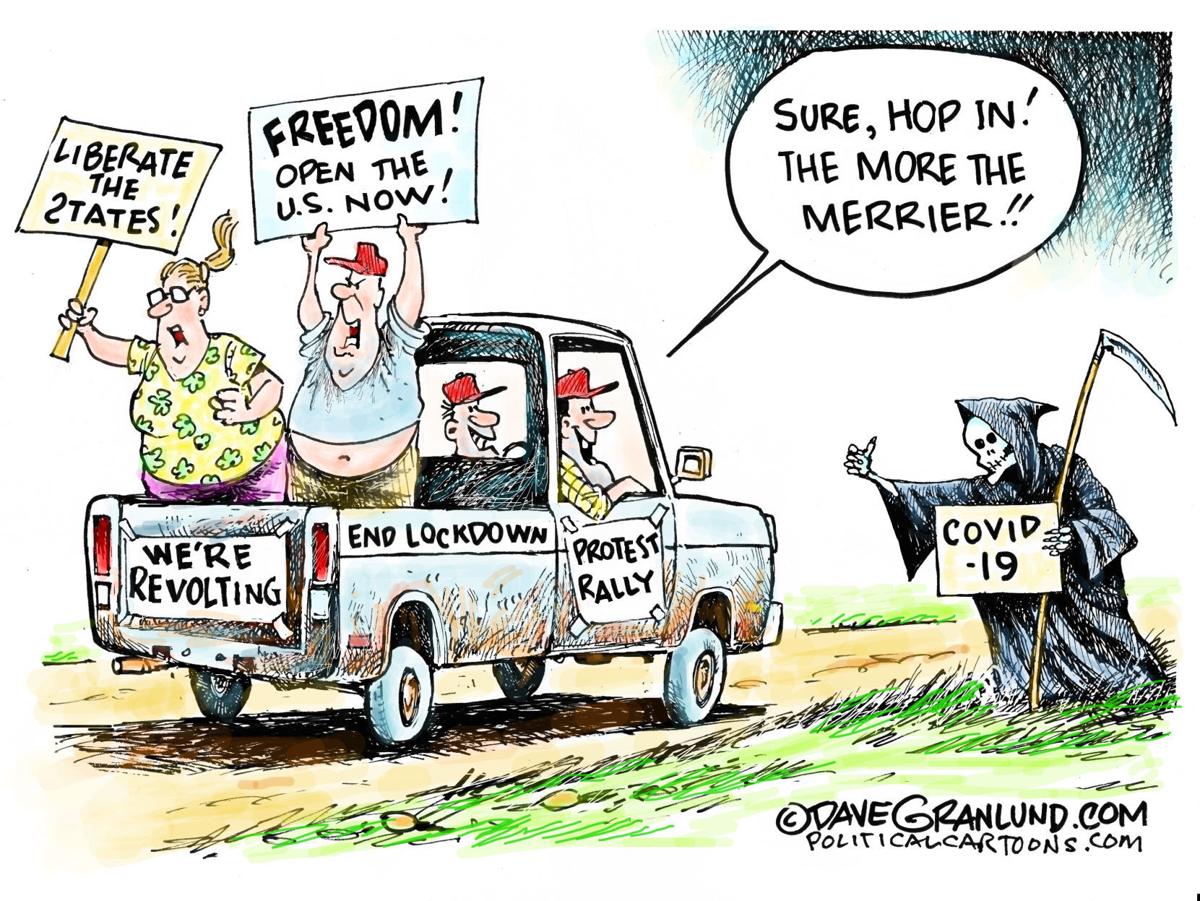
Cartoon – Open the U.S. Now

A. Christian van Gorder: George Washington meets a viral pandemic | Board  Of Contributors | wacotrib.com

Yogi Berra on the Pandemic

Yogi Berra's wordplay wisdom for writers: "It ain't over till it's over"  and more | Stuff Writers Like

How Vaccine Refusal Could Prolong the Pandemic

Stephanie Nana, an evangelical Christian in Edmond, Okla., refused to get a Covid-19 vaccine because she believed it contained “aborted cell tissue.”

Nathan French, who leads a nondenominational ministry in Tacoma, Wash., said he received a divine message that God was the ultimate healer and deliverer: “The vaccine is not the savior.”

Lauri Armstrong, a Bible-believing nutritionist outside of Dallas, said she did not need the vaccine because God designed the body to heal itself, if given the right nutrients. More than that, she said, “It would be God’s will if I am here or if I am not here.”

The deeply held spiritual convictions or counterfactual arguments may vary. But across white evangelical America, reasons not to get vaccinated have spread as quickly as the virus that public health officials are hoping to overcome through herd immunity.

The opposition is rooted in a mix of religious faith and a longstanding wariness of mainstream science, and it is fueled by broader cultural distrust of institutions and gravitation to online conspiracy theories. The sheer size of the community poses a major problem for the country’s ability to recover from a pandemic that has resulted in the deaths of half a million Americans. And evangelical ideas and instincts have a way of spreading, even internationally.

There are about 41 million white evangelical adults in the U.S. About 45 percent said in late February that they would not get vaccinated against Covid-19, making them among the least likely demographic groups to do so, according to the Pew Research Center.

“If we can’t get a significant number of white evangelicals to come around on this, the pandemic is going to last much longer than it needs to,” said Jamie Aten, founder and executive director of the Humanitarian Disaster Institute at Wheaton College, an evangelical institution in Illinois.

As vaccines become more widely available, and as worrisome virus variants develop, the problem takes on new urgency. Significant numbers of Americans generally are resistant to getting vaccinated, but white evangelicals present unique challenges because of their complex web of moral, medical, and political objections. The challenge is further complicated by longstanding distrust between evangelicals and the scientific community.

“Would I say that all public health agencies have the information that they need to address their questions and concerns? Probably not,” said Dr. Julie Morita, the executive vice president of the Robert Wood Johnson Foundation and a former Chicago public health commissioner.

No clear data is available about vaccine hesitancy among evangelicals of other racial groups. But religious reasoning often spreads beyond white churches.

Many high-profile conservative pastors and institutional leaders have endorsed the vaccines. Franklin Graham told his 9.6 million Facebook followers that Jesus would advocate for vaccination. Pastor Robert Jeffress commended it from an anti-abortion perspective on Fox News. (“We talk about life inside the womb being a gift from God. Well, life outside the womb is a gift from God, too.”) The president of the Southern Baptist Convention, J.D. Greear, tweeted a photo of himself receiving a shot.

But other influential voices in the sprawling, trans-denominational movement, especially those who have gained their stature through media fame, have sown fears. Gene Bailey, the host of a prophecy-focused talk show on the Victory Channel, warned his audience in March that the government and “globalist entities” will “use bayonets and prisons to force a needle into your arm.” In a now-deleted TikTok post from an evangelical influencer’s account that has more than 900,000 followers, she dramatized being killed by authorities for refusing the vaccine.

Dr. Simone Gold, a prominent Covid-19 skeptic who was charged with violent entry and disorderly conduct in the Jan. 6 Capitol siege, told an evangelical congregation in Florida that they were in danger of being “coerced into taking an experimental biological agent.”

The evangelical radio host Eric Metaxas wrote “Don’t get the vaccine” in a tweet on March 28 that has since been deleted. “Pass it on,” he wrote.

Some evangelicals believe that any Covid restrictions — including mask mandates and restrictions on in-person church worship — constitute oppression.

And some have been energized by what they see as a battle between faith and fear, and freedom and persecution.

Fear is the motivating power behind all of this, and fear is the opposite of who God is,” said Teresa Beukers, who travels throughout California in a motor home. “I violently oppose fear.”

Ms. Beukers foresees severe political and social consequences for resisting the vaccine, but she is determined to do so. She quit a job at Trader Joe’s when the company insisted that she wear a mask at work. Her son, she said, was kicked off his community college football team for refusing Covid testing protocols.

“Go ahead and throw us in the lions’ den, go ahead and throw us in the furnace,” she said, referring to two biblical stories in which God’s people miraculously survive persecution after refusing to submit to temporal powers.

Jesus, she added, broke ritual purity laws by interacting with lepers. “We can compare that to people who are unvaccinated,” she said. “If they get pushed out, they’ll need to live in their own colonies.”

One widespread concern among evangelicals is the vaccines’ ties to abortion. In reality, the connection is remote: Some of the vaccines were developed and tested using cells derived from the fetal tissue of elective abortions that took place decades ago.

The vaccines do not include fetal tissue, and no additional abortions are required to manufacture them. Still, the kernel of a connection has metastasized online into false rumors about human remains or fetal DNA being an ingredient in the vaccines.

Some evangelicals see the vaccine as a redemptive outcome for the original aborted fetus.

Some Catholic bishops have expressed concerns about the abortion link, too. But the Vatican has concluded the vaccines are “morally acceptable,” and has emphasized the immediate danger posed by the virus. Just 22 percent of Catholics in America say they will not get the vaccine, less than half the share of white evangelicals who say that.

White evangelicals who do not plan to get vaccinated sometimes say they see no need, because they do not feel at risk. Rates of Covid-19 death have been about twice as high for Black, Hispanic, and Native Americans as for white Americans.

White pastors have largely remained quiet. That’s in part because the wariness among white conservative Christians is not just medical, but also political. If white pastors encourage vaccination directly, said Dr. Aten, “there are people in the pews where you’ve just attacked their political party, and maybe their whole worldview.”

Dr. Morita, of the Robert Wood Johnson Foundation, said the method to reach white evangelicals is similar to building vaccine confidence in other groups: Listen to their concerns and questions, and then provide information that they can understand from people they trust.

But a public education campaign alone may not be enough.

There has been a “sea change” over the past century in how evangelical Christians see science, a change rooted largely in the debates over evolution and the secularization of the academy, said Elaine Ecklund, professor of sociology and director of the Religion and Public Life Program at Rice University.

There are two parts to the problem, she said: The scientific community has not been as friendly toward evangelicals, and the religious community has not encouraged followers to pursue careers in science.

Distrust of scientists has become part of cultural identity, of what it means to be white and evangelical in America, she said.

For slightly different reasons, the distrust is sometimes shared by Asian, Hispanic and Black Christians, who are skeptical that hospitals and medical professionals will be sensitive to their concerns, Dr. Ecklund said.

“We are seeing some of the implications of the inequalities in science,” she said. “This is an enormous warning of the fact that we do not have a more diverse scientific work force, religiously and racially.”

Among evangelicals, Pentecostal and charismatic Christians may be particularly wary of the vaccine, in part because their tradition historically emphasizes divine health and miraculous healing in ways that can rival traditional medicine, said Erica Ramirez, a scholar of Pentecostalism and director of applied research at Auburn Seminary. Charismatic churches also attract significant shares of Black and Hispanic Christians.

Dr. Ramirez compares modern Pentecostalism to Gwyneth Paltrow’s Goop, with the brand’s emphasis on “wellness” and “energy” that infuriates some scientists: “It’s extra-medical,” she said. “It’s not anti-medical, but it decenters medicine.”

The Centers for Disease Control and Prevention and Dr. Anthony Fauci are not going to be able to persuade evangelicals, according to Curtis Chang, a consulting professor at Duke Divinity School who is leading an outreach project to educate evangelicals about the vaccine.

The project includes a series of short, shareable videos for pastors, answering questions like “How can Christians spot fake news on the vaccine?” and “Is the vaccine the Mark of the Beast?” The latter refers to an apocalyptic theory that the AntiChrist will force his sign onto everyone at the end of the world.

These are questions that secular public health entities are not equipped to answer, he said. “The even deeper problem is, the white evangelicals aren’t even on their screen.”

Mr. Chang said he recently spoke with a colleague in Uganda whose hospital had received 5,000 vaccine doses, but had only been able to administer about 400, because of the hesitancy of the heavily evangelical population.

“How American evangelicals think, write, feel about issues quickly replicates throughout the entire world,” he said.

At this critical moment, even pastors struggle to know how to reach their flocks. Joel Rainey, who leads Covenant Church in Shepherdstown, W.Va., said several colleagues were forced out of their churches after promoting health and vaccination guidelines.

Politics has increasingly been shaping faith among white evangelicals, rather than the other way around, he said. Pastors’ influence on their churches is decreasing. “They get their people for one hour, and Sean Hannity gets them for the next 20,” he said.

Mr. Rainey helped his own Southern Baptist congregation get ahead of false information by publicly interviewing medical experts — a retired colonel specializing in infectious disease, a church member who is a Walter Reed logistics management analyst, and a church elder who is a nurse for the Department of Veterans Affairs.

On the worship stage, in front of the praise band’s drum set, he asked them “all of the questions that a follower of Jesus might have,” he said later.

“It is necessary for pastors to instruct their people that we don’t always have to be adversaries with the culture around us,” he said. “We believe Jesus died for those people, so why in the world would we see them as adversaries?”

The pandemic’s coming new normal

Photo illustration of the Freedom from Want image by Norman Rockwell with all the participants of the dinner wearing surgical masks.

As both vaccinations and acquired immunity spread, life will likely settle into a new normal that will resemble pre-COVID-19 days— with some major twists.

The big picture: While hospitalizations and deaths are tamped down, the novel coronavirus should recede as a mortal threat to the world. But a lingering pool of unvaccinated people — and the virus’ own ability to mutate — will ensure SARS-CoV-2 keeps circulating at some level, meaning some precautions will be kept in place for years.

Driving the news: On Tuesday, Johnson & Johnson CEO Alex Gorsky told CNBC that people might well need a new coronavirus vaccine annually in the years ahead, much as they do now for the flu.

  • Gorsky’s comments were one of the clearest signals that even as the number of vaccinated people rises, the mutability of SARS-CoV-2 means the virus will almost certainly be with us in some form for years to come.

Be smartThat sounds like bad news — and indeed, it’s much less ideal than a world in which vaccination or infection conferred close to lifelong immunity and SARS-CoV-2 could be definitively conquered like smallpox.

  • With more contagious variants spreading rapidly, “the next 12 weeks are likely to be the darkest days of the pandemic,” says Michael Osterholm, the director of the University of Minnesota’s Center for Infectious Disease Research and Policy.
  • But the apparent effectiveness of the vaccines in preventing hospitalizations and death from COVID-19 — even in the face of new variants — points the way toward a milder future for the pandemic, albeit one that may be experienced very differently around the world.

Details: From studying what happened after new viruses emerged in the past, scientists predict SARS-CoV-2 will eventually become endemic, most likely in a seasonal pattern similar to the kind of coronaviruses that cause the common cold.

  • That’s nothing to sneeze at — literally, it will make us sneeze — but as immunity levels accumulate throughout the population, our experience of the virus will attenuate, and we’ll be highly unlikely to experience the severe death tolls and overloaded hospitals that marked much of the past year.

Yes, but: The existence of a stubborn pool of Americans who say they won’t get vaccinated — as well as the fact that it may take far longer for children, whom the vaccines have yet to be tested on, to get coverage — will give the virus longer legs than it would otherwise have.

  • “This will be with us forever,” says Osterholm. “That’s not even a debate at this point.”

What’s next: This means we can expect the K-shaped recovery that has marked the pandemic to continue, says Ben Pring, who leads Cognizant’s Center for the Future of Work.

  • With the virus likely to remain a threat, even if a diminished one, “those who are more stuck in the analog world are really going to continue to struggle,” he says.
  • Health security will also become a more ingrained part of daily life and work, which means temperature checks, masks, frequent COVID-19 testing and even vaccine passports for travel are here to stay.

The catch: That’s not all bad — the measures put in place to slow COVID-19 have stomped the flu and other seasonal respiratory viruses, and if we can hold onto some of those benefits in the future, we can save tens of thousands of lives and billions of dollars.

  • If the inequalities seen in the early phase of the vaccine rollout persist, COVID-19 could become a disease of the poor and disadvantaged, argues Mark Sendak, the co-founder and scientific adviser for Greenlight Ready, a COVID-19 resilience system that grew out of Duke Health.
  • Sendak points to the example of HIV, a disease that is entirely controllable with drugs but continues to exert a disproportionate toll on Black Americans, who take pre-exposure prophylactic medicine at much lower rates.

“If we go back to ‘normal,’ then we have failed.”

— Mark Sendak

What to watch: Whether the vaccine rollout can be adapted to reach hard to find and hard to persuade populations.

  • The Biden administration announced yesterday that it will start delivering vaccines directly to community health centers next week in an effort to promote more equity in the vaccine distribution process.
  • As the administration rolls out new COVID-19 plans, it needs to “invest in the community health care personnel” who can ensure that no one is left behind, says Sendak.

The bottom line: While SARS-CoV-2 has proven it can adapt to a changing environment, so can we. But we have to do so in a way that is fairer than our experience of the pandemic has been so far.

Large Numbers Of Health Care And Frontline Workers Are Refusing Covid-19 Vaccine

Large Numbers Of Health Care And Frontline Workers Are Refusing Covid-19  Vaccine

TOPLINE

Despite the Covid-19 death count in the United States rapidly accelerating, a startlingly high percentage of health care professionals and frontline workers throughout the country—who have been prioritized as early receipts of the coronavirus vaccine—are reportedly hesitant or outright refusing to take it, despite clear scientific evidence that the vaccines are safe and effective.

KEY FACTS

Earlier this week, Ohio Gov. Mike DeWine said he was “troubled” by the relatively low numbers of nursing home workers who have elected to take the vaccine, with DeWine stating that approximately 60% of nursing home staff declined the shot. 

Dr. Joseph Varon, chief of critical care at Houston’s United Memorial Medical Center, told NPR in December more than half of the nurses in his unit informed him they would not get the vaccine.

Roughly 55 percent of surveyed New York Fire Department firefighters said they would not get the coronavirus vaccine, the Firefighters Association president said last month.

The Los Angeles Times reported Thursday that hospital and public officials in Riverside, Calif., have been forced to figure out how best to allocate unused doses after an estimated 50% of frontline workers in the county refused the vaccine.

Fewer than half of the hospital workers at St. Elizabeth Community Hospital in Tehama County, Calif., were willing to be vaccinated, and around 20% to 40% of L.A. County’s frontline workers have reportedly declined an opportunity to take the vaccine. 

Dr. Nikhila Juvvadi, the chief clinical officer at Chicago’s Loretto Hospital, said that a survey was administered in December, and 40% of the hospital staff said they would not get vaccinated.

KEY BACKGROUND:

recent survey by the Kaiser Family Foundation found that 29% of healthcare workers were hesitant to receive the vaccine, citing concerns related to potential side effects and a lack of faith in the government to ensure the vaccines were safe. Frontline workers in the United States are disproportionately Black and Hispanic. The pandemic has taken an “outsized toll” on this segment of the population, which has reportedly accounted for roughly 65% of fatalities in cases in which there are race and ethnicity data. A study published by the journal The Lancet over the summer found “healthcare workers of color were more than twice as likely as their white counterparts” to test positive for the coronavirus. According to a Pew Research Center poll published in December, vaccine skepticism is highest among Black Americans, as less than 43% said they would definitely/probably get a Covid-19 vaccine. Dr. Juvvadi told NPR that “there’s no transparency between pharmaceutical companies or research companies — or the government sometimes — on how many people from” Black and Latino communities were involved in the research of the vaccine. Dr. Varon said that “the fact that [President] Trump is in charge of accelerating the process bothers” those individuals who refuse to be immunized, adding “they all think it’s meant to harm specific sectors of the population.” In an op-ed published in the New York Times earlier this week, emergency physicians Benjamin Thomas and Monique Smith wrote that “vaccine reluctance is a direct consequence of the medical system’s mistreatment of Black people” and past atrocities, such as the unethical surgeries performed by J. Marion Sims and the Tuskegee Syphilis Study, best exemplifies “the culture of medical exploitation, abuse and neglect of Black Americans.” 

CRUCIAL QUOTE: 

“I’ve heard Tuskegee more times than I can count in the past month — and, you know, it’s a valid, valid concern,” said Dr. Juvvadi.

WHAT TO WATCH FOR:

Dr. Anthony Fauci, the director of the National Institute of Allergy and Infectious Diseases, said in a Friday interview that it’s “quite possible” the Covid-19 vaccine could be required for international travel and to attend school at some point in the future.

BIG NUMBER:

40 million. In early December, government officials said they planned to have 40 million doses available by the end of 2020, which would be enough to fully vaccinate 20 million Americans. However, according to the Centers for Disease Control and Prevention, less than 3 million Americans have received the first dose of the vaccine, with 14 million doses have been distributed.

Demand for COVID Vaccines Expected to Get Heated — And Fast

Americans have made no secret of their skepticism of COVID-19 vaccines this year, with fears of political interference and a “warp speed” timeline blunting confidence in the shots. As recently as September, nearly half of U.S. adults said they didn’t intend to be inoculated.

But with two promising vaccines primed for release, likely within weeks, experts in ethics and immunization behavior say they expect attitudes to shift quickly from widespread hesitancy to urgent, even heated demand.

“People talk about the anti-vaccine people being able to kind of squelch uptake. I don’t see that happening,” Dr. Paul Offit, a vaccinologist with Children’s Hospital of Philadelphia, told viewers of a recent JAMA Network webinar. “This, to me, is more like the Beanie Baby phenomenon. The attractiveness of a limited edition.”

Reports that vaccines produced by drugmakers Pfizer and BioNTech and Moderna appear to be safe and effective, along with the deliberate emphasis on science-based guidance from the incoming Biden administration, are likely to reverse uncertainty in a big way, said Arthur Caplan, director of the division of medical ethics at New York University School of Medicine.

“I think that’s going to flip the trust issue,” he said.

The shift is already apparent. A new poll by the Pew Research Center found that by the end of November 60% of Americans said they would get a vaccine for the coronavirus. This month, even as a federal advisory group met to hash out guidelines for vaccine distribution, a long list of advocacy groups — from those representing home-based health workers and community health centers to patients with kidney disease — were lobbying state and federal officials in hopes their constituents would be prioritized for the first scarce doses.

“As we get closer to the vaccine being a reality, there’s a lot of jockeying, to be sure,” said Katie Smith Sloan, chief executive of LeadingAge, a nonprofit organization pushing for staff and patients at long-term care centers to be included in the highest-priority category.

Certainly, some consumers remain wary, said Rupali Limaye, a social and behavioral health scientist at the Johns Hopkins Bloomberg School of Public Health. Fears that drugmakers and regulators might cut corners to speed a vaccine linger, even as details of the trials become public and the review process is made more transparent. Some health care workers, who are at the front of the line for the shots, are not eager to go first.

“There will be people who will say, ‘I will wait a little bit more for safety data,” Limaye said.

But those doubts likely will recede once the vaccines are approved for use and begin to circulate broadly, said Offit, who sits on the FDA advisory panel set to review the requests for emergency authorization Pfizer and Moderna have submitted.

He predicted demand for the COVID vaccines could rival the clamor that occurred in 2004, when production problems caused a severe shortage of flu shots just as influenza season began. That led to long lines, rationed doses and ethical debates over distribution.

“That was a highly desired vaccine,” Offit said. “I think in many ways that might happen here.”

Initially, vaccine supplies will be tight, with federal officials planning to ship 6.4 million doses within 24 hours of FDA authorization and up to 40 million doses by the end of the year. The CDC panel recommended that the first shots go to the 21 million health care workers in the U.S. and 3 million nursing home staff and residents, before being rolled out to other groups based on a hierarchy of risk factors.

Even before any vaccine is available, some people are trying to boost their chances of access, said Dr. Allison Kempe, a professor of pediatrics at the University of Colorado School of Medicine and expert in vaccine dissemination. “People have called me and said, ‘How can I get the vaccine?’” she said. “I think that not everyone will be happy to wait, that’s for sure. I don’t think there will be rioting in the streets, but there may be pressure brought to bear.”

That likely will include emotional debates over how, when and to whom next doses should be distributed, said Caplan. Under the CDC recommendations, vulnerable groups next in line include 87 million workers whose jobs are deemed “essential” — a broad and ill-defined category — as well as 53 million adults age 65 and older.

“We’re going to have some fights about high-risk groups,” said Caplan of NYU.

The conversations will be complicated. Should prisoners, who have little control over their COVID exposure, get vaccine priority? How about professional sports teams, whose performance could bolster society’s overall morale? And what about residents of facilities providing care for people with intellectual and developmental disabilities, who are three times more likely to die from COVID-19 than the general population?

Control over vaccination allocation rests with the states, so that’s where the biggest conflicts will occur, Caplan said. “It’s a short fight, I hope, in the sense in which it gets done in a few months, but I think it will be pretty vocal.”

Once vaccine supplies become more plentiful, perhaps by May or June, another consideration is sure to boost demand: requirements for proof of COVID vaccination for work and travel.

“It’s inevitable that you’re going to see immunity passports or that you’re required to show a certificate on the train, airplane, bus or subway,” Caplan predicted. “Probably also to enter certain hospitals, probably to enter certain restaurants and government facilities.”

But with a grueling winter surge ahead, and new predictions that COVID-19 will fell as many as 450,000 Americans by February, the tragic reality of the disease will no doubt fuel ample demand for vaccination.

“People now know someone who has gotten COVID, who has been hospitalized or has unfortunately died,” Limaye said.

“We’re all seeing this now,” said Kempe. “Even deniers are beginning to see what this illness can do.”

What makes a Bad Vaccine?

A Covid-19 vaccine, amazingly, is close. Why am I so worried?

A mere six months after identifying the SARS-CoV-2 virus as the cause of Covid-19, scientists are on the precipice of a having a vaccine to fight it. Moderna and the National Institutes of Health recently announced the start of a Phase 3 clinical trial, joining several others in a constructive rivalry that could save millions of lives.

It’s a truly impressive a feat and a testament to the power of basic and applied medical sciences. Under normal circumstances, vaccine approvals are measured in decades. Milestones that once took months or years have been achieved in days or weeks. If these efforts are successful, the Covid-19 vaccine could take a place alongside the Apollo missions as one of history’s greatest scientific achievements.

I’m optimistic. And yet, as someone who studies drug development, I want to temper expectations with a dose of realism and perhaps a bit of angst. Behind the proud declarations, many science and medical professionals have been whispering concerns. These whispers have escalated into a murmur. It’s time to cry them loudly:

Hey, Food and Drug Administration: Don’t be rash! Premature approval of a sub-standard Covid-19 vaccine could have dire implications, and not just for this pandemic. It could harm public health for years, if not generations, to come.

Unfortunately, elements now in place make such a disastrous outcome not only possible but in fact quite likely. Specifically, the FDA and its staff of chronically overworked and underappreciated regulators will face enormous public and political pressure to approve a vaccine. Whether or not one worries about an “October surprise” aimed at the upcoming election, regulators will be pressed hard. Some will stand firm. Some may resign in protest. But others could break and allow a bad vaccine to be released.

What makes a “bad vaccine”? Insufficient protection against the disease it is designed for, unwanted side effects, or some combination of the two. If an approved Covid-19 vaccine turns out to be ineffective, this could unintentionally promote wider spread of the disease by individuals who presume they were protected from it. Likewise, a negative experience with one vaccine might discourage the use of other vaccines that are far more safe and effective, whether they are for Covid-19 or other vaccine-preventable diseases.

Some things take time. Under normal circumstances, ensuring that a vaccine’s effects are safe and durable requires years of study and monitoring. And there is some evidence that natural immune responses to SARS-CoV-2 infection could be transient, making sustained investigation all the more necessary. A merely short-term effect could encourage vaccinated individuals to resume risky behaviors, which would all but guarantee that the epidemic endures. And if unintended side effects turn out to include, for instance, chronic inflammatory or autoimmune disease, a bad vaccine could impart lifelong damage.

But wait, there’s worse! A bad Covid-19 vaccine could further undermine confidence in the many safe, reliable vaccines already in our public health arsenal. Vaccine skepticism and anti-science bias, propagated by B-list celebrities and Russian troll farms, have been gaining strength all year. Combined with disappointing Covid-19 outcomes, such malign forces could facilitate the reemergence of once-vanquished foes — polio, measles, mumps, rubella, diphtheria, whooping cough, and tetanus — that once killed multitudes of children each year.

These are enormous risks. Placing all of our bets on a small set of untried vaccine technologies would be gobsmackingly foolish. Yet this is exactly what we are now doing. Most of the high-profile names capturing headlines are pursuing comparatively minor variations on a theme of genetic vaccines (those delivered via DNA or RNA). If one approach happens to work, the odds are higher the others will work as well. Disappointing results from one candidate, though, might presage failure across the board.

Rather than investing in a balanced portfolio of vaccines with different approaches — not to mention different therapies, devices, and diagnostics for treating Covid-19 — too many observers, too many companies, and too many governmental officials seem to be narrowly focused on hopes for a “savior” vaccine. Were that savior to fail, our national morale, already low, could plummet even further.

Don’t get me wrong. I, along with millions of Americans, want a Covid-19 vaccine. But we deserve one that’s been proven to be safe and effective.

It’s not too late to take a deep breath and devise a strategy to balance short- and long-term goals, including vaccination, improved diagnostics, and existing and novel treatments. We must support the FDA and hope that its scientists and physicians retain the strength and conviction to resist approving a substandard vaccine.

For encouragement, we should look to Frances Oldham Kelsey, a veritable patron saint of the FDA. In 1960, during her first month working for the agency, Kelsey was asked to approve a sedative called Kevadon, which had the potential to generate billions in revenue. Despite enormous pressure, Kelsey spotted a risk for toxicity and dug in her heels. She refused to rubber stamp the approval. Her actions saved the lives of countless babies. Kevadon, better known as thalidomide, proved to be one of the most dangerous and disfiguring drugs in history.

Kelsey passed away in 2015 at the age of 101. We must pray that her spirit inspires a new generation of FDA leaders with the courage to say, “No.”