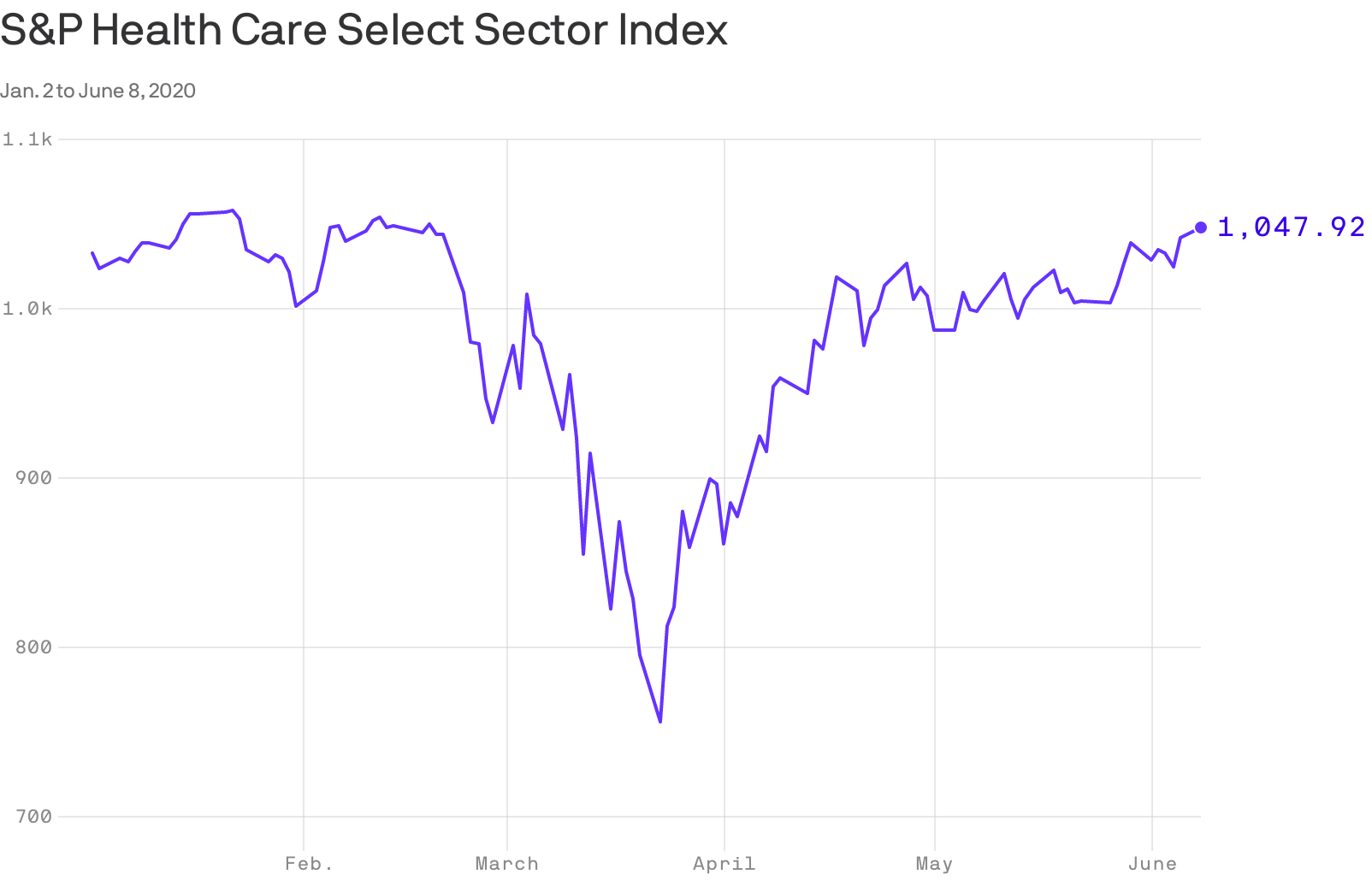
The pandemic isn’t hurting health care companies

https://www.axios.com/newsletters/axios-vitals-d0f987be-1f6b-4b4b-bcb6-0132dc0e7e3f.html?utm_source=newsletter&utm_medium=email&utm_campaign=newsletter_axiosvitals&stream=top

The pandemic isn't dampening Wall Street's view of health care - Axios

The S&P index of top health care companies finished Monday higher than where it opened the year, Axios’ Bob Herman reports.

The big picture: A global coronavirus pandemic, social unrest, mass unemployment, and the halting of medical procedures haven’t been enough to derail Wall Street’s rosy view of the health care industry.

Where things stand: The coronavirus started to affect the economy toward the tail end of the first quarter, but the health care industry was relatively unscathed.

  • Among the 109 publicly traded health care companies tracked by Axios, first-quarter profits exceeded $50 billion, good for a 7.4% net profit margin.
  • Pharmaceutical companies and health insurers generated the highest returns. Wall Street believes drug companies stand to benefit from potential coronavirus treatments or vaccines.
  • The stock price of Gilead Sciences, for example, is up 18% so far this year, partially on the assumption its coronavirus drug, remdesivir, will produce billions of dollars of revenue — even though the drug has showed only modest benefit for patients.

Between the lines: The second quarter likely will be worse, as the brunt of the coronavirus lockdown was felt in April and May. But normal operations have already started resuming for some health care sectors, regardless of the virus’ spread.


Trump reportedly squandered 3 crucial weeks to mitigate the coronavirus outbreak after a CDC official’s blunt warnings spooked the stock market

https://www.businessinsider.com/trump-wasted-3-weeks-coronavirus-mitigation-time-february-march-nyt-2020-4

Dow closes with decline of 950 points as coronavirus continues to ...

  • President Donald Trump’s administration wasted three key weeks between February and March that could have been spent enacting mitigatory measures against COVID-19, The New York Times reported on Saturday.
  • By the end of February, top officials knew that time was running out to stem the virus spread, and wanted to present Trump with a plan to enact aggressive social distancing and stay-at-home measures.
  • But on February 26, a top CDC official issued stark warnings about the virus’ spread right before the stock market plummeted, which angered Trump for being, in his view, too alarmist. 
  • The Times reported that the entire episode killed off the efforts to persuade Trump to take aggressive, action to mitigate the virus’ spread. In the end, Trump didn’t issue stay-at-home guidance until March 16. 

President Donald Trump’s administration stalled three key weeks in February that could have been spent enacting mitigatory measures against COVID-19 after Trump was angered by a public health official issuing a dire warning about the virus, The New York Times reported on Saturday.

On Saturday,The Times published a lengthy investigation of all the instances Trump brushed aside warnings of the severity of the coronavirus crisis, failed to act, and was delayed by significant infighting and mixed messages from the White House over what action to take and when. 

The Times wrote: “These final days of February, perhaps more than any other moment during his tenure in the White House, illustrated Mr. Trump’s inability or unwillingness to absorb warnings coming at him.”

The Times conducted dozens of interviews with current and former officials and obtained 80 pages of emails from a number of public health experts both within and outside of the federal government who sounded the alarm about the severity of the crisis on an email chain they called “Red Dawn.”

One of the members of the email group, Health & Human Service disaster preparedness official Dr. Robert Kadlec, became particularly concerned about how rapidly the virus could spread when Dr. Eva Lee, a Georgia Tech researcher, shared a study with the group about a 20-year-old woman in China who spread the virus to five of her family members despite showing no symptoms.

“Eva is this true?! If so we have a huge [hole] on our screening and quarantine effort,” he replied on February 23. 

At that point, researchers and top officials in the federal government determined that since it was way too late to try to keep the virus out of the United States, the best course of action was to introduce mitigatory, non-pharmaceutical interventions (NPIs) like social distancing and prohibiting large gatherings.

As officials sounded the alarm that they didn’t have any time to waste before enacting aggressive measures to contain the virus, top public health officials including Dr. Robert Kadlec concluded that it was time to present Trump with a plan to curb the virus called “Four Steps to Mitigation.”

The plan, according to The Times, included canceling large gatherings, concerts, and sporting events, closing down schools, and both governments and private businesses alike ordering employees to work from home and stay at home as much as possible, in addition to quarantine and isolating the sick.

But their entire plan was derailed by a series of events that ended up delaying the White House’s response by several weeks, wasting precious time in the process.

Trump was on a state visit to India when Dr. Kadlec and other experts wanted to present him with the plan, so they decided to wait until he came back.

But less than a day later, Dr. Nancy Messonnier, the director of the National Center for Immunization and Respiratory Diseases at the CDC, publicly sounded the alarm about the severity of the coronavirus outbreak in a February 26 press conference, warning that the outbreak would soon become a pandemic.

“It’s not so much a question of if this will happen anymore but rather more a question of exactly when this will happen and how many people in this country will have severe illness,” Messonnier said, bluntly warning that community transmission of the virus would be inevitable.

The Times reported that Trump spent the plane ride stewing in anger both over Messonnier’s comments and the resulting plummet of the stock market they caused, calling Secretary of Health & Human Services Alex Azar “raging that Dr. Messonnier had scared people unnecessarily,” The Times said. 

The Times reported that the entire episode effectively killed off any efforts to persuade Trump to take aggressive, decisive action to mitigate the virus’ spread and led to Azar being sidelined, writing, ” With Mr. Pence and his staff in charge, the focus was clear: no more alarmist messages.” 

In the end, Dr. Kadlec’s team never made their presentation. Trump did not issue nationwide social distancing and stay-at-home guidelines until March 16, three weeks after Messonnier warned that the US had limited time to mitigate community transmission of the virus, and several weeks after top experts started calling for US officials to implement such measures.

In those nearly three weeks between February 26 and March 16, the number of confirmed COVID-19 cases rose from just 15 to 4,226, The Times said. As of April 12, there are over half a million confirmed cases in the United States with over 21,000 deaths.


Fauci: US could have ‘saved lives’ if social-distancing restrictions were enforced earlier

https://thehill.com/homenews/administration/492411-fauci-us-could-have-saved-lives-if-social-distancing-restrictions

Top doc Fauci admits lives could have been saved if US had shut ...

Anthony Fauci, the U.S. government’s top infectious disease expert, said Sunday that the U.S. would have saved lives had the country enforced firm social-distancing requirements as early as February, but noted that those recommendations were met with pushback at the time.

Speaking on CNN’s “State of The Union,” Fauci addressed a New York Times report that said he and other health experts concluded on Feb. 21 that the Trump administration would need to issue aggressive mitigation measures in order to slow the spread of COVID-19, the disease caused by the novel coronavirus. 

“As I have said many times, we look at it from a pure health standpoint,” Fauci said. “We make a recommendation. Often, the recommendation is taken. Sometimes, it’s not. It is what it is. We are where we are right now.”

Fauci added that “you could logically say, that if you had a process that was ongoing, and you started mitigation earlier, you could have saved lives.”

“Obviously, no one is going to deny that. But what goes into those kinds of decisions is complicated,” he said. “I mean, obviously, if we had, right from the very beginning, shut everything down, it may have been a little bit different. But there was a lot of pushback about shutting things down back then.”

The National Security Council reportedly received intelligence reports in January warning that the COVID-19 outbreak would spread to the U.S. By the third week of February, Dr. Robert Kadlec, the top disaster response official at the Health and Human Services Department (HHS), convened a meeting on whether officials should lock down the country to prevent an outbreak. The group determined that mitigation measures such as school and business closures were necessary despite the devastating economic implications, The Times noted.

The White House issued social-distancing guidelines, including recommendations against gatherings of more than 10 people, in mid-March. President Trump later that month extended those guidelines through the end of April.

The U.S. has reported more than 530,000 confirmed COVID-19 cases and roughly 20,600 deaths caused by it as of Sunday morning, according to a Johns Hopkins University database. 

Asked whether the statistics were a direct cause of the late start on mitigation measures, Fauci said that “it isn’t as simple as that.” While earlier mitigation efforts would have had an impact, Fauci noted that “where we are right now is the result of a number of factors,” including the size of the country and the heterogeneity of the country.

“I think it’s a little bit unfair to compare us to South Korea, where they had an outbreak in Daegu, and they had the capability of immediately, essentially, shutting it off completely in a way that we may not have been able to do in this country,” he said. “So, obviously it would have been nice if we had a better head start, but I don’t think you could say that we are where we are right now because of one factor.”

The Trump administration has faced continued scrutiny over its handling of the outbreak, as state and federal officials raise alarms over testing and medical equipment shortages.

The president on Feb. 28 predicted that the disease would disappear like a “miracle.” Asked about those comments last week, Trump said that “the cases really didn’t build up for a while” and that he was trying to avoid stirring panic. 


If the U.S. economy is in good shape, why is the Federal Reserve cutting interest rates?

https://www.washingtonpost.com/business/2019/07/31/if-us-economy-is-good-shape-why-is-federal-reserve-cutting-interest-rates/?utm_term=.1346fb3da080&wpisrc=nl_most&wpmm=1

Federal Reserve Board Chair Jerome Powell speaks during a Senate Banking Committee hearing on July 11.

The Federal Reserve is all but certain Wednesday to do something it hasn’t done in more than a decade: cut interest rates. The question on a lot of people’s minds is why.

Lowering interest rates, the Fed’s main way to boost the economy, is typically used in dire times, which it’s difficult to argue the United States is experiencing right now. Instead, top Fed officials are defending this as an “insurance cut” that’s akin to an immunization shot in the arm. They want to counteract the negative effects of President Trump’s trade war and prevent the United States from catching the same cold that Europe, China and elsewhere seem to have.

The Fed’s big decision comes at 2 p.m. Wednesday and will be followed by a 2:30 p.m. news conference from Fed Chair Jerome H. Powell, a frequent target of Trump’s criticism.

The Fed is widely expected to do a modest cut on Wednesday, probably lowering the benchmark interest rate from about 2.5 percent down to just shy of 2.25 percent. But the Fed seldom does just one cut, which is why Trump, Wall Street and much of the world will be listening closely to Powell for signs of when another cut is likely.

Wall Street is pricing in that the Fed will lower interest rates to about 1.75 by the end of the year, a far more dramatic move. And Trump has been blasting the Fed for months, saying he wants to see a “large” cut.

“The Fed is often wrong,” Trump said this week, reiterating his view that the stock market would be up 10,000 more points if the Fed had not raised interest rates four times last year. “I’m very disappointed in the Fed. I think they acted too quickly, by far. I think I’ve been proven right.”

But there are plenty of economists and prominent investors saying the Fed shouldn’t cut at all because it is not justified and will look as though the Fed is caving in to Trump’s bullying — or Wall Street’s.

“I have to conclude the Fed has lost some independence here,” said Blu Putnam, chief economist at CME Group.

The last time the Fed cut rates was in December 2008, when unemployment was over 7 percent (and rising quickly), the stock market had lost a third of its value, and a major financial institution, Lehman Brothers, had just declared bankruptcy, rocking the financial system.

Today unemployment is at a half-century low (3.7 percent), the economy is growing at a healthy pace (over 2 percent) and the stock market is sitting at record highs.

Congress gave the Fed two mandates: to keep unemployment low and prices stable. By about any measure one can look at, the Fed has achieved those goals. The job market is strong, and inflation remains surprisingly low.

The world will be listening closely for Powell’s rationale for lowering rates during fairly good economic times — and for his signal about whether another cut is coming in the fall.

It’s a tricky calculus. The one thing nearly everyone agrees on is this would be the biggest gamble yet for Powell, who took over as the central bank’s chair in early 2018.

The likely cut on Wednesday should make loans a little cheaper for businesses and Americans looking to buy homes and cars or start a company. But realistically, one cut won’t do much. The reason the stock market has rallied sharply in recent weeks is an expectation that this is the first of several cuts.

If the Fed does not do three cuts this year, the market could pull back, making financial conditions “tight” again, even though the Fed is cutting rates to try to loosen conditions.

Top Federal Reserve leaders see three key reasons to cut now.

1. Trump’s trade war. There is concern about the trade war, as well as weakness overseas, dragging down the U.S. economy. A closer look at the U.S. economy reveals there are already a few yellow, if not red, flags. Manufacturing was in a “technical recession” the first half of the year, the housing market remains sluggish, and business investment tanked in the spring as corporate leaders grow more wary of the ongoing trade tensions.

Powell and Fed Vice Chair Richard Clarida refer to these as “head winds” and “downside risks” that are picking up, and they prefer to address them before they grow into deeper problems. Clarida often points to 1995, when the Fed did three modest rate cuts (starting in July 1995 and ending in January 1996) that helped keep the economy growing for years to come.

2. The Fed needs to act sooner rater than later. New York Fed President John Williams, among others, has made the case that the Fed has limited medicine in the medicine cabinet to aid the economy and that it’s better to administer the pills at the first signs of trouble rather than waiting for full-blown illness when there might not be enough medicine left to make a difference. “When you only have so much stimulus at your disposal, it pays to act quickly to lower rates at the first sign of economic distress,” Williams said in a speech earlier this month.

Interest rates are very low by historical standards. For example, the benchmark rate was over 5 percent before the Fed started reducing it in 2007. Now the benchmark rate is half that amount, meaning there will be less stimulus this time around from cutting rates.

3. Inflation is too low. The Fed wants to see inflation of about 2 percent a year. For the past several years, it’s been running below that threshold and is currently sitting around 1.6 percent. Some Fed leaders, such as St. Louis Fed President James Bullard, say the Fed should cut rates to try to run the economy a bit hotter to boost inflation. They see little risk in doing this since inflation is so low, but they see great risk in not getting inflation back to target because business leaders will stop believing that 2 percent is the true target if it is never achieved.

While there are reasons to cut, some Fed leaders, including Boston Fed President Eric Rosengren and Kansas City Fed President Esther George, have raised doubts about whether it makes sense to cut now, before there are clear signs of trouble in the United States.

Rosengren has warned in recent speeches that insurance cuts do not come without a cost. Keeping rates low tends to spur bubbles that can come back to harm the economy later on. Already there are concerns about too much risky corporate lending, and lower rates are only likely to encourage more of those loans. He and others have also pointed out that using up the medicine now doesn’t leave much left to fight worse problems later on.

There are 10 members on the Fed’s committee that decides interest rate policy, and they do not appear to be in unison on this decision, let alone what to do in the fall, a reminder of just how much debate there is about the right course of action.

The U.S. economy is in the midst of a record-breaking expansion that has been growing for more than a decade, the longest expansion in U.S. history. Powell says keeping it going is his top goal.