5 COVID-19 myths politicians have repeated that just aren’t true

https://theconversation.com/5-covid-19-myths-politicians-have-repeated-that-just-arent-true-141972

5 COVID-19 myths politicians have repeated that just aren't true ...

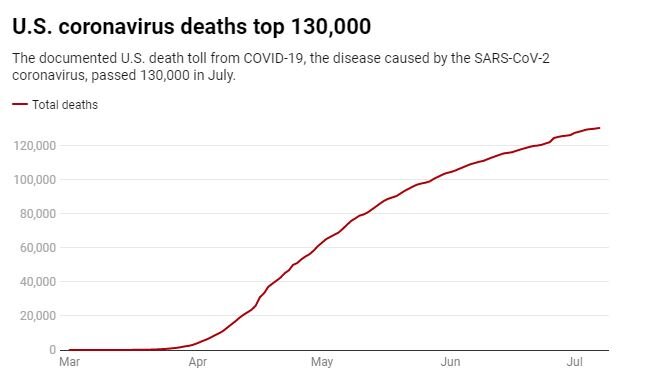
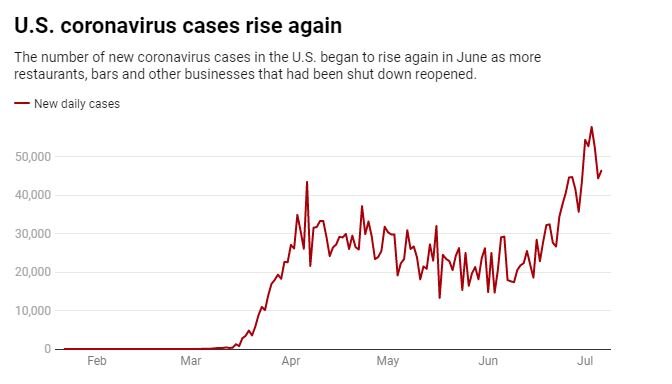
The number of new COVID-19 cases in the U.S. has jumped to around 50,000 a day, and the virus has killed more than 130,000 Americans. Yet, I still hear myths about the infection that has created the worst public health crisis in America in a century.

The purveyors of these myths, including politicians who have been soft peddling the impact of the coronavirus, aren’t doing the country any favors.

Here are five myths I hear as director of health policy at the University of Southern California’s Schaeffer Center that I would like to put to rest.

Myth: COVID-19 is not much worse than the flu

President Donald Trump and plenty of pundits predicted early on that COVID-19 would prove no more lethal than a bad flu. Some used that claim to argue that stay-at-home orders and government-imposed lockdowns were un-American and a gross overreaction that would cost more lives than they saved.

By the end of June, however, the director of the Centers for Disease Control and Prevention announced that national antibody testing indicated 5% to 8% of Americans had already been infected with the virus. With over 130,000 confirmed COVID-19-related deaths – and that’s likely an undercount – the case fatality rate is around 0.49% to 0.78% or about four to eight times that of the flu.

Brazilian President Jair Bolsonaro, who also downplayed COVID-19 as the death toll grew, calling it a “little flu,” announced on July 7 that he had tested positive for the coronavirus.
5 COVID-19 myths politicians have repeated that just aren't true


Myth: Cases are increasing because testing is increasing

At one point, the idea that COVID-19 case numbers were high because of an increase in testing made intuitive sense, especially in the early stages of the pandemic when people showing up for tests were overwhelmingly showing symptoms of possible infection. More testing meant health officials were aware of more illnesses that would have otherwise gone under the radar. And testing predominately sick and symptomatic people can result in an overestimate of its virulence.

Now, with millions of tests conducted and fewer than 10% coming back positive, the U.S. knows what it is facing. Testing today is essential to finding the people who are infected and getting them isolated.

Unfortunately, Trump has been a leading purveyor of the myth that we test too much. Fortunately, his medical advisers disagree.

Myth: Lockdowns were unnecessary

Given the current spike in infections after reopening the economy, more people are arguing that the lockdowns were unsuccessful in crushing the virus and shouldn’t have been implemented at all. But what would the country look like today if state governments had tried to build herd immunity by letting the disease spread rather than promoting social distancing, prohibiting large gatherings and telling the elderly to stay home?

Most epidemiologists who study pandemics believe that reaching herd immunity could only be achieved at enormous cost in terms of illness and death. About 60% or 70% of Americans would have to become infected before the spread of the virus diminished. That would result in 1 to 2 million U.S. deaths and 5 to 10 million hospitalizations.

These are horrific, yet conservative estimates, given that mortality rates would surely rise if that many people were infected and hospitals were overrun.
5 COVID-19 myths politicians have repeated that just aren't true

Myth: The epidemiological models are always wrong

It is not surprising that many people are confused by the proliferation of predictions about the course of the virus. How many people become infected depends on how individuals, governments and institutions respond, which is hard to predict.

Faced with the warning early in the pandemic that 1 to 2 million Americans could die if the U.S. simply let the coronavirus run its course, federal and state governments imposed restrictions to constrain the spread of the virus. Then, they relaxed those restrictions as new cases ebbed and pressure mounted to reopen the economy.

Now, they must consider reimposing some of those restrictions as infection rates rise in a majority of states, including Texas, Arizona, Florida and California. The models were based on data and assumptions at that time, and likely influenced responses which in turn changed underlying conditions. For example, new cases of COVID-19 are rising in the U.S., while fatalities are falling. This reflects a shift in infection rates toward younger populations, as well as improved treatment as providers learn more about the virus.

Just like an investment disclaimer that past returns do not guarantee future performance, modeling a pandemic should be seen as suggestive of what might happen given current information and not a law of nature.

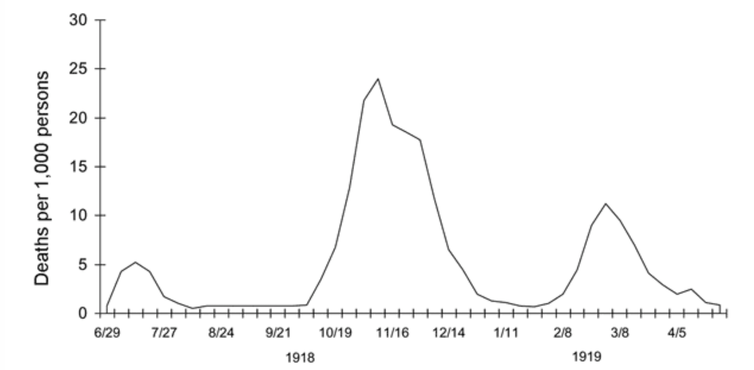
Myth: It’s a second wave

Sadly, the myth here is that we have contained the virus enough to buy time to prepare for a second wave. In fact, the first wave just keeps getting bigger.

A second wave would require a trough in the first wave, but there is little evidence of that from either an epidemiologic or economic perspective.
5 COVID-19 myths politicians have repeated that just aren't true

During the 1918-1919 flu pandemic, the weekly UK death toll from influenza and pneumonia, shown here, reflected three clear waves. Taubenberger JK, Morens DM. 1918 Influenza: the Mother of All Pandemics. Emerg Infect Dis. 2006;12(1)

The U.S. recorded a record number of new cases during the first week of July, exceeding 50,000 per day for four straight days. The rising number of cases led several states to halt or roll back their reopening plans in hopes of stemming the spread of the virus.

Meanwhile, most consumers are reticent to return to “normal” economic activity: Fewer than one-third of adults surveyed by Morning Consult in early July were comfortable going to a shopping mall. Only 35% were comfortable going out to eat, and 18% were comfortable going to the gym. For almost half of the population, an effective treatment or vaccine may be the only way they will feel comfortable returning to “normal” economic activity.

COVID-19 is an immediate threat that requires a unified, science-based response from governments and citizens to be successful. But it is also an opportunity to rethink how we prepare for future pandemics. Some misinformation is inevitable as a new virus emerges, but perpetuating myths for political or other reasons ultimately costs lives.


Mask resistance during a pandemic isn’t new – in 1918 many Americans were ‘slackers

https://theconversation.com/mask-resistance-during-a-pandemic-isnt-new-in-1918-many-americans-were-slackers-141687?utm_medium=email&utm_campaign=The%20Weekend%20Conversation%20-%201680716207&utm_content=The%20Weekend%20Conversation%20-%201680716207+Version+A+CID_c211e1b0b6c4b69b3a29a9d1624a2ab6&utm_source=campaign_monitor_us&utm_term=Mask%20resistance%20during%20a%20pandemic%20isnt%20new%20%20in%201918%20many%20Americans%20were%20slackers

Mask resistance during a pandemic isn't new – in 1918 many ...

We have all seen the alarming headlines: Coronavirus cases are surging in 40 states, with new cases and hospitalization rates climbing at an alarming rate. Health officials have warned that the U.S. must act quickly to halt the spread – or we risk losing control over the pandemic.

There’s a clear consensus that Americans should wear masks in public and continue to practice proper social distancing. While a majority of Americans support wearing masks, widespread and consistent compliance has proven difficult to maintain in communities across the country. Demonstrators gathered outside city halls in Scottsdale, ArizonaAustin, Texas; and other cities to protest local mask mandates. Several Washington state and North Carolina sheriffs have announced they will not enforce their state’s mask order.

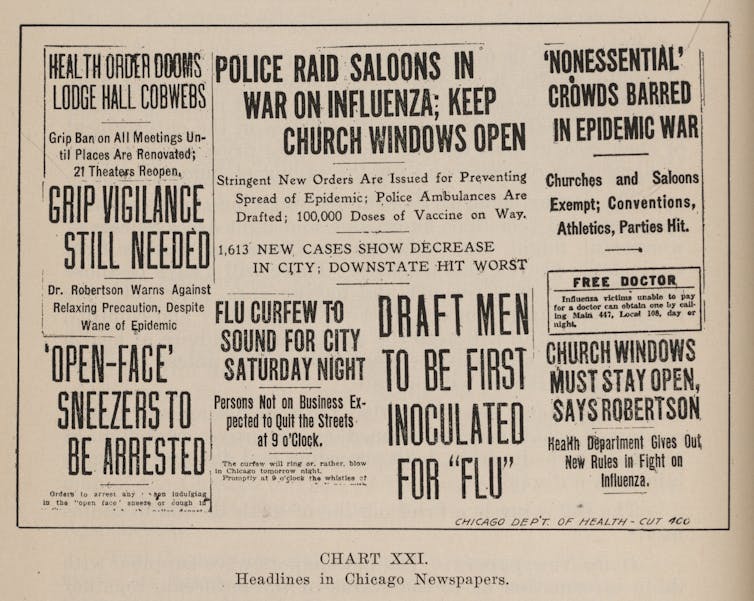
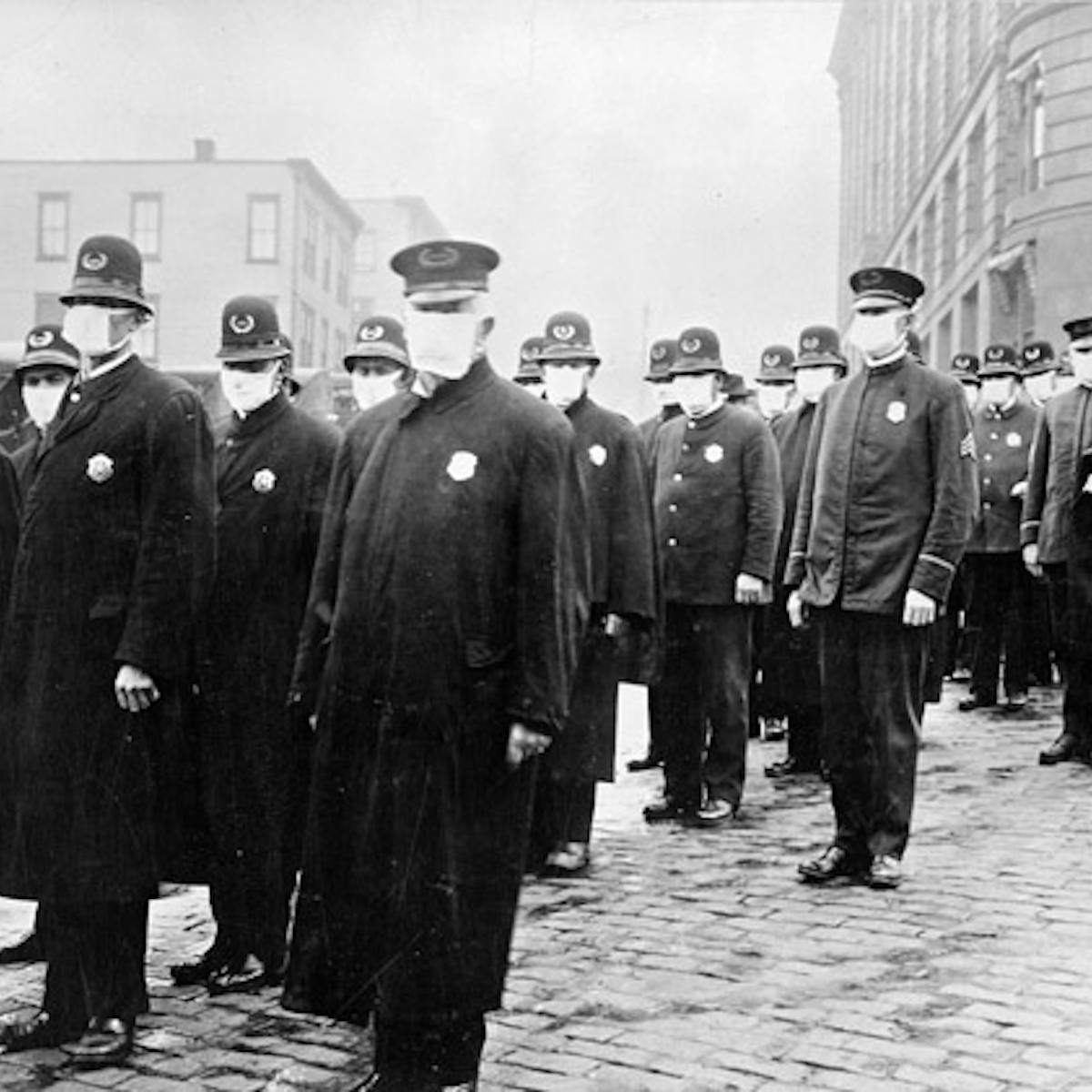
I’ve researched the history of the 1918 pandemic extensively. At that time, with no effective vaccine or drug therapies, communities across the country instituted a host of public health measures to slow the spread of a deadly influenza epidemic: They closed schools and businesses, banned public gatherings and isolated and quarantined those who were infected. Many communities recommended or required that citizens wear face masks in public – and this, not the onerous lockdowns, drew the most ire.

Mask resistance during a pandemic isn't new – in 1918 many ...

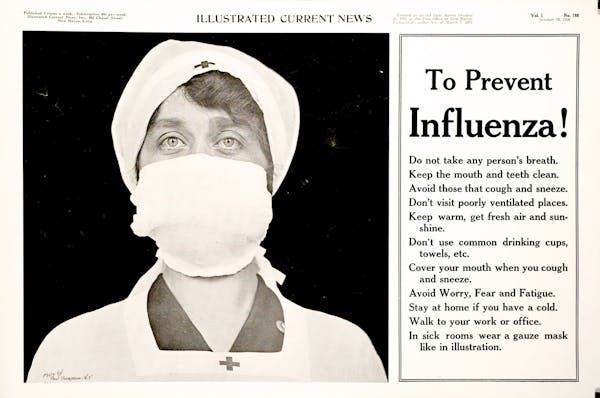
In mid-October of 1918, amidst a raging epidemic in the Northeast and rapidly growing outbreaks nationwide, the United States Public Health Service circulated leaflets recommending that all citizens wear a mask. The Red Cross took out newspaper ads encouraging their use and offered instructions on how to construct masks at home using gauze and cotton string. Some state health departments launched their own initiatives, most notably California, Utah and Washington.

Nationwide, posters presented mask-wearing as a civic duty – social responsibility had been embedded into the social fabric by a massive wartime federal propaganda campaign launched in early 1917 when the U.S. entered the Great War. San Francisco Mayor James Rolph announced that “conscience, patriotism and self-protection demand immediate and rigid compliance” with mask wearing. In nearby Oakland, Mayor John Davie stated that “it is sensible and patriotic, no matter what our personal beliefs may be, to safeguard our fellow citizens by joining in this practice” of wearing a mask.

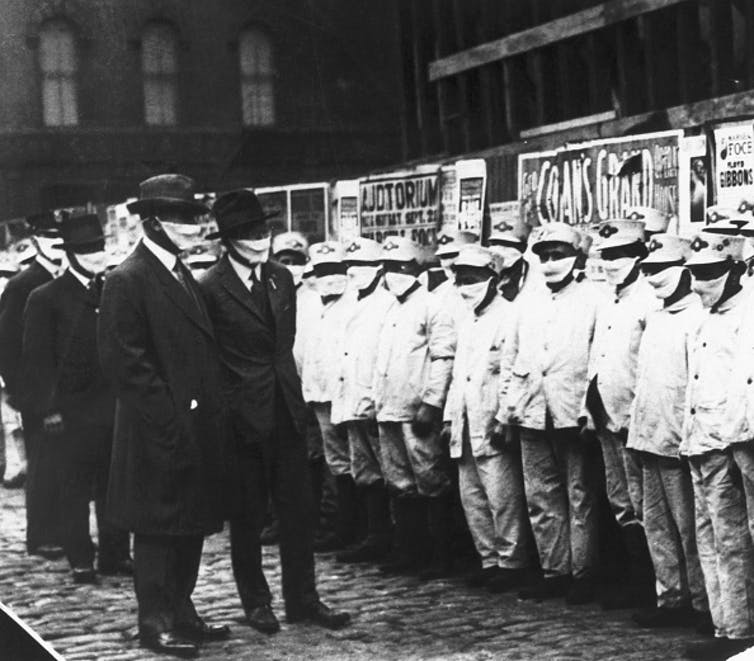
Health officials understood that radically changing public behavior was a difficult undertaking, especially since many found masks uncomfortable to wear. Appeals to patriotism could go only so far. As one Sacramento official noted, people “must be forced to do the things that are for their best interests.” The Red Cross bluntly stated that “the man or woman or child who will not wear a mask now is a dangerous slacker.” Numerous communities, particularly across the West, imposed mandatory ordinances. Some sentenced scofflaws to short jail terms, and fines ranged from US$5 to $200.

Mask resistance during a pandemic isn't new – in 1918 many ...

Passing these ordinances was frequently a contentious affair. For example, it took several attempts for Sacramento’s health officer to convince city officials to enact the order. In Los Angeles, it was scuttled. A draft resolution in Portland, Oregon led to heated city council debate, with one official declaring the measure “autocratic and unconstitutional,” adding that “under no circumstances will I be muzzled like a hydrophobic dog.” It was voted down.

Utah’s board of health considered issuing a mandatory statewide mask order but decided against it, arguing that citizens would take false security in the effectiveness of masks and relax their vigilance. As the epidemic resurged, Oakland tabled its debate over a second mask order after the mayor angrily recounted his arrest in Sacramento for not wearing a mask.prominent physician in attendance commented that “if a cave man should appear…he would think the masked citizens all lunatics.”

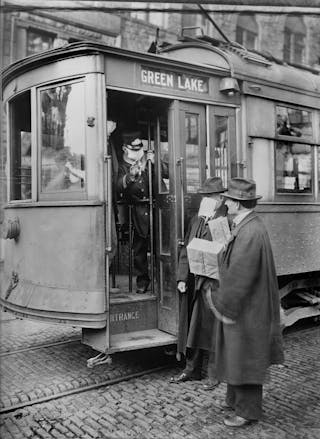
In places where mask orders were successfully implemented, noncompliance and outright defiance quickly became a problem. Many businesses, unwilling to turn away shoppers, wouldn’t bar unmasked customers from their stores. Workers complained that masks were too uncomfortable to wear all day. One Denver salesperson refused because she said her “nose went to sleep” every time she put one on. Another said she believed that “an authority higher than the Denver Department of Health was looking after her well-being.” As one local newspaper put it, the order to wear masks “was almost totally ignored by the people; in fact, the order was cause of mirth.” The rule was amended to apply only to streetcar conductors – who then threatened to strike. A walkout was averted when the city watered down the order yet again. Denver endured the remainder of the epidemic without any measures protecting public health.

Mask resistance during a pandemic isn't new – in 1918 many ...

In Seattle, streetcar conductors refused to turn away unmasked passengers. Noncompliance was so widespread in Oakland that officials deputized 300 War Service civilian volunteers to secure the names and addresses of violators so they could be charged. When a mask order went into effect in Sacramento, the police chief instructed officers to “Go out on the streets, and whenever you see a man without a mask, bring him in or send for the wagon.” Within 20 minutes, police stations were flooded with offenders. In San Francisco, there were so many arrests that the police chief warned city officials he was running out of jail cells. Judges and officers were forced to work late nights and weekends to clear the backlog of cases.

Many who were caught without masks thought they might get away with running an errand or commuting to work without being nabbed. In San Francisco, however, initial noncompliance turned to large-scale defiance when the city enacted a second mask ordinance in January 1919 as the epidemic spiked anew.

Many decried what they viewed as an unconstitutional infringement of their civil liberties. On January 25, 1919, approximately 2,000 members of the “Anti-Mask League” packed the city’s old Dreamland Rink for a rally denouncing the mask ordinance and proposing ways to defeat it. Attendees included several prominent physicians and a member of the San Francisco Board of Supervisors.

It is difficult to ascertain the effectiveness of the masks used in 1918. Today, we have a growing body of evidence that well-constructed cloth face coverings are an effective tool in slowing the spread of COVID-19. It remains to be seen, however, whether Americans will maintain the widespread use of face masks as our current pandemic continues to unfold.

Deeply entrenched ideals of individual freedom, the lack of cohesive messaging and leadership on mask wearing, and pervasive misinformation have proven to be major hindrances thus far, precisely when the crisis demands consensus and widespread compliance.

This was certainly the case in many communities during the fall of 1918. That pandemic ultimately killed about 675,000 people in the U.S. Hopefully, history is not in the process of repeating itself today.


Modeling the ominous impact of testing delays

https://mailchi.mp/da2dd0911f99/the-weekly-gist-july-17-2020?e=d1e747d2d8

Sponsors Delay Trials and Shift Toward Using Remote Procedures ...

With delays in getting test results growing in many areas of the country, a new analysis in the Lancet shows just how destructive increased turnaround times for COVID tests can be.

Researchers modeled the impact of the timeliness and completeness of contact tracing, finding that minimizing testing delay—shortening the time between symptom onset and a positive test result—had the greatest impact on reducing future spread of the disease.

Digging into the details, if infected individuals who develop symptoms are isolated within one day of symptom onset, the R0 (“R-naught”) can be reduced to 1—each existing infection seeds one new case—stabilizing the level of infection in a population. With contact tracing, the R0 can be reduced to 0.8, meaning the disease will decline.

And researchers found with a testing delay of three days or more, even the most efficient isolation and contact tracing is essentially futile, powerless to bend the curve of transmission rates.

Ominous findings for many states, where average test turnaround times are again approaching one week, showing just how far we are from being able to implement the basic public health strategy of “test, trace and isolate”, which has proven effective for so many countries around the world.


The surge in coronavirus hospitalizations is severe

https://www.axios.com/newsletters/axios-vitals-b0ebd340-d76f-49c3-8f02-cb2896ae2e8d.html?utm_source=newsletter&utm_medium=email&utm_campaign=newsletter_axiosvitals&stream=top

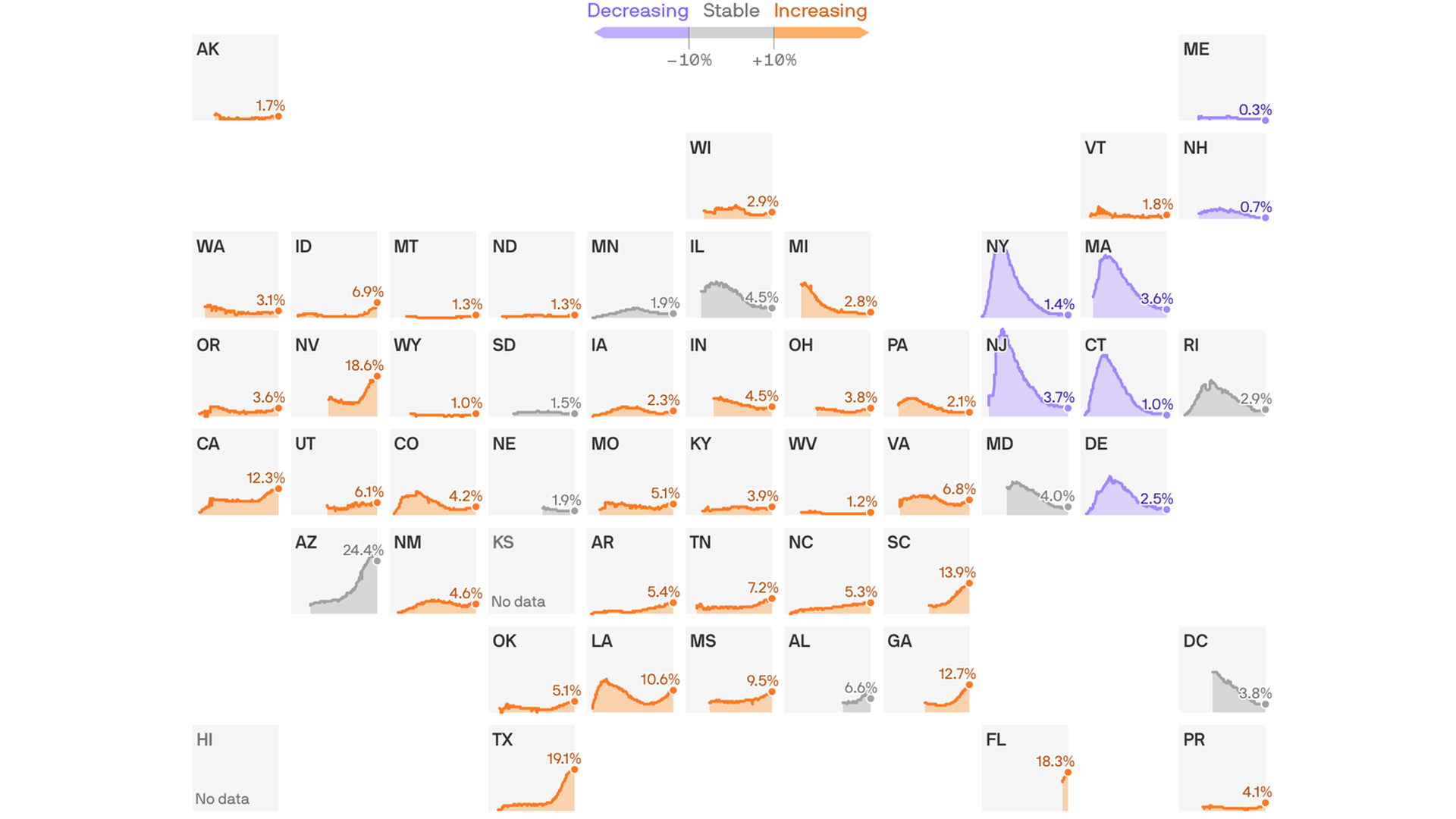
Share of hospital beds occupied
by COVID-19 hospitalizations

States shown from first date of reported data, from March 17 to July 19, 2020

  • In the last two weeks hospitalizations are:

The coronavirus surge is real, and it's everywhere - Axios


Coronavirus hospitalizations are skyrocketing, even beyond the high-profile hotspots of Arizona, Florida and Texas, Axios’ Bob Herman and Andrew Witherspoon report.

Why it matters: The U.S. made it through the spring without realizing one of experts’ worst fears — overwhelming hospitals’ capacity to treat infected people. But that fear is re-emerging as the virus spreads rapidly throughout almost every region of the country.

Where things stand: Arizona remains in the worst shape; 27.1% of all hospital beds in the state are occupied by COVID-19 patients as of July 15, according to an analysis combining data from the COVID Tracking Project and the Harvard Global Health Institute. Texas is second at 18.8%.

  • Nevada is the next worst, with COVID-19 patients taking up 18.7% of all hospital beds. That’s up significantly from 11.2% at the start of July.
  • Florida just started tallying current hospitalization data, showing more than 16% of all hospital beds occupied.

It gets worse: Many other states are showing significant upticks in coronavirus hospitalizations during the first half of July, including Alabama, California, Louisiana, Mississippi, South Carolina and Tennessee.

  • Many of these states, which reopened a lot of their economies in May, do not have mask mandates.

Between the lines: Intensive-care unit beds, reserved for the sickest patients, are completely full in parts of ArizonaFloridaMississippi and Texas.

  • Hospitals can convert other areas into ICUs, but that’s not all that useful if hospitals don’t have enough staff and supplies.

The bottom line: Cases have soared over the past 45 days, and hospitalizations naturally follow many of those cases.

  • Rising hospitalizations mean the outbreaks in many areas are not close to being controlled, and some percentage of those hospitalizations will end as deaths.


U.S. blows past coronavirus record with more than 70,000 new cases in one day

https://www.washingtonpost.com/nation/2020/07/17/coronavirus-live-updates-us/?utm_campaign=wp_post_most&utm_medium=email&utm_source=newsletter&wpisrc=nl_most

FirstFT: Today's top stories | Financial Times

There was a time in the United States when 40,000 coronavirus cases in a day seemed like an alarming milestone. That was less than three weeks ago.

Now, the number of new infections reported each day is reaching dizzying new heights. On Thursday, the daily U.S. caseload topped 70,000 for the first time, according to data tracked by The Washington Post.

Record numbers of covid-19 fatalities were reported in Florida, Texas and South Carolina on Thursday, and officials throughout the Sun Belt are worried that hospitals could soon reach a breaking point.

Here are some significant developments:

  • Masks are now mandatory in more than half of U.S. states — with the governors of Arkansas and Colorado the latest to issue face-covering orders. Major retailers phased in new mask policies, and Maryland Gov. Larry Hogan (R), chairman of the National Governors Association, said that masks should be mandated in states across the country.
  • Larry Fink, the chief executive of investment firm BlackRock, said that if states moving forward with reopening plans required masks, the economy would recover much sooner.
  • Atlanta Mayor Keisha Lance Bottoms (D) blasted Georgia’s Republican governor, Brian Kemp (R), for suing to stop block her city’s mask ordinance, accusing him of “putting politics over people.”
  • An unpublished report from the White House Coronavirus Task Force suggests that nearly 20 hard-hit states should enact tougher public health measures.
  • Real-time coronavirus tracking data temporarily disappeared from the Centers for Disease Control and Prevention’s website, sparking an outcry.
  • President Trump faces rising disapproval and widespread distrust on coronavirusaccording to a new Post-ABC poll.
  • India on Friday surpassed 1 million confirmed coronavirus cases, becoming the third country to cross that threshold, behind the United States and Brazil..


Florida And Texas Both Set Coronavirus Death Records Thursday

https://www.forbes.com/sites/nicholasreimann/2020/07/16/florida-and-texas-both-set-coronavirus-death-records-thursday/?utm_source=newsletter&utm_medium=email&utm_campaign=dailydozen&cdlcid=5d2c97df953109375e4d8b68#226e63bb720a

Florida coronavirus: State marks Covid-19 case record as July ...

TOPLINE

Coronavirus deaths are again on the rise in the U.S., with all three of the nation’s largest states setting new highs for daily death tolls Thursday following weeks of record increases in new cases and hospitalizations, even as President Donald Trump and other conservatives have touted death statistics as a sign the U.S. is handling the pandemic well.

KEY FACTS

California, Texas and Florida all reported new record daily highs for deaths Thursday.

California reported 149 deaths, while Florida reported 120 and Texas set a new record for the third-straight day, with 105.

Deaths are rising rapidly in Texas, with the 105 deaths breaking Wednesday’s record of 98, which shattered the record of 60 that was set on Tuesday.

Coronavirus deaths in the U.S. declined from early May through mid-June, but have picked up recently, and are now pacing at just under 1,000 per day.

The rise is being driven by record new death tolls in the nation’s largest states—the same states that have in large part contributed to the U.S.’s record rise in new cases recently.

Experts have said that deaths lag behind increases in cases and hospitalizations, with former FDA Commissioner Scott Gottlieb saying in an interview Sunday that “the total number of deaths is going to start going up again.”

KEY BACKGROUND

Coronavirus deaths reached a peak nationally in April through early May with over 2,000 a day on many days, largely driven by the severe outbreak in New York. Now the pandemic has eased in the Northeast while states in the South and West are the new national epicenters for coronavirus.

CHIEF CRITICS

Trump and Republican politicians had used the decline in deaths and a decrease in mortality rates to argue that the U.S. response to coronavirus has worked. However, there has also been a massive increase in testing, meaning that many less severe cases are now being identified.

BIG NUMBER

4.3%. According to Johns Hopkins University, that’s what the current mortality rate is among confirmed coronavirus cases in the U.S., a number that’s continually dropped as testing has increased. However, health experts like Dr. Anthony Fauci said early on in the pandemic that they believe the actual mortality rate is around 1%, which is still at least 10 times the lethality of the seasonal flu. And Gottlieb noted that even if the reported death rate continues to drop, if there is an increase in infections, the amount of deaths will ultimately rise, as well.

CRITICAL QUOTE

“It’s a false narrative to take comfort in a lower rate of death,” Fauci said on Tuesday, adding “There’s so many other things that are very dangerous and bad about this virus, don’t get yourself into false complacency.”


Administration’s war on the public health experts

https://www.axios.com/trump-public-health-experts-cdc-fauci-e1509d14-0cf1-4b1c-b107-7753bf95395d.html

Trump's war on the public health experts - Axios

A pandemic would normally be a time when public health expertise and data are in urgent demand — yet President Trump and his administration have been going all out to undermine them.

Why it matters: There’s a new example almost every day of this administration trying to marginalize the experts and data that most administrations lean on and defer to in the middle of a global crisis.

Here’s how it has been happening just in the past few weeks:

  • The administration has repeatedly undermined the Centers for Disease Control and Prevention. Most recently, Trump has criticized the CDC’s school reopening guidelines, Education Secretary Betsy DeVos declared that “kids need to be in school,” and the administration has reportedly ordered hospitals to bypass the CDC in reporting coronavirus patient information.
  • It has repeatedly undermined Anthony Fauci. Trump distanced himself on Wednesday from an op-ed attack by White House trade adviser Peter Navarro, but longtime Trump aide Dan Scavino also called the infectious diseases specialist “Dr. Faucet” in a Facebook post accusing him of leaking his disagreements. And the White House gave a opposition research-style list of the times Fauci “has been wrong” to the Washington Post and other media outlets.
  • Trump himself undermined public health experts generally with his retweet of former game show host Chuck Woolery’s “everyone is lying” tweet — which blamed “The CDC, Media, Democrats, our Doctors, not all but most, that we are told to trust.”
  • Trump has made numerous statements suggesting, over and over again, that we wouldn’t have as many COVID cases if we just tested less. (From his Tuesday press conference at the White House: “If we did half the testing we would have half the cases.”)

The impact: The result is that the CDC — which is supposed to be the go-to agency in a public health crisis — is distracted by constant public critiques from the highest levels. And Fauci, “America’s Doctor,” is the subject of yet another round of stories about whether Trump is freezing him out.

  • “The way to make Americans safer is to build on, not bypass, our public health system,” Tom Frieden, a former CDC director under Barack Obama, said in a statement to Axios about the efforts to sideline the agency.
  • “Unfortunately, as with mask-up recommendations and schools reopening guidance, the administration has chosen to sideline and undermine our nation’s premier disease fighting agency in the middle of the worst pandemic in 100 years,” Frieden said.
  • And Fauci, in an interview with The Atlantic, said of the efforts to discredit him: “Ultimately, it hurts the president to do that … It doesn’t do anything but reflect poorly on them.”

The other side: The White House insists there’s no problem. “President Trump has always acted on the science and valued the input of public health experts throughout this crisis,” said White House deputy press secretary Sarah Matthews.

  • Trump campaign communications director Tim Murtaugh closed ranks with the experts as well. “President Trump has said repeatedly that he has a strong relationship with Dr. Fauci, and Dr. Fauci has always said that the President listens to his advice,” he said.
  • And Department of Health and Human Services spokesman Michael Caputo declared that “the scientists and doctors speak openly, they are listened to closely, and their advice and counsel helps guide the response.”
  • “Frankly, when it comes to this tempest in a teapot over Dr. Fauci, I blame the media and their unending search for a ‘Resistance’ hero, for turning half a century of a brilliant scientist’s hard work into a clickbait headline that helps reporters undermine the president’s coronavirus response,” Caputo said.

Between the lines: Murtaugh deflected several times when asked whether there was a deliberate strategy to marginalize the CDC and the experts: “The President and the White House have consistently advised Americans to follow CDC guidelines. The President also believes we can open schools safely on time and that we must do so.”

  • However, one administration official said there were parts of the CDC school reopening guidelines that were impractical, and noted that kids can also suffer long-term harm by staying out of school too long.

Our thought bubble, by Axios White House reporter Alayna Treene: The responses make it clear that the White House and the Trump campaign don’t want to advance the narrative that they’re deliberately battling with America’s health experts, or that there’s any kind of strategy behind it.

The bottom line: When the history of this pandemic is written, it will show that the public health experts who were trying to fight it also had to deal with political fights that made their jobs harder.


Cartoon – False Narratives Today

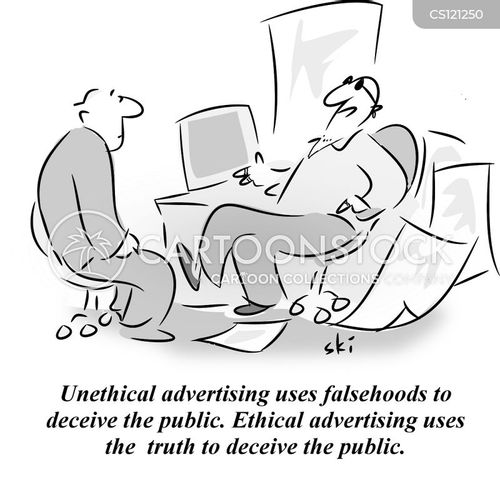
Cartoon – Unethical vs. Ethical Advertising | HENRY KOTULA

Cartoon – We’re way beyond Rational Thinking

Management Cartoon # 7684: We're way beyond rational thinking. You ...

The US saw a record number of new Covid-19 cases yesterday. These are the country’s virus hotspots.

https://www.cnn.com/world/live-news/coronavirus-pandemic-07-15-20-intl/index.html

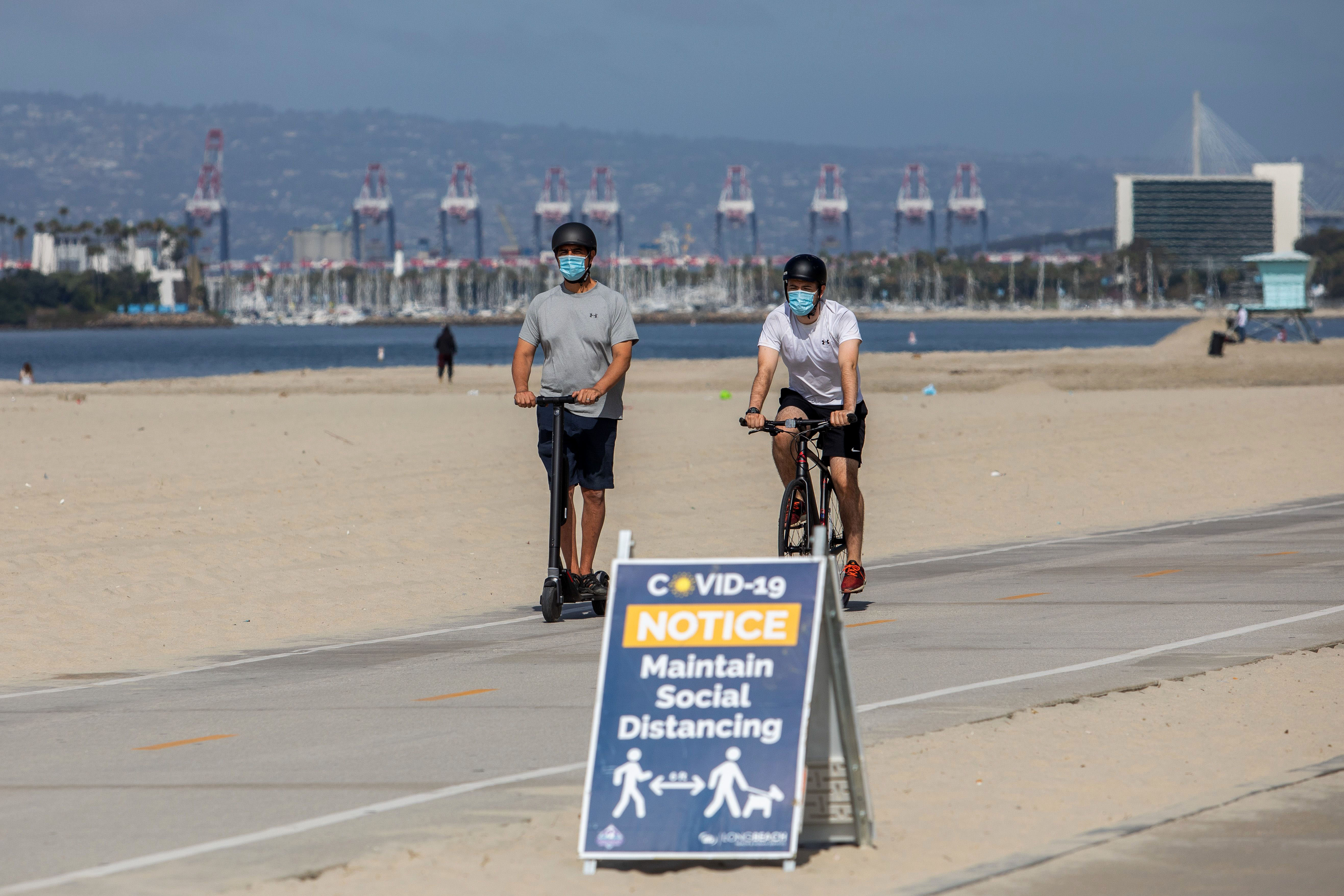
A sign about social distancing is seen on July 14 in Long Beach, California.

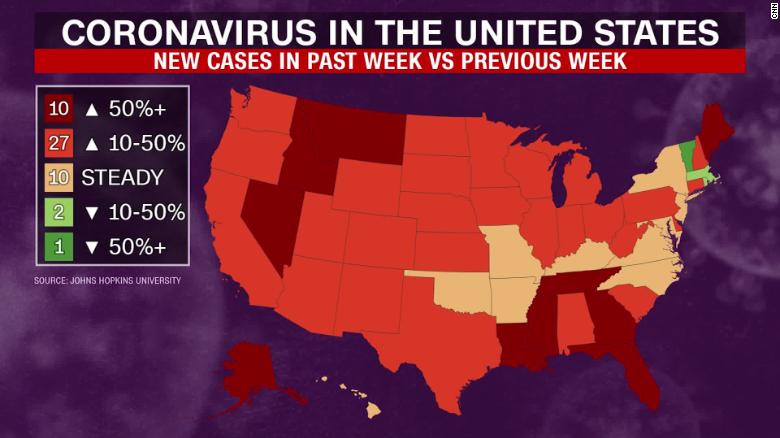
The United States saw a record number of new cases Tuesday with 67,417, according to data from Johns Hopkins University. As of Tuesday, more than 3.4 million people in the US have been infected, and 38 states are reporting an increase in the number of new cases from the week before.

With Covid-19 cases soaring in the US South and Southwest, the nation’s public health experts fear the end is not yet in sight and wonder what normal will look like as the pandemic stretches on through the rest of the year.

While New York and New Jersey were the early virus hotspots, California, Florida, Arizona and Texas now have become the states to watch, Dr. Anthony Fauci, the nation’s top infectious disease doctor, said Tuesday.

The states continue to report new records: 

  • California: Hospitalizations and ICU admissions for Covid-19 patients continue to rise in the state, setting a new record with a total of 6,745 hospitalizations and 1,886 ICU admissions, according to data from the California Department of Public Health.
  • Texas: The state reported at least 10,745 new Covid-19 cases on Tuesday, a record high daily number.
  • Florida: The Florida Department of Health reported at least 9,194 new cases and an additional 132 deaths Tuesday, the most deaths in one day in the state. Meanwhile, at least 54 hospitals have reached their ICU capacity.
  • Arizona: The state has led the nation — for over a month — with the highest 7-day average of new coronavirus cases per 100,000 people, according to a CNN analysis of data from Johns Hopkins University.

Meanwhile, at least 27 states have paused or rolled back plans to reopen their economies. Among them is Nevada, where 37 bars have filed a lawsuit to fight Gov. Steve Sisolak’s order to revert back to Phase 1 of the state’s reopening plan.

But Fauci cautioned that relaxed restrictions in California, Florida, Arizona and Texas are partly to blame for rising cases in those states, particularly among young people.

Addressing the climb in the number of cases overall and among young people, US Centers for Disease Control and Prevention Director Dr. Robert Redfield said Tuesday the nation is in a much better place than it was in the spring, because the mortality rate is lower, but said “we’re not out of the woods for this.”