The U.S. was beset by denial and dysfunction as the coronavirus raged

https://www.washingtonpost.com/national-security/2020/04/04/coronavirus-government-dysfunction/?arc404=true

America Wasn't a Democracy, Until Black Americans Made It One ...

From the Oval Office to the CDC, political and institutional failures cascaded through the system and opportunities to mitigate the pandemic were lost.

By the time Donald Trump proclaimed himself a wartime president — and the coronavirus the enemy — the United States was already on course to see more of its people die than in the wars of Korea, Vietnam, Afghanistan and Iraq combined.

The country has adopted an array of wartime measures never employed collectively in U.S. history — banning incoming travelers from two continents, bringing commerce to a near-halt, enlisting industry to make emergency medical gear, and confining 230 million Americans to their homes in a desperate bid to survive an attack by an unseen adversary.

Despite these and other extreme steps, the United States will likely go down as the country that was supposedly best prepared to fight a pandemic but ended up catastrophically overmatched by the novel coronavirus, sustaining heavier casualties than any other nation.

It did not have to happen this way. Though not perfectly prepared, the United States had more expertise, resources, plans and epidemiological experience than dozens of countries that ultimately fared far better in fending off the virus.

The failure has echoes of the period leading up to 9/11: Warnings were sounded, including at the highest levels of government, but the president was deaf to them until the enemy had already struck.

The Trump administration received its first formal notification of the outbreak of the coronavirus in China on Jan. 3. Within days, U.S. spy agencies were signaling the seriousness of the threat to Trump by including a warning about the coronavirus — the first of many — in the President’s Daily Brief.

And yet, it took 70 days from that initial notification for Trump to treat the coronavirus not as a distant threat or harmless flu strain well under control, but as a lethal force that had outflanked America’s defenses and was poised to kill tens of thousands of citizens. That more-than-two-month stretch now stands as critical time that was squandered.

Trump’s baseless assertions in those weeks, including his claim that it would all just “miraculously” go away, sowed significant public confusion and contradicted the urgent messages of public health experts.

“While the media would rather speculate about outrageous claims of palace intrigue, President Trump and this Administration remain completely focused on the health and safety of the American people with around the clock work to slow the spread of the virus, expand testing, and expedite vaccine development,” said Judd Deere, a spokesman for the president. “Because of the President’s leadership we will emerge from this challenge healthy, stronger, and with a prosperous and growing economy.”

The president’s behavior and combative statements were merely a visible layer on top of deeper levels of dysfunction.

The most consequential failure involved a breakdown in efforts to develop a diagnostic test that could be mass produced and distributed across the United States, enabling agencies to map early outbreaks of the disease, and impose quarantine measure to contain them. At one point, a Food and Drug Administration official tore into lab officials at the Centers for Disease Control and Prevention, telling them their lapses in protocol, including concerns that the lab did not meet the criteria for sterile conditions, were so serious that the FDA would “shut you down” if the CDC were a commercial, rather than government, entity.

Other failures cascaded through the system. The administration often seemed weeks behind the curve in reacting to the viral spread, closing doors that were already contaminated. Protracted arguments between the White House and public health agencies over funding, combined with a meager existing stockpile of emergency supplies, left vast stretches of the country’s health-care system without protective gear until the outbreak had become a pandemic. Infighting, turf wars and abrupt leadership changes hobbled the work of the coronavirus task force.

It may never be known how many thousands of deaths, or millions of infections, might have been prevented with a response that was more coherent, urgent and effective. But even now, there are many indications that the administration’s handling of the crisis had potentially devastating consequences.

Even the president’s base has begun to confront this reality. In mid-March, as Trump was rebranding himself a wartime president and belatedly urging the public to help slow the spread of the virus, Republican leaders were poring over grim polling data that suggested Trump was lulling his followers into a false sense of security in the face of a lethal threat.

The poll showed that far more Republicans than Democrats were being influenced by Trump’s dismissive depictions of the virus and the comparably scornful coverage on Fox News and other conservative networks. As a result, Republicans were in distressingly large numbers refusing to change travel plans, follow “social distancing” guidelines, stock up on supplies or otherwise take the coronavirus threat seriously.

“Denial is not likely to be a successful strategy for survival,” GOP pollster Neil Newhouse concluded in a document that was shared with GOP leaders on Capitol Hill and discussed widely at the White House. Trump’s most ardent supporters, it said, were “putting themselves and their loved ones in danger.”

Trump’s message was changing as the report swept through the GOP’s senior ranks. In recent days, Trump has bristled at reminders that he had once claimed the caseload would soon be “down to zero.”

More than 7,000 people have died of the coronavirus in the United States so far, with about 240,000 cases reported. But Trump has acknowledged that new models suggest that the eventual national death toll could be between 100,000 and 240,000.

Beyond the suffering in store for thousands of victims and their families, the outcome has altered the international standing of the United States, damaging and diminishing its reputation as a global leader in times of extraordinary adversity.

“This has been a real blow to the sense that America was competent,” said Gregory F. Treverton, a former chairman of the National Intelligence Council, the government’s senior-most provider of intelligence analysis. He stepped down from the NIC in January 2017 and now teaches at the University of Southern California. “That was part of our global role. Traditional friends and allies looked to us because they thought we could be competently called upon to work with them in a crisis. This has been the opposite of that.”

This article, which retraces the failures over the first 70 days of the coronavirus crisis, is based on 47 interviews with administration officials, public health experts, intelligence officers and others involved in fighting the pandemic. Many spoke on the condition of anonymity to discuss sensitive information and decisions.

Scanning the horizon

Public health authorities are part of a special breed of public servant — along with counterterrorism officials, military planners, aviation authorities and others — whose careers are consumed with contemplating worst-case scenarios.

The arsenal they wield against viral invaders is powerful, capable of smothering a new pathogen while scrambling for a cure, but easily overwhelmed if not mobilized in time. As a result, officials at the Department of Health and Human Services, the CDC and other agencies spend their days scanning the horizon for emerging dangers.

The CDC learned of a cluster of cases in China on Dec. 31 and began developing reports for HHS on Jan. 1. But the most unambiguous warning that U.S. officials received about the coronavirus came Jan. 3, when Robert Redfield, the CDC director, received a call from a counterpart in China. The official told Redfield that a mysterious respiratory illness was spreading in Wuhan, a congested commercial city of 11 million people in the communist country’s interior.

Redfield quickly relayed the disturbing news to Alex Azar, the secretary of HHS, the agency that oversees the CDC and other public health entities. Azar, in turn, ensured that the White House was notified, instructing his chief of staff to share the Chinese report with the National Security Council.

From that moment, the administration and the virus were locked in a race against a ticking clock, a competition for the upper hand between pathogen and prevention that would dictate the scale of the outbreak when it reached American shores, and determine how many would get sick or die.

The initial response was promising, but officials also immediately encountered obstacles.

On Jan. 6, Redfield sent a letter to the Chinese offering to send help, including a team of CDC scientists. China rebuffed the offer for weeks, turning away assistance and depriving U.S. authorities of an early chance to get a sample of the virus, critical for developing diagnostic tests and any potential vaccine.

China impeded the U.S. response in other ways, including by withholding accurate information about the outbreak. Beijing had a long track record of downplaying illnesses that emerged within its borders, an impulse that U.S. officials attribute to a desire by the country’s leaders to avoid embarrassment and accountability with China’s 1.3 billion people and other countries that find themselves in the pathogen’s path.

China stuck to this costly script in the case of the coronavirus, reporting Jan. 14 that it had seen “no clear evidence of human-to-human transmission.” U.S. officials treated the claim with skepticism that intensified when the first case surfaced outside China with a reported infection in Thailand.

A week earlier, senior officials at HHS had begun convening an intra-agency task force including Redfield, Azar and Anthony S. Fauci, director of the National Institute of Allergy and Infectious Diseases. The following week, there were also scattered meetings at the White House with officials from the National Security Council and State Department, focused mainly on when and whether to bring back government employees in China.

U.S. officials began taking preliminary steps to counter a potential outbreak. By mid-January, Robert Kadlec, an Air Force officer and physician who serves as assistant secretary for preparedness and response at HHS, had instructed subordinates to draw up contingency plans for enforcing the Defense Production Act, a measure that enables the government to compel private companies to produce equipment or devices critical to the country’s security. Aides were bitterly divided over whether to implement the act, and nothing happened for many weeks.

On Jan. 14, Kadlec scribbled a single word in a notebook he carries: “Coronavirus!!!”

Despite the flurry of activity at lower levels of his administration, Trump was not substantially briefed by health officials about the coronavirus until Jan.18, when, while spending the weekend at Mar-a-Lago, he took a call from Azar.

Even before the heath secretary could get a word in about the virus, Trump cut him off and began criticizing Azar for his handling of an aborted federal ban on vaping products, a matter that vexed the president.

At the time, Trump was in the throes of an impeachment battle over his alleged attempt to coerce political favors from the leader of Ukraine. Acquittal seemed certain by the GOP-controlled Senate, but Trump was preoccupied with the trial, calling lawmakers late at night to rant, and making lists of perceived enemies he would seek to punish when the case against him concluded.

In hindsight, officials said, Azar could have been more forceful in urging Trump to turn at least some of his attention to a threat that would soon pose an even graver test to his presidency, a crisis that would cost American lives and consume the final year of Trump’s first term.

But the secretary, who had a strained relationship with Trump and many others in the administration, assured the president that those responsible were working on and monitoring the issue. Azar told several associates that the president believed he was “alarmist” and Azar struggled to get Trump’s attention to focus on the issue, even asking one confidant for advice.

Within days, there were new causes for alarm.

On Jan. 21, a Seattle man who had recently traveled to Wuhan tested positive for the coronavirus, becoming the first known infection on U.S. soil. Then, two days later, Chinese authorities took the drastic step of shutting down Wuhan, turning the teeming metropolis into a ghost city of empty highways and shuttered skyscrapers, with millions of people marooned in their homes.

“That was like, whoa,” said a senior U.S. official involved in White House meetings on the crisis. “That was when the Richter scale hit 8.”

It was also when U.S. officials began to confront the failings of their own efforts to respond.

Azar, who had served in senior positions at HHS through crises including the 9/11 terrorist attacks and the outbreak of bird flu in 2005, was intimately familiar with the playbook for crisis management.

He instructed subordinates to move rapidly to establish a nationwide surveillance system to track the spread of the coronavirus — a stepped-up version of what the CDC does every year to monitor new strains of the ordinary flu.

But doing so would require assets that would elude U.S. officials for months — a diagnostic test that could accurately identify those infected with the new virus and be produced on a mass scale for rapid deployment across the United States, and money to implement the system.

Azar’s team also hit another obstacle. The Chinese were still refusing to share the viral samples they had collected and were using to develop their own tests. In frustration, U.S. officials looked for other possible routes.

A biocontainment lab at the University of Texas medical branch in Galveston had a research partnership with the Wuhan Institute of Virology.

Kadlec, who knew the Galveston lab director, hoped scientists could arrange a transaction on their own without government interference. At first, the lab in Wuhan agreed, but officials in Beijing intervened Jan. 24 and blocked any lab-to-lab transfer.

There is no indication that officials sought to escalate the matter or enlist Trump to intervene. In fact, Trump has consistently praised Chinese President Xi Jinping despite warnings from U.S. intelligence and health officials that Beijing was concealing the true scale of the outbreak and impeding cooperation on key fronts.

The CDC had issued its first public alert about the coronavirus Jan. 8, and by the 17th was monitoring major airports in Los Angeles, San Francisco and New York, where large numbers of passengers arrived each day from China.

In other ways, though, the situation was already spinning out of control, with multiplying cases in Seattle, intransigence by the Chinese, mounting questions from the public, and nothing in place to stop infected travelers from arriving from abroad.

Trump was out of the country for this critical stretch, taking part in the annual global economic forum in Davos, Switzerland. He was accompanied by a contingent of top officials including national security adviser Robert O’Brien, who took an anxious trans-Atlantic call from Azar.

Azar told O’Brien that it was “mayhem” at the White House, with HHS officials being pressed to provide nearly identical briefings to three audiences on the same day.

Azar urged O’Brien to have the NSC assert control over a matter with potential implications for air travel, immigration authorities, the State Department and the Pentagon. O’Brien seemed to grasp the urgency, and put his deputy, Matthew Pottinger, who had worked in China as a journalist for the Wall Street Journal, in charge of coordinating the still-nascent U.S. response.

But the rising anxiety within the administration appeared not to register with the president. On Jan. 22, Trump received his first question about the coronavirus in an interview on CNBC while in Davos. Asked whether he was worried about a potential pandemic, Trump said, “No. Not at all. And we have it totally under control. It’s one person coming in from China. . . . It’s going to be just fine.”

Spreading uncontrollably

The move by the NSC to seize control of the response marked an opportunity to reorient U.S. strategy around containing the virus where possible and procuring resources that hospitals would need in any U.S. outbreak, including such basic equipment as protective masks and ventilators.

But instead of mobilizing for what was coming, U.S. officials seemed more preoccupied with logistical problems, including how to evacuate Americans from China.

In Washington, then-acting chief of staff Mick Mulvaney and Pottinger began convening meetings at the White House with senior officials from HHS, the CDC and the State Department.

The group, which included Azar, Pottinger and Fauci, as well as nine others across the administration, formed the core of what would become the administration’s coronavirus task force. But it primarily focused on efforts to keep infected people in China from traveling to the United States even while evacuating thousands of U.S. citizens. The meetings did not seriously focus on testing or supplies, which have since become the administration’s most challenging problems.

The task force was formally announced on Jan. 29.

“The genesis of this group was around border control and repatriation,” said a senior official involved in the meetings. “It wasn’t a comprehensive, whole-of-government group to run everything.”

The State Department agenda dominated those early discussions, according to participants. Officials began making plans to charter aircraft to evacuate 6,000 Americans stranded in Wuhan. They also debated language for travel advisories that State could issue to discourage other travel in and out of China.

On Jan. 29, Mulvaney chaired a meeting in the White House Situation Room in which officials debated moving travel restrictions to “Level 4,” meaning a “do not travel” advisory from the State Department. Then, the next day, China took the draconian step of locking down the entire Hubei province, which encompasses Wuhan.

That move by Beijing finally prompted a commensurate action by the Trump administration. On Jan. 31, Azar announced restrictions barring any non-U.S. citizen who had been in China during the preceding two weeks from entering the United States.

Trump has, with some justification, pointed to the China-related restriction as evidence that he had responded aggressively and early to the outbreak. It was among the few intervention options throughout the crisis that played to the instincts of the president, who often seems fixated on erecting borders and keeping foreigners out of the country.

But by that point, 300,000 people had come into the United States from China over the previous month. There were only 7,818 confirmed cases around the world at the end of January, according to figures released by the World Health Organization — but it is now clear that the virus was spreading uncontrollably.

Pottinger was by then pushing for another travel ban, this time restricting the flow of travelers from Italy and other nations in the European Union that were rapidly emerging as major new nodes of the outbreak. Pottinger’s proposal was endorsed by key health-care officials, including Fauci, who argued that it was critical to close off any path the virus might take into the country.

This time, the plan met with resistance from Treasury Secretary Steven Mnuchin and others who worried about the impact on the U.S. economy. It was an early sign of tension in an area that would split the administration, pitting those who prioritized public health against those determined to avoid any disruption in an election year to the run of expansion and employment growth.

Those backing the economy prevailed with the president. And it was more than a month before the administration issued a belated and confusing ban on flights into the United States from Europe. Hundreds of thousands of people crossed the Atlantic during that interval.

A wall of resistance

While fights over air travel played out in the White House, public health officials began to panic over a startling shortage of critical medical equipment including protective masks for doctors and nurses, as well as a rapidly shrinking pool of money needed to pay for such things.

By early February, the administration was quickly draining a $105 million congressional fund to respond to infectious disease outbreaks. The coronavirus threat to the United States still seemed distant if not entirely hypothetical to much of the public. But to health officials charged with stockpiling supplies for worst-case-scenarios, disaster appeared increasingly inevitable.

A national stockpile of N95 protective masks, gowns, gloves and other supplies was already woefully inadequate after years of underfunding. The prospects for replenishing that store were suddenly threatened by the unfolding crisis in China, which disrupted offshore supply chains.

Much of the manufacturing of such equipment had long since migrated to China, where factories were now shuttered because workers were on order to stay in their households. At the same time, China was buying up masks and other gear to gird for its own coronavirus outbreak, driving up costs and monopolizing supplies.

In late January and early February, leaders at HHS sent two letters to the White House Office of Management and Budget asking to use its transfer authority to shift $136 million of department funds into pools that could be tapped for combating the coronavirus. Azar and his aides also began raising the need for a multibillion-dollar supplemental budget request to send to Congress.

Yet White House budget hawks argued that appropriating too much money at once when there were only a few U.S. cases would be viewed as alarmist.

Joe Grogan, head of the Domestic Policy Council, clashed with health officials over preparedness. He mistrusted how the money would be used and questioned how health officials had used previous preparedness funds.

Azar then spoke to Russell Vought, the acting director of the White House Office of Management and Budget, during Trump’s State of the Union speech on Feb. 4. Vought seemed amenable, and told Azar to submit a proposal.

Azar did so the next day, drafting a supplemental request for more than $4 billion, a sum that OMB officials and others at the White House greeted as an outrage. Azar arrived at the White House that day for a tense meeting in the Situation Room that erupted in a shouting match, according to three people familiar with the incident.

A deputy in the budget office accused Azar of preemptively lobbying Congress for a gigantic sum that White House officials had no interest in granting. Azar bristled at the criticism and defended the need for an emergency infusion. But his standing with White House officials, already shaky before the coronavirus crisis began, was damaged further.

White House officials relented to a degree weeks later as the feared coronavirus surge in the United States began to materialize. The OMB team whittled Azar’s demands down to $2.5 billion, money that would be available only in the current fiscal year. Congress ignored that figure, approving an $8 billion supplemental bill that Trump signed into law March 7.

But again, delays proved costly. The disputes meant that the United States missed a narrow window to stockpile ventilators, masks and other protective gear before the administration was bidding against many other desperate nations, and state officials fed up with federal failures began scouring for supplies themselves.

In late March, the administration ordered 10,000 ventilators — far short of what public health officials and governors said was needed. And many will not arrive until the summer or fall, when models expect the pandemic to be receding.

“It’s actually kind of a joke,” said one administration official involved in deliberations about the belated purchase.

Inconclusive tests

Although viruses travel unseen, public health officials have developed elaborate ways of mapping and tracking their movements. Stemming an outbreak or slowing a pandemic in many ways comes down to the ability to quickly divide the population into those who are infected and those who are not.

Doing so, however, hinges on having an accurate test to diagnose patients and deploy it rapidly to labs across the country. The time it took to accomplish that in the United States may have been more costly to American efforts than any other failing.

“If you had the testing, you could say, ‘Oh my god, there’s circulating virus in Seattle, let’s jump on it. There’s circulating virus in Chicago, let’s jump on it,’ ” said a senior administration official involved in battling the outbreak. “We didn’t have that visibility.”

The first setback came when China refused to share samples of the virus, depriving U.S. researchers of supplies to bombard with drugs and therapies in a search for ways to defeat it. But even when samples had been procured, the U.S. effort was hampered by systemic problems and institutional hubris.

Among the costliest errors was a misplaced assessment by top health officials that the outbreak would probably be limited in scale inside the United States — as had been the case with every other infection for decades — and that the CDC could be trusted on its own to develop a coronavirus diagnostic test.

The CDC, launched in the 1940s to contain an outbreak of malaria in the southern United States, had taken the lead on the development of diagnostic tests in major outbreaks including Ebola, zika and H1N1. But the CDC was not built to mass-produce tests.

The CDC’s success had fostered an institutional arrogance, a sense that even in the face of a potential crisis there was no pressing need to involve private labs, academic institutions, hospitals and global health organizations also capable of developing tests.

Yet some were concerned that the CDC test would not be enough. Stephen Hahn, the FDA commissioner, sought authority in early February to begin calling private diagnostic and pharmaceutical companies to enlist their help.

But when senior FDA officials consulted leaders at HHS, Hahn, who had led the agency for about two months, was told to stand down. There were concerns about him personally contacting companies regulated by his agency.

At that point, Azar, the HHS secretary, seemed committed to a plan he was pursuing that would keep his agency at the center of the response effort: securing a test from the CDC and then building a national coronavirus surveillance system by relying on an existing network of labs used to track the ordinary flu.

In task force meetings, Azar and Redfield pushed for $100 million to fund the plan, but were shot down because of the cost, according to a document outlining the testing strategy obtained by The Washington Post.

Relying so heavily on the CDC would have been problematic even if it had succeeded in quickly developing an effective test that could be distributed across the country. The scale of the epidemic, and the need for mass testing far beyond the capabilities of the flu network, would have overwhelmed Azar’s plan, which didn’t envision engaging commercial lab companies for up to six months.

The effort collapsed when the CDC failed its basic assignment to create a working test and the task force rejected Azar’s plan.

On Feb. 6, when the World Health Organization reported that it was shipping 250,000 test kits to labs around the world, the CDC began distributing 90 kits to a smattering of state-run health labs.

Almost immediately, the state facilities encountered problems. The results were inconclusive in trial runs at more than half the labs, meaning they couldn’t be relied upon to diagnose actual patients. The CDC issued a stopgap measure, instructing labs to send tests to its headquarters in Atlanta, a practice that would delay results for days.

The scarcity of effective tests led officials to impose constraints on when and how to use them, and delayed surveillance testing. Initial guidelines were so restrictive that states were discouraged from testing patients exhibiting symptoms unless they had traveled to China and come into contact with a confirmed case, when the pathogen had by that point almost certainly spread more broadly into the general population.

The limits left top officials largely blind to the true dimensions of the outbreak.

In a meeting in the Situation Room in mid-February, Fauci and Redfield told White House officials that there was no evidence yet of worrisome person-to-person transmission in the United States. In hindsight, it appears almost certain that the virus was taking hold in communities at that point. But even the country’s top experts had little meaningful data about the domestic dimensions of the threat. Fauci later conceded that as they learned more their views changed.

At the same time, the president’s subordinates were growing increasingly alarmed, Trump continued to exhibit little concern. On Feb. 10, he held a political rally in New Hampshire attended by thousands where he declared that “by April, you know, in theory, when it gets a little warmer, it miraculously goes away.”

The New Hampshire rally was one of eight that Trump held after he had been told by Azar about the coronavirus, a period when he also went to his golf courses six times.

A day earlier, on Feb. 9, a group of governors in town for a black-tie gala at the White House secured a private meeting with Fauci and Redfield. The briefing rattled many of the governors, bearing little resemblance to the words of the president. “The doctors and the scientists, they were telling us then exactly what they are saying now,” Maryland Gov. Larry Hogan (R) said.

That month, federal medical and public health officials were emailing increasingly dire forecasts among themselves, with one Veterans Affairs medical adviser warning, ‘We are flying blind,’” according to emails obtained by the watchdog group American Oversight.

Later in February, U.S. officials discovered indications that the CDC laboratory was failing to meet basic quality-control standards. On a Feb. 27 conference call with a range of health officials, a senior FDA official lashed out at the CDC for its repeated lapses.

Jeffrey Shuren, the FDA’s director for devices and radiological health, told the CDC that if it were subjected to the same scrutiny as a privately run lab, “I would shut you down.”

On Feb. 29, a Washington state man became the first American to die of a coronavirus infection. That same day, the FDA released guidance, signaling that private labs were free to proceed in developing their own diagnostics.

Another four-week stretch had been squandered.

Life and death

One week later, on March 6, Trump toured the facilities at the CDC wearing a red “Keep America Great” hat. He boasted that the CDC tests were nearly perfect and that “anybody who wants a test will get a test,” a promise that nearly a month later remains unmet.

He also professed to have a keen medical mind. “I like this stuff. I really get it,” he said. “People here are surprised that I understand it. Every one of these doctors said, ‘How do you know so much about this?’ ”

In reality, many of the failures to stem the coronavirus outbreak in the United States were either a result of, or exacerbated by, his leadership.

For weeks, he had barely uttered a word about the crisis that didn’t downplay its severity or propagate demonstrably false information. He dismissed the warnings of intelligence officials and top public health officials in his administration.

At times, he voiced far more authentic concern about the trajectory of the stock market than the spread of the virus in the United States, railing at the chairman of the Federal Reserve and others with an intensity that he never seemed to exhibit about the possible human toll of the outbreak.

In March, as state after state imposed sweeping new restrictions on their citizens’ daily lives to protect them — triggering severe shudders in the economy — Trump second-guessed the lockdowns.

The common flu kills tens of thousands each year and “nothing is shut down, life & the economy go on,” he tweeted March 9. A day later, he pledged that the virus would “go away. Just stay calm.”

Two days later, Trump finally ordered the halt to incoming travel from Europe that his deputy national security adviser had been advocating for weeks. But Trump botched the Oval Office announcement so badly that White House officials spent days trying to correct erroneous statements that triggered a stampede by U.S. citizens overseas to get home.

“There was some coming to grips with the problem and the true nature of it — the 13th of March is when I saw him really turn the corner. It took a while to realize you’re at war,” Sen. Lindsey O. Graham (R-S.C.) said. “That’s when he took decisive action that set in motion some real payoffs.”

Trump spent many weeks shuffling responsibility for leading his administration’s response to the crisis, putting Azar in charge of the task force at first, relying on Pottinger, the deputy national security adviser, for brief periods, before finally putting Vice President Pence in the role toward the end of February.

Other officials have emerged during the crisis to help right the United States’ course, and at times, the statements of the president. But even as Fauci, Azar and others sought to assert themselves, Trump was behind the scenes turning to others with no credentials, experience or discernible insight in navigating a pandemic.

Foremost among them was his adviser and son-in-law, Jared Kushner. A team reporting to Kushner commandeered space on the seventh floor of the HHS building to pursue a series of inchoate initiatives.

One plan involved having Google create a website to direct those with symptoms to testing facilities that were supposed to spring up in Walmart parking lots across the country, but which never materialized. Another centered an idea advanced by Oracle chairman Larry Ellison to use software to monitor the unproven use of anti-malaria drugs against the coronavirus pathogen.

So far, the plans have failed to come close to delivering on the promises made when they were touted in White House news conferences. The Kushner initiatives have, however, often interrupted the work of those under immense pressure to manage the U.S. response.

Current and former officials said that Kadlec, Fauci, Redfield and others have repeatedly had to divert their attentions from core operations to contend with ill-conceived requests from the White House they don’t believe they can ignore. And Azar, who once ran the response, has since been sidelined, with his agency disempowered in decision-making and his performance pilloried by a range of White House officials, including Kushner.

“Right now Fauci is trying to roll out the most ambitious clinical trial ever implemented” to hasten the development of a vaccine, said a former senior administration official in frequent touch with former colleagues. And yet, the nation’s top health officials “are getting calls from the White House or Jared’s team asking, ‘Wouldn’t it be nice to do this with Oracle?’ ”

If the coronavirus has exposed the country’s misplaced confidence in its ability to handle a crisis, it also has cast harsh light on the limits of Trump’s approach to the presidency — his disdain for facts, science and experience.

He has survived other challenges to his presidency — including the Russia investigation and impeachment — by fiercely contesting the facts arrayed against him and trying to control the public’s understanding of events with streams of falsehoods.

The coronavirus may be the first crisis Trump has faced in office where the facts — the thousands of mounting deaths and infections — are so devastatingly evident that they defy these tactics.

After months of dismissing the severity of the coronavirus, resisting calls for austere measures to contain it, and recasting himself as a wartime president, Trump seemed finally to succumb to the coronavirus reality. In a meeting with a Republican ally in the Oval Office last month, the president said his campaign no longer mattered because his reelection would hinge on his coronavirus response.

“It’s absolutely critical for the American people to follow the guidelines for the next 30 days,” he said at his March 31 news conference. “It’s a matter of life and death.”


As coronavirus spreads, so do reports of companies mistreating workers

https://www.washingtonpost.com/business/2020/03/31/worker-retaliation-mistreatment-coronavirus/?fbclid=IwAR1uQPecWtRM3G__toecrlhfYhszBQkDoYFkxsUrMYY_UZtKaTHpq3cblH4&utm_campaign=wp_main&utm_medium=social&utm_source=facebook

Workers complain of mistreatment as they try to cope with the ...

From nurses to retail salespeople, workers are walking off the job and facing retribution for speaking out.

She could wear her protective mask while seeing her patients. Many were, after all, elderly, with respiratory problems, susceptible to getting severely sick from the novel coronavirus. And so Laura Moreno, a nurse in Oklahoma City, wanted to protect them — as well as herself and her 12-year-old daughter, who has asthma and a thyroid condition.

She could not, however, wear her mask in the hallways, or the cafeteria or any of the hospital’s common areas, because her supervisors told her it would scare patients. “I was told if I wanted to wear a mask, I would not be working there,” she said. “So I said I’m not willing to put my life at risk, and my contract was terminated.”

Since the viral pandemic started ravaging the country in recent weeks, workers, unions and attorneys are seeing a dramatic rise in cases they say illustrate a wave of bad employer behavior, forcing workers into conditions they fear are unsafe, withholding protective equipment, and retaliating against those who speak up or walk out.

Moreno’s case was one of many that her attorney, Rachel Bussett, and her colleagues at the National Employment Lawyers Association have been inundated with as workers grow increasingly fearful of retribution from, as Bussett said, “employers who value the economy over people.”

A handful of workers at a McDonald’s outside San Francisco walked off the job to protest the lack of safety measures. So did about 50 workers at a Perdue chicken plant in Georgia, as well as workers at Instacart and Amazon, while the companies said they were taking steps to ensure their employees’ safety and well-being. (Amazon’s chief executive, Jeff Bezos, owns The Washington Post.)

Meanwhile, employees at several major retailers have circulated petitions urging the companies to close their stores and protect workers. And some workers have said they were fired outright for speaking their minds and pushing companies to look after them.

The complaints come as the virus’s toll mounts and health officials warned that extreme measures, such as lockdowns, would continue. On Sunday, health officials said social distancing guidelines would remain in place through April, and President Trump said the nation “will be well on its way to recovery” by June 1, not Easter, as he had said previously.

“This is a situation we’ve never had to deal with before,” said Heidi Burakiewicz, a D.C. attorney and a member of the employment lawyers association. “We’re doing everything we can to help these employees — not just about protecting jobs. But people’s lives are at stake, and people should never have to be faced with questions about whether they need to risk exposing themselves and their families or losing their jobs.”

The designations for “essential” businesses can vary by state but generally include supermarkets, pharmacies, hardware stores, auto repair shops and the defense industry.

Workers at a number of large retailers — such as craft stores, video-gaming shops and office supply chains — have questioned their employers’ decision to stay open despite stay-at-home orders across the country.

“It is unnecessary and unsafe to be open during a PANDEMIC,” Staples employees wrote in a petition. “We are not an essential store and corporate is fighting and begging to stay open, claiming Staples is essential and putting employees and their families at risk. Staples should temporarily close stores and pay their employees for the time being.”

Staples spokeswoman Meghan McCarrick said the company is “an essential provider of business and educational materials and products, household goods and cleaning supplies.” She said that an intensive care unit at a Baltimore hospital recently purchased ink and toner for a printer at Staples, while a hospital in Virginia bought webcams to set up remote telemedicine offices.

Last week, the Federal Bureau of Prisons turned away employees who said they had taken pain medications such as Advil, Tylenol or Motrin within four hours of reporting for work. That meant guards with balky hips or bad backs were forced to take sick leave, even if they had no fever or other symptoms of the virus, union officials said.

“You have unqualified people asking questions that are medically related,” said Sandy Parr, a union official. “They’re sending people home just because they took Motrin, which is decreasing the staff available to work — and that increases the danger.”

After guard workers complained and The Post inquired about the measure, the Bureau of Prisons said last week that it was discontinuing the practice.

Across the country, some health-care facilities are hoarding masks, goggles and gloves — forcing some workers to bring in their own, use the same equipment again and again, or go without.

“It’s in cabinets locked away, collecting dust while people need it now,” said Rebecca Reindel, the safety and health director of the AFL-CIO, who said the union has raised the issue “in every avenue we can.”

Moreno’s concern wasn’t the availability of the equipment — only her ability to use it. A contract nurse at Select Specialty Hospital, she felt she needed to wear a mask at all times, especially given that the patients she was treating were particularly susceptible to the worst effects of the virus. The hospital’s website says it provides “specialized care for patients with acute or chronic respiratory disorders. Our primary focus is to wean medically complex patients from mechanical ventilation and restore independent breathing.”

The state is under a “safer at home” order, which directs people over 65 and those with underlying medical conditions to stay home and limits gatherings to no more than 10 people, among other restrictions.

On Wednesday, however, Moreno was told her contract was being terminated because the hospital did not want her wearing a mask in common areas of the hospital, she said. But by the next afternoon, after The Post had contacted the hospital, she said hospital officials “had completely changed their tune” and decided to allow nurses to wear masks throughout the hospital and not just in patient rooms.

On Friday, she went back to work. In an email, a hospital spokeswoman said, “The nurse is still engaged with us and her upcoming scheduled shifts have been confirmed.”

The policy change “feels wonderful,” Moreno said, “because I know I will be protected and my friends and co-workers will be protected.”

Kevin Readel, another nurse in Oklahoma City, said he was fired for a similar reason — but in his case it was for insisting on wearing a mask while with patients.

He said he was told “point blank that I can’t wear a mask” because it “could cause fear and anxiety amongst the other nurses and the patients.”

He filed a suit against the Oklahoma Heart Hospital South for wrongful termination, claiming that “the hospital was more concerned about the perception of due diligence than actually performing due diligence.”

A spokesman for the hospital said he could not comment on pending litigation but said the hospital’s “entire focus is on making sure we protect the safety of our patients and health care professionals in preparation for an expected surge in COVID-19 patients. As part of our preparation, we are strictly complying with the guidelines on the personal protective equipment set forth by the World Health Organization and the Centers for Disease Control.”

Lauri Mazurkiewicz, a nurse who lives outside Chicago, grew nervous when she was repeatedly exposed to patients diagnosed with covid-19, the disease caused by the coronavirus. “This is so contagious. It’s spreading so fast. I need an N95 mask,” she said, referring to a specialty mask worn by many health-care workers.

She happened to have an N95 and began wearing it during her rounds at Northwestern Memorial Hospital, she said, but was told the hospital was prohibiting the use of N95 masks and using regular surgical masks instead.

She sent an email warning her colleagues that those masks were less effective. She was fired shortly afterward — the result, she alleged in a lawsuit against the hospital, of her attempts to “disclose public corruption and/or wrongdoing.”

A spokesman for the hospital declined to comment on the specifics of her complaint in the lawsuit, but said it is “committed to the safety of our employees who are on the frontlines of this global health care crisis.” He added that it follows “CDC guidance regarding the use of personal protective equipment for our health care providers.”

In a statement Monday, the American College of Emergency Physicians said it was “shocked and outraged by the growing reports of employers retaliating against frontline health workers who are trying to ensure they and their colleagues are protected while caring for patients in this pandemic. … Not only does this type of retribution remove healthy physicians from the frontlines, it encourages others to work in unsafe conditions, increasing their likelihood of getting sick.”

In the retail sector, employees at Michaels crafts stores said they were told the company’s shops would remain open because they serve “people who are bored at home” and double as UPS drop-off sites, according to an employee at a Phoenix store who is awaiting results for a coronavirus test.

The worker, who spoke on the condition of anonymity, has been home with a low-grade fever, cough and chest pain but says store managers have not been supportive.

“Every time I call in sick, there’s just an incredibly disappointed sound on the other end,” she said. “This is not an essential business — nobody in the history of mankind has ever dropped dead from boredom. They need to close their doors.”

Anjanette Coplin, a spokeswoman for Michaels, said its stores provide necessary products and services for parents and small-business owners. “We want to support and remain a lifeline for the teachers, parents and small businesses who rely on Michaels and our products to enable creative learning,” she said. Michaels is offering curbside pickup and has temporarily closed locations in certain states, including California, New York and Pennsylvania.

JoAnn craft stores, GameStop, Office Depot and Guitar Center have also come under fire for keeping stores open. A spokesman for Office Depot said the company is not requiring retail employees to come to work if they are not comfortable. Guitar Center, which furloughed 9,000 workers on Monday, said it is following state and local rules regarding store closures. JoAnn and GameStop did not respond to requests for comment.

In Plain City, Ohio, workers at a TenPoint Complete call center who administer automotive surveys by phone have been instructed to report to work even after the state issued a stay-at-home order, according to one employee who spoke on the condition of anonymity because she feared reprisal.

Her work, she said, consists of calling customers to ask about their experience at the body shop.

“This is not an essential job,” she said.

TenPoint Complete did not respond to a request for comment.

Even as other department stores, such as Nordstrom and Kohl’s, have temporarily shut their doors and kept paying their workers, Dillard’s has kept locations operating where government authorities allow it, making it one of the few remaining mall-based stores to remain open despite the pandemic, employees say.

That has sparked concern from employees, social media outrage by community members and a petition drive urging it to close that alleges, “Unlike other retailers who care about the safety and well-being of their employees and the guests they serve everyday, Dillard’s is choosing to run a blind eye in order to keep money funneling into their greedy pockets.”

Some employees who work for the company expressed fear about the stores remaining open, saying that they have been offered no assurances of pay if their stores close and that they had to pay more for their health insurance as their hours were cut.

One full-time Dillard’s employee based in Colorado, who requested anonymity to preserve her job, said that before her store closed in the middle of last week, she tried to use the vacation time she has accumulated to take off two weeks, but was told she couldn’t because the store was short-staffed. Her store has since closed because of local restrictions for nonessential businesses, and she said they were not being paid during the closure, other than for earned vacation leave. They have received little clear information about whether they would get their jobs back when the stores reopened, she said.

An employee in her 60s based in southwest Florida said she has not yet accumulated any paid time off, so if she were to get sick, she would have no paid leave. “They say you’re more than welcome to stay home, but that’s, of course, without pay,” at least for her.

She said the company has done little to directly encourage social distancing from customers making purchases. “They’re just telling us to relay to customers — politely — to stand back,” she said, but not putting up signage or tape to mark where customers should stand. “They are providing us at each register with a little small bottle of hand sanitizer. Mine has about a quarter of it left.”

In an email, Julie Johnson Guymon, a company spokeswoman, said “direct communication” with associates began Monday. In an earlier statement, she said Dillard’s is “fully cooperating with any government directives in our markets and promptly closing under those guidelines. Importantly, we are strictly following CDC guidelines for the safety of our associates and the customers who choose to visit us where open. No associate who is uncomfortable working is required to do so. We believe continuing to operate using current safety standards is the best thing we can do long term for our associates and for the economy.”


Fauci says US could have ‘millions’ of coronavirus cases and over 100,000 deaths

https://thehill.com/homenews/administration/490048-fauci-says-us-could-have-millions-of-coronavirus-cases-and-over?rnd=1585493013

Fauci says coronavirus deaths in US could top 100,000 ...

Dr. Anthony Fauci, one of the faces of the Trump administration’s coronavirus task force, on Sunday warned that the novel coronavirus could infect millions of people in the United States and account for more than 100,000 deaths. 

Speaking on CNN’s “State of the Union,” Fauci said that, based on what he’s seeing, the U.S. could experience between 100,000 and 200,000 deaths from Covid-19.

“We’re going to have millions of cases,” Fauci, the head of the National Institute of Allergy and Infectious Diseases, said, noting that projections are subject to change, given that the disease’s outbreak is “such a moving target.”

The novel coronavirus, which first appeared in China in December, has infected more than 124,000 people in the U.S. and accounted for more than 2,000 deaths, according to a Johns Hopkins University database. The U.S. has reported the most confirmed cases of the virus worldwide.

Video of Dr. Fauci telling @jaketapper that “Looking at what we’re seeing now, I would say between 100,000 and 200,000 cases… excuse me, deaths. I mean, we’re going to have millions of cases.”

These next few weeks could be pretty rough.

The outbreak has upended everyday life, causing a mass closure of businesses and schools as federal and state officials enforce measures designed to slow the spread of the disease. Areas such as the New York metropolitan area have been hit particularly hard, producing concerns about a surge in patients overwhelming its health care system.

Fauci has continually called for social-distancing requirements to remain in place for an extended period of time. He said Sunday that lifting those restrictions would depend on the availability of testing kits that will be able to confirm a diagnosis within about 15 minutes.

“It’s going to be a matter of weeks. It’s not going to be tomorrow and it’s certainly not going to be next week,” he said.

Fauci added that he wanted to to see a substantial flattening of the curve in terms of cases before curbing social-distancing restrictions. 

“As I have said before, it’s true the virus itself determines that timetable. You can try and influence that timetable by mitigating against the virus, but, ultimately, it’s what the virus does,” he said.


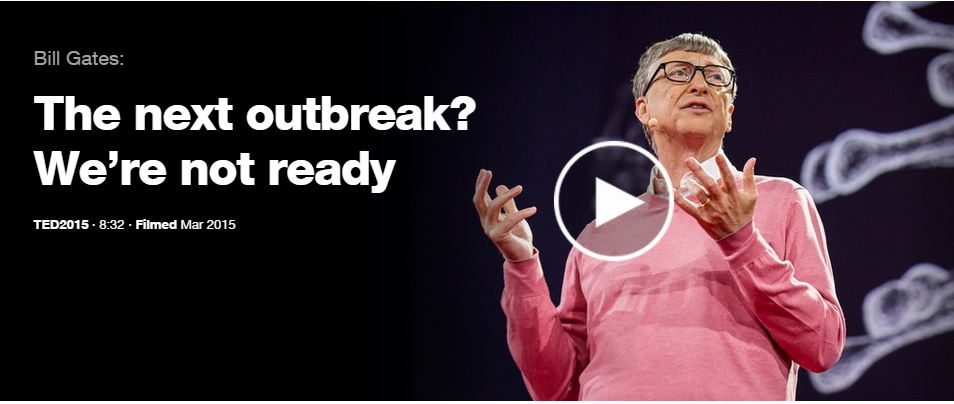
The next outbreak? We’re not ready – Bill Gates 2015

Image result for bill gates the next outbreak we're not ready


How the coronavirus pandemic differs from the flu

https://www.axios.com/coronavirus-pandemic-differs-from-flu-48e81eae-d275-4d33-83fa-4716551c61c0.html

Image result for axios How the coronavirus pandemic differs from the flu

The COVID-19 pandemic is caused by a virus humans haven’t encountered before — meaning our bodies have no built-in immunity to it and researchers are frantically working to learn more about it.

Why it matters: While there are important lessons to be learned from other pandemic flus and even seasonal flu outbreaks, the coronavirus pandemic is new and not exactly comparable, making predictions, policies and treatments all the more difficult.

The latest: The coronavirus is spreading throughout the U.S., with at least 35,224 confirmed cases and 471 deaths early Monday morning, per Johns Hopkins’ Center for Systems Science and Engineering.

  • Meanwhile, the Centers for Disease Control and Prevention estimates the 2019-2020 seasonal flu has caused at least 38 million illnesses, 390,000 hospitalizations and 23,000 deaths so far this season.

What they’re saying: Anthony Fauci, who’s served as director of the National Institute of Allergy and Infectious Diseases since 1984, told a JAMA podcast he’s worked on multiple infectious disease crises “but nothing of the magnitude of this.”

  • One of the problems, he said, is that without strong containment and mitigation efforts, it hits society and its health care system “all of a sudden — boom! It starts to skyrocket.”
  • The World Health Organization on Friday warned against dismissing the coronavirus as just a bad outbreak of the flu, saying overwhelmed health systems are “collapsing” around the world.
  • “This is not normal. This isn’t just a bad flu season,” WHO’s Mike Ryan said.

While both seasonal flu and COVID-19 cause similar respiratory illnesses, there are key differences between the viruses.

  • Influenza has an incubation period of roughly 2-3 days, whereas the coronavirus incubates longer (5-6 days on average) before symptoms appear, possibly allowing more people to unknowingly spread the virus.
  • On average, 1.3 people catch the flu from an infected person versus 2-3 for the coronavirus.
  • There’s a flu vaccine and multiple effective treatments, so many exposed to the flu will have lessened symptoms. There’s no vaccine or treatment yet approved for COVID-19.
  • Children appear to be more susceptible to severe complications from this seasonal flu than from COVID-19, with the CDC reporting the highest number of influenza-associated deaths (149) at this point in the season, with the exception of the 2009 flu pandemic.
  • But, the overall mortality rate for COVID-19 is between 10 and 40 times higher than the average 0.1% mortality rate for the seasonal flu.

The U.S. can learn from both Asia and Europe, which experienced cases of COVID-19 earlier than the U.S., Julie Fischer of Georgetown University’s Center for Global Health Science and Security tells Axios.

  • China is providing data showing what measures are working better than others, and is conducting treatment tests on patients, which will be valuable, she said.
  • In South Korea, robust diagnostic testing using creative measures like drive-thrus combined with strong health care followup shows the importance of isolating the right people early enough to limit the spread, Fischer says.
  • Italy tried to do a widespread but unfocused social distancing. There’s been some success in stemming the outbreak in certain areas that tested a large number of people, tracing and quarantining those who have been in contact with positive cases. But, it wasn’t early enough or sufficiently extensive, and many parts of Italy are now overwhelmed.

Longer term lessons can be drawn from prior pandemics, like the Spanish flu of 1918, Fischer says.

  • Comparing Philadelphia’s response with that of St. Louis is quite striking, Fischer says. Philadelphia decided to hold a 200,000-person parade to boost morale — but this led to widespread infections. In contrast, St. Louis rapidly battened down the hatches and reported a smaller epidemic.
  • Another lesson from the Spanish flu was that closing schools early on was “one of the most beneficial” non-pharmaceutical interventions.

The bottom line: “This is not an ‘abandon all hope, ye who enter here,’ scenario,” Fischer says. “We can focus our strategy and become much more aggressive” in diagnostics testing and social distancing measures until scientists make advancements on vaccines and treatments.


The problems with our coronavirus testing are worse than you think

https://www.axios.com/coronavirus-outbreak-testing-delays-60a25ce6-f08d-438f-b294-358e0c300d95.html?utm_source=newsletter&utm_medium=email&utm_campaign=newsletter_axiosvitals&stream=top

Image result for The problems with our coronavirus testing are worse than you think

If the coronavirus outbreak in the U.S. gets really bad — if it stretches on longer than we anticipated, if huge numbers of people get sick, if the disruptions to daily life become even more severe — early flaws in the testing process will bear a lot of the blame.

The big picture: You probably know that there were some early problems with testing, and that they’re getting better — which they are. But those early failures will help define the entire scope of this pandemic, and there’s not much we can do now to reverse the damage.

Why it matters: Because we haven’t been doing enough testing, we don’t actually know how many people in the U.S. have coronavirus. We know the official count is too low, and that the number of confirmed cases is likely to explode in the coming weeks as testing improves.

  • But that’s not the only problem. The lack of testing hasn’t just left us in the dark about how bad the situation is; it has also made that situation worse.

By the numbers: Independent researchers estimate that the U.S. has completed about 20,000 coronavirus tests as of Friday.

  • By contrast, South Korea — a success story in controlling the coronavirus — has performed an estimated 250,000 tests.
  • As bad as that discrepancy is, it’s even worse when you consider that the U.S. population is more than six times bigger than South Korea’s (327 million vs. 51 million).

Widespread, accurate testing has been a key component of other countries’ success in bringing their outbreaks under control.

  • When we can quickly and accurately diagnose one patient, we can immediately pinpoint who that person is most likely to have infected, then quarantine those people and test the ones who start to show symptoms, and repeat that process on down the line.
  • We can spot clusters of new cases, so that the public health system can react quickly and focus its resources.

But the U.S. has not been able to do those things on the scale we’d need. And so, experts say, the virus has probably been spreading undetected for weeks.

  • More people than we know about are infected, which means more people than we know about are spreading the virus, which likely means way more people than we know about are infected.

“Our response is much, much worse than almost any other country that’s been affected,” Ashish Jha, a public health expert and the director of Harvard’s Global Health Institute, told NPR last week.

  • “Without testing, you have no idea how extensive the infection is. You can’t isolate people. You can’t do anything,” he said.

Between the lines: This makes other interventions, including individual “social distancing” and the cancellation of big events, even more important.

  • “We have to shut schools, events and everything down, because that’s the only tool available to us until we get testing back up. It’s been stunning to me how bad the federal response has been,” Jha told NPR.

What’s next: Testing capacity in the U.S. is improving quickly. Nationwide, we now have the ability to test about 26,000 people per day, according to former Food and Drug Administration Commissioner Scott Gottlieb.

  • He expects that capacity to “rise substantially” this week.
  • As more people can get tested, we’ll be able to get a handle on how many cases there actually are, and to start focusing attention and resources appropriately.

How we got here: The testing shortfall has been a multi-phase failure.

  • For reasons that remain unknown, the U.S. did not rely on the World Health Organization’s coronavirus test in the earliest days of the outbreak. Instead, the Centers for Disease Control and Prevention set out to make its own.
  • But the CDC’s test didn’t always work. Manufacturing had to be relocated following a possible contamination. And it has taken time to come up with a new one.
  • Regulatory red tape slowed down academic labs that wanted to jump in and develop their own tests, and capacity among private-sector labs is still ramping up.

In the early days, testing was focused narrowly on people who had traveled to China. And that was probably the best way to triage limited resources, but it was never going to be sufficient.

  • China and the U.S. are so thoroughly connected to the rest of the world that cases were always going to spread from China to multiple countries, and so people travelers from multiple countries could bring it into the U.S. From there, people in the U.S. started spreading it themselves.

The bottom line: Yes, the testing capacity is about to catch up. When it does, we will see a tidal wave of new confirmed cases. The fact that we needed to catch up made that tidal wave bigger — made the outbreak worse. And that won’t be undone by more tests now.


Coronavirus updates: State Department urges Americans not to travel abroad

https://www.axios.com/coronavirus-latest-developments-8b8990c4-6762-494a-8ee0-5091746bda9b.html?utm_source=newsletter&utm_medium=email&utm_campaign=newsletter_axiosvitals&stream=top

Image result for Johns Hopkins Confirmed cases of COVID-19

The State Department issued a global level 3 health advisory late Wednesday advising Americans to “reconsider travel abroad due to the global impact” of the novel coronavirus pandemic.

The big picture: President Trump announced hours earlier European travel to the U.S. will be restricted for 30 days, with some exemptions, and the NBA suspended its season. There are more than 126,000 cases in over 100 countries and territories and more than 4,600 deaths. There are over 1,300 cases in the U.S.

LAST 48 HOURS
  • Travel restrictions: The Trump administration’s new rules affect European member states of the Schengen Area, which includes most but not all of the EU. The United Kingdom and Ireland are not in the zone and are not affected by the restrictions.
    • In Israel, all travelers entering from any country — including Israeli citizens — are required to self-quarantine for 14 days.
  • Travel advisory: “Many areas throughout the world are now experiencing COVID-19 outbreaks and taking action that may limit traveler mobility, including quarantines and border restrictions,” the State Department advisory reads. “Even countries, jurisdictions, or areas where cases have not been reported may restrict travel without notice.”


  • U.S. cases: Nearly 40 states reported at least 1,220 cases as of Wednesday, and roughly two dozen have declared a state of emergency. The novel coronavirus has now killed at least 30 Americans in five states.
    • Washington, D.C., Mayor Muriel Bowser announced a state of emergency Wednesday, as well as six new COVID-19 cases. There are now 10 presumptive cases in D.C. — including person-to-person transmission and at least two individuals who contracted the virus from unknown causes.
    • A staffer in the D.C. office of Sen. Maria Cantwell (D-Wash.) has tested positive to the virus — the first known case of a congressional staffer becoming infected with the virus.
    • California’s Los Angeles County announced six additional cases on Wednesday — including one that health officials presume is the county’s second case of community spread transmission.
    • The state’s health officials now recommend that events larger than 250 people be canceled.
    • There are now four deaths in California after Los Angeles County announced Wednesday the death of an “older adult” who “traveled extensively over the past month,” including to South Korea.
    • Virginia announced that a teenager in the Chickahominy Health District, who recently traveled internationally, has tested positive for COVID-19 on Wednesday, marking 9 current cases in the state. The affected teen did not attend school.
    • The states with the most cases as of Wednesday are: WashingtonNew York and California — where three TSA officers at Mineta San Jose International Airport were confirmed to have tested positive for the virus Tuesday night.
    • Maryland now has 9 confirmed cases after a 70-year-old Montana resident who was visiting Anne Arundel County came in close contact with someone who had contracted the virus, Maryland Gov. Larry Hogan said Wednesday.
    • New York Gov. Andrew Cuomo said he planned to deploy the National Guard to the New York City suburb New Rochelle on Tuesday to establish a one-mile “containment zone” and help contain the spread of the novel coronavirus.


  • Pandemic classification: The World Health Organization classified the outbreak as a pandemic Wednesday.
  • Global impact: Cases continue to surge in Spain, Germany, France and Italy, which is on complete lockdown with more than 12,000 cases — second-highest to China.
  • Business: Twitter announced Wednesday night that it instructed all employees globally to work from home.
  • Google recommended Tuesday that all its employees in North America work from home until at least April 10 amid the novel coronavirus outbreak, one of the most sweeping cautionary edicts.
    • The Securities and Exchange Commission is the first federal agency to direct its staff at its D.C. office to work remotely after an employee with respiratory problems was told they may have the virus.
    • IBM is encouraging its employees who live or work in New York City and Westchester County to work from home. Amazon, Facebook, Microsoft and Salesforce have similar practices in place.
    • Deloitte has recommended its staff return from areas impacted by COVID-19 to work from home for 14 days from their return date. The consulting firm has asked workers to defer nonessential international and domestic travel.


  • Australia: Actor Tom Hanks confirmed Wednesday he and his wife, Rita Wilson, tested positive for the virus while in Australia, which now has 128 cases.
  • Federal aid: The Department of Health and Human Services announced Wednesday it is allocating over $560 million to states and local areas to assist with COVID-19 response.
  • Cruise ship: Nearly 300 people left the docked Grand Princess ship in Oakland, Calif. on Tuesday, with more than half sent to Travis Air Force base and 98 to Lackland Air Force base in Texas, Gov. Gavin Newsom said Tuesday.
  • Community spread warning: Some areas in the U.S. have passed the point of containment and communities should focus on mitigation plans, such as canceling events, CDC director Robert Redfield said Tuesday.
  • Conferences and events: Music festival Coachella has been postponed until October. Many international and domestic conferences affecting all businesses, trades and entertainment are being either postponed or canceled.


  • Financial impact: U.S. stocks have taken a toll with various dips and corrections all week. Worries are growing that the outbreak could shrink global GDP and perhaps sink the U.S. dollar.
  • Oil: Already struggling with mounting debt and falling market valuations, energy companies are at serious risk for mass bond defaults.
  • Diagnostics: Health insurers and regulators are working to ensure coronavirus diagnostic tests are covered — but that doesn’t necessarily mean COVID-19 treatment will be affordable. Concerns linger as to how the health care system can meet the demands of high-volume testing.
  • Universities: As colleges cancel classes and boot students off campus because of the coronavirus, they’re creating logistical and financial nightmares that could leave many students in a bind.
  • Tourism: White House advisers are looking at policy changes to help relieve the travel and hospitality industry. Tourism and travel operators have had to reprice globally, as airlines, hotels and travel operators see major declines in bookings and revenue.
  • Social media: A large part of the problem is the “infodemic,” as stories get shared that are designed to drive fear rather than build understanding about the illness, according to NewsWhip data provided to Axios.


WHO declares the coronavirus outbreak a pandemic

WHO declares the coronavirus outbreak a pandemic

Image result for WHO declares the coronavirus outbreak a pandemic

The World Health Organization on Wednesday declared the rapidly spreading coronavirus outbreak a pandemic, acknowledging what has seemed clear for some time — the virus will likely spread to all countries on the globe.

Director General Tedros Adhanom Ghebreyesus said the situation will worsen.

“We expect to see the number of cases, the number of deaths, and the number of affected countries climb even higher,” said Tedros, as the director general is known.

As of Wednesday, 114 countries have reported that 118,000 have contracted Covid-19, the disease caused by the virus, known as SARS-CoV2. In the United States, where for weeks state and local laboratories could not test for the virus, just over 1,000 cases have been diagnosed and 29 people have died. But authorities here warn continuing limits on testing mean the full scale of spread in this country is not yet known.

The virus causes mild respiratory infections in about 80% of those infected, though about half will have pneumonia. Another 15% develop severe illness and 5% need critical care.

“Describing the situation as a pandemic does not change WHO’s assessment of the threat posed by this coronavirus,” Tedros said at the WHO’s headquarters in Geneva, in making the announcement. “It doesn’t change what WHO is doing, and it doesn’t change what countries should do.”

At the same time, Tedros said: “This is not just a public health crisis, it is a crisis that will touch every sector — so every sector and every individual must be involved in the fight.”

The virus, which probably originated in bats but passed to people via an as yet unrecognized intermediary animal species, is believed to have started infecting people in Wuhan, China, in late November or early December. Since then the virus has raced around the globe.

While China appears on the verge of stopping its outbreak — it reported only 24 cases on Tuesday — outbreaks are occurring and growing in a number of locations around the world including Italy, Iran and the United States.

South Korea, which has reported nearly 8,000 cases, also appears poised to bring its outbreak under control with aggressive measures and widespread testing. But other countries have struggled to follow the leads of China and South Korea — a reality that has frustrated WHO officials who have exhorted the world to do everything possible to end transmission of the virus.

“The bottom line is: We’re not at the mercy of the virus,” Tedros said on Monday. “The great advantage is that the decisions we all make as governments, businesses, communities, families and individuals can influence the trajectory of this epidemic.”

“The rule of the game is: Never give up,” he insisted.

The WHO has been criticized and second-guessed for not declaring the outbreak a pandemic sooner. Mike Ryan, head of the agency’s health emergencies program, admitted in a press conference on Monday that the agency fears that countries may interpret a pandemic declaration as a sign efforts to contain the virus have failed and they no longer need to try.

“For me, I’m not worried about the word. I’m more concerned about that the world’s reaction will be to that word. Will we use it as a call to action? Will we use it to fight? Or will we use it to give up?” Ryan asked.


Settling in for a long fight against coronavirus

https://mailchi.mp/9e118141a707/the-weekly-gist-march-6-2020?e=d1e747d2d8

Image result for Settling in for a long fight against coronavirus

As of Friday, the number of confirmed cases of the novel coronavirus, or COVID-19, has surpassed 100,000 worldwide, with over 3,400 deaths. In the US, there have been 250 confirmed cases and 14 deaths reported so far—although the actual number of cases is certainly many times higher, with testing yet to be widely available and many patients exhibiting only mild to moderate symptoms.

Vice President Mike Pence, who was put in charge of federal response efforts last week, conceded Thursday that the country does not yet have enough coronavirus tests to meet demand, and the administration will not meet its goal of having 1M tests ready by the end of the week; perhaps the $8B emergency funding package approved by Congress will help expedite efforts.

Public worry and concern among officials hit new levels, with the Director-General of the World Health Organization warning that time to contain the virus may be running out, and expressing concern that countries may not be acting fast enough. New levels of containment effort have begun to take shape. Schools shut down in areas of the country most affected by the virus, including Seattle and some New York City suburbs. All told, the New York Times reports that 300M students are out of school around the world. Companies began to cancel conferences and other large gatherings—next week’s Health Information and Management Systems Society (HIMSS) conference was called off despite a planned appearance by President Trump, given rising cancellations and vendor exits.

Hospitals around the nation have rallied to prepare for a growing wave of patients that has yet to hit. Experts expressed concerns about whether hospitals have enough open capacity, but even more critical will be gaps in the supply of staff and equipment—especially the ICU beds and ventilators necessary for critically ill patients, and the nurses and respiratory therapists needed to care for them.

The vast majority of hospitals report having a coronavirus action plan in place; however, a recent survey of nurses suggests that critical information may not be making its way to frontline clinicians. Only 44 percent of nurses reported that their organization gave them information on how to identify patients with the virus, and just 29 percent said there is a plan in place to isolate potentially infected patients.

Worries about patient financial exposure to the costs of diagnosis and treatment intensified, with fears that individuals could be held accountable for the cost of government-mandated isolation. Most patients with high-deductible plans saw their deductibles “reset” at the beginning of the year, raising concerns that individuals might refrain from seeking treatment.

The heightened worry is palpable as we connect with hospital and physician leaders around the country, and we are deeply grateful for their around-the-clock efforts, and the willingness of doctors, nurses and other caregivers to put their own safety at risk to provide the best possible care to patients under increasingly difficult circumstances.


First Case of Coronavirus Lands in U.S.

https://www.medpagetoday.com/infectiousdisease/publichealth/84458?xid=NL_breakingnewsalert_2020-01-21&eun=g885344d0r&utm_source=Sailthru&utm_medium=email&utm_campaign=VirusUpdateAlert_012120&utm_term=NL_Daily_Breaking_News_Active

Image result for First Case of Coronavirus Lands in U.S.

The first travel-related case of the novel coronavirus has been detected in the U.S. in a man from Washington state, CDC officials said on Tuesday.

The man tested positive for the novel coronavirus via laboratory testing, CDC officials said. According to Washington health officials, he arrived without symptoms on an “indirect” flight into Seattle-Tacoma International Airport on Jan. 15, prior to implementation of the new screening procedures at other U.S. airports. Described as “an astute gentleman,” the passenger was aware of the virus and promptly shared information with his provider when his symptoms developed.

Currently, the patient is hospitalized “out of an abundance of caution,” but not because of severe illness. He reported he did not visit any of the implicated markets in the Wuhan area.

A statement released by the CDC details how the man sought care at a nearby medical facility, where health professionals suspected novel coronavirus, and based on the patient’s travel history and symptoms, sent specimens out for testing. CDC confirmed the diagnosis on Monday.

Washington health officials emphasized that this was one of the hospitals that had “done a drill” about this type of illness, including how to transport a patient in an ambulance and what type of isolation is needed. They said that the patient here is “isolated and poses low risk to staff or to the general public.”

Julie Fischer, PhD, of Georgetown University in Washington, D.C., told MedPage Today that this looks to be a similar pattern for human-to-human transmission as SARS, where currently most cases of this novel coronavirus “are probably close contacts,” including healthcare workers. Chinese health officials announced that 14 healthcare workers had been infected.

“This is a big heads up to the rest of the world to go ahead and start preparing your healthcare workers and make sure they have proper equipment,” she said. “It’s a reminder of what we already knew was a risk.”

Fischer said that in addition to taking precautions to avoid infection (such as personal protective equipment), clinicians should “pay attention to evolving guidance.”

The CDC had already decided to step up screening at two additional U.S. airports prior to this case being reported, with additional screening being added at both Hartsfield-Jackson Atlanta International Airport (ATL) and Chicago O’Hare International Airport (ORD) this week. In addition, passengers from Wuhan will be “funneled” into airports with enhanced screening measures, CDC officials said.

“The long incubation period [for the virus] also makes early detection much harder, especially as we do not know how many passengers have flown abroad and how many will do so in the coming weeks,” Stratfor Senior East Asia analyst Zhixing Zhang said in a statement.

Fischer added that screening will be especially challenging, given that this is in the middle of increased flu activity in the U.S. and that clinicians must rely on a “non-specific, place-based case definition” (based on travel) until new diagnostics emerge.

She emphasized the importance of “a good diagnostic test,” saying that only a handful of labs are capable of testing for the virus now. Once molecular testing is available, such as a polymerase chain reaction (PCR) test, the CDC will figure out how best to optimize it and share it more widely, Fischer said.

Indeed, CDC officials said that they are having “active conversations” about diagnostics, as well as research into vaccines.

Over the weekend, the case count for the novel coronavirus rose to over 300, with 6 deaths, according to news reports. The World Health Organization (WHO) is scheduled to meet on Wednesday about whether this virus constitutes an international health emergency.