Truth #2: Medicare Coverage May Not Be As “Good”​ As You Expected

https://www.linkedin.com/pulse/truth-2-medicare-coverage-may-good-you-expected-denny-weinberg/

Denny Weinberg

Background

In the mid 1960’s, Medicare was first created as a “Social Insurance Program”, designed to be consistently applied to all older Americans. Comprehensive, inexpensive, and relevant to the standards-of-care at the time, this was considered “Good” Coverage.

But the passing of years unveiled a multitude of unanticipated dynamics.

  • For example, the very definition of “health care” has both broadened and deepened materially since 1965. The first MRI or the first Angioplasty would not occur until a decade later.
  • Meanwhile, the age-65 life expectancy has expanded by nearly 50% since then, exposing the medical system to care demands and opportunities never contemplated, late in life.
  • While care technology, science and processes have responded to this expanding demand, they brought with them dramatically accelerating costs, year after year.
  • Finally, political pressures to respond to special populations, including dialysis patients, or emerging care settings like home health or hospice, or even outpatient prescription drugs… all resulted in substantial Medicare Program scope creep.

So it should not be surprising that since inception, Medicare COVERAGE itself has required regular, often dramatic modifications to keep its “social insurance purpose” in balance with these and other continually changing demands. Some of that pressure has even challenged the highly protected “social Insurance” model itself:

  • By the early 2000’s, these pressures yielded to means-based-pricing for seniors of varying income levels
  • A 2013 survey of Americans over age 65 revealed “raising the age of eligibility to 67” as the second most popular to reduce costs and improve long term viability.

Americans Are Not Very Informed About Medicare

Most Americans (even beneficiaries) are not really aware of the full effect of these sequential program changes, because they have been spread out over many years. After all, the Medicare program has been around for 50 years, but most beneficiaries participate for less than a dozen years. So, many assume this program has been stable and managable year after year, with surprising simplicity and effectiveness. But Medicare Coverage is not at all what it was 50 years ago.

Consider a small number of coverage dynamics between the late 1960’s and today:

No alt text provided for this image

Other coverage details and provisions have had to change along the way too, few offsetting the additional copayments, co-insurance, annual and lifetime limits or out-of-pocket cost exposure for beneficiaries.

Could Today’s Medicare Even Work Without The Private Market?

These exposures explain why most Medicare beneficiaries are compelled to purchase a supplemental private insurance plan to cover those costs not covered by today’s Medicare. Such private plans are called Medicare Supplement Plans, and they have been increasingly necessary as the exposures under the Traditional Medicare program have grown over the years. But they too have become expensive due to the the increasing uncovered portions of Medicare. Over the years, the average Medicare Supplement has increased in price from less than $20 per month in the 1980’s to a few Hundred dollars per month today.

Alternatively, Medicare beneficiaries today can choose to leave Traditional Medicare altogether, and apply their “benefit equivalent eligibility” to the purchase of an alternative from a private Insurance company. These programs, called Medicare Advantage Plans, attract nearly 1/3 of all Medicare Beneficiaries who simply can’t make Traditional Medicare pencil out.

So What Does This Mean?

Most of the Medicare-For-All proposals don’t advertise the high coverage gaps in the current model, and the dependency on either a private market supplement (Medicare Supplement Plans), or private market alternative (Medicare Advantage Plans). Without these, Medicare-For-All will be woefully inadequate to meet the coverage expectations of Americans. Alternatively, Medicare-For-All proposals could completely re-invent what Medicare is , increasing its coverage and raising its price substantially.

Either way, it is going to cost a lot of money.


Truth #1: Many Opt-Out of Medicare?

https://www.linkedin.com/pulse/medicare-all-opt-outs-denny-weinberg/

For All?

… like liberty and justice, Medicare is imagined by some to be All-American. But is it? Can it be? Should it be?

A Historical Perspective:

In 1965, the first year of Medicare, nearly 19 Million Americans enrolled, 56% of whom were previously uninsured according to a Kennedy-era study. It was a simple program back then, providing only acute hospital and physician coverage for Americans over age 65. It was the only real health insurance option for people over age 65, virtually all of whom retired by that age back then.

Today, an estimated 63 Mil or 18% of the US population are eligible for Medicare. And after decades of major program changes, the 2018 program covers more than just older Americans, and Medicare coverage is more complex and broader than the original program. Like the original program (Traditional Medicare), the coverage still has substantial patient exposures for deductibles, co-payments and lifetime / per-incident limits. And, despite popular folklore, it is far more expensive due to the same pressures that impact coverages for the rest of us.

Along the way, other alternative or complementary coverages have emerged. No surprise, this dynamic reflects in part, the vastly different nature and demands of American consumers including older American consumers. These newer coverage sources include private insurers, employers, unions, states, municipalities and school districts as well as expanded coverages for the poor (including the older poor).

Does Medicare ALONE Work For Those That Have Access Today?

Consider this:

  • 38 Mil, or only 60% of those eligible are enrolled in Traditional Medicare. But because of indexing coverage limitations, only 19% of these Traditional Program participants do not have some form of supplemental or alternative coverage.
  • Another 9 Mil are over 65 but still working, and only because of their employer wrap-around coverage, Medicare is workable.
  • Another 21 Mil are enrolled in Private Alternatives to Medicare called Advantage Plans after opting out of Traditional Medicare. In 2018 there were 2,317 such Medicare Advantage plans available nationwide allowing the average beneficiary to choose among 21, an increase from 19 in 2017. This is anything but single-payer and becoming less single-payer-like each year due to natural market dynamics.
  • Finally, 12 Mil of all of these are also enrolled in Medicaid (dually eligible), due to low income, disability, etc. Most are part of the 38 Mil people with Traditional Medicare, but only because of the Medicaid program, their Medicare is coverage and price affordable and/or relevant.

What Does This Say About Medicare For All?

Nearly 1/2 of all who are offered Medicare today choose a private market alternative, or can only make it work due to other private market wraparound safety nets. So why do we think Medicare will be attractive to the rest of the population without similar private market protections?


More on the employer health plan churn

https://www.axios.com/newsletters/axios-vitals-64abbaf8-c86f-4ac1-8561-525b0fd33c25.html?utm_source=newsletter&utm_medium=email&utm_campaign=newsletter_axiosvitals&stream=top

Image result for More on the employer health plan churn

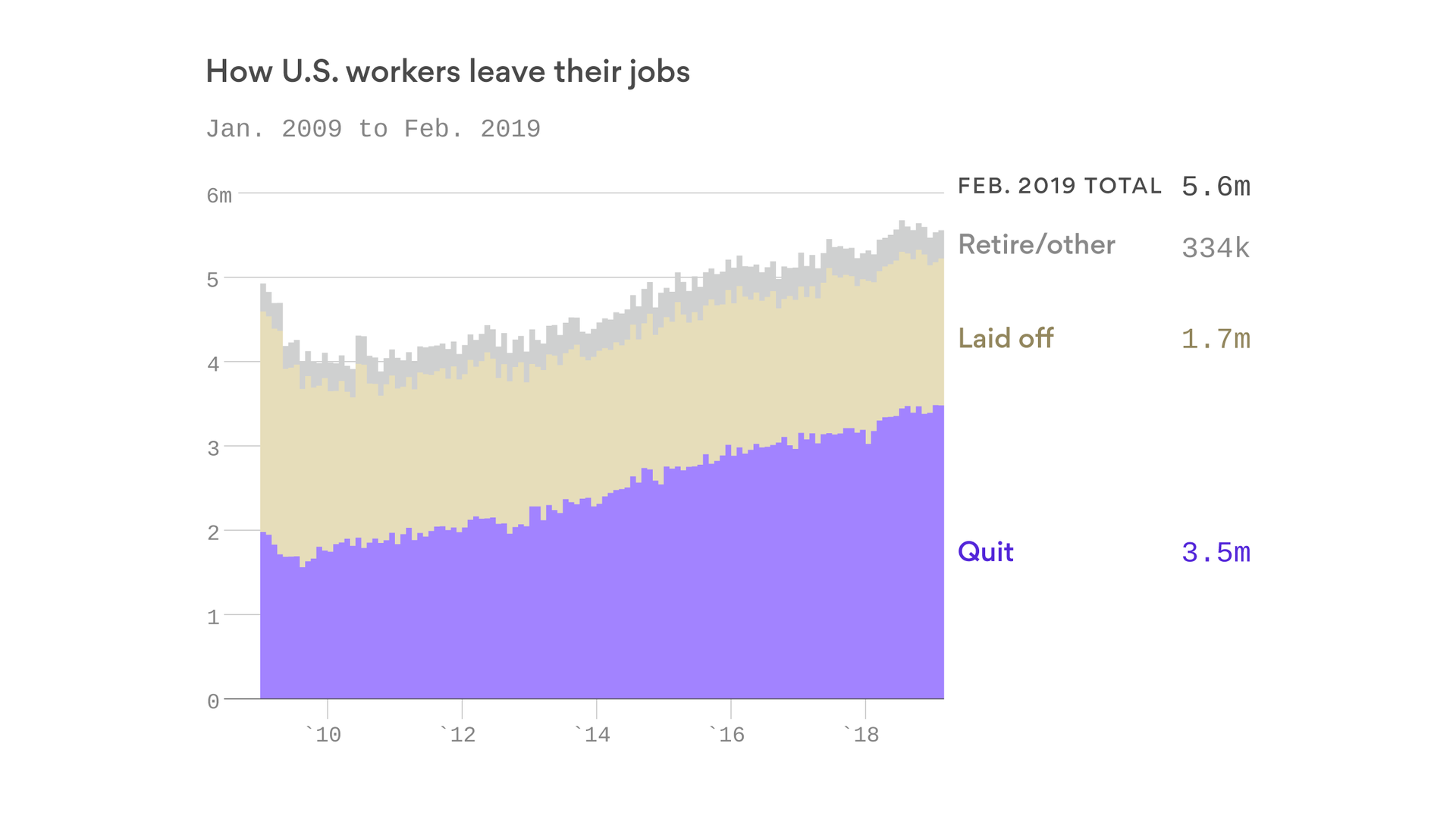
A lot of readers gave us feedback on yesterday’s lead item about how millions of working Americans lose or change their employer health plans every month, usually through quitting a job or getting fired/laid off.

One point that came up several times: Employees who don’t leave their jobs sometimes have to switch to new health plans, Bob reports.

  • Larry Levitt of the Kaiser Family Foundation reminded us that 61% of companies that offer health benefits shopped around for new employee plans in 2018, and a quarter of them changed insurers, according to KFF’s annual employer survey.
  • Changing or cutting health benefits for current employees is no small matter — doing so was the driving force behind teachers striking in West Virginia last year.

The bottom line: Employer coverage changes all the time, both when people leave their jobs and when companies decide to tinker with their benefits packages.


Wall Street is still selling off health care stocks

https://www.axios.com/newsletters/axios-vitals-64abbaf8-c86f-4ac1-8561-525b0fd33c25.html?utm_source=newsletter&utm_medium=email&utm_campaign=newsletter_axiosvitals&stream=top

Image result for medicare for all

Yesterday, UnitedHealth Group posted $3.5 billion of profit in the first quarter — its second-most profitable quarter ever — and collected more than $60 billion of revenue, Axios’ Bob Herman reports.

Yes, but: UnitedHealth’s stock price tanked by 4%, which consequently dragged down shares of the other major health insurers and hospital chains. Cigna’s stock price plummeted 8%, and Anthem and Humana were close behind. HCA tumbled 10%.

Driving the news: Wall Street remains fearful of “Medicare for All” becoming a reality, and UnitedHealth CEO Dave Wichmann tried to get ahead of the message by telling investors that single-payer would “jeopardize” people’s care.

  • Many investment bank analysts were perplexed by the sell-off, considering that UnitedHealth has more cash than it knows what to do with.
  • Steven Halper of Cantor Fitzgerald wrote to investors: “What more can you ask for? Take advantage of poor sentiment.”

The big picture: Medicare for All discussions matter far more to Wall Street right now, and that makes the industry’s Q1 financial reports a lot less important.


Red states’ Medicaid gamble: Paying more to cover fewer people

https://www.axios.com/republicans-medicaid-affordable-care-act-expensive-d7057a8e-0a55-4f0d-906e-e42aa3f00ba9.html?utm_source=newsletter&utm_medium=email&utm_campaign=newsletter_axiosvitals&stream=top

Illustration of a price tag hanging from an IV stand

Red states are getting creative as they look for new ways to limit the growth of Medicaid. But in the process those states are taking legal, political and practical risks that could ultimately leave them paying far more, to cover far fewer people.

Why it matters: Medicaid and the Children’s Health Insurance Program cover more than 72 million Americans, thanks in part to the Affordable Care Act’s Medicaid expansion. Rolling back the program is a high priority for the Trump administration, and it needs states’ help to get there.

The big picture: The Centers for Medicare & Medicaid Services, under the leadership of Administrator Seema Verma, has made clear that it wants to say “yes” to new limits on Medicaid eligibility, and has invited states to ask for those limits.

  • But CMS hasn’t actually said “yes” yet to some of the most significant limits states have asked for.
  • In the meantime, states are left either with vague ambitions they’re not sure how to implement, or with risky plans that put their own budgets on the line.

What we’re watching: State-level Republicans are waiting for CMS to resolve two related issues: how much federal funding their versions of Medicaid can receive, and the extent to which they’re able to cap enrollment in the program.

  • “These issues are going to continue to be intertwined,” said Joan Alker, the executive director of Georgetown University’s Center for Children and Families.

Verma has reportedly told state officials that she wants to use her regulatory power to convert Medicaid funding into a system of block grants — which would be an enormous rightward shift and probably a big cut in total funding.

  • CMS probably cannot do that on its own, experts said, but it could achieve something similar by approving caps on either enrollment or spending.

Where it stands: GOP lawmakers in a handful of states are looking to Utah, which has bet big on Verma’s authority, for signals about what’s possible.

  • Utah voters approved the full ACA expansion last year, but the state legislature overruled them to pass a more limited version.
  • By foregoing the full expansion, Utah passed up enhanced federal funding. It’s still asking for that extra money — a request CMS has never previously approved.
  • Utah will also ask CMS to impose a per-person cap on Medicaid spending — a steep cut that was part of congressional Republicans’ failed repeal-and-replace bill, and which may strain CMS’ legal authority.
  • If Utah doesn’t get those two requests, its backup plan is simply to adopt the full expansion.

What’s next: Utah is not the only red state leaning into Verma’s agenda, but it’s further out on a limb than any other.

  • Idaho, like Utah, overruled its voters to pass a narrower Medicaid bill. But it preserved an option for people to buy into the ACA’s expansion.
  • Alaska Gov. Mike Dunleavy has said he wants to take Verma up on her offer of block grants; so have legislators in Tennessee and Georgia. But in the absence of any detail about what that means, or what CMS will approve, that’s all pretty vague right now.

If CMS does move forward on any of this, it could face the same threat of lawsuits that have stymied its first big Medicaid overhaul — work requirements.

  • Those rules are on ice in two states because a judge said they contravene Medicaid’s statutory structure and goals. The same argument could await a partial expansion or tough spending caps.

“There’s a clear agenda here to get a handful of states to take up these waivers, which fundamentally undermine the central tenets of the Medicaid program — which [are] that it is a guarantee of coverage, and a guarantee of federal funding,” Alker said.


Millions already lose or change health plans every year

https://www.axios.com/newsletters/axios-vitals-1ef6e02e-18e5-4a57-9dd2-891aadfbcaf1.html

Image result for Millions already lose or change health plans every year

Millions of Americans lose their health insurance plans every month, by leaving the job through which they got that coverage, Axios’ Bob Herman reports.

Why it matters: Critics and skeptics of “Medicare for All” worry about eliminating people’s existing coverage because most people are relatively satisfied with their employer-based plans.

  • But millions of workers and their families already switch or lose their insurance from their jobs.

By the numbers: More than 66 million Americans voluntarily quit their jobs, were laid off or otherwise separated from their employers in 2018, and that high turnover rate has continued into 2019, according to data from the Bureau of Labor Statistics.

Details: The BLS data does not measure whether separated jobs offered health insurance.

  • However, close to half of all private employers provide coverage to their workers, and more than 90% of companies with at least 100 employees offer health benefits.
  • It’s therefore reasonable to estimate that at least 2 million workers and their families lose or transfer to new commercial health plans every month.

The bottom line: Behavioral economics teaches that people don’t like to lose what they have, a concept known as “loss aversion.”

Go deeper:


Considering “Single Payer” Proposals in the U.S.: Lessons from Abroad

https://www.commonwealthfund.org/publications/2019/apr/considering-single-payer-proposals-lessons-from-abroad

Flags and sky 21x9

ABSTRACT

  • Issue: When discussing universal health insurance coverage in the United States, policymakers often draw a contrast between the U.S. and high-income nations that have achieved universal coverage. Some will refer to these countries having “single payer” systems, often implying they are all alike. Yet such a label can be misleading, as considerable differences exist among universal health care systems.
  • Goal: To compare universal coverage systems across three areas: distribution of responsibilities and resources between levels of government; breadth of benefits covered and extent of cost-sharing in public insurance; and role of private insurance.
  • Methods: Data from the Organisation for Economic Co-operation and Development, the Commonwealth Fund, and other sources are used to compare 12 high-income countries.
  • Key Findings and Conclusion: Countries differ in the extent to which financial and regulatory control over the system rests with the national government or is devolved to regional or local government. They also differ in scope of benefits and degree of cost-sharing required at the point of service. Finally, while virtually all systems incorporate private insurance, its importance varies considerably from country to country. A more nuanced understanding of the variations in other countries’ systems could provide U.S. policymakers with more options for moving forward.

Background

Despite the gains in health insurance coverage made under the Affordable Care Act, the United States remains the only high-income nation without universal health coverage. Coverage is universal, according to the World Health Organization, when “all people have access to needed health services (including prevention, promotion, treatment, rehabilitation, and palliation) of sufficient quality to be effective while also ensuring that the use of these services does not expose the user to financial hardship.”1

Several recent legislative attempts have sought to establish a universal health care system in the U.S. At the federal level, the most prominent of these is Senator Bernie Sanders’ (I–Vt.) Medicare for All proposal (S. 1804, 115th Congress, 2017), which would establish a federal single-payer health insurance program. Along similar lines, various proposals, such as the Medicare-X Choice Act from Senators Michael Bennet (D–Colo.) and Tim Kaine (D–Va.), have called for the expansion of existing public programs as a step toward a universal, public insurance program (S. 1970, 115th Congress, 2017).

At the state level, legislators in many states, including Michigan (House Bill 6285),2 Minnesota (Minnesota Health Plan),3 and New York (Bill A04738A)4 have also advanced legislation to move toward a single-payer health care system. Medicare for All, which enjoys majority support in 42 states, is viewed by many as a litmus test for Democratic presidential hopefuls.5 In recent polling, a majority of Americans supported a Medicare for All plan.6

Medicare for All and similar single-payer plans generally share many common features. They envision a system in which the federal government would raise and allocate most of the funding for health care; the scope of benefits would be quite broad; the role of private insurance would be limited and highly regulated; and cost-sharing would be minimal. Proponents of single-payer health reform often point to the lower costs and broader coverage enjoyed by those covered under universal health care systems around the world as evidence that such systems work.

Other countries’ health insurance systems do share the same broad goals as those of single-payer advocates: to achieve universal coverage while improving the quality of care, improving health equity, and lowering overall health system costs. However, there is considerable variation among universal coverage systems around the world, and most differ in important respects from the systems envisioned by U.S. lawmakers who have introduced federal and state single-payer bills. American advocates for single-payer insurance may benefit from considering the wide range of designs other nations use to achieve universal coverage.

This issue brief uses data from the Organisation for Economic Co-operation and Development (OECD), the Commonwealth Fund, and other sources to compare key features of universal health care systems in 12 high-income countries: Australia, Canada, Denmark, England, France, Germany, the Netherlands, Norway, Singapore, Sweden, Switzerland, and Taiwan.

We focus on three major areas of variation between these countries that are relevant to U.S. policymakers: the distribution of responsibilities and resources between various levels of government; the breadth of benefits covered and the degree of cost-sharing under public insurance; and the role of private health insurance. There are many other areas of variation among the health care systems of other high-income countries with universal coverage — such as in hospital ownership, new technology adoption, system financing, and global budgeting — that are beyond the scope of this discussion.


Healthcare Triage News: Why Do Insulin Prices Keep Rising?

Healthcare Triage News: Why Do Insulin Prices Keep Rising?

Image result for Healthcare Triage News: Why Do Insulin Prices Keep Rising?

Frederick Banting discovered insulin in 1921 and didn’t want to profit off of such a life-saving drug. Fast forward to 2019, and the price of insulin continues to increase year over year. Why is that?


How “Medicare for All” changes health care financing

https://www.axios.com/newsletters/axios-vitals-f500be38-f71e-4984-955b-efc69e20a435.html?utm_source=newsletter&utm_medium=email&utm_campaign=newsletter_axiosvitals&stream=top

Image result for medicare for all

Sen. Bernie Sanders’ “Medicare for All” plan would drastically change not only how health care is paid for, but who ultimately pays for it.

  • While the wealthy and the poor usually pay the same premium for today’s employer-based insurance, Sanders’ plan would beef up insurance coverage for everyone and pay for it by increasing taxes on the wealthy.

Driving the news: As part of yesterday’s rollout, Sanders released a white paper with several “options” on how to raise the additional revenue it would take for the government to pay for everyone’s health care without any premiums or out-of-pocket costs.

  • While most people’s taxes would go up, the wealthy would pay for a much greater portion of the nation’s health care system than they currently do.
  • A 4% “income-based premium” for workers who make more than $29,000 and a 7.5% “income-based premium” on employers (exempting the first $2 million in payroll) are two of the financing options. Most economists assume that the employer tax would get passed onto employees through lost wages.
  • Other options include increasing the individual tax rate on high earners, taxing “unearned” income at the same rate as earned, and establishing a wealth tax.

What they’re saying: Even if all of these payment options were implemented, they still wouldn’t cover the total cost of Sanders’ plan, said the Committee for a Responsible Federal Budget’s Marc Goldwein.

  • He said there could also be unintended consequences of such high taxes on the wealthy, such as discouraging investment.

The bottom line: “More progressive tax-based financing of health care is a feature, not a bug, of Medicare for all,” the Kaiser Family Foundation’s Larry Levitt said.

  • “The idea of financing health care through taxes rather than premiums and out-of-pocket costs would be fairer in some people’s minds, but also disruptive,” he said.


Walking back plans for an ACA replacement plan

https://mailchi.mp/5a57c9e710d7/the-weekly-gist-april-5-2019?e=d1e747d2d8

Image result for about face

Reversing course in the face of strong pushback from his own party’s leaders in Congress, President Trump this week backed off his earlier pledge to deliver a Republican healthcare plan to replace the Affordable Care Act (ACA).

After the Department of Justice switched positions on the Texas court case testing the constitutionality of the ACA, urging the Fifth Circuit Court of Appeals to invalidate the 2010 law entirely, Trump doubled down by declaring that Republicans would be known as the “party of healthcare”, going so far as to tap four GOP senators to craft a replacement bill.

However, the White House received a rare rebuke from Senate Majority Leader Mitch McConnell (R-KY), who said this week that in private discussions with the President, “I made it clear to him that we’re not going to be doing that in the Senate.” In tweets and a subsequent speech, Trump signaled his frustration with Congressional Republicans on the issue (“We blew it the last time. Man, I was fed a bill of goods.”), vowing to return to the issue after the 2020 elections.

By highlighting GOP divisions on the issue, this week’s public dust-up and Presidential about-face all but guarantee that healthcare will be a marquee issue in the upcoming elections, allowing Democrats to campaign on an issue that proved a strong suit for them in the 2018 midterms. Expect the politics of healthcare to remain front and center in the months to come.