Uncertainty. Opportunity. It’ll all be there for healthcare in 2017, PwC says

http://www.healthcaredive.com/news/uncertainty-opportunity-itll-all-be-there-for-healthcare-in-2017-pwc-sa/432384/

You reap what you sow. The idea is the push behind countless movie plots and rock songs but it’s also a central theme to PricewaterhouseCooper’s (PwC) Health Research Institute’s (HRI) new report on healthcare trends to watch out for in 2017. The seeds for next year were planted in 2007, according to the new report.

There will be certain uncertainty over the fate of the Affordable Care Act next year. However, many of the trends that should be on top-of-mind for hospital administrators next year will relate to value-based care, Trine Tsouderos, PwC’s Health Research Institute director, told Healthcare Dive. “If you think about the political changes as the waves on the surface of the ocean, there’s a very strong current underneath that is the shift to value-based care,” she said. “We do not see that changing. We see the shift continuing industry-wide despite any changes in Washington, DC.”

For example, only 90 or so retail clinics were in operation and about one in 10 consumers have been to one in 2016. Today, more than 3,000 such clinics have been propped up across the U.S. with one in three consumers having visited one. This drift highlights the continued move to more convenience in healthcare access as well as price transparency for patients.

Sticking with the nautical theme, Tsouderos likened the healthcare industry to a battleship in explaining why ideas from 10 years ago are now coming to fruition. It takes a long time to change the course of such a large and complex ship. “You can’t turn [the industry] on a dime,” she said.

What emerging trends administrators should know for 2017

https://www.pwc.com/us/en/health-industries/top-health-industry-issues.html
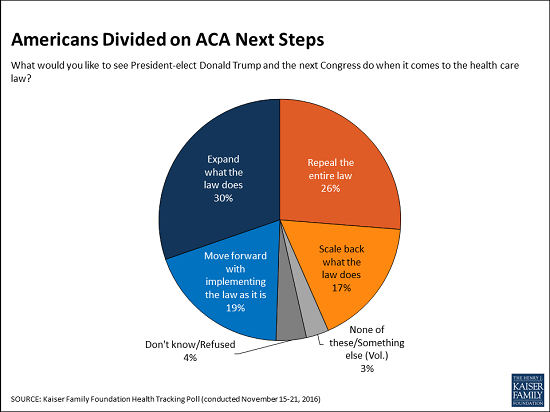
 

After the Election, the Public Remains Sharply Divided on Future of the Affordable Care Act

http://connect.kff.org/after-the-election-the-public-remains-sharply-divided-on-future-of-the-affordable-care-act?ecid=ACsprvtkG7thn0KvqmasXGGSnW1I2ovnfcZhoigDXi-aw9Wa_OhWGcyqpjasxqgfF_XFOsbs0N1f&utm_campaign=KFF-2016-November-Tracking-Poll&utm_source=hs_email&utm_medium=email&utm_content=38490459&_hsenc=p2ANqtz–qXSbCJ4pmKneag47QgP5kargBeYht5Al3rljRS8wEAQj-n-71yE8rwo5xn_Bg9Nwp-C89R9o_HVKBqqv5G6aMyddn9g&_hsmi=38490459

november poll1.png

Among Those Who Favor Repeal, Arguments About Loss of Coverage for Those with Pre-Exiting Conditions Can Sway Some Opinions

Many Obamacare Provisions Remain Broadly Popular Across Party Lines, But Not its Mandate

The first Kaiser Health Tracking Poll since the 2016 election finds that Americans are largely divided on the future of the Affordable Care Act even though many of the law’s major provisions remain quite popular across party lines.

The new survey finds that one fourth (26%) of Americans want to see President-elect Donald Trump and the next Congress repeal the entire law, and an additional 17 percent want them to scale back what the law does. This compares to 30 percent of the public who want to see the law expanded and 19 percent who want to see lawmakers move forward with implementing the law as it is.

The poll captures a slight uptick in the share of Americans who want lawmakers to scale back the law as well as a decrease in the share who want lawmakers to repeal the entire law.  This is largely driven by Republicans: About half (52%) of Republicans now say they want to see the Affordable Care Act repealed, down from 69 percent in October. At the same time, a quarter (24%) of Republicans now want to see the law scaled back, up from 11 percent in October.

Among the quarter (26%) of Americans that want to see the Affordable Care Act repealed, 31 percent want to see the health care law just repealed and not replaced. About two-thirds wants lawmakers to repeal the health care law and replace it with a Republican-sponsored alternative, with 42 percent wanting lawmakers to wait to repeal it until the details of a replacement plan have been figured out and 21 percent wanting lawmakers to repeal it immediately and figure out a replacement plan later.

Among those who want the law repealed, 38 percent (or 10% of the public overall) change their opinion after hearing the argument that repealing the ACA would mean that insurance companies could deny coverage to people with pre-existing conditions. A slightly smaller share change their opinion after hearing that more than 20 million Americans could lose their coverage.

What Are the Implications of Repealing the Affordable Care Act for Medicare Spending and Beneficiaries?

What Are the Implications of Repealing the Affordable Care Act for Medicare Spending and Beneficiaries?

Image result for What Are the Implications of Repealing the Affordable Care Act for Medicare Spending and Beneficiaries?

The 2010 Affordable Care Act (ACA) included many provisions affecting the Medicare program and the 57 million seniors and people with disabilities who rely on Medicare for their health insurance coverage. Such provisions include reductions in the growth in Medicare payments to hospitals and other health care providers and to Medicare Advantage plans, benefit improvements, payment and delivery system reforms, higher premiums for higher-income beneficiaries, and new revenues.

President-elect Donald Trump, Speaker of the House Paul Ryan, Health and Human Services (HHS) Secretary-nominee and current House Budget Committee Chairman Tom Price, and many other Republicans in Congress have proposed to repeal and replace the ACA, but lawmakers have taken different approaches to the ACA’s Medicare provisions. For example, the House Budget Resolution for Fiscal Year 2017, introduced by Chairman Price in March 2016, proposed a full repeal of the ACA. The House Republican plan, “A Better Way,” introduced by Speaker Ryan in June 2016, proposed to repeal some, but not all, of the ACA’s Medicare provisions.

This brief explores the implications for Medicare and beneficiaries of repealing Medicare provisions in the ACA. The Congressional Budget Office (CBO) has estimated that full repeal of the ACA would increase Medicare spending by $802 billion from 2016 to 2025.1 Full repeal would increase spending primarily by restoring higher payments to health care providers and Medicare Advantage plans. The increase in Medicare spending would likely lead to higher Medicare premiums, deductibles, and cost sharing for beneficiaries, and accelerate the insolvency of the Medicare Part A trust fund. Policymakers will confront decisions about the Medicare provisions in the ACA in their efforts to repeal and replace the law.

Pre-existing Conditions and Medical Underwriting in the Individual Insurance Market Prior to the ACA

Pre-existing Conditions and Medical Underwriting in the Individual Insurance Market Prior to the ACA

Image result for pre existing conditions

Before private insurance market rules in the Affordable Care Act (ACA) took effect in 2014, health insurance sold in the individual market in most states was medically underwritten.1  That means insurers evaluated the health status, health history, and other risk factors of applicants to determine whether and under what terms to issue coverage. To what extent people with pre-existing health conditions are protected is likely to be a central issue in the debate over repealing and replacing the ACA.

This brief reviews medical underwriting practices by private insurers in the individual health insurance market prior to 2014, and estimates how many American adults could face difficulty obtaining private individual market insurance if the ACA were repealed or amended and such practices resumed.  We examine data from two large government surveys: The National Health Interview Survey (NHIS) and the Behavioral Risk Factor Surveillance System (BRFSS), both of which can be used to estimate rates of various health conditions (NHIS at the national level and BRFSS at the state level). We consulted field underwriting manuals used in the individual market prior to passage of the ACA as a reference for commonly declinable conditions.

GOP’S ‘OBAMACARE’ REPEAL PATH WORRIES HEALTH CARE INDUSTRY

http://hosted.ap.org/dynamic/stories/U/US_HEALTH_OVERHAUL_REPEAL_QUALMS?SITE=AP&SECTION=HOME&TEMPLATE=DEFAULT&CTIME=2016-12-10-02-38-12&utm_source=RealClearHealth+Morning+Scan&utm_campaign=4e312288c8-EMAIL_CAMPAIGN_2016_12_12&utm_medium=email&utm_term=0_b4baf6b587-4e312288c8-84752421

Related image

One by one, key health care industry groups are telling the incoming Republican administration and Congress that it’s not a good idea to repeal the 2010 health care law without clear plans to address the consequences.

Hospitals, insurers and actuaries – bean-counters who make long-range economic estimates – have weighed in, and more interest groups are expected to make their views known soon. Representing patients, the American Cancer Society Cancer Action Network reminded lawmakers that lives are at stake.

The concerns go beyond the obvious potential hardship for the 20 million people covered by subsidized private insurance and expanded Medicaid under President Barack Obama’s signature law.

Hospitals say a stand-alone repeal would cost them billions, compromising their ability to serve local communities. Insurers say Congress must be careful not to create even more uncertainty and instability. Actuaries worry the mere promise of an eventual replacement won’t be enough to sustain the individual health insurance market.

For Obamacare, ‘Repeal & Delay’ Isn’t Just Republicans’ Best Choice — It’s Their Only Choice

http://www.forbes.com/sites/theapothecary/2016/12/11/for-obamacare-repeal-delay-isnt-just-republicans-best-choice-its-their-only-choice/#5e17ce2a445b

WASHINGTON, DC – DECEMBER 06: Senate Majority Leader Mitch McConnell (R-KY, (C), speaks to the media after attending a weekly luncheon with Senate Republicans at the Capitol, December 6, 2016 in Washington, DC. Senate Republicans gathered at the weekly luncheon to discuss their upcoming agenda. (Photo by Mark Wilson/Getty Images)

Republican leaders in Congress have announced their intention to repeal key parts of Obamacare in early 2017, but delay the implementation of that repeal until 2019 or 2020. Some conservatives are complaining about this delay, arguing that the GOP should replace Obamacare immediately. But GOP leadership is right—and here’s why.

Republicans don’t have a shovel-ready replace plan

The fundamental problem is that in order to fully replace Obamacare, Republicans need to come up with a bipartisan plan that can attract the 60 votes necessary to overcome a Democratic filibuster.

 Given that Republicans don’t even agree among themselves as to how to replace Obamacare, it’s going to take them some time—at least a year or two—to figure out how to do that.

Based on dozens of conversations I’ve had with Democrats on this subject, it seems clear that Republicans’ best and only chance to get 60 votes is to develop a plan that can cover approximately the same number of people as Obamacare—and ideally more.

Think about it the other way around. If Republicans try to pass legislation that covers 10 million fewer people than Obamacare, most Democrats won’t support it. And then when Obamacare’s funding streams expire, Dems will blame Republicans for the resultant turmoil. On the other hand, if Republicans draft legislation that credibly covers a comparable number of people to the ACA, then it’s Democrats who would look stubborn if they refuse to play ball.

Building A System That Works: The Future Of Health Care

http://healthaffairs.org/blog/2016/12/12/building-a-system-that-works-the-future-of-health-care/?utm_source=RealClearHealth+Morning+Scan&utm_campaign=4e312288c8-EMAIL_CAMPAIGN_2016_12_12&utm_medium=email&utm_term=0_b4baf6b587-4e312288c8-84752421

Blog_Burwell2

Nearly a century after Theodore Roosevelt’s Bull Moose Party first called for health insurance reform, the United States has made major advances in access, quality, and affordability.

In the six years since President Obama signed the Affordable Care Act (ACA) into law, 20 million more people have health insurance, and, for the first time in our history, more than nine out of every 10 Americans are insured. Growth in both premiums for employer coverage and overall Medicare spending has also slowed. The Centers for Medicare and Medicaid Services’ Actuaries now project that we are on track to spend $2.6 trillion less over the ACA’s first decade than was projected without the ACA back in 2010.

Even with this slow down, any increase in costs can be challenging for businesses monitoring expenses or families working through their budgets. That’s why stakeholders nationwide have been coming together to reshape the future of health care. Using new advancements in data, medicine, and the tools and resources provided by the Affordable Care Act, institutions across the country are building a health care system that works better for all Americans.

This work has gone on steadily for years — through political turmoil and challenges in the courts. Yet through each challenge, these reforms have endured.

They must continue to endure. The 20 million Americans who gained coverage cannot lose it again. The more than 129 million people with pre-existing conditions do not want to go back to a time when insurers could discriminate against them, or block them from coverage. Eleven million Medicare Part D beneficiaries cannot afford to lose the $2,000 they have each saved, on average, from the law’s work to begin closing the “donut hole.” The American people do not want to turn back our nation’s progress. Improvements need to be made, but they need to build on progress and not take us backwards in terms of access (the number of insured), affordability (costs to individuals, businesses, and taxpayers), and quality (the benefits that are being provided).

As the Obama Administration comes to a close, this piece lays out my vision for the future of health care. I share the steps we have taken to change how we pay for health care, incentivize coordination, and unlock health care data. This is the path forward—a system where innovative actors are putting the patient at the center—and, despite differences in health care, I firmly believe it is a vision on which we can all agree.

Hospital groups: ACA repeal may cost billions, jobs

http://www.healthcaredive.com/news/hospital-groups-aca-repeal-may-cost-billions-jobs/431786/

Click to access impact-repeal-aca-exec-summary.pdf

Click to access impact-repeal-aca-report.pdf

Members of the Republican party have been attempting to repeal the ACA ever since the healthcare law was implemented in 2010. In the proposed ACA repeal-and-replace plans currently available, such a replacement plan may not come for up to three years, Kahn said. In addition, there still doesn’t seem to be a unified front on what that replacement would actually entail.

President-elect Donald Trump has said he would make repealing and replacing the healthcare law a top priority. However, HHS Secretary Sylvia Mathews Burrell has warned that getting rid of the ACA could potentially have dire consequences, including the estimated 22 million people that could be left without health insurance coverage. In addition, current repeal-and-delay plans could widely change the already fragile individual insurance markets.

The hospital groups sent a letter to Trump and members of Congress to urge any repeal bill include a simultaneous mechanism for replacement coverage. “We strongly believe that any repeal legislation must be accompanied by provisions that protect the coverage for those currently receiving such protection,” the letter noted. What would be “absolutely essential” to include would be to restore the Medicare and Medicaid payment cuts so that hospitals can provide the care that communities “both respect and deserve,” according to Tom Nickels, executive vice president of government relations and public policy at the American Hospital Association.

Hospitals were under the impression that they would be getting more insured patients, so they reasoned that the Medicare and Medicaid payment cuts that came with the ACA implementation were not necessarily going to have a major impact, both AHA President and CEO Richard Pollack and Kahn noted on the media call. Yet the payment cuts to hospitals that date back to 1997 with the Balanced Budget Act have caused hospitals to “cut back staff, services, education, research, investments in new technology, and modernization, and upgrading of aging facilities,” the letter stated.

The losses that would come from ACA repeals as they have been proposed “cannot be sustained and would adversely impact patients’ access to care, decimate hospitals’ and health systems’ to provide services, weaken local economies that hospitals sustain and grow and result in massive job losses,” Nickels said on the media call.

One of the Dobson reports explains why the groups support using HR 3762 as a starting point. Even though the bill, which President Obama vetoed after it passed Congress, repeals ACA provisions that expand health insurance coverage and does not offer a replacement plan, it restores all ACA reductions in hospital payments that were supposed to help to finance the additional coverage, the report states.

How will Trump change healthcare? 6 of the biggest questions answered

http://managedhealthcareexecutive.modernmedicine.com/managed-healthcare-executive/news/how-will-trump-affect-healthcare-6-biggest-questions-answered?cfcache=true&ampGUID=A13E56ED-9529-4BD1-98E9-318F5373C18F&rememberme=1&ts=02122016

Throughout his campaign and in the days following the election, President-elect Donald Trump said that one of his top priorities as the commander in chief would be to repeal and replace Obamacare, a major component of the Affordable Care Act (ACA). By having a Republican president as well as the GOP holding a majority in Congress (which also support its repeal), it’s likely that this will occur, says Ashraf Shehata, MBA, advisory leader for health plans and partner of the firm’s Global Healthcare Center of Excellence, KPMG.

But how do you go about replacing Obamacare when 20 million Americans are now obtaining healthcare coverage from it?