KHN’s ‘What The Health?’ Health Care Politics, Midterm Edition

https://khn.org/news/podcast-khns-what-the-health-health-care-politics-midterm-edition/

Image result for KHN’s ‘What The Health?’ Health Care Politics, Midterm Edition

The 2018 midterm elections were supposed to be a referendum on President Donald Trump, not about issues such as health care. Still, voters, Democrats and, to a lesser extent, Republicans seem to be keeping health care on the front burner.

The news from Medicare’s trustees that its hospital trust fund is on shakier financial footing than it was last year, hefty premium increases being proposed in several states and activity on Medicaid expansion all take on a political tinge as the critical elections draw closer.

Also this week, an interview with Matt Eyles, president and CEO of America’s Health Insurance Plans, the health insurance industry trade group.

This week’s panelists for KHN’s “What the Health?” are Julie Rovner of Kaiser Health News, Stephanie Armour of The Wall Street Journal, Alice Ollstein of Talking Points Memo and Rebecca Adams of CQ Roll Call.

Among the takeaways from this week’s podcast:

  • Outside Washington, concerns about health care accessibility and prices remain a big issue.
  • Democrats, looking toward the midterm elections in the fall, think that health care can be a potent issue for them. But many also believe that they can’t just run on complaints that the Republicans are sabotaging the Affordable Care Act. They are seeking to find a message that looks to the future.
  • Republicans see the plans by the White House to implement new regulations that allow expansion of association health plans and short-term health plans as a strong action that will thwart complaints that they haven’t fixed the ACA.
  • The states are beginning to release the initial requests from health insurers for premium increases. They vary substantially, but many appear to be partly attributed to the decision last year by Congress to repeal the penalty for people who don’t get insurance.
  • The report this week by the Medicare trustees that the hospital trust fund is closer to insolvency has ignited Democratic criticism of changes in health care law that were part of the GOP tax cut last year.
  • Arkansas has begun implementing its work requirements for healthy adults covered by the Medicaid expansion. It’s the first state to do that. But critics point out that those adults will have to register their work hours online only — and many do not have access to computers.


The ‘Biggest Health Care News of the Year’

http://www.thefiscaltimes.com/2018/06/08/Biggest-Health-Care-News-Year

Image result for supreme court


Trump Administration Says ACA Protections for Preexisting Conditions Are Unconstitutional.

The Department of Justice said Thursday that it will not defend the constitutionality of key provisions of the Affordable Care Act in a lawsuit currently underway in Texas. Here’s what you need to know:

The background: Twenty states, led by Texas, sued the federal government in February as part of an effort to overturn the Affordable Care Act, arguing that, because the GOP tax bill eliminated the penalty for individuals who don’t buy health insurance, the law as a whole was unconstitutional. The Supreme Court’s 2012 ruling that upheld the Affordable Care Act called the individual mandate penalty a tax — and therefore legal. But the lawsuit argues that since the mandate can no longer raise any revenue, the mandate itself is now unconstitutional – and so is the entire ACA.

What they did: The Department of Justice filed a brief Thursday in support of the suit, saying “this Court should hold that the ACA’s individual mandate will be unconstitutional as of January 1, 2019,” and that some other provisions of the law – including those protecting people with pre-existing conditions being denied coverage or charged higher premiums – are inseparable from the mandate and therefore should be declared unconstitutional as well.

Why they did it: Republicans have targeted the Affordable Care Act for elimination ever since it passed, and President Trump continues to promise that it will be overturned. However, the federal support for the states’ lawsuit is unusual, since the Justice Department typically defends existing law. Attorney General Jeff Sessions wrote a letter to House Speaker Paul Ryan explaining that this is a “rare case” that warrants deviating from the Justice Department’s “longstanding tradition of defending the constitutionality of duly enacted statutes.” Tom Miller of the American Enterprise Institute told Politico that the refusal to defend key parts of the ACA shows that the Trump administration is going even further in its battle against the health care law.

What it means: If successful, the states’ lawsuit would allow insurers to charge much higher rates to people with pre-existing conditions, or deny them coverage altogether, effectively ending the ACA’s promise of providing health care for all Americans. If the Justice Department’s analysis is ultimately persuasive, however, other parts of the law, including Medicaid expansion, could stay in place. Some legal experts say the suit is weak, since it turns on the idea that if one part of a law is invalid, the whole thing is invalid, without recognizing that the Congress passed the law and is free to alter it while leaving the rest in place. But the lawsuit has been filed in a conservative court in Texas, and the Trump administration’s refusal to defend key parts of the law has likely boosted the plaintiffs’ chances.

Supporters of the health care law expressed considerable alarm on Friday. Andy Slavitt, who ran the Centers for Medicare and Medicaid Services under President Obama, tweeted that the Justice Department’s decision is the “biggest health care news of the year” and a blow to public health. Slavitt and others criticized the move as an unprecedented decision by the Justice Department to not defend the rule of law. Ultimately, the case may be heading for the Supreme Court.


Trump’s Justice Department says the ACA is unconstitutional

https://www.axios.com/trumps-justice-department-says-aca-is-unconstitutional-06f8714d-7606-4104-9982-f057786828a7.html?stream=top-stories&utm_source=alert&utm_medium=email&utm_campaign=alerts_all

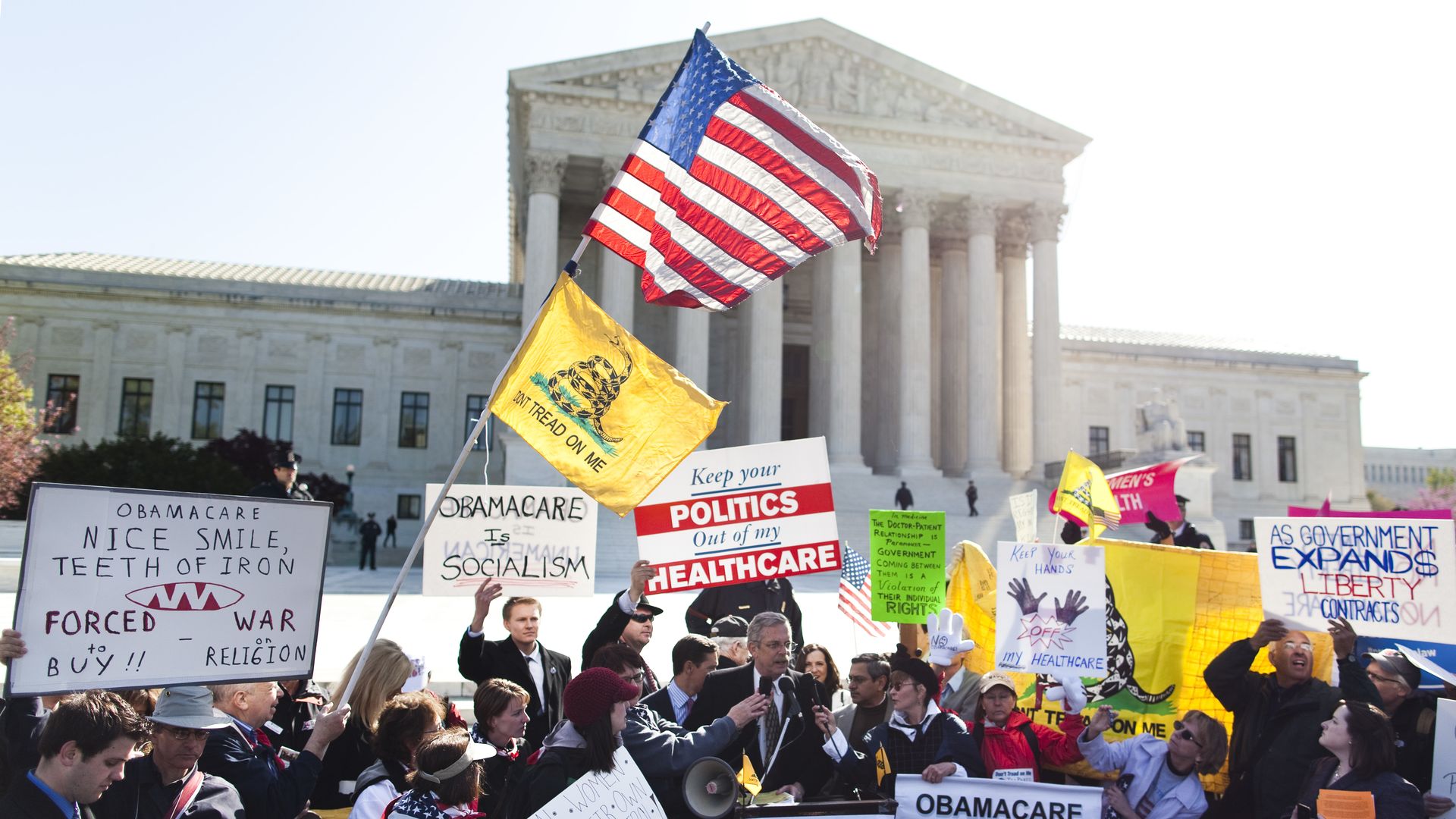
Affordable Care Act protesters in front of the Supreme Court


The Justice Department will not defend the Affordable Care Act in court, and says it believes the law’s individual mandate — the provision the Supreme Court upheld in 2012 — has become unconstitutional.

Why it matters: The Justice Department almost always defends federal laws when they’re challenged in court. Its departure from that norm in this case is a major development — career DOJ lawyers removed themselves from the case as the department announced this shift in its position.

The details: The ACA’s individual mandate requires most people to buy insurance or pay a tax penalty. The Supreme Court upheld that in 2012 as a valid use of Congress’ taxing power.

  • When Congress claimed it repealed the individual mandate last year, what it actually did was drop the tax penalty to $0.
  • So the coverage requirement itself is still technically on the books. And a group of Republican attorneys general, representing states led by Texas, say it’s now unconstitutional — because the specific penalty the Supreme Court upheld is no longer in effect.
  • The Justice Department agreed with that position in a brief filed Thursday night.
  • DOJ said the courts should strike down the coverage requirement, as well as the provision of the law that forces insurance companies to cover people with pre-existing conditions.

Between the lines: For the Justice Department to stop defending a federal law is not unprecedented — the Obama administration did it with the Defense of Marriage Act. But it is exceptionally rare.

Yes, but: A group of Democratic attorneys general has been granted permission to defend the ACA in this case, so someone will be in its corner.

What to watch: The argument against it is by no means a slam dunk. For starters, critics — now including the Justice Department — will have to prove that people are still being injured by the remaining shell of the individual mandate, even without a penalty for non-compliance.

Justice Dept. argues key parts of ObamaCare are unconstitutional

Justice Dept. argues key parts of ObamaCare are unconstitutional

Image result for aca challenge

The Department of Justice (DOJ) argued in court Thursday that key parts of ObamaCare are now unconstitutional, siding in large part with a conservative challenge to the law.

The move is a break from the norm of the DOJ to defend federal laws when they are challenged in court. Under President Trump, the department has opted not to defend a law that it strongly opposes.

Attorney General Jeff Sessions acknowledged in a letter to Speaker Paul Ryan (R-Wis.) that the DOJ has a “longstanding tradition” of defending federal laws, but argued that this is “a rare case where the proper course is to forgo defense” of the law.

The lawsuit in question was filed in February by Texas and 19 other GOP-led states, arguing that ObamaCare is unconstitutional and should be overturned.

Legal experts are deeply skeptical the challenge can succeed, and 17 Democratic-led states have already intervened to defend the law in the absence of DOJ action.

The DOJ argues that ObamaCare’s protections against people with pre-existing conditions being denied coverage or charged more should be invalidated, maintaining that the individual mandate that people have insurance or face a tax penalty is now unconstitutional.

The conservative states and DOJ point to the Supreme Court’s 2012 ruling that upheld ObamaCare’s individual mandate under Congress’s taxing power. Now that Congress has repealed the mandate penalty as part of last year’s tax bill – while technically keeping the mandate itself in place – they argue the mandate is no longer a tax and is now invalid.

They also argue that the key pre-existing condition protections cannot be separated from the mandate and should be invalidated. The DOJ argues the remainder of the law can stay.

The chances for that argument succeeding are viewed with deep skepticism by legal experts, in part because Congress itself indicated that the rest of ObamaCare could still stand without the mandate when it moved to repeal the tax penalty last year.

The case is currently before a federal district court judge in Texas, Reed O’Connor, who was appointed by former President George W. Bush.

Some supporters of ObamaCare view the DOJ’s move more as a damaging break from precedent rather than an actual serious legal threat to ObamaCare, since the lawsuit is unlikely to succeed.


Virginia Senate approves Medicaid expansion

Virginia Senate approves Medicaid expansion

Virginia Senate approves Medicaid expansion

Virginia is on the cusp of expanding Medicaid after the Senate on Wednesday narrowly approved a budget that would allow the state to cover as many as 400,000 low-income people.

The House, which already voted in favor of expansion earlier this year, will have to vote again before the bill can go to Gov. Ralph Northam (D). Northam has made expansion one of the top priorities of his administration.

When it passes, Virginia will become the 33rd state, along with Washington, D.C., to expand Medicaid under ObamaCare.

The 23-17 vote for expansion is a major victory for Virginia Democrats and other ObamaCare advocates, who have been fighting for six years to convince enough Republicans in the state to accept federal money to pay for the expansion.

“We have the ability to move something through that’s very sure in these uncertain times,” said Sen. Emmett Hanger, Jr., (R), the sponsor of the Medicaid expansion compromise bill. “We can develop a uniquely Virginia plan. While it draws from the experience of many states that have been out there before us, it will serve our citizens.”

Northam’s predecessor, Gov. Terry McAuliffe (D), was unable to get Republicans in the state to expand Medicaid, but Democrats in the state have been gaining power and nearly flipped the state’s House of Delegates in November.

Under ObamaCare, the federal government originally covered 100 percent of the costs of states that expanded Medicaid beginning in 2014. In 2017, the federal share dropped to 95 percent; it will drop to 90 percent in 2020, but never fall below that amount.

The Virginia expansion relies on provider taxes as a way to raise money.

The expansion agreement comes at a cost for Democrats, as the state will eventually submit a waiver request to the federal government to impose work requirements and premiums on beneficiaries who earn more than the federal poverty level.

The Trump administration has made state innovation a priority and has promised to fast-track Medicaid waivers, especially those that will impose work requirements on beneficiaries.

Four states have been granted permission to do so — Arkansas, Kentucky, Indiana and New Hampshire — and six others have pending waivers.

Virginia has yet to work out the final details of the work requirement, but Senate proponents of the policy rejected arguments from expansion opponents that the requirement would be weak and unenforceable.

Northam has not said he supports work requirements, but he has said he will sign any legislation that expands Medicaid.

National Republicans have been attempting to derail Medicaid expansion in Virginia. White House Office of Management and Budget Director Mick Mulvaney in March urged Virginia not to pursue expansion, saying it was unsustainable, and that the administration is committed to addressing it.

Earlier on Wednesday, former Pennsylvania Sen. Rick Santorum (R) met with Virginia Republicans to speak about efforts in Washington to repeal ObamaCare, including the Medicaid expansion. Santorum has been working with conservative groups on a long-shot plan to keep repeal alive this year.


It Costs $685 Billion a Year to Subsidize U.S. Health Insurance

https://www.bloomberg.com/news/articles/2018-05-23/it-costs-685-billion-a-year-to-subsidize-u-s-health-insurance


It will cost the U.S. government almost $700 billion in subsidies this year help provide Americans under age 65 with health insurance through their jobs or in government-sponsored health programs, according to a report from the nonpartisan Congressional Budget Office.

The subsidies come from four main categories. About $296 billion is federal spending on programs like Medicaid and the Children’s Health Insurance Program, which help insure low-income people. Almost as big are the tax write-offs that employers take for providing coverage to their workers. Medicare-eligible people, such as the disabled, account for $82 billion. Subsidies for Obamacare and for other individual coverage are the smallest segment, at $55 billion.

In total, the subsidies are equivalent to about 3.4 percent of the U.S. gross domestic product.

Financing Americans’ Insurance

In 2018, subsidizing health coverage will cost taxpayers almost $700 billion.

Also known as the Affordable Care Act, Obamacare reduced the number of uninsured, but 29 million people will likely go without health coverage in an average month this year, the CBO said. Thirty-five million Americans could lack coverage by 2028 as rising premiums and the elimination of the individual mandate drive more people to drop coverage.

The subsidies in the Affordable Care Act are designed to insulate people in the program from premium increases. The CBO projected that monthly premiums for a mid-range plan in the program will increase by 15 percent by 2019, and by about 7 percent annually through 2028.

One reason for the rising premiums is the actions of President Donald Trump. Last year, Trump topped funding for the cost-sharing reduction payments made to insurers under Obamacare to help Americans afford health costs.

The non-payment of those subsidies, less enforcement of a rule requiring people to have insurance and limited competition caused insurers to raise their premiums by about 34 percent in 2018, compared to 2017. That increased the cost of the subsidies to the federal government, according to the CBO.

States Take the Lead on Reinsurance to Stabilize the ACA Marketplaces

http://www.commonwealthfund.org/publications/blog/2018/may/reinsurance-to-stabilize-marketplaces?omnicid=EALERT1408707&mid=henrykotula@yahoo.com


Image result for reinsurance

Recent actions by Congress and the Trump administration are likely to disrupt Affordable Care Act (ACA) marketplaces in 2019, leading to higher premiums for individuals and families. These actions include Congress’ termination of financial penalties for failing to obtain health insurance and the administration’s resistance to paying cost-sharing reductions for low-income purchasers of marketplace coverage, its encouragement of the sale of short-term policies and association health plans, and its defunding of advertising and outreach in federally facilitated marketplaces. Recent estimates suggest that there have already been small but significant declines in coverage.

A total collapse of ACA marketplaces is unlikely because of continuing federal subsidies for the purchase of insurance by individuals with incomes below 400 percent of the federal poverty level. But those not eligible for subsidies may face higher premiums in some states, and some may be forced to forgo coverage. Those who remain in the market may be sicker than average, leading to a higher-risk pool and fueling premium increases.

A key way to mitigate the adverse effects of these recent policies is by offering reinsurance, a policy that is garnering bipartisan support at the federal and state levels.

What Is Reinsurance?

Reinsurance was a critical feature of ACA marketplaces in their first three years. The marketplaces were new, and insurers faced considerable uncertainty about the health status of enrollees. The law thus offered insurers some protection against unexpectedly high claims through a reinsurance program. Reinsurance protects insurers by limiting their exposure to very high, unpredictable medical expenses incurred by their members by covering some of those expenses when they exceed a certain threshold. For example, the ACA stipulated that insurers with claims costs that exceeded a threshold amount for a particular individual — $45,000 in 2014 — qualified for reinsurance payments for 100 percent of the excess up to $250,000. The program was financed by fees on both individual and employer plans, including self-insured employers, and was thus deficit neutral. It is estimated that reinsurance reduced average premiums in the marketplaces by as much as 14 percent.

The ACA legislation phased down the reinsurance program over 2014–2016 since it was assumed that as insurers gained more familiarity with enrollees, they could price their products with greater certainty. After the program ended in 2016, premiums rose in 2017 more sharply than they had in prior years, an increase that was partly attributed to the loss of reinsurance.

Industry stakeholders and health policy experts have suggested that reinsurance could stabilize the individual market. Researchers Chrissy Eibner and Jody Liu of RAND estimated that reinstating the reinsurance program could reduce premiums in the marketplaces by 3.9 percent to 19.3 percent in 2020, depending on the generosity of the program. Because lower premiums also reduce what the federal government spends on tax credits, the researchers projected federal deficit savings of $2.9 billion to $13.1 billion. However, the researchers also assume that some of those fees ultimately would be passed on to people enrolled in private plans.

Federal reinsurance programs have appeared in a number of recent Congressional bills. Last year, ACA repeal-and-replace bills included reinsurance programs for the individual market that would be financed directly by the federal government. Senators Susan Collins (R–Maine) and Bill Nelson (D–Fla.) introduced a bill with a similarly structured reinsurance program at the end of 2017. And a recently introduced bill from Senators Jeff Merkley (D–Ore.) and Chris Murphy (D–Conn.) proposing that a Medicare plan be offered through the marketplaces and by employers also includes a reinsurance program.

Some of these proposals would fund reinsurance through upfront federal expenditures, rather than charging fees to insurers. Deficit reductions could be lower under this scenario, but may still be possible because the federal expenditures on reinsurance would be offset by savings on lower tax credit expenditures as premiums fall. However, the RAND researchers find that the cost to taxpayers would be about the same under both approaches, since insurers would likely pass on fees to their customers in the form of higher premiums.

States Take the Lead

In the absence of consensus in Congress on how to strengthen the marketplaces, several states have secured, or are seeking, approval from the federal government to establish state-based reinsurance programs through the ACA’s innovation waiver program. Under the waiver program, states can make changes to their marketplaces as long as they cover at least the same number of people and maintain the same levels of affordability. Reinsurance has been the most common innovation pursued by states.

Alaska, Minnesota, and Oregon have received federal approval to establish reinsurance programs. There are notable differences in their approaches:

  • In Alaska, medical claims for individuals with at least one of 33 high-cost conditions are covered by the Alaska Reinsurance Program. The program was responsible for preventing the state’s last remaining insurer from leaving the individual market in 2017.
  • In Minnesota, the reinsurance program covers 80 percent of claims for individuals up to $250,000 once a $50,000 threshold is passed. For the 2018 plan year, insurers submitted two sets of premiums, one assuming reinsurance and one without it. The rates accounting for reinsurance were approximately 20 percent lower.
  • Oregon’s waiver application sought approval for a program that would reimburse 50 percent of claims between a yet-to-be-established threshold up to $1 million. The U.S. Department of Health and Human Services approved the proposal in October 2017.

Six more states have passed legislation or submitted applications to establish reinsurance programs.

  • On May 9, Maine became the latest state to submit a waiver application to the federal government seeking funding for a state-based reinsurance program. Earlier this year on April 18, Wisconsin also submitted a waiver application for a reinsurance program.
  • New Hampshire and Louisiana are developing similar applications, and New Jersey and Maryland passed legislation in April to establish state-operated reinsurance programs.

Experience with reinsurance programs clearly demonstrates their efficacy in reducing health insurance premiums in the private individual market. Implemented at the federal level, such programs also reduce federal spending and deficits. Though enterprising states are moving forward with these initiatives, a more comprehensive national effort to help private insurers manage unpredictable risks in individual health insurance markets has enduring appeal.


Despite Attacks on Obamacare, the Uninsured Rate Held Steady Last Year

The Uninsured Rate Held Steady

Image result for Despite Attacks on Obamacare, the Uninsured Rate Held Steady Last Year


The numbers suggest a surprising resilience of the health law.

Last year, Trump administration officials declared Obamacare “dead,” pulled enrollment ads offline, distributed social media videos critical of the law and sent signals that the law’s requirement to buy health insurance was no longer in effect.

But the number of Americans with health insurance stayed largely unchanged. The results of a big, government survey on health insurance status were published Tuesday, and they show that the uninsured rate remained basically flat at 9.1 percent in the first year of the Trump presidency.

The numbers suggest a surprising resilience of the health law, and its expansion of insurance coverage, even in the face of efforts that the law’s defenders call “sabotage.”

The new statistics come from the Centers for Disease Control and Prevention, which monitors the number of Americans with and without health insurance every quarter. Some smaller private surveys, from Gallup and the Commonwealth Fund had shown the uninsured rate rising last year. But the C.D.C. research includes a larger sample size, and is generally regarded as a more definitive study. Tuesday’s study contains data from the entire calendar year of 2017.

Among states that expanded their Medicaid programs under the Affordable Care Act, the uninsured rate actually fell last year. Among states that didn’t expand, it rose a little.

Overall, Obamacare has substantially reduced the number of Americans without insurance. According to the report, 19.3 million fewer people were living without health insurance in 2017 compared with 2010, when the Affordable Care Act passed Congress.

New health insurance options aren’t the only thing that has changed since the passage of the Affordable Care Act. A strengthening economy has nudged more Americans into the work force, increasing people’s access to health insurance at work.

Obamacare has shown other signs of hardiness. This year, the Trump administration slashed the program’s advertising budget by 90 percent, and withdrew key subsidies from insurance companies, leading to premium increases for some customers. But every market had at least one insurer that continued to offer plans on the Obamacare marketplaces, and sign-ups dipped only slightly.

That does not mean that the insurance trends will hold forever. There are several reasons the uninsured rate may rise in the future:

  • In the face of rising premiums, it is likely that some who do not qualify for federal subsidies have dropped coverage this year.

  • Several states are trying to set up work or other “community engagement” requirements for some Medicaid beneficiaries. A few will impose such rules this year. States requesting such changes estimate they will result in a declining number of residents covered by Medicaid.

  • The Trump administration is working on regulations to allow more loosely regulated insurance plans into the market. These plans could prove appealing to some people who are currently uninsured. But they could cause prices to rise for insurance plans with all of the Obamacare consumer protections, prompting other people to drop their coverage. According to an estimate from the Urban Institute, about 2.6 million fewer people may have comprehensive coverage next year.

  • The tax penalty for people who decline to obtain insurance will disappear entirely next year. That change alone is likely to cause several million fewer Americans to have insurance. Early filings by insurance carriers suggest the change will cause another round of big price increases. And economists at the Congressional Budget Office estimate that the policy’s disappearance will also cause fewer people eligible for government help from even investigating such options.

The combination of those changes is likely to mean some backsliding. But last year’s data suggest that Obamacare’s policies have helped create options that are appealing to many Americans who would have gone without insurance in the years before its passage.


Implications of the ACA Medicaid Expansion: A Look at the Data and Evidence

Implications of the ACA Medicaid Expansion: A Look at the Data and Evidence


More than four years after the implementation of the Medicaid expansion included in the Affordable Care Act, debate and controversy around the implications of the expansion continue. Despite a large body of research that shows that the Medicaid expansion results in gains in coverage, improvements in access and financial security, and economic benefits for states and providers, some argue that the Medicaid expansion has broadened the program beyond its original intent diverting spending from the “truly needy”, offers poor quality and limited access to providers, and has increased state costs. New proposals allow states to implement policies never approved before including conditioning Medicaid eligibility on work or community engagement. New complex requirements run counter to the post-ACA movement of Medicaid integration with other health programs and streamlined enrollment processes. This brief examines evidence of the effects of the Medicaid expansion and some changes being implemented through waivers. Many of the findings on the effects of expansion cited in this brief are drawn from the 202 studies included in our comprehensive literature review that includes additional citations on coverage, access, and economic effects of the Medicaid expansion. Key findings include the following:

  • Coverage: Research and data show that Medicaid expansion has resulted in coverage gains without diverting coverage from traditional groups; for example, data do not support a relationship between states’ expansion status and community-based services waiver waiting lists. Reductions in Medicaid coverage would result in an increase in the uninsured population.
  • Access, Affordability, and Health Outcomes: Research demonstrates that Medicaid generally, and expansion specifically, positively affects access to care, utilization of services, the affordability of care, and financial security among the low-income population. While there is a growing body of evidence on Medicaid and outcomes, further research is needed to more fully determine the health effect of expansion on outcomes given that measureable changes take time to occur.
  • Economic Effects: Analyses find positive economic effects of expansion largely tied to the infusion of federal dollars, despite Medicaid enrollment growth initially exceeding projections in many states. Some studies look at 2014-2016 when expansion costs were 100% financed by the federal government, others studies project net fiscal gains even after states start to pay a share of expansion costs (up to 10% by 2020). Studies also show that Medicaid expansion resulted in reductions in uninsured visits and uncompensated care costs for hospitals, clinics, and other providers.
  • Expansion and Work: Studies find that Medicaid expansion has had positive or neutral effects on employment and the labor market and new work requirement proposals add complexity and could result in coverage losses for many who are working or face barriers to work.


Americans’ Confidence in Their Ability to Pay for Health Care Is Falling

http://www.commonwealthfund.org/publications/blog/2018/may/americans-confidence-paying-health-care-falling?omnicid=CFC1404232&mid=henrykotula@yahoo.com

President Trump is expected to soon address the nation about the rising cost of prescription drugs. But Americans are worried about more than drug prices. New findings from the Commonwealth Fund Affordable Care Act Tracking Survey show that consumers’ confidence in their ability to afford all their needed health care continues to decline.

Last week, we reported that the survey indicated a small but significant increase in the uninsured rate among working-age adults since 2016. In this post, we look at people’s views of the affordability of their health care. The Affordable Care Act Tracking Survey is a nationally representative telephone survey conducted by SSRS that tracks coverage rates among 19-to-64-year-olds, and has focused in particular on the experiences of adults who have gained coverage through the marketplaces and Medicaid. The latest wave of the survey was conducted between February and March 2018.1

Findings

Confidence in Ability to Afford Health Care Continues to Decline

In each wave of the survey, we’ve asked respondents whether they have confidence in their ability to afford health care if they were to become seriously ill. In 2018, 62.4 percent of adults said they were very or somewhat confident they could afford their health care, down from a high of nearly 70 percent in 2015 (Table 1). Only about half of people with incomes less than 250 percent of poverty ($30,150 for an individual) were confident they could afford care if they were to become very sick, down from 60 percent in 2015 and about 20 percentage points lower than the rate for adults with higher incomes. There were also significant declines in confidence among young adults, those ages 50 to 64, women, and people with health problems. Declines were significant among both Democrats and Republicans.

People in Employer Plans Have the Greatest Confidence in Their Insurance

We asked people with health insurance how confident they were that their current insurance will help them afford the health care they need this year. Majorities of adults were somewhat or very confident in their coverage; those with employer coverage were the most confident. More than half (55%) of adults insured through an employer were very confident their coverage would help them afford their care compared to 31 percent of adults with individual market coverage and 41 percent of people with Medicaid (Table 2). The least confident were adults enrolled in Medicare. Working-age adults enrolled in Medicare were the sickest among insured adults and the second-poorest after those covered by Medicaid (data not shown).2

One-Quarter of Adults Said Health Care Became Harder to Afford

We asked people whether, over the past year, their health care, including prescription drugs, had become harder for them to afford, easier to afford, or if there had been no change. The majority (66%) said there had been no change, one-quarter (24%) said it had become harder to afford, and 8 percent said it had become easier (Table 3). People with individual market coverage were significantly more likely than those with employer coverage or Medicaid to say health care had become harder to afford. About one-third of adults with deductibles of $1,000 or more said health care had become harder to afford, twice the share of those who had no deductible. About one-third of those enrolled in Medicare and 41 percent who were uninsured also reported that their health care had become harder to afford.

Only About Half of Americans Would Have Money to Pay for an Unexpected Medical Bill

Accidents and other medical emergencies can leave both uninsured and insured people with unexpected medical bills, which usually require prompt payment. We asked people if they would have the money to pay a $1,000 medical bill within 30 days in the case of an unexpected medical event. Nearly half (46%) said they would not have the money to cover such a bill in that time frame (Table 4). Women, people of color, people who are uninsured, those covered by Medicaid or Medicare, and those with incomes under 250 percent of poverty were among the most likely to say they couldn’t pay the bill.

Health Care Is Among People’s Top Four Greatest Personal Financial Concerns

Fourteen percent of adults said that health care was their biggest personal financial concern, after mortgage or rent (23%), student loans (17%), and retirement (17%) (Table 5). Those most likely to cite health care as their greatest financial concern were people who could potentially face high out-of-pocket costs because they were uninsured or had high-deductible health plans.

Policy Implications

Uninsured adults are the least confident in their ability to pay medical bills. But the risk of high out-of-pocket health care costs doesn’t end when someone enrolls in a health plan. The proliferation and growth of high-deductible health plans in both the individual and employer insurance markets is leaving people with unaffordable health care costs. Many adults enrolled in Medicare for reasons of disability or serious illness also report unease about their health care costs. An estimated 41 million insured adults have such high out-of-pocket costs and deductibles relative to their incomes that they are effectively underinsured. As this survey indicates, the nation’s health care cost burden is felt disproportionately by people with low and moderate incomes, people of color, and women.

The ACA’s reforms to the individual insurance market have doubled the number of people who now get insurance on that market to an estimated 17 million, with approximately half receiving subsidies through the ACA marketplaces. The ACA also has made it possible for people who were regularly denied coverage by insurers — older Americans and those with health problems — to get insurance. They are now entitled by law to an offer should they want to buy a plan.

But as this survey suggests, the ACA’s reforms did not fully resolve the individual market’s relatively higher costs for all those enrolled, compared to employer coverage or Medicaid. Moreover, recent actions by Congress and the Trump administration, including the repeal of the individual mandate penalty and loosened restrictions on plans that don’t comply with the ACA, are expected to exacerbate those costs for many. In the survey, people with individual market coverage are more likely than those with employer coverage or Medicaid to say that their health care, including prescription drugs, has become harder to afford in the past year. They express less confidence than those with employer coverage that their insurance will help them afford their care this year. As explained in the first post, there are a number of policy options that Congress can pursue that would improve individual market insurance’s affordability and cost protection. In the absence of bipartisan Congressional agreement on legislation, several states are currently pursuing their own solutions. But if current trends continue, the federal government will likely confront growing pressure to provide a national solution to America’s incipient health care affordability crisis.