Debt Sickened a Hospital Giant. Now the Doctors Are Revolting

https://www.bloomberg.com/news/articles/2017-09-21/debt-sickened-a-hospital-giant-now-the-doctors-are-revolting?


The standoff over Lutheran shows how for-profit chain CHS, once the nation’s largest, allowed its facilities to decay, compromising care and destroying investor value.

Four doctors from Lutheran Hospital in Fort Wayne, Ind., showed up at parent company Community Health Systems Inc. in May with a message for Chief Executive Officer Wayne Smith and his board. Physicians were in widespread revolt, they said. Facilities were cash-strapped and crumbling. Powerful locals wanted CHS to reinvest or leave.

The doctors urged Smith to sell the eight-hospital Lutheran Health Network to their physician group, which already owned a 20 percent stake, and an investor partner, for $2.4 billion—triple CHS’s current market value. The combative 71-year-old CEO denied authorizing cost cuts in Fort Wayne and demanded the names of those who did, say people in the meeting. The board refused the offer, and rather than pursue the budget-cutters, Smith fired Lutheran’s CEO, who’d sided with the doctors.

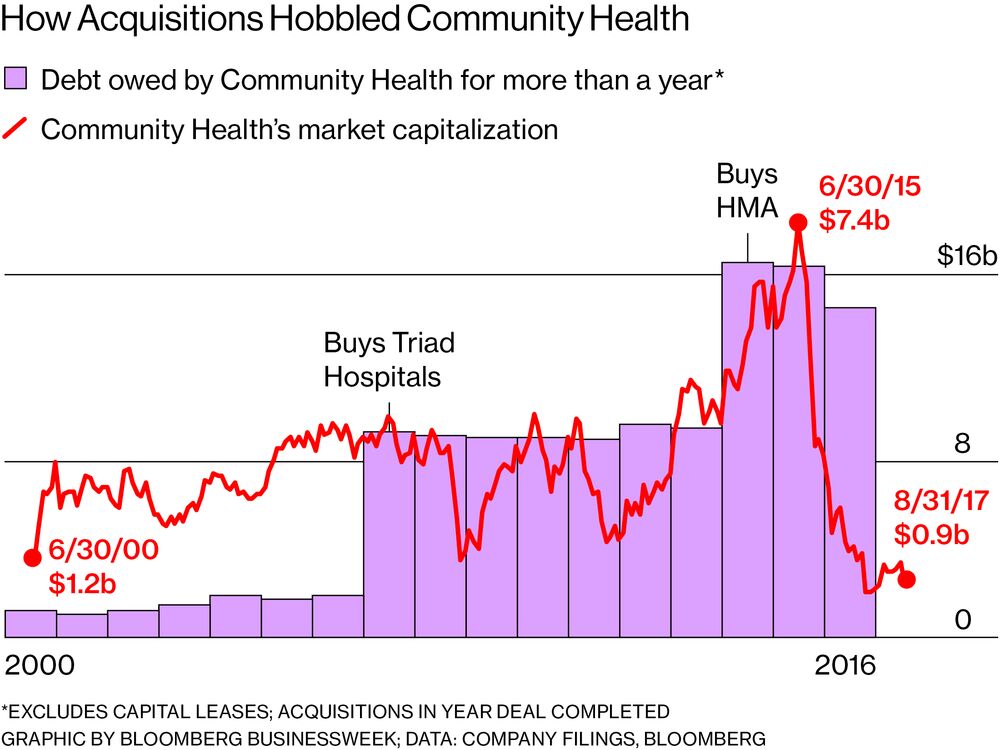
The standoff over Lutheran provides a window into how CHS, once the largest for-profit hospital chain in the U.S., has allowed facilities to languish, possibly compromising care and destroying investor value in the process. Smith presided over a decade-long acquisition binge that saddled CHS with total debt of almost eight times its earnings and a network of underperforming facilities. The company lost $2 billion in the past six quarters, during which doctors from Key West to Spokane have accused the chain of pinching pennies and regulators have fined it for overcharging Medicare. Says Indiana Republican Representative Jim Banks, who’s sided with the Fort Wayne doctors: “It’s buy, squeeze, and repeat.”

“At some point you reach a dead end, and you can’t cut the expenses anymore”

Smith took CHS public in 2001, just four years after coming to the company from Humana Inc., where he’d been head of hospital operations. The big acquisitions began in 2007, when the chain bought Texas-based Triad Hospitals Inc. for $6.4 billion, more than quadrupling its debt. Smaller deals followed. By the end of 2014, CHS had nearly doubled its debt again to finance its buyout of Health Management Associates LLC (HMA), a Florida-based group of mostly rural facilities that required costly upgrades.

Smith’s plan was to try to increase doctor productivity and slash costs, often replacing experienced doctors with loyal patients for younger ones who were willing to work longer hours. Like most for-profit operators, “they focused on cost control,” says Joshua Nemzoff of Nemzoff & Co., who advises hospitals on sale transactions. “At some point you reach a dead end, and you can’t cut the expenses anymore.”

Along with the rest of the hospital industry, CHS expected the Affordable Care Act to provide a windfall of insurance money from the newly covered. Investor enthusiasm soured when 19 states—including Florida and Texas, two key CHS markets—declined to expand Medicaid eligibility, leaving many low-income people without coverage. At the same time, insurers and other government programs began working to divert patients from hospitals into doctors’ offices, outpatient clinics, and other less expensive venues. The combined effect was particularly hard on rural hospitals, a large share of CHS’s network.

Raising prices while slashing costs has been a hallmark of CHS under Smith. In Fort Wayne, Lutheran charges more than rival Parkview Medical Center Inc. for 8 of 10 common medical procedures. During the first half of this year, patients were placed in beds in Lutheran’s emergency room hallways because the wards they should have been moved to were understaffed, and a leaking air conditioner in the neonatal care unit was dripping water on infants’ beds, according to people familiar with the conditions. While Parkview invested in its cancer and cardiac units, Lutheran doctors said at the board meeting that the CHS hospital was using lower-priced monitors they feared would miss potentially fatal heart rhythms.

Company spokeswoman Tomi Galin said in an email that many other hospitals use the same monitors. Nevertheless, CHS plans to spend $500 million on improvements and will recruit new doctors at Lutheran, she wrote, adding that employee retention there is rising.

Other critics of Smith have taken their complaints to court. After Gregg Becker quit his job as chief financial officer of CHS’s Rockwood Clinic in Spokane, Wash., in 2012, he filed a whistleblower claim with the U.S. Department of Labor, saying his superiors told him to reduce the facility’s forecast loss from $12.8 million to $4 million and threatened to fire him if he didn’t. Becker was awarded a settlement of almost $1.9 million by an administrative law judge, according to court documents. CHS has appealed the case to the Washington Supreme Court and the federal Arbitration and Review Board. (CHS sold Rockwood earlier this year.)

In 2014, CHS agreed to pay $98.15 million to the Department of Justice to settle lawsuits in five different districts accusing the company of charging for higher-cost inpatient services at hospitals, including Lutheran, when less expensive outpatient services would have been sufficient. CHS didn’t admit wrongdoing. But the DOJ in a statement said the company had “engaged in a deliberate corporate-driven scheme to increase inpatient admissions of Medicare, Medicaid, and the Department of Defense’s Tricare program.”

With losses mounting and the stock down more than 80 percent from its peak in June 2015, Smith has resorted to selling hospitals to pay off debt. One result: CHS will soon be about the same size it was before it attempted to digest HMA. Hedge fund ASL Strategic Value, a CHS shareholder, sent a letter to the board on Aug. 8 asking directors to replace Smith. Tom Kelley, a Fort Wayne car dealer whose employees rely on Lutheran for care, quit the Lutheran board in July and says he’s reviewing his employee medical plan. He tried and failed to broker a peace deal between the doctors and Smith.

“He’s a street fighter,” Kelley says of Smith. “He has survived government actions against him. He has survived lawsuits. He has survived all of this by being a tough SOB.”


BOTTOM LINE – Community Health Systems used acquisitions to become a major for-profit hospital operator. But the added heft wasn’t matched by profitability gains.


5 Ways the Graham-Cassidy Proposal Puts Medicaid Coverage At Risk

5 Ways the Graham-Cassidy Proposal Puts Medicaid Coverage At Risk

Image result for 5 Ways the Graham-Cassidy Proposal Puts Medicaid Coverage At Risk


The Graham-Cassidy proposal to repeal and replace the Affordable Care Act (ACA) is reviving the federal health reform debate and could come up for a vote in the Senate in the next two weeks before the budget reconciliation authority expires on September 30. The Graham-Cassidy proposal goes beyond the American Health Care Act (AHCA) passed by the House in May and the Better Care Reconciliation Act (BCRA) that failed in the Senate in July. The Graham-Cassidy proposal revamps and cuts Medicaid, redistributes federal funds across states, and eliminates coverage for millions of poor Americans as described below:
  1. Ends federal funding for current ACA coverage and partially replaces that funding with a block grant that expires after 2026. The proposal ends both the authority to cover childless adults and funding for the ACA Medicaid expansion that covers 15 million adults. Under Graham-Cassidy, a new block grant, the “Market-Based Health Care Grant Program,” combines federal funds for the ACA Medicaid expansion, premium and cost sharing subsidies in the Marketplace, and states’ Basic Health Plans for 2020-2026. Capped nationally, the block grant would be lower than ACA spending under current law and would end after 2026. States would need to replace federal dollars or roll back coverage. Neither the AHCA nor the BCRA included expiration dates for ACA-related federal funds or eliminated the ability for states to cover childless adults through Medicaid.
  2. Massively redistributes federal funding from Medicaid expansion states to non-expansion states through the block grant program penalizing states that broadened coverage. In 2020, block grant funds would be distributed based on federal spending in states for ACA Medicaid and Marketplace coverage. By 2026, funding would go to states according to the states’ portion of the population with incomes between 50% and 138% of poverty; the new allocation is phased in over the 2021-2025 period. The Secretary has the authority to make other adjustments to the allocation. This allocation would result in a large redistribution of ACA funding by 2026, away from states that adopted the Medicaid expansion and redirecting funding to states that did not. No funding is provided beyond 2026.
  3. Prohibits Medicaid coverage for childless adults and allows states to use limited block grant funds to purchase private coverage for traditional Medicaid populations. States can use funds under the block grant to provide tax credits and/or cost-sharing reductions for individual market coverage, make direct payments to providers, or provide coverage for traditional Medicaid populations through private insurance. The proposal limits the amount of block grant funds that a state could use for traditional Medicaid populations to 15% of its allotment (or 20% under a special waiver). These limits would shift coverage and funds for many low-income adults from Medicaid to individual market coverage. Under current law, 60% of federal ACA coverage funding is currently for the Medicaid expansion (covering parents and childless adults). Medicaid coverage is typically more comprehensive, less expensive and has more financial protections compared to private insurance. The proposal also allows states to roll back individual market protections related to premium pricing, including allowing premium rating based on health status, and benefits currently in the ACA.
  4. Caps and redistributes federal funds to states for the traditional Medicaid program for more than 60 million low-income children, parents, people with disabilities and the elderly. Similar to the BCRA and AHCA, the proposal establishes a Medicaid per enrollee cap as the default for federal financing based on a complicated formula tied to different inflation rates. As a result, federal Medicaid financing would grow more slowly than estimates under current law. In addition to overall spending limits, similar to the BCRA, the proposal would give the HHS Secretary discretion to further redistribute capped federal funds across states by making adjustments to states with high or low per enrollee spending.
  5. Eliminates federal funding for states to cover Medicaid family planning at Planned Parenthood clinics for one year. Additional funding restrictions include limits on states’ ability to use provider tax revenue to finance Medicaid as well as the termination of the enhanced match for the Community First Choice attendant care program for seniors and people with disabilities. Enrollment barriers include the option for states to condition Medicaid eligibility on a work requirement and to conduct more frequent redeterminations.
Much is at stake for low-income Americans and states in the Graham-Cassidy proposal. The recent debate over the AHCA and the BCRA has shown the difficulty of making major changes that affect coverage for over 70 million Americans and reduce federal funding for Medicaid. Medicaid has broad support and majorities across political parties say Medicaid is working well. More than half of the states have a strong stake in continuing the ACA Medicaid expansion as it has provided coverage to millions of low-income residents, reduced the uninsured and produced net fiscal benefits to states. Graham-Cassidy prohibits states from using Medicaid to provide coverage to childless adults. With regard to Medicaid financing changes, caps on federal funding could shift costs to states and result in less fiscal flexibility for states. States with challenging demographics (like an aging population), high health care needs (like those hardest hit by the opioid epidemic), high cost markets or states that operate efficient programs may have the hardest time responding to federal caps on Medicaid spending. Faced with substantially reduced federal funding, states would face difficult choices: raise revenue, reduce spending in other areas, or cut Medicaid provider payments, optional benefits, and/or optional coverage groups.

Last-Ditch Effort By Republicans To Replace ACA: What You Need To Know

http://khn.org/news/last-ditch-gop-effort-to-replace-aca-5-things-you-need-to-know/

Related image

Republican efforts in Congress to “repeal and replace” the federal Affordable Care Act are back from the dead. Again.

While the chances for this last-ditch measure appear iffy, many GOP senators are rallying around a proposal by Sens. Lindsey Graham (R-S.C.) and Bill Cassidy (R-La.), along with Sens. Dean Heller (R-Nev.) and Ron Johnson (R-Wis.)

They are racing the clock to round up the needed 50 votes — and there are 52 Senate Republicans.

An earlier attempt to replace the ACA this summer fell just one vote short when Sens. Susan Collins (R-Maine), Lisa Murkowski (R-Alaska) and John McCain (R-Ariz.) voted against it. The latest push is setting off a massive guessing game on Capitol Hill about where the GOP can pick up the needed vote.

After Sept. 30, the end of the current fiscal year, Republicans would need 60 votes ­— which means eight Democrats — to pass any such legislation because special budget rules allowing approval with a simple majority will expire.

Unlike previous GOP repeal-and-replace packages that passed the House and nearly passed the Senate, the Graham-Cassidy proposal would leave in place most of the ACA taxes that generated funding to expand coverage for millions of Americans. The plan would simply give those funds as lump sums to each state. States could do almost whatever they please with them. And the Congressional Budget Office has yet to weigh in on the potential impact of the bill, although earlier estimates of similar provisions suggest premiums would go up and coverage down.

“If you believe repealing and replacing Obamacare is a good idea, this is your best and only chance to make it happen, because everything else has failed,” said Graham in unveiling the bill last week.

Here are five things to know about the latest GOP bill: 

1. It would repeal most of the structure of the ACA.

The Graham-Cassidy proposal would eliminate the federal insurance exchange, healthcare.gov, along with the subsidies and tax credits that help people with low and moderate incomes — and small businesses — pay for health insurance and associated health costs. It would eliminate penalties for individuals who fail to obtain health insurance and employers who fail to provide it.

It would eliminate the tax on medical devices. 

2. It would eliminate many of the popular insurance protections, including those for people with preexisting conditions, in the health law.

Under the proposal, states could “waive” rules in the law requiring insurers to provide a list of specific “essential health benefits” and mandating that premiums be the same for people regardless of their health status. That would once again expose people with preexisting health conditions to unaffordable or unavailable coverage. Republicans have consistently said they wanted to maintain these protections, which polls have shown to be popular among voters.

3. It would fundamentally restructure the Medicaid program.

Medicaid, the joint-federal health program for low-income people, currently covers more than 70 million Americans. The Graham-Cassidy proposal would end the program’s expansion under the ACA and cap funding overall, and it would redistribute the funds that had provided coverage for millions of new Medicaid enrollees. It seeks to equalize payments among states. States that did not expand Medicaid and were getting fewer federal dollars for the program would receive more money and states that did expand would see large cuts, according to the bill’s own sponsors. For example, Oklahoma would see an 88 percent increase from 2020 to 2026, while Massachusetts would see a 10 percent cut.

The proposal would also bar Planned Parenthood from getting any Medicaid funding for family planning and other reproductive health services for one year, the maximum allowed under budget rules governing this bill. 

4. It’s getting mixed reviews from the states.

Sponsors of the proposal hoped for significant support from the nation’s governors as a way to help push the bill through. But, so far, the governors who are publicly supporting the measure, including Scott Walker (R-Wis.) and Doug Ducey (R-Ariz.), are being offset by opponents including Chris Sununu (R-N.H.), John Kasich (R-Ohio) and Bill Walker (I-Alaska).

On Tuesday 10 governors — five Democrats, four Republicans and Walker — sent a letterto Senate leaders urging them to pursue a more bipartisan approach. “Only open, bipartisan approaches can achieve true, lasting reforms,” said the letter.

Bill sponsor Cassidy was even taken to task publicly by his own state’s health secretary. Dr. Rebekah Gee, who was appointed by Louisiana’s Democratic governor, wrote that the bill “uniquely and disproportionately hurts Louisiana due to our recent [Medicaid] expansion and high burden of extreme poverty.”

5. The measure would come to the Senate floor with the most truncated process imaginable.

The Senate is working on its Republican-only plans under a process called “budget reconciliation,” which limits floor debate to 20 hours and prohibits a filibuster. In fact, all the time for floor debate was used up in July, when Republicans failed to advance any of several proposed overhaul plans. Senate Majority Leader Mitch McConnell (R-Ky.) could bring the bill back up anytime, but senators would immediately proceed to votes. Specifically, the next order of business would be a process called “vote-a-rama,” where votes on the bill and amendments can continue, in theory, as long as senators can stay awake to call for them.

Several senators, most notably John McCain, who cast the deciding vote to stop the process in July, have called for “regular order,” in which the bill would first be considered in the relevant committee before coming to the floor. The Senate Finance Committee, which Democrats used to write most of the ACA, has scheduled a hearing for next week. But there is not enough time for full committee consideration and a vote before the end of next week.

Meanwhile, the Congressional Budget Office said in a statement Tuesday that it could come up with an analysis by next week that would determine whether the proposal meets the requirements to be considered under the reconciliation process. But it said that more complicated questions like how many people would lose insurance under the proposal or what would happen to insurance premiums could not be answered “for at least several weeks.”

That has outraged Democrats, who are united in opposition to the measure.

“I don’t know how any senator could go home to their constituents and explain why they voted for a major bill with major consequences to so many of their people without having specific answers about how it would impact their state,” said Senate Minority Leader Chuck Schumer (D-N.Y.) on the Senate floor Tuesday.

Exposure Draft: U.S. Not-For-Profit Hospitals andHealth Systems Rating Criteria

https://www.fitchratings.com/site/re/895646

Image result for Fitch U.S. Not-For-Profit Hospitals

Fitch Ratings has proposed rating criteria changes for nonprofit hospitals and health systems.

Here are five things to know.

1. Fitch said the proposed criteria changes include introduction of revenue defensibility, operating risk and financial profile rating factors as well as individual assessments for each of those factors.

2. Other proposed criteria changes from Fitch include “financial profile alignment with business profile in rating assessment; forward looking consideration of the impact of existing or needed capital investments that may increase financial leverage; and introduction of FAST, an issuer specific scenario analysis tool measuring investment portfolio stress linked to asset allocation, stress on revenue and cost growth rates.”

3. The overall goal with the proposed criteria changes is “to communicate Fitch’s credit ratings more clearly and better express the characteristics that affect a credit’s relative resilience in changing economic conditions,” said Fitch Senior Director Kevin Holloran.

He added, “Fitch believes that this will facilitate a more forward-looking approach to ratings and will better highlight differences among credits within the same rating category.”

4. The agency said it anticipates “fewer than 15 percent of ratings will be affected, with a roughly equal mix of upgrades and downgrades” as a result of the proposed criteria changes.

5. Fitch is accepting comments on the proposed criteria changes via email until Oct. 20. The full Fitch report on the proposed criteria changes is available here.

Moody’s: Nonprofit healthcare medians reversed trajectory in FY 2016

http://www.beckershospitalreview.com/finance/moody-s-nonprofit-healthcare-medians-reversed-trajectory-in-fy-2016.html

Image result for hospital belt tightening

Annual expense growth for nonprofit and public healthcare organizations outpaced annual revenue growth in fiscal year 2016, according to Moody’s Investors Service.

After years of cost containment, annual expense growth hit 7.2 percent in fiscal year 2016, which outpaced annual revenue growth of 6 percent. The expenses were fueled by several factors, including rising pension contributions and higher labor and pharmaceutical costs, according to Moody’s.

“Higher expenses coupled with positive, albeit slower, revenue growth, contributed to lower profitability, tempered liquidity growth, and moderation of nearly all financial metrics,” said Beth Wexler, a Moody’s vice president.

Ms. Wexler said total admissions at nonprofit and public hospitals grew in fiscal year 2016, but the growth rate slowed due to stabilization of the uninsured population.

The medians are based on an analysis of audited fiscal year 2016 financial statements for 323 freestanding hospitals, single-state health systems and multi-state healthcare systems, representing 81 percent of all Moody’s rated healthcare entities.

5 hospitals with strong finances

http://www.beckershospitalreview.com/finance/5-hospitals-with-strong-finances-080117.html

Here are five hospitals and health systems with strong operational metrics and solid financial positions according to recent reports from Fitch Ratings, Moody’s Investors Service and S&P Global Ratings.

Note: This is not an exhaustive list. Hospital and health system names were compiled from recent credit rating reports and are listed in alphabetical order.

1. Coral Gables-based Baptist Health South Florida has an “AA-” rating and stable outlook with S&P. The system maintained key balance sheet metrics and generated better-than-projected financial results in fiscal year 2016, according to S&P.

2. Carolinas HealthCare System has an “Aa3” rating and stable outlook with Moody’s. The Charlotte, N.C.-based system has a track record of good financial performance, strong balance sheet metrics and a large scope of operations with multiple hospitals. Moody’s expects Carolinas HealthCare System to maintain stable leverage metrics while continuing to generate financial results at current levels.

3. Children’s Healthcare of Atlanta has an “Aa2” rating and stable outlook with Moody’s. CHOA is a leading provider of high acuity pediatric care in the Atlanta area and has favorable leverage metrics and a track record of strong margins and liquidity, according to Moody’s.

4. Cleveland Clinic Health System has an “Aa2” rating and stable outlook with Moody’s. The system has a track record of meeting operating challenges to sustain strong cash flow, exceptional fundraising capabilities, strong liquidity and a growing ability to leverage an international brand into revenue diversification, according to Moody’s. The debt rating agency expects Cleveland Clinic to manage execution risks of multiple strategies, as demonstrated in the past.

5. Broomfield, Colo.-based SCL Health has an “AA-” rating and stable outlook with Fitch. The system’s operating performance improved in fiscal year 2015, and SCL has sustained those results, according to Fitch. The system has manageable capital needs in the near term, a stable liquidity position and geographic diversity, with 12 hospitals in five markets across three states.


9 recent hospital, health system outlook and credit rating actions

http://www.beckershospitalreview.com/finance/9-recent-hospital-health-system-outlook-and-credit-rating-actions.html

Image result for credit ratings

The following hospital and health system credit rating and outlook changes and affirmations took place in the last week, beginning with the most recent.

1. Fitch assigns ‘A+’ rating to Regional Health’s bonds
Fitch Ratings assigned an “A+” rating to Rapid City, S.D.-based Regional Health’s proposed $214.4 million series 2017 revenue bonds to be issued by the South Dakota Health & Educational Facilities Authority.

2. Moody’s downgrades Midland County Hospital District’s debt rating to ‘Aa3’
Moody’s Investors Service downgraded Midland (Texas) County Hospital District’s general obligation debt rating to “Aa3” from “Aa2,” affecting $101.1 million of general obligation debt.

3. Moody’s assigns ‘Baa3’ rating to SoutheastHealth’s bonds
Moody’s Investors Service assigned its “Baa3” rating to Cape Girardeau, Mo.-based SoutheastHealth’s proposed $86.9 million series 2017A and $6.29 million series 2017B revenue bonds, to be issued through the Industrial Development Authority of the County of Cape Girardeau and the Industrial Development Authority of Stoddard County. The bonds will mature in 2042.

4. Moody’s affirms ‘A1’ rating on Sarasota County Public Hospital District’s bonds
Moody’s Investors Service affirmed its “A1” rating on Sarasota (Fla.) County Public Hospital District’s outstanding bonds, affecting $192 million of debt.

5. S&P revises NorthShore University HealthSystem’s outlook to stable
S&P Global Ratings affirmed the “AA” rating on Evanston, Ill.-based NorthShore University HealthSystem’s series 2010 revenue refunding bonds, issued by the Illinois Finance Authority.

6. S&P upgrades HealthEast Care System’s bond rating to ‘A+’
S&P Global Ratings upgraded the rating to “A+” from “BBB+” on St. Paul, Minn.-based HealthEast Care System’s series 2017A bonds, issued by the Redevelopment Authority of the City of Saint Paul.

7. Moody’s assigns ‘A2′ rating to Fairview Health Services’ bonds
Moody’s Investors Service assigned its “A2” rating to Minneapolis-based Fairview Health Services proposed $197 million series 2017A revenue bonds to be issued through the Housing and Redevelopment Authority of the City of St. Paul, Minn. The bonds will be fixed rate and will mature in 2047.

8. Moody’s assigns ‘A3’ rating to North Valley Hospital’s bonds
Moody’s Investors Service assigned its “A3” to Tonasket, Wash.-based North Valley Hospital’s proposed $8.5 million unlimited tax general obligation refunding bonds. The expected sale date is Aug. 16.

9. Moody’s downgrades Lucile Packard Children’s Hospital’s credit rating
Moody’s Investors Service downgraded Palo Alto, Calif.-based Lucile Packard Children’s Hospital’s credit rating to “A1” from “Aa3.”

29 hospital, health system outlook and credit rating actions in July

http://www.beckershospitalreview.com/finance/29-hospital-health-system-outlook-and-credit-rating-actions-in-july.html

Image result for credit ratings


5 hospitals with strong finances

http://www.beckershospitalreview.com/finance/5-hospitals-with-strong-finances-080117.html

Here are five hospitals and health systems with strong operational metrics and solid financial positions according to recent reports from Fitch Ratings, Moody’s Investors Service and S&P Global Ratings.

Note: This is not an exhaustive list. Hospital and health system names were compiled from recent credit rating reports and are listed in alphabetical order.

1. Coral Gables-based Baptist Health South Florida has an “AA-” rating and stable outlook with S&P. The system maintained key balance sheet metrics and generated better-than-projected financial results in fiscal year 2016, according to S&P.

2. Carolinas HealthCare System has an “Aa3” rating and stable outlook with Moody’s. The Charlotte, N.C.-based system has a track record of good financial performance, strong balance sheet metrics and a large scope of operations with multiple hospitals. Moody’s expects Carolinas HealthCare System to maintain stable leverage metrics while continuing to generate financial results at current levels.

3. Children’s Healthcare of Atlanta has an “Aa2” rating and stable outlook with Moody’s. CHOA is a leading provider of high acuity pediatric care in the Atlanta area and has favorable leverage metrics and a track record of strong margins and liquidity, according to Moody’s.

4. Cleveland Clinic Health System has an “Aa2” rating and stable outlook with Moody’s. The system has a track record of meeting operating challenges to sustain strong cash flow, exceptional fundraising capabilities, strong liquidity and a growing ability to leverage an international brand into revenue diversification, according to Moody’s. The debt rating agency expects Cleveland Clinic to manage execution risks of multiple strategies, as demonstrated in the past.

5. Broomfield, Colo.-based SCL Health has an “AA-” rating and stable outlook with Fitch. The system’s operating performance improved in fiscal year 2015, and SCL has sustained those results, according to Fitch. The system has manageable capital needs in the near term, a stable liquidity position and geographic diversity, with 12 hospitals in five markets across three states.

7 recent hospital, health system outlook and credit rating actions

http://www.beckershospitalreview.com/finance/7-recent-hospital-health-system-outlook-and-credit-rating-actions.html

Image result for hospital credit ratings

The following hospital and health system rating and outlook changes and affirmations took place in the last week, beginning with the most recent.

1. Moody’s affirms ‘A1’ rating on Munson Healthcare
Moody’s Investors Service affirmed the “A1” rating on Traverse City, Mich.-based Munson Healthcare’s revenue bonds issued by the Grand Traverse County Hospital Authority, affecting $155 million of debt.

2. S&P downgrades North Broward Hospital District’s bond rating to ‘BBB+’
S&P Global Ratings downgraded the rating on Fort Lauderdale, Fla.-based Broward Hospital District’s series 2005A, 2007 and 2008A variable-rate revenue bonds to “BBB+” from “A-.”

3. Fitch affirms ‘AA-‘ on SCL Health’s revenue bonds
Fitch Ratings affirmed the “AA-” rating on Broomfield, Colo.-based SCL Health’s revenue bonds issued by the Colorado Health Facilities Authority, Kansas Development Finance Authority and Montana Facility Finance Authority, affecting $1.3 billion of outstanding debt.

4. Moody’s revises Agnesian HealthCare’s outlook to negative
Moody’s Investors Service assigned its “A2” rating to Fond du Lac, Wis.-based Agnesian HealthCare’s proposed $58 million series 2017 revenue bonds to be issued by the Wisconsin Health and Educational Facilities Authority. The expected sale date is July 27.

5. Fitch affirms ‘BBB’ rating on Methodist Hospitals’ revenue bonds
Fitch Ratings affirmed its “BBB” rating on Gary, Ind.-based The Methodist Hospitals’ series 2014A revenue refunding bonds issued by the Indiana Finance Authority.

6Fitch affirms ‘AA’ rating on Texas Children’s Hospital’s
Fitch Ratings affirmed the “AA” rating on a number of Houston-based Texas Children’s Hospital’s revenue bonds, including series 2015-1, series 2015-3, series 2015-4, series 2010, series 2009 and series 2008-2, all issued by the Harris County Cultural Education Facilities Finance Corp. These rating actions affect a total of $683 million of debt.

7. Moody’s affirms ‘Baa1’ rating on Cooper Health System
Moody’s Investors Service affirmed its “Baa1” rating on Camden, N.J.-based Cooper Health System’s revenue bonds issued by the Camden County Improvement Authority and New Jersey Economic Development Authority, affecting $240 million of outstanding debt.