The Trump administration is facing new pressure to disclose details about its confidential pricing agreements with big drug companies and whether they meaningfully lower costs for patients.
Why it matters:
President Trump has touted the “most favored nation” drug pricing deals as one of his signature accomplishments, but most of the details have been kept under wraps, including how the new prices are calculated.
Driving the news:
The advocacy group Public Citizen filed a Freedom of Information Act suit last week, seeking the text of the deals the administration struck with Eli Lilly and Pfizer.
Those and other agreements were touted in high-profile Oval Office ceremonies as a step toward lowering U.S. drug prices and aligning them with what’s paid in other developed countries.
The deals have been described in broad terms, but questions remain about basic matters like what exactly the companies agreed to.
The administration is “shaking hands with pharma CEOs and telling us they fixed drug pricing and then not disclosing any text,” said Peter Maybarduk, access to medicines director at Public Citizen. “It makes it hard to believe, makes it hard to understand, makes it hard to assess.”
Congressional Democrats alsowrote to Pfizer, Eli Lilly, AstraZeneca and Novo Nordisk in December asking for details of their respective agreements.
The letter to Pfizer said the company and the administration seem to be “attempting to shield themselves from oversight, accountability, and specifics that could inform consumers about whether this agreement will save money.”
An administration official said: “Because the drug pricing agreements contain confidential, proprietary and commercially sensitive information, they will not be released publicly.”
None of the four companies provided more details when asked about the agreements. A Novo Nordisk spokesperson said “this agreement will bring semaglutide medicines to more American patients at a lower cost,” referring to the active ingredient in its blockbuster weight-loss drugs.
Between the lines:
The deals would for the most part not lower existing drug prices for a huge segment of the public that gets coverage through Medicare or workplace insurance.
Instead, the most-favored nation prices would apply to Medicaid. One unanswered question is how much lower would those prices be, since drugmakers already are required to have low prices for Medicaid.
The deals also anticipate most-favored nation prices for newly launched drugs in future years. But it’s not fully clear how that would work, since drugs are usually launched in the United States first and there wouldn’t yet be prices abroad to use as a comparison.
There would also be discounted drugs sold through the government’s direct-to-consumer website TrumpRx. But the portal is built around cash purchases, which many cannot afford.
The big picture:
Trump has railed against what he calls “global freeloading” and ending the way the U.S. pays more for drugs than other developed countries. But policy experts have questioned whether manufacturers will only meet him halfway, raising prices abroad without cutting them in the U.S.
“You can kind of see why the pharmaceutical industry wouldn’t be so opposed if what they end up getting is maybe a slightly lower price in the U.S. and higher prices in other countries,” said Juliette Cubanski, deputy director of the Program on Medicare Policy at KFF.
The Trump administration has also proposed new payment models to incorporate most-favored nation pricing into Medicare, which would lead to savings.
But the changes are tests that would only apply in certain geographic areas, and analysts say they would not have a drastic impact on Medicare spending.
The bottom line:
Maybarduk, of Public Citizen, acknowledged that the goals of the drug pricing efforts are laudable, even if the practical effects remain unclear.
“The thing that we agree with here, of course, is that Americans pay too much for drugs, and we pay more than other countries for drugs.”
The Senate will vote tomorrow on dueling health care plans: Democrats’ proposal to extend enhanced Affordable Care Act subsidies for three years, and a plan from two Republican chairmen that would instead give enrollees funds in health savings accounts.
Why it matters:
The move gives the GOP an alternative to point to if the ACA subsidies expire at the end of the year and health care costs spike for millions of people.
But neither plan is expected to get the 60 votes to advance.
Driving the news:
The plan from Finance Committee chair Mike Crapo (R-Idaho) and health committee Chair Bill Cassidy (R-La.) wouldn’t extend the tax credits past their year-end expiration, instead providing $1,000 to $1,500 in health savings accounts to help certain marketplace enrollees with out-of-pocket costs.
It’s drawn sharp criticism from some Democrats for leaving working-class Americans saddled with high health costs.
Senate Majority Leader John Thune (S.D.) left open the possibility of talks after both votes fail on Thursday, though there is deep skepticism about the chances of reaching a bipartisan agreement.
“If neither proposal gets 60 then we’ll see where it goes from there,” Thune said.
President Trump, asked later about the Crapo-Cassidy bill and whether Republicans should vote for it, told reporters, “I like the concept. … I love the idea of money going directly to the people.”
Between the lines:
On the House side, GOP leadership, committee chairs and leaders of House GOP factions met yesterday to discuss health proposals, with an eye toward a possible House vote this year.
Members left the meeting tight-lipped, saying discussions are ongoing.
The full House Republican conference is expected to discuss health proposals in its meeting this morning ahead of potential votes next week.
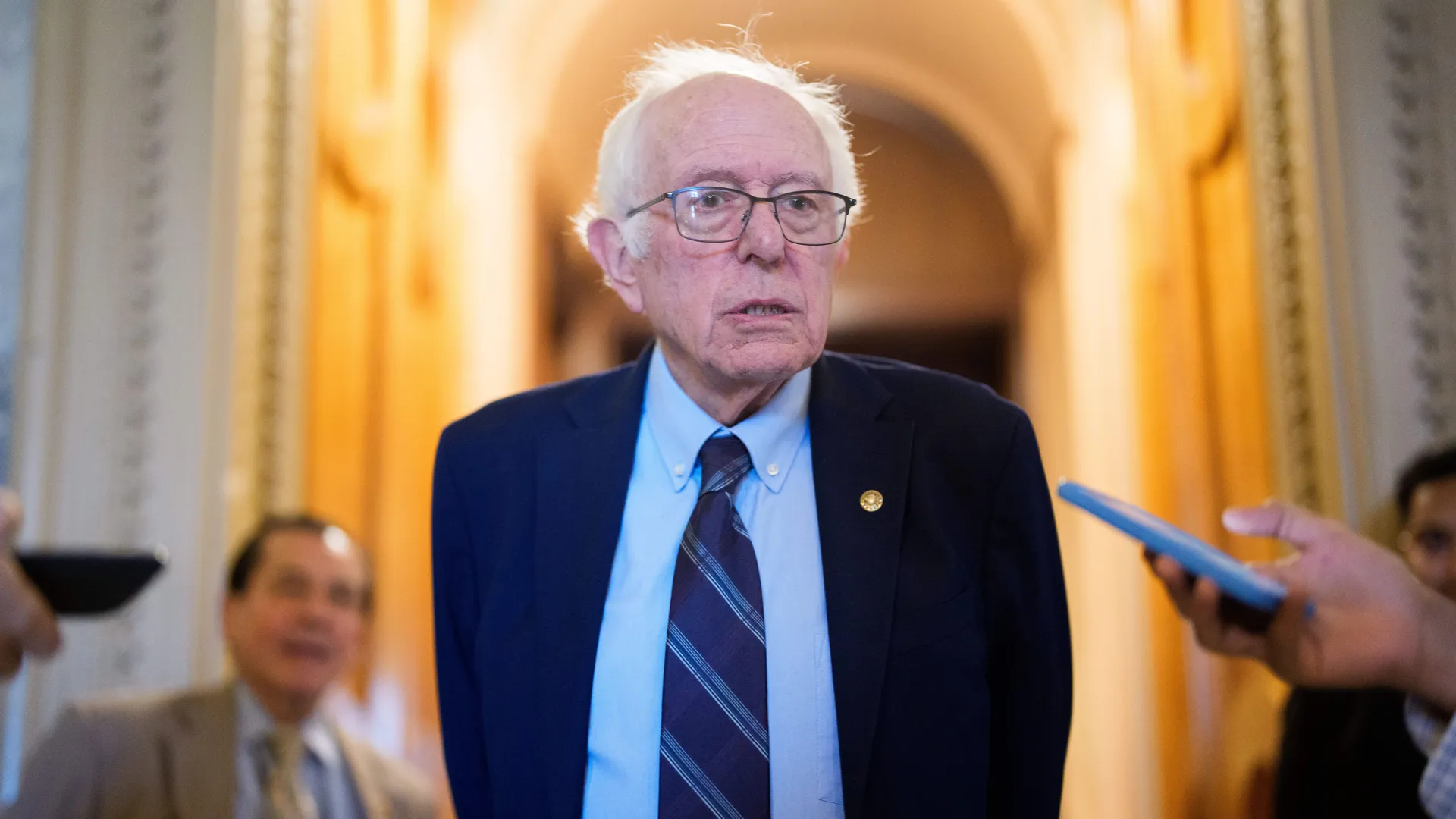
Sen. Bernie Sanders (I-Vt.) is urging Senate Democrats to unite behind an expansive health care proposal in the party’s negotiations with Republicans to extend Affordable Care Act tax credits.
Why it matters:
GOP leaders have promised Democrats a vote on the expiring tax credits next month as part of their deal to end the government shutdown.
Sanders wants the Democratic proposal to extend the ACA tax credits, repeal $1 trillion in GOP health care cuts, expand Medicare and lower prescription drug prices, he said in a letter to colleagues late Monday.
Republicans, however, have signaled that any deal to extend the tax credits must be short term and require reforms.
Premiums will more than double for millions of ACA enrollees next year if Congress does not renew enhanced marketplace subsidies by year’s end, according to a new analysis.
The big picture:
Democratic leaders have argued that the government shutdown has made health care a top political issue.
Sanders, the top Democrat on the Senate Health, Education, Labor and Pensions Committee, said Democrats must make proposals that address “systemic deficiencies.”
“We should not be defending a system which is not only, by far, the most expensive in the world, but one which numerous international studies describe as one of the worst,” Sanders wrote to Democratic senators.
Sanders’ HELP committee is expected to be involved in negotiations with Republicans over a potential bipartisan deal to extend the credits next month.
A spokesperson for Senate Minority Leader Chuck Schumer (D-N.Y.) said: “The bill Democrats bring to the floor will be a caucus product.”
Between the lines:
Sanders acknowledged in his letter that his Medicare For All proposal “does not yet have majority support” in the caucus. But he said his latest proposal included “much-needed reforms.”
Sanders also encouraged Democrats to propose investments to expand primary care services, ban stock buybacks and dividends and substantially reduce CEO compensation in the health care industry.
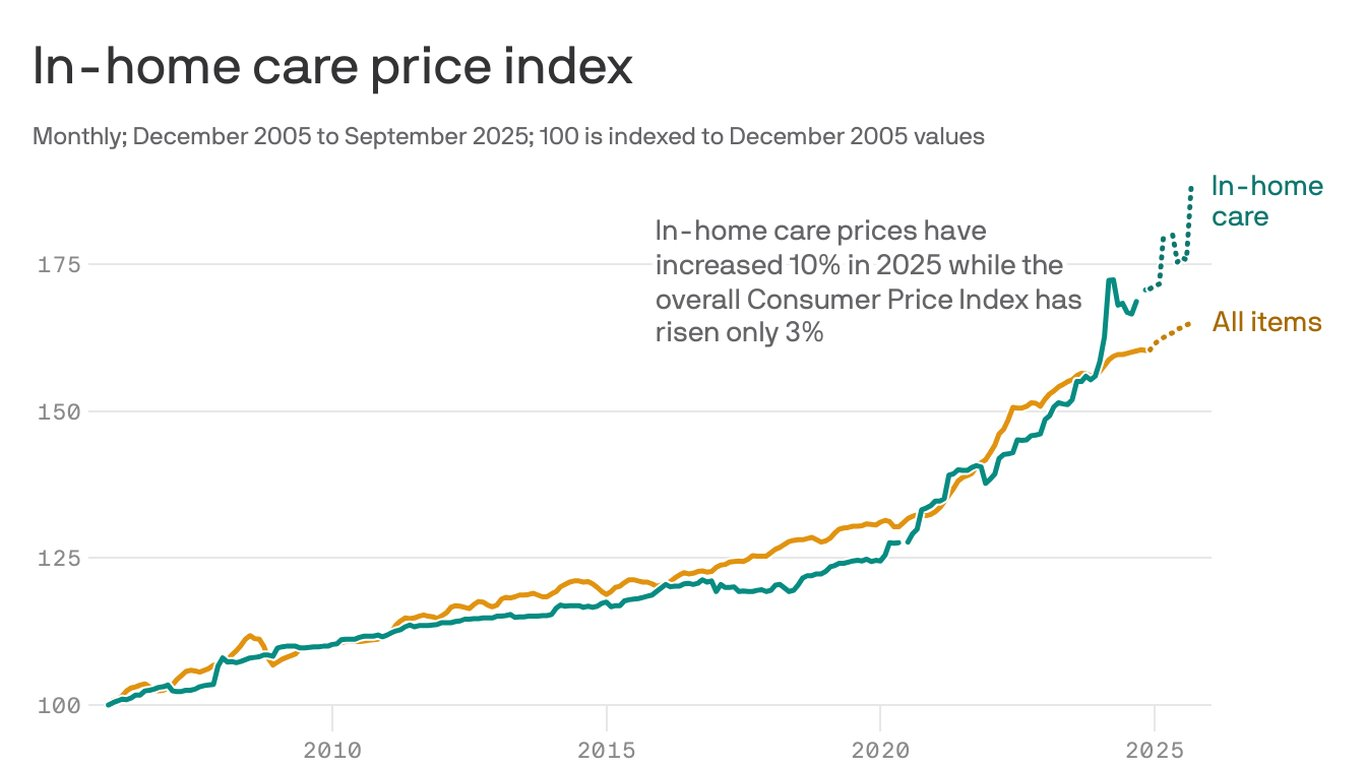
The cost of hiring help to care for an elderly or a sick person at home is skyrocketing.
Why it matters:
A labor shortage and surging demand from an aging population was already driving up prices, and nowthe White House’s crackdown on immigration and funding cuts are making things worse.
By the numbers:
So far this year, the price of in-home care for the elderly, disabled or convalescent at home is up 10%, compared with a rise of 3% for prices overall, according to government data.
From just August to September, prices for home health care spiked a staggering 7%.
Zoom in:
Rising prices and the limited availability of people who do this work are pushing families to make hard choices. Some will put relatives and loved ones into institutions, a more expensive and often less desirable option than staying at home.
Others will drop out of the workforce or cut back their hours to care for parents, relatives or partners.
The supply of workers is not keeping up with demand, Matthew Nestler, senior economist at KPMG, writes in a post. “That hurts workers and their families, employers and the overall U.S. economy.”
Friction point:
Last year, employment was surging in home health care, with an average of 13,500 jobs added each month.
But after the Trump administration immigration crackdown began in January, employment dropped off, falling into negative territory for three consecutive months in the spring, Nestler noted this summer.
This isn’t a matter of demand falling, but a cutoff in supply, he explained.
How it works:
Immigrants make up 1 in 3 workers in home care settings, per data from KFF, a health care research organization.
The severe crackdown this year on undocumented immigrants and the Trump administration’s removal of legal status from workers who are here from Venezuela and other countries are making it hard to find workers, says Mollie Gurian, vice president of policy and government affairs at LeadingAge, an aging-services nonprofit.
“The supply of workers was already so low,” she says. With fewer folks available, the companies that provide these service are raising prices to put pressure on demand. Others are raising prices in anticipation of cuts to Medicaid funding, she says.
The big picture:
At the same time that the supply of people to do this work is falling, the number of Americans who need care is rising, as a silver tsunami of baby boomers ages.
The bottom line:
We are only at the very beginning of a dramatic demographic shift, Nestler says.
Elder care is a “ticking time bomb that no one’s talking about.”
It may already be too late to implement certain changes Republicans are insisting on as a condition for renewing to Affordable Care Act subsidies, further casting doubt on any congressional deal to extend the financial aid.
Why it matters:
GOP lawmakers have made clear that they need to see changes to the enhanced ACA tax credits at the center of the government shutdown fight in order to extend them.
But insurers, states and other experts say some changes could already be impossible for next year, with ACA enrollment due to begin in less than two weeks, on Nov. 1. The subsidies are due to expire at year’s end, absent further action.
What we’re hearing:
Extending the credits after Nov. 1 is still possible, experts say, but gets much harder if there are significant changes, such as capping eligibility at a certain income level or requiring recipients to make a minimum premium payment.
What they’re saying:
“I have zero confidence that there’s enough operational time for systems and issuers to be able to implement changes, significant changes,” said Jeanne Lambrew, a former key health adviser in the Obama White House and later a top health official in Maine.
Sen. Mike Rounds (R-S.D.), one of the GOP senators more open to some form of subsidy extension, acknowledged that the implementation timeline poses a problem.
“Good question, and that’s why a lot of us started talking about it in July,” Rounds told Axios, blaming Democrats for triggering the shutdown on Oct. 1.
“When you have a shutdown that just kind of kills the discussions,” he said.
Between the lines:
One possible workaround would be for Congress to extend the enhanced subsidies unchanged for one year and then have GOP changes take effect in 2027. It’s not clear if that would pass muster in the House and Senate.
Some insurers are warning about implementation challenges in trying to make major changes for 2026.
“Our recommendation would be [a] straight extension for 2026 so that you can get the tax credits updated immediately and get people covered,” said an insurance industry source, speaking on the condition of anonymity to share private conversations. “Then, if Congress wants to make changes, those should apply in 2027 or later.”
Devon Trolley, executive director of Pennsylvania’s ACA marketplace, said “at this point in the calendar, the lowest risk option is an extension of the same framework that the enhanced tax credits have today.”
“Some changes might be not possible to implement if they structure it in a very different, very complicated way in the near term,” she said. “But other changes might be.”
An added complication is that there is no solution in sight for satisfying Republican demands that additional language be added preventing the subsidies from funding elective abortions.
The bottom line:
Congressional Democrats have been urging Republicans to enter negotiations, saying time is running short, while the GOP counters that Democrats need to open the government first.
“We can’t do any of that if we’re not negotiating,” said Sen. Chris Murphy (D-Conn.) when asked about the time frame for changes to the tax credits.
“We’ve always understood there’s going to be a negotiation, but it’s only Republicans that are boycotting those negotiations.”
Congress on Wednesday enters the eighth day of the federal shutdown with neither party giving an inch and the path to a resolution nowhere in sight.
But something will have to give if lawmakers hope to reopen the government in any timely fashion, and that movement will likely be the result of external forces exerting pressure on one party — or both of them — to break the deadlock.
That’s been the case in the protracted shutdowns of years past, when a number of outside factors — from economic sirens to public frustration — have combined to compel lawmakers to cede ground and carry their policy battles to another day.
Public sentiment
Among the most recycled quotes on Capitol Hill is attributed to Abraham Lincoln: “Public sentiment is everything.” The trouble, in these early stages of the shutdown fight, is that the verdict is still out on where that sentiment will land.
That uncertainty has led both parties to dig in while they await more concrete evidence of which side is bearing the brunt of the blame. But those polls are coming, and if history is any indication, they will be a potent factor in forcing at least one side to shift positions for the sake of ending the shutdown.
That was the case in 2013, when Republicans demanding a repeal of ObamaCare saw their approval ratings plummet — and dropped their campaign after 16 days without winning any concessions. A similar dynamic governed the shutdown of 2018 and 2019 — the longest in history — when Republicans agreed to reopen the government without securing the border wall money they’d insisted upon.
A recent CBS poll found that 39 percent of voters blame Trump and Republicans for the shutdown; 30 percent blame congressional Democrats; and 31 percent blame both parties equally.
A Harvard/Harris poll also showed that more respondents blame Republicans, 53 to 47 percent, but nearly two-thirds believe Democrats should accept the GOP’s stopgap funding bill without a fix for the expiring Affordable Care Act premium subsidies.
The ambiguity of those sentiments has heightened the partisan blame game — and has given both sides an incentive to hold the line until a clearer picture emerges.
Air traffic controller issues
It was nearly seven years ago that the 35-day shutdown ended after travel chaos and short-staffing of air traffic controllers brought immense strain on the aviation sector — and trouble is already starting up again.
An uptick of air traffic controllers calling in sick Monday forced numerous flight delays and cancellations, prompting concerns that a reprisal of what happened in 2019 could be starting up again.
“We should all be worried,” said Sen. Mike Rounds (R-S.D.), who was part of informal rank-and-file talks last week about a possible resolution.
Transportation Security Administration workers and air traffic controllers are all considered essential workers, with the Department of Transportation announcing more than 13,000 controllers are set to work without pay during this shutdown.
Those calling in sick prompted delays at numerous big airports, including Denver International Airport and Newark Liberty International Airport. The Hollywood Burbank Airport went without any air traffic controller on-site for nearly six hours Monday.
Just like the record-setting 2019 shutdown, Democrats are counting on this issue creating problems for Trump and Republicans. Sen. Chris Van Hollen (D-Md.) told reporters that he and other local officials are holding a press event at Baltimore/Washington International Thurgood Marshall Airport on Wednesday to highlight the rising issue.
“It had a direct impact on people’s abilities to get around the country,” Van Hollen said of the 2019 shutdown issue. “Donald Trump shut down the government in his first term, and he needs to end the shutdown he ended in the second term.”
Frozen paychecks
The central, defining factor of any shutdown is the scaling back of federal services and the siloing of hundreds of thousands of federal employees. Some of those workers are deemed “essential,” meaning they still have to come to work, while others are furloughed, meaning they’ll stay at home. But both groups share the unenviable position of not being paid until the government reopens.
That reality will hit home Oct. 10, when the first round of federal paychecks will fail to go out. The most immediate impact, of course, is on those workers and their families, who will have to find alternative ways to pay bills and make ends meet.
But the pain will also reverberate through the broader economy, as federal workers stay at home and avoid the types of routine daily purchases — lunches, cabs, haircuts — that can make local economies hum.
The numbers are enormous.
The White House Council of Economic Advisers has estimated that every week of the shutdown will reduce the nation’s gross domestic product by $15 billion.
“This is resulting in crippling economic losses right now,” Speaker Mike Johnson (R-La.) warned Tuesday. “A monthlong shutdown would mean not just 750,000 federal civilian employees furloughed right now, but an additional 43,000 more unemployed Americans across the economy, because that is the effect, the ripple effect, that it has in the private sector.”
In a typical shutdown, furloughed workers receive back pay for the days lost during the impasse, providing a delayed bump in economic activity. But even that customary practice is now in question in the face of a threat from Trump’s budget office to withhold back pay for certain workers. Others, Trump has said, will be fired altogether.
The combination is sure to exacerbate a volatile economy that’s already been roiled by declining consumer confidence, sinking job creation and Trump’s tariffs. Whichever party suffers the blame for the economic strain will come under the most pressure to cave in the shutdown fight.
Military paychecks
Pay for members of the military has been a constant talking point in past shutdowns, and that’s no different this go-around.
Military service members could miss their paychecks Oct. 15, a date front and center for lawmakers.
Johnson huddled with Senate Republicans on Tuesday during their weekly policy luncheon and told reporters afterward that he is considering having the House vote on a bill to pay troops.
“I’m certainly open to that. We’ve done it in the past. We want to make sure our troops are paid,” Johnson said, noting one GOP member has filed legislation aimed at doing that. “We’re looking forward to processing all of this as soon as we gather everybody back up.”
The Speaker added that the shutdown would need to end by Monday in order to process the paychecks by Oct. 15.
One problem for Johnson, though, is that the House is not slated to return until Monday at the earliest, and he has indicated that he will keep the chamber out of session until the shutdown is over.
Democrats indicated they are also worried about those impacts, but say Johnson has bigger fish to fry.
“I’m concerned about all the impacts of a shutdown. … There’s a lot of impacts of a shutdown,” Sen. Chris Murphy (D-Conn.) said. “How on earth does Mike Johnson say anything with a straight face right now when he won’t even bring his members here to vote on anything? How does he know what he can deliver if his members aren’t even here?”
“It’s not worth listening to anything the Speaker says until he tells his people to get back and show up for work.”
Health care factors
Democrats have made health care the lynchpin of their opposition to the Republicans’ short-term spending bill, demanding a permanent extension of enhanced Affordable Care Act (ACA) subsidies set to expire at the end of the year.
Citing that expiration date, GOP leaders have refused to negotiate on the issue as part of the current debate, saying there’s time to have that discussion after the government opens up.
“That’s a Dec. 31 issue,” Johnson told reporters Tuesday.
But there are several related factors that will surface long before Jan. 1, and they could put pressure on GOP leaders to reconsider their position in the coming weeks.
For one thing, private insurance companies that sponsor plans on the ObamaCare marketplace are already sending out rate notices to inform patients of next year’s costs. Those rates are crunched based on current law — not predictions about what Congress might do later — meaning they’re being calculated under the assumption that the enhanced subsidies, which were established during the COVID-19 pandemic, will expire Jan. 1.
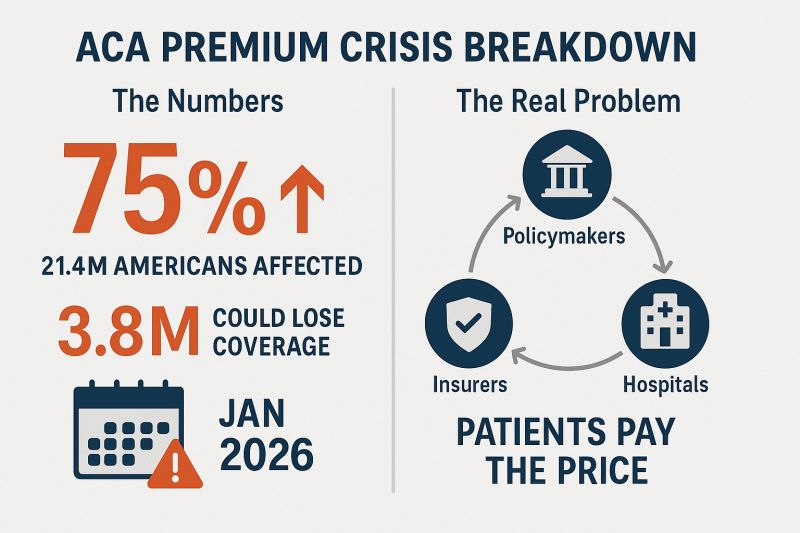
That distinction is enormous: If Congress doesn’t act, the average out-of-pocket premium for patients enrolled in ObamaCare marketplace plans would jump by 75 percent, according to KFF. Those are the figures patients are already getting in the mail. And faced with drastically higher rates, many are likely to buy lesser coverage next year — or no coverage at all.
Adding to the time squeeze, the ACA’s open enrollment period begins Nov. 1, meaning patients will begin making their decisions long before GOP leaders say they’re ready to act.
“Insurers aren’t waiting around to set rates for next year,” Senate Minority Leader Chuck Schumer (D-N.Y.) warned this week. “They’re doing it right now — not three months from now.”
Hospitals and health systems across the country are telling some Medicare and Medicaid patients that they can’t schedule telehealth appointments due to the federal government’s shutdown, now heading into its second week. That’s because Medicare reimbursement for telehealth expired on September 30, leaving health systems with the choice of pausing such visits or keeping them going in hopes of retroactive reimbursement after the shutdown ends.
Reimbursement for the Hospital at Home program, which allows patients to receive care without being admitted to a hospital, also lapsed with the shutdown. That led to providers scrambling to discharge patients under the program or admit them to a hospital. Mayo Clinic, for example, had to move around 30 patients from their homes in Arizona, Florida and Wisconsin to its facilities.
At issue in the government shutdown is healthcare, specifically tax credits for middle- and lower-income Americans that enable them to afford health insurance on the federal exchanges set up by the Affordable Care Act. Democrats want to extend those tax credits, which are set to expire at the end of the year, while Republicans want to reopen the government first and then negotiate about the tax credits in a final budget.
The impasse has prevented the Senate from overcoming a filibuster, despite a Republican majority. Around 24 million Americans get their health insurance through the ACA, and the loss of tax credits will cause their premiums to rise an average of 75%–and as high as 90% in rural areas–and likely cause at least 4 million people to lose coverage entirely.
The government’s closure has reverberated through its operations in healthcare. The Department of Health and Human Services has furloughed some 41% of its staff, making it harder to run oversight operations. CDC’s lack of staff will hinder surveillance of public health threats. And FDA won’t accept any new drug applications until funding is restored.
When the government might reopen remains unclear. Most shutdowns are relatively brief, but the longest one, which lasted 35 days, came during Donald Trump’s first term. Senate majority leader John Thune, R-S.D., and Speaker of the House Mike Johnson, R-La., have both said they won’t negotiate with Democrats, and the House won’t meet again until October 14.Bettors on Polymarket currently expect it to last until at least October 15. Pressure on Congress will increase after that date because there won’t be funds available to pay active military members.
People who buy health insurance through the Affordable Care Act (ACA) are set to see a median premium increase of 18 percent, more than double last year’s 7 percent median proposed increase, according to an analysis of preliminary filings by KFF.
The proposed rates are preliminary and could change before being finalized in late summer. The analysis includes proposed rate changes from 312 insurers in all 50 states and DC.
It’s the largest rate change insurers have requested since 2018, the last time that policy uncertainty contributed to sharp premium increases. On average, ACA marketplace insurers are raising premiums by about 20 percent in 2026, KFF found.
Insurers said they wanted higher premiums to cover rising health care costs, like hospitalizations and physician care, as well as prescription drug costs. Tariffs on imported goods could play a role in rising medical costs, but insurers said there was a lot of uncertainty around implementation, and not many insurers were citing tariffs as a reason for higher rates.
But they are adding in higher increases due to changes being made by the Trump administration and Republicans in Congress. For instance, the majority of insurers said they are taking into account the potential expiration of enhanced premium tax credits.
Those subsidies, put in place during the COVID-19 pandemic, are set to expire at the end of the year, and there are few signs that Republicans are interested in tackling the issue at all.
If Congress takes no action, premiums for subsidized enrollees are projected to increase by over 75 percent starting in January 2026, according to KFF.
But some states are pushing back.
Arkansas Gov. Sarah Huckabee Sanders (R) on Wednesday called on the state’s insurance commissioner to disapprove the proposed increases from Centene and Blue Cross Blue Shield. The companies filed increases of up to 54 percent and 25.5 percent, respectively, she said.
“Arkansas’ Insurance Commissioner is required to disapprove of proposed rate increases if they are excessive or discriminatory, and these are both,” Huckabee Sanders said in a statement.
“I’m calling on my Commissioner to follow the law, reject these insane rate increases, and protect Arkansans.”





 HENRY KOTULA