Behind Rising Health-Care Bills: Secret Hospital Deals

https://www.realclearhealth.com/2018/09/20/behind_rising_health-care_bills_secret_hospital_deals_278180.html?utm_source=morning-scan&utm_medium=email&utm_campaign=mailchimp-newsletter&utm_source=RC+Health+Morning+Scan&utm_campaign=82a1cdfd43-MAILCHIMP_RSS_EMAIL_CAMPAIGN&utm_medium=email&utm_term=0_b4baf6b587-82a1cdfd43-84752421

Image result for Behind Rising Health-Care Bills: Secret Hospital Deals

Last year, Cigna Corp. and the New York hospital system Northwell Health discussed developing an insurance plan that would offer low-cost coverage by excluding some other health-care providers, according to people with knowledge of the matter. It never happened.

The problem was a separate contract between Cigna and New York-Presbyterian, the powerful hospital operator that is a Northwell rival. Cigna couldn’t find a way to work around restrictive language that blocked it from selling any plans that didn’t include New York-Presbyterian.

Read Full Article »

Health care startup aims to eliminate hospital and doctor bills

https://www.axios.com/startup-ooda-health-aims-to-eliminate-hospital-doctor-bills-e1fc6bdc-6755-4627-b954-59fc35326d3e.html?utm_source=newsletter&utm_medium=email&utm_campaign=newsletter_axiosvitals&stream=top

Image result for upfront payment

New payment startup Ooda Health has raised $40.5 million on the premise that its technology will make sure patients never get another bill from a hospital or doctor.

Why it matters: Ooda Health not only has big-name venture capitalists on board (Oak HC/FT and DFJ led the funding round), but also has large health insurers and providers as investors. However, while the company attempts to cut administrative waste, it won’t address the health care system’s underlying pricing and spending habits.

The details: Anthem, Blue Cross Blue Shield of Arizona, Blue Shield of California, Blue Cross Blue Shield of Massachusetts, Dignity Health and Hill Physicians are the initial industry investors.

  • Ooda Health would not disclose their investments. Seth Cohen, Ooda Health’s co-founder and president, said the company got its start after Blue Shield of California CEO Paul Markovich recommended a meeting with Dignity Health CEO Lloyd Dean.

How it works: Health insurance companies pay Ooda Health an administrative fee and a risk-sharing payment. Ooda Health then connects with hospitals and doctors and pays them instantly based on what is in the electronic health record instead of a traditional medical claim. Any outstanding payment issues would be handled through the insurance company, rather than directly by providers.

  • Cohen made this analogy: If you’re at a restaurant and you use your credit card for the meal, the restaurant gets paid immediately. The credit card company, not the restaurant, then follows up with you about how to pay off what you owe.
  • Health insurers would avoid late fees and penalties for missing payment deadlines, patients who are encountering higher deductibles and out-of-pocket costs wouldn’t have to pay providers directly, hospitals wouldn’t have to chase outstanding balances, and providers would get paid quickly.
  • “It is a bad model for providers to collect from patients,” Cohen said, noting that collection agencies are cut out in this scenario.

Yes, but: Out-of-network hospitals and doctors would still charge exorbitant fees on their own, and administrative work wouldn’t be completely eradicated. This also makes the electronic health record a de facto tool for billing instead of solely a repository for patient medical information.


How hospitals protect high prices

https://www.axios.com/newsletters/axios-vitals-5af4f54b-8427-48c2-b638-933a1ae4883a.html?utm_source=newsletter&utm_medium=email&utm_campaign=newsletter_axiosvitals&stream=top

Large hospital systems don’t command high prices just because patients like them, or just because they have strong market share. There’s also another big reason: their contracts with insurance companies actively prohibit the sort of competitive pressures a free market is supposed to support.

“The free market has been distorted in an unhealthy way,” health care consultant Stuart Piltch told the Wall Street Journal’s Anna Wilde Mathews for this deep dive into hospitals’ pricing practices.

How it works: Hospital systems are consolidating rapidly and buying up physicians’ practices (which charge higher prices once they’re part of a hospital).

On top of that, per WSJ: Hospitals’ deals with insurance companies “use an array of secret contract terms to protect their turf and block efforts to curb health-care costs.”

  • Some hospitals do not allow their prices to be posted on the comparison-shopping sites insurers provide to their customers.
  • They often require insurers to cover every facility or doctor the hospital owns, and prohibit insurers from offering incentives — like lower copays — for patients to use less expensive competitors.
  • When Walmart, the country’s biggest private employer, wanted to exclude the lowest-quality 5% of providers from its network, its insurers couldn’t do so because of their hospital contracts.

The other side: Hospital executives told the Journal that mergers don’t drive higher prices, and reiterated their position that hospitals have to collect higher payments from private insurance to make up for the lower rates they get from Medicare and Medicaid.

My thought bubble: High-deductible health plans are increasingly popular, in part, because of the idea that patients will use their purchasing power to drive a more efficient system overall.

  • But if Walmart doesn’t have enough market power to actually penalize low-quality providers, you and I definitely don’t, either — especially if we can’t find out what the prices are, and especially if we only have one hospital to choose from in the first place.

Go deeper: Think drug costs are bad? Try hospital prices


Montana health plan strikes victory over cost-sharing reduction payments

https://www.healthcarefinancenews.com/news/montana-health-plan-strikes-victory-over-cost-sharing-reduction-payments?mkt_tok=eyJpIjoiTWpNM05qYzVPR1k0TldKbCIsInQiOiJTd2RzaU9sS1FuKzBOaVF3RXp5RkNqc3plbXp0NFlhdkk1MFlSNGY1NUJKa2NHd3IrXC9OdlJoSW1EQ2FIM3hkVkVzZ2FuaUhkcTNXcUtNczhNQWI2NFd1ckNCOHViSzdFbjRUS2xGMTdrXC90M1BjbCtRcVVnbkxweFwvdlY5VnZGViJ9

Montana Health Co-Op. Credit: Google Street View

The insurer says it is owed $5 million in payments mandated under the Affordable Care Act.

Health insurers in the Affordable Care Act market got a major win Tuesday when the Montana Health Co-op became the first plan to win its case for cost-sharing reduction payments.

Montana Health Co-op said it is owed an estimated $5 million in CSRs for 2017.

United States Court of Federal Claims Judge Elaine Kaplan said it didn’t matter that Congress never appropriated the funds, as argued by the Department of Justice. Kaplan sided with the Montana Health Co-op that said the Affordable Care Act created the mandatory obligation whether Congress approved the funds or not.

Judge Kaplan directed the parties to file a joint status report on or before October 4.

CSRs were set up under the ACA to allow insurers to pay the deductibles and other out-of-pocket costs for lower-income consumers.

The Department of Health and Human Services began making the CSR payments in 2014.

In that same year, Republicans in the House of Representatives sued the Obama Administration over the payments, saying they and others in Congress had never approved the funds. They won and an appeal was brought, but under President Donald Trump, the appeal became moot.

In 2017, Attorney General Jeff Sessions issued an opinion that the funds were never appropriated and the government stopped the payments.

While insurers no longer received the funds, they were still mandated under the ACA to offer to qualifying consumers the benefit of lower out-of-pocket costs.

Several insurers filed lawsuits, including Blue Cross Blue Shield of Vermont, Maine Community Health Options, LA Care Health Plan and Sanford Health Plan, according to Health Affairs. Common Ground Healthcare Cooperative led a class action lawsuit.

Insurers have also filed lawsuits to get payments promised through another ACA program, risk corridors. Under the three-year, budget neutral risk corridors program, the government was to take money from plans that had fewer higher risk beneficiaries and give the  funds to those that suffered losses in insuring higher risk consumers.

In making her decision Tuesday, Judge Kaplan cited a lawsuit brought by Moda Health Plan over risk corridor payments. In that case, the Federal Circuit Court said the government was obligated to make risk corridor payments to insurers.

But that case was overturned in mid-June, when a majority of a three-judge panel of the Court of Appeals for the Federal Circuit said the government did not have to pay health insurers the full amount owed to them in risk corridors payments.


Humana completes sale of long-term care insurance policy business KMG, at a loss of $790 million

https://www.healthcarefinancenews.com/news/humana-completes-sale-long-term-care-insurance-policy-business-kmg-loss-790-million?mkt_tok=eyJpIjoiWTJNeE5UZzRNalU1WWprMSIsInQiOiJRNjRWYXFQcSt3aHpGMlB4RVwvbXA3ckt4MVlxZ04zeHl5VWtKMzB4V2dpa21LTTY3U2pMdWlnSHh3MXRMWlwvWkdQNEdldGVjRWpWUG5Md0xmbTlQVE0zVTdFUStxY0lQcmNpUkRRRHpPelZSOUNBTW90WDNNbGd1ekZsZGZHVU04In0%3D

Image result for humana headquarters

Humana has completed the sale of its wholly-owned subsidiary KMG America Corporation, in a transaction first announced in November 2017.

Humana has owned KMG since 2007.

KMG subsidiary, Kanawha Insurance Company, offers commercial, long-term care insurance policies and currently serves an estimated 29,300 policyholders.

Humana sold its shares in KMG for a reported $2.4 billion to HC2 Holdings, which includes Continental General Insurance Company, based in Texas.

In its second quarter earnings statement, Humana reported a $790 million loss on the sale of KMG, which is expected to close during the third quarter.

Humana said it would no longer have plans in the commercial long-term care insurance business.

Humana instead is closing on two transactions to acquire an at-home provider in Kindred at Home and Curo Health Services, which specializes in hospice care, according to the Q2 report.

Curo provides hospice care in 22 states. Humana and a consortium of TPG Capital and Welsh, Carson, Anderson & Stowe, purchased Curo for $1.4 billion, Humana announced in April.

Humana will have a 40 percent interest.

Also, this past June, Humana partnered with Walgreens Boots Alliance in a pilot to operate senior-focused primary care clinics inside of two drug stores in the Kansas City, Missouri area.

Revenue remained strong for the insurer, which specializes in Medicare Advantage plans. Its MA business in Q2 realized both growth and lower utilization.

While revenue remained strong, Humana’s net income dropped to a reported $684 million this year compared to $1.8 billion last year.

The insurer benefitted from a lower tax rate year-over-year as a result of the tax reform law and negatively felt the return of health insurance tax in 2018.

“Our strong 2018 financial results are testimony to the underlying improvement in our operating metrics, like Net Promoter Score, digital self-service utilization and call transfer reduction, and to the growing effectiveness of our national and local clinical programs,” said Bruce D. Broussard, Humana’s CEO and president. “Also, we took another large step this quarter in helping our members, especially those living with chronic conditions, by beginning the integration of important clinical services through our investments in Kindred at Home and Curo, and through our partnership with Walgreens.”


ACA Marketplace Premiums Grew More Rapidly In Areas With Monopoly Insurers Than In Areas With More Competition

https://www.healthaffairs.org/doi/abs/10.1377/hlthaff.2018.0054?utm_term=Jessica+Van+Parys+of+Hunter+College%2C+City+University+of+New+York&utm_campaign=Health+Affairs%5Cu2019+August+issue%3A++Medicaid%2C+Markets+%2526+More&utm_content=email&utm_source=Act-On+Software&utm_medium=email&cm_mmc=Act-On+Software-_-email-_-Health+Affairs%5Cu2019+August+issue%3A++Medicaid%2C+Markets+%2526+More-_-Jessica+Van+Parys+of+Hunter+College%2C+City+University+of+New+York

Related image

 It pays to have an insurance monopoly
Also from Health Affairs: The level of competition among insurance companies has affected Affordable Care Act premiums more than any other factor.

By the numbers: Premiums are 50% higher this year in areas with just one insurer than in areas with two insurers.

  • “The presence of a monopolist insurer was the strongest, and most precise, predictor of 2018 premiums,” the study says.
  • Other factors commonly associated with higher premiums — like hospital concentration and the health of the people who live there — showed significantly smaller effects.

How it works: Jessica Van Parys, the Hunter College economics professor who conducted the study, suggests that insurers underpriced their ACA offerings in the first few years to capture market share, then raised their prices over the years.

  • Costs and regulatory uncertainty largely kept new competitors from entering those monopolized markets.


INSURANCE CONSOLIDATION MAY SOON INCLUDE HOSPITALS, CREATE POWERHOUSES

https://www.healthleadersmedia.com/finance/insurance-consolidation-may-soon-include-hospitals-create-powerhouses

Image result for healthcare conglomerates


Recent moves to consolidate insurance customers under one corporate structure could lead next to carriers acquiring hospital networks.

The continued market consolidation and efforts to create an “all-in-one” approach to healthcare insurance customers may lead to carriers acquiring large hospital networks, particularly if the CVS-Aetna transaction proves to be successful and profitable, one analyst says.

The mergers and acquisitions in the insurance industry over the last year is the preamble for what will happen over the next two years, says CEO of Tom Borzilleri of InteliSys Health, a company aimed at bringing greater transparency to prescription drug prices, and the former founder and CEO of a pharmacy benefit manager (PBM).

The effort will ramp up to include hospitals if health plans start seeing financial rewards from the recent moves, he says.

“We are seeing carriers acquiring PBMs, as with Cigna/Express Scripts, and pharmacy chains/PBMs acquiring carriers, like CVS/Aetna, in search of cost efficiencies to increase earnings,” he says. “One may view these mergers and acquisitions as a favorable strategy to delivering both cost savings and patient convenience, but this strategy also has the potential to produce a serious negative effect on other critical stakeholders like doctors, hospitals, clinics, and others.”

In the past, many carriers managed their pharmacy benefits internally and found that it would be more cost-efficient to outsource that function to third-party PBMs, Borzilleri notes.

“As the PBM industry grew significantly over the last decade, allowing PBMs to gain market share and buying power for the millions of lives they managed, it opened the door for PBMs to methodically profiteer at the expense of both the carriers and their insured through the vague and complicated contracts for services the carriers were forced to sign,” he says.

Borzilleri continues, “In essence, the carriers really didn’t know what they were paying for at the end of the day for these services. As the market began to change with the onset of a movement and demand within the industry for more price transparency, carriers began to realize that they would be better served to bring the PBM function back in-house to reduce costs and increase earnings.”

CREATING A CLOSED LOOP

Borzilleri explains that a merger like the CVS-Aetna acquisition provides the insurer the ability to:

  • Control drug costs by eliminating the profits that the PBM formerly enjoyed
  • Realize cost efficiencies to dispense medications at the pharmacy level
  • Directly employ the providers that can treat their members at a cost much lower than the reimbursement rates they currently pay their network doctors
  • Create a brand-new revenue stream from the retail products sold in these stores

That brings a ton of reward to CVS-Aetna, but not to anyone else, Borzilleri says.

“This type of closed-loop network will limit patient options to everything from who will be treating them, where they will be treated, and how much they will be forced to pay for services and their prescriptions,” he says.

“Based on the millions of patient lives that both CVS-Caremark and Aetna manage, patients will be herded into their own locations to be treated by their own doctors/providers and the independent physician or practice will be significantly impacted. So in essence, both the patients and doctors who treat them will lose,” Borzilleri says.

RETURNING TO CLASSIC DESIGN

Hospital acquisition also could be driven by consumers, says Bill Shea, vice president  of Cognizant, a company providing digital, consulting, and other services to healthcare providers. As consumers select health services on demand, they will create their own systems of care instead of relying on a third party to do so, he says.

“The impact of these changes likely means integrated delivery systems must focus on providing on-demand healthcare and do so on a large scale. These systems can point to the proven value of offering a vetted and curated set of cost-effective providers and coordinating care to deliver better cost and quality outcomes,” Shea says.

Health plans also may consider returning to their pre-managed care origins to purse a classic insurance model of benefit design, risk management, and underwriting, he says. Some organizations could become a one-stop shop for every insurance need.

“These diversified insurance players will have the economies of scale to better manage profit and loss across multiple lines of business and to take creative approaches to health-related insurance, such as offering personalized policies targeted to specific market segments,” Shea says.

MORE STATE, REGIONAL MOVES

Consolidation is likely to increase at the state and regional level, says Suzanne Delbanco, PhD, executive director of Catalyst for Payment Reform.

“As providers with market dominance command higher prices, insurers will need to amass greater market power to push back. This means fewer choices of insurers for employers, other healthcare purchasers and consumers,” Delbanco says.

She says, “Fewer choices means less competition and less pressure to innovate. It’s possible we’ll see more of the integrated delivery systems and accountable care organizations beginning to offer insurance products where state laws and regulations allow them to as new entrants into the market.”

Those changes will make it more and more difficult to thrive as a small insurer or a small provider, she says.

Also, while rising prices and a continuation of uneven quality will motivate employers and other healthcare purchasers to demand greater transparency into provider performance and prices, larger players may more easily resist that call, she says.

“Increasingly it will be a seller’s game, not a buyer’s,” Delbanco says. “While quality measurement, provider payment reforms, and healthcare delivery reforms increasingly move toward putting the patient at the center, this may be more lip service than reality. Even if consumers end up with more information to make smarter decisions, their options may have dwindled to ones that are largely unaffordable.”


Health Insurers Had Their Best Quarter in Years, Despite the Flu

https://www.bloomberg.com/news/articles/2018-05-03/health-insurers-had-their-best-quarter-in-years-despite-the-flu

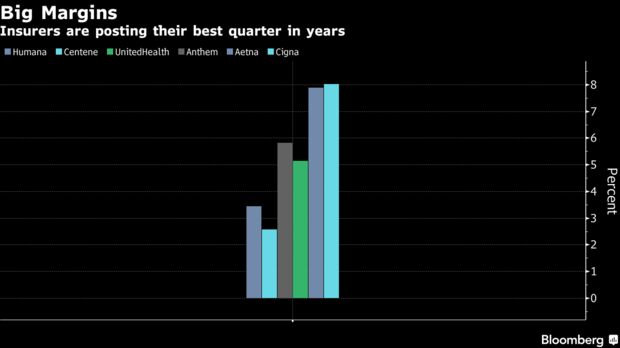
Here’s a look at how the margins of the largest in the quarter, based on data compiled by Bloomberg:

U.S. health insurers just posted their best financial results in years, shrugging off worries that the worst flu season in recent history would hurt profits.

Aetna Inc., for instance, posted its widest profit margin since 2004. Centene Corp. had its most profitable quarter since 2008. And Cigna Corp., which reported on Thursday, had its biggest margin in about seven years.

Analysts at Morgan Stanley, in a research note, said insurers are in the midst of a “hot streak.”

One big reason for the windfall is the tax cuts passed by Congress last year, which in some cases more than halved what the insurers owe the government. Aetna said its effective tax rate fell to 16.8 percent from 39.6 percent, for example. Many insurers also spent less on medical care than analysts had expected, even taking into account increased spending on flu treatments.